Category: politics

Disillusionment setting in?

By Daniel Margrain

Jeremy Corbyn and Diane Abbott
Jeremy Corbyn and Diane Abbott CREDIT: AFP

After Jeremy Corbyn’s election victory by one of the biggest majorities in Labour party history, the feeling of optimism among the grass roots membership was palpable. Here was a leader who was said to have genuinely held socialist principles who was about to smash the iron-clad neoliberal consensus that had come to dominate the PLP machine. However, as great as his victory was, for me personally, the optimism was offset by the knowledge that from the outset the corporate media and political class had it in for him. Many of us suspected, therefore, that some of the biggest struggles were yet to come.

These suspicions were confirmed after it emerged that not only were some of Corbyn’s most critical enemies to be found within his own party, but that the media en mass began acting, not as a dispassionate observer but as the delegitimizing arm of the British state. That Corbyn not only defeated the campaign by the plotters to undermine him, but that he also managed to shrug off the media hate-fest that accompanied it with consummate ease, is a testament to the strength of his character.

But it’s more than that. It’s also a testament to his supposed deeply-held and longstanding political convictions and, arguably most importantly of all, his unswerving democratic commitment to the mass membership who elected him into power, not just once, but twice. Unlike the period preceding the 1997 General Election when the media depicted Blair being swept-up in an apparent rising tide of jingoistic sentiment, Corbyn’s success was marked by their overriding intention to demonize him.

Dichotomy

Given that both Blair and Corbyn were elected on an almost identical Left mandate, how can this apparent dichotomy be rationally explained other than the notion the former, as opposed to the latter, was willing to serve elite interests? The rise of Blair was accompanied by flattering noises from the Murdoch press that underlined a palpable sense of intellectual curiosity totally absent from their coverage of Corbyn. This was because unlike the former, such curiosity wasn’t deemed a requirement. Demonization requires neither intellectualism nor curiosity, merely blind bigotry and hate which is precisely what the media-political establishment thrive on.

The most effective way to deal with this kind of bigotry and hate, is to challenge head-on the injustices, misinformation and false propaganda that give rise to them. To a large extent, whatever Corbyn does or says, the media will be unduly critical and biased against him. And so on their terms, he will never be seen to have done the right thing despite that his unequivocal stated commitment to social justice issues, Trident, the re-nationalization of the railways and the NHS are all highly commendable and universally popular.

Talking the talk

So what’s the problem? As effective as he has been in saying the right things at the right time, it’s nevertheless been the case that Corbyn’s leadership has largely been marked by his inability to act on is pronouncements. In terms of the NHS, for example, he appears to be reluctant to publicly denounce the dubious record of NHS England’s Simon Stevens, or to address the highly controversial statements made by his shadow health minister, Heidi Alexander regarding her alleged lack of commitment to its underlying principles. In view of the contentions made by activist Dr Bob Gill, it’s difficult to conclude anything other than the notion Corbyn is not as committed to the ethos of a universally free at the point of delivery HHS as perhaps he has led many people to believe.

In opposition and on the back benches, Corbyn’s stated long-term commitment and principled opposition to social injustice has been exemplary. However, even his most ardent of supporters will surely concede that as Labour leader he has often fallen short in fulfilling some of those principles. Another illustration of this has been his lack of public support for comrades like Ken Livingston and Jackie Walker who have had a series of unjustified and defamatory McCarthyite antisemitic attacks levelled at them.

Corbyn’s opposition to the illegalities of the Israeli Zionist state is long-standing and well known, and yet his failure as leader to break the links between the Labour party and the Labour Friends of Israel is unforgivable. It underscores a weakness in his leadership that cannot simply be brushed aside. Equally, as serious an issue, has been Corbyn’s virtual silence over the corrupt practices of NECs Iain McNicol as well as an apparent inability to tackle the systemic failings of the organisation he leads. More broadly, and arguably most worrying of all, has been Corbyn’s reluctance to set in motion a process by which the MPs who attempted to depose him could be deselected.

It should be recalled that it was McNicol who not only tried to fix the vote to the detriment of Corbyn, but had gone out of his way to prevent him even standing. For a Labour leader not to have supported the Left in the party has meant that the Right, although a minority, has managed to keep control of the Conference and the NEC.

Latest error of judgement

Corbyn’s latest error of judgement – and arguably his biggest – relates to his disastrous Brexit strategy. His entire approach to the issue seems to me to be not only his agreeing to the triggering of Article 50, but his acceptance that Brexit is inevitable when there is no inevitability about it. Corbyn has admitted that his support for EU membership was only 70 to 75% despite the fact that a similar proportion of his constituents voted to remain.

Corbyn’s half-hearted approach has almost certainly played into the hands of the Right. Rather than sending out an ambivalent message, it would arguably have been far more effective had Corbyn demonstrated an unequivocal commitment to defending the right of elected Labour MPs to vote in a way that accurately reflects the interests of their constituents. Instead, we were left with a situation in which a democratically elected Labour leader, albeit inadvertently, ended up being pulled to the Right.

Corbyn’s problematic situation is compounded by evidence which shows that withdrawal from the Single Market will likely result in a decline in working class living standards. Moreover, as Tony Greenstein puts it:

“If May chooses to make Britain a tax haven then this will mean that with far less tax revenue not only will there not be enough resources to fund an expansion of the welfare state but a Labour government would be a rerun of previous austerity governments. Access to the Single Market, both for manufacturing and the financial services is crucial. London faces the prospect of losing its role as the world’s leading financial sector to New York, Frankfurt and Paris. Companies which are located in Britain because of tariff free access to Europe will simply move. The fact that a narrow majority of people were fooled into voting against their own interests, for good reasons, by nationalist bile is not a reason to accept the decision. Parties exist to change peoples’ minds not to pander to their prejudices.”

It is the job of the Labour opposition to oppose not to compete for the racist vote which is what Corbyn’s apparent avatism implies. It’s one thing to yearn for a nostalgic concept of nationalist-based socialism, but another to do so when, firstly, there is clearly no current demonstrable appetite for socialism among the body politic of British society, and secondly, when the implications of the isolationist neoliberal alternative approach is shown to impact negatively on the poorest and most vulnerable.

Island of socialism

What Corbyn effectively envisages is a concept in which the UK exists extraneously from the rest of Europe. This ‘island of socialism’ mentality is the very antithesis of an internationalist concept of a kind he appears to have abandoned. The idea that internationalism can exist without international institutions is farcical. Furthermore, as Craig Murray argues, “to write off those institutions because they are currently controlled by right wing governments is short-sighted to the point of being stupid.”

The reason why the EU as an institution adopts right wing policies, is because it is currently dominated by right-wing governments. That fact is not a justifiable reason to want to abandon the project altogether, but to continue arguing for the reinstatement of the kind of federalist and internationalist concept of the EU envisaged by Jacques Delors in which the appropriation and destruction of national sovereignty is to be encouraged rather than belittled.

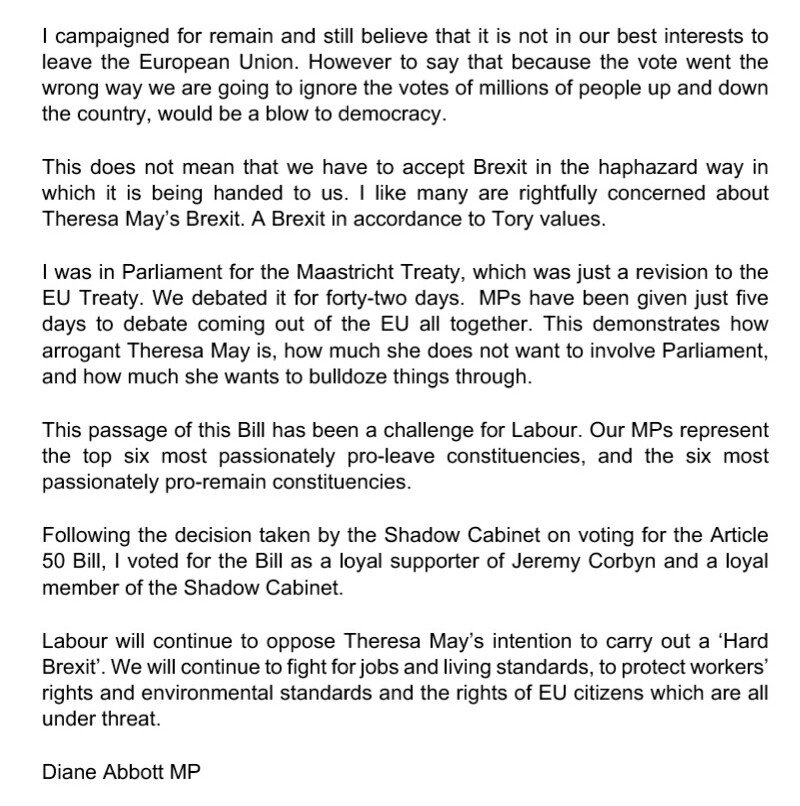
More wiser heads than Corbyn’s on the left, such as Diane Abbot, are able to see how out of touch Corbyn’s retrograde form of feudal socialism is. His ambivalence on the Brexit issue clearly put the likes of Abbot in a difficult political position. The dilemma she, and other Labour MPs faced, was whether to vote with their conscience and in the interests of their constituents who voted to remain, or go against their principles by voting for the Article 50 Bill on the basis of maintaining a sense of loyalty to both their leader and to the Shadow Cabinet?

Abbot’s statement below published on twitter, indicates that her preferred option was to go for the latter approach:

Conclusion

Jeremy Corbyn comes across as a sincere and honourable man whose motivations are not self-enrichment but to make society a better place for everybody. Morally and intellectually, he is head and shoulders above his political opponents and would make a far better prime minister than the hapless autocrat, Theresa May.

However, he is not perfect (who is?). His overly accommodating approach towards his enemies, the lack of support he has shown to his longstanding friends and his attempt to effectively coerce Labour MPs into taking the pro-Brexit line, are all major strategic miscalculations that have the potential to back-fire on him.

Nevertheless, despite these flaws, I am of the opinion that if Corbyn and his team can motivate enough young people to come out and vote, Labour can beat the Tories at the next General Election. Very few people are likely to detest the Tories more than me. I have direct experience of the negative consequences resulting from their welfare retrenchment policies.

I want to make the Labour party the most effective opposition to the Tories as possible. It’s for this reason I feel it’s my duty to provide constructive criticisms as, and when, required. I am not motivated by an intention to undermine Corbyn, but to help ensure the party he leads replaces the Tories at the next election.


Make a small donation

If you’ve enjoyed reading this or another posting, please consider making a donation, no matter how small. I don’t make any money from my work, and I’m not funded. You can help continue my research and write independently.… Thanks!


Donate Button with Credit Cards

The Russian’s Are Coming

By Daniel Margrain

The other day, I watched Norman Jewison’s 1966 comedy satire, The Russian’s Are Coming, The Russian’s Are Coming about the panic that ensues as a result of the forced landing of Russian submarines on a Connecticut holiday island. Released during the height of the Cold War, the film is not a particularly good one, but having spent a great deal of my adult life conditioned into believing the ‘Reds Under the Bed’ propaganda, the one thing that struck me was the extent to which Jewison portrayed the Russian’s in a positive light.

Jewison’s sympathetic portrayal was given added resonance in as much as that during the ensuing post Cold War world, Russian’s continued to be depicted, as Steven Kurutz puts it, as “Hollywood’s go-to villains”. The stereotyping of Russian’s in this way is of course premised on a real life political-based Russophobia narrative whose origins go back until at least the Napoleonic wars of the early 19th century. Propaganda against Russia was, as Ivor Neumann argued, continued by Napoleon’s former confessor, Dominique Georges-Frédéric de Pradt, who in a series of books portrayed Russia as “despotic”, “Asiatic” and “power hungry”. This was a period in which Britain had invaded Russia during the Crimean war. Craig Murray proffers some invaluable historical detail:

“As early as 1834 David Urquhart, First Secretary at the British Embassy in Constantinople, was organising a committee of “mujahideen” – as he called them – and running guns to Chechnya and Dagestan for the jihadists to fight Russia. In 1917 British troops again invaded Russia, landing at Archangel and Murmansk.”

A necessary condition to waging wars against official enemies, is the use of propaganda by the state to achieve that end. Even the influential British economist John Maynard Keynes was not averse to its power. Fifteen years after British troops landed at Archangel and Murmansk, Keynes wrote on Russia in Essays of Persuasion (pp.297-312) that the oppression in the country, rooted in the Red Revolution, perhaps was “the fruit of some beastliness in the Russian nature.”

Russia is no threat

In contrast to the historical threat to Russia from Britain, there is no evidence that the former poses a threat to the latter. Indeed, foreign and defence policy predicated on the alleged Russian threat is a British establishment concocted fantasy that has been perpetuated over time in order to justify the augmenting of the military industrial complex from which the British establishment continues to benefit financially.

Unlike the British empire, its Russian and Soviet counterparts had established their rule through the acquisition of contiguous land which ensured their hegemony over eastern Europe. Most of modern Russia that includes, for example, Dagestan and Chechnya, wasn’t the Russia of the 19th century when Britain was organising its gun running as part of the war of aggression against it.

An understanding of the historical context helps explain why Russia is fearful of Islamic instability and why Russia is concerned with the further spread of Islamic Jihad. It also partly explains why Putin got involved in Syria following Assad’s invitation in October, 2015. The existential threat Russia faces from Islamic extremism in its colonies is comparatively greater than that faced by the West.

Threat to Russia

Historically, the threat to Russia from Islamic extremists has been exacerbated by the British as part of their imperial strategy. By the 1830s the British were consciously and explicitly exploiting the Sunni-Shia divide in Afghanistan where they were playing off their support for the Shia-based communities against their Sunni counterparts during their first invasion of the country. Russia is demonised for the role it is currently playing in Syria, but the main reason it’s active in the country is to act as a counterbalance to the centuries-long determination by British imperial forces to exploit this divide as the precursor to gaining territory and thereby to attempt to dislodge Russia from land that it conquered through its own imperial endeavours.

The increase in Russophobia over the last few years that in many ways is more extreme that anything experienced during the height of the Cold War, mirrors Russia’s intervention in Crimea which was a reaction to the US-led engineered coup in Ukraine that preceded it. Overriding this is the notion that Russophobia, driven by Western fears of the Soviet role in communism’s mission to take over the “Free World”, arises periodically as a consequence of the perceived Russian threat to Western imperialist ambitions. Nothing Putin has ever said or done warrants this fear mongering. He has displayed no desire to attack the UK or the US and there is no cultural, linguistic or historical reasons why he would want to do so.

Offence not defence

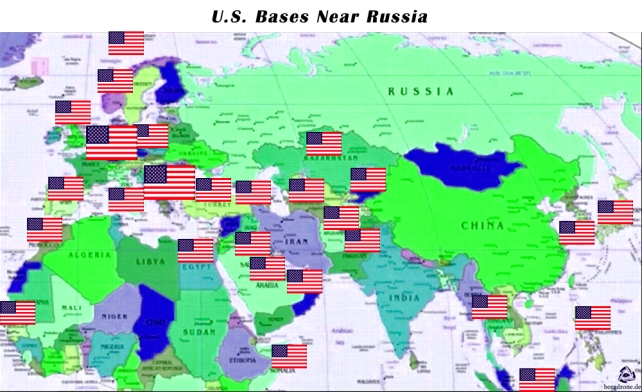
Russia’s imperialist ambitions have involved the swallowing up of contiguous land rather than extraneous colonial land grabs and the eastward expansion of NATO typical of Western imperialism. The growth in the amount of US-NATO missile bases positioned around Russia which is much larger than during the period of the Cuban missile crisis, is clearly an act of provocation tantamount to aggression.

Image result for nato bases around russia

While Russia is faced with genuine potential threats from its Islamic colonies, Britain’s adversarial positioning in places like Cyprus and Bahrain serve no purpose other than as an expression of the projection of aggressive military power. In terms of the latter, the British establishment is actively supporting one of the most appalling human rights abusing regimes on earth. With its majority Shia population that rules over a tiny Sunni minority, Bahrain is a state essentially created by British imperialism underpinned by a fluid foreign policy that shifts depending on which president has been elected to the White House.

During a recent speech she made in Washington, Theresa May claimed that the days of military interventions are over. But if this were true, why would Britain need a military base in Bahrain? As Craig Murray contends, its difficult to argue in favour of the notion that Britain’s military capability is anything other than offensive:

“Britain’s forces are not configured for defence. They are configured for attack. Aircraft carriers are of no defensive use whatsoever, and indeed are hopelessly vulnerable against any sophisticated enemy. Their sole purpose today is the projection of power against poor countries. Their use lies only in the neo-con policy of attacking smaller states like Iraq, Libya and Syria. They are Blair force carriers.”

Murray continues:

“Britain is a country where thousands of children go to bed hungry. Yet is spends billion upon billion on Trident missiles whose sole purpose is to increase politicians’ sense of importance, and aircraft carriers designed to facilitate the maiming of other nations’ children. A rational, defence oriented military would have neither.”

Big business & the 2006 G8 Summit

Orwell’s famous phrase “war is not meant to be won, it is meant to be continuous”, is probably no more aptly applied than in relation to the Wests periodic war games with Russia. War is big business and the “Russian threat” is the justification by which this business is conducted. In this sense, the Cold War and Russophobia could be seen as synonymous. Putin is a Western ‘demon’ because unlike his Russian predecessors of the post- German unification period, he refuses to be seduced by the Washington consensus.

One of the more recent Cold War phases emerged in July, 2006 after Putin began reasserting Russia’s super-power status as part of the country’s first ever hosting of the G8 summit. Under Putin’s predecessor Boris Yeltsin, Russia had effectively become a vassal of the US. Putin ended that subservient status.

It was Moscow’s international independence in foreign policy, allied to its role as a gas and oil supplier, that prompted the then US vice-president, Dick Cheney, to make one of the most anti-Russian US speeches of modern times. Condemning Russia’s lack of democracy to an audience in Lithuania, Cheney proceeded on to Kazakhstan, where he praised its president whose elections are more flawed than Putin’s.

Hypocrisy

Russia’s continued trend towards the recentralisation of power in the Kremlin that began in the late 1990s under Washington’s poster boy, Yeltsin, was now depicted by the Americans as a policy trajectory defined and initiated by Putin. Western governments approved Yeltsin’s use of tanks against the Russian parliament in 1993 and his biased control of TV coverage in the 1996 elections, and yet here were the Americans criticising Russia’s faltering democracy without an apparent ability to self-reflect on their hypocrisy.

Putin’s reaction to the Cheney tirade was significant. He made only three mentions of the US in his state of the nation address a few days later, one of which was a flattering reference to Roosevelt’s new deal as a partial model for Russia. Unlike the hard power of the US under Obama, Russian foreign policy under Putin appears to be guided by soft power, which judging by the signals emanating from Trump, will be reciprocated by Washington.

Under Obama, as well as the current Conservative administration headed by Theresa May in Britain and her predecessor, David Cameron, the shift by Putin exemplified by the 2006 summit, should have been welcomed. But instead, it was seen as a new “Russian threat.” A decade on, following the unsubstantiated accusations that Russia leaked emails showing Clinton’s corruption, allegedly in order to influence the US election, Cold War anti-Russian propaganda has reached a new phase. Whatever the misgivings people have about Trump’s presidency, his attempts to reconcile US-Russian foreign policy differences must surely be welcomed.

COPYRIGHT

All original material created for this site is ©Daniel Margrain. Posts may be shared, provided full attribution is given to Daniel Margrain and Road To Somewhere Else along with a link back to this site. Using any of my writing for a commercial purpose is not permitted without my express permission. Excerpts and links, including paraphrasing, may be used, provided that full and clear credit is given to Daniel Margrain and Road To Somewhere Else with appropriate and specific direction to the original content. Unless otherwise credited, all content is the site author’s. The right of Daniel Margrain to be identified as the author of this work has been asserted by him in accordance with the Copyright, Designs and Patents Act 1988.

Make a small donation

If you’ve enjoyed reading this or another posting, please consider making a donation, no matter how small. I don’t make any money from my work, and I’m not funded. You can help continue my research and write independently.… Thanks!


Donate Button with Credit Cards

Syria: Unraveling the Propaganda

By Daniel Margrain

One of the key signs of a healthy democracy is the extent to which state and corporate media encourage genuine diversity of opinions and the ability for alternative narratives to flourish. On both counts, the mass Western media have failed in relation to their coverage of the Syrian conflict. The inability to report objectively on Syria is indicative of a structural and systematic media bias. The highly concentrated nature of the corporate media has resulted in a sustained narrative of misinformation, deceptions and outright lies.

The mass media’s propaganda campaign against the government of President Bashar al-Assad began to surface during the events which led up to an intended series of planned demonstrations – the much hyped “Day of Rage” of March 4 and 5, 2011. However, at this early stage the propaganda proved to have been a failure and the planned action never materialized. Time correspondent, Rania Abouzeid conceded that the inability of the protest organizers to draw significant support for the “Day of Rage” was a reflection of the Syrian people’s support for their government and its policies.

Iranian influence

The support for Assad had become rooted as far back as 2007 after Iranian influence in neighbouring Iraq became established and the former’s relationship with the Syrian government strengthened. It was around this time that the American’s began to switch policy from opposing Sunni Jihadist militants embodied in al-Qaeda, to opposing Iran who they regarded as the bigger threat to their wider regional objectives. In Washington this switch became known as “re-direction”. The US attempts to destabilize Syria in order to counter growing Shi-ite predominance in the region was probably best articulated by renowned investigative journalist, Seymour Hersh:

“To undermine Iran, which is predominantly Shi-ite”, Hersh wrote, “the Bush administration has decided, in effect, to reconfigure its priorities in the middle east. In Lebanon the administration has cooperated with the Saudi Arabian government, which is Sunni, in clandestine operations that are intended to weaken Hezzbollah. The US has also taken part in clandestine operations aimed at Iran and its allies in Syria. The by-product of these activities is the bolstering of Sunni extremist groups that espouse a militant vision of Islam – one hostile to America and sympathetic to al-Qaeda.”

False narrative

What former UK ambassador, Craig Murray, described as the active arming, funding and training of anti-Assad groups from 2007 onward, contradicts the “completely untrue narrative” that the conflict in Syria suddenly erupted and that the American’s came in to support democratic forces – a narrative that culminated in the outbreak of violent protests in the Syrian-Jordanian town of Daraa on March 17, 2011, less than two weeks after the failed “Day of Rage” protests outlined above. Echoing Murray, Professor of Economics, Michel Chossudovsky noted that the violence:

“had all the appearances of a staged event involving, in all likelihood, covert support to Islamic terrorists by Mossad and/or Western intelligence. Government sources point to the role of radical Salafist groups (supported by Israel). Other reports have pointed to the role of Saudi Arabia in financing the protest movement.”

Jeremy Salt, associate professor in Middle Eastern History and Politics at Bilkent University, Ankara, wrote:

“The armed groups are well armed and well organised. Large shipments of weapons have been smuggled into Syria from Lebanon and Turkey. They include pump action shotguns, machine guns, Kalashnikovs, RPG launchers, Israeli-made hand grenades and numerous other explosives. It is not clear who is providing these weapons but someone is, and someone is paying for them.”

Reports (suppressed in the Western media) indicating that the number of policemen killed at Daraa (seven) was more than the number of demonstrators killed (four), is hardly indicative of the brutal actions of a government intent on oppressing its own people.

Legitimacy

Time reported that unlike “the ousted pro-American leaders of Tunisia and Egypt, Assad’s hostile foreign policy toward Israel, strident support for Palestinians and the militant groups Hamas and Hezbollah, are in line with popular Syrian sentiment.” Assad, in other words, had legitimacy.

This was confirmed when, twelve days after the Western fomented violence at Daraa, tens of thousands of Syrians gathered at central bank square in Damascus in support of their president. The pro-government rally, which can be viewed here was wrongly portrayed in the Western media as an anti-government demonstration. The Guardian, for instance, reported the rally as a “military crackdown against civilians”

This kind of misinformation prompted Russia and China to veto a European-backed UN security council resolution threatening sanctions against the Syrian regime “if it did not immediately halt its military crackdown against civilians”.

Members of a US Peace Council inferred that the key motivations underpinning the foreign policy objectives of Washington and its allies in relation to Syria, have nothing to do with protecting civilians, nor with democracy but is about inflaming sectarian divisions and thus political instability as the prelude to initiating regime change in the country.

Former French Foreign Minister Roland Dumas confirmed in 2013 that Britain had been planning the war on Syria “two years before the Arab spring” which was to involve the organizing of an invasion of rebels into the country. “This operation goes way back. It was prepared, preconceived and planned”, he said.

Regime change: a brief historical summary

Anglo-American plots to overthrow governments who refuse to play imperialist ball, often assisted in the endeavor by Muslim extremists, go back a long way. Craig Murray proffers some invaluable historical detail:

“As early as 1834 David Urquhart, First Secretary at the British Embassy in Constantinople, was organising a committee of “mujahideen” – as he called them – and running guns to Chechnya and Dagestan for the jihadists to fight Russia. In 1917 British troops again invaded Russia, landing at Archangel and Murmansk.”

It’s this kind of historical legacy, in which nations act autonomously from the over-arching reach of the colonial-imperialist state, that drives the Anglo-American war machine on. In relation to Syria, this attitude goes back to the late 1940s when in response to the Baath Parties support of Nasser’s anti-imperial policies and its close ties to Moscow, Britain by 1956 began promoting the idea that Syria people needed to be saved from the egalitarianism of the Syrian state.

Working in conjunction with the U.S, the British agreed that a serious attempt should be made to establish a pro-Western government in Syria by means of an engineered coup that enlisted the use of Turkish, Iraqi and Lebanese forces as well as the Muslim Brotherhood. In December, 1954, the British ambassador in Damascus, Sir John Gardener, told Anthony Eden, then foreign secretary, of ‘monster demonstrations arranged by the Muslim Brotherhood in Syria’, which took place after Egypt’s clampdown against the movement.

However, this strategy proved counterproductive in the long-term with respect to British interests. The coup, known as Operation Straggle, ultimately failed. It was replaced in September, 1957, by another plan. Backed at the highest level in Britain, this plan principally involved the provoking of an internal uprising by the Muslim Brotherhood in Damascus as a prelude to the Syrian government’s overthrow.

Carried out in coordination with the Iraqi, Jordanian and Lebanese intelligence services, the ‘Preferred Plan’ again involved divide and conquer and false flag tactics, the use of Syrian MI6 agents working inside the Baath Party and the CIA to augment tensions in Jordan, Iraq and Lebanon. Syria had to be made to appear as the sponsor of plots, sabotage and violence directed against neighbouring governments.

The Anglo–American plan also involved Prime Minister Harold Macmillan authorising the assassination of key Syrian officials. The head of Syrian military intelligence, the chief of the Syrian general staff and the leader of the Syrian Communist Party, were all approved as targets. Yet in the end, the 1957 plan never went ahead, mainly because Syria’s Arab neighbours could not be persuaded to take action.

The plan was ditched in early October in favour of a strategy of ‘containment plus’, which involved enlisting pro-Western Arab states and exiled opposition groups to maintain pressure against Syria.

From the colonial-imperial wars of the early 19th century when the British aligned themselves with the Islamist extremists through to the 1950s in Syria and the early 1980s in Afghanistan and beyond, the objectives of the Western powers has always been the same – the drive for profits.

Then, as now, wars of aggression, are motivated by the financial imperatives associated with big business. In his book Towards a New Cold War: U.S. Foreign Policy from Vietnam to Reagan, Noam Chomsky argues that:

“If we hope to understand anything about the foreign policy of any state, it is a good idea to begin by investigating the domestic social structure. Who sets foreign policy? What interests do these people represent? What is the domestic source of their power? It is a reasonable surmise that the policy that evolves will reflect the special interests of those who design it.”


It’s the concentration of wealth into the executive arm of the state which defines the logic of a capitalist system driven by war that enables this state of affairs to continue. For centuries the powerful have consistently sought to ascribe blame on the powerless in order to justify the initiation of wars against them and the theft of their resources.

Regime change/Ghouta & Houla

Given the context described, it comes as no surprise that much of UK journalism had decided that the Wests current official enemy was responsible for the chemical attacks in the Damascus suburb of Ghouta in 2013. This was the year former French Foreign Minister Roland Dumas announced that Britain had been planning the war on Syria “two years before the Arab spring” which was to involve the organizing of an invasion of rebels into the country.

On September 16 of that year, the UN published the evidence in its report on “the alleged use of chemical weapons in the Ghouta area”. The UN did not blame the Syrian president, Assad, for the attack, but instead expressed “grave doubts” that the Syrian government was responsible.

Just one day after the attacks, a Guardian leader claimed there was not “much doubt” who was to blame, as it simultaneously assailed its readers with commentary on the West’s “responsibility to protect” (see below). The media’s response to the May 2012 massacre in Houla, similarly reported the Assad government as having been mainly responsible for the deaths.

On June 27, 2012, a UN Commission of Inquiry delivered its report on the Houla massacre by concluding that they were unable to determine the identity of the perpetrators. However, the gruesome nature of many of the deaths pointed to the kinds of atrocities typical of Al Qaida and their affiliates in the Anbar province of Iraq. Nevertheless, the clear intention of the media was to attempt to cast Syria into the ‘civil war’ of the Wests making. The propaganda offensive continued two months later when Barack Obama announced his “red line.”

On cue, on April, 2013, the White House claimed that US intelligence assessed “with varying degrees of confidence” that “the Syrian regime has used chemical weapons on a small scale in Syria, specifically the chemical agent sarin”. This was flatly contradicted by former Swiss attorney-general Carla Del Ponte on May 6, 2013. Speaking for the United Nations independent commission of inquiry on Syria, Del Ponte said, “We have no indication at all that the Syrian government have used chemical weapons.”

September 16, 2013 UN report

Seemingly undeterred, Washington continued with the accusations following the chemical attacks in Ghouta over three months later, long before the UN published the conclusions in its September 16, 2013 report. The reports findings were cautious in terms of blaming the Assad regime for the attack. Nevertheless, as far as the U.S administration was concerned, Assad had crossed the ‘red line’ and was pronounced ‘guilty’. As a result, the U.S president announced on television that he was going to respond with a ‘targeted’ military strike on Syria, despite widespread public opposition to any such attack.

In response to the opposition to mission creep and war, the BBC produced the now infamous documentary, Saving Syria’s Children, arguably the most overt piece of war propaganda ever made. Sequences filmed by BBC personnel and others at Atareb Hospital, Aleppo on 26 August 2013 that purported to show the aftermath of an incendiary bomb attack on a school in Urm Al-Kubra were, in the words of journalist Robert Stuart, “largely, if not entirely, staged.” Broadcast on the day the House of Commons was due to vote for military action in Syria, the documentary was clearly intended to influence the vote which the Cameron government ultimately lost. Stuart’s brilliant and meticulous analytical demolition of the documentary is discussed here.

Qatari government report

Yet another cynical piece of anti-Assad propaganda that passed the corporate mainstream media class by, was the BBCs distorted interpretation of a report commissioned by the Qatari government which claimed that the Syrian government had “systematically tortured and executed about 11,000 detainees since the start of the uprising.” Craig Murray, described the BBCs presentation of the report as “a disgrace” that again, was clearly intended to influence public opinion in favour of war. The media war-drive was averted after Obama agreed to a Russian proposal at the UN to dismantle Syria’s capability for making chemical weapons after having been exposed for his deceptions.

Based on interviews with US intelligence and military insiders, Seymour Hersh, the journalist who revealed the role the United States played in the My Lai massacre in Vietnam, asserted that Obama deceived the world in making a cynical case for war. This claim was supported in April, 2016, by former CIA analyst, Ray McGovern, who argued that the Turkish government, at the behest of Washington, engineered the chemical attacks in Ghouta in order to draw the United States into Syria. McGovern stressed that one of the Turkish journalists who exposed Turkey’s involvement in the alleged false flag attack has (as part of president Erdogan’s crackdown on independent journalism), been imprisoned and charged with treason.

Arms company profits

The prospect of a lengthy war against Syria provided a boost to the profits of the arms and weapons companies while simultaneously reining in Russian and Iranian influence in the region. According to Charles Glass, in order to help achieve this, U.S tax payers’ money “has been used to fund terrorist groups from the very beginning.” The author, journalist and film-maker proffered the U.S rationale for this course of action:

“Iran is president Assad’s only ally in the region, and Assad is the only client state of Russia in the entire Arab war. Remember, there are only twenty-two members of the Arab League, twenty-one of whom are client American states, and Russia wasn’t going to give the one that remains [ie Syria] up. So from the point of view of the U.S, they want to have all twenty-two.”

Glass continued:

“Moreover, they want the Syrian army to be U.S trained, and they want a Qatari pipeline to go through Syria. They want to dominate the whole region and Syria is the missing piece. In addition to which, because Syria supported Hezzbollah in Lebanon, which the Israeli’s have never forgiven them for, they wanted to break the bridge with Tehran. For the outside powers, it’s never been about human rights and democracy inside Syria (emphasis added). That’s not the issue. The issue has always been about Assad’s relationship with Iran.”

Glass’s assertions, which are supported by Craig Murray, have been corroborated by Wikileak cables. But regime change that invokes the imposition of an anti-Russian leader within the power structures of the Syrian state, cannot be achieved without the aid of ISIS on the ground who have gained access to weapons exported by the UK to the Middle East in the wake of the 2003 US-led Iraq invasion.

However, gaining access to weapons is not possible without access to money to purchase them. The main source of ISIS funds is from the sale of oil from nearly a dozen oil fields in northern Iraq and Syria’s Raqqa province. It then passes through Turkey and Iraq’s Kurdistan region. In September 2014, in a briefing to the European Parliament Foreign Affairs Committee, EU Ambassador to Iraq, Jana Hybaskova, conceded that some European countries have purchased crude from ISIS from the areas in northern Iraq and Syria they have captured. This is all part of the West’s strategy to wreck the relatively secular and stable nature of Syrian civic society.

Black market oil/Arab allies funding ISIS

In 2012, a Pentagon document obtained by Judicial Watch spelled out the fact that the Wests supported terrorist opposition – who have burned down churches and massacred the world’s oldest Christian communities – “are the major forces driving the insurgency in Syria.” Two years later (2014), David Cohen, US Treasury under-secretary for terrorism and financial intelligence, claimed that middlemen from Turkey and Iraq’s Kurdistan region buy black market oil from ISIS that earns the terror group some $1 million a day.

If Western governments were serious about obliterating the existential threat they claim ISIS represents, they would not have aligned themselves with 70,000 unidentified ‘moderates’ who, as Patrick Cockburn contends “are weak or barely exist”. On the contrary, they would have aligned themselves with the forces on the ground that are resisting ISIS most effectively. These groups are the Syrian Kurds, the Syrian National Army, Hezzbollah and Iran – all of whom were, and to some extent still are, being backed by Russian air power.

Nafeez Ahmed notes that in his testimony before the Senate Armed Services Committee in September 2014, General Martin Dempsey, then chairman of the US Joint Chiefs of Staff, was asked by Senator Lindsay Graham whether he knew of “any major Arab ally that embraces ISIL”? Dempsey replied: “I know major Arab allies who fund them.” In other words, the most senior US military official at the time had confirmed that ISIS were being funded by the very same “major Arab allies” that had just joined the US-led anti-ISIS coalition. Dempsey’s testimony is consistent with information contained within a leaked US State Department memo, dated 17 August 2014, which states that:

“We need to use our diplomatic and more traditional intelligence assets to bring pressure on the governments of Qatar and Saudi Arabia, which are providing clandestine financial and logistic support to Isis and other radical groups in the region.”

The ‘Responsibility to Protect’ Doctrine

The following year (September 28, 2015), in a speech to the U.N General Assembly in New York, Barack Obama alluded to the ‘responsibility to protect’ (R2P) doctrine as the justification for Assad’s overthrow and, in the name of democracy, the bombing of Syrian cities. Earlier that day at the British Labour Party Conference in Brighton, England, the neocon fanatic, Hilary Benn, was more explicit by actually citing the R2P doctrine by name as the justification to attack Syria.

Formulated at the 2005 UN World Summit, the version of R2P currently in vogue and proposed by the [Gareth] Evans Commission, authorises “regional or sub-regional organisations” such as NATO to determine their “area of jurisdiction” and to act in cases where “the Security Council rejects a proposal or fails to deal with it in a reasonable time”.

Often used as a justification to protect suffering populations, in reality the R2P doctrine has been used to overthrow a series of sovereign states, most recently in Libya. The version of R2P formulated at the UN World Summit will, in all probability, be used in an attempt to legally justify the dismembering of Syria. The use of the R2P doctrine in Iraq set a precedent whereby Western powers have been able to circumvent the consensus view of what constitutes illegality among the world’s leading international lawyers.

The Caroline Principle

The rejection of the consensus view of the world’s leading international lawyers, was outlined in a memorandum where the concept of the Caroline Principle was developed. A key part of the memorandum states:

“It must be right that states are able to act in self-defence in circumstances where there is evidence of further imminent attacks by terrorist groups, even if there is no specific evidence of where such an attack will take place or of the precise nature of the attack” (emphasis added).

In other words, the re-framing of international law based, as one administration official  put it – on “pre-emptive retaliation” – means that the West can make any decision to attack a potential adversary without evidence of any wrongdoing. During a January 11, 2017 speech, the English and Welsh Attorney General (AG) outlined the legal position on the UK’s use of drones stating that it was dependent on a subjective interpretation of “pre-emptive”, specifically on the word, “imminent”.

According to Craig Murray, during the time of the Iraq war in 2003, the entire UK legal department of the Foreign and Commonwealth Office (FCO) advised Jack Straw that it would be illegal for the UK to attack Iraq. In response, Straw was said to have done two things. First, he allegedly asked the Attorney General to sack the person the AG appointed – ie the chief Foreign office legal adviser, Michael Woods, who advised Straw about the illegality of going to war with Iraq.

Secondly, having failed in his attempt to get Woods sacked, Murray alleges that Straw sent the AG for England and Wales, Lord Goldsmith, to the US to consult with G.W Bush’s legal advisers, ostensibly in order to clarify the legal position. The consultation resulted in Goldsmith changing his view from one where he argued the war was illegal to one of legality.

Murray contends that Straw realized that he could no longer depend on the FCOs legal advise to justify war. So, after Woods subsequently left the FCO voluntarily, Straw appointed, for the first time ever, a new chief legal adviser who originated from outside the FCO. This outsider was the international lawyer who developed the Caroline Principle, Daniel Bethlehem.

Prior to his role as legal adviser to the FCO, Bethlehem was legal adviser to Benjamin Netanyahu and had represented Israel before the Mitchell Inquiry into violence against the people of Gaza, arguing that Israel’s actions could be sanctioned on the basis of self-defense using the reconfigured “imminent threat” definition as justification.

Bethlehem also supplied the Government of Israel with a Legal Opinion that the vast Wall they were building in illegally occupied land, surrounding and isolating all the major Palestinian communities and turning them into large prisons, was also legal.

When on January 11, 2017, the AG gave his speech in which he made public the legal advise of Daniel Bethlehem, none of the British media made any critique of it at all. Not a single media outlet inquired about the background of Daniel Bethlehem, his development of the Caroline Principle and the R2P doctrine that underpins it. This doctrine, it is to be recalled, is used to legitimize drone strikes without due legal process and was used as the legal basis for the Iraq war. But arguably, most significant of all in the context of this article, is the mass media have failed in their duty to critique Bethlehem’s possible role as part of the Wests broader strategy to dismember Syria.

Israel & energy independence

This broader strategy involves the granting of oil exploration rights inside Syria, by Israel, in the occupied Golan Heights, to the multinational corporation, Genie Energy. Major shareholders of the company – which also has interests in shale gas in the United States and shale oil in Israel – include Rupert Murdoch and Lord Jacob Rothschild. Other players involved include the Israeli subsidiary, Afek Oil and Gas, American Shale, French Total and BP.

Thus, there exists a broad and powerful nexus of US, British, French and Israeli interests at the forefront of pushing for the break-up of Syria and the control of what is believed to be potentially vast untapped oil and gas resources in the country.

Against this are the competing agendas of the various belligerent gas-exporting foreign factions, that according to Orstein and Romer, have interests in one of the two gas pipeline projects that seek to cross Syrian territory to deliver either Qatari or Iranian gas to Europe. As Orenstein explained:

“In 2009, Qatar proposed to build a pipeline to send its gas northwest via Saudi Arabia, Jordan, and Syria to Turkey… However, Syrian President Bashar al-Assad refused to sign the plan; Russia, which did not want to see its position in European gas markets undermined, put him under intense pressure not to”.

Russia’s Gazprom sells 80 per cent of its gas to Europe. So in 2010, Russia put its weight behind “an alternative Iran-Iraq-Syria pipeline that would pump Iranian gas from the same field out via Syrian ports such as Latakia and under the Mediterranean.” The project would allow Moscow “to control gas imports to Europe from Iran, the Caspian Sea region, and Central Asia.”

Up to this point, US policy toward Assad had been ambivalent – the intention being that “jaw-jaw” rather than “war-war” would more likely pry Assad away from Iran, thus opening up the Syrian economy to US investors, and aligning the Assad government with US-Israeli regional designs. But the signing in July, 2011, of a $10 billion Iran-Iraq-Syria pipeline deal put an end to the U.S ‘softly-softly’ approach.

The rebel-terrorist factions whose violence had been fomented by the Western imperial axis at Daraa in March 2011 had, by the end of that year, seen their levels of covert assistance increase substantially. The purpose of this increase in support, was to elicit the “collapse” of the Assad government. This kind of ‘war of attrition’strategy of supporting Islamist terrorists, was intended to draw Russia into Syria in the same way the Carter government in 1979 had supported the mujahideen in Afghanistan in order to draw the Soviet Union, as it was then, into that country as the prelude to its collapse.

Meanwhile, across the Atlantic, major defense contractors Raytheon, Oshkosh, and Lockheed Martin assured investors that they stood to gain from the escalating conflicts in the Middle East. Lockheed Martin Executive Vice President Bruce Tanner said his company will see “indirect benefits” from the war in Syria. In addition, a deal that authorized $607 billion in defense spending brokered by the U.S Congress, was described as a “treat” for the industry. What better way to benefit from this ‘treat’ than for the major powers to secure the hydrocarbon potential of Syria’s offshore resources with the aim of reducing European dependence on Russian gas and boosting the potential for energy independence?

Concerted

None of the above would have been possible without one of the most concerted media propaganda offensives since the Iraq invasion. At the forefront of this offensive has been the Murdoch printed press with the rest of the pack not far behind. According to the Pew Research Journalism Project, “the No. 1 message” on CNN, MSNBC, Fox News and Al Jazeera, is that “the U.S. should “get involved” in the conflict in Syria”. But involvement requires a semblance of public consent and this is often achieved as the result of a singularly defining propaganda image or event.

In terms of the first Gulf conflict, the event in question was the infamous nurse Nayirah affair. In relation to the 2003 Iraq invasion, it was the WMD debacle, and in Libya in 2011 it was the false claims of rape said to have been committed by Libyan government troops. Aside from Saving Syria’s Children, the defining propaganda event in relation to Syria is probably the image of a small boy, Omran Daqneesh, photographed covered in dust sitting on a chair which brought a CNN anchor to tears.

But this incident is one of many. From the media’s use of the term “barrel bombs”, the glorification of White Helmets (who have been exposed as terrorist-enabler’s) – through to the ‘weaponizing’ of children exemplified by the exploitation of seven year old Bana Alabed by an individual whose on-line activities suggest complicity in a criminal disinformation campaign – the propaganda during this latest conflict has arguably been more sophisticated and far-reaching than at any time since WW1.

A major factor in the mass media’s hidden agenda in the selling of fake narratives to large swaths of the public, has been their ability to portray themselves as legitimate and reputable news organisations. During the conflict, Channel 4 News, CNN and Al-Jazeera have all reported overt, and often crude, false anti-Syrian propaganda as a replacement for objective reportage. The latter, for example, produced what was clearly a piece of absurd theatre in which the news anchor struggled not to laugh out loud live on air. This was reminiscent of CNNs interview with the fake “Danny”- clearly a Western-funded propagandist and Islamist extremist enabler.

Interwoven web

More broadly, evidence points to the existence of a complex interwoven web that connects the various government departments, NGOs, opposition groups and activists with the corporate media who facilitate and amplify this kind of propaganda. The evidence, outlined by Barbara McKenzie, is compelling:

“The role played by the British Foreign Office and other government departments in the unremitting propaganda against the Syrian government is unquestionable. The British government is determinedly pursuing its policy of regime change in Syria, and sees gaining public acceptance of that policy through propaganda that demonises the Syrian government and glorifies the armed opposition as essential to achieving that goal.”

Manufacturing Consent & the Myth of the Unelectable Left

By Daniel Margrain

Unelectable Left


In 1978, the Australian social scientist, Alex Carey, pointed out that the twentieth century has been characterized by three developments of great political importance: “the growth of democracy; the growth of corporate power; and the growth of corporate propaganda as a means of protecting corporate power against democracy.”

In order to defend their interests against the forces of democracy, the corporations that now dominate much of the domestic and global economies recognize the need to manipulate the public through media propaganda by manufacturing their consent. This is largely achieved through coordinated mass campaigns that combine sophisticated public relations techniques.

The result is the media underplay, or even ignore, the economic and ideological motivations that drive the social policy decisions and strategies of governments’. Sharon Beder outlines the reasoning behind the coordinated political, corporate and media attacks on democracy:

“The purpose of this propaganda onslaught has been to persuade a majority of people that it is in their interests to eschew their own power as workers and citizens, and forego their democratic right to restrain and regulate business activity. As a result the political agenda is now largely confined to policies aimed at furthering business interests.”

This is the context in which the UK political and media establishment continue to both attack Jeremy Corbyn’s leadership and demean the membership of the party who had the temerity to vote for him, securing one of the biggest electoral mandates of any Labour leader in British political history.

It’s the possibility that Corbyn will break the iron-clad neoliberal consensus that scares the establishment the most. As Mike Sivier has shown, the significant role the media have played in undermining Corbyn’s leadership, as well as their failure to explicitly acknowledge the establishment coup against him, can be traced back until at least April, 2016.

Media hate-fest

Arguably, the plot to oust Corbyn began after a hardcore group of right-wing MPs all refused to serve under him. The corporate media also played their part in what has arguably been the most vitriolic and biased reportage ever witnessed against any British political figure in history. What Media Lens accurately described as a “panic-driven hysterical hate-fest right across the corporate media spectrum,” began during Corbyn’s campaign to become leader.

As the media analysts noted at the time, “the full extent of media bias against Jeremy Corbyn can be gauged simply by comparing the tone and intensity of attacks on him as compared to those directed at the other three candidates: Andy Burnham, Yvette Cooper and Liz Kendall.”

The intensity of the media attacks on Corbyn increased after he secured ‘the largest mandate ever won by a party leader’. The focus of these attacks included what colour poppy Corbyn would wear, his refusal to sing the national anthem or whether he would wear a tie or do up his top button. All of this was granted national news headlines and incessant coverage. Not to be outdone, in October 2015, the BBCs political editor Laura Kuenssberg featured in an almost comically biased, at times openly scornful, attack on Corbyn’s reasonable stance on nuclear weapons. The BBC then broadcast five senior Blairite Labour figures all opposing Corbyn without any opportunity for an alternative viewpoint.

Kuenssberg followed up this hatchet-job three months later when she helped to orchestrate the live resignation of Labour shadow foreign minister Stephen Doughty on the BBC2 Daily Politics show as a pre-requisite to accusing Corbyn’s team of ‘unpleasant operations’ and ‘lies’. Then came the April 12, 2016 Telegraph article – a non-story about Corbyn’s state-funded salary and pension.

Not to be outdone, eleven months later (March 5, 2017), the same rag continued with the smears by suggesting Corbyn had paid insufficient tax on his declared annual earnings – a claim subsequently debunked within hours on social media. Meanwhile, the news that Tory Chancellor, Philip Hammond, refused point-blank to publish his own tax returns after being prompted to do so by Shadow Chancellor, John McDonnell, did not receive anything like the same kind of media scrutiny.

The implication of this ‘fake news’ story, was that Corbyn had misled the public. However, similar media outrage was not leveled at PM Theresa May after it was revealed (March 7, 2017) that she had lied to parliament after having falsely claimed that Surrey Council had not engaged in a ‘sweat heart’ deal with the Conservative government. It appears that when it comes to Corbyn, a completely different set of media standards are applied. Indeed, this is supported by the evidence. Academic studies confirm the media’s anti-Corbyn bias.

  • A major content analysis from Cardiff University revealed that the BBC is pro-business and Conservative-leaning in its coverage.
  • The London School of Economics and Political Science found strong media bias against Corbyn, claiming the press had turned into an “attack dog” against the opposition leader.
  • The UK’s public service broadcaster gave double the airtime to Corbyn’s critics than to his allies at the start of the 2016 Labour coup, according to content analysis from the Media Reform Coalition.

letter from numerous academics and media activists, including Greg Philo of the Glasgow Media Group, Noam Chomsky and Edward Herman, published in the Guardian, ironically, noted:

“The leadership of Jeremy Corbyn has been subject to the most savage campaign of falsehood and misrepresentation in some of our most popular media outlets. He has, at different times, been derided, ignored, vilified and condemned.”

Portland Communications & the antisemitism row

Arguably, one of the most serious impacts that have emerged from this sustained media campaign of biased vilification, have been the attempts by the right-wing Friends of Israel group within the Parliamentary Labour Party (PLP) to topple Corbyn using the specter of antisemitism as a weapon with which to achieve it. Among the most comprehensive analyses of the McCarthy-style witch-hunts undertaken so far has been by journalist Asa Winstanley.

In an excellent piece published by the Electronic Intifada (April 28, 2016), Winstanley outlined the links between right-wing, anti-Corbyn and pro-Israel forces within the Labour party. He meticulously showed how this lobby manufactured an ‘antisemitism crisis’, pinpointing the individuals involved, the tactics and dirty tricks used and the connections to powerful individuals whose ties lead to pro-Israel groups both in London and Israel.

One of the most prominent attacks on Corbyn centred on a contrived ‘antisemitism’ accusation made by Labour MP, Ruth Smeeth who Wikileaks have revealed is a ‘strictly protected’ US informant. Smeeth staged a highly publicised walk-out during Corbyn’s launch of a review into the Labour party’s ‘anti-semitism crisis’ on June 30, 2016 which, as Jonathan Cook pointed out, was in fact, “a crisis entirely confected by a toxic mix of the right, Israel supporters and the media.”

A few days earlier another manufactured and staged anti-Corbyn story made the headlines. This time it centred around a Corbyn ‘heckler’ at Gay Pride, who in fact, as Craig Murray observed turned out to have been Tom Mauchline who works for the public relations firm, Portland Communications, whose ‘strategic counsel’ is Alastair Campbell, Blair’s former media chief who helped to sell the illegal invasion-occupation of Iraq.

Eagle’s hard landing

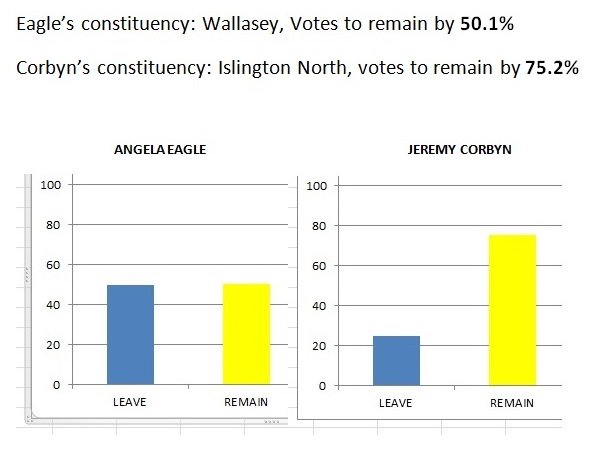
In addition to all of this, Corbyn’s pro-Remain position with respect to the EU referendum provided his critics with the ammunition they needed in their attempts to undermine him further. Chief among these critics is Angela Eagle, one of the many Oxford educated New Labour plotters who resigned her post in order to position herself as a potential replacement for Corbyn and who claimed to be dissatisfied with Corbyn’s performance during the EU referendum campaign. However, as the graphic below indicates, Corbyn did much better than Eagle in defending their respective Remain positions:

According to a YouGov poll in the run up to the second election, Eagle commanded just 6 per cent support from Labour members and eventually dropped out of the race to be replaced by challenger, Owen Smith.

The Owen Smith debacle

In a debate on the September 8, 2016 edition of BBC’s Question Time leading up to the election, a studio audience member accused Smith of “being in the wrong party”. Smith’s voting record in parliament appeared to support this thesis.

Having pitched himself as a ‘soft-left’ anti-austerity alternative to Corbyn, the former public relations professional had previously given interviews supporting PFI and, as chief lobbyist for the U.S multinational Pfizer, he actively pushed for the privatization of NHS services. Commenting on a Pfizer funded ‘focus group’ study as part of a press release, Smith referenced and promoted the notion that the precondition for greater availability of healthcare services was the ability of the public to be able to pay for them.

Smith also supported Blair’s city academies and assiduously courted the arms industry of which his support of Trident was a reflection. Arguably, most important of all, is that Smith effectively lined up with the Tories, alongside another 183 Labour MPs in July, 2015 by refusing to vote against the Conservative governments regressive and reactionary policy of welfare cuts to some of the most vulnerable people in society.

In the end, Labour Party members saw through the Smith brand, realized he was, as Craig Murray put it, “another New Labour unprincipled and immoral careerist”, and voted accordingly.

The cementing of Corbyn’s mandate

Consequently, Corbyn increased his proportion of the vote and hence his mandate. This was despite a war of attrition by the PLP that involved a McCarthyite purging of Corbyn supporters – a disdain for the grass roots membership which has a long history within the hierarchy of the party.

The grass-roots popularity for Corbyn must be seen against a backdrop in which the Labour party gained 60,000 members in one week following the attempted coup against him. Membership of the party is currently higher than it’s last peak of 405,000 members last seen under Tony Blair’s leadership.

As Corbyn’s vindication by the memberships overwhelming support of him shows, the ‘race to the bottom’ strategy of his opponents serves nobody other than the narrow careerist motivations of an out of touch elite who have their snouts embedded in the trough and don’t want to give up their privileges without a fight. A sincere and incorruptible politician like Corbyn represents a potential threat to these privileges and the gravy train that sustains them.

This explains why the careerists inside the New Labour bubble would prefer a Tory government over a Corbyn government and thus are happy to continue with the ‘divided party at war with one another’ narrative. This was what the challenge to Corbyn’s authority within the right-wing of the party is really all about. It’s not that Corbyn hasn’t a realistic chance of winning the next General Election, rather, it’s more a case that the establishment will do everything in their power to ensure that he doesn’t.

Battle lines drawn

In that sense, the political battle lines have been drawn, not between the Tories, the corporate mass media and the right-wing ‘opposition’, but between these factions and the rest of us. The resignation of the right-winger, Tristram Hunt, who was essentially parachuted into his Stoke-On-Trent constituency, represents a tacit acknowledgement by the Blairites that the New Labour faction within the party is on the ropes and that Corbyn is in the ascendancy. This notion was articulated by Ken Livingston, who in response to the resignation echoed the views of the grass roots when he depicted Hunt as being part of:

“a small elite that is very much London based that dominated the Labour party under the Blair-Brown years and were in awe of the bankers and forgot the needs of ordinary working class and middle class families, that era is gone.”

The popularity of Corbyn among grass roots members did not deter the right-wing of the party prior to the General Election from making the assertion  that Corbyn was an electoral liability for Labour and that he was unelectable.

However, the massive swing to Labour proved them wrong, In addition, his impressive record at elections more generally, should have been a warning to them. In his constituency of Islington North, Corbyn inherited a majority of 4,456, which increased to 21,194. He added a further 10,430 at the General election. He’s one of the few Labour MPs whose vote increased between 2005 and 2010, when he added 5,685 to his majority.

It must also be remembered that pre-coup, Labour led the Tories in three polls in a row over 41 days. Furthermore, London, Bristol and Greater Manchester now have Labour mayors, rolling back years of Tory dominance, while Labour’s majorities in by-elections have generally increased. It’s true that the by-election in Copeland was a major disappointment but this was largely offset by the fact that Labour took the Stoke on-Trent seat on the same day.

It is also worth noting that Labour won three local government by-elections – two off the Tories and one off the SNP. In last May’s local elections, the party overtook the Tories in the share of the vote, coming from seven points behind at the last but one election.

Meanwhile, the party haemorrhaged 4.9 million votes between 1997 and 2010 under the ‘triangulated’ leadership of Tony Blair. The man who took the country to war in Iraq under a false prospectus, and who lobbies on behalf of some of the world’s most brutal and corrupt dictators, claimed in a moment of Orwellian doublespeak that Corbyn is a disaster for the party.

Myth-making

This narrative is consistent with the notion that the left are un-electable more generally. Such a narrative is a myth. As Craig Murray posited, the idea that you have to be right-wing to win elections is belied by the fact that the SNP under Nicola Sturgeon won the people of Scotland over on a left-wing ticket. Secondly, as he rightly says, there is no point being elected just so you can carry out the same policies as your opponents. Third, the British public’s ‘enthusiasm’ for somebody like Blair in 1997 was not based on policies known as Blairite. As Murray astutely points out:

“The 1997 Labour Manifesto  was not right-wing. It did not mention Academy schools, Private Finance Initiative, Tuition Fees, NHS privatisation, financial sector deregulation or any of the right wing policies Blair was to usher in. Labour actually presented quite a left wing image, and figures like Robin Cook and Clare Short were prominent in the campaign. There was certainly no mention of military invasions. It was only once Labour were in power that Blair shaped his cabinet and his policies on an ineluctably right wing course and Mandelson started to become dominant. As people discovered that New Labour were “intensely relaxed about people getting filthy rich”, to quote Mandelson, their popular support plummeted. “The great communicator” Blair for 90% of his Prime Ministership was no more popular than David Cameron is now. 79% of the electorate did not vote for him by his third election.”

Murray continued:

“Michael Foot consistently led Margaret Thatcher in opinion polls – by a wide margin – until the Falklands War. He was defeated in a victory election by the most appalling and intensive wave of popular war jingoism and militarism, the nostalgia of a fast declining power for its imperial past, an emotional outburst of popular relief that Britain could still notch up a military victory over foreigners in its colonies. It was the most unedifying political climate imaginable. The tabloid demonization of Foot as the antithesis of the military and imperial theme was the first real exhibition of the power of Rupert Murdoch. Few serious commentators at the time doubted that Thatcher might have been defeated were it not for the Falklands War – which in part explains her lack of interest in a peaceful solution. Michael Foot’s position in the demonology ignores these facts. The facts about Blair and about Foot are very different from the media mythology.”

The reality, as one commentator on twitter put it, is that in corporate media and political establishment parlance, “un-electable” is media-political code for ‘likely to be highly electable but ‘will not serve elite interests.’”

Snap election

No sooner had PM Theresa May announced in April her decision to go to the country in a snap election predicated on a single issue Brexit strategy, Corbyn, was quickly out of the blocks in his attempts to wrong-foot her. The Labour leaders first General Election campaign speech and Q&A in which he outlined a broad set of policies to tackle growing inequality and reverse years of Tory austerity, was a tour de force.

Corbyn was able to capitalize on May’s unpopular campaign on bread and butter issues such as grammar schools and the dementia tax. Where I disagree with Corbyn is in relation to his position on Brexit which I regard as economically illiterate. I outlined my thinking here.

However, given that a poll (July 16, 2017) commissioned by Blair suggests that 56 per cent of the public agree with the statement, “Brexit must mean Brexit”, it would appear that Corbyn looks set to pull off a tactical masterstroke. By refusing to adopt the Remain position of the Liberal Democrats, means that Corbyn is likely to be best placed to capitalize on May’s calamitous hard Brexit outcome.

Other issues that the Tories won’t be able to hide away from, is the chaos in the NHS and social care sector, the scandal of zero hours contracts, in-work poverty, lack of affordable housing and welfare cuts among others.

Ultimately, the implication the public don’t necessarily favour Corbyn’s politics is wrong. His position on the NHS and the re-nationalization of the railways, for example, are universally popular. Rather, it’s more the case that the elite political-media establishment know Corbyn is incorruptible and therefore feel they are unable to win him over on their own terms. Consequently, they realize that the longer Corbyn remains at the helm the more likely it will be that those sympathetic to him and his policies will be elected into positions of power.

The fact that the media barons are constantly drumming it into the public’s heads that Corbyn is useless and should resign, is a testament to his unflinching endurance to see through the mandate entrusted upon him by the rank and file. If both the right-wing Tory media and his political opponents were so convinced that he had no chance of winning the election, why did they keep insisting that he resign?

Moreover, the criticism often leveled at Corbyn that he provides weak opposition at the dispatch box during PMQs, is belied by the fact that under his leadership the Tories have been forced into some thirty policy u-turns.

Cracks

Cracks had started to appear in the Tory armory way before the General Election. Left-Foot Forward noted, both the PMs press secretary, and her director of communications and long-term adviser, departed company with her. In addition, “May’s two closest advisers have a long history of intra-government feuds – both were forced to leave May’s home office team after rifts with other members of David Cameron’s cabinet – and the trend seems to be continuing in Number 10.”

According to Politico:

“The string of departures from Number 10 has been linked to May’s highly controlled leadership style. Government officials frequently report that power over government messaging and media strategy is heavily concentrated in the hands of ‘the chiefs’… and that more junior members of staff have limited freedom to operate.”

May’s authoritarianism has arguably been the motivating factor which has led to what the Canary reported (April 24, 2017) as the resignation of a third senior adviser from Downing Street within a week. The PMs control freakery was underlined by what Ash Sarkar, described as “a moment of short-term political opportunism which actually has potential catastrophic affects in terms of a concentration of power in the executive.”

It’s May’s totalitarian instincts that are symbiotic of the rightward drift in politics over the last four decades, that has culminated in some of the most severe attacks on our civil liberties within living memory.

In November 20, 2016, Craig Murray, published a blog piece that is apposite for the current situation. In it, he illustrates an example of the PMs total contempt for democracy legitimized by what he accurately terms as “an over-mighty executive government backed by corporate wealth which controls a corporate media.”

Murray continued:

“Her [May’s] default position is to retreat into secrecy and blatant abuse of power. That is precisely what we are seeing over Brexit, where there is no plan and much to hide. May’s natural instinct is to brook no opposition, debate or discussion of her actions, but to proceed on the basis of executive fiat, with as little information as possible given to parliament, devolved authorities and – Heaven forbid – the public.”

Both Murray and Sarkar’s assertions were illustrative of May’s refusal to take part in a televised public debate in the run-up to the election, her banning of both the public and journalists from Tory events and the insistence that her MPs sign a three lock pledge.

May’s autocratic style and her reluctance to allow proper democratic scrutiny, points to a lack of intellectual acumen and the paucity of her campaign policies underpinned by the repetitive mantra, “strong and stable” – amusingly parodied by Mike Sivier (April 27, 2017).

The paucity of May’s campaign was even noted by some establishment commentators. Columnist Fraser Nelson, for example, revealed in the Telegraph (April 21, 2017), that May’s election manifesto was extremely light in both content and detail which a single hard Brexit strategy implied.

An illustration of the PMs lack of intellectual acumen and autocratic style, was perhaps most pertinently highlighted by constituent, Louise Trethowanwho related a fifteen minute encounter she had with May at her constituency office in Maidenhead.

Trethowan said:

“For me, it was an excellent opportunity to put all my fears – and the concerns of the 48 per cent – to the woman who will lead us towards the Brexit cliff edge. I expected… her to present some strong arguments that would counter my own.”

But what she witnessed was a rude, aggressive and finger-pointing individual who was unable to hold an argument.

Trethowan added:

She [the PM] seemed petulant, defensive, tired and rattled… If the Prime Minister is so easily angered how on earth is she going to be the best negotiator for Brexit? I fear she will lose her temper and start jabbing her finger at people.”

The reliance on a constituency of right-wing extremists to argue the Tories’ case for returning an unstable individual to Downing Street based on a ‘blank cheque’ hard Brexit, while ignoring the key bread and butter issues, proved to have been a risky one that ultimately failed.

Of course, the billionaire-owning mass media support the Tories with near unanimity. But the front page of the Daily Mail (April 19, 2017) which ran with the headline “Crush The Saboteurs” (see below), almost certainly alienated 48 per cent of the population who voted Remain. Therefore, given the shifting attitudes towards Brexit, the right-wing media’s depiction of over 16 million people as “the enemy” probably backfired on the Tories.

Behind in the polls

It’s true that when May announced the election, Corbyn was well behind in the polls but, as Craig Murray pointed out at the time, this is misleading. The downside for Corbyn, according to YouGov, is that Labour looked set to lose out to the Tories for the vote of the oldest and least educated demographic – many of whom are traditional working class voters. It seemed at the time Labour’s longer-term prospects would have been hindered by the fact that society is ageing.

But on the other hand, YouGov found that Labour was leading the voting intention polls with under-40s. The problem for Labour, historically, has been that it’s this group who have been the least likely to go out and vote. I stated at the time that “If Corbyn can mobilize this former hitherto relatively passive demographic group into voting, then the polls could be significantly closer than many pundits are suggesting.” And so it came to pass. It is also worth keeping in mind that the last Tory PM to have called an early election on a single issue while ahead in the polls was Edward Heath – and he lost.

It was music to this writers ears that Corbyn began his campaign emphasizing Labour’s policy plans in a lucid and persuasive way. The two-pronged strategy of focusing on May’s shortcomings over Brexit on the one hand, and Corbyn’s emphasis on outlining policies to reduce inequality and create a fairer society on the other, was inspired.

The announcement by Corbyn’s team on April 26, 2017, that the Labour leader would not take part in a live televised TV debate, only for him to change his mind, was another tactical master stroke. The decision wrong-footed May who was the first to announce she would not participate. She was then perceived as ducking out of the challenge to face Corbyn.

Polls narrowed

As the election neared, the public began to frame their views on Corbyn, less on what the media wanted them to believe through their propagandizing of him, and more on what they saw and heard in public speeches and debates. They liked what they heard. The bread and butter issues resonated across the board, but particularly with the young who saw in Corbyn somebody who at last was prepared to put issues like tuition fees, education, inequality, social justice and affordable housing at the top of the agenda.

The media’s depiction of him as a bumbling idiot and terrorist sympathizer didn’t square with the reality. Thus the closer the election got, the narrower the polls became. When the election was called in April, the Tories lead over Labour was 24 points. A week before the election, the lead had been cut to just three.

Having galvanized the young and encapsulated the wider public mood with an inspired insurgency campaign, it was clear in the early hours of June 9, 2017, that Corbyn against all the odds, had prevented a Tory majority. May’s ‘one trick pony’ hard Brexit strategy had failed and the electorate in huge numbers had been persuaded by the Labour leaders message of compassion, justice and humanity.

Given the level of media vilification, hostility and bias against Corbyn from the moment he became Labour leader, the election result was nothing less than astonishing. Corbyn ‘increased Labour’s share of the vote by more than any other of the party’s election leaders since 1945′ with ‘the biggest swing since shortly after the Second World War. He won a larger share of the vote than Tony Blair in 2005.

The corporate media commentariat – most of whom were fanatical, during the election campaign in promoting May and had predicted a Tory landslide – had been caught with their tails between their legs. When a tweeter suggested that Corbyn’s result was “brilliant”, New Statesman editor Jason Cowley replied: “Yes, I agree.” Just three days earlier, Cowley had written under the ominous title:

“The Labour reckoning – Corbyn has fought a spirited campaign but is he leading the party to worst defeat since 1935?”

In March, Cowley opined:

“The stench of decay and failure coming from the Labour Party is now overwhelming – Speak to any Conservative MP and they will say that there is no opposition. Period.”

Corbyn’s success means that the power of the mainstream media to dictate public opinion has been broken. But the shifting political landscape is not reflected in the unrepresentative nature of TV political punditry which continues as it did before the election. The call by Naomi Klein to have fixed terms for pundits just like presidents and prime ministers, is long overdue.

The likes of Polly Toynbee, Toby Young, Andrew Neil, Julia Hartley Brewer et al have not displayed any sense of humility, self-awareness or embarrassment since the election, which illustrates their sense of self-entitlement and the programme-makers disregard for public opinion.

But it isn’t just the commentariate and TV producers within the elite media bubble who are out of touch and aloof. The Labour party establishment who endorse the elite narrative and who were filmed predicting Corbyn’s demise and felt he was unsuitable to lead the party into the election, ought to (but won’t) be hanging their head in shame.

None of the Blairites will be missed as the party enters a new post-New Labour era. Corbyn should take advantage of his popularity and he may now feel emboldened enough to encourage their deselection. Blairites are only motivated by money and power and they will go away once the money dries up.

If you’ve enjoyed reading this or another posting, please consider making a donation, no matter how small. I don’t make any money from my work, and I’m not funded. You can help continue my research and write independently outside the control of corporate-owned and power-serving media structures.… Thanks!


Donate Button with Credit Cards

Assange’s stitch-up is a lesson for us all

By Daniel Margrain

December 7, 2010, was the day Wikileaks founder, Julian Assange lost his liberty following the accusation of rape against him in Sweden. Throughout the intervening six years, Assange has been willing to give a statement to the Swedish authorities, either by receiving officials in the UK or over telephone or video link, which is the routine method of carrying out questioning.

Ten months ago, the UN adjudged  that the effective imprisonment of Assange in the Ecuadorian embassy in London was unlawful. This legally binding judgement was a vindication of all those activists who have supported the quest of the Wikileaks founder to bring into the public domain the illegalities of Western power.

Upon the release of the UN ruling, one of the leading political gatekeepers of the said powers, then UK foreign secretary, Phillip Hammond, did his utmost to publicly undermine the findings of the UN body – of which the UK government is a signatory – by attempting to deceive the British people. What was shocking was the extent to which Hammond was prepared to sink in order to attempt to justify the unjustifiable at the behest of his masters in Washington.

In what former UK diplomat, Craig Murray, described  as an “utterly astonishing” statement, Hammond said:

“I reject the decision of this working group. It is a group made up of lay people and not lawyers. Julian Assange is a fugitive from justice. He is hiding from justice in the Ecuadorian embassy.”

Hammond’s statement was a blatant lie. Every single one of the UN panel is an extremely distinguished lawyer. According to Edward Snowden, Hammond is writing “a pass for every dictatorship to reject UN rulings.” Craig Murray stated that, “Countries who have ignored rulings by this UN panel are rare. No democracy has ever done so. Recent examples are Egypt and Uzbekistan. The UK is putting itself in pretty company”, he said.

Previous rulings by the panel have gone against countries with some of the world’s worst human rights records, such as Saudi Arabia, Myanmar and Egypt. Recent cases where the UN has ruled in circumstances in which individuals have similarly been detained, include the Washington Post journalist, Jason Rezaian in Iran in December, 2015 and former pro-democracy president Mohamed Nasheed two months previously (both subsequently released).

On 30 November 2016, the United Nations rejected the UK’s attempt to appeal the UN’s February ruling in favour of Julian Assange. The decision made ten months ago therefore stands. The UN instructed that UK is once again required to immediately put an end to Assange’s arbitrary detention and to take immediate steps to ensure his liberty and enjoyment of fundamental human rights are re-established. Having reached the end of the legal road, the UK government is compelled to release Assange from his six years of illegal detention.

justice4assange.com provides some background to the case:

“Julian Assange, editor-in-chief of WikiLeaks, has been detained without charge in one form or another since 7 December 2010…In Sweden, Julian Assange is not charged with a crime. But in a highly unusual move, Sweden issued an Interpol Red Notice and a European Arrest Warrant, immediately after WikiLeaks began publishing a cache of 250,000 US Diplomatic Cables on 29 November 2010. Such warrants are usually issued for persons whose whereabouts are unknown. But Julian Assange’s whereabouts were known (he had given a press conference and hundreds of interviews in London). His lawyers were in communication with the prosecutor and had communicated that he was available to answer questions from the Swedish prosecutor through standard means.”

“Questioning people within European borders is a routine and uncomplicated process, which is standardised throughout the European Union. Sweden often uses these means to question people. In the initial ten days after 20 August 2010, the police opened the ’preliminary investigation’, it was assigned to three different prosecutors in quick succession. The penultimate prosecutor found that the case had no basis, and that there were no grounds to place Julian Assange under a criminal investigation.”

The final prosecutor however, Marianne Ny, took over on 1 September 2010 and reopened the investigation. The Swedish investigation has been frozen since 2010. In November 2014, Sweden’s Svea Court of Appeal ruled that the prosecutor had failed her professional duty to progress the investigation against Julian Assange.”

The context of the ruling vindicating the Wikileaks founder stems from the fact that he has never been charged with any offence. The UN findings confirm that his detention has been unlawful since his very first arrest in the UK in 2010 and that there has never been any genuine attempt by the Swedish authorities to investigate the allegations against him. For all those commentators who have been following the case closely, it has been obvious that from the outset the establishment have had it in for Assange. The rape allegations were the Casus Belli.

This was given credible weight early on by Naomi Wolf, a prominent American writer, feminist and social commentator, who argued that the allegations against Assange bore all the hallmarks of a set-up. This was further elaborated on by Craig Murray who thoroughly demolished the case against Assange. As John Pilger outlined, the reality is, there was no genuine judicial process in train against Assange in Sweden, a point that was advanced by Assange’s lawyers before the UK supreme court:

“The Assange case has never been primarily about allegations of sexual misconduct in Sweden – where the Stockholm Chief Prosecutor, Eva Finne, dismissed the case, saying, ‘I don’t believe there is any reason to suspect that he has committed rape’, and one of the women involved accused the police of fabricating evidence and ‘railroading’ her, protesting she ‘did not want to accuse JA of anything’ – and a second prosecutor mysteriously re-opened the case after political intervention, then stalled it.”

Finne’s dismissal of the case against Assange has since been vindicated by the release of SMS records which appear to indicate that the Wikileaks founder was, as Stockholm’s Chief Prosector suggested, framed by the police. Indeed, the police themselves admit that the rape allegations were fabricated in what they concede was an elaborate plot against Assange.

Given the astounding level of misinformation, demonization, smears, deceptions and outright lies in the mainstream corporate media’s reporting of Assange, an observer unfamiliar with the case might reasonably form the impression that the man in question is the devil incarnate, who is using his work as a cover in order to avoid facing justice for the crime of rape.

Some of these commentators, it would appear, have seen fit to pronounce a verdict of guilty on the head of the whistle blower in advance of any hypothetical future trial. The self-appointed Witch finder General, Joan Smith from London Women against Violence, for example, virtually alluded to Assange’s guilt with a series of crass pseudo-psychologically-based observations and insinuations.

Much of the vitriol stems, not from the traditional right-wing of the media terrain, but rather from what many people consider to be the liberal-left of the political spectrum. Owen Jones, for example, who appears to be the latest poster boy for left wing opinion throughout the corporate media, penned, in August 2012, an article for the UK’s Independent newspaper, titled “There should be no immunity for Julian Assange from these allegations.”  But Jones’ inference that diplomatic immunity is a feature of the Assange case is, in reality, a red-herring since neither Assange, his supporters, legal team or anybody else outside the media bubble, have ever suggested that his case is predicated on a claim of immunity.

The lie was repeated by the legal expert, Joshua Rozenberg, presumably in an attempt to add a certain degree of gravitas to the claim. The truth is that all Assange has ever requested from the outset, is a guarantee from the Swedish authorities that if he agrees to travel to Sweden to answer the rape allegations made against him, he won’t be extradited to the United States. Assange’s request for this assurance from Sweden is supported by Amnesty International. However, the Swedish authorities have consistently failed to give Assange such an assurance.

Despite all this, the Sky News journalist and LBC stand-in presenter, Tim Marshall, implied that callers to his programme on February 5, 2016, who suggested that should Assange step foot outside the Ecuadorean embassy, he would ultimately be extradited to the U.S predicated on the trumped up charge of rape and subsequently be imprisoned, were mad conspiracy theorists. The incandescent, Marshall, is apparently unaware of the case of Chelsea Manning who was imprisoned for 35 years in 2013 for leaking information to WikiLeaks.

He is also seemingly unaware that, according to Edward Snowden, Assange is on a US “manhunt target list” or that the Independent revealed that both the Swedish and American governments’ have already discussed Assange’s onward extradition. If Marshall had bothered to avail himself of the views of Mats Andenas, the Norwegian chair of the UN Working Group for much of its investigation, he would have realized that the panel had to resist intense pressure from the US and UK to arrive at a decision contrary to the one they actually reached.

Marshall’s tone throughout was one of incredulity that the “liberal” Sweden would place Assange at risk of extradition to the US or for that matter that the latter under the liberal-progressive Obama, could ever preside over an administration that has imprisoned more whistle blowers than all his predecessors combined. In terms of the former (something else that Marshall is apparently oblivious to), is the subject matter of Amnesty International’s 2013 report which highlights Sweden’s damning record of extraditing people to other countries and its cooperation with the US in extraordinary renditions.

Jonathan Cook sums up just how far down the perilous road towards fascism our governments’ and their accomplices in the media are prepared to go in order to augment the interests of the powerful:

“The degraded discourse about the UN group’s decision does not just threaten Assange, but endangers vulnerable political dissidents around the world. The very fact that…[liberal media commentators]… are so ready to sacrifice these people’s rights in their bid to tar and feather Assange should be warning enough that there is even more at stake here than meets the eye.”

In a humane and fair world, it would be incumbent upon the media horde who have unjustly smeared Assange, to admit they were wrong and publicly apologize to him and his supporters, all of whom have been vindicated by events. But not only have no such apologies been forthcoming, the commentariate at the Guardian have actually continued with the smears.


A message to the people of Stoke & Copeland: Let’s propel Nuttall & the UKIP P*ss-taker’s into the dustbin of history

Paulnuttall.jpg

By Daniel Margrain

During his barnstorming speech at the last Labour Party Conference, Jeremy Corbyn said:

“If you believe, like me, it’s a scandal that here in Britain, in the sixth biggest economy in the world, 4 million children are in poverty, 6 million workers are paid less than the living wage. And if, like me, you believe we can do things far better, then help me build support for a genuine alternative that will invest in our future – a more prosperous future – in which the wealth we all create is shared more equally.”

Buoyed by both the electoral success of Trump, and the disorientation of large sections of the Left resulting largely from the growth in right-wing populism throughout Europe, Paul Nuttall will exploit these issues during this coming Thursday’s Stoke and Copeland by-election campaigns by cynically using the kind of socialist language of Corbyn above, in an attempt to steal the Labour vote.

Nuttall, who gained a fraction of the votes secured by Corbyn during their respective leadership campaigns, denies climate change and opposes abortion and gay marriage. He is also in favour of capital punishment, fox hunting, NHS privatization and lied when he claimed to have been “a survivor of the Hillsborough disaster.” The latest scandal emerged on February 18 when a UKIP canvasser was allegedly caught on CCTV urinating on the house of 73-year-old widow Marjorie Pinches, from Northwood in Stoke.

Rarely is the political-media establishment willing to discredit the kind of fascist cult UKIP represents, particularly when faced with the potential threat of a genuine socialist alternative. But to their credit, up until now, they have done a pretty good job of exposing Nuttall for the lying, homophobic, racist and xenophobic thug that he is.

Class consciousness

What would appear to be a growing class consciousness among a significant segment of the population is, I would contend, offset by a large minority of working class voters who are sympathetic to UKIPs right-wing message and who, too often, are persuaded to vote against their own interests. This would explain the reason why the UKIP vote among ordinary people during the forthcoming by-elections are unlikely to be insignificant.

As far back as the 1930s, Italian philosopher Antonio Gramsci grasped that when confidence in the working class is high – like it was, for example, during the 1960s – people are less likely to be ‘brainwashed’ by the kind of extreme ruling class ideology represented by groups like UKIP than is the case when confidence in the class is relatively low, as it is now.

These kinds of contradictions help explain how the emergence of an opportunistic right-wing establishment tool like Nuttall is able to exploit the same political space as principled socialists. This is achieved by perpetuating the myth that the party Nuttall leads is in any way able to effectively represent the interests of an angry and disaffected working class, many of whom channel their anger and disaffection towards immigrants. Nuttall will hope to be able to channel this disillusionment at the ballot box in Stoke where anti-EU sentiment is high.

Unfortunately, some unprincipled and careerist Labour politicians like Rachel Reeves are also only too willing to pander to racists in order to grab their votes. For example, during an anti-immigration speech, she sought to ensure potential Labour voters that her party could be just as racist and reactionary as UKIP and the Tories. Similarly, a tweet by a long-standing Labour party member and Brexit-supporter, Scott Nelson, who I responded to in the wake of Nuttall’s victory (see below), illustrates that pandering to racist ideas is not the monopoly of right-wing and faux-left politicians.

Scott Nelson @SocialistVoice

“If Labour doesn’t take immigration seriously then UKIP will take control of the party’s heartlands in the north” 

Daniel Margrain Retweeted Scott Nelson

“No pandering to racists, sorry. If we lose votes, then so be it.”

People voted for Brexit for a multitude of reasons that include anti-establishment sentiments, the democracy argument, to give David Cameron a kick, naive wishful thinkingLexit and because they believed the brazen lies that the hard-right Vote Leave mob told them. However, it’s undeniable that a significant percentage of the 17.4 million people who voted for Brexit, did so because they bought into the racist immigration fear-mongering ideas of extreme-right groups like UKIP and Britain First.

Given the level of contradictory working class consciousness outlined above, it’s not unreasonable to suggest that many working class UKIP voters who oppose the socialist principles and values espoused by Corbyn, nevertheless favour issues like taxing the rich and renationalizing the railways.

Deflector shield

It’s this kind of contradiction that underpins the genius of a propaganda system that demonizes political figures the establishment regard as a threat to the status quo. The corporate mainstream media tend to bash socialists like Corbyn while promoting bigots like Farage by giving the latter a media outlet such as a mainstream radio talk show with which to espouse reactionary right-wing views, because his role is akin to that of a deflector shield whose purpose is to conceal the political establishments own ineptitude.

The inability of the media in highlighting, in any fundamental way, the tensions that exist between Theresa May, Boris Johnson and EU ministers over the Brexit debacle is a case in point. Johnson’s contention, for example, that the EUs position amounting to an automatic trade-off between access to the single market and free movement was “complete baloney”, is a total misreading of the Lisbon Treaty that nevertheless went largely unchallenged in the media.

In response to Johnson’s outburst, German finance minister Wolfgang Schäuble said in a rather sardonic fashion, If we need to do more, we’ll gladly send her Majesty’s foreign minister a copy of the Lisbon Treaty then he can read that there is a link between the single market and the four core principles in Europe.” The minister continued, “I can also say it in English, so if clarification is necessary, I can pay a visit and explain this to him in good English.”

Johnson’s assertion that the UK should already have triggered Article 50, was subsequently contradicted by May, while the three ministers tasked at extricating the UK from the EU are too busy fighting among themselves. Moreover, Johnson has spent a great deal of his time flying around Europe apologizing to everybody he has insulted. And yet, the media only tend to report on the lack of unity within the Labour ranks with regards to Brexit. Meanwhile, EU leaders continue to harden their stance against the Tories saying that they intend to rule out any cherry-picking in relation to the ability of Britain to access the single market.

Lowest common denominator

By demonizing Corbyn on the one hand, and with their disproportionate coverage of right-wing parties like the Tories and UKIP on the other, the media fail to bring real power to account. There can only be one reason why they have barely mentioned any of the tensions within the ruling class that have arisen over the Brexit debacle, and that’s because they regard Corbyn as the lightening rod for abuse and bad publicity.

The election of Paul Nuttall as leader of UKIP, whose image is more worker and street fighter than cheeky-chappy banker and financier, will not only serve as another establishment deflector shield, but is also intended to split the working class Labour vote by appealing to the lowest of common denominators. Like a journeyman who travels on a road without end in the anticipation that beyond the rainbow lies salvation, Nuttall’s race to the bottom is in reality, a race on a road to nowhere. I am hoping that come the vote on Thursday, the good people of Stoke and Copeland will see sense, and help propel UKIP to the dustbin of history where they belong.

COPYRIGHT

All original material created for this site is ©Daniel Margrain. Posts may be shared, provided full attribution is given to Daniel Margrain and Road To Somewhere Else along with a link back to this site. Using any of my writing for a commercial purpose is not permitted without my express permission. Excerpts and links, including paraphrasing, may be used, provided that full and clear credit is given to Daniel Margrain and Road To Somewhere Else with appropriate and specific direction to the original content. Unless otherwise credited, all content is the site author’s. The right of Daniel Margrain to be identified as the author of this work has been asserted by him in accordance with the Copyright, Designs and Patents Act 1988.

Make a small donation

If you’ve enjoyed reading this or another posting, please consider making a donation, no matter how small. I don’t make any money from my work, and I’m not funded. You can help continue my research and write independently.… Thanks!


Donate Button with Credit Cards

Stepping into the mud with the barefoot economist, Manfred Max-Neef

By Daniel Margrain

Manfred Max Neef sits at a table near a notebook computer. On the wall behind him is a slide from a presentation.

The media’s trumping (excuse the pun) of economic growth over environmental concerns exemplified by their lack of any critique of the latter following yesterday’s (November 23) Autumn Statement announcement by chancellor, Philip Hammond, is a familiar, if rather depressing, narrative. The news from the government’s Office for Budget Responsibility (OBR) that growth forecasts for 2017 as a percentage of GDP are projected to fall by 0.8 per cent, largely due to Brexit-related affects, was perhaps expected.

But what is rarely questioned by the media are the consequences this prioritizing of growth as a central plank of the governments economic strategy has for the medium to long term sustainability of the planets ecosystems upon which the well-being, and even survival, of humanity depends.

The Green Party MP, Caroline Lucas raised her concern in the House of Commons that neither Hammond in his Autumn Statement – nor any of his Tory predecessors – “have ever mentioned the words ‘climate change’ in the year that’s the hottest on record and where parts of the country are under flood water.”

To all rational observers this is a particularly alarming state of affairs given that the government’s own 2015 National Security Strategy states that human-induced climate change is one of three tier-one threats – alongside international terrorism and cyber crime – that the UK currently faces. By subordinating climate change to a neoliberal economic growth model within a finite planet, amounts to willful ignorance and stupidity of the most serious and blatant kind, namely, because the consequences are potentially catastrophic for all living things.

Shifting the paradigm

Of all the recent discussions around the production of fake news, the inability of the mainstream media to bring the issue of climate change to the forefront of public discourse is probably the greatest dereliction of duty that can be brought to bear on the credibility of professional journalism.

But arguably just as unforgivable, is the media’s inability to bring political power to account in respect to the latter’s fetishization of the current growth model and to shift the discourse from a paradigm where this model is currently regarded to be a panacea among large swaths of the public, to one where it is widely regarded as the death knoll for society and the planet.

The November 22 edition of the BBCs current affairs Newsnight programme featured an extended piece on the current chancellor. Some of Philip Hammond’s former school friends were interviewed, all of whom described him as a highly intelligent figure who, after having completed his class work before everybody else, would often put his feet up on his desk in lessons. Hammond was portrayed by his friends as being so clever that he regularly outsmarted his teachers.

Having made large sums of money as a music promoter soon after having left school, Hammond fulfilled his youthful boast that he would become a millionaire by the age of thirty. But although well-educated, wealthy and well connected, this former Oxford graduate like so many other chancellors before him who have gone on to be the pillar of the political establishment, continues to promulgate the deluded notion that sustained economic growth is emblematic of societal progress.

Hammond is part of a Tory establishment that continues to perpetuate the myth that the current economic growth model is the best way to curtail the threat posed from the likelihood of further economic crisis as opposed to recognizing it’s the major cause. Consequently, Hammond will continue to systematically push for policies that fly in the face of all available scientific evidence.

Politician’s like Hammond know what is to be done but for ideological and dogmatic reasons they do the opposite. Rather than the global financial crisis of 2008 acting as a wake up call, Hammond and Osborne before him, continue with the same poisonous model until the next crisis comes along, by which time they will continue with it until the one after that. And so it goes on. This is the economics of the madhouse.

Radical visions – development not growth

What is required is a radical alternative vision for society – a break from the concept by which everything has become a commodity to be bought and sold for profit. But who, other than a handful of creative thinkers in the academic sphere, are proposing alternative, imaginative visions? One of the most ambitious thesis I’ve come across is that postulated by Pat Devine, who articulates in some detail, the processes by which the development of a democratically planned socialist economy can come into being.

Devine’s thesis is closely aligned to that of the Chilean economist, Manfred Max-Neef whose visionary holistic and philosophical appraisal of the existing model ought to go a long way in persuading people of the legitimacy of the planned socialist model. While recognizing the importance, geographically, of bringing production closer to consumption, Max-Neef argues that the root of the existing problem stems from how establishment economists perceive their academic discipline as being above, and separate from, nature and the biosphere.

For Max-Neef, economists know nothing about ecosystems, thermodynamics or biodiversity. “I mean, they are totally ignorant in that respect”, he said… “And I don’t see what harm it would do, for an economist to know that if the beasts would disappear, he would disappear as well, because there wouldn’t be food anymore. But he doesn’t know that we depend absolutely from nature. But for these economists we have, nature is a subsystem of the economy.”

Max-Neef argues that for the paradigm to shift, it is necessary for economics to be taught in a different way based in five postulates and one fundamental value principle:

1) The economy is to serve the people and not the people to serve the economy.

2) Development is about people and not about objects.

3) Growth is not the same as development, and development does not necessarily require growth.

4) No economy is possible in the absence of ecosystem services.

5) The economy is a subsystem of a larger finite system, the biosphere, hence permanent growth is impossible.

The fundamental value to sustain a new economy should be that no economic interest, under no circumstance, can be above the reverence of life.

For far too long, humanity and the natural world has been subordinate to the imperatives associated with an economic growth paradigm that’s perceived by economists and politicians as being separate and distinct from the former. What Max-Neef is saying in the first point above is that the dialectical relationship between economy and people has to be restored in order for society and nature to function properly.

The distinction Max-Neef makes between growth and development in point three, is particularly significant. As the economist from Berkeley points out:

“Growth is a quantitative accumulation. Development is the liberation of creative possibilities. Every living system in nature grows up to a certain point and stops growing. You are not growing anymore, nor he nor me. But we continue developing ourselves… So development has no limits. Growth has limits. And that is a very big thing, you know, that economists and politicians don’t understand. They are obsessed with the fetish of economic growth.”

This fetishization of economic growth is arguably explained, in part, by the fact that the monetary offshoots that accrue as a consequence of this growth have, since the onset of ‘trickle-down’ neoliberalism, increasingly ‘gushed upwards’ towards the top of the socioeconomic pyramid.

This is revealed by statistics which indicate that economic output (GDP) in the UK, adjusted for inflation, has over doubled from £687bn in 1979 to £1,502bn in 2011. However, over the same period, income inequality, as measured by the Gini coefficient, increased from 0.25 to 0.34. In other words, since the era of neoliberalism, working people who have created the sustained increase in wealth in society, have seen their slice of the pie reduced. Max-Neef understands that the ruling class obsession with the fetish of economic growth is underscored by the fact that this is the class that disproportionately benefits the most from it.

The threshold hypothesis

One of the later works Max-Neef authored was the famous threshold hypothesis, which says that in every society there is a period in which economic growth, conventionally understood or not, brings about an improvement of the quality of life. But only up to a point – the threshold point – beyond which, if there is more growth, quality of life begins to decline.

According to Max-Neef, the U.S, which he terms an “undeveloping nation” is currently at this point. The UK is not far behind. This is reflected in the growing concentration of wealth towards the one per cent at the expense of the 99 per cent. The logic of diminishing returns applies to other parts of the system that eventually results in net costs over the long-term.

These costs are quantified not only in strict monetary terms, but involve human capital too – something which the economic-growth fetishists rarely factor in to their cost-benefit calculations. Diane Abbot’s posting on Twitter yesterday (November 23) of an OBR sourced graph (see below) highlighting the impact of immigration on UK debt, is a case in point.


“OBR has also shown immigration reduces Government debt, because it is a net economic benefit.”


The ORB (and Abbot) present only a partial truth. While Abbot is correct in stating that “immigration is a net economic benefit because it reduces government debt”, the analysis doesn’t take into account other factors such as the uneven distribution of wealth described which negate the benefits accrued, or indeed, other (social) indicators such as reduced quality of life resulting from, for example, a lack of school places or other pressures on public services that mass immigration potentially brings.

Walking barefoot

It’s the apparent inability of politicians to view the economic growth paradigm as destructive that opens up spaces for alternative narratives of the likes of Max-Neef to fill. After winning the Right Livelihood Award in 1983, two years after the publication of his book Outside Looking In: Experiences in Barefoot Economics, the Chilean economist’s metaphor was inspired as a result of the ten years he spent working in extreme poverty in the Sierras, jungles and urban areas of different parts of Latin America. It was during this period that the economist from Berkeley began to view his profession in a different light. What subsequently happened was to change his life for ever.

“I was one day in an Indian village in the Sierra in Peru”, recalls Max-Neef. “It was an ugly day. It had been raining all the time. And I was standing in the slum. And across me, another guy also standing in the mud — not in the slum, in the mud. And, well, we looked at each other, and this was a short guy, thin, hungry, jobless, five kids, a wife and a grandmother. And I was the fine economist from Berkeley, teaching in Berkeley, having taught in Berkeley and so on.

“And we were looking at each other, and then suddenly I realized that I had nothing coherent to say to that man in those circumstances, that my whole language as an economist, you know, was absolutely useless. Should I tell him that he should be happy because the GDP had grown five percent or something? Everything was absurd.”

Max-Neef continued:

“So I discovered that I had no language in that environment and that we had to invent a new language. And that’s the origin of the metaphor of barefoot economics, which concretely means that is the economics that an economist who dares to step into the mud must practice.”

“The point is, you know, that economists study and analyze poverty in their nice offices, have all the statistics, make all the models, and are convinced that they know everything that you can know about poverty. But they don’t understand poverty. And that’s the big problem. And that’s why poverty is still there. And that changed my life as an economist completely. I invented a language that is coherent with those situations and conditions.”

The ‘language’ Max-Neef refers to relates to the way that we as human beings in developed countries have lost the capacity to understand. Despite our ability to accumulate knowledge, this capacity, in the absence of empathy, love and understanding, is according to Max-Neef, insufficient:

“You can only attempt to understand that of which you become a part”, says Max-Neef. “If we fall in love, as the Latin song says, we are much more than two. When you belong, you understand. When you’re separated, you can accumulate knowledge. And that is — that’s been the function of science. Now, science is divided into parts, but understanding is holistic.”

For Max-Neef, in order for professional economists to understand poverty, it’s necessary they live among people who are poor. Only then can economists understand that in such an environment there exists a different set of values and principles that are alien to world of academia that cannot be learned or understood their.

“What I have learned from the poor is much more than I learned in the universities”, said Max-Neef. “But very few people have that experience, you see? They look at it from the outside, instead of living it from the inside.”

The economist from Berkeley, continued:

“And you learn extraordinary things. The first thing you learn, that people who want to work in order to overcome poverty and don’t know, is that in poverty there is an enormous creativity. You cannot be an idiot if you want to survive. Every minute, you have to be thinking, what next? What do I know? What trick can I do here? What’s this and that, that, that, that? And so, your creativity is constant.”

“In addition, I mean, that it’s combined, you know, with networks of cooperation, mutual aid, you know, and all sort of extraordinary things which you’ll no longer find in our dominant society, which is individualistic, greedy, egoistical, etc. It’s just the opposite of what you find there. And it’s sometimes so shocking that you may find people much happier in poverty than what you would find, you know, in your own environment, which also means, you know, that poverty is not just a question of money. It’s a much more complex thing.”

What underlines Max-Neef’s message, perhaps more than anything else, is that the developed world that sees itself as sophisticated, educated and cultured, while pushing away to the margins the poor of the developing world by building walls, do so while failing to acknowledge that the kind of ‘progress’ the economists and politicians sitting in their plush offices aspire to, is in truth measured by the speed at which they are destroying the conditions that sustain life.

The Imperial arrogance of the BBC


By Daniel Margrain

“I think the days of Britain having to apologize for our history are over….I think we should celebrate much of our [imperialist] past rather than apologize for it, and we should talk, rightly so, about British values.”

The above words were uttered not by Nigel Farage, Nick Griffin or Enoch Powell, but former New Labour Chancellor, Gordon Brown eleven years ago during the recording of a BBC ‘Newsnight’ film which explored Brown’s ideas about Britishness. The “values” supposedly specific to Britain that Brown was referring to were not made clear.

Four years later, in 2009, Brown as Prime Minister, became embroiled in the controversy that surrounded the appearance of the fascist Nick Griffin on the BBCs flagship political forum programme, Question Time. After much to-ing and fro-ing between the BBC hierarchy and Brown, it was the latter who finally decided that the responsibility to allow Griffin on to the programme rested with the former.

Although in principle the BBC Trust – which oversees the requirement of the organisation “to deliver duly impartial news by the Royal Charter and Agreement and to treat controversial subjects with due impartiality” – is able to intervene in cases like this, in practice the body never interferes in individual programme content prior to transmission.

The decision to allow the then leader of an openly fascist party on to the programme on the basis that not to have done so would have breached the corporations impartiality guidelines, is an illustration of the absurdity underpinning the BBC claim. The organization frequently breaches its guidelines in this area. This can be seen in terms of a) how little BBC journalists scrutinize and challenge fascists in interviews and political debating programmes (Andrew Marr’s treatment of French MEP, Marine Le Pen being an example), and b) the extent to which these journalists uncritically accept the views and pronouncements of those in political power.

Stenography

Another clear example of how the corporation breaches its impartiality guidelines was in 2007. The then North America editor for the BBC, Justin Webb, whose role could be said to be closer to that of a stenographer than a journalist, rejected the charge he was a propagandist for US power. Webb said:”Nobody ever tells me what to say about America or the attitude to take about the United States. And that is the case right across the board in television as well”

Webb began a radio programme from the Middle East as follows:

“June 2005. US Secretary of State, Condoleeza Rice flies to Cairo and at the American University makes a speech that will go down in history”.

Reproducing Rice’s subsequent statement verbatim, Webb allowed her views to be aired without challenge or critique. Rice said, “For sixty years my country, the United States, pursued stability at the expense of democracy in this region, here in the Middle East, and we achieved neither”.

The former U.S Secretary of State added:

“Now we are taking a different course. We are supporting the democratic aspirations of all people.”

Webb told his listeners in all seriousness:”I believe the Bush administration genuinely wanted that speech to be a new turning point; a new start”.

Nobody had to tell Webb to say these words; he genuinely believed them.

In March, 2009, BBC reporter Reeta Chakrabarti was asked why she had claimed that Tony Blair had “passionately believed” that Iraq had weapons of mass destruction when all evidence suggested otherwise. Chakrabarti responded it was because he [Blair] had “consistently said so.”

When Media Lens challenged former BBC news director Helen Boaden on whether she thought these kinds of uncritical responses relating to U.S-UK intent compromised the BBC’s commitment to impartial reporting, she replied that “analysis of the underlying motivation of the coalition is borne out by many of the speeches and remarks of both Mr Bush and Mr Blair.”

Another clear illustration of how the BBC breaches its impartiality guidelines occurred in 1999. It was during this year that the corporation made the political decision to allow its own high-profile newsreader, Jill Dando, to present a DEC appeal for Kosovo at the height of NATO’s 78-day bombing campaign against Serbian “genocide” in Kosovo (the genocide claim has since been proven to have been false).

Shortly after broadcasting the appeal, the BBC reported:”Millions of pounds of donations have been flooding in to help the Kosovo refugees after a national television appeal for funds.”

In a linked article, Tony Blair was was quoted as saying:”This will be a daily pounding until he [the Serbian leader Slobodan Milosevic] comes into line with the terms laid down by NATO”.

The Kosovo appeal contrasted with the BBC’s decision not to broadcast the Gaza Charity Appeal a decade later in response to Israel’s violent 22-day attack on Gaza as part of Operation Cast Lead.

The BBC’s refusal to broadcast a national humanitarian appeal for Gaza, breached an agreement that dates back to 1963 and left “aid agencies with a potential shortfall of millions of pounds in donations.”

The BBCs support of the Kosovo appeal was consistent with the British states political and military imperial objectives in the region. By contrast, the notion of any support given to the Palestinian’s in Gaza run counter to these objectives. Apparently, the BBC had no concerns that this clear double-standard might damage its alleged reputation for impartiality.

The state broadcaster’s claims of impartiality are further compromised in relation to both the nature of their senior management appointments which are made by the government of the day, and by acts of cronyism of which there is clear evidence. For instance, at the time of the 2003 invasion of Iraq, both the BBC chairman, Gavyn Davies and his director-general, Gregg Dyke, were supporters of, and donors to, Blair’s New Labour government. Davies’s wife ran Gordon Brown’s office; his children served as pageboy and bridesmaid at the Brown wedding. Tony Blair has stayed at Davies’s holiday home.

Consider too, the establishment links of the members of the BBC Trust whose duty, to recall, is to uphold its public obligations, including impartiality. Are the general public seriously expected to believe that the unrepresentative demographic composition of the trustees, as reflected in their relatively narrow educational and professional backgrounds, are independent of the government that appointed them and of the elite corporate and other vested interests which they are deeply embedded?

Lord Reith, founder of the BBC, was honest in his assessment of the corporation and its relationship to the establishment: “They know they can trust us not to be really impartial”, he said.

Arguably, it’s the Iraq debacle more than any other event in recent history that has exposed the BBCs flagrant beaching of its Charter. BBC journalist, Andrew Gilligan lost his job after he revealed that the Blair regime had manipulated intelligence in relation to Saddam’s supposed possession of WMD.

Marr and full spectrum dominance

Probably no clearer illustration of BBC bias has existed as that which occurred outside 10 Downing Street on April 9, 2003. The BBCs political editor, Andrew Marr’s infamous piece to camera in which he described government ministers walking around Whitehall “with smiles like split watermelons” amounted to imperial hyperbole of the most obnoxious kind.

But it was his premature eulogizing of war criminal Tony Blair that will go down in history as one of the most blatant examples of pro-establishment propaganda ever witnessed. Marr, in overtones that echoed Churchill, and with a wry smirk and air of self-congratulatory righteousness, said of Blair and the coalition forces:

“He [Blair] said they [coalition forces] would be able to take Baghdad without a bloodbath, and in the end the Iraqi’s would be celebrating. And on both of those points he has been proved conclusively right. And it would be entirely ungracious even for his critics not to acknowledge that tonight he stands a larger man and a stronger prime minister as a result.”

With Iraq fast becoming an historical footnote, the latest Western-led imperialist wars of aggression in the middle east extended to Libya and latterly, Syria. However, unlike the former two countries, the government of president Bashar al Assad is proving to be a far stronger adversary than perhaps many U.S-UK strategists initially thought.

The BBCs propaganda offensive against Syria and its key regional Russian ally, is all-pervasive. John Pilger said, correctly, that “the first casualty of war is journalism.” What the public is witnessing, in other words, is a media propaganda war machine in ‘full spectrum dominance’ mode.

The BBCs deceptions and lies in relation to Syria – whether in terms of their uncritical stance to the role played by the White Helmets, their use of a fake BBC documentary film in an attempt to influence an important government vote in the House of Commons, or of their censorship by omission –  is so entrenched as to have become systemic and normalized in virtually all aspects of mainstream reportage emanating from that country.

RT & the demonization of Russia

The lies and deceptions also involves the BBCs demonizing of Russia. One way the media manages to achieve this is by instilling fear in the UK population. For instance, on the same day the head of Britain’s M15, Andrew Parker, was interviewed in the Guardian about the Russian “threat” – subsequently reported uncritically on the BBC – the CIA-financed Henry Jackson Society unveiled their new Manual of Russophobia.

A crucial component of the BBCs ‘demonization of Russia strategy’ relates to their attempts at discrediting the broadcaster, RT (also known as Russia Today). The BBCs Andrew Neil, for example, who post-satirist, Victor Lewis-Smith points out, hosts three political programmes on the station, while acting as chairman of the company that runs the Spectator and Telegraph, oversaw, on the Daily Politics programme, arguably one of the most repugnant pieces of anti-Russian propaganda ever witnessed on British television.

Launched in October, 2014, the RT channel is accused by its critics as essentially being a Putin propaganda mouthpiece. However, writer Glenn Greenwald proffers a far more nuanced (and accurate) evaluation. Writing about an anti-RT campaign in March, 2015, Greenwald said:

“The most vocal among the anti-RT crowd – on the ground that it spreads lies and propaganda — such as Nick Cohen and Oliver Kamm — were also the most aggressive peddlers of the pro-U.K.-government conspiracy theories and lies that led to the Iraq War. That people like this, with their histories of pro-government propaganda, are the ones demanding punishment of RT for ‘bias’, tells you all you need to know about what is really at play here”.

It’s also worth noting that another of the prominent liberal ‘leftist’ anti-Russia-RT brigade is David “those [Iraqi] weapons had better be there” Aaranovitch of the Times whose role for decades on the BBC appears to be to support just about every opportunity to wage war.

Journalists and broadcasters like Aaranovitch, Kamm and Cohen who are critical of RT, nevertheless tend to overstate the channel’s influence. The reality is RT’s global reach is far less than the BBCs, whose World Service is essentially funded by the organization who founded it – the Foreign and Commonwealth Office.

Meanwhile, the U.S spends hundreds of millions annually on outfits like RFE/RL in order to spread American values to the rest of the world in much the same way the BBC does in relation to its spreading of British values to a global market.

Apparently propaganda is only ‘evil’ when the broadcaster of the official enemy engages in promoting it, even though the impact of such propaganda is far less destructive than the propaganda emanating from the BBC.

The default position of the British state broadcaster appears to be that the nature of the liberal-democratic state in which they are embedded is such it confers them with certain entitlements – one of which is an unwritten rule allowing them to be selective in terms of their reportage. Thus, ignoring ‘our’ criminality is deemed to be acceptable based on the premise that elected politicians serve the people, and that it is the task of journalism to support, not undermine democracy.

However, democracy is dependent on a fair and impartial media to keep it in check. The realization that corporate lobbying money is becoming increasingly concentrated within the executive arm of the state, results in the subversion of democracy and a lack of honest media scrutiny of its actions. This explains why the mainstream’s demonization of official enemies like Russia and Syria is a given. As Media Lens put it:

“As a rule of thumb, we can be sure that the demonization of official enemies is a key requirement of all [mainstream] journalists in [influential positions]….It is simply understood.”

This structural bias also explains why Barack Obama, for example, continues to be depicted by the BBC as an almost saintly figure, while in truth his record of bombing seven countries is indicative of a warmongering psychopath. In Britain, the notion that the BBC is a propaganda organ of the British state that promotes imperialist war, is widely regarded as being outside the boundaries of acceptable discourse.


Liberal journalism feeds from the trough of intolerance, racism & hate

By Daniel Margrain


Those who have been following the career of the flamboyant political showman and president-elect Donald Trump, whose heavy-handed approach to demonstrators at his rallies and outrageously racist remarks many are familiar with, might be surprised to learn that similar comments, albeit hidden under the cover of liberal respectability, have gone largely unnoticed within media circles.

Nine years before the widespread condemnation of Trump’s remarks, Douglas Murray, associate director of the Henry Jackson Society, a neoconservative organisation financed by CIA money laundered through U.S supported private foundations and which has links to U.S and European far-right groups, echoed Trump when, in an admittedly less demagogic fashion, he argDouglasmurray.jpgued for the banning of Muslim immigration into Europe. Murray has also defended the use of torture by Western intelligence agencies.

The role call of pro-war Blairites within the Parliamentary Labour Party (PLP) who sit on the Political Council of the Henry Jackson Society, include Margaret Beckett, Hazel Blears, Ben Bradshaw, Chris Bryant and Gisela Stuart, while the BBC regularly give air time to Murray and fellow liberal-left commentators like pro-war David Aaranovitch and Alistair Campbell on mainstream political discussion and debating programmes such as Question Time, This Week, Today and Daily Politics.

Another commentator the BBC likes to do business with on a regular basis, is columnist Melanie Phillips. An avowed Zionist who writes for immigrant baiting the Mail and Murdoch’s Times, Phillips, claimed in a recent article for the latter, that activists opposed to a man who appointed an antisemite, white supremacist and misogynist as one of his senior advisers, were the real racists.

Phillips has form in relation to her attempts to whip-up fears and divisions. After the previous U.S election, for example, former UK diplomat, Craig Murray quoted Phillip’s’ incitement to religious hatred:

“Romney lost”, Phillips said, “because, like Britain’s Conservative party, the Republicans just don’t understand that America and the west are being consumed by a culture war.”

Phillips continued:

“In their cowardice and moral confusion, they all attempt to appease the enemies within. And from without, the Islamic enemies of civilisation stand poised to occupy the void…With the re-election of Obama, American now threatens to lead the west into a terrifying darkness.”

One might think that leading figures within the political and media corporate establishments – particularly on the liberal-left of the spectrum – would be keen to distance themselves from the likes of Phillips and the Henry Jackson Society who talk up the Jihadi threat. On the contrary, both the hierarchy within the PLP who sit on the Political Council of the HJS as well as ostensibly liberal-left political commentators, are not remain silent in relation to Phillip’s and Murray’s casual racism, but they regularly cite the Henry Jackson Society when commenting on Islamic affairs, even though the organization acts as a front for the security services via the Quilliam Foundation.

The fact that among the elite, it is not seen as a conflict of interest that a stated impartial news broadcaster like the BBC regularly cites a think tank whose role, in return for tax payers money, is to publicly denounce Muslim organisations, is extremely revealing. That the Quilliam Foundation operates in collaboration with Pegida UK whose head is the infamous former English Defence League street-fighting fascist, Tommy Robinson, further undermines the credibility of the nations state broadcaster.

It’s also revealing that establishment figures within the hierarchy of the PLP, their Blairite wing Progress, and Labour friends of Israel – all of whom complain about the alleged infiltration of left wing elements within the party – are willing to align themselves with fascists and Islamophobes. Le Pen, Marine-9586.jpgBut as the general public have become increasingly wise to the bogus modus operandi of the British state and it’s liberal media echo-chambers who promote fear and hatred of Muslims, new fears and hatreds are needed to replace them. Hence, the current fear is Russia.

Russophobia & the normalization of fascism

With the recent publication of their Manual of Russophobiathe aim of the Henry Jackson Society is once again to brainwash the British public – this time into believing a revamped cold war narrative predicated on the myth that Russia poses a threat to Western civilization as the justification to keep the industrial-military complex rolling along. The HJS-produced hate manual – which will be cited by pro-war groups of Conservative and New Labour Progress MPs as a way of ramping-up military confrontation with Russia – was released on the same day the head of MI5 gave an interview to the Guardian about the “Russian threat”.

The unsubstantiated claims made against Russia and the covert form of racism of the likes of Murray and Phillips et al are rarely, if ever, challenged in mainstream and corporate media circles. To my knowledge, apart from Craig Murray, not a single prominent commentator has alluded to Phillips’ and Douglas Murray’s Islamophobia and racism. This, I suspect, is because they are widely seen by the metropolitan elite, of which they are a part, as commentators who espouse liberal-democratic values. By contrast, the working class and openly racist Robinson, is widely regarded as the unacceptable face of fascism which explains why his much less frequent media appearances have mainly been limited to radio broadcasts.  .

The format of debate and discussion programmes are such that hateful views are not properly debated or challenged by journalists and broadcasters. This was the case for example, when the  far-right fascist French MEP, Marine Le Pen appeared on the November 13 edition of the BBCs Marr programme, a decision that was presumably sanctioned by the BBCs incumbent Director General, Tony Hall.

Another example was the sympathetic treatment the BBC afforded to the former BNP president, Nick Griffin. In 2009, Griffin appeared on the BBC’s flagship political discussion programme, Question Time even though a) the Standards Board for England’s description in 2005 that the BNP is Nazi was “within the normal and acceptable limits of political debate”, and b) that the European Parliament’s Committee on racism and xenophobia described the BNP as an “openly Nazi party”. When asked in 1993 if the party was racist, its then deputy leader Richard Edmonds, who has been convicted for racist violence, said, “We are one-hundred per cent racist, yes.”

Prior to his appearance on the programme, Griffin expressed delight with the decision of the BBC to have granted him a major political platform with which to air his party’s views. These views went largely unchallenged by the other guests on the show that included Labour’s Jack Straw. It’s worth remembering that Straw insisted that female Muslim constituents visiting his constituency office in Blackburn remove their veils. He also claimed that Pakistani men saw white girls as “easy meat”.

At the time of Griffin’s appearance on Question Time, the BBC attracted an audience of almost 8 million viewers, three times its average. Following the publicity generated by Griffin’s appearance, the Daily Telegraph revealed the resultsNick griffin bnp from flickr user britishnationalism (cropped).jpg of a UK Gov opinion poll which indicated that 22 percent of British people would “seriously consider” voting for the BNP and that 9,000 people applied to join the party after the programme aired. Two years before the Question Time appearance, Griffin had generated a significant amount of publicity following the controversy surrounding Oxford universities decision to allow him a public platform to address students at the universities campus.

These examples counter the notion that it’s a legitimate course of action for racists and fascists to be given a media platform to air their views on the spurious grounds that not to do so would impinge on their right to free speech. By allowing these kinds of views to go unchallenged in the manner described, effectively gives confidence to racists and fascists everywhere. As one commentator on Twitter succinctly put it in relation to Andrew Marr’s approach to Le Pen:

You let a racist say they’re not racist without a proper challenge, you let a million racists watching think they are also not racist

The appearance on the BBC of Oxbridge-educated Griffin was presumably sanctioned by the then BBC Director General, Mark Thompson who was himself educated at one of two of Britain’s elite educational establishments – Oxford and Cambridge. Griffin, who graduated in law, told the Guardian that he admired Thompson’s “personal courage” by inviting him. Nicholas Kroll, then director of the BBC Trust – an organization that supposedly represents the interests of the viewing public – was also educated at Oxford. At the time of writing, at least three of the 12 members of the government-appointed trustees, were educated at either Oxford or Cambridge and the majority have corporate, banking and finance backgrounds.

Despite the unrepresentative nature of the BBC and the media and the political elites attempts at normalizing fascism, the notion that fascist sympathies are rooted within the British establishment has not been widely recognized by the general public, even though last July, British royalty were shown giving Nazi salutes as part of a home movie, or that Prince Harry dressed up as a Nazi two weeks before Holocaust Memorial Day. The problem for the elites is not that these relationships exist, rather the concern is the possibility that dissidents within the media will shine a light on them. As Craig Murray put it:

“It says a huge amount about the confidence of the royal family, that they feel able to respond to their Nazi home movie with nothing other than outrage that anybody should see it…. The royal family is of course only the tip of the iceberg of whitewashed fascist support.”

Fascist political-media culture

Fascist ideology is the bedrock on which our political and media culture is based. The reality is liberal-establishment organisations and think-tanks like the Henry Jackson Society, Quilliam Foundation and MigrationWatch UK in alliance with the media, give political expression to the largest established political parties. It’s the right-wing elements within these parties who use neoliberalism as a cover for racist-based justifications for arguing either for British withdrawal from the EU on the one hand, or on the other, for the implementation of greater neoliberal reforms dekas a precondition for maintaining the countries continued membership within it.

These factors explain why the establishment give far-right groups and their intellectual liberal mouthpieces of the likes of David Aaranovitch, Melanie Phillips and Douglas Murray the oxygen of publicity they need to promulgate war and racism and thereby to perpetuate and legitimize the agendas of the British security services and, by extension, the military arm of the state.

The role played by the liberal commentariate is an essential part of the functioning of the modern liberal democratic state which transcends party political lines. Both the ‘left’ and ‘right’ are prepared to use false and contradictory racist-based arguments in order to whip up divisions within society for crude, opportunistic short-term electoral gain. Under the New Labour government of Tony Blair, for example, Gordon Brown opened up the UK labour market to potentially millions of workers from the Accession 8 (A8) countries that comprised the former Soviet Bloc as the basis for restoring Britain’s economic status against a backdrop of sustained industrial decline.

British jobs for British workers

Brown did this to address Britain’s demographic problems in terms of its ageing population as well as to fill existing skills gaps. However, by the time he had taken over the reigns of power from Blair, he began using the racist language of division by emphasizing the need to secure “British jobs for British workers”. This was after oil refinery workers in 2009 protested against their replacement by foreign workers that he – Brown – encouraged. Short-term electoral interests encourage politician’s to play the race card which does not necessarily correspond with those of their paymasters in the boardrooms of the corporations whose primary concern is to secure the most plentiful, skilled and cheap workers possible.

In pure economic terms, immigrants make a positive contribution, not least because the state has been spared the considerable expense of educating and training them. Political leaders know this and that is precisely why the shrill talk deployed at elections is invariably at odds with the policies they actually implement when in office. That, in turn, is why it is so easy for the bigots within racist parties like UKIP and the BNP to expose the hypocrisy of the mainstream parties while also providing organisations like the Henry Jackson Society and MigrationWatch UK with the cover for pursuing a racist agenda of their own.

Exploiting voters concerns

Too readily, those at the top are quick to exploit voters concerns about the supposed threat that immigration poses in terms of undermining ‘social cohesion’. But they do this so as to engender a sense of division to make it easier for them to rule over everybody. When tensions arise from time to time, it’s those at the bottom who are routinely condemned by the media for their prejudice and bigotry, whereas the more significant racism which emanates from the policies of those at the top who foment it, goes virtually unnoticed.

It’s not my intention to absolve working class racists of their actions, but rather to point out that the more significant forms of racism is formed in the corporate and media boardrooms, think-tanks and elite political sphere indicative of ruling class power. Although this racism is given political expression in the form of scare stories almost daily in the gutter press of the Sun, Daily Mail and Daily Express that perpetuate them, it’s not restricted to these tabloids. The Chair of MigrationWatch UK, Sir Andrew Green, for example, is regularly granted a media platform in order to push an anti-immigrant agenda, albeit a subtle one.

Similarly, the likes of Douglas Murray, David Aaranovitch, Melanie Phillips and Toby Young who newspaper proprietors and TV executives consistently employ to espouse their views, do a great deal to distill the more overt expressions of racist scare stories so as to appeal to the realms of their middle and upper middle class viewers and readers. It’s deemed irrelevant by corporate executives that the ‘journalists’ they employ proffer spurious and deliberately misleading information, simply that they give their demographic what they think they want to hear and read to increase their customer base and so boost their profits in order to satisfy the demands placed on them by their advertisers.

And that, I submit, is hardly the foundation on which to build a civilized, multi-cultural and inclusive society. The liberal media and political Guardian commentariate who claim to be in favour of this kind of society and who were in a state of incredulous denial following Trump’s election victory, continue to blame the result on everybody and everything but their own complicity.

Whether it’s the perceived stupidity of white racists, misogynists, misguided women, or any other form of identity politics, the notion that the success of Trump was a symptom of the metropolitan elites inability to report honestly on the relevant issues the electorate faced, is simply regarded by the liberal media herd as inconceivable. Donald Trump may be an oaf and a racist, but fundamentally are his values really much different to a corporate-media-political elite that attempts to shape how we think and act on a daily basis resulting from a systematic culture of false propaganda, misrepresentations and lies?


Why Trump’s victory isn’t as shocking as the MSM would have us believe

By Daniel Margrain

For this writer, the election of Donald Trump as the 45th president of the United States didn’t come as a surprise. The same, however, could not be said of numerous “experts” and media political pundits, many of whom responded in shock and incredulity to the result in the early hours on November 9. Independent journalist, Neil Clark quoted one irate Oxford-educated columnist who tweeted:

“Just woke up. Jesus H Christ, America. What the f*** just done. You should be ashamed of yourselves.” 

For such “experts” the idea that ordinary American’s could have voted for a chauvinistic, misogynistic and demagogic racist as opposed to a what the media bubble perceived was Clinton’s modern liberal and humanist values and sense of dynastic self-entitlement, was inconceivable. The pollsters who were wrong about the 2015 UK general election, the EU Referendum and Corbyn’s election victory, predicted with near unanimity that Clinton would win as illustrated by CNBC in the graphic below.

Analysis of the polls prompted Dan Hodges, who has been wrong on virtually everything else, to make the following prediction on Twitter:

Meanwhile, hardcore anti-Corbyn ‘socialist’ and former adviser to Tony Blair, John McTernan tweeted:

The “expert” views above were largely predicated on what the polls were telling them. In view of the pollsters latest debacle, it must be increasingly obvious to the public that the purpose of the metropolitan media elite’s use of polls – which as Mark J Doran pointed out – “are expensive and have no shelf-life” – is to influence, rather than reflect, public opinion.

The notion that Trump’s flamboyant and largely inflammatory campaign was directed at a disillusioned, disenfranchised and alienated working class, while Clinton’s rather lackluster and robotic campaign was aimed towards a corporate-media elite, appeared to be beyond the understanding of the liberal-left broadsheets. Jonathan Freedland’s piece for the Guardian entitled, Who is to blame for this awful election?, for example, was written as if he had just ventured to earth from another planet.

At no point did Freedland make reference to Clinton’s complicit role in the destruction of Libya, the dismembering of Syria, her role in Honduras or the comments she made in relation to Palestinian elections. Neither, did he mention the disastrous domestic economic policies of the Obama administration and its fetishizing of neoliberalism, or the wider ratcheting-up by the establishment of anti-Russian propaganda. Instead, the politics of identity were preferred. It appeared to be beyond the comprehension of the Guardian journalist that one of the main reasons why the American people voted Trump into power was that the failed economic policies of his predecessors over the last two decades, have resulted in a fall in their incomes, while those at the top have increased

Neither, apparently, had Freedland considered that the de-industrialization and hollowing-out of U.S cities and the mass outsourcing of jobs, might actually equate to the American public voting for a politician who promised a major programme of investment in public infrastructure, a revitalization of industry and the creation of millions of jobs to boost a flailing economy akin to the New Deal. Nowhere were these factors mentioned in Freedland’s analysis. But perhaps most significantly of all, not a single reference was made in respect to the American public’s lack of any desire for a new cold war and military confrontation with Russia which Clinton’s rhetoric promoted, nor of the Wikileaks revelations of her e-mails proving “beyond reasonable doubt the extent of Hillary’s corruption.”

Predictably, recriminations from liberal academics and others followed the realization that Trump had won. Economist Paul Krugman, for example, exclaimed on Twitter:

“Btw, Jill Stein has managed to play Ralph Nader. Without her Florida might have been saved.”

Krugman’s tweet was a clear slur on all those who had the temerity to vote on principle for a candidate who was closer in ideology and policy to Sanders than Clinton.

Meanwhile, this is what @RachelleLefevre had to say on the subject:
“The numbers don’t lie: If you voted for Gary Johnson or Jill Stein, you voted for Trump. You were told. Don’t ever tell yourself different.”
I responded to Rachelle’s tweet with:

“Let me guess. During the primaries, you favoured warmonger Clinton over the man who would have beaten Trump?”

This is important. The Democratic National Committee rigged the election against Bernie Sanders in order to ensure their favoured candidate, Clinton, would win. I’m almost certain that had Sanders run against Trump he would have won the race to the White House. So its somewhat rich for a Clinton supporter to be critical of people for voting for a third candidate on the basis that it split the Clinton vote.

There’s an argument to be had whether there’s a core element among Trump’s supporters motivated by the racist sentiments and crass economic nationalism expressed by the president-elect. It’s also legitimate to acknowledge the anti-intellectualism and ‘post-truth’ nature of modern society in which major grievances are embodied, for example, in the comments of Michael Gove and the public’s reaction to the High Court judgement regarding Brexit. But this is vastly overshadowed by the real socioeconomic concerns of the mass of working people in terms of the race towards the lowest wages, employment rights and working conditions in an era of neoliberal globalization.

It’s the latter that Freedland and other metropolitan elite commentators and journalists routinely fail to acknowledge in their articles and opinion pieces. The reason they fail to acknowledge it, is because they don’t understand what’s going on and totally underestimate the public’s disdain towards them. As Bernie Sander’s put it on Twitter:

It’s this failure to understand that contributes enormously to the rise of right-wing populist movements of which Trump’s electoral success exemplifies. The gap between what elite political commentators believe is credible on the one hand, and the reality on the ground on the other, is enormous. Unless this gap closes, corporate newspaper sales will continue to decline. With declining readership comes falling advertising revenues which means more newspapers going to the wall in the months and years ahead.