Tag: neoliberalism

Is Something Fishy Going On With Greta?

For a very long time, I have strongIy suspected that something wasn’t quite right with the media’s Greta Thunberg narrative. Then on March, 16 I was very much taken by the recent comment on twitter by Dr Simon Goddek – @goddeketal.

Dr Goddek wrote the following:

Could the narrative constructed around Greta finally be crumbling?

Here’s the full text:

”The more I dug into @GretaThunberg‘s story, the more I realized that something stinks here. It’s no COINCIDENCE that her first appearance was on August 20, 2018, with a sit-in protest in front of the Swedish Parliament, followed COINCIDENTALLY four days later by the release of a book she co-authored with her mother.

But that’s not all – the PR machine for her was already in full swing on August 20, thanks to a man named Ingmar Rentzhog, who financed and drove the campaign through his company, @WeDontHaveTime.

And guess what? Rentzhog is also COINCIDENTALLY the chairman of the think tank “Global Challenge” (@ChallengesFnd), which is now COINCIDENTALLY fully financed by a billionaire named Kristine Person, a member of the Swedish Social Democratic Workers’ Party and former minister in the government under Stefan Löfven.

And if that’s not enough, Rentzhog purely COINCIDENTALLY happened to walk by the Swedish Parliament on August 20 and encounter Greta during her sit-in protest, taking a photograph of her.

But wait, there’s more – Rentzhog and Greta’s mother had already met before at a climate conference on May 4, 2018, which is COINCIDENTALLY the exact date when Rentzhog became CEO of the aforementioned think tank.

And here’s something interesting – both Kristine Person and Stefan Löfven happen to be members of Klaus Schwab’s @WEF.

It’s amazing how all these connections seem to come full circle, isn’t it?

It’s clear to me that something fishy is going on behind the scenes here. These people are manipulating the public and abusing their power for their own political gain. We need to be aware of their tactics and warn everybody we know about the Great Reset and the Fourth Industrial Revolution.”

Very well said, Dr Goddek.

Talking of coincidences:

Greta’s function is to warn of impending doom for the planet if we do not do something about CO2, is COINCIDENTALLY the same message pumped out by the WEF that’s intended to further empower the United Nations and helps pave the way for global government.

Greta’s social media accounts are completely focused on the task in hand – creating ‘climate panic’ in defiance of the facts. Her Facebook account is series of self-promotional posts with no interraction with comments. The list of people that Greta follows on twitter are world leaders and major political figures, climate and environment accounts like Soros-funded Greenpeace, the WEF and celebrities.

Over the past five years, the political and media establishment have helped galvanise the world’s youth in her support. ‘Independent analysts’, Media Lens, who falsely portray themselves an an alternative to the corporate media, heavily promote Greta’s climate catastrophism, as does the Guardian’s, George Monbiot.

Greta works in tandem with Extinction Rebellion (XR), which appears to be the climate cult’s Antifa, promoting civil disobedience in order to force action on the ‘climate emergency’.

Within a few short months Greta’s stature was such that she was invited to address the UN’s Climate Change Conference at Katowice, making her plea for ‘climate justice’.

Greta was motivated, it seems, by a heatwave in Sweden, due of course to “climate change” -never mind the fact that Swedish high temperature records go back many decades::
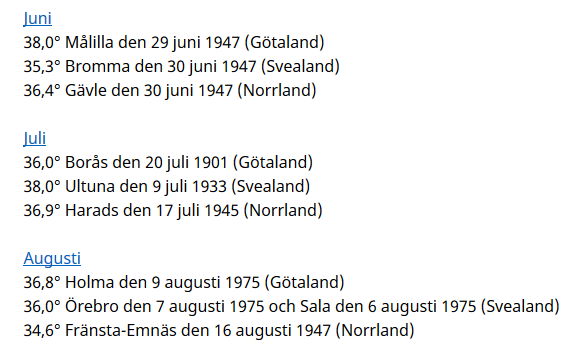
Sweden June July August high temperature records

Greta’s very first tweet back in June 2018 – which has since been deleted – was to post an article (in English of course) which warned that climate change will wipe out all of humanity unless we stop using fossil fuels over the next five years.

This is what Greta said in her tweet, dated June 21, 2018:

“A top climate scientist is warning that climate change will wipe out all of humanity unless we stop using fossil fuels over the next five years.”https://t.co/AOr2DDZORc— Greta Thunberg (@GretaThunberg).

For the first time in 33 million years, it seems, we are almost at a point where there is no ice at either pole:

The chance that there will be any permanent ice left in the Arctic after 2022 is essentially zero,[…] with 75 to 80 percent of permanent ice having melted already in the last 35 years’‘.

How did that turn out, Greta?

Greta’s obvious claptrap underscores the fact that the Arctic was never anywhere melting away. The earth has not returned to the temperatures of the Medieval Warm Period when Greenland was colonised – how can we be approaching temperatures not seen in 33 million years?

The spectacle of the legacy media using a young girl in order to panic the world into giving more power to the WEF is, to say the least, bizarre. Thousands of the world’s scientists (see here and here) have called climate alarmism a hoax.

However ludicrous as it may seem, we are expected to ignore the facts about geological history, Co2 and global climate, and to follow the lead of a young woman who, since the age of 15, has parroted arrant nonsense embedded in unending cliché, on the say-so of the likes of George Monbiot and Media Lens.

This same media not only continue to parrot Thunberg’s nonsense, but seemingly have absolutely no qualms about having callously exploitated and manipulated a child in order to further the goal of world government.

Investigative journalist and researcher, Whitney Webb summed-up what is behind the prevailing climate change orthodoxy and the media’s fetishization of Greta.

Webb highlighted the fact that the twin phenomena are intimately tied to corporate interests embodied in the UN’s climate change agenda:

“COP26 is about setting up the financial infrastructure for a completely new economic system based on CBDCs and the financialization of ‘natural capital’ and ‘human capital’ into new asset classes. It’s about complete economic domination of the planet, not about ‘saving’ it.”

Webb revealed the nefarious Malthusian underpinnings that drive the UNs climate change agenda and that legitimate environmental concerns have been usurped in pursuit of this agenda.

That the UNs position on climate change is motivated by political and ideological factors is outlined in The Club of Rome’s 1992 book, The First Global Revolution which says:

”In searching for a common enemy against whom we can unite, we came up with the idea that pollution, the threat of global warming, water shortages, famine and the like, would fit the bill. In their totality and their interactions these phenomena do constitute a common threat which must be confronted by everyone together. But in designating these dangers as the enemy, we fall into the trap, which we have already warned readers about, namely mistaking symptoms for causes. All these dangers are caused by human intervention in natural processes, and it is only through changed attitudes and behavior that they can be overcome. The real enemy then is humanity itself.”

Lost In New Imaginings

dreams about people from your past

Groups of young parents huddle in a hallway, making plans. Old men nap on couches, waiting for dessert. It’s the extended family in all its tangled, loving, exhausting glory.

This particular family is the one depicted in Barry Levinson’s 1990 film,  Avalon, based on the film directors own childhood in Baltimore. But it’s also one that could equally be played out in any post-war town or city in a smog drenched Keyensian Britain.

Battle-fatigued young men who fought for God and country were in no mood for the platitudes of politician’s who had sent many of their comrades to the battlefields where the stench of death still lingered. Hitler fascism, although defeated had, through the passing of time, left indelible scars on the faces of generations of young men ravaged by its consequences.

The fraternity among men who returned to Blighty from war in the hope that society back home could be transformed for the better, was a hope not lost on the ruling class. The establishment were to suffer the torment of a disillusioned nation tired of being used as cannon fodder for the interests of Whitehall pen-pushers.

‘No more war’ was the cry of the huddled, restless, masses. Churchill had underestimated the level of the nations discontent. The epithet ‘war hero’ would have to wait for the writings of historians as the war statesman was rejected at the polls by the very people who had put him into power seven months after Germany’s fascists invaded Poland.

By 1945 it was widely understood by the ruling class that the amelioration of the antagonistic relations between capital and labour was a necessary price to pay to stave off revolutionary levels of proletarian discontent. Churchill, considered by many to be an historical footnote by the working classes who fought a war ostensibly for the vanity of others, were now in a position to force the hand of their rulers.

The Red Army paid the heaviest price for fascisms defeat. Russian revolutionary sentiment still lingered in the air on the streets of London, Birmingham and Belfast. The British working class hadn’t forgotten the toll the war had on the Soviet people, nor had generations before them forgotten the gains of the bolshevik revolution. British prols were in no mood to genuflect at the feet of their ‘betters’.

Perhaps, somewhat ironically, it was the poetic realism of the film, Brief Encounter, that managed to unify a nation distraut by war. David Lean’s 1945 masterpiece about a middle-class woman’s imagined confession of a extramarital love affair, was an allegory for a society in a state of flux, hamstrung by conformity.

The key message of the film was that the ‘free time’ available to the films protaganists, Laura and Alec, that involved their chance encounters at Boots chemist, the Palladium cinema and at a railway station refreshment room, represented newly formed spaces in the public imagination that only an immediate post-war world borne out of servitude was capable of filling. Underlying the poetic sense of realism was a quest for balance and harmony in an otherwise fractured world.

In post-war Britain, nothing less than fair play was acceptable to the masses. Brits weren’t demanding the best cut steak, caviar or smoked salmon but neither were they content with the breadcrumbs from their rulers banquetting table. People needed and demanded homes. Not dilapidated, damp-ridden, rat infested hovels, but ‘homes fit for heroes’. And they got them, three hundred thousand of them, year on year.

But widespread access to post-war housing and the consumerism that followed in its wake, marked the beginning of a societal shift. Family bonds, once close and extended, began to split apart as the desire for more convenience, privacy and mobility represented a shrinking of time and space within the newly booming capitalism.

The time-piece which was popularized at least a generation before, was now a means by which the ruling class would attempt to remind British workers that showing up at the factory gates on time was the necessary price to be paid in order for them to enjoy the exuberent excesses experienced by their counterparts across the Atlantic.

”You’ve never had it so good” was the cry of the Westminster hordes. The young had time on their hands and money with which to spend it. Full employment and ‘jobs for life’ weren’t merely the mantras of dinner partying socialists, but were the realities for millions of working class people. It wouldn’t be long before the public’s appetite for convenience and increasing levels of consumption that money and time implied, would feed into the realm of leisure.

The young bedraggled by war became increasingly hungry for entertainment. They found it in the restaurants, football terraces, shopping malls and movie theatres. American consumerism in all of it’s unbridled excesses was depicted in the latter and Brits demanded some of the action.

Food, entertainment and their corollary, leisure time, perfectly encapsulated the rapid pace of change that was beginning to take hold amid the rubble of bombed neighbourhoods. These shifts in society gave way to new antagonisms across dinner tables the length and breadth of the country as family loyalties began to be questioned.

The violation of well-established protocols was not only seen as a sign of disrespect but more broadly as a metaphor for the beginning of the collapse of the entire family structure and the speeding-up of the pace of life.

As the 1960s beckoned, the extended family began to play an ever diminishing role. In his film, Avalon, Levinson depicts the total destruction of the extended family. What we witness is a young father and mother and their son and daughter eating turkey off trays in front of the television.

In the final scene, the main character is living alone in a nursing home, wondering what happened. “In the end, you spend everything you’ve ever saved, sell everything you’ve ever owned, just to exist in a place like this.”

The scene Levinson depicts is reminscent of the famous parable about materialism and contrasting values in which an American investment banker sits at the pier of a small coastal Mexican village. After meeting a local fisherman, the banker begins to reflect on the meaning of his life, and starts to question notions of success and capitalist values to which he had become accustomed. The American begins to understand that a simpler, slow paced life experienced by the fisherman was far more enriching and fullfilling than his own urban ‘rat race’ life as a banker.

The author, Milan Kundera, said:

”To sit with a dog on a hillside on a glorious afternoon is to be back in Eden, where doing nothing was not boring – it was peace.”

Kundera’s evocation of being at peace with life is like a dream in time and space. It’s akin to the days where people told family stories, of the stable, centralized, family and the dense cluster of many siblings and extended kin. It’s like the phantasmagorical experience when watching a colourized film clip of an early twentieth century Paris street scene and a sense of stepping into that world.

The serenity of time and place thus imbued is intensified by the imagination, prolonged by a multitude of echoes. But imagination is also an expression of pain for that which has been lost and can never be recaptured. Today, such visions of historical memory are routinely mocked like a rust that corrodes all it touches. The truth is, the world of reality has its limits; the world of imagination is boundless. It will take you everywhere.

.

Caught In the System’s Death Grip

By Daniel Margrain

For many people, buying a property is the biggest long-term investment they will make in their lives. The problem, however, is that the systemic frailities of the current financial system means that the ‘nest egg’ is not all it seems on the surface.

When banks lend money to people for a ‘mortgage’ – literally translated as ‘death grip’ – the increasing circulation of debt-fueled cash results in greater demand for property when supply is low. This has a knock-on effect in terms of rising prices.

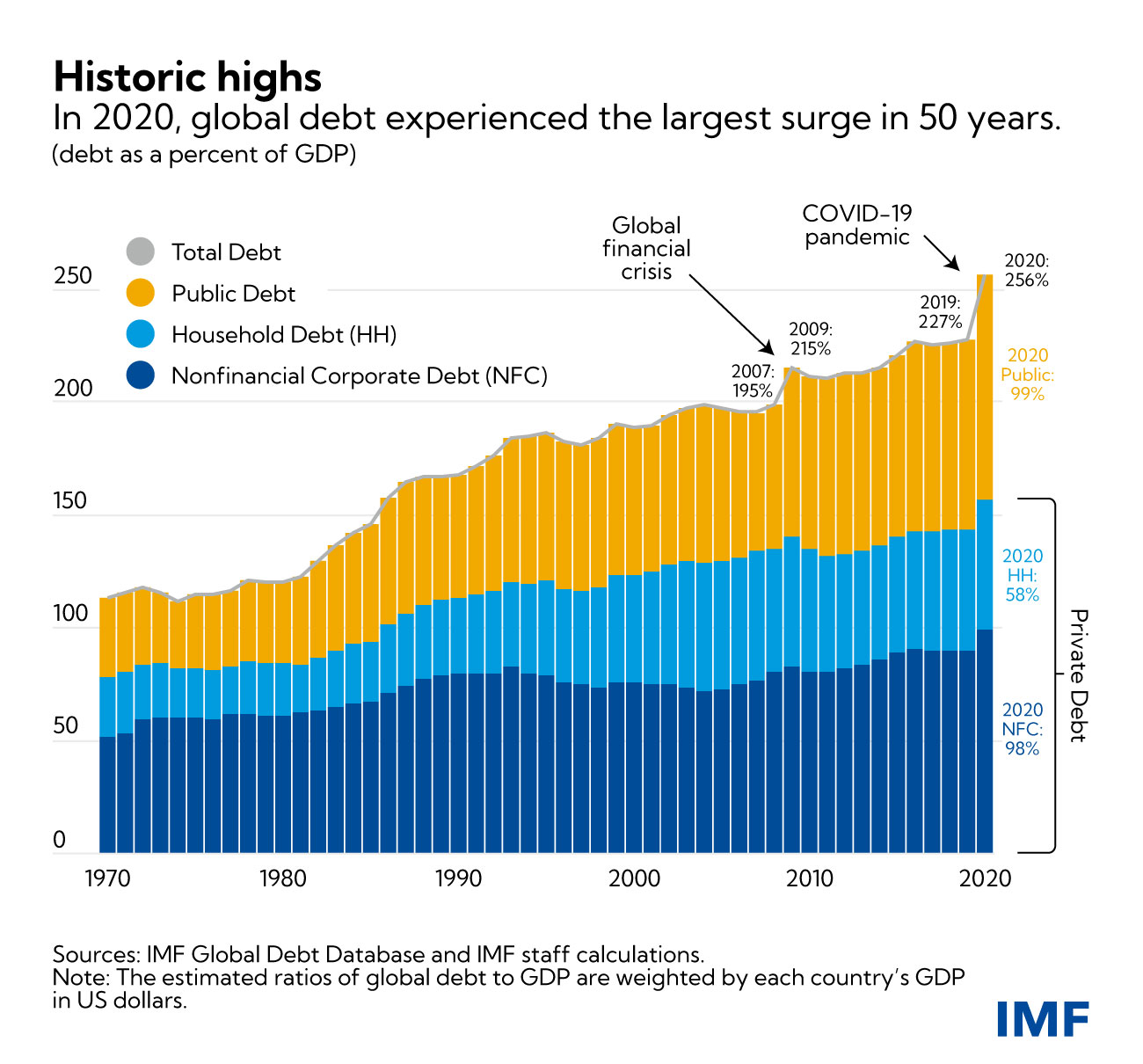
For the bankers, this process amounts to an apparent never ending cycle of growth. But for society in general this means an increasing mortgage debt burden which has culminated in global record levels of overall debt. According to the latest update of the IMF’s Global Debt Database, global debt rose by 28 percentage points to 256 percent of GDP.

Private debt from non-financial corporations and households also reached new highs. Increasing demand has exacerbated expanding household debt levels which, in the case of the UK, for example, is already tipping 65 thousand pounds per household.

The accumulation of public debt now accounts for almost 40 percent of total global debt, the highest share since the mid-1960s. Since 2007, this accumulation of public debt is largely attributable to the current global financial crisis.

The political response to the Covid pandemic and the Russia-Ukraine conflict has exacerbated a crisis that largely resulted from the fact that people continue to buy houses and goods with money they don’t have. In the UK, we can see how this insane system has played out in terms of the relationship between house price and stock market inflation and what we have been told has been a growth in living standards.

The price of nearly all assets – shares, bonds, property, land etc – have been on an upward trajectory for the best part of fifteen years since the last crash. And yet the economy is no better then it was in 2009. “Green shoots” have been talked about ever since but never materialized.

This is because stock markets, and particularly house prices, have no bearing on reality. This false reality is sustained because bankers motivated by short-term gain, have persuaded people to buy assets. If, for instance, a large swath of people invest their money into the same company by buying shares, then the value of those shares will increase and so will their return on their initial investment.

The current record level of debt is predicated on historically low levels of interest. The problem is as interest rates are now beginning to climb, it is putting more people into debt which has a negative knock on effect in terms of housing demand.

This has a downward pressure on prices. For those people who took out variable mortgages at the peak of the bubble, any increase in mortgage rates mean they are likely to fall into a negative equity. The FT reports: ”A pandemic-induced property boom peaked at the end of 2021 but the sector is now braced for the broadest slowdown since the financial crash.” Under these circumstances buying a house becomes less of an attractive option.

One might think that putting savings into a bank would be a more secure alternative than taking on a potentially precarious mortgage debt. But this isn’t necessarily the case. The Financial Services Compensation Scheme (FSCS) is supposedly intended to cover depositors for a limited amount invested per bank in the event of any collapse.

But under such circumstances, depositors’ would likely panic and demand all of their cash back at the same time. Inevitably, there would be shortfall of available cash since the banks wouldn’t be able to release it on mass given that it would almost certainly be tied up in high risk off shore investments.

Moreover, governments’ are not in a position to underwrite each individual depositor. Since the 2008 crisis, the official establishment line has been that governments’ would not allow banks to collapse because as institutions they were too big to fail.

The problem is that the reach of these banks is greater now than previously because other smaller banks that were teetering on the edge have been swallowed up by the larger ones. So the banks who in 2008 were regarded as being too big to fail are even bigger in 2023.

In the event on a run on banks, the priority of government is not to protect depositors, but rather, to protect the bankers from their own incompetence and proflicacy One of the main functions of the banking racket is to ensure the ‘socialization’ of losses and the ‘privatization’ of profits. So for them, it’s ‘win-win’ situation.

The close knit ‘revolving door’ culture that exists between retired parliamentarians’ taking their places on the boards of financial companies’ and the fact that irresponsible actions of bankers continue to be underwritten by the tax payer, means there is no incentive for either parliament or banks to change their destructive ways.

With property prices now in decline, against a backdrop of low growth, rising inflation and the Russia-Ukraine conflict coming on the back of the international response to the Covid crisis, it’s not unreasonable to assume that the property market will take a huge hit sooner rather than later.

The last time the real estate bubble burst, the global economy plunged into the deepest downturn since the Great Depression. The public, therefore, might be advised to increase their liquidity by ensuring they have access to physical money.

But there is another potential problem. The move towards Central Bank Digital Currencies implies the phasing-out of cash which will almost certainly mean increasing demand for precious metals like gold and silver.

As society and economy begins to ‘reset’ on a new footing that reflects a move away from the current Fiat system, a concomitant new paradigm with regards to the way human beings attribute value to their lives, is also likely to emerge in the post-interregnum new world order.

Hell of a state: What the tragic story of Don Lane tells us about Tory Britain

By Daniel Margrain

Don Lane

Don Lane, who suffered from diabetes, earned his living by delivering parcels to peoples’s homes and businesses throughout the country. Although Mr Lane was paid a salary by the giant courier company he worked for, according to the law, he was “self-employed”.

The amount he was paid depended on how many parcels he delivered. Mr Lane received no holiday or sick pay and was under constant pressure to meet targets. Drivers for the company get fined by them for rounds they miss. Mr Lane was recently fined for attending a medical appointment to treat his diabetes where tragically he collapsed and died.

The scandal that underlies the story is one which the bosses and shareholders of giant multinational companies like the one Don Lane worked “self-employed” for, have seen their dividends and pay go through the roof, while workers at the bottom, have experienced a real terms drop in their income over many years. The ideology that drives this “gushing up” of wealth towards the top, is called neoliberalism.

Before its onset four decades ago, the UK was a much more equal society than it is at present. The available data shows that the share of income going to the top 10 per cent of the population fell over the 40 years to 1979, from 34.6 per cent in 1938 to 21 per cent, while the share going to the bottom 10 per cent rose slightly.

As measured by the Gini Coefficient (see below), the redistribution of wealth from the poorest to the richest, rose sharply under the Thatcher government in 1979. The trend continued, albeit less drastically, under successive Tory and Labour governments where it reached a peak in 2009-10.

Figures show that GDP, adjusted for inflation, has grown over the last 60 years from £432bn in 1955 to £1,864bn in 2016. This increase in wealth, however, has become increasingly concentrated in fewer hands.

Inequality

SourceIFS 2016

Impact of inequality

report by Oxfam highlights the significant role neoliberalism plays in perpetuating inequality and suggests that the societies most affected are more prone to conflict or instability. The report also points out that extremes of inequality are bad for economic growth, as well as being related to a range of health and social problems including mental illness and violent crime.

Moreover, Richard Wilkinson and Kate Pickett, authors of the book, The Spirit Level. argue that other impacts of inequality include drug addiction, obesity, loss of community life, imprisonment, unequal opportunities and poorer well-being for children.

Left Foot Forward has cited studies that illustrate the close correlation between inequality and unhappiness. The tendency to equate outward wealth with inner worth means that inequality colours our social perceptions. It invokes feelings of superiority and inferiority, dominance and subordination – which affect the way we relate to, and treat, each other.

But rather than introducing socioeconomic policies that help reduce inequality, the Conservative government under Theresa May, has deliberately and consciously continued with the failed high borrowing-low investment/high debt economic neoliberal model that gives rise to it. Under the guise of austerity, the government have instead turned on workers, the sick and the disabled. The result has been increasing rates of depression, anxiety and suicides.

Fragmented

The existence of fragmented and atomised communities outside the confines of the workplace, the reduction in organised labour within it (illustrated by the long-term decline in trade union membership) and the lack of any safety net, means that ordinary people are increasingly vulnerable to the vagaries of “market forces”.

The ideology that underpins the neoliberal assault is the pseudo-science concept known as biological determinism, the legitimacy of which rests on the assertion that the social order is a consequence of unchanging human biology, as opposed to the result of inherited economic privilege or luck.

Thus, biological determinism reinforces the notion that inequality, injustice and the existence of entrenched hierarchical social structures of government, media and commerce are “natural”.

But it also highlights the artificial limits that a system driven by profit imposes. Any rejection of biological determinism and the rigged market system that reinforces it, is regarded by its promoters as being the fault of the individual, not the social institutions or the way society is structured.

Thus, according to evolutionary psychologists, sociobiologists and those within the elite political and media establishment, the solution to overcoming inequality and injustice is not to challenge existing social structures upon which “reality” is based, but rather to alter the chemical composition of the human brain to accommodate it to this reality.

In extreme circumstances it has been used to justify the elimination of individuals altogether who challenge the prevailing orthodoxy and/or whose values are perceived to be a “drain on the taxpayer”.

Social Darwinism

Years before moving towards explicit racial genocide, the Nazis developed the notion of ‘useless mouths’ or ‘life unworthy of life’ to justify its killing of ‘undesirables’ or ‘low hanging fruit’. These ideas are a variant of nineteenth century ‘Social Darwinism’ and eugenicist theories.

The said theories adapted Darwin’s notion of the survival of the fittest to describe relationships within society or between nations and races as a perpetual evolutionary struggle in which the supposedly weaker or defective elements were weeded out by the strongest and the ‘fittest’ by natural selection.

Intellectual challenges to neoliberalism and evolutionary psychology help undermine the notion that rigid social stratification, inequality and injustice used to justify them, are inevitable. Indeed, prominent economists such as Joseph Stiglitz, Paul Krugman, Dani Rodrik and Jeffrey Sachs have for a long time been raising their voices against the neoliberal experiment.

What is self-evidently clear is that the current rigged economic system in which power is increasingly concentrated at the top, is not sustainable. The only thing preventing our ability to tackle extreme inequality is political will.

At the next election voters will be faced with a clear choice – either to maintain the status quo by returning the Conservatives to power or, alternatively, to engender a paradigm shift by electing a Labour government. If future Don Lane’s are to be avoided, then we have no alternative other than to ensure a Corbyn victory.

Please make a small donation

If you’ve enjoyed reading this or another posting, please consider making a donation, no matter how small. I don’t make any money from my work, and I’m not funded. You can help continue my research and write independently.… Thanks!


Donate Button with Credit Cards

Theresa May’s Mansion House speeches: Is Putin an agent of the British state?

By Daniel Margrain

In Alfred Hitchcock’s classic 1959 film, North By Northwest, Cary Grant plays the part of an advertising executive who inadvertently gets caught up in a web of espionage after he is mistaken for “George Kaplan”, a fictional persona created by a government agency in order to thwart the nefarious activities of a spy, Phillip Vandamm (James Mason).

After reading the transcript of Theresa May’s recent Mansion House speech in which she alluded to the alleged nefarious activities of Vladimir Putin, one might reasonably conclude that real life imitates art and that the Russian leader is a creation of Britain’s secret services.

Hard power

Resplendent with cliches and insubstantial rhetorical flourishes low on substance, May’s projection of hard power harked back to the days of the British Empire in which, as George Galloway famously remarked, “the sun never set because God would never trust the English in the dark”.

May’s vision of a post-Brexit Britain in a globalized world, is marked by ‘humanitarian interventionism’ predicated on military pre-emption, or as one US administration official put it, “pre-emptive retaliation”. Such a foreign policy strategy is one in which the ‘responsibility to protect’ is informed by a notion of imperialist exceptionalism couched in the language of economic liberalism and free markets. This is regarded by the political establishment as the best way to counter (largely imaginary) military threats.

Last years Mansion House speech

Thus, in the tradition of Kipling, May emphasized that the historic role of Britain was to nurture ‘less enlightened’ societies by invoking in them the virtues of neoliberal ‘trickle-down’ economics. This sentiment echoes the substantive part of the Mansion House speech May made this time last year:

“Over our long history, this country has set the template for others to follow”, said May.

The PM continued:

“We demonstrate to the world that we can be the strongest global advocate for free markets and free trade.”

But as income inequality has continued to increase inexorably since last years Mansion House speech, the PM has been left to ponder as to whether ‘trickle-down’ is not really a case of ‘gushing-up’. Regardless, there is scant evidence she intends to do anything about it, preferring instead to regurgitate the requisite caveats:

“There have been downsides to globalisation in recent years, and that – in our zeal and enthusiasm to promote this agenda as the answer to all our ills – we have on occasion overlooked the impact on those closer to home who see these forces in a different light”, said the PM.

May added:

“If we take a step back and look at the world around us, one of the most important drivers becomes clear – the forces of liberalism and globalisation which have held sway in Britain, America and across the Western world for years have left too many people behind.”

But rather than acknowledge that neoliberal ideology is the catalyst for growing inequality, May persists with the illusion that the rules-based international capitalist system on which it is based, represents the solution to the problem:

“Liberalism and globalisation…underpin the rules-based international system that is key to global prosperity and security and which I am clear we must protect and seek to strengthen,” claimed May.

White man’s burden

The alleged merits of a 19th century rules-based liberal system rooted in the Kipling-esque “white man’s burden” notion of modern international relations, was a topic May returned to during her November 13, 2017 speech:

“So as we reach out into the world and write this new chapter in our national history, the task of a global Britain is clear – to defend the rules based international order against irresponsible states that seek to erode it”, said May.

Clearly, the PM had one country in mind as one of the more significant of the worlds “irresponsible states” who she regards as potentially undermining neoliberalism’s global reach:

“The comprehensive new economic partnership we seek will underpin our shared commitment to open economies and free societies in the face of those who seek to undermine them. Chief among those today, of course, is Russia”, said May.

Ratcheting-up

Ratcheting-up Russia’s imaginary threat to Western civilization, May remarked:

“Russia’s illegal annexation of Crimea was the first time since the Second World War that one sovereign nation has forcibly taken territory from another in Europe.”

This simplistic analysis conveniently overlooks the subversive actions of the US in the Ukraine and broader geopolitical and strategic contextual objectives of the Western-led alliance which meant that Putin was left with little option other than to incorporate Crimea in order to attempt to fend off an encroaching NATO.

Also, by limiting her critique to Europe, May ignored the attempts by Britain, France, the US, Israel and Saudi Arabia among others, to destabilize Syria in addition to the US-led coalitions decades-long illegal wars of aggression against the sovereign nations of Iraq and Libya.

May stepped-up the anti-Russian line by reproducing unsubstantiated soundbites against the country. The PM falsely inferred that Russia’s supposed state-run media propaganda is unique to a country whose official enemies constantly use the rhetoric of war against it.

May’s anti-Russian tirade during the latter part of her speech culminated in what were clear threats against Putin – an arrogance akin to that of a 19th century imperial overseer. Seemingly eager to continue justifying the reinforcing of the British industrial-military complex, May added to the fear mongering rhetoric:

“The UK will do what is necessary to protect ourselves, and work with our allies to do likewise”, she said.

That it’s Britain and it’s NATO allies, not Russia, that represents the greatest potential threat to world peace, is unmentionable in mass corporate media parlance.

Weaponising information

Ironically, the Russian state broadcaster, RT, who Theresa May in her speech alluded seeks to “weaponise information…in an attempt to sow discord in the West and undermine our institutions”, revealed the collusion between the Western powers and ISIS. This was a fact that the BBC only began to belatedly acknowledge many years later.

So, as Patrick Henningsen astutely pointed out with an air of sarcasm, using May’s logic, the much maligned Vladimir Putin – who the PM effectively accused of ‘weaponising information’ – is presumably meddling in the BBC?

Another possibility is that he is a double agent, who like the Cary Grant character in North By Northwest, is unknowingly working for the British government. The third, and most likely possibility, is that Theresa May is a hypocrite and liar.

If you’ve enjoyed reading this or another posting, please consider making a donation, no matter how small. I don’t make any money from my work, and I’m not funded. You can help continue my research and write independently.… Thanks!


Donate Button with Credit Cards

Why Corbyn Will Win the Next Election

By Daniel Margrain


Jeremy Corbyn at the thousands-strong Leeds rally on Saturday

Jeremy Corbyn at a thousands-strong Leeds rally (Pic: Neil Terry)

During the Labour leadership nomination process last year – much to the consternation of Harriet Harman – forty-eight opposition MPs who genuinely desire an alternative to the austerity-driven policies of the Tories, did the honourable thing by voting against the governments welfare reform legislation. One of the other numerous prominent Labour MPs who refused to vote against the Tories was Owen Smith. Needless to say, Jeremy Corbyn wasn’t one of them.

As I alluded to at the time, the kind of concession to the Tories made by Harman and Smith was predicated on the belief that Labour has to move to the right in order to be electable.

Given the Liberal Democrat’s close ideological proximity to the Tories during their power sharing term, and their subsequent virtual demise following the last election, the strategic move by Harman and the party hierarchy was clearly a calculable risk.

Harman’s assumption appeared to have been that there was no longer any more political and electoral traction to be gained by appealing to a diminishing band of traditional left wing voters. However, subsequent events proved that she was wrong and that these, as well as other voters, many of whom are young had, prior to Corbyn, been largely abandoned by the political class.

If it is to be accepted that the class structure of British society remains largely intact and that the real life experiences of the vast majority in the country were made worse under the austerity-driven policies of the Tories, then rationally the notion would be that the voices of those adversely affected by these policies would eventually at some point make themselves heard.

And so it came to pass. The rise of Corbyn gave voice to the voiceless and hope that things could change for the better by transforming apathy into a mobilizing political force. Corbyn went on to oversee a growth in the party’s membership to well over half a million – making it the biggest left-of-centre party in Europe, while Harman, Smith and the rest of the New Labour ideologues are fast becoming a footnote in history.

Outside the relatively small band of Labour party dissenters, the opposition to welfare cuts and austerity in England have come from the SNP, Plaid and the Greens. Tony Blair’s election victory in 1997 predicated on a left-wing mandate, the dominance of the SNP in Scotland and the popularity of both Jeremy Corbyn and Nicola Sturgeon, all put the lie to many of the claims in the corporate media that you have to be right wing to win elections. The official announcement this morning (September 24) that Jeremy Corbyn had convincingly beaten his right-wing rival, Owen Smith with a second mandate of 61.8 per cent is likely to bring this myth into even more of a sharper focus.

The reality is the people of England are inherently no more right wing than the people of Scotland. But the mainstream media commentators who marginalize, ridicule and smear those with left wing views, most certainly are. So it’s not a question of their being no appetite for left-wing views among the public, rather, the issue is one in which an inherently right-wing mainstream media attempt to manufacture the public’s consent through a process of propaganda and censorship by omission. As self-publicist, John McTernan illustrated on last Wednesday’s (September 21) Channel 4 News, rather than bringing political power to account, the media’s role is that of its gatekeeper.

As has been well documented, the orchestrated and systematic media vilification of Corbyn has been virtually incessant since the moment he was elected as leader. Moreover, the decision to challenge Jeremy Corbyn’s leadership was planned by a core group in the Parliamentary Labour Party (PLP) almost as soon as he won his landslide victory in September last year.

Corbyn’s second decisive victory within a year is unlikely to deter his detractors in their quest to continue to smear and undermine his leadership at every opportunity. Those who pre-planned and coordinated the coup and the subsequent war of attrition against him were so confident in succeeding that they briefed the Daily Telegraph about their plot to overthrow the Labour leader.

As journalist Steve Topple has shown, the attempt to depose Corbyn continues to be orchestrated behind the scenes by among others, public relations company Portland Communications whose Strategic Counsel includes former Blair spin-doctor, Alistair Campbell. The war of attrition also involves the McCarthyite purging of Corbyn supporters, a tradition of disdain for the grass roots membership which has a long history within the hierarchy of the party.

As Corbyn’s vindication by the memberships overwhelming support of him shows, the ‘race to the bottom’ strategy of his opponents serves nobody other than the narrow careerist motivations of an out of touch elite who have their snouts embedded in the trough and don’t want to give up their privileges without a fight. And that, as far the likes of Harman, Smith and the rest of the New Labour establishment are concerned, is clearly the crux of the matter.

A sincere and incorruptible politician like Corbyn represents a potential threat to these privileges and the gravy train that sustains them. This explains why the New Labour bubble would prefer a Tory government over a Corbyn government and thus are happy to continue with the ‘divided party at war with one another’ meme. This was what the challenge to Corbyn’s authority within the right-wing of the party is really all about. It’s not that Corbyn hasn’t a realistic chance of winning the next General Election, rather, it’s more a case that the establishment will do everything in their power to ensure that he doesn’t.

In that sense, the political battle lines have been drawn, not between the Tories, MSM and the opposition, but between the Tories, MSM, opposition and the rest of us. In the weeks and months prior to the election of Corbyn, I hadn’t remembered a time when the disconnect between the political establishment and ordinary people that Corbyn’s popularity represents had been greater. The former argue that he is unelectable while the latter put the lie to that myth.

The notion that Corbyn is unelectable is a joke. In his constituency of Islington North, Corbyn inherited a majority of 4,456, which is now 21,194. He’s one of the few Labour MPs whose vote increased between 2005 and 2010, when he added 5,685 to his majority. It’s true that Corbyn is currently well behind in the polls and it’s going to be tough – in my view, impossible – to unite the right-wing of the party that appears unwilling to work alongside him.

But it must be remembered that pre-coup, Labour led the Tories in three polls in a row over 41 days. Also Corbyn’s record at elections is exemplary. London and Bristol now have Labour mayors, rolling back years of Tory dominance, while Labour’s majorities in by-elections have uniformly increased. Moreover, as George Galloway pointed out, last Thursday Labour won three local government by-elections – two off the Tories and one off the SNP. In May’s local elections, the party overtook the Tories in the share of the vote, coming from seven points behind at the last election.

Meanwhile, the party which haemorrhaged 4.9 million votes between 1997 and 2010 under the ‘triangulated’ leadership of a man who lobbies on behalf of some of the world’s most brutal and corrupt dictators, claimed in a moment of Orwellian irony, that Corbyn is a disaster for the party. This can only be beneficial for the current Labour leader. Finally, Corbyn’s Tory counterpart, Theresa May’s unpopular campaign focusing on grammar schools and the uncertain situation around Brexit is also likely to play into Corbyn’s hands.

So the implication the public don’t necessarily favour Corbyn’s politics is wrong. On the contrary, his position on issues like the NHS and the re-nationalization of the railways are universally popular. Rather it’s more the case that the establishment know Corbyn is incorruptible and therefore feel they are unable to win him over on their terms. Consequently, they realize that the longer Corbyn remains at the helm the more likely it will be that those sympathetic to him and his policies will be elected into positions of power.

It’s unlikely that the Tories will call a snap election given that the proposed boundary changes will benefit them electorally at a later date. This means that Corbyn will potentially have time to initiate the changes required in order to unite the party or, more likely, rid it of the plotters before the likely election in 2020. Four years is a lifetime in political terms and I’m convinced that if Corbyn and those close to him can see off the plotters, he can win.


September 12, 2015: the day Blairism died

By Daniel Margrain

The momentous nature of Jeremy Corbyn’s landslide victory  one year ago should not be underestimated. It has to go down as one of the most sensational and politically earth shattering events in modern British political history – the impacts of which sent tremors throughout the entire establishment. After the announcement was made that Corbyn had won, it was obvious that the smiles, handshakes and applause of the vast majority of the calculating and opportunistic labour elite were as a fake as Blair’s claim that Saddam was about to attack Britain within 45 minutes.

A pointer to the overwhelming inspiration underlying Corbynism was the fact that no less than 160,000 volunteers who seemingly emerged out of nowhere, were recruited to the cause. The grass roots support that Corbyn engendered – by far the biggest of its kind in history – was almost certainly the catalyst that propelled him to victory. Although the activists were mainly young people, they were by no means exclusively so. In fact the demographic was wide ranging.

Corbyn’s straight talking, lucidity, and unambiguous commitment to a programme of anti-austerity brought many older activists who had felt betrayed by the direction the party had gone under Blair, back into the fold. To put Corbyn’s victory into context, he secured a higher percentage of votes than Blair in 1994  Even more significantly, the 554,272 votes he achieved was more than double Blair’s, and no less than 76 per cent of them actually voted, a higher percentage turnout than Blair received.

This suggests that ‘Corbynmania’ is no ‘flash in the pan’. On the contrary, it represents a new hope for people that society can make a great leap forward from the decades of Blairism where nothing happened, to weeks where decades happen. Neoliberal ideology and the cementing of the Red-Tory axis, which for many was perceived to have been fixed and immutable has, with the rise of Corbynism ,the potential to be swept into the dustbin of history. All that is solid really can melt into air.

When Corbyn was first nominated, he was seen by his opponents – both inside and outside the party – as a joke candidate. But an indication of how seriously he has been taken since he became leader is the extent to which the mainstream corporate media and Tory establishment continue to unanimously attack him.

Tories such as Gove, Fallon, Cameron, Osborne and Patel who thought an opposition party lead by Corbyn could only enhance their political careers, were the ones who subsequently read out an unsubstantiated claim contained within what was clearly a widely circulated Whitehall-issued memo which asserted Corbyn was a threat to national security. Gove then went on to misquote the Labour leader by implying he was economically incompetent and an apologist for Osama bin Laden.

The smearing wasn’t restricted to the media and Tories. On the labour side, around twelve MPs ‘lent’ Corbyn their support ostensibly to widen the contest. Blairites such as Margaret Beckett who nominated Corbyn clearly as a tokenistic gesture, described herself as a moron after Corbyn won. His victory had therefore rebounded back in her face.

No sooner had Corbyn’s victory based on clear and unambiguous principles been announced, then threats to resign by ‘modernizing’ frontbenchers followed. According to the Daily Mail at the time of Corbyn’s election victory, among the Labour figures refusing to serve in his team were high profile prominent Blairites Chris Leslie, Tristram Hunt, Emma Reynolds, Vernon Coaker, Michael Dugher, Shabana Mahmood, Mary Creagh and Lucy Powell. I’m sure the Tories will welcome these unscrupulous careerists with open arms.

The resignations were undertaken on the basis that Corbyn’s programme was too ‘extreme’. Is a refusal to be a part of the Labour friend of ethnic cleansing (sorry, Israel) rump within the party ‘extreme’? Is supporting the nationalization of the railways and utilities ‘extreme’?

Is it also ‘extreme’ to oppose nuclear weapons, war, the growing wealth gap and supporting the need for a massive affordable house building programme that benefits the mass of the population? How can it be that as far as the PLP are concerned, all these things are regarded as ‘extreme’, yet the bailing-out of bankers that benefit nobody other than bankers, is not?

It’s precisely the kinds of principles Corbyn espouses that has resulted in the regurgitation of the official/media meme which criticises him for voting against his party 500 times. This is represented as disloyalty. The notion that he might have voted against the Tories, while most of his Blairite colleagues, many of whom are war criminals, voted with them, is quietly forgotten.

The notion that the Blairites within the PLP will willingly work alongside Corbyn after having spent a large part of the past year conspiring against him – despite the elected leader’s continued attempts at reconciliation – is, I would suggest, delusional. If he wins the election on September 24, as expected, it’s almost certain that the war of attrition against him will continue. Any reluctance to act decisively against the destabilizing elements is likely to be seized upon resulting in a possible split within the party.

Corbyn might be banking on the possibility that a newly elected pro-Corbyn NEC will reinvigorate the party further from the grass roots up leading to a dissipation of the Blairites by stealth, akin to the melting of ice enveloped by steam. As the parties grass roots expand, the reliance on corporate funding and large individual donations lessens. This will give more confidence for Corbyn and his allies to expose, as John Moon put it“the ongoing immoral motivations and machinations of their elected Blairite MPs”, thus initiating the possibility of deselection at the grass-roots level.

A year ago, I heard Ken Livingston on LBC say that under Corbyn the party will unify with little signs of any attempts to undermine him. In terms of the latter, he has been proven wrong. We await the outcome of the former. My fear is that in the absence of any purging of the Blairite clique, the gap between the ideology represented by the elite within the hierarchy of the party and the multitude of its members is so vast, as to be irreconcilable. I strongly suspect that something will have to give as the party moves forward, but we will see.

The idea that a highly principled leader of a party who espouses peace and reconciliation can reconcile two diametrically opposing forces, seems to me to be a bridge too far. But equally, the notion that these irreconcilable forces are able to keep Blairism teetering on the edge of the precipice by its fingernails indefinitely, is as misguided as the insistence that a free-falling object is able to resist the gravitational pull of the earth.

As I type this, I’m watching Corbyn being interviewed by the BBC in relation to the proposed boundary changes against a backdrop in which fellow comrades are seen uniting behind those protesting against the police brutality at Orgreave. A year ago a newly elected Corbyn was protesting at a rally about the terrible treatment of refugees created by Cameron and Blair’s wars. Could, you dear reader, imagine Owen Smith or any of Corbyn’s predecessors post-Michael Foot doing that?


Why Owen Smith is a Red-Tory

By Daniel Margrain

Last week a prominent independent journalist claimed on Twitter that my assertion Owen Smith was effectively a Tory was “intellectually lazy”. Coincidentally, a few days later on Thursday’s (September 8) edition of BBC’s Question Time during the Labour party leadership debate between challenger Owen Smith and incumbent Jeremy Corbyn, a studio audience member and Corbyn supporter accused Smith of “being in the wrong party”.

Smith responded angrily to this suggestion by denying this was the case and asserted that the claim amounted to a term of abuse. Smith’s view was supported the next day (September 9) on Twitter by Smith supporter, John McTernan who said that such a suggestion was “ludicrous”. Of course, nobody is claiming that Smith, in the literal sense, is a Tory, but his voting record in the House of Commons and his commercial activities outside it, would indicate that he might as well be.

So let’s take a look at his record. Since at least July, the public relations professional, Smith, has pitched himself as a ‘soft-left’ anti-austerity alternative to Corbyn. This implies that Smith is first and foremost concerned with image and branding as opposed to adopting a principled political and ideological position.

The ‘soft-left’ Smith had previously given interviews supporting PFI and, as chief lobbyist for the U.S multinational Pfizer, he actively pushed for the privatization of NHS services. Commenting on a Pfizer funded ‘focus group’ study as part of a press release, Smith referenced and promoted the notion that the precondition for greater availability of healthcare services was the ability of the public to be able to pay for them. This is one of the significant passages from a section of the study that Smith was keen to promote:

“The focus groups… explored areas of choice that do not yet exist in the UK – most specifically the use of direct payments and the ability to choose to go directly to a specialist without first having to see the GP.”

In other words, Smith favours direct payments from the public to doctors as a replacement for current NHS services. This policy strategy is consistent with the 1988 Tory ‘self-funding’ privatization blueprint for the NHS drawn up by Oliver Letwin and John Redwood. In the document ‘Britain’s Biggest Enterprise: ideas for radical reform of the NHS’, Letwin and Redwood suggest that the aim of charging is to “replace comprehensive universal tax funding for the NHS.”

Smith’s conflation of greater choice with an ability to pay, represents one more stage in the execution of Letwin and Redwood’s plans. The implementation of these plans were accelerated by Blair and Brown as documented by Leys and Player in their book The Plot Against the NHS. Smith intends to continue where Brown and Blair – then Lansley and now Hunt – left off as part of the final stages of the wholesale Letwin-Redwood privatization blueprint of which the 2012 Health & Social Care Act  is a major component part.

Since the 2015 general election, the Tory government have explicitly admitted that the NHS should be modelled on US-style “accountable or integrated healthcare” which is where Smith’s connections to Pfizer come in. In addition to his Policy and Government Relations role for the giant US corporation, Smith was also directly involved in Pfizer’s funding of Blairite right-wing entryist group Progress. Pfizer gave Progress £52,287 while the latter has actively pursued the agenda of PFI and the privatisation of NHS services.

So while Smith’s image is largely predicated on his attempt to convince the Labour membership that in policy terms he publicly supports Corbyn’s position that the NHS should remain a universally free at the point of delivery service, in reality nothing could be further from the truth.

Smith also supported Blair’s city academies that have continued under the Tories as well as assiduously courting the arms industry of which his support of Trident is a reflection. Arguably, most important of all, is that Smith effectively lined up with the Tories, alongside another 183 Labour MPs in July last year by refusing to vote against the Conservative governments regressive and reactionary policy of welfare cuts to some of the most vulnerable people in society.

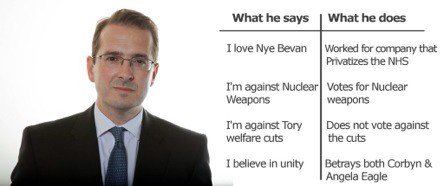
In an Orwellian rejection of socialist values, Blairite Iraq war apologist and establishment gatekeeper, John Rentoul, affirmed his support for the policies of Owen Smith on Twitter:

As the graphic above shows, and as Craig Murray correctly posits:

“There is no evidence whatsoever that Smith is a left winger. There is every evidence that he is another New Labour unprincipled and immoral careerist, adopting a left wing pose that he thinks will win him votes.”

The graphic below highlights the hypocrisy of Smith and, by extension, his total contempt for ordinary Labour party members.


Smith’s acquiescence to corporate power is indicative of a wider democratic deficit within the liberal democracies of the West in an era of globalization more generally. But his close relationship to the PLP and the Tory-Labour establishment consensus that they represent, reflects a relatively recent historical pattern in which governments of both the left and the right have prioritized the interests associated with private capital over and above that of labour.

Thus the first serious attacks on the welfare state in Britain came not in 2008, or even with the election of Margaret Thatcher in 1979, but several years previously, with that of a Labour government in 1974. Contrary to popular belief, dismantling the welfare state was not a key priority for Thatcher following her election in 1979. It was not until her third term of office in 1987 that Thatcher and her advisers (notably the Sainsbury’s chief executive Sir Roy Griffiths) began to develop the neoliberal ideas of the Chicago School.

These ideas were subsequently picked up and developed by New Labour under Tony Blair following his election victory in 1997. It was during this point that the introduction of competition into public services, ideas about the state as purchaser of public services and the outsourcing and privatization of health and social care services, became the norm.

The privatization of the NHS, made possible by the 2012 Health and Social Care Act, arguably poses the most immediate threat to the welfare state in the UK in its totality in which the outsourcing of services becomes the default position. The functioning of a welfare state that increasingly serves the minority interests of capital at the expense of fulfilling the needs of the majority of the population, is a process driven by a neoliberal-driven ideological consensus rather than any pragmatic attempts at ameliorating deficits and the encouragement of socioeconomic and environmental sustainability.

It’s the continued satisfying of minority elite interests rather than the wider public good that Owen Smith and the establishment – of which he is a part – are embedded. That’s fundamentally the reason why there is nothing that separates Owen Smith from the neoliberalism of Blair, Brown, Miliband, Major, Thatcher and May.

Whether one agrees with Jeremy Corbyn’s politics or not, he at least offers a genuine alternative to the consensus view that Smith represents. Even the right-wing commentator, Peter Hitchens, recognizes that the emergence of Corbyn is important to the adversarial nature of political discourse and, by extension, to democracy itself. If the UK was a healthy democracy instead of an effective corporate-political-media oligarchy, this development would be welcomed. Instead, Corbyn is demonized and smeared at almost every opportunity.


Normal service resumed as the Zionist political class push the UK towards the 19th century

By Daniel Margrain

The optimism that surrounded the election of a genuine and principled democratic socialist in Jeremy Corbyn as leader of the Labour opposition following the cynical attempts of right-wing Zionist elements within the PLP to drive a wedge between traditionalists and Blairites using the specter of antisemitism as their ideological weapon, has since receded. Corbyn’s unfortunate capitulation to the pro-Israel lobby represented by the Zionist Labour Friends of Israel that resulted in his ‘comrade’ Ken Livingston being hung out to dry, looks set to reverse the gains the party had hitherto made. The results of the forthcoming local elections will indicate the extent of the damage the calculated attacks on Corbyn’s leadership has done to the party’s fortunes.

The recent appointment of the ultra-Zionist Mark Regev to the role of Israeli ambassador to the UK, has arguably played a part in the instigation of the timely coup ahead of the said elections with the openly anti-Corbyn figure John Mann, operating as the Zionists principal henchman. The pro-Israel lobby, who have a significant financial stake in the Labour party and whose influence spreads throughout the British political establishment more generally, clearly see Pro-Palestinian Corbyn as an anathema to their wider interests viz a viz Israel. Certainly the Hasbara propaganda web site, UK Media Watch, regard the witch-hunt against Corbyn, as well as the attempts by his detractors to disorientate the membership, as ‘a job well done’.

Free from the undue influence of the mass pro-Corbyn Labour membership, the right-wing Blairite rump envisage themselves returning to a ‘business as usual’ cross-party consensus, pro-establishment and imperialist politics whose natural alignment is geared towards the unconditional support of Israel. More broadly, with Corbyn gone, the political establishment will effectively have an unchallenged hand to return to their plundering of state coffers while reinstating their disciplining of the workforce by removing all forms of in-work financial support to them. The gradual real terms reduction of out-of-work benefits by stealth, as well as the undermining of human rights for those who refuse to work in return for their ‘benefits’, means that the Tories will effectively be in a position to force, unhindered, ordinary people to work for anyone, under any conditions, for any amount of money, no matter how small.

These kinds of attacks on the weakest in society are not new. The Poor Law Amendment Act of 1834, for instance, was one of the earliest measures aimed at instilling labour discipline in the new working class. The core principle of the Poor Law, the principle of less eligibility, was aimed at disciplining the working class by ensuring that the alternative to working – the Workhouse, or Poor House – was so awful that workers would accept any jobs and any conditions. The philosopher Jeremy Bentham, who developed the concept of “less eligibility”, according to which poor relief should always be set at below the level of income of the worst paid, argued that:

“Only the cheapest fare should be served in the house: an ample fare might be served only if it did not ‘render the condition of the burdensome poor more desirable than that of the self-maintaining poor.”

Fundamentally nothing has changed between the Poor Law ideology of the 19th century and the political establishments demonization of the poor today. It does not take great political insight to see that the modern equivalent of less eligibility in Britain – and the current ‘stimulus to industry’ – is provided by measures such as the Work Capability Assessment test introduced in April 2013 for those who fail to meet every appointment, and a cap on benefits which means that those on benefits can never receive more than the national average wage, regardless of circumstances. The Tory argument made in support of this, is that British tax payers – in contrast to those on the Europe mainland – subsidize poverty pay through working tax credits and its therefore necessary to remove this subsidy in order to fall in line with Britain’s European partners. But this is a bogus line of reasoning since the UKs comparative European competitors are far more productive than they are in Britain and they earn more. Former Labour MP for Oldham, Michael Meacher, made the point that:

“Britain already has the highest proportion of low-paid workers — ie about a fifth earning less than two-thirds of median earnings, which is the OECD definition of low pay — of any advanced industrial nation, including Japan, Australia and Germany, except the US.”

Although on the surface, the Conservative governments stated intention to phase-in a £9 an hour living (minimum) wage by 2020 sounds progressive, the real intention is to hoodwink the public into thinking this announcement counteracts the affect on the poor resulting from the abolition of working tax credits and the limiting of household welfare payments. Of course, the intended £9 an hour increase in four years time that will likely form one of the main Tory pledges prior to the next election, will be worth a lot less than £9 in real terms. I predict this pledge will be quietly dropped after the election. It’s far more likely that ‘market forces’ will end up determining wages that are likely to have reached a minimum of at least £9 by 2020 anyway, meaning that the supposed introduction of a ‘legal’ minimum is a moot point.

The announcement, therefore, appears to be a move intended to shift the emphasis away from the necessity of the state as provider of welfare to that of ‘private wealth facilitator’. It’s evident to me that this shift is part and parcel of a Tory strategy to abolish the welfare state altogether by stealth, thus counter-intuitively bringing forth the potential for a deeper capitalist crisis and civil disorder sooner than perhaps many people anticipate. Meanwhile, the absence of a significant increase in the minimum wage to ameliorate the impacts of further cuts, will likely result in widespread homelessness and hardship for the poorest in society of a kind not experienced in mainland Britain since the Victorian era.

It would appear that the Tories are intent to make life so intolerable for the poor so as to push them towards something akin to a real revolutionary transformation of neoliberal capitalism. Although the vast majority of ordinary people – particularly the young – have not yet been reduced to the levels of extreme poverty witnessed in many of the countries of the developing world, the trajectory is nevertheless heading in that direction. Given that the Labour opposition to Tory welfare cuts prior to the last General Election were non- existent, Osborne’s decision to introduce the £9 living wage sounded by many to be a comparatively revolutionary concept – which said a lot about the depressing nature of the Labour Party under Ed Miliband’s leadership as well as the British political scene in general at that time.

A week is a long time in politics and the eight months since Corbyn’s shaking-up of the consensus now seems like a lifetime ago. Personally, I will be surprised if he will be able to ride out the current contrived ‘antisemitic’ storm intact in spite of his justifiable claims to the contrary predicated on an intention to fulfill the mandate entrusted to him by the people. Within the current Zionist political landscape dominated by the power of money, democratic mandates sadly mean very little. I am clear in my own mind that the establishment attacks on Corbyn and Livingston amount to a form of revenge, not only for their opposition to ruling class political violence on those least likely to be able to defend themselves, but also for their strident opposition to Zionist imperialist wars and the colonial settler Israeli state for which all the factors described above are deeply implicit.

What upsets the political and media establishment the most, is the fact that both Corbyn and Livingston have been vindicated on these core issues while, by contrast, many of their critics have been exposed for their duplicitous lies and deceits. It seems likely that the concerted attempts by the pro-Israel lobby under the tutelage of John Mann and his fellow Zionist cohorts to purge Corbyn and Livingston from the Labour party will continue until the coup attempt has been achieved.

The claims of widespread antisemitism within the party are an obvious smokescreen as a basis in which to discredit all legitimate support for the Palestinians by influential or prominent figures both inside and outside the party. The deliberate misrepresentation of the views of Craig Murray by the Daily Mail’s Jake Wallis Simons – one of the many Zionists at the forefront of the anti-Corbyn campaign – is an example of the latter. Unfortunately, I have very little hope in the ability of the wider UK population, come this Thursday’s local elections, to see through the pro-Zionist corporate media headlines and lies. I hope I’m proven wrong.