No Man Is An Island: Why UBI Would Benefit Society

By Daniel Margrain

survival-500-white

Last year the Dutch government introduced an experimental universal basic income (UBI) system which is paid to the residents of Utrecht and 19 other Dutch municipalities. Unemployed people receive the equivalent of about £150 a week. If successful, the pilot will include payments to all citizens whether working or not. The aim is not to penalize the unemployed for finding work because they will receive their employment income in addition to the universal income payment. The Finnish government is planning to roll out the latter comprehensive model later this year.

Chris Dillow has done rough sums for the UK and comes up with £130 a week (around $200). Charles Murray had a look at it for the US and went for $10,000 a year, a remarkably similar sum. These are the sorts of amounts that could be paid within our current societies and wouldn’t act as a disincentive to employment because, as Tim Harford argues, people would want to supplement it.

Writer and blogger Tim Worstall has posited that traditional welfare schemes create a disincentive to work, because they typically cause people to lose benefits at around the same rate that their income rises (a form of welfare trap where the marginal tax rate is 100 percent). He has asserted that this particular disincentive is not a property shared by basic income as the rate of increase is positive at all incomes.

Money-saving

In an era when intelligent machines will soon replace human workers in all sectors of the economy, the hope is that a UBI scheme will prevent the government having to spend extra money on the vast array of related services connected to the bureaucratic elements of the state that are dependent on the unemployed for their existence.

This covers everything from unemployed benefit snoopers to the administering of homeless shelters. Then there are the knock-on affects that stem from inequality such as health, poverty and crime. Writing in the Guardian, John O’Farrell astutely points out the benefits of such a system to the UK:

“Since the decline of the unions, workers have been increasingly powerless to refuse longer hours and less money with only the food bank to fall back on if they walk away from an exploitative job. With a guaranteed state income to keep the wolf from the door, employees would be given the bargaining power to demand civilized working conditions and reasonable rates of pay….Our labyrinthine system of benefits and tax credits would disappear and all the stigma of signing on with its degrading culture of blame and humiliation for those at the bottom of the pile.”

The benefit system currently in use in the UK is punitive. Humiliation is cast on those at the bottom of the pile enabling the majority in the middle, to feel better about themselves. O’Farrell  concludes:

“For all the apparent expense of the UBI, we would save the small fortune that the state currently spends mopping up the mess of social problems caused overwhelmingly by chronic poverty. Of course, there are complex reasons for increasing homelessness, for bulging prisons, for growing mental health problems – but desperate financial pressure is a major factor in all of them. Every decade sees us spending increasing billions trying to tighten the lid of the boiling cauldron. It might be so much cheaper just to turn down the temperature a bit.”

Nurturing talent

The long-term socioeconomic and health benefits related to the kind of progressive and enlightened policy adopted by the Dutch and Finns is palpable, not only to the poorest in society but it also has some benefits to those at the top. As Richard Wilkinson put it: “There seems to be some truth in John Donne’s “No man is an island.”

Rather than the punitive strategy of coercion adopted by the British and other governments by which the ‘stick’ is preferred to the ‘carrot’, the introduction of the UBI – based on economic pragmatism rather than state vindictiveness – will almost certainly result in the nurturing of talents and creativity that otherwise wouldn’t necessarily come to fruition.

It’s almost certainly no coincidence that what was arguably the peak of working class creativity in the arts occurred during the 1960s when, underpinned by a universal system of welfare provision, the class in question was at its most confident – a confidence that has been in decline from the mid 1970s onward marked by the ending of the post-war settlement between capital and labour.

Over the last 40 years, ordinary people have found it increasingly difficult to focus on doing things they really like because they tend to spend most of the productive part of their lives working at something they hate often for no other a reason than to maintain the necessities of life – namely securing a roof over their head and ensuring they have access to enough food.

Since the Callaghan government, punishment has been the overriding factor that has guided the social policy of successive UK administrations’ – both Conservative and Labour. The purpose has been to foster a lack of any sense of entitlement. This has involved the gradual removal of a social security safety net to enable the government of the day to maintain a level of social stratification in order that the demands set by unfettered capital be established.

The Dutch and Finnish models, intended to be correctives to the lack of universal provision, is in principle similar to that adopted by the Green Party as outlined in their previous General Election Manifesto. The rationale underpinning the introduction of a system of UBI is that it would not only end the kinds of state bureaucracy and inefficiencies described, but would also be cheaper to administer and hence save the tax payer money. Third, it would boost local economies because poor people would have greater income at their disposal with which to spend on goods and services.

Reduction in inequality

But arguably the greatest benefit is that such a policy would lead to a reduction in inequality whose affects, as Richard Wilkinson has shown, are divisive, harmful and socially corrosive. Research indicates that the world’s richest 1 percent of people own the same amount of wealth as the rest. As Oxfam shows this kind of extreme wealth confers political power that can be used to influence rules and systems in favour of an elite at the expense of everyone else.

However, the more equitable and egalitarian the society, the greater the control people have over their lives. More equal and fair societies provide the conditions by which a system of equality of opportunity can be put into place. Workers, as participants in a scheme of cooperation that contribute toward national income, would then have a claim to a fair share of what they have helped to produce.

Richard Wilkinson shows that a correlation exists between income inequality within countries (not between them) and social gradients in terms of a multitude of indicators. These include health, life expectancy, literacy/numeracy, infant mortality rates, homicide rates, proportion of the population in prison, teenage birthrates, levels of trust, obesity, mental illness – which in standard diagnostic classification includes drug and alcohol addiction – and social mobility.

What the data shows is that in the more equal countries – Japan, Finland, Norway, Sweden – the top 20 percent are about three and a half to four times as rich as the bottom 20 percent. But on the more unequal end – U.K., Portugal, USA, Singapore – the differences are twice as big. On that measure, the UK is twice as unequal as some of the other successful market democracies.

According to research measured by the Gini coefficient, which is widely regarded as the best measurement of income inequality, Holland is the fourth most equal society within the EU while the UK is ranked way down at twenty-one. What impacts on society does this level of inequality point to?

Wilkinson collected internationally comparable data on problems with social gradients – the kind of problems that are more common at the bottom of the social ladder of the kind outlined above – and weighted them equally by putting them all in one index. The data shows an extraordinarily close correlation between inequality and the kinds of social problems described. The same correlation equally applies to children who also perform worse in the more unequal societies.

Data, in its totality

What the data in its totality indicates, is that the average well-being of our societies is not dependent any longer on national income and economic growth. Wilkinson elaborates further:

“That’s very important in poorer countries, but not in the rich developed world. But the differences between us and where we are in relation to each other now matter very much. I’m going to show you some of the separate bits of our index. Here, for instance, is trust. It’s simply the proportion of the population who agree most people can be trusted. It comes from the World Values Survey. You see, at the more unequal end, it’s about 15 percent of the population who feel they can trust others. But in the more equal societies, it rises to 60 or 65 percent. And if you look at measures of involvement in community life or social capital, very similar relationships closely related to inequality.”

In terms of mental illness:

WHO put together figures using the same diagnostic interviews on random samples of the population to allow us to compare rates of mental illness in each society. This is the percent of the population with any mental illness in the preceding year. And it goes from about eight percent up to three times that — whole societies with three times the level of mental illness of others. And again, closely related to inequality.”

The overriding factor that emerges from Wilkinson’s research into inequality are it’s psycho-social effects and how this relates to the kinds of values inherent to a capitalist system in which society is driven by consumerism and competition that leads to status insecurity. The potential for the onset of chronic stress and depression from social sources in turn:

“affect the immune system, the cardiovascular system. Or for instance, the reason why violence becomes more common in more unequal societies is because people are sensitive to being looked down on….I should say that to deal with this we’ve got to…constrain income, the bonus culture incomes at the top. I think we must make our bosses accountable to their employees in any way we can. I think the take-home message though is that we can improve the real quality of human life by reducing the differences in incomes between us.”

With regards to social mobility, Wilkinson states bluntly that “if Americans want to live the American dream, they should go to Denmark.”

Please make a small donation

If you’ve enjoyed reading this or another posting, please consider making a donation, no matter how small. I don’t make any money from my work, and I’m not funded. You can help continue my research and write independently.… Thanks!


Donate Button with Credit Cards

The Office For Budget Irresponsibility

By Daniel Margrain

 Philip HammondBudget giveaway: Philip Hammond’s National Insurance rises have provoked a furious reaction in the Tory grassroots CREDIT: AP

The economic growth model is like a cult that is fetishized by governments’ as if it were a religion. With the aid of mass advertising campaigns, the latest consumption-profit driven craze involves attempts by giant corporations to persuade the British people to purchase new cars, on credit, at ever increasing rates.

The moment these cars leave the showroom they depreciate in value by at least a third. This means that the buyer is in a position where he/she has to service the debt of a rapidly depreciating commodity. In other words, advertisers in a deregulated market, overseen by a Tory government, are encouraging people to spend on depreciating luxury goods like cars they don’t need with money they haven’t got.

As a consequence people whose incomes have largely remained static for a decade or more, are being saddled with unsustainable debts similar in principle to conditions that led to a housing bubble which crashed and caused the 2008 financial crisis. More cars on the roads is also bad for the environment. Pollution levels in London, have breached annual limits just five days into 2017 and often exceed the regulatory amounts recommended by the European Union.

Dystopia

Meanwhile, the elderly are shoved in hospital corridors for hours on end because of government under funding in the NHS and when they are due to leave hospital, there is increasingly unlikely to be any social care provision in place for them to go to. But that’s alright, just as as long as the growth the rich disproportionately benefit from continues to increase, the ‘low-lying fruit’ can wither away and die because there are too many ‘useless mouths’ to feed anyway. The notion that a government strategy of cheque book euthanasia in a society where robots will soon replace the few remaining blue collar jobs that exist, is far from a dystopian fantasy.

The kind of nightmarish scenarios described above are symptoms of an irrational profit-driven system predicated on the Tory governments obsession with a neoliberal economic growth model focused primarily on banking. Chancellor Philip Hammond’s first budget which George Galloway described on twitter as “the most complacent out of touch other-worldly I’ve heard in nearly 50 years”, will result in more preventable deaths. The lie in which the masses were encouraged to believe that wealth trickles down, as opposed to gushing upwards, should finally be laid to rest by Hammond’s budget.

The reason for the continued upward flow of wealth is due to the fact that the public sector is being continually squeezed to the point that it can be squeezed no more, meaning that the road to serfdom will become an increasing reality for many. All the baloney from May about the Tories being the party of the people and the so-called ‘just about managing’ (jams), has, over the last few days, been finally blown into the dustbin of history. If ever proof were needed that the primary function of tax revenue collection is the syphoning of large amounts of cash into the already bulging pockets of those who don’t need it, while the poorest are left on the shelf, then Hammond’s budget was it.

Tax giveaway

The Chancellor’s £70bn tax giveaway to those on the top of the pyramid is contrasted with the £2bn national insurance hike he has lumbered low and middle income earners with. What the Independent described as “Hammond’s tax-raid on the gig economy,” not only cements the Tories reputation as the ‘nasty party’, but what can only be described as the Chancellor’s sociopathic behaviour towards the poor, even outdoes the callousness of his predecessor who, in May 2015, reduced the top rate of tax on the same day as introducing the pernicious bedroom tax which resulted in the widespread social cleansing of working class communities.

It’s almost hard to keep up with Tory shenanigans – from the largely unreported election fraud scandal and Hammond’s unwillingness to reveal his tax returns, through to May’s repeated lies to parliament – it seems that barely a day goes by without some scandal or other entering the public domain. Many of the people Hammond is targeting are the increasing amount of workers on zero hours contracts who have no in-work protections of any kind.

Hammond is not planning to include in his “spreadsheet” an increase in spending in order to address any of these issues, nor to raise spending on social care and the NHS comparable to other major European economies despite the fact that both are in a state of emergency. Instead, the Tories have once again demonstrated that what motivates them is their preoccupation with augmenting the interests of their class. The Tories are clear where their priorities lie. The question is, will a sufficient amount of working class Tory voters shift their support towards a Labour leader who has their best interests at heart at the next General Election?

The rigging of the economy by the Tories that has resulted in six million people earning less than the living wage, and where nearly four million children are in poverty, will get worse as long as this bunch of lying crooks remain in power. Much of the media present the economic policies of the Tories as being somehow inevitable. But of course they are predicated on choice. Their priority is not for a fairer and more inclusive society, but one ridden with hate and division. The poor are to be kept firmly in their place while the rich, including the banking cartels, continue getting richer on the backs of them.

Transfer of wealth

Tory economic policies are geared specifically towards facilitating this transfer of wealth which was what QE was all about. In recent years this has probably been no more evident than under the leadership of Cameron and his Chancellor, Osborne. One of the biggest controversies to have arisen during the Cameron-Osborne era was the former’s offer to China of generous tax breaks to encourage their firms to re-locate to a new property development in Manchester. The same incentives are not, of course, applicable to small British businesses as Hammond’s budget confirms.

Meanwhile, Willem Buiter, chief economist at CitiBank, predicts a hard landing for the global economy that looks set to push the world back into crisis. In the summer of 2015, the Shanghai stock market crashed by 40 per cent within two months, erasing $7 trillion dollars in company valuations in China. The risk is that the countries slow down will drag the rest of the emerging world with it.

The International Monetary Fund (IMF) has estimated that every one percentage point drop in Chinese GDP growth, will wipe 0.3 percentage points from states’ in south east Asia. As emerging markets power 70 per cent of global growth, if China sneezes the rest of the world will almost certainly catch a cold. The problems do little to ally the lack of public confidence in the ability of the UK banking sector to self-regulate itself in order to ameliorate any unease.

Banking cartel

A Competition and Markets Authority (CMA) report found that the market in the UK lacked dynamism, with the four big banks – Lloyds, RBS, Barclays and HSBC – controlling an incredible 80 per cent of personal current accounts and nearly 90 per cent of business accounts. The existence of a private banking cartel and consolidation of power among both the giant banking players and the government, illustrates the inability of the Tories to punish this sector. To paraphrase Mark J Doran, “Just try and imagine a government of multi-millionaires devoted to serving billionaire tax-dodging bankers, challenging these bankers.”

Alasdair Smith the head of the CMA said the body was “reluctant to pursue heavy handed remedies to deal with bankers.” Clearly, this “reluctance” is predicated on May and Hammond’s eagerness to succumb to the power of the banking lobbyists and others. This runs contrary to any notion that the government acts in the public interest. Brexiter’s would be wise to keep this in mind before they next complain about the alleged lack of sovereignty of the UK remaining in the European Union. The problem is, the power the corporate lobbyists command is such that they are able to usurp the democratic and legislative process. In relation to the banks, the Daily Mail of all papers, said this:

“After years of scandals in which the public were mercilessly ripped off, the CMA promised a radical shake up of Britain’s bloated, often money grabbing, high street banks. Yet after an 18 month inquiry, all it produced yesterday was some minor tinkering which consumer groups warned doesn’t go anywhere near far enough to inject genuine competition.”

As inferred above, this is all part of a mutually reciprocal corrupt culture in which highly controversial big business practices and government policy have become increasingly intertwined. Finding bankers guilty of misdeeds in Britain is particularly difficult given the labyrinthine nature of banking in this country. Rather like the structure of the Mafia, the trail of criminality is almost impossible to pin down to specific individuals. This has been exacerbated by the Tory government which back-tracked on its ‘guilty until proven innocent’ rule – regulations that were supposedly intended to bring unscrupulous bankers to account.

Lobbying power

This stipulation was to be the financial regulators most powerful tool in putting senior bankers on the hook for serious wrongdoing, and was a response to the public’s fury that almost no individuals within the banking sector have been seriously punished for a crisis ordinary working people are paying for by way of austerity. The shift in government policy was prompted by concerted lobbying by some of the top foreign banks who threatened to withdraw from Britain if their demands were not attended to. But instead of calling their bluff, the government caved in.

Iceland is one country where a rather different and radical approach has been undertaken in response to the criminality of their bankers. In two separate rulings, the Supreme Court of Iceland, sentenced twenty six top bankers and CEOs to prison for a total of 74 years in relation to financial crimes committed in the lead up to the banking crisis of 2008.

Meanwhile, in Britain not a single banker has been arrested, charged or sentenced. Instead, they are given untold amounts of public money which they use to award themselves with huge bonuses. If you happen to be a criminal British banker, then crime really does pay. The scandal is that it’s the 99 per cent who have to pick up the pieces resulting from this criminality. The message that emerged from Hammond’s budget was that corporate criminality can be tolerated just as long as it’s the poor who continue to suffer.

Please make a small donation

If you’ve enjoyed reading this or another posting, please consider making a donation, no matter how small. I don’t make any money from my work, and I’m not funded. You can help continue my research and write independently.… Thanks!


Donate Button with Credit Cards

The Real Reason Behind Public Library Closures

How the NHS is Being Systematically Destroyed

By Daniel Margrain

Shadow Chancellor John McDonnell (C) joins protesters through central London

Dr Bob Gill who has worked for the NHS for 23 years and is currently seeking crowdfunding for his documentary filmThe Great NHS Heist, recently released a short video presentation where he discusses how the move towards privatizing the NHS has been an agenda-driven project continued over many years by successive Conservative and Labour governments’. Over the course of the twelve minute talk, Dr Gill highlights some of the issues the NHS faces. These are the key assertions he makes in the presentation:

-The intention of successive governments’ has been to transform a publicly-funded free at the point of delivery healthcare system into something that is driven by the need for profit.

-The privatization agenda has been a well-planned long-term project.

-Successive governments’ have understood NHS privatization is not in the public interest and thus they have devised alternative narratives in order to deceive the public.

-A key component of this deception has been the deliberate cultivation of a ‘scapegoating’ culture in which the elderly, immigrants, overweight etc are blamed for government under-investment in the NHS. This lack of investment is portrayed in the media as NHS Trust ‘overspending’.

-The hospital network has been deliberately saddled with toxic loans.

-In legal terms, the 2012 Health and Social Care Act abolished the NHS. The result was the emergence of a Quango headed by NHS England’s Simon Stevens who has the day-to-day power of managing the service.

-In 2014 Steven’s introduced a 5 year ‘Sustainability and Transformation’ Plan (STP). This will move the NHS closer to the private US insurance system through a process of re-structuring, dismantling, integration, means-testing and merging of existing NHS services.

-Both the NHS workforce and the general public are largely unaware of these plans which have been made deliberately complex and drawn-out over many years. This is yet another part of the plan to deceive, not just the general public, but NHS staff also.

-NHS reforms are reported in the media in a positive way. This is despite the fact that the said reforms will result in its destruction.

-The British Medical Association (BMA) is largely complicit in the privatization agenda as illustrated by their capitulation over the junior doctors contract dispute.

-Jeremy Hunt, whose powers are limited, is being used by the media as a distraction.

-Simon Stevens, who has the real power, has been deliberately set-up by the media as a ‘saviour’ for the NHS, whereas Hunt is portrayed as the ‘bad guy’. This is a deliberate media distraction.

-Simon Stevens has one duty and ambition for the NHS and that’s to hand it over to his former colleagues at United Health in the US and the US insurance industry.

-Stevens is “the most dangerous public servant in the country.”

-The NHS is subject to competition law and is under constant threat from internationally negotiated trade deals.

-As a result of the introduction of a process of data gathering, increasingly the NHS is being geared-up to work against the interests of the patient.

-The NHS is heading in a direction in which doctors will be incentivized to deny patient care.

-The introduction of the principle of private insurance will result in a more expensive system with worse outcomes.

-The plan to fully privatize the NHS is “endemically fraudulent”.

Dr Gill alludes to the fact that the deliberate asset-stripping of the NHS ranks as one of the greatest crimes inflicted on the British people. The jewel in Britain’s crown is being whittled away in front of the public’s eyes. All the while the Conservative government has convinced large swaths of the public that Simon Stevens is the saviour of the service when in truth he’s its principal destroyer. Like a TV illusionist, the government is involved in an incredible sleight of hand – some may say, collective hypnosis of the British people.

The Health Secretary, Jeremy Hunt, is the public’s punch bag whose role, in reality, is little more than a public relations figure for the government and corporations they represent. Where the blows of both NHS workers and the public alike would arguably be better targeted is on the chin of the head of NHS England’s, Simon Stevens whose power to be able to shape the future direction of the NHS far exceeds that of Hunt.

Although it’s highly encouraging that an estimated 250,000 people attended the last national demonstration against NHS cuts in London, it is somewhat perplexing to this writer why Corbyn in his otherwise excellent speech, failed to mention the nefarious role played by Stevens which is crucial to the entire NHS debate. How is it possible for activists and campaigners to get anywhere near the bulls eye with their arrows when the correct target hasn’t even been identified by the leader of the opposition?

Please make a small donation

If you’ve enjoyed reading this or another posting, please consider making a donation, no matter how small. I don’t make any money from my work, and I’m not funded. You can help continue my research and write independently.… Thanks!


Donate Button with Credit Cards

Al-Qaeda Win the Oscar for ‘Best Documentary Short’

By Daniel Margrain

Barry Jenkins receiving the award for Best Picture for Moonlight

It was hard to avoid the mix-up that occurred at the Oscar ceremony because it made the headlines on every major corporate news channel. Never mind the fact that human beings are dying of famine in Yemen or are being killed by bombs raining down on them supplied by BAE whose head is vice-chair of the BBC Trust. Never mind that four million other people are without water in Chile, or that current Arctic sea ice extent has reached a record 36th-time low for 2017 alone.

Never mind any of these things, just remember that what’s important is that Warren Beatty or whoever, messed up in front of a bunch of self-congratulatory narcissists. Many of these privileged people take almost every opportunity they can to bash a president who has stated publicly that he wants a good relationship with a country that has most effectively dealt a hammer blow to Salafist-inspired terrorists in Syria. Is it any wonder that Trump had no intention of showing up to the ceremony, particularly as he probably had insider knowledge as to who won the Oscar for the Best Documentary Short category? That particular accolade went to the Netflix-produced The White Helmets. The photographic evidence linking the White Helmets to the various Salafist terrorist groups in Syria is overwhelming.

Public relations

The nefarious agenda behind the White Helmets operation was initially exposed by brave independent journalists working inside Syria – Vanessa Beeley and Eva Bartlett – both of whom have written extensively on the White Helmets. What follows is a relatively brief synopsis for the benefit of numerous media commentators who are not yet up to speed on the issue. The White Helmets are essentially a public relations project who work in areas of Syria controlled by al-Qaida and their various offshoots. Their primary function is the production of propaganda that involves demonizing the Assad government, the aim of which is to encourage direct foreign military intervention into the country with a view to regime change.

Their strategy has involved writing a Washington Post editorial in addition to being very active on social media where they have a presence on Twitter and Facebook. According to their website, contact to the group is made by email through The Syria Campaign which underscores the relationship. Although the organization is highly publicized as civilian rescue workers in Syria, in reality they are a project that have been created by the UK and US governments.

Training of the White Helmets in Turkey has been overseen by former British military officer and current contractor, James Le Mesurier, and the promotion of their activities is undertaken by The Syria Campaign supported by the foundation of billionaire Ayman Asfari. Ubiquitous in the mainstream media’s coverage of the aftermath of bomb damage in Aleppo, have been the images of ‘volunteers’ of the White Helmets rescuing young children trapped in the rubble of buildings allegedly bombed by the Syrian government and its Russian ally forces.

Neutrality

The group, who have some 2,900 members and claim complete neutrality, are said to operate as first responder, search and rescue teams in areas outside of Syrian government control. They are portrayed in the Western media as selfless individuals who rush into the face of danger and feted as being saviours of humanity. Western journalists and human rights groups frequently cite unverified casualty figures and other uncorroborated claims from the White Helmets and therefore take at face value the organization’s self-proclaimed assertions they are an unarmed, impartial and independent NGO whose sources of funding are not derived from any of the conflicting parties in Syria.

The group have produced a slick website in which they push for a No Fly Zone (euphemism for regime change) in Syria. Their public relations campaigns include a short documentary film – which in reality amounts to a self-promotional advertisment – that was shown at a prestigious invitation-only Chatham House event in London. The group were subsequently nominated for the Nobel Peace Prize.

Funding

Funding for the White Helmets comes principally from the United States Agency for International Development (USAID) who have committed at least $23 million to the group since 2013. In addition, the organization have received £22m from the UK rising to a probable £32m and £7m from Germany. Other substantial funds come from Holland and Japan. Conservative estimates suggest that some $100m dollars in total have been donated to the group.

Essentially, the White Helmets are the most prominent manifestation of what is a highly sophisticated propaganda campaign by the UK government comprising a complex interwoven web that connects the various government departments, NGOs, opposition groups and activists with the corporate media who facilitate and amplify the propaganda in order to help achieve the ultimate objective of regime change in Syria.

High profile advertising campaigns and public relations exercises that involve the production of videos, photos, military reports, radio broadcasts, print products and social media posts, have unfortunately persuaded many well-meaning activists that the White Helmets are an independently funded bi-partisan humanitarian group, when in reality they are Salafist sectarian extremists who operate as a front for al- Qaida, ISIS and their various affiliates. Many of the fighting groups tied to the White Helmets are branded with the logos of fighting groups by contractors hired out by the Foreign Office and overseen by the Ministry of Defence (MoD). The evidence outlined by Dr Barbara McKenzie is compelling:

“The role played by the British Foreign Office and other government departments in the unremitting propaganda against the Syrian government is unquestionable. The British government is determinedly pursuing its policy of regime change in Syria, and sees gaining public acceptance of that policy through propaganda that demonises the Syrian government and glorifies the armed opposition as essential to achieving that goal.”

Given the extent to which the Foreign Office financially and logistically support the White Helmets in Syria, it was fitting that they congratulated them on their ‘success’ at the Oscars. As Dr Barbara McKenzie put it on Twitter, the Foreign Office were, in effect, congratulating themselves.

Saving Syria’s Children

The fake BBC documentary, Saving Syria’s Children, painstakingly critiqued by Robert Stuart, whose principle purpose was to attempt to persuade British parliamentarians to vote for military intervention, represents the apex of this propaganda process. But having failed in that objective, the propaganda effort was stepped-up. In the autumn of 2013, the UK government embarked on behind-the-scenes work to influence the course of the war by shaping perceptions of opposition fighters.

It was during this time that the media narrative began to shift. Where previously Islamist extremist beheaders were described as ‘Jihadists’ and ‘terrorists’ the more benign terms, ‘rebels’ and ‘Syrian opposition’ were preferred. Speaking on UK Column News (February 27, 2017), Vanessa Beeley, who was one of only a handful of independent investigative journalists on the ground in Syria, said this about the attempts to glorify the White Helmets exemplified by their Oscar ‘success’. I want to quote Beeley extensively because her impassioned plea was emotionally powerful and clearly sincere. What she had to say is of extreme importance:

“Terrorism gets given the red carpet treatment in Hollywood which demonstrates very clearly who we are dealing with. In fact, one positive that comes out of this, is that it fully exposes the elite cartel behind the attempt to dismember Syria. This cartel is essentially Zionism, along with Saudi extremist ideology funded, of course, by the US-UK deep state and supported by the illegal state of Israel, Turkey and various other nations in the region.

The intention is to whitewash terrorist atrocities that are being committed on a daily basis inside Syria and facilitated by the organization that has just been given one of the highest accolades that can be given in the film industry. So for that reason it is also extremely fitting that they are all effectively some of the best actors around at the moment.

The celebration of The White Helmets is tantamount to celebrating the use of children for war porn, the killing of more children in Syria, the support and celebration of the rape of Syrian women, the massacre of entire families, the ethnic cleansing of minorities, the kidnapping and abuse of children and the selling of them to paedophile rings, drug traffickers and pimps. In other words, the Oscars are basically celebrating every evil that has been created by our regimes.

We can no longer sit back and pretend that it’s happening somewhere else and we don’t have an obligation to take a stand against it. It’s time to stand up and be counted. It’s time to stop sitting on the fence. It’s not only about Syria, but about Yemen, Libya, Iraq and Ukraine – about every country that is being infested by this terrorist plague that is being created by our regimes. We are responsible for that and we need to start taking that responsibility seriously and to actually express that outrage.

If you are at a party where people are celebrating the Oscars – speak out! Because until your voices are heard, this is going to continue and these children in Syria – these orphans – are going to continue suffering. We are responsible for that, and that same plague is not that far off from being on our doorsteps. So we need to start making a stand – right now.”

Please make a small donation

If you’ve enjoyed reading this or another posting, please consider making a donation, no matter how small. I don’t make any money from my work, and I’m not funded. You can help continue my research and write independently.… Thanks!


Donate Button with Credit Cards

Disabled people: marginalised, dehumanised & declared fit to work


By Daniel Margrain

This time next month, council tax bill increases that average five per cent will have arrived on the door mats of millions of people. The low paid, unemployed and pensioners with fixed incomes will be among the hardest hit. But there is another group of people – the disabled – who will be hit even harder. This increase will likely push many of the most vulnerable of our citizens over the edge of an already gaping precipice that began widening following drastic reforms to the welfare system that followed the 2012 Welfare Reform Act. Further drastic cuts occurred four years later following the passing of the Welfare Reform and Work Act which, it has been estimated, will have cut nearly £28bn of social security support to 3.7m disabled people by 2018.

What film director Ken Loach described as the “conscious cruelty” of the Tory government seems to know no bounds. A few days before the May, 2015 General Election, 100 disabled people from a variety of backgrounds – ranging from nurses to actresses, academics to museum managers – signed and published a letter addressed to the British electorate – saying they believe that “if the Conservative Party was to form the next government, either our own lives or the lives of others in our community would be in profound danger”. The letter continued: “Disabled people have been hit by spending cuts nine times harder than the general population, and those needing social care have been hit 19 times harder…Now we read of £12 billion more cuts.”

This ought to have been the cause of massive, sustained outrage and disgust, and should certainly have been sufficient enough to have brought down not only the minister responsible at the time, Iain Duncan Smith, but the entire Tory government. But not only were the government under Cameron re-elected, but Duncan-Smith’s revised plans to transform disabled people’s lives by getting them into work, ended up killing many more of them in the days, weeks and months that followed.

Cheque book euthanasia

On August 27, 2015, Department for Work and Pensions (DWP) figures revealed that between December 2011 to February 2014, 2,650 people died after being told they should find work following a “Work Capability Assessment” (WCA). Duncan-Smith, who admitted that his department has a “duty of care” to benefit claimants, disingenuously insisted that there was no evidence of a ‘causal link’ between the WCA and the subsequent 590 recorded deaths from suicide, despite the fact that the coroners findings stated that all of the deaths “certainly aren’t linked to any other cause.”

Not only did the Conservative government try to cover-up the figures, but have continued with a policy strategy that has resulted in the killing of hundreds or possibly thousands more people after they have been deemed “fit for work.”

Such a policy can reasonably be described as ‘cheque book euthanasia’ in as much as it is clear that the intention to kill is deliberate, conscious and systematic. While researching for the film I, Daniel Blake, Ken Loach’s script-writer, Paul Laverty referred to a statement made to him by a civil servant who described the victims of this cheque book euthanasia as “low-lying fruit”, in other words the easy targets. Several whistle blowers he met anonymously said they were “humiliated how they were forced to treat the public.”

While all decent people rightly regard this ‘involuntary euthanasia’ strategy to be deeply shocking, it should be noted that it is not a new one. Years before moving towards explicit racial genocide, the Nazis developed the notion of ‘useless mouths’ or ‘life unworthy of life’ to justify its killing of ‘undesirables’. As was the case with the Nazi’s, the underlying narrative of the Tories is that the long-term unemployed, sick and disabled are a ‘drain on society’ whose value is measured solely in terms of their perceived negative impact on the ‘taxpayer’.

Social Darwinism

These ideas are a variant of nineteenth century ‘Social Darwinism’ and eugenicist theories, which adapted Darwin’s notion of the survival of the fittest to describe relationships within society or between nations and races as a perpetual evolutionary struggle in which the supposedly weaker or defective elements were weeded out by the strongest and the ‘fittest’ by natural selection.

Many people might opine that to compare modern day Tories to Nazi’s is far-fetched. While they may have a point, it’s nevertheless undeniable that similar disturbing parallels and types of trends that blinded Germans to the potential of Adolf Hitler can be found in contemporary society. For example, both Nazi Germany and the Conservative government over time, created – through a strategy of divide and rule – a climate in which the marginalization and the dehumanization of targeted minorities were blamed for societies ills.

What is also undeniable, is that a universal social security system that has at its basis the proposals set out in the Beveridge Report (1942), has been in steady retreat from the mid- 1970s with a greater emphasis on means-testing and exclusion. The Conservative government under David Cameron, and now Theresa May, seem to be taking this ethos several stages further with their Dickensian ‘back to the future’ strategy not experienced since the Poor Law of the 19th century and before.

Civilized society?

Emboldened by what some perceive as a weakness in the Labour opposition to bring the Tories to account, the May government appears to be testing the limits by which civilized society is measured. Recently announced government measures intended to undermine the basis of legal rulings will, if successful, result in around 160,000 disabled people being stripped of their right to access Personal Independent Payment (PIPs).

These measures also undermine mental and physical health parity, contradicting a speech by PM Theresa May in which she promised to transform attitudes to mental health by reducing the stigma attached to it. This contradiction was underlined further after Tory MP George Freeman stated that benefits should only go to the “really disabled.”

The attempt to strip some of the most vulnerable people in society of their basic humanity in these ways are, in the words of the shadow work and pensions secretary, Debbie Abrahams, “a step too far, even for this Tory government.”

Fine words. But will a future Labour government reverse these cruel Tory policies? Under a Corbyn government one would hope so. But judging by the actions of some other prominent members of the party in the recent past, this is not guaranteed. The acting Labour leader prior to the election of Jeremy Corbyn, Harriet Harman, for example, supported the principle of the Tory Welfare Cap.

Imaginary wheelchair woman

But Harman’s actions were put in the shade by those of Yvette Cooper. While Secretary of State for Work and Pensions under the previous Labour government, Cooper had drawn up plans that would almost certainly have met with the approval of Iain Duncan-Smith.

This is the relevant part of an article from April 13, 2010, which suggests that Cooper’s policy outlook is no different to that of the Tories she supposedly despises:

“Tens of thousands of claimants facing losing their benefit on review, or on being transferred from incapacity benefit, as plans to make the employment and support allowance (ESA) medical much harder to pass are approved by the secretary of state for work and pensions, Yvette Cooper.

The shock plans for ‘simplifying’ the work capability assessment, drawn up by a DWP working group, include docking points from amputees who can lift and carry with their stumps. Claimants with speech problems who can write a sign saying, for example, ‘The office is on fire!’ will score no points for speech and deaf claimants who can read the sign will lose all their points for hearing.

Meanwhile, for ‘health and safety reasons’ all points scored for problems with bending and kneeling are to be abolished and claimants who have difficulty walking can be assessed using imaginary wheelchairs.

Claimants who have difficulty standing for any length of time will, under the plans, also have to show they have equal difficulty sitting, and vice versa, in order to score any points. And no matter how bad their problems with standing and sitting, they will not score enough points to be awarded ESA.

In addition, almost half of the 41 mental health descriptors for which points can be scored are being removed from the new ‘simpler’ test, greatly reducing the chances of being found incapable of work due to such things as poor memory, confusion, depression and anxiety.

There are some improvements to the test under the plans, including exemptions for people likely to be starting chemotherapy and more mental health grounds for being admitted to the support group. But the changes are overwhelmingly about pushing tens of thousands more people onto JSA.

If all this sounds like a sick and rather belated April Fools joke to you, we’re not surprised.  But the proposals are genuine and have already been officially agreed by Yvette Cooper, the Secretary of State for Work and Pensions. They have not yet been passed into law, but given that both Labour and the Conservatives seem intent on driving as many people as possible off incapacity related benefits, they are likely to be pursued by whichever party wins the election…..”

If this wasn’t bad enough, it should also be noted that during Cooper’s challenge for the Labour leadership, she accepted an undisclosed sum of £75,000 from businessman Dan Jarvis which contributed to the New Labour enthusiasts campaign.

The mainstream media didn’t pay much attention to that scandal at the time, nor did they highlight Coopers subsequent hypocrisy and nastiness. Following what columnist Fraser Nelson described tellingly as “the terrifying victory of Jeremy Corbyn’s mass movement” at staving off the coup attempt against him, the Corbyn critic and New Labour MP for Normanton, Ponefract, Castleford and Nottingley tweeted the following:

Congratulations re-elected today. Now the work starts to hold everyone together, build support across country & take Tories on

Clearly, a day is a long time for liars to avoid tripping over their own pronouncements. Less than 48 hours after her insincere message on Twitter, the Blairite MP engaged in a media publicity stunt intended to draw a deeper wedge between the PLP and the membership.

Sisterly love?

Cooper’s crude ‘politics of identity’ strategy was to infer that shadow chancellor John McDonnell was a misogynist for his use of emotionally charged language in defending the “appalling” treatment of disabled people by the last government.

The context in which McDonnell made his remark was set against a backdrop in which former Tory secretary of state for work and pensions, Esther McVey, planned to cut the benefits of more than 300,000 disabled people. That Cooper rushed to the defence of a Tory who presided over some of the most wicked policies of arguably the most reactionary and brutal right-wing government in living memory, is extremely revealing.

What was also revealing was the media’s obvious double-standards. A few days prior to their reporting of McDonnell’s comment, Guardian journalist Nicholas Lezard called for the crowdfunded assassination of Corbyn. Needless to say, there was no media outrage at this suggestion.

Selective outrage is what many people have come to expect from a partisan anti-Corbyn media. In May, 2015, independent journalist, Mike Sivier reported on Cooper’s criticism of those “using stigmatising language about benefit claimants”.

But as the article highlighted above illustrates, while in office as Labour’s secretary of state for work and pensions, Cooper had drawn up plans that were as brutal as any Tory.

Indeed, the policy plans she drew up were subsequently adopted by the Coalition government under the tutelage of Esther McVey. In policy terms, it would thus appear Cooper has more in common with McVey than she does with McDonnell. This, and her disdain towards both Corbyn and McDonnell and the mass membership they represent, explains her outburst. She was not motivated by sisterly love.

Cooper’s deeds and words are yet another illustration as to the extent to which the ideological consensus between the New Labour hierarchy as represented by the Parliamentary Labour Party (PLP) on the one hand, and the ruling Tory establishment on the other, is structurally embedded within a dysfunctional system of state power that is no longer fit for purpose.

Please make a small donation

If you’ve enjoyed reading this or another posting, please consider making a donation, no matter how small. I don’t make any money from my work, and I’m not funded. You can help continue my research and write independently.… Thanks!


Donate Button with Credit Cards

Disillusionment setting in?

By Daniel Margrain

Jeremy Corbyn and Diane Abbott
Jeremy Corbyn and Diane Abbott CREDIT: AFP

After Jeremy Corbyn’s election victory by one of the biggest majorities in Labour party history, the feeling of optimism among the grass roots membership was palpable. Here was a leader who was said to have genuinely held socialist principles who was about to smash the iron-clad neoliberal consensus that had come to dominate the PLP machine. However, as great as his victory was, for me personally, the optimism was offset by the knowledge that from the outset the corporate media and political class had it in for him. Many of us suspected, therefore, that some of the biggest struggles were yet to come.

These suspicions were confirmed after it emerged that not only were some of Corbyn’s most critical enemies to be found within his own party, but that the media en mass began acting, not as a dispassionate observer but as the delegitimizing arm of the British state. That Corbyn not only defeated the campaign by the plotters to undermine him, but that he also managed to shrug off the media hate-fest that accompanied it with consummate ease, is a testament to the strength of his character.

But it’s more than that. It’s also a testament to his supposed deeply-held and longstanding political convictions and, arguably most importantly of all, his unswerving democratic commitment to the mass membership who elected him into power, not just once, but twice. Unlike the period preceding the 1997 General Election when the media depicted Blair being swept-up in an apparent rising tide of jingoistic sentiment, Corbyn’s success was marked by their overriding intention to demonize him.

Dichotomy

Given that both Blair and Corbyn were elected on an almost identical Left mandate, how can this apparent dichotomy be rationally explained other than the notion the former, as opposed to the latter, was willing to serve elite interests? The rise of Blair was accompanied by flattering noises from the Murdoch press that underlined a palpable sense of intellectual curiosity totally absent from their coverage of Corbyn. This was because unlike the former, such curiosity wasn’t deemed a requirement. Demonization requires neither intellectualism nor curiosity, merely blind bigotry and hate which is precisely what the media-political establishment thrive on.

The most effective way to deal with this kind of bigotry and hate, is to challenge head-on the injustices, misinformation and false propaganda that give rise to them. To a large extent, whatever Corbyn does or says, the media will be unduly critical and biased against him. And so on their terms, he will never be seen to have done the right thing despite that his unequivocal stated commitment to social justice issues, Trident, the re-nationalization of the railways and the NHS are all highly commendable and universally popular.

Talking the talk

So what’s the problem? As effective as he has been in saying the right things at the right time, it’s nevertheless been the case that Corbyn’s leadership has largely been marked by his inability to act on is pronouncements. In terms of the NHS, for example, he appears to be reluctant to publicly denounce the dubious record of NHS England’s Simon Stevens, or to address the highly controversial statements made by his shadow health minister, Heidi Alexander regarding her alleged lack of commitment to its underlying principles. In view of the contentions made by activist Dr Bob Gill, it’s difficult to conclude anything other than the notion Corbyn is not as committed to the ethos of a universally free at the point of delivery HHS as perhaps he has led many people to believe.

In opposition and on the back benches, Corbyn’s stated long-term commitment and principled opposition to social injustice has been exemplary. However, even his most ardent of supporters will surely concede that as Labour leader he has often fallen short in fulfilling some of those principles. Another illustration of this has been his lack of public support for comrades like Ken Livingston and Jackie Walker who have had a series of unjustified and defamatory McCarthyite antisemitic attacks levelled at them.

Corbyn’s opposition to the illegalities of the Israeli Zionist state is long-standing and well known, and yet his failure as leader to break the links between the Labour party and the Labour Friends of Israel is unforgivable. It underscores a weakness in his leadership that cannot simply be brushed aside. Equally, as serious an issue, has been Corbyn’s virtual silence over the corrupt practices of NECs Iain McNicol as well as an apparent inability to tackle the systemic failings of the organisation he leads. More broadly, and arguably most worrying of all, has been Corbyn’s reluctance to set in motion a process by which the MPs who attempted to depose him could be deselected.

It should be recalled that it was McNicol who not only tried to fix the vote to the detriment of Corbyn, but had gone out of his way to prevent him even standing. For a Labour leader not to have supported the Left in the party has meant that the Right, although a minority, has managed to keep control of the Conference and the NEC.

Latest error of judgement

Corbyn’s latest error of judgement – and arguably his biggest – relates to his disastrous Brexit strategy. His entire approach to the issue seems to me to be not only his agreeing to the triggering of Article 50, but his acceptance that Brexit is inevitable when there is no inevitability about it. Corbyn has admitted that his support for EU membership was only 70 to 75% despite the fact that a similar proportion of his constituents voted to remain.

Corbyn’s half-hearted approach has almost certainly played into the hands of the Right. Rather than sending out an ambivalent message, it would arguably have been far more effective had Corbyn demonstrated an unequivocal commitment to defending the right of elected Labour MPs to vote in a way that accurately reflects the interests of their constituents. Instead, we were left with a situation in which a democratically elected Labour leader, albeit inadvertently, ended up being pulled to the Right.

Corbyn’s problematic situation is compounded by evidence which shows that withdrawal from the Single Market will likely result in a decline in working class living standards. Moreover, as Tony Greenstein puts it:

“If May chooses to make Britain a tax haven then this will mean that with far less tax revenue not only will there not be enough resources to fund an expansion of the welfare state but a Labour government would be a rerun of previous austerity governments. Access to the Single Market, both for manufacturing and the financial services is crucial. London faces the prospect of losing its role as the world’s leading financial sector to New York, Frankfurt and Paris. Companies which are located in Britain because of tariff free access to Europe will simply move. The fact that a narrow majority of people were fooled into voting against their own interests, for good reasons, by nationalist bile is not a reason to accept the decision. Parties exist to change peoples’ minds not to pander to their prejudices.”

It is the job of the Labour opposition to oppose not to compete for the racist vote which is what Corbyn’s apparent avatism implies. It’s one thing to yearn for a nostalgic concept of nationalist-based socialism, but another to do so when, firstly, there is clearly no current demonstrable appetite for socialism among the body politic of British society, and secondly, when the implications of the isolationist neoliberal alternative approach is shown to impact negatively on the poorest and most vulnerable.

Island of socialism

What Corbyn effectively envisages is a concept in which the UK exists extraneously from the rest of Europe. This ‘island of socialism’ mentality is the very antithesis of an internationalist concept of a kind he appears to have abandoned. The idea that internationalism can exist without international institutions is farcical. Furthermore, as Craig Murray argues, “to write off those institutions because they are currently controlled by right wing governments is short-sighted to the point of being stupid.”

The reason why the EU as an institution adopts right wing policies, is because it is currently dominated by right-wing governments. That fact is not a justifiable reason to want to abandon the project altogether, but to continue arguing for the reinstatement of the kind of federalist and internationalist concept of the EU envisaged by Jacques Delors in which the appropriation and destruction of national sovereignty is to be encouraged rather than belittled.

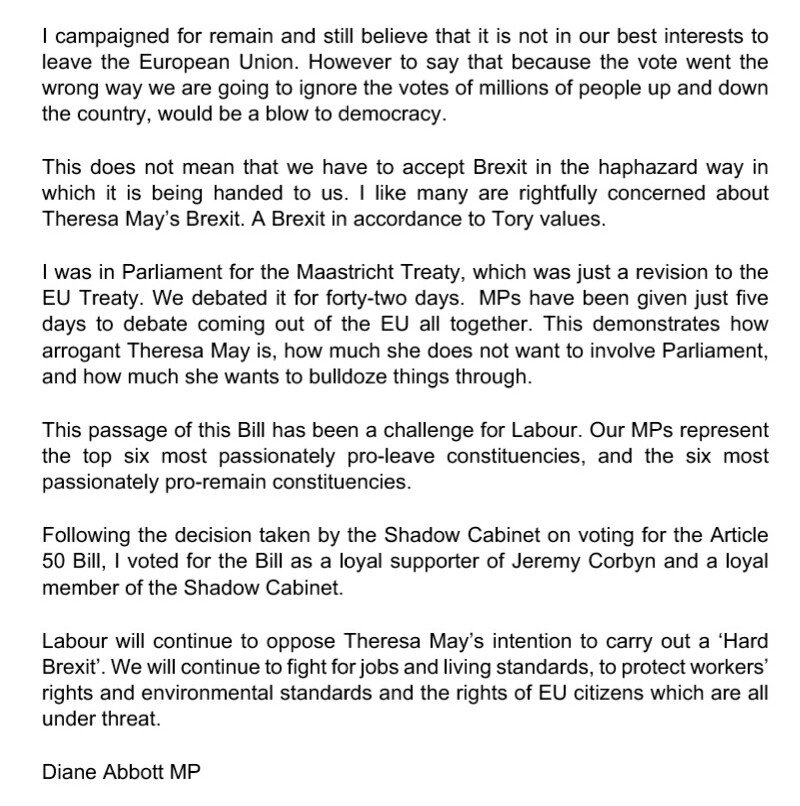
More wiser heads than Corbyn’s on the left, such as Diane Abbot, are able to see how out of touch Corbyn’s retrograde form of feudal socialism is. His ambivalence on the Brexit issue clearly put the likes of Abbot in a difficult political position. The dilemma she, and other Labour MPs faced, was whether to vote with their conscience and in the interests of their constituents who voted to remain, or go against their principles by voting for the Article 50 Bill on the basis of maintaining a sense of loyalty to both their leader and to the Shadow Cabinet?

Abbot’s statement below published on twitter, indicates that her preferred option was to go for the latter approach:

Conclusion

Jeremy Corbyn comes across as a sincere and honourable man whose motivations are not self-enrichment but to make society a better place for everybody. Morally and intellectually, he is head and shoulders above his political opponents and would make a far better prime minister than the hapless autocrat, Theresa May.

However, he is not perfect (who is?). His overly accommodating approach towards his enemies, the lack of support he has shown to his longstanding friends and his attempt to effectively coerce Labour MPs into taking the pro-Brexit line, are all major strategic miscalculations that have the potential to back-fire on him.

Nevertheless, despite these flaws, I am of the opinion that if Corbyn and his team can motivate enough young people to come out and vote, Labour can beat the Tories at the next General Election. Very few people are likely to detest the Tories more than me. I have direct experience of the negative consequences resulting from their welfare retrenchment policies.

I want to make the Labour party the most effective opposition to the Tories as possible. It’s for this reason I feel it’s my duty to provide constructive criticisms as, and when, required. I am not motivated by an intention to undermine Corbyn, but to help ensure the party he leads replaces the Tories at the next election.


Make a small donation

If you’ve enjoyed reading this or another posting, please consider making a donation, no matter how small. I don’t make any money from my work, and I’m not funded. You can help continue my research and write independently.… Thanks!


Donate Button with Credit Cards

The Government’s Deliberate Destruction of Our NHS

By Daniel Margrain

'Humanitarian crisis' in NHS hospitals, warns Red Cross (Getty) Royal Sussex County Hospital, UK (Photo by Universal Images Group via Getty Images)‘Humanitarian crisis’ in NHS hospitals, warns Red Cross (Getty) Royal Sussex County Hospital, UK (Photo by Universal Images Group via Getty Images)

Pictures that emerged last week from the Royal Blackburn hospital that showed mothers and babies being held in corridors for 13 hours and 89 year old Iris Sibley spending more than six months in a hospital bed because a care home place could not be found for her, are the kinds of incidences that are now becoming the norm in the NHS. Figures from the BBC suggest that nine out of 10 hospitals have unsafe numbers on their wards.

Health Secretary Jeremy Hunt’s comment on Friday (February 10) that the treatment of some patients was “completely unacceptable” in response to the worst A&E waiting times on record, was uttered as if he was absolving himself of all responsibility for the chaos. The reason why he gives the impression that he has no intention to do anything about the unfolding crisis enveloping the NHS, is because the chaos is a by-product of government policy.

The government’s objective is to move more healthcare to people’s homes and the community which will involve the merging of NHS and social care budgets that largely have already been privatized. This will lead to contamination and the entry-point for patient charges and co-payments. Given that the overall framework for such a system within the NHS already exists, it’s just a matter of time before such payments and charges are put in place.

Health & Social Care Act

The stated referencing for NHS funding is a deception, as was the assurance in 2010 that there would be no top-down re-organization of the service. The 2012 Health and Social Care Act undermines this assurance since it removes the duty on the Secretary of State for Health to provide a comprehensive health service, while the act requires up to 49 percent of services can be tendered out to any qualified provider”. Already between a quarter and a half of all community services are now run by Virgin Care.

Since the late 1980s during Margaret Thatcher’s third term in office, whole entities within the public sector have increasingly been outsourced, health and social care services privatized and competition and the business ethos introduced into public services. Following the advice of the then chief executive of Sainsbury’s, Sir Roy Griffiths in 1987, the Thatcher government set about removing the foundations upon which the welfare state had been built. One study suggests that “the privatisation of social care services is arguably the most extensive outsourcing of a public service yet undertaken in the UK”. 

The aim is to ensure the domination of the market by a small number of very powerful multinational corporations whose primary concern is not the welfare of the residents in care homes which they own or patients in hospitals, but rather with maximizing profits. In line with Noam Chomsky’s defunding notion, the strategy of successive governments’ over the last three decades has been to shrink the NHS and bring it to the point of collapse as the basis for then claiming the only solution is more privatization.

Britain’s Biggest Enterprise

The retreating from the principle of the universal provision of free at the point of delivery health care, can be pin-pointed to 1988 when Tory politician, Oliver Letwin, wrote a ‘blueprint’ document called ‘Britain’s Biggest Enterprise’ where he set out the stages governments’ would have to go through to achieve a US model of healthcare without the public noticing.

The New Labour government under Tony Blair adopted Letwin’s principles. But prior to the 1997 General Election, Blair had to disguise the strategy by using dissembling language in order to get elected. Once in office, he took several steps towards privatization – for example, breaking up the hospital network into foundation trusts which are essentially separate business entities. He also deliberately saddled hospitals with Private Finance Initiative (PFI) liabilities which involved the government borrowing £11 billion from private banks and financiers in order to justify the sale and breakdown of the NHS further down the line.

This culminated with the New Labour government introducing in 2009 what was termed the “unsustainable provider regime” which is a fake bankruptcy framework to justify closing hospitals. The £11 billion of public money Blair and Brown borrowed from the banks and financiers ostensibly to invest in the NHS through PFI (a sum that has soared to £80 billion which the NHS is duty bound to pay), helps further this eventuality in two ways.

Firstly, financing hospitals through PFI displaces the burden of debt from central government to NHS trusts and with it the responsibility for managing spending controls and planning services, thereby hindering a coherent national strategy. Secondly, the high cost of PFI schemes has presented NHS trusts with an affordability gap. The financing of these legally questionable PFI contracts, which has increased the public’s liability by a massive £69 billion, cannot be examined because they hide behind strict confidentiality rules.

Nevertheless, the Labour party under Jeremy Corbyn appears to be reluctant to raise the issue surrounding the alleged inadmissibility of the contracts despite the high probability that best value and cost effectiveness criteria were unlikely to have been adhered to in this instance.

Simon Stevens

The most powerful and influential individual currently working in the NHS is former Labour councillor, Simon Stevens, chief executive of NHS England. After having served under the Blair government, Stevens went on to work for the US private health care provider, United Health, where he campaigned against Obama Care. Stevens then argued for the Transatlantic Trade and Investment Partnership (TTIP) to be included within the UK health care remit. Those encouraged by the election of Jeremy Corbyn (myself included) are still waiting to hear something from the shadow health team about this troubling development.

The latest controversy to have emerged from NHS England led by Stevens is the proposed introduction of its ‘Sustainability and Transformation Plans’ which forms part of the annual 2016-17 HHS Planning Guidance. “Sustainability and transformation” is Orwellian-speak for the move towards the total reorganization of the NHS predicated on more privatizations and cuts. As Mike Sivier puts it:

“We’re told the project is about ‘strengthening local relationships’ and building on ‘local energy and enthusiasm’ to achieve ‘genuine and sustainable transformation in patient experience and health outcomes’. But in fact, the Guidance contains some very specific requirements that will test these new collaborations to the limits and usher in a new wave of privatisations and huge cuts.”

Last January, activist Dr Bob Gill from the Save Our NHS Campaign attended a meeting to get some insight into what the position of the Shadow Secretary of State for Health, Heidi Alexander, was in relation to the direction NHS England was moving in under Stevens. What he heard were narratives that fitted into the ongoing privatization agenda. According to Gill, Alexander expressed support for Simon Stevens, despite his appalling track record.

Concerning

This is deeply concerning for people who see in Corbyn somebody who might be willing to take a man who appears less committed to ethics and patient care than to ensuring medicine is a profit-based ‘conveyor belt’ service, to task. Unfortunately, there is no indication that he is the man who intends to do it. On the contrary, the narrative of the shadow health team appears to be one of support for both Simon Stevens and the existing regime of privatization that he is overseeing.

A year down the line since Dr Bob Gill’s revelation and with no action taken by Corbyn against Stevens, it’s now a matter of urgency that activists exert political pressure on Corbyn’s team to address the rightward direction Stevens, in conjunction with the Tories, is taking the NHS. Prior to the last election, David Cameron promised to “protect the NHS budget and continue to invest more.” This promise has been broken. According to the Nuffield Trust, “government spending on the English NHS is falling as a share of UK GDP – from 6.5 per cent of GDP at the end of the last decade to 6.2 per cent in 2015-16.”

Research by the Kings Fund indicates that the UK is ranked 13th out of 15 original EU members. In Orwellian fashion, health under-funding is portrayed in the media as “unprecedented levels of overspending by hospitals and NHS trusts.”Under-funding has inevitably impacted on staffing levels. The shortage of nurses within the NHS has reached dangerous levels in 90 per cent of UK hospitals, and the amount of doctors per capita is the second lowest among eleven European countries.

Overall, on six out of nine measures of varying sorts – five year survival rates for breast cancer; the same for prostate cancer; the number per capita of MRI scanners, CT scanners, angioplasty operations, hip replacements and knee replacements; waiting times to see a specialist and the OECD assessment of outcomes compared to money spent – Britain did worse than any other advanced country in the world. Under both Stevens and the Tories every aspect of the NHS is under attack.

At the time of writing, Virgin Care is in control of well in excess of 200 contracts across the UK while administration for the new NHS market alone, costs tax payers £1 in every £10 the NHS spends (4.5 billion). The carving open of the service for exploitation by private interests is proceeding at a pace and the government shows no indication of wanting to reverse the process. This is hardly surprising given that 70 MPs have financial links to private healthcare firms while hundreds of private healthcare corporations have donated to Tory coffers.

The erosion of the principle of a free at the point of delivery service also undermines what Sir Michael Marmont refers to  as “the optimal allocation of resources.” This, in part, explains why a country like the United States where the marketization of its health care system is long established, is ranked 44th in the world in 2014 in terms of efficiency compared to 10th for the UK. Given these figures, one might reasonably ask why the government appears to be insistent on dismantling something that, despite its faults, essentially works, and then restructuring it in the image of a system that doesn’t?

The US model we are moving towards

During his recent trip to America following Trump’s inauguration, it is likely that UK Health Secretary, Jeremy Hunt, took the opportunity to discuss with US financiers further moves to carve up the NHS in order to bring it closer to the US insurance-based model. The requirement of the US Affordable Care Act (which was signed into law in March 2010 but is actually unaffordable for large swaths of the US population), is that people are forced to buy private health care insurance if they fail to qualify for public health programmes, namely Medicare and Medicaid. However, the insurers have created plans that restrict the number of doctors in hospitals.

These “ultra narrow networks” have resulted in the reduction of at least 70 per cent of health facilities within communities throughout the US, thereby restricting access to care for people with serious health problems. This means that increasingly Americans are paying higher premiums but are not getting sufficient access to services they need. They are, therefore, having to find the money upfront, largely because their insurance policies do not provide adequate cover for their injuries or illnesses.

So America is still seeing high rates of people who are either delaying, avoiding getting access to the care they need, or are being confronted with medical debts. Research shows that tax-funded expenditures account for 64.3 percent of US health spending, with public spending exceeding total spending in most countries with universal care. Yet, 33 million people in the US do not have access to health insurance cover.

When Obama came into office in January 2009 there were approximately 15 per cent of American’s who had been uninsured for at least a year which meant that unless they had access to a significant amount of money, they could not go to a doctor when they or their children fell ill. During this period, surveys showed that two-thirds of all Americans favoured a single payer health plan (ie a publicly financed system of universal health care provision free at the point of delivery for all, similar to the NHS) but Obama rejected it outright. This was despite the fact that war veterans and senior citizens have a variation of publicly/privately delivered and funded arrangements already in place within the existing system.

These limited single payer systems have also proven to be cost effective with good outcomes. In addition, Obama was riding high on a wave of popular support following his election victory. Not only did the Democrats control the White House and Senate but they also commanded a majority in the House of Representatives. It would appear that the $20 million Obama received from private health care companies during his election campaign helped sway his decision not to introduce the single payer system across the board despite the fact that nearly 80 per cent of Democrat voters support the introduction of such a system.

Obama, in other words, had the democratic mandate to introduce the extremely popular single payer system universally but instead he turned his back on the people who elected him into power. The conflicting interests that American presidents like Obama face relates to the close relationship they have to members of Congress who need to get reelected. If Congress speak out against the interests who are funding their campaigns, they’re not going to get that funding. Commenting on a report from the National Journal, Ashlie Rodriguez wrote:

“Health care interests have given $46.6 million in campaign donations since 2005 to [the] 21 lawmakers” at the bipartisan healthcare summit, including Senator Max Baucus, Senate Minority Leader Mitch McConnell, House Minority Whip Eric Cantor, and to the summit’s host, President Obama.”

And Citizens for Responsibility and Ethics in Washington found that:

“health professionals, political action committees, hospitals and nursing homes, pharmaceutical and health product companies, health services firms, HMOs and accident insurers have given heavily to all summit attendees.”

Dysfunctional

Tiny efforts to try and patch together what is clearly a dysfunctional system is further undermined in as much as that patchwork involves another obvious paradox. This is highlighted by the origin of the Obama Care Plan which has its roots in the Heritage Foundation, a conservative Think Tank, which came up with the model of forcing people to buy private insurance and to use public tax dollars to subsidize the purchase of this insurance. In other words, as a result of a process of publicly funded corporate welfare, billions of funds are shifted into the hands of private insurance companies.

Nevertheless, this was passed into law in Massachusetts under governor Mitt Romney who was Obama’s Republican opponent in the race for the White House. Almost exactly the same plan was passed by Obama at the national level. This led to the insane situation in which the Democrats were essentially championing a Republican plan in which the latter subsequently distanced themselves from. Instead, the Republican policy under Trump is for everybody to pay privately with no public provision and no safety net of any kind in place.

America’s health care costs are the highest per capita of any country in the world with some of the worst outcomes. Attempts to reform the US system are undermined by the insurance companies whose only function is to be middlemen between the patients and the health professionals.The U.S government’s treatment of health care as a commodity instead of a public good is out of sync with the rest of the developed world and illustrates the extent to which, more broadly, the giant corporations have usurped democracy in the United States.

As things currently stand, the US is the only industrialized nation on the planet that has used a market-based model for healthcare. Alarmingly, whether people want to admit it or not, this is the direction of travel both the Tories and NHS England under Simon Stevens are taking the system of UK healthcare provision. In other words, we are heading for a potential nightmare.

COPYRIGHT

All original material created for this site is ©Daniel Margrain. Posts may be shared, provided full attribution is given to Daniel Margrain and Road To Somewhere Else along with a link back to this site. Using any of my writing for a commercial purpose is not permitted without my express permission. Excerpts and links, including paraphrasing, may be used, provided that full and clear credit is given to Daniel Margrain and Road To Somewhere Else with appropriate and specific direction to the original content. Unless otherwise credited, all content is the site author’s. The right of Daniel Margrain to be identified as the author of this work has been asserted by him in accordance with the Copyright, Designs and Patents Act 1988.
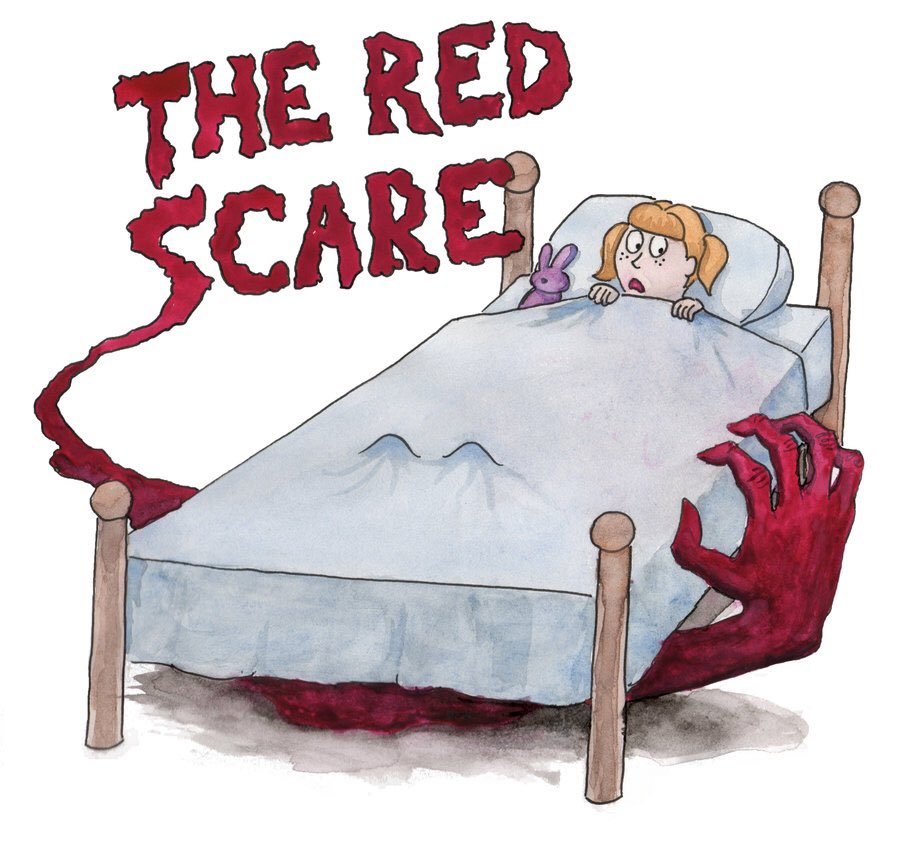
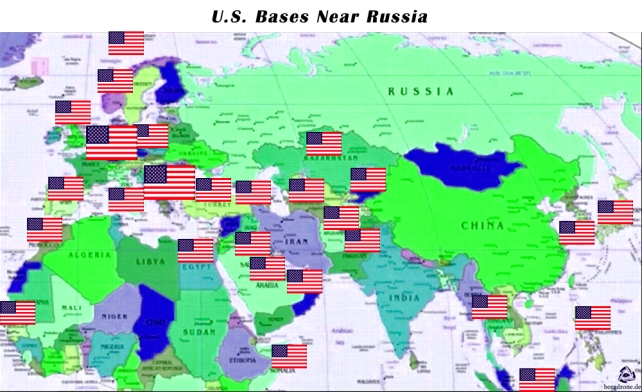
Make a small donation

If you’ve enjoyed reading this or another posting, please consider making a donation, no matter how small. I don’t make any money from my work, and I’m not funded. You can help continue my research and write independently.… Thanks!


Donate Button with Credit Cards

The Russian’s Are Coming

By Daniel Margrain

The other day, I watched Norman Jewison’s 1966 comedy satire, The Russian’s Are Coming, The Russian’s Are Coming about the panic that ensues as a result of the forced landing of Russian submarines on a Connecticut holiday island. Released during the height of the Cold War, the film is not a particularly good one, but having spent a great deal of my adult life conditioned into believing the ‘Reds Under the Bed’ propaganda, the one thing that struck me was the extent to which Jewison portrayed the Russian’s in a positive light.

Jewison’s sympathetic portrayal was given added resonance in as much as that during the ensuing post Cold War world, Russian’s continued to be depicted, as Steven Kurutz puts it, as “Hollywood’s go-to villains”. The stereotyping of Russian’s in this way is of course premised on a real life political-based Russophobia narrative whose origins go back until at least the Napoleonic wars of the early 19th century. Propaganda against Russia was, as Ivor Neumann argued, continued by Napoleon’s former confessor, Dominique Georges-Frédéric de Pradt, who in a series of books portrayed Russia as “despotic”, “Asiatic” and “power hungry”. This was a period in which Britain had invaded Russia during the Crimean war. Craig Murray proffers some invaluable historical detail:

“As early as 1834 David Urquhart, First Secretary at the British Embassy in Constantinople, was organising a committee of “mujahideen” – as he called them – and running guns to Chechnya and Dagestan for the jihadists to fight Russia. In 1917 British troops again invaded Russia, landing at Archangel and Murmansk.”

A necessary condition to waging wars against official enemies, is the use of propaganda by the state to achieve that end. Even the influential British economist John Maynard Keynes was not averse to its power. Fifteen years after British troops landed at Archangel and Murmansk, Keynes wrote on Russia in Essays of Persuasion (pp.297-312) that the oppression in the country, rooted in the Red Revolution, perhaps was “the fruit of some beastliness in the Russian nature.”

Russia is no threat

In contrast to the historical threat to Russia from Britain, there is no evidence that the former poses a threat to the latter. Indeed, foreign and defence policy predicated on the alleged Russian threat is a British establishment concocted fantasy that has been perpetuated over time in order to justify the augmenting of the military industrial complex from which the British establishment continues to benefit financially.

Unlike the British empire, its Russian and Soviet counterparts had established their rule through the acquisition of contiguous land which ensured their hegemony over eastern Europe. Most of modern Russia that includes, for example, Dagestan and Chechnya, wasn’t the Russia of the 19th century when Britain was organising its gun running as part of the war of aggression against it.

An understanding of the historical context helps explain why Russia is fearful of Islamic instability and why Russia is concerned with the further spread of Islamic Jihad. It also partly explains why Putin got involved in Syria following Assad’s invitation in October, 2015. The existential threat Russia faces from Islamic extremism in its colonies is comparatively greater than that faced by the West.

Threat to Russia

Historically, the threat to Russia from Islamic extremists has been exacerbated by the British as part of their imperial strategy. By the 1830s the British were consciously and explicitly exploiting the Sunni-Shia divide in Afghanistan where they were playing off their support for the Shia-based communities against their Sunni counterparts during their first invasion of the country. Russia is demonised for the role it is currently playing in Syria, but the main reason it’s active in the country is to act as a counterbalance to the centuries-long determination by British imperial forces to exploit this divide as the precursor to gaining territory and thereby to attempt to dislodge Russia from land that it conquered through its own imperial endeavours.

The increase in Russophobia over the last few years that in many ways is more extreme that anything experienced during the height of the Cold War, mirrors Russia’s intervention in Crimea which was a reaction to the US-led engineered coup in Ukraine that preceded it. Overriding this is the notion that Russophobia, driven by Western fears of the Soviet role in communism’s mission to take over the “Free World”, arises periodically as a consequence of the perceived Russian threat to Western imperialist ambitions. Nothing Putin has ever said or done warrants this fear mongering. He has displayed no desire to attack the UK or the US and there is no cultural, linguistic or historical reasons why he would want to do so.

Offence not defence

Russia’s imperialist ambitions have involved the swallowing up of contiguous land rather than extraneous colonial land grabs and the eastward expansion of NATO typical of Western imperialism. The growth in the amount of US-NATO missile bases positioned around Russia which is much larger than during the period of the Cuban missile crisis, is clearly an act of provocation tantamount to aggression.

Image result for nato bases around russia

While Russia is faced with genuine potential threats from its Islamic colonies, Britain’s adversarial positioning in places like Cyprus and Bahrain serve no purpose other than as an expression of the projection of aggressive military power. In terms of the latter, the British establishment is actively supporting one of the most appalling human rights abusing regimes on earth. With its majority Shia population that rules over a tiny Sunni minority, Bahrain is a state essentially created by British imperialism underpinned by a fluid foreign policy that shifts depending on which president has been elected to the White House.

During a recent speech she made in Washington, Theresa May claimed that the days of military interventions are over. But if this were true, why would Britain need a military base in Bahrain? As Craig Murray contends, its difficult to argue in favour of the notion that Britain’s military capability is anything other than offensive:

“Britain’s forces are not configured for defence. They are configured for attack. Aircraft carriers are of no defensive use whatsoever, and indeed are hopelessly vulnerable against any sophisticated enemy. Their sole purpose today is the projection of power against poor countries. Their use lies only in the neo-con policy of attacking smaller states like Iraq, Libya and Syria. They are Blair force carriers.”

Murray continues:

“Britain is a country where thousands of children go to bed hungry. Yet is spends billion upon billion on Trident missiles whose sole purpose is to increase politicians’ sense of importance, and aircraft carriers designed to facilitate the maiming of other nations’ children. A rational, defence oriented military would have neither.”

Big business & the 2006 G8 Summit

Orwell’s famous phrase “war is not meant to be won, it is meant to be continuous”, is probably no more aptly applied than in relation to the Wests periodic war games with Russia. War is big business and the “Russian threat” is the justification by which this business is conducted. In this sense, the Cold War and Russophobia could be seen as synonymous. Putin is a Western ‘demon’ because unlike his Russian predecessors of the post- German unification period, he refuses to be seduced by the Washington consensus.

One of the more recent Cold War phases emerged in July, 2006 after Putin began reasserting Russia’s super-power status as part of the country’s first ever hosting of the G8 summit. Under Putin’s predecessor Boris Yeltsin, Russia had effectively become a vassal of the US. Putin ended that subservient status.

It was Moscow’s international independence in foreign policy, allied to its role as a gas and oil supplier, that prompted the then US vice-president, Dick Cheney, to make one of the most anti-Russian US speeches of modern times. Condemning Russia’s lack of democracy to an audience in Lithuania, Cheney proceeded on to Kazakhstan, where he praised its president whose elections are more flawed than Putin’s.

Hypocrisy

Russia’s continued trend towards the recentralisation of power in the Kremlin that began in the late 1990s under Washington’s poster boy, Yeltsin, was now depicted by the Americans as a policy trajectory defined and initiated by Putin. Western governments approved Yeltsin’s use of tanks against the Russian parliament in 1993 and his biased control of TV coverage in the 1996 elections, and yet here were the Americans criticising Russia’s faltering democracy without an apparent ability to self-reflect on their hypocrisy.

Putin’s reaction to the Cheney tirade was significant. He made only three mentions of the US in his state of the nation address a few days later, one of which was a flattering reference to Roosevelt’s new deal as a partial model for Russia. Unlike the hard power of the US under Obama, Russian foreign policy under Putin appears to be guided by soft power, which judging by the signals emanating from Trump, will be reciprocated by Washington.

Under Obama, as well as the current Conservative administration headed by Theresa May in Britain and her predecessor, David Cameron, the shift by Putin exemplified by the 2006 summit, should have been welcomed. But instead, it was seen as a new “Russian threat.” A decade on, following the unsubstantiated accusations that Russia leaked emails showing Clinton’s corruption, allegedly in order to influence the US election, Cold War anti-Russian propaganda has reached a new phase. Whatever the misgivings people have about Trump’s presidency, his attempts to reconcile US-Russian foreign policy differences must surely be welcomed.

COPYRIGHT

All original material created for this site is ©Daniel Margrain. Posts may be shared, provided full attribution is given to Daniel Margrain and Road To Somewhere Else along with a link back to this site. Using any of my writing for a commercial purpose is not permitted without my express permission. Excerpts and links, including paraphrasing, may be used, provided that full and clear credit is given to Daniel Margrain and Road To Somewhere Else with appropriate and specific direction to the original content. Unless otherwise credited, all content is the site author’s. The right of Daniel Margrain to be identified as the author of this work has been asserted by him in accordance with the Copyright, Designs and Patents Act 1988.

Make a small donation

If you’ve enjoyed reading this or another posting, please consider making a donation, no matter how small. I don’t make any money from my work, and I’m not funded. You can help continue my research and write independently.… Thanks!


Donate Button with Credit Cards

My Review of the opening episode of the BBC3 Comedy, ‘Fleabag’

By Daniel Margrain

Photo: Amazon

There is likely to be nobody who detests the vast majority of what passes for BBC comedy output more than I do. From the unedifying spectacle of Mrs Brown’s Boys to the stupefying banality of Miranda, what the sheer dearth of quality output over the years highlights is the importance teams of writers are to the production of quality comedy. This explains why American comedy’s invariably hit the mark but on the whole, their British counterparts fail.

But once in a while, something extraordinary hits our television screens. I witnessed such a moment the other night thanks to a recommendation from Victor Lewis-Smith. As somebody who appreciates the quirky character-led observational and acerbic comedy canon, I knew I was going to be in for a treat from the opening sequence. One of the early scenes in which the boyfriend of Fleabag creator and star Phoebe Waller-Bridge left her due to her habit of masturbating to Barack Obama speeches, was genius. This was one of the many inventive and inspired tragic-comic sequences that punctuated the shows 26 minute duration.

Firmly set within the confessional territory of Bridget Jones, Waller-Bridge’s first person monologues to camera, which hint at its Edinburgh fringe origins, were repeated throughout the episode. While these sequences were not original – having been seen in Woody Allen films (most notably Annie Hall) – they were nevertheless brilliantly executed.

What we quickly learn is that Fleabag is the epitome of a woman constantly on the verge of having a hyperventilating nervous breakdown in what is an increasingly dysfunctional world. As she navigates an urban terrain of awkward men while struggling to bond with her sister, it soon becomes obvious that her nihilism and inability to deal with personal relationships is an expression of a melancholy that’s rooted in personal tragedy, money problems or both.

We soon learn that somebody close to her had suffered an untimely death and that she lied to her financially successful sister about her financial situation as a front in order to get her approval. Her father (Bill Paterson) appears as a distant and peripheral figure in her life while her stepmother (Olivia Coleman) who tells her how awful she looks, has the potential to be as venomous a character as Julia Davis’ in Nighty Night whose magnetic on-screen presence Waller-Bridge manages to equal, if not surpass.

As with Julia Davis’ character, Waller-Bridge pulls off a woman, whose ferocious self-loathing is out of control and whose life is in a state of perpetual chaos, with great aplomb and technical skill. But unlike Davis’ character, Fleabag’s method of dealing with these frailties is to not take anything seriously.

In contrast to the derivative and telegraphed pratfall farce of a sit-com like Miranda, the sense of pathos and melancholy in Fleabag is never far from the surface. After having watched the opening episode, I get the feeling that a number of tragedies will unfold as the series progresses in which underlying themes of alienation, loneliness and loss look set to be developed.

All the performances were first class, but particular congratulations go to Waller-Bridge whose front and centre role stole the show. I was never quite sure what she was about to do or when she was going to do it – real edge of the seat stuff. I was mezmerized by her which is a testament to the brilliant writing, inventive set pieces, casting and strong characters.

Those responsible for taking the decision to commission this brave and fresh work of art are to be commended for their risk-taking in bringing Fleabag to the small screen. We need more of it.

COPYRIGHT

All original material created for this site is ©Daniel Margrain. Posts may be shared, provided full attribution is given to Daniel Margrain and Road To Somewhere Else along with a link back to this site. Using any of my writing for a commercial purpose is not permitted without my express permission. Excerpts and links, including paraphrasing, may be used, provided that full and clear credit is given to Daniel Margrain and Road To Somewhere Else with appropriate and specific direction to the original content. Unless otherwise credited, all content is the site author’s. The right of Daniel Margrain to be identified as the author of this work has been asserted by him in accordance with the Copyright, Designs and Patents Act 1988.

Make a small donation

If you’ve enjoyed reading this or another posting, please consider making a donation, no matter how small. I don’t make any money from my work, and I’m not funded. You can help continue my research and write independently.… Thanks!


Donate Button with Credit Cards

SPeye Joe (Welfarewrites)

Joe Halewood writes about tenant and welfare wrongs

Bryan Hemming

short stories, comment, articles, humour and photography

juxtaposed

Subject to change.

Modern Monetary Theory: Real Economics

"The economy doesn't work like most people think it works!"

Always Under-Occupied

Experiences and Thoughts of an Angry Carer

Think Left

The purpose of Think Left is to present a view of politics from a left-wing perspective.

Rocoja's Blog

Social Media for Small Business in Surrey & SW London

Rogues & Vagabonds

theatre, film & tv past and present 2001-2008 & 2013...

Tory Britain!

Since 2010 the Tories have killed over 250,000 claimants & starved and made homeless millions more! The poor, sick & disabled need your help for this to end. Not voting Tory is a start!

Politics and Insights

Public interest issues, policy, equality, human rights, social science, analysis

Road To Somewhere Else

the view from the dark side: politics, media, cities & culture

Kendrickmusicfreak

Blogging about music from early 80s indie to Britpop and beyond

Unknowing

interior intimo meo

L u k e n . o r g

FATHER + SAILOR + TECHNOLOGIST + MUSICIAN + CYCLIST

The Electronic Intifada - Ilan Pappe

the view from the dark side: politics, media, cities & culture

John Pilger

the view from the dark side: politics, media, cities & culture

Jonathan Cook: the View from Nazareth

the view from the dark side: politics, media, cities & culture

John Molyneux

the view from the dark side: politics, media, cities & culture

All That Is Solid ...

the view from the dark side: politics, media, cities & culture

openDemocracy RSS

the view from the dark side: politics, media, cities & culture

Bloggerheads

the view from the dark side: politics, media, cities & culture

Informed Comment

the view from the dark side: politics, media, cities & culture

George Monbiot

the view from the dark side: politics, media, cities & culture

Media Lens

the view from the dark side: politics, media, cities & culture

Craig Murray

the view from the dark side: politics, media, cities & culture

WordPress.com News

The latest news on WordPress.com and the WordPress community.

Eleventh Stack

A books, movies, and more blog from the staff at the Carnegie Library of Pittsburgh - Main.

the void

narking off the state since 2005