Can Corbyn’s democracy succeed against May’s ‘strong & stable’ autocracy?

By Daniel Margrain

Unelectable Left

No sooner had PM Theresa May announced her decision to go to the country in a snap election predicated on a single issue Brexit strategy, the leader of the opposition, Jeremy Corbyn, was quickly out of the blocks in his attempts to wrong-foot her. Corbyn’s first General Election campaign speech and Q&A in which he outlined a broad set of policies to tackle growing inequality and reverse years of Tory austerity, was a tour de force.

Electable

The Labour leader’s critics – including many within his own party – argue he is unelectable. However, Corbyn’s political record would suggest otherwise. In his constituency of Islington North, Corbyn inherited a majority of 4,456, which is now 21,194. He’s one of the few Labour MPs whose vote increased between 2005 and 2010, when he added 5,685 to his majority. It must also be remembered that Corbyn’s record during elections is exemplary, and that pre-coup, Labour led the Tories in three polls in a row over 41 days.

Furthermore, London and Bristol now have Labour mayors, rolling back years of Tory dominance, while Labour’s majorities in by-elections have generally increased. It’s true that the by-election in Copeland was a major disappointment but this was largely offset by Gareth Snell who took the Stoke seat.

It is also worth noting that Labour won three local government by-elections – two off the Tories and one off the SNP. In last May’s local elections, the party overtook the Tories in the share of the vote, coming from seven points behind at the last election.

Meanwhile, the party haemorrhaged 4.9 million votes between 1997 and 2010 under the ‘triangulated’ leadership of Tony Blair. The man who took the country to war in Iraq under a false prospectus, and who lobbies on behalf of some of the world’s most brutal and corrupt dictators, claimed in a moment of Orwellian doublespeak that Corbyn is a disaster for the party. Given Blair’s toxicity, this can only be beneficial for the current Labour leader’s fortunes.

There are other potentially toxic issues that Corbyn can capitalize on. For example, May’s unpopular campaign focusing on grammar schools is likely to play into Corbyn’s hands. Unfortunately, this gain could be offset by his misjudged Brexit strategy prior to May’s announcement which I commented on here. But, as I contend below, this situation is not irreversible.

Other issues that the Tories won’t be able to hide away from, is the chaos in the NHS and social care sector, the scandal of zero hours contracts, in-work poverty and welfare cuts among others.

Ultimately, the implication the public don’t necessarily favour Corbyn’s politics is wrong. His position on the NHS and the re-nationalization of the railways, for example, are universally popular. Rather, it’s more the case that the elite political-media establishment know Corbyn is incorruptible and therefore feel they are unable to win him over on their own terms. Consequently, they realize that the longer Corbyn remains at the helm the more likely it will be that those sympathetic to him and his policies will be elected into positions of power.

The fact that the media barons are constantly drumming it into the public’s heads that Corbyn is useless and should resign, is a testament to his unflinching endurance to see through the mandate entrusted upon him by the rank and file. If both the right-wing Tory media and his political opponents are so convinced that he has no chance of winning the election, why would they keep insisting that he resign?

Moreover, the criticism often leveled at Corbyn that he provides weak opposition at the dispatch box during PMQs, is belied by the fact that under his leadership the Tories have been forced into some thirty policy u-turns.

Cracks

Cracks have already started to appear in the Tory armory. As Left-Foot Forward have noted, both the PMs press secretary, and her director of communications and long-term adviser, have departed company with her. In addition, “May’s two closest advisers have a long history of intra-government feuds – both were forced to leave May’s home office team after rifts with other members of David Cameron’s cabinet – and the trend seems to be continuing in Number 10.”

According to Politico:

“The string of departures from Number 10 has been linked to May’s highly controlled leadership style. Government officials frequently report that power over government messaging and media strategy is heavily concentrated in the hands of ‘the chiefs’… and that more junior members of staff have limited freedom to operate.”

May’s authoritarianism has arguably been the motivating factor which has led to what the Canary reported (April 24, 2017) as the resignation of a third senior adviser from Downing Street within a week. The PMs control freakery is underlined by what Ash Sarkar, describes as “a moment of short-term political opportunism which actually has potential catastrophic affects in terms of a concentration of power in the executive.”

It’s May’s totalitarian instincts that are symbiotic of the rightward drift in politics over the last four decades, that has culminated in some of the most severe attacks on our civil liberties within living memory.

Five months ago (November 20, 2016), former UK ambassador to Uzbekistan, Craig Murray, published a blog piece that is apposite for the current situation. In it, he illustrates an example of the PMs total contempt for democracy legitimized by what he accurately terms as “an over-mighty executive government backed by corporate wealth which controls a corporate media.”

Murray continues:

“Her [May’s] default position is to retreat into secrecy and blatant abuse of power. That is precisely what we are seeing over Brexit, where there is no plan and much to hide. May’s natural instinct is to brook no opposition, debate or discussion of her actions, but to proceed on the basis of executive fiat, with as little information as possible given to parliament, devolved authorities and – Heaven forbid – the public.”

Both Murray and Sarkar’s assertions, in addition to the public being denied a televised debate, May’s banning of both the public and journalists from Tory events and the insistence that her MPs sign a three lock pledge, reinforce the notion that the PM is refusing to participate in democracy.

May’s stage-managed autocratic style, indicative of her reluctance to allow proper democratic scrutiny, points to a lack of intellectual acumen and the paucity of her campaign policies underpinned by the repetitive mantra, “strong and stable” – amusingly parodied by Mike Sivier (April 27, 2017).

The former has been picked-up on by Craig Murray: “That May is intellectually out of her depth is plain even to Conservatives every Prime Minister’s question time in the Commons”, he said.

May’s lightweight campaign matches the Tories inability to present a package of policies to the public. Even the establishment columnist, Fraser Nelson, revealed in the Telegraph (April 21, 2017), that May’s election manifesto will be extremely light in both content and detail which a single hard Brexit strategy implies.

An illustration of the PMs lack of intellectual acumen and autocratic style, was perhaps most pertinently highlighted by constituent, Louise Trethowanwho related a fifteen minute encounter she had with May at her constituency office in Maidenhead.

Trethowan said:

“For me, it was an excellent opportunity to put all my fears – and the concerns of the 48 per cent – to the woman who will lead us towards the Brexit cliff edge. I expected… her to present some strong arguments that would counter my own.”

But what she witnessed was a rude, aggressive and finger-pointing individual who was unable to hold an argument.

Trethowan added:

She [the PM] seemed petulant, defensive, tired and rattled… If the Prime Minister is so easily angered how on earth is she going to be the best negotiator for Brexit? I fear she will lose her temper and start jabbing her finger at people.”

The reliance on a constituency of right-wing extremists to argue the Tories’ case for returning an unstable individual to Downing Street based on a ‘blank cheque’ hard Brexit, while ignoring the key bread and butter issues, is a risky one and could easily play into the hands of her political opponents.

Beneficiary

A major beneficiary of such an approach will almost certainly be the pro-Remain Liberal Democrats which could significantly split the Tory vote. Of course, the billionaire-owning mass media support the Tories with near unanimity. But the front page of the Daily Mail (April 19, 2017) which ran with the headline “Crush The Saboteurs” (see below), is likely to alienate 48 per cent of the population who voted Remain. Therefore, the right-wing media’s depiction of over 16 million people as “the enemy” could realistically backfire on the Tories.

Battle ahead

Arguably, some of Corbyn’s biggest battles in the campaign ahead will be with the media and the disrupting forces inside his own party. However, those already writing-off the Labour leaders chances are, in my view, doing so prematurely.

It’s true that at the present time Corbyn is well behind in the polls but, as Craig Murray points out, this can be misleading. The downside for Corbyn, according to YouGov, is that Labour is losing out to the Tories for the vote of the oldest and least educated demographic – many of whom are traditional working class voters. Labour’s longer-term prospects are also hindered by the fact that society is ageing.

But on the other hand, YouGov found that Labour was leading the voting intention polls with under-40s. The problem for Labour, historically, has been that it’s this group who have been the least likely to go out and vote compared to their older counterparts. If Corbyn can mobilize this former hitherto relatively passive demographic group into voting, then the polls could be significantly closer than many pundits are suggesting. It is also worth keeping in mind that the last Tory PM to call an early election on a single issue while ahead in the polls was Edward Heath – and he lost.

It was music to this writers ears that Corbyn began his campaign emphasizing Labour’s policy plans in a lucid and persuasive way. But in my view, he needs also to ensure that voters are to be under no illusion that the hard Brexit May is offering is not what people voted for. He needs to come out and say so unambiguously. In this way he has every chance of capturing a great swath of the Lib-Dem vote. It was therefore disappointing that Corbyn’s team announced on April 26, 2017 that the Labour leader would not take the opportunity to do so within a live televised TV debate format.

Nevertheless, the two-pronged strategy of focusing on May’s shortcomings over Brexit on the one hand, and Corbyn’s emphasis on outlining policies to reduce inequality and create a fairer society on the other, could be the trigger required to get the young to come out and vote in huge numbers.

Whatever the outcome, it’s difficult not to agree with Craig Murray when he said:

“I do not think this will be a comfortable election for the Tories, as even the media cannot prevent the electorate from twigging May avoids people, avoids scrutiny, and is programmed with only three lines. But if Labour do suffer large losses in England, then Corbyn should look to Scotland for an example and take heart. Any defeated Blairites will not come back. They go away if you stop paying them. That should embolden him to carry on as leader. Politics is in an era of unprecedented volatility, and assuming May is re-elected, within two years she will be massively unpopular as the effects of Brexit hit.”

I rely on the generosity of my readers. I don’t make any money from my work and I’m not funded. If you’ve enjoyed reading this or another posting, please consider making a donation, no matter how small. You can help continue my research and write independently..… Thanks!


Donate Button with Credit Cards

Killing them softly

By Daniel Margrain

The 30 minute documentary film Killing Us Softly (1979) based on a lecture by Jean Kilbourne focuses on the effects of advertising on women’s self-image and the objectification of women’s bodies. Kilbourne argues that the superficial and unreal portrayal of women in advertising lowers their self-esteem and that sexualized images of them are being used to sell virtually all kinds of goods.

Kilbourne then goes on to posit that these images degrade women, encourage abuse, and reinforce a patriarchal and sexist society. She also makes the connection between advertising and pornography, stating that “the advertisers are America’s real pornographers”.

Almost four decades after the release of ‘Killing Us Softly’, Kilbourne discussed some of the issues in her film to a new audience of young people. Significantly, she says that since the film’s initial release in 1979 “things have got worse, not better.”

It can barely get any worse than the case of 21 year old bulimia sufferer, Eloise Perry. On April 12, 2015, Ms Perry tragically died at the Royal Shrewsbury Hospital one week after having swallowed eight unlicensed fat-burning pills that she purchased from the internet.

The pills, which the Food Standards Agency describe as being illegal to sell for human consumption, contained DNP which is an industrial chemical historically used in the manufacture of explosives and fungicides. Website companies who sell this chemical depict DNP as a fat burning product and some even use the tag line “getting leaner through chemistry” as a marketing tool.

Social pressures

The social pressures for young women (and increasingly young men) to conform to certain expectations placed upon them by the media are immense. The upshot is that they are involved in a constant psychological battle between myth and reality. In Britain, for example, the average size of a woman is 16 but the ‘aspirational’ size is zero – an unobtainable goal.

The contradiction between reality and aspiration and the weaponization of feminism is undermining many of the gains that women made in the debates of the 1960s and 1970s. What Ariel Levi terms “raunch culture” – the sexualisation of women as sex objects – is another symptom of the undermining of these gains.

The High Street Honey’s tour and, more recently, the Dorchester Hotel harassment scandal, in which the condition of employment is that young women dress up as porn stars, puts pressure on them to conform to certain body-image stereotypes often determined by men.

The normalization of sexist imagery in pop videos and television commercials and the sexualization of young girls clothes, is another illustration of raunch culture outlined by Levi in which fantasies, desires and ambitions are transformed into commodities to make money.

The growth in cosmetic surgery is another factor that increases expectations on women’s appearances. Ninety-one per cent of cosmetic surgery is undertaken on women of which the most popular is breast enhancement. I was astounded to learn that in the U.S it’s widely considered normal practice for girls to be given a breast enlargement as a graduation present.

It’s a fact that a growing number of girls who suffer low self-esteem perpetuated by a media system that constantly portrays an ‘ideal’ body shape is a tendency that’s less common in the developing world.

Objectification

This would seem to suggest that mental illness, of which eating disorders are a reflection, is to a large extent symptomatic of the growth of the consumerist capitalist society in which human relations are objectified. In Marxist terms, objectification is the process by which human capacities are transferred to an object and embodied in it.

Young females who read fashion magazines tend to have more bulimic symptoms than those females who do not – further demonstrating the impact the media has on the likelihood of developing the disorder. As J. Kevin Thompson and Eric Stice have shown, individuals first accept and ‘buy into’ the ideals set by fashion magazines, and then attempt to transform themselves in order to reflect the societal ideals of attractiveness.

The thin fashion model ideal is then reinforced by the wider media reflecting unrealistic female body shapes leading to high levels of discomfort among large swaths of the female population and the drive towards thinness that this implies.

Consequently, dissatisfaction, coupled with a drive for thinness, is thought to promote dieting and its negative affects, which could eventually lead to bulimic symptoms such as purging or binging. Binges lead to self-disgust which causes purging to prevent weight gain.

Thompson’s and Stice’s research  highlights the extent to which the media affect what they term the “thin ideal internalization”. The researchers used randomized experiments (more specifically programmes) dedicated to teaching young women how to be more critical when it comes to media, in order to reduce thin ideal internalization. The results showed that by creating more awareness of the media’s control of the societal ideal of attractiveness, the thin ideal internalization significantly dropped.

In other words, less thin ideal images portrayed by the media resulted in less thin ideal internalization. Therefore, Thompson and Stice were able to conclude that there is a direct correlation between the media portrayal of women and how they feel about themselves.

Social media also plays a part. A 2014 two part study [1] looking at social media sites, such as Facebook and Twitter, researched influence and risk for eating disorders. In the first part of the study, 960 women completed self-report surveys regarding Facebook use and disordered eating. In the second part of the study, 84 women were randomly assigned to use Facebook or to use an alternate internet site for 20 minutes.

What the cross-sectional survey illustrates, is that more frequent Facebook use is associated with greater disordered eating. The survey indicates a close correlation between Facebook use and the maintenance of weight/shape concerns and state anxiety compared to an alternate internet activity [1]. Other research suggests an etiological link between eating disorders and the tendency towards self-harming [now referred to as Non Suicidal Self Injury (NSSI)] [2].

Prevalence

In terms of prevalence, over 1.6 million people in the UK are estimated to be directly affected by eating disorders. However, the Department of Health estimate that the figure is more likely to be 4 million due to the huge level of unmet need in the community [3].

Studies suggest that as many as 8 per cent of women have bulimia at some stage in their life. The condition can occur at any age, but mainly affects women aged between 16 and 40 (on average, it starts around the age of 18 or 19). Reports estimate that up to a quarter of Britons struggling with eating disorders may be male [4].

References

1.Mabe AG, Forney KJ, Keel PK. Int J Eat Disord. 2014 Jul;47(5):516-23 Do you “like” my photo?  

2.Colleen M. Jacobson and Cynthia C. Luik, Epidemiology and Sociocultural Aspects of Non-suicidal Self-Injury and Eating Disorders 2014

3. Joint Commissioning Panel For Mental Health (www.jcpmh.info/wp-content/uploads/10keymsgs-eatingdisorders.pdf)

4. http://www.nhs.uk/Conditions/Bulimia/Pages/Introduction.aspx


Please make a small donation

If you’ve enjoyed reading this or another posting, please consider making a donation, no matter how small. I don’t make any money from my work, and I’m not funded. You can help continue my research and write independently.… Thanks!


Donate Button with Credit Cards

Why the claims against Assad are a pack of lies

By Daniel Margrain

Image result for anti-assad propaganda

“This article should be published in a more widely read media outlet. You have summarized the skeptical case extremely effectively”

(Richard Falk, Professor of International Law Emeritus, Princeton)

With a critical public increasingly turning to social media to scrutinize the claims of the mainstream as well as the credibility of the assertions made by the various NGOs and government-funded human rights organisations, it’s arguably becoming more difficult for the corporate press to pass their propaganda off as legitimate news.

This is particularly the case during periods when the establishment pushes for military conflicts. One salutary lesson from the Iraq debacle, is that the public appear not to be so readily fooled. Or are they?

It’s a measure of the extent to which the mass media barely stray from their paymasters tune, that president Trump, with near-unanimous journalistic support, was able to launch an illegal missile strike on Syria on April 7, 2017. Cathy Newman on Channel 4 News (April 10, 2017) stated that the attack on the al-Shayrat airbase was “in retaliation to a sarin gas attack by president Assad” (three days earlier). However, for the reasons outlined below, such a scenario seems highly unlikely.

New York Times reporter, Michael B Gordon, who co-authored that papers infamous fake aluminum tube story of September 8, 2002 as part of the media’s propaganda offensive leading up to the 2003 U.S-led Iraq invasion, published (along with co-author Anne Barnard), the latest chemical weapons fake news story intended to fit with the establishment narrative on Syria.

Lack of scepticism

Showing no scepticism that the Syrian military was responsible for intentionally deploying poison gas in Khan Seikhoun, the authors cited the widely discredited $100m-funded terrorist-enablers, the White Helmets, as the basis for their story. Meanwhile, the doyen of neocon drum-beating war propaganda in Britain, Jonathan Freedland of the Guardian, wrote a day after the alleged April 4 attack: “We almost certainly know who did it. Every sign points to the regime of Bashar al-Assad.” What these ‘signs’ are were not specified in the article.

Even the usually cautious Guardian journalist George Monbiot appears to be eager for military action. On Twitter (April 7, 2017) Monbiot claimed: “We can be 99% sure the chemical weapons attack came from Syrian govt.” Three days later, media analysts Media Lens challenged Monbiot by citing the views of former UN weapons inspectors, Hans Blix and Scott Ritter, both of whom contradicted Monbiot’s assertion. “What do you know that Hans Blix and Scott Ritter don’t know?”, inquired the analysts. Monbiot failed to reply.

Apparently it hadn’t occurred to these, and practically all the other mainstream journalists (with the notable exception of Peter Oborne and Peter Hitchens), that Assad’s motive for undertaking such an attack was weak. As investigative reporter Robert Parry, who broke many of the Iran-Contra stories, argued:

“Since Assad’s forces have gained a decisive upper-hand over the rebels, why would he risk stirring up international outrage at this juncture? On the other hand, the desperate rebels might view the horrific scenes from the chemical-weapons deployment as a last-minute game-changer.”

A second major inconsistency in the official narrative are the contradictory claims relating to the sarin issue. Charles Shoebridge referred to a Guardian article that claims sarin was used, but he counters the claim by stating: “Yet, a rescuer tells its reporter “we could smell it 500m away”. The intelligence and terrorism expert was quick to point out that sarin is odorless (unless contaminated). Blogger Mark J Doran astutely remarked: “Now, who is going be stuck with lousy, impure sarin? A nation state or a terrorist group?”

Meanwhile, independent investigative journalist Gareth Porter pointed out that neurological symptoms that mimic those of sarin can be achieved by phosphine gas when in contact with moisture and the smell is similar to what was reported by eyewitnesses in Khan Seikhoun.

Then there has been the willingness of the media to cite what is clearly an untrustworthy source, ‘British doctor’, Shajul Islam. Despite  having been struck off the British medical register for misconduct in March 2016, the media have quoted or shown Islam in their reports where he has been depicted as a key witness to the alleged gas attack and hence helped augment the unsubstantiated media narrative. In 2012 Shajul Islam was charged with terror offences in a British court.

Peter Hitchens takes up the story:

“He was accused of imprisoning John Cantlie, a British photographer, and a Dutchman, Jeroen Oerlemans. Both men were held by a militant group in Syria and both were wounded when they tried to escape. Shajul Islam, it was alleged, was among their captors. Shajul Islam’s trial collapsed in 2013, when it was revealed that Mr Cantlie had been abducted once again, and could not give evidence.

Mr Oerlemans refused to give evidence for fear that it would further endanger Mr Cantlie. Mr Oerlemans has since been killed in Libya. So the supposedly benevolent medical man at the scene of the alleged atrocity turns out to be a struck-off doctor who was once put on trial for kidnapping.”

Fourth, there is the question as to why the U.S would launch a military strike in the knowledge that it would risk further sarin leaks into the atmosphere. As the writer and musician, Gilad Atzmon, argues:

“It doesn’t take a military analyst to grasp that the American attack on a remote Syrian airfield contradicts every possible military rationale. If America really believed that Assad possessed a WMD stockpile and kept it in al-Shayrat airbase, launching a missile attack that could lead to a release of lethal agents into the air would be the last thing it would do. If America was determined to ‘neutralise’ Assad’s alleged ‘WMD ability’ it would deploy special forces or diplomacy. No one defuses WMD with explosives, bombs or cruise missiles. It is simply unheard of.”

Atzmon adds:

“The first concern that comes to mind is why do you need a saxophonist to deliver the truth every military expert understands very well? Can’t the New York Times or the Guardian reach the same obvious conclusion? It’s obvious enough that if Assad didn’t use WMD when he was losing the war, it would make no sense for him to use it now when a victory is within reach.”

Logical explanation

A far more logical explanation,  given the location, is that chemicals were released into the air by Salafist terrorists to frame the Syrian government. The location of the alleged attack is the al-Qaeda-affiliated controlled, Khan Sheikhoun, in Idlib province. It is from here that the Western-funded White Helmets operate. Rather conveniently, they were soon at the scene of the alleged attack without the necessary protective clothing being filmed hosing down victims.

As Al-Qaeda and their enabler’s are the kinds of people who cut out and eat human organs as well as decapitate heads, they are likely to have little compunction in using Syrian civilians, including children and women, as a form of ‘war porn propaganda’ in order to garner public sympathy as the pretext for Western intervention.

Syrian-based journalist, Tom Dugan, who has been living in the country for the last four years, claims no gas attack happened. Rather, he asserts that the Syrian air force destroyed a terrorist-owned and controlled chemical weapons factory mistaking it for an ammunition dump, and “the chemicals spilled out.” This seems to be the most plausible explanation.

Mr Dugan’s version is markedly similar to the analysis of former DIA colonel, Patrick Lang Donald who, on April 7, 2017 said:

“Trump’s decision to launch cruise missile strikes on a Syrian Air Force Base was based on a lie. In the coming days the American people will learn that the Intelligence Community knew that Syria did not drop a military chemical weapon on innocent civilians in Idlib. Here is what happened:

  1. The Russians briefed the United States on the proposed target. This is a process that started more than two months ago. There is a dedicated phone line that is being used to coordinate and deconflict (i.e., prevent US and Russian air assets from shooting at each other) the upcoming operation.
  2. The United States was fully briefed on the fact that there was a target in Idlib that the Russians believes was a weapons/explosives depot for Islamic rebels.
  3. The Syrian Air Force hit the target with conventional weapons. All involved expected to see a massive secondary explosion. That did not happen. Instead, smoke, chemical smoke, began billowing from the site. It turns out that the Islamic rebels used that site to store chemicals, not sarin, that were deadly. The chemicals included organic phosphates and chlorine and they followed the wind and killed civilians.
  4. There was a strong wind blowing that day and the cloud was driven to a nearby village and caused casualties.
  5. We know it was not sarin. How? Very simple. The so-called “first responders” handled the victims without gloves. If this had been sarin they would have died. Sarin on the skin will kill you. How do I know? I went through “Live Agent” training at Fort McClellan in Alabama.

A third similar account was proffered by another retired Colonel – Lawrence Wilkerson, who was former chief of Staff to General Colin Powell. Here’s what he said in a recent interview:

“I personally think the provocation was a Tonkin Gulf incident….. Most of my sources are telling me, including members of the team that monitors global chemical weapons –including people in Syria, including people in the US Intelligence Community–that what most likely happened …was that they hit a warehouse that they had intended to hit…and this warehouse was alleged to have to ISIS supplies in it, and… some of those supplies were precursors for chemicals….. conventional bombs hit the warehouse, and due to a strong wind, and the explosive power of the bombs, they dispersed these ingredients and killed some people.”

The corroborated testimony above exposes the media’s attempts to take at face value Pentagon propaganda.

On April 12, 2017 Media Lens cited Philip Giraldi, a CIA counterterrorism official from 1976 to 1992, who has an impressive track record in exposing fake government claims. Giraldi commented:

“I am hearing from sources on the ground, in the Middle East, the people who are intimately familiar with the intelligence available are saying that the essential narrative we are all hearing about the Syrian government or the Russians using chemical weapons on innocent civilians is a sham. The intelligence confirms pretty much the account the Russians have been giving since last night which is that they hit a warehouse where al Qaida rebels were storing chemicals of their own and it basically caused an explosion that resulted in the casualties.

“Apparently the intelligence on this is very clear, and people both in the Agency and in the military who are aware of the intelligence are freaking out about this because essentially Trump completely misrepresented what he should already have known – but maybe didn’t – and they’re afraid this is moving towards a situation that could easily turn into an armed conflict.”

Giraldi added:

“These are essentially sources that are right on top of the issue right in the Middle East. They’re people who are stationed there with the military and the Intelligence agencies that are aware and have seen the intelligence. And, as I say, they are coming back to contacts over here in the US essentially that they astonished at how this is being played by the administration and by the media and in some cases people are considering going public to stop it. They’re that concerned about it, that upset by what’s going on.”

Giraldi concluded:

“There was an attack but it was with conventional weapons – a bomb – and the bomb ignited the chemicals that were already in place that had been put in there. Now bear in mind, Assad had no motive for doing this. If anything, he had a negative motive. Trump said there was no longer any reason to remove him from office, well, this was a big win for him [Assad]. To turn around and use chemical weapons 48 hours later, does not fit any reasonable scenario, although I’ve seen some floated out there, but they are quite ridiculous.”

Another convincing reason to discount the official narrative, is because Assad doesn’t possess any chemical weapons. Even The Wall Street Journal, citing a Hague-based watchdog agency, conceded on June 23, 2014 that “the dangerous substances from Syria’s chemical weapons program, including sulfur mustard and precursors of sarin, have now been removed from the country after a months-long process.”

In an attempt to get some clarity amid the fog of propaganda, Peter Hitchens announced to his readers in his Mail on Sunday column (April 30, 2017), that he had sent a series of questions to the Foreign Office (FCO) about their apparent confidence as to Assad’s guilt. In the view of Hitchens, the answers he received – which he has been prevented from publishing – were “useless, unrevealing and unresponsive”.

Three days later (May 3, 2017), Hitchens published the said questions which the FCO “won’t or can’t answer” in his Mail column. The questions are extremely pertinent that include legitimate requests at clarifying contradictory statements and accounts. The fact that the FCO refused to answer them satisfactorily, or allow them to be published, hints very strongly at a government cover-up.

The plot thickens

On April 11. 2017 in response to the claims and counter claims, Washington released into the public domain a four-page White House Intelligent Report (WHR) by the National Security Council (NSC), purporting to prove the Syrian government’s responsibility for the alleged sarin attack and a rebuttal of Russia’s claim that rebels unleashed the gas to frame the Syrian government. Among the numerous claims of the WHR, was that the site of the alleged sarin release had not been tampered with.

But as one commentator pointed out, “any serious examination of the WHR reveals it to be a series of bare assertions without any supporting evidence….and is filled with phrases like “The United States is confident” … “We have confidence in our assessment” … “We assess” … “Our information indicates” … “It is clear” … and so on. In other words, “this is the US government speaking, trust us.”

More importantly, upon its release, the credibility of the WHR was also called into question by the respected US physicist and missile expert Theodore Postol, emeritus professor at MIT. In his detailed analysis released on April 11, 2017 titled A Quick Turnaround Assessment of the White House Intelligence Report about the Nerve Agent Attack in Khan Shaykhun, Syria, professor Postol argues that the physical evidence strongly suggests the delivery system for the nerve gas was a mortar shell placed on the ground, not a bomb dropped from a warplane. Towards the end of his critique, Postol said, “The situation is that the White House has produced a false, obviously misleading and amateurish report.”

Elaborating on his argument in a television interview, the MIT professor said:

“The report, quite frankly, doesn’t meet the laugh test. As an American citizen I want to know who signed it off….I think this is an indication that there is something extremely problematic in the American national system with regard to the use of intelligence.”

Postol added:

“It indicates a willingness on the part of high level people in the White House to distort and to use intelligence claims that are false to make political points and political arguments….I think this report was almost certainly politically-motivated… This is a serious and intolerable situation.”

On April 13, 2017 Postol produced a follow-up critique of the WHR – an Addendum to the first report – in which he asserts that “the assumption that the site of the alleged sarin release had not been tampered with was totally unjustified and no competent analyst would have argued that this assumption was valid.”

Postel goes on to criticise the veracity of the claims the WHR make with regards to the “communications intercepts” and the basis by which other intelligence assessments were made.

In a third paper – all of which have been totally ignored by the corporate Western media – Postol augments his previous papers by citing additional evidence from two selected videos which were uploaded to YouTube in the time period between April 5, 2017 and April 7, 2017.

The MIT professor posits that:

“Analysis of the videos shows that all of the scenes taken at the site where the WHR claims was the location of a sarin release indicate significant tampering with the site.  Since these videos were available roughly one week before the White House report was issued on April 11, this indicates that the office of the WHR made no attempt to utilize the professional intelligence community to obtain accurate data in support of the findings in the report.”

Postol points out that one of the videos indicates that workers in the close vicinity of the alleged bomb site were not wearing any protection of any kind to protect them from sarin poisoning, while others were inadequately protected.

Postol concludes by stating bluntly that “the WHR report was fabricated without input from the professional intelligence community.” He then reiterates the corporate media’s version of events, namely, that on April 4, 2017 a nerve agent attack had occurred in Khan Shaykhun, Syria during the early morning hours locally on that day and that three days later the U.S government carried out a cruise missile attack on Syria ordered by President Trump without any valid intelligence to support it.

Significantly, Postol then states:

“In order to cover up the lack of intelligence to support the president’s action, the National Security Council produced a fraudulent intelligence report on April 11, four days later. The individual responsible for this report was Lieutenant General H. R. McMaster, the National Security Advisor. The McMaster report is completely undermined by a significant body of video evidence taken after the alleged sarin attack and before the US cruise missile attack that unambiguously shows the claims in the WHR could not possibly be true. This cannot be explained as a simple error….

“…This unambiguously indicates a dedicated attempt to manufacture a false claim that intelligence actually supported the president’s decision to attack Syria, and of far more importance, to accuse Russia of being either complicit or a participant in an alleged atrocity.”

Finally Postol repeats a quote from the WHR:

“An open source video also shows where we believe the chemical munition landed—not on a facility filled with weapons, but in the middle of a street in the northern section of Khan Shaykhun [Emphasis Added]. Commercial satellite imagery of that site from April 6, after the allegation, shows a crater in the road that corresponds to the open source video.”

And then adds:

“The data provided in these videos make it clear that the WHR made no good-faith attempt to collect data that could have supported its “confident assessment.” that the Syrian government executed a sarin attack as indicated by the location and characteristics of the crater.”

If Postol’s version of events, which is the basis of Russia’s position (see below), is true (which is extremely likely), it’s almost certainly the case that the rebels on the ground linked to al-Qaeda who control Khan Sheikhoun, are the same people who carried out the alleged false flag attack.

Timing

Another aspect to all this which seems to have been overlooked by many commentators, is the timing of the incident. An observant reader, kindly pointed out to me the discrepancy between the reported time-frames of the gas release and the alleged sarin chemical attack. Lebanese independent investigative journalist, Adel Karim, stated that at 8am on April 4, 2017, journalists linked to radical groups located in Idlib provided him with material that purported to show the consequences of the alleged attack.

The timing of the rebel account of the attack was contradicted by Russian defense ministry spokesman Igor Konoshenkov who claimed that an attack took place between 11.30am and 12.30pm on that day, and that the said attack was directed against a “large terrorist ammunition depot and a concentration of military hardware in the eastern outskirts of Khan Sheikhoun town.”

The above anomaly, therefore, reiterates the contention made by Syrian Foreign Minister Walid Muallem that the first reports of the chemical attack from rebel-affiliated groups “appeared several hours before the government airstrike”. It follows that Karim’s version of events appears credible and the account provided to him by rebel groups in Idlib, is therefore almost certainly bogus.

The Lebanese journalist concludes convincingly that “the decision to attack the Syrian military infrastructure was taken in Washington long before the fabricated events in Khan Sheikhoun and what happened was a “staged falsification” aimed to “justify U.S aggression against Syria.”

Whatever the truth, both the anomaly in regard to the timings of the alleged incident and, more significantly, the testimonies of the various experts cited, are surely significant enough to be worthy of further investigation by Western corporate media outlets such as the BBC. But other than the occasional brief interview with former Syrian ambassador, Peter Ford, no alternative narratives have been aired.

One of the few media outlets who have been prepared to give the oxygen of publicity to opposing viewpoints, however, is RT. Unlike the BBC, the Russian-based broadcaster interviewed Postol at some length on April 12, 2017. They have also questioned – with justification – the integrity of a April 26, 2017 French intelligence report (FIR), which blames the Syrian government for the alleged chemical attack. Charles Shoebridge, remarked on twitter, that “the report relies on ‘signature’ presence of hexamine. Yet UN Syria chemical weapon chief states it isn’t a signature.”

But even more damning is that professor Postol (cited above), pointed out the fact that the FIR focused on an unrelated event in a different location from Khan Sheikhoun where the alleged gas attack was said to have occurred and on a different date (April 29, 2013).

Pattern

The above sequence of events follows a recent pattern of anti-Assad claims exemplified by four similar controversial stories in which the corporate media have attempted to pass off unsubstantiated or independently unverifiable claims as fact. The first of these on February 13, 2017, relates to the findings of a report by Amnesty International which contends that Assad was responsible for the “execution by mass hangings” of up to 13,000 people. The alleged atrocity that evoked in the press comparisons to Nazi concentration camps, was within days criticised for its unsubstantiated and uncorroborated claims.

It should be recalled that it was Amnesty International who uncritically supported the emergence of a fake news story during the first Gulf War in which Iraqi soldiers were said to have taken scores of babies out of incubators in Kuwait City leaving them to die.

The second press release, three days after the mass-execution story aired, concerned the heart-rending case of a Syrian boy who Anne Barnard of the New York Times reported on twitter as having “his legs…cut because of attacks from Assad and Russia.”

It soon transpired, however, that the organization credited with filming the “attacks” was Revolution Syria, a pro-insurgency media outfit who also provided the videos for the equally fraudulent claim that the Russians bombed a school in Haas in October 2016. Dr Barbara McKenzie provides a detailed background to the story which can be read here.

The third piece of false reporting to have emerged, is in connection with Security Council resolution 2235 which highlights the conclusions of a August, 2015 OPCW-UN report. The said report, aimed at introducing new sanctions against Syria (which Russia and China vetoed), didn’t make the claims subsequently attributed to it in the corporate media, namely that between April, 2014 and August, 2015 the Assad government was definitively responsible for three chemical attacks using chlorine.

Charles Shoebridge pointed out on March 1, 2017, that “most media didn’t even seem to bother reading the report”. Shoebridge confirmed that the OPCW-UN investigation contained findings that did not correspond to what the public was being told. Pointing out the reports many caveats and reservations, the analyst said the evidence “wasn’t sufficiently good to declare that Syria had dropped chlorine to a standard that could be considered “strong”, or “overwhelming”, adding that “investigators were largely reliant on reports from the White Helmets.”

Finally, independent journalist Gareth Porter inferred that U.N. investigators increasingly make their conclusions fall in line with Western propaganda after he exposed distortions contained in a March 1, 2017 report by the United Nations’ “Independent International Commission of Inquiry which claimed that an airstrike on a humanitarian aid convoy in the west of Aleppo City on Sept. 19, 2016, was undertaken by Syrian government planes. Porter reveals that the reports findings were based on pro-rebel Syrian White Helmets testimonies that were “full of internal contradictions.”

Extraordinarily, in March, 2016 German journalist Dr. Ulfkotte brought the lies of the mainstream out into the open by confessing live on television that he was forced to publish the works of intelligence agents under his own name, adding that noncompliance with these orders would result in him losing his job. Sharing this information in front of millions of people (reminiscent of the film Network), Ulfkotte said:

“I’ve been a journalist for about 25 years, and I was educated to lie, to betray, and not to tell the truth to the public. But seeing right now within the last months how the German and American media tries to bring war to the people in Europe, to bring war to Russia — this is a point of no return and I’m going to stand up and say it is not right what I have done in the past, to manipulate people, to make propaganda against Russia, and it is not right what my colleagues do and have done in the past because they are bribed to betray the people, not only in Germany, all over Europe.”

The inability of mainstream journalists to undertake basic fact-checking illuminated by the examples described, reinforce the veracity of Ulfkotte’s claims that corporate journalists are “educated to lie, to betray, and not to tell the truth to the public.” But more than that, it amounts to a stark admission that the corruption at the heart of the elite media and political establishment is systemic. As Mark Doran on Twitter put it: “Our corrupt politics, our international crime, and our ‘free media’ form a seamless whole.” The goal of this consolidation of power is to secure yet another middle east resource grab.

Daniel Margrain is a freelance writer based in London. He has a masters degree in Globalization, Culture & the City from Goldsmiths. His articles have appeared in numerous on-line publications and blogs.

Please make a small donation

If you’ve enjoyed reading this or another posting, please consider making a donation, no matter how small. I don’t make any money from my work, and I’m not funded. You can help continue my research and write independently.… Thanks!


Donate Button with Credit Cards

Jonathan Freedland: Britain’s Greatest Stenographer?

Image result for jonathan freedland, pics

By Daniel Margrain

In his latest article for the Guardian (April 5, 2017), Jonathan Freedland provides a commentary in support of the near-consensus view among the corporate mass media that Syria’s president Bashar al-Assad’s government was responsible for the latest chemical gas atrocity in Idlib province in the north of the country. “We almost certainly know who did it. Every sign points to the regime of Bashar al-Assad.” says Freedland. What these ‘signs’ are were not specified in the article.

Any chances the public had of getting any clarification from an alternative source like the BBC were also dashed. What a great swath of the British public have now come to expect is that the country’s national broadcaster is little more than a propaganda arm of the state. The organisations latest report on the incident via their middle east website does nothing to dispel such a claim.

As expected, the basis for their assertion that Assad was responsible for the incident were statements made by White House officials and UK-based NGOs. From Iraq to Libya, and now Syria, this kind of reliance on partial and unreliable sources represents, an only too familiar pattern.

Surely, the public can expect a more honest and critical evaluation of events from the nations premium left of centre and liberal ‘progressive’ broadsheet, the Guardian, right? Well, actually, no.

As with the BBC, Freedland discounts the far more likely and rational explanation proffered by the UK governments official enemies, Damascus and Moscow. Echoed by UK security analyst, Charles Shoebridge, the rationale underlying this explanation is that it’s extremely unlikely that Assad would engage in such a self-destructive action.

This is because the world-wide condemnation that would follow one day in advance of a UN EU conference in Brussels beginning today (April 5, 2017) – the stated intention of which is to bring about peace – would run contrary to such a strategy. Logically, the only people who would benefit from the disruption of such a meeting would be Assad’s extremist political opponents.

Furthermore, as Shoebridge suggests, Assad cannot, from his perspective, be said to be motivated by any need to deflect from what is currently an advantageous position, militarily. The people who benefit from this kind of attack the most are the Western-backed ‘rebel’ terrorists “because they gain a major political advantage at a time when they are struggling both politically and geo-strategically.”

It should also be recalled, that until very recently the Trump administration’s stated position was the rejection of Obama’s policy of regime change in Syria. Rather, he was more concerned with destroying Assad’s terrorist enemies. Conveniently, the gas attack provided the pretext for a shifting of policy back towards regime change. As the former ambassador to Syria, Peter Ford, put it:

“If the Jihadists wanted to complicate Trump’s task of making American policy more sensible, they wouldn’t have gone about it any way other than to amount a piece of fake news like this.”

A slight variation on this interpretation of events was posited by Craig Murray, another former UK ambassador, who stated:

“Assad had seen his position go from strength to strength, thanks to Putin’s astute deployment of Russia’s limited military power. Militarily the balance had swung dramatically in Assad’s favour, while Trump had said the unsayable and acknowledged that putting Syria into the hands of Wahabbist crazies was not in the United States interest. So I cannot conceive that Assad would risk throwing all of this away for the sake of a militarily insignificant small chemical weapons attack. It would be an act of the most extreme folly.”

None of this is deemed worthy of any column inches by Freedland. Instead, he plumps for a “more credible” individual as a means of supporting his case in the form of an ex-British army captain and one of the current directors of the UK NGO, Doctors Under Fire.

Another director of this organization is BBC Newsnight and Channel 4 News favourite, David Nott, a much in demand ‘media-savvy’ surgeon who, like the Western-funded “humanitarian” NGO the White Helmets, seemingly takes every photo opportunity to be pictured alongside suffering children for propaganda affect.

For journalists like Freedland, whose role is essentially that of a Whitehall stenographer, it’s apparently inconceivable that UK funded NGOs like Doctors Under Fire, the White Helmets and Hand In Hand For Syria, could present a major conflict of interest in respect to his reportage.

Freedland correctly states that “for six long bloody years, atrocities have been continued in Syria”, but he’s careful not to apportion any blame for the said atrocities on the shoulders of the West’s proxies and mercenary forces who the UK government help financially support, fund and train. These forces include ISIS, al-Qaeda and their various offshoots and affiliates.

The Guardian journalist then goes on to interpret US Secretary of State’s Rex Tillerson’s support for the self-determination rights of the Syrian people to be free from the influence of external foreign powers, as a negative. Furthermore, he is contemptuous of Trump’s UN ambassador, Nikki Haley, for her stated rejection (since changed) of illegal regime change in Syria.

Freedland then casually dismisses Russia’s legitimate case in February for a veto against UN sanctions based on unsubstantiated allegations regarding Assad’s alleged use of chemical weapons.

Finally, he goes on to claim that “more than 400,000 have been killed [in Syria]…” asserting that “Assad has himself broken international law”. Freedland failed to back-up either claim, but rather, pronounced Assad guilty of committing this latest atrocity even though no evidence whatsoever has been provided. This also applies to all previous claims where the Syrian president has been accused of using chemical weapons.

Extraordinary journalistic claims demand extraordinary evidence. Freedland adheres to the former but is remiss in terms of the latter. This latest in a long line of fake news from the once respected Guardian, is nothing more than government propaganda dressed up as investigative journalism. Is it any wonder that the paper’s sales are in a terminal state of decline?

Please make a small donation

If you’ve enjoyed reading this or another posting, please consider making a donation, no matter how small. I don’t make any money from my work, and I’m not funded. You can help continue my research and write independently.… Thanks!


Donate Button with Credit Cards

Panama Papers: Business As Usual

By Daniel Margrain

The Panama Papers : How the rich rob us

Steve Topple’s excellent piece for the Canary which revisited the one year old Panama Papers scandal, was a welcome reminder of the background to the biggest data leak in history. As Topple outlined, the government’s stated intention to tackle the systematic corruption that resulted from the handing over by an anonymous source of massive amounts of data from the Panama-based, German-run law firm Mossack Fonseca which specializes in providing clients with dodgy offshore accounts, was essentially a face-saving exercise intended to give the public the impression that the elites were taking the issue seriously. But a year down the line, it appears to be business as usual.

Due to the specific nature of the leak, it’s clear that the potentially incendiary material is unlikely to see the light of day within the public domain. Given that the leaked material is being managed by the International Consortium of Investigative Journalists (ICIJ) who in turn are supported by some of America’s biggest corporate funders, this was always going to be the case.

As was suggested at the time, had the leaker approached Wikileaks with the 2.6 terabytes of data consisting of 11.5 million documents, rather than Suddeutsche Zeitung – and by extension, the Western media more widely – the impact and potential consequences for those concerned would of been far greater. Instead, the largest data leak that journalists have ever worked with was selectively ‘drip-fed’ with most of the significant amounts implicating Western elites being censored from the public gaze.

Luke Harding

The public had already seen signs of that with the release of Luke Harding’s Guardian piece published exactly one year to the day (April 4, 2016). Predictably, Harding focused on Russian individuals and companies whose wealth represents a minority of the money stashed away. Crucially, he failed to mention that 9,670 UK Companies and over 3,000 US Companies, as well as former PM David Cameron’s father, top Tories and some of the UK’s biggest allies, were implicated and/or named in the Panama Papers.

Did the corporate media vilify David Cameron for some serious high-ranking connections to this mother of all leaks? No, it did not. Did the same media publish any damning report that featured Cameron airbrushed alongside global ‘baddies,’ like former Iranian leader Ahmadinejad? Again, the answer is No.

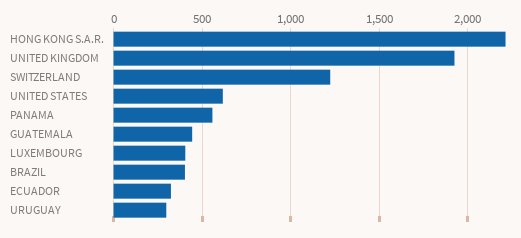
In the year since the leak, there has been no mention in the corporate media of the fact that the amount of UK companies, banks and accountants complicit in the scandal ranked second highest in an international league table (see below):

Neither has there been any mention of the numerous huge Western multinational corporations or billionaires involved, some of whom sit in the House of Lords. It’s also worth recalling that Harding failed to mention by name the 12 leaders, past and present, identified in the documents. Instead, the Guardian journalist, in line with the methodological approach adopted by Suddeutsche Zeitung, selectively focused on the West’s official enemies – Russia, Syria and North Korea.

There was certainly no impression given in the Guardian article that the global web of corruption and tax avoidance extends to 72 states, heads or former heads of state. Instead, the front cover of the paper at the time sensationally headlined with the words “Exclusive: The Secret $2bn trail of deals that lead all the way to Putin”.

Kowtowing

Neither would one have ascertained the scale of the corruption having watched the UK state broadcaster, the BBC, who chose to mention just five of the 72 – Egypt, Iceland, Gaddafi, Putin and Assad. Central to all this is the pathetic kowtowing to power by our media that’s supposed to be impartial and independent yet they act reflexively on mass by directing their fire at enemies of the state.

Naturally, the media cannot be perceived to be so transparently biased which is why the occasional ‘balanced’ message is required. Step forward the Telegraph. A year ago to the day (April 4, 2016), the paper reported:

“David Cameron’s father ran an offshore fund which avoided paying tax in Britain by hiring Bahamas residents, including a bishop, to sign paperwork…The fund, which was established in the 1980s with help from the Prime Minister’s late father, continues today. The Guardian says it has confirmed that ‘in 30 years Blairmore has never paid a penny of tax in the UK on its profits.”

Nevertheless, the targeting of a dead man is virtually risk free as will be the ‘outing’ of an occasional senile corrupt Lord to be cynically used a sacrificial lamb for the media hacks to peruse over if and when the time is right. Ultimately, the UK Secret Services will never allow the media to publish anything that is likely to damage the ‘reputations’ of leading establishment figures. The Snowden files that the Guardian had in its possession but were requested to be destroyed by M15, are proof of that.

Agenda

On Monday April 4, 2016, I had been watching the UK media all day after the Panama Papers story broke. All of the news bulletins, without exception, prefaced the scandal with either Putin, Cameron’s deceased father or Assad. It’s mainly the first two which are easy and convenient targets intended to deflect away from the crimes that implicate ‘our’ leaders. Almost certainly then, there is a highly motivated political agenda at work here.

This explains why Iceland, who locked up many of its corrupt and criminal bankers, was also named. Following the revelation that the country’s PM was implicated in the scandal, the people of Reykjavik took to the streets in their thousands demanding his resignation which happened shortly afterwards.

The elites on both sides of the Atlantic are concerned about the affect the revealing of widespread and systematic corruption within the high echelons of media and politics will have on the body politic of Europe and North America. They don’t want Reykjavik to spread to London, Paris and Washington. This is another reason why the full scale nature of those implicated is unlikely to be revealed for many years to come, if ever.

What all this highlights is the public is being cynically deceived by the corporate media in order to get their fellow elites off the hook. Craig Murray’s brilliant expose of the BBC Panorama documentary, Tax Havens of the Rich and Powerful Exposed, highlights the extent to which BBC producers and presenters will go to in order to misdirect their audience to this end.

Perhaps less subtle than the overt propaganda pieceSaving Syria’s Children, but no less effective, the BBC related at length the stories of the money laundering companies of the Icelandic PM and Putin’s alleged cellist. As Murray said:

“The impression was definitely given and reinforced that these companies were in Panama. [Presenter] Richard Bilton deliberately suppressed the information that all the companies involved were in fact not Panamanian but in the corrupt British colony of the British Virgin Islands. At no stage did Bilton even mention the British Virgin Islands.”

Murray goes on to say:

“Is it not truly, truly, astonishing the British Virgin Islands were not even mentioned when the BBC broadcast their “investigation” of these documents?”

The BBC, and media in general, are obscuring the key role British money-laundering via its base in the British Virgin Islands plays in these transactions. It can never be stated enough that this corruption scandal mostly concerns the British Virgin Islands. Yes, the corruption is widespread and involves a number of world leaders, some of whom are the UK governments official enemies.

However, in the broader scheme of things, these political figures are essentially peripheral. The level of corruption is widespread and systemic. It’s important that the ruling elites are constantly reminded that the British public haven’t forgotten about the Panama Papers scandal.

Please make a small donation

If you’ve enjoyed reading this or another posting, please consider making a donation, no matter how small. I don’t make any money from my work, and I’m not funded. You can help continue my research and write independently.… Thanks!


Donate Button with Credit Cards

Brexit: A Disaster In Waiting

 By Daniel Margrain

With article 50 triggered, the clock is ticking: the UK government has less than two years to reach a settlement in what is going to be the ‘mother of all divorce cases’. With the Tory government having been, up until now, deliberately vague about what it seeks to achieve during the negotiations, the predicted outcome of Brexit is based on unwarranted optimism at best and catastrophe at worst.

This is not what the British people voted for. It’s not the job of politician’s to support a suicidal Brexit strategy predicated on a racist narrative and false promises written on the side of a bus, but to scrutinize claims and represent the best interests of their constituents by voting accordingly in parliament.

There was never any compulsion to follow- through on a referendum based on falsehoods or pandering to racists. In my view, the Labour opposition could and should have done more to defend the Remain campaign from the crass opportunism of their opponents. Labour missed an ideal opportunity to capitalize on Tory divisions over Europe exemplified by Theresa May’s lies and dramatic u-turns.

Richard Corbett nailed it when he said:

“Until recently, the argument that the UK would be able to thrive without any kind of trade deal with the European Union was only promoted by UKIP and the Eurosceptic fringe of the Conservative party. Now, it is apparently shared by UK Prime Minister Theresa May and her foreign secretary, Boris Johnson, repeatedly saying that “no deal is better than a bad deal.”

Beneficiaries

The main beneficiaries of such complacency have been the Liberal Democrats who are stealing many of the 48 per cent of disenchanted English and Welsh voters who voted Remain from under Labour’s nose. What Corbyn seems to be banking on is that enough people will buy into his ‘island of socialism’ narrative.

This appears to involve his rejection of the notion that the EU, as an international institution, is synonymous with an internationalist conception of socialism. That’s not to say the EU is a perfect international institution – far from it. But its effectiveness in the progressive sense is dependent upon the nature of the governments who control it.

Rather than retreating into the concept of an inverted socialist vision, it’s my view that Corbyn would have been better served by maintaining a strategy of solidarity with other pro-EU socialist colleagues within Europe by helping to create a much more integrated and supranational form of political organisation at the European level and thus radically helping to change the direction of EU policy. Big capital can only be countered by big institutions.

Much of the Tory austerity drive has to do with the systemic and structural limitations associated with state power at the national level. The “pooling of national sovereignty” which implies greater European integration and federalization, goes some way to addressing these limitations, which is no bad thing.

Regardless, many of those who favour greater integration in principle, falsely believe that the lackluster performance of the Euro undermines it. In truth, the national schadenfruede that culminated in the British government’s reaction to the performance of the Euro, is a red-herring.

The problem, as Craig Murray recognized, is not currency union, but the lack of any fiscal union. The one is not feasible without the other. The economic argument for the alleged failure of the EU as an economic project, therefore, cannot be made on the basis of the relative weakness of the Euro, but rather on the lack of any implementation of a fiscal union.

Rolling back

Similar unjust criticisms are leveled at EU legislatures as the basis for arguing for UK withdrawal from the union. The anti-EU right have attempted to roll back the powers of both the EU Court of Justice (ECJ) and the European Court of Human Rights (ECHR). The Brexit establishment has objected to some of the humane rulings of the ECHR. In particular, this includes the protection of the human rights of immigrants at risk of being deported by the UK. The ECHR is itself outside the remit of the European Union.

But the ECJ is bound by the overarching decisions of the ECHR when ruling on matters of specifically EU law. The Tories want a “British” convention on human rights to replace the European convention which if achieved, would further seriously undermine civil liberties and human rights in Britain.

Given the numerous advantages of the EU described, it seems strange that Corbyn hasn’t come out more stridently in public to defend the notion that more, not less, European integration is needed. The labour leader’s calculated rejection of the Remain position is a risky strategy. It’s one in which he seems to be prepared to put all his eggs into one basket.

We will know closer to the next General Election whether the implications of a damaging Brexit predicated on the isolationist neoliberal approach by those who champion it, will be sufficient enough to engender a return to socialism among the body politic of British society.

However, if by 2020 Corbyn’s ambivalence to Brexit backfires on him and he loses the election, it will be the poorest and weakest in society who will pay the biggest price in terms of further cuts to welfare and the undermining of workers rights and protections.

Having left the EU, any post-2020 Labour opposition will have to win arguments on these and other key issues such as social legislation and human rights that are currently protected by the EU but which the Tories have long wanted to opt out of.

Scrapped

There can be no doubt that in a Brexit Britain under the Tories, many European regulations restricting working hours and other employment and social reforms will be scrapped and working class living standards diminished.

This will be achieved through the enactment of something as far reaching as the Great Repeal Act. Embodied in the Statute of Proclamations 1539, the Great Repeal Act will override the preservation of EU law by granting executive powers to enable legislation to be changed by order, rather than through parliament; a method of lawmaking wholly at odds with democracy and accountability.

To add salt to the wound, the Tories dream of extending a tax-haven for the super-rich will mean that the 99 per cent will be expected to fund the shortfall of a welfare state depleted of resources. Any future Labour government will be left to pick up the pieces of Brexit against a backdrop in which access to the Single Market both for manufacturing and financial services will of been severely hampered.

With the prospect of London losing its role as the world’s leading financial sector to New York, Frankfurt and Paris due to companies’ relocating resulting from lack of tariff-free access, these problems will be further compounded. Already German car manufacturer’s are bracing themselves for a new era of trade tariffs with the UK because Angela Merkel has warned that she is going to put the interests of the 27 remaining EU members first in the forthcoming Brexit talks.

The possibility of a country like Australia plugging the gap, has been torpedoed by the decision of that nations foreign minister to consider relocating Australian companies from Britain to Ireland in order to allow the country to keep its access to the Single Market. Meanwhile, across the Atlantic, Donald Trump’s trade chief, Wilbur Ross, has urged Britain’s rivals to exploit the “God-given opportunity” of Brexit to take business away from the UK.

Taking back control

These kinds of examples illustrate the nonsense behind the rhetoric of those who argue that Brexit will enable Britain to “take back control”. How does a country take back control of its trade relationships by giving complete control of these relationships to the union it has just left, arguably because its people felt it had too much control of their country?

Paradoxically, what the 52 per cent who voted for Brexit on the basis that the EU have too much control did, was to ensure that the EU have absolute control. In other words, “taking back control” is essentially coded language for saying that the remaining 27 EU members will exercise complete control over precisely what relationship the UK will be able to enjoy with the world’s largest trading bloc.

Moreover, May and Johnson’s populist mantra “no deal is better than a bad deal” means the exact opposite. As Richard Corbett points out:

“The National Institute for Economic and Social Research predicts that leaving without a deal, and thus falling under WTO rules and tariffs, would reduce real wages by between 4.6 per cent and seven per cent. A leaked Treasury report also warns that leaving the EU with no trade deal is the “alternative to membership with the most negative long-term impact” and would cause a “major economic shock”.

Corbett continued:

“Some studies estimate the increase in UK food prices alone could be as much as eight per cent, in addition to those already created by the devaluation of the pound following the referendum. Yet the impacts are not just financial or trade-related. A report from the UK House of Commons’ cross-party foreign affairs committee highlights the difficulties that UK citizens in other EU countries, and EU citizens in the UK, would face on issues such as residence rights, access to healthcare, employment rights, cross-border civil law disputes and pensions if we exit with no arrangements in place. It would also take our universities out of European research programmes, our police out of cross-border crime-fighting systems and our airlines out of EU skies.”

White Paper

Then there is the issue that the British people voted for Brexit on the basis that in so doing they would ensure parliamentary sovereignty would be reclaimed. But, as the government’s Brexit White Paper reveals, this is yet another false argument. Parliament has “remained sovereign throughout our membership to the EU”.

In a section titled “taking control of our own laws”, the White Paper states: “The sovereignty of Parliament is a fundamental principle of the UK constitution. Whilst Parliament has remained sovereign throughout our membership of the EU, it has not always felt like that.”

Even the suggestion that the fishing industry has a glittering future as a result of Brexit falls apart given that 60 per cent of fish landed in British ports arrives in Scotland which voted to Remain.

Meanwhile, the DUP’s Nigel Dodds seems to be suggesting that Sein Fein are poised to head for full unification of Ireland which means the UK won’t exist anymore. Then there is the issue of Scottish independence. A few days ago the Scottish parliament voted for another referendum.

This puts Theresa May in a difficult position. On the one hand, the woman who argued that “we need more unity” while undertaking negotiations that guarantee disunity, can’t be seen to be granting Scotland a referendum. This is because if she loses she will be forced to resign. On the other hand, if May does grant Scotland a referendum and puts a date on it, she will send her negotiators to Brussels without knowing what her own country looks like.

Michael Howard’s jingoistic remarks over the British money laundering tax haven, Gibraltar – 96 per cent of whose residents voted Remain – will undermine Britain’s negotiating position no matter what approach May decides to take. It’s quite possible to envisage a situation in the near future in which the “country we got back” consists of nothing more than England and Wales.

In the comments section of a recent LabourList article, Richard Dean provides a neat “conservative” summary of the likely impacts resulting from the irrational Brexit position. He writes:

  • We are going to get control of our borders, but according to leading Brexiteers this is not going to change immigration much, because we actually benefit from immigration overall.
  • We are going to get control of our laws, but according to leading Brexiteers this does not mean that anything much will be changed. At most we might tweak a few little things here and there, but Brexiteers don’t know what things.
  • We are going to get control of our money, except that we are likely to end up losing money as a result of the loss of trade with the EU27. We will probably lose about the same as we gain from not paying the famous £350 million.
  • We are going to be able to strike trade deals with countries outside the EU, just like the trade deals that we currently benefit from by being inside the EU.
  • We are going to leave the ECJ, and then negotiate an identical arrangement to settle trade disputes. We will agree to be bound by whatever the independent new adjudicators adjudicate, just like being in the ECJ, because if we didn’t do that it wouldn’t be the independent arbiter of trade disputes that every trade deal needs.

David Jackson adds:

“Brexit is the equivalent of doing a parachute jump without checking the pack on your back actually has something in it. Still it’s not the falling that does the damage its the sudden stop at the bottom or in our EU exit case in 2 years time!”


Please make a small donation

If you’ve enjoyed reading this or another posting, please consider making a donation, no matter how small. I don’t make any money from my work, and I’m not funded. You can help continue my research and write independently.… Thanks!


Donate Button with Credit Cards

Justice for Alexander Blackman. But shouldn’t Fallon have been in the dock too?

Claire Blackman, the wife of Alexander Blackman, speaking outside the Royal Courts of Justice (Photo: PA)

 By Daniel Margrain

On March 28, 2017 justice was seen to have been done at the Court of Appeal in London where the murder case of Royal Marine, Alexander Blackman, was reduced to manslaughter. Back in September, 2015, the Daily Mail reported on a leaked dossier that contained crucial evidence withheld from Blackman’s court martial into the killing of a mortally wounded Taliban insurgent in Afghanistan.

Military chiefs solely blamed Blackman for the killing. However, the report into the incident says that his over-stretched unit was being pushed to be too aggressive; that his senior officer was not prepared for the demands of the war zone and that there were signs that Blackman’s unit was cracking up. All these things, the leaked report says, were missed by commander’s.

If not for the investigative work of the Daily Mail and the informant who unearthed these details, none of the MOD’s censoring of the admission of command failings in Helmand province would have come to light. What the paper revealed, is that the MOD conducted a report into their own actions and put a black line through anything that didn’t make them look good.

Warning signs

The MOD report said that the supervision of the commanding officer where Blackman and his men were based was insufficient to identify a number of warning signs that could have indicated that they were showing evidence of moral regression, psychological strain and fatigue. I think you and I would show evidence of moral regression if somebody was shooting at us while we were at work.

The Daily Mail says this shows that high-ranking officers were partly responsible for the extreme state that Blackman was in when he pulled the trigger. The report, which formed a major plank of his battle for justice, was debated in Parliament on September 16, 2015. The papers discovery of the full executive summary of the report was followed by minsters’ caving in to demands from Blackman’s lawyers to have confidential access to all its 50 pages. What was the MOD trying to protect?

It’s not for the benefit of the British public that this report was blacked out, but for the benefit of pen-pushers in the MOD. “Blackman and his troops were at breaking point”, says the Mail in their report after a “tour from hell in Hellmand province that had seen comrades tortured and killed.”

But the Daily Mail investigation discovered that Blackman’s court martial was blocked from hearing the truth about these mitigating circumstances. The executive summary of the Navy’s report into the shooting that was leaked to the Mail  was marked “official-sensitive”. It lays bare how commanders were blind to the psychological strain and fatigue endured by Blackman and his men.

Censored

The fact that the damning conclusion is blotted out with censors’ black ink illustrates how the UK government refuse to acknowledge that there are any systemic problems within the corridors of power. On the contrary, they have shifted criticism from attributing blame to those within the high chain of command towards the whistle blower and the journalists who exposed the scandal.

Meanwhile, in responding to a question in the House of Commons from Green Party MP Caroline Lucas, Defence Secretary, Michael Fallon said the estimated number of ISIS fighters killed as a result of UK strikes from September 2014 to 31 August 2015 was around 330. “This figure is highly approximate,” he said, “not least given the absence of UK ground troops in a position to observe the effects of strike activity.” He added that he believed no civilians had been injured or killed by such strikes. “

Fallon effectively admits that the British government doesn’t have the faintest idea how many people had been killed by British airstrikes in the year up to 31 August 2015. If he doesn’t know how many had been killed, it follows that he doesn’t know who had been killed and in what circumstances. Therefore, he is unable to satisfactorily conclude, as he did, that it was his belief that “no civilians had been injured or killed by such strikes”.

Imminent threat

Fallon’s inconsistent line of argumentation followed the extrajudicial murder of two British citizens in Syria justified on absurd grounds that the alleged terrorists presented an imminent threat to the population in Britain thousands of miles away. The notion the government acted in self-defense in this case is preposterous. What Fallon’s comments, on the one hand, and the initial conviction of Blackman for murder on the other highlight, is the contradictory approaches the state takes towards the crime.

Logically, it’s only possible to claim you are under imminent threat from terrorists if you are able to identify the nature of the said threat. The only way to do that is if one is able to identify those who are allegedly threatening you. How then, can the government claim self defense under such vague circumstances? Dropping bombs from a great height in order to supposedly ‘target’ terrorists can never be precise despite the propaganda claims to the contrary. Killing in this way is necessarily indiscriminate.

How can it be the case that commanding officers who were partly responsible for the extreme state of mind of one of their underlings, and a foreign secretary who oversees them all, get a free pass for murder, while one of the men at the bottom of the chain of command who pulled the trigger on a foe in the battlefield while under enormous stress, was initially sentenced to life imprisonment for the crime?

It’s reasonable to assume that there are certain circumstances in which somebody on the battlefield who is showing evidence of moral regression, psychological strain and fatigue, and whose life would almost always be under imminent threat, could be justified in killing an enemy combatant. But it’s impossible to envisage the mitigating circumstances by which it could be justified for others higher up the chain of command who oversee or give orders to others who kill by pressing buttons on computer screens.

Telling

It’s perhaps telling that at the time of Blackman’s conviction for murder, not a single political establishment figure within the Cabinet came forward to publicly criticise the decision. On the contrary, the then PM David Cameron, prior to a visit to see the Afghan president, defended the decision of the court to imprison Blackman for life.

This is a classic example of the elite class closing ranks in order to deflect the massive crimes of the establishment onto soldiers on the ground. I, for one, am glad that justice was finally done at the Court of Appeal. The question is, when can we expect to see the likes of Michael Fallon stand in front of the judges to face justice?

Please make a small donation

If you’ve enjoyed reading this or another posting, please consider making a donation, no matter how small. I don’t make any money from my work, and I’m not funded. You can help continue my research and write independently.… Thanks!


Donate Button with Credit Cards

What Kind of A Society Are We Prepared to Fight For?

By Daniel Margrain

Pushing Earth of a cliff

In my February 21, 2017 article for Scisco Media I focused on the “conscious cruelty” inflicted by recent Labour and Tory governments’ on some of the weakest and most vulnerable people in our society. The piece proved to have been quite popular, reflecting a widespread hatred of a largely out-of-touch political class whose underlying set of principles are not much different to those that typified the rise of Nazism during the 1930s.

I pointed out that New Labour “feminist” ideologues like Harriet Harman and Yvette Cooper were complicit in ensuring that Tory attacks against the sick and disabled would be implemented. The notion that both the Tories and Right factions within the Labour party consider Britain’s “low-lying fruit” as a drain on society to be eliminated, is not as far-fetched as some might believe.

This was certainly the view of Pat Hibernian McQueenie who commented:

“Good piece, it is time for JC and JMCD to remove the linen glove and put on the Iron Fist. If these two Politicians are removed from their posts the British Working Class will cease to exist. A new Class will be born or I should say reborn The British Slave Class will be implemented by the Right Wing.

Queuing at Work Premises I would use gates but there are not that many Left anyway all you who voted for the Tory be afraid be very very afraid. Death Camps will spring up in isolated places and I think you know the rest. All of You Should Have Watched “THE NAZIS A WARNING FROM HISTORY”

I hope whatever God if any You Worship Forgives You because I a disabled Human Being who worked all his Life from 9 until being struck down at the age of 59 WILL NEVER FORGIVE YOU SELFISH SCUM SOCIETY You are the Worst Stupidest EVER.”

My piece also appeared to have struck a chord with Elizabeth Newport who wrote:

“Labour’s apathy since 2010 over the appalling benefit reforms upsets me more than the fact the tories have done it. I expect the tories to scapegoat and demean the vulnerable, that’s what they do, but I expected Labour to make their lives very difficult and for charities to be extremely vocal.

The truth is no one cares about the vulnerable, the electorate voted the tories in knowing what their plans were. Labour rolled over on the welfare reform bill. When we have all died from stress and poverty or killed ourselves they will find a new group to scapegoat. I can honestly say that as a mentally disabled person I have never felt so hopeless with regards to any political changes. I was a single parent in the early 1990’s when single parents were blamed and targeted. This is even worse.”

Elizabeth is partly right. The Tories did not mention who their intended target was for the cuts. Not one mainstream journalist leading up to the election pressed then DWP minister, Iain Duncan Smith, for clarification, and therefore, the Tories had no mandate with which to implement their stated programme of cuts.

Pathological

Although it could be reasonably argued that people rarely base their decision to vote for a party on a single issue, the notion that poor people vote in large numbers for the Tories who clearly have them in their sights, is only incomprehensible if one is of the opinion that such people are immune from directing similar forms of pathological hatred against those who are even poorer and weaker than they are.

Of course, the far-right tabloid media play a major part in fanning the flames of hate. But it’s insufficient to put the blame solely on them. Despite falling sales, Murdoch continues to shift millions of copies of the Sun on a daily basis and nobody is physically forcing working class people into the shops to buy it. It’s not just the Tories who pander to the whims of Murdoch either. New Labour under Blair and Brown, were only too eager to appease the racist demographic in the country.

Charity-industrial complex

A corrupt corporate media-political system dominated by power and money means that, literally, the government is getting away with murder. This injustice was articulated by Iam Klaatu in the comments section:

“I do not understand why this is allowed to continue? There are so many breaches of the Universal Declaration of Human Rights, especially Articles 23 and 24, and even United Nations condemnation! And under Articles 2 & 4 of the Convention for the Prevention and Punishment of the Crime of Genocide, we have EVERY RIGHT, to see not just politicians and Lords, but EVERY SINGLE INDIVIDUAL RESPONSIBLE, from politicians, civil servants, job centre staff and managers, they can and WILL be made accountable for this crime against humanity!

The passive approach among what I refer to as the “charity-industrial complex” also play a complicit role. Klaatu continues:

“So why doesn’t Scope, MENCAP, MS, Cancer Research, etc etc etc , get off their backsides and unite, and stop this genocidal policy??? Or are they afraid of seeing their funding cut??? Their apathy is sickening!!! David Cameron, has even made patron of a charity, whose people are just one group of people that HIS government has hounded and starved to death!…It is an outrage!!!”

Eugenics

It’s my view that what we are witnessing in Britain today, is an early manifestation of a policy of eugenics which will become increasingly more obvious in the years ahead, particularly as robots begin to create a growing pool of idle ‘useless eaters’ among the existing white collar and blue collar workforce. Eventually, a critical-mass point will be reached in which the government of the day will be forced into making binary political choices.

Future governments will be faced with either funding a Universal Basic Income system or resist the necessity for change and, therefore, be prepared for mass civil disobedience on the streets of our towns and cities. As successive governments over the last 40 years have preferred the punitive ‘stick’ rather than the incentivising ‘carrot’ approach, the introduction of a UBI system is far from being a formality.

Of course, none of these potential policy proposals can be announced publicly by the government of the day, or by their media mouthpieces. Rather, the aim is to introduce them incrementally. It’s clear that the eugenics policy is one that is already well under way in Britain in 2017.

The latest in a series of appalling stories to have emerged, concerns Nicola Jeffery, a single parent from south east London. Nicola has fibromyalgia which causes chronic pain across the body. She is one of thousands of people with “invisible disabilities” whose benefits have been axed by the Tories as a result of new “reforms” to the personal independence payment (Pip) benefits system.

The “reforms” are part of a wider long-term strategy of welfare retrenchment, austerity and cuts to those most in need. The aim is the destruction of civilized society. All associated notions of civilization that people have come to take for granted – NHS, social care, fire service, education, public child care provision etc – are being whittled away and sold off for the benefit of private capital and shareholder’s, many of whom are working class people.

So we have to ask the question, what kind of a society do we want?

It’s no longer acceptable to solely blame the Tories for the problems we face. Many ordinary people who vote for right wing parties, including a corporate-corrupted Labour party dominated by a neoliberal core of war-monger’s, Friends of Israeli ethnic cleansing and austerity apologists, have to start looking in the mirror and begin educating themselves about what’s going on in their own communities; their own country; their own world.

Taking responsibility

Many of the problems stem from the fact that for far too long, too many people have not been prepared to take responsibility for their own actions, nor to evaluate how the individual decisions they make on a daily basis impact on society in general. The easy option in which people are prepared to look the other way for perceived short-term gain, can no longer be tolerated.

People who litter and fly-tip on our streets and fields, drive aggressively and at speed in built-up areas, in addition to engaging in other forms of anti-social behaviour, need to be politely confronted. We also need to minimize our individual carbon footprints the best we can, buy locally sourced and organic produce and reduce our consumption of meat.

The attitude for many seems to be that as long as they, as individuals, are not directly being affected by the travails going on around them, then they would sooner prefer to be oblivious to them, irrespective of their adverse impacts.

This lack of awareness and compassion for others, rooted in selfishness and crass individualism, is the bane of society and civilization. Although it might not be the case that the individual or close family member is seemingly unaffected, the nature of the direction of travel in society is such that in the absence of viable alternatives, it will nevertheless become the case further down the line.

Finite planet

Although it might not be the situation today, tomorrow or the day after that, the fragile nature of the planet humanity inhabits, means that the infinite grabbing of finite resources will eventually result in insurmountable negative repercussions in which even the super-rich will not be immune. After all, environmental degradation affects everybody and air pollution is democratic.

Never has Pastor Niemoller’s famous aphorism been more relevant. Climate change is altering the very fabric upon which the functioning of civilized society rests. What use can a depleted planet wrought by a system that prioritizes the accumulation of wealth for wealth’s sake, serve for an elite that continuously craves it? The answer, of course, is that such a planet is of no use to any living thing.

The time to save humanity from itself is fast running out which is why we need to act. However, political shifts at the ballot box alone won’t be enough. We need collectively to go beyond naval-gazing towards positive action. We need to start getting informed about the real issues that humanity faces going forward and start to begin to look for radical solutions.

But we can only do this if an informed public is in a position to be able to correctly identify the cause of our collective malaise. Instead of devoting our energies on attacking the Other for the problems we face, we need to identify and target the source of our oppression. This means we have to think Big.

The local-global nexus, has arguably never been as relevant as it is now. This is because unlike previous epochs, we are the potential authors of our own destruction. In the past, as we moved from one socioeconomic and political form of organisation to another, we confronted, head on, the challenges we faced.

From hunter-gatherer societies through to feudalism, humans were master’s of their own destiny and they survived and prospered along the way. But during the latest capitalist phase, we have seemingly failed to acknowledge our limits as a species.

We cannot reason that lack of knowledge is the cause for our downfall. At the crossroad point along the metaphorical super highway, we made the informed choice to turn rapidly right in the certain knowledge that at the end of the road was a cliff whose precipice we were fast approaching but decided to continue along it’s fatal path regardless. For a species that claims to be at the top of the intellectual food chain, we sure are dumb.

Falling off a cliff

The truth is, we’ve not only sped to the cliff’s edge akin to being passengers of an out-of-control juggernaut, but we are plunging, free fall, towards a giant burning cauldron. We possess parachutes that are, in theory, capable of saving us from the affects of free-fall, but are fast reaching the point where the only eventuality will be hitting the ground with a thud.

Currently, we are at a critical stage between an insurmountable fate and a precarious survival. One of the things that can save us from our mass hypnosis and passivity in the face of a self-inflicted untimely death, is mass collective action. But collective activity in the strict political sense of the term is not enough either.

We also have to start radically changing our behaviour as consumers. This means a dramatic shift in expectations. It’s no longer reasonable for people to expect to spend £2 on a tee-shirt that has been produced by sweated labour in Pakistan, or to feign ignorance in order to justify other forms of immoral decision-making. Crucially, we need to stop buying ‘things’ we don’t need with money we haven’t got.

Because consumption is effectively the oil that lubricates the capitalist system, alternative forms of collective action on a massive scale will naturally correspondingly alter the way the current set of consumption-production relations function. This can only be beneficial for humanity and the planet.

Like the impact of a stone that lands in a pond whose ripples gradually spread further afield, the individual choices we as consumers make, in conjunction with our political choices, can eventually begin to set us free. But we need to hurry up because time is fast running out.

Please make a small donation

If you’ve enjoyed reading this or another posting, please consider making a donation, no matter how small. I don’t make any money from my work, and I’m not funded. You can help continue my research and write independently.… Thanks!


Donate Button with Credit Cards

Kind To Be Cruel: Female Judge Blames Women For Rape

By Daniel Margrain

Image result for judges hammer

As recently as fifty years ago, the courts in Britain didn’t recognize marital rape. In other words, during that time it was legal for married men to have sex with their wives without their consent. A recent rape case  in Manchester presided over by a female judge appeared to suggest there is still a long way to go before attitudes to the crime of rape perpetuated against women are satisfactorily addressed.

Judge Lindsey Kushner’s claim that women are at greater risk of being raped if they get drunk, was rightly condemned by Police and Crime Commissioner, Dame Vera Baird. In her final line in her final criminal trial, Kushner said:

“I don’t think it’s wrong for a judge to beg women to take actions to protect themselves. That must not put responsibility on them rather than the perpetrator. How I see it is burglars are out there and nobody says burglars are OK but we do say: Please don’t leave your back door open at night, take steps to protect yourselves.”

However, this analogy falls apart because it fails to recognize there is a history in Britain of blaming women for sexual assaults committed against them rather than putting the blame where it belongs – on the attackers. The same line of reasoning is not applicable to drunk men who, for instance, happen to get mugged in the street. In such cases, judges will rarely place the onus for such attacks on the male victim.

In jailing the rapist in Manchester, Kushner said there was “absolutely no excuse” for sex attacks. But she contradicted herself moments later after adding the caveat, “Men gravitate towards vulnerable women.” She insisted that while women were entitled to “drink themselves into the ground”, their “disinhibited behaviour” could put them in danger and they were “less likely to be believed” than a sober victim.

The implication that women can do as they please with their own bodies by drinking themselves silly, but that this scenario means they are more likely to get raped, effectively shifts the onus for the crime from the perpetrator to the victim and will almost certainly prevent the latter from coming forward in the future.

Despite judge Kushner’s contradictory comments that appear to be more suited to 1967 than 2017, there have been no shortage of men and women who have come to her defence. Others, that include a victim of rape, seem at best confused about the issue, perhaps understandably given the trauma involved. Nevertheless, it’s inexcusable how anybody else in the sober light of day (excuse the pun) could regard the judge’s comments as anything other than outrageous.

The fact that the controversy was not regarded as being worthy of prominent coverage on mainstream TV news channels is indicative of how societal attitudes regarding such matters seem to be in reverse. Thankfully, the issue was covered in some length by LBC broadcaster, Maajid Nawaz, whose clarity of thought was a welcome counterbalance to the illogical and contradictory points made by some of the callers to his show.

Nawaz’s opening salvo was lucid and convincing. Exposing Kushner’s false burglary-rape analogy, the LBC presenter remarked:

“There isn’t a history of hundreds and perhaps thousands of years of homeowners being blamed for burglary. But there is a history of hundreds and perhaps thousands of years of women being blamed for rape.”

Nawaz continued:

“The problems I have with the kind of remarks uttered by the judge in public, is that victim-blaming is part of a slippery slope. Where do we draw the line? Do we say if a woman’s skirt is too short, should she also bear a level of responsibility for a man (or woman) sexually abusing her? Where does this stop? Where is behaviour ever acceptable for somebody to say, ‘well you shouldn’t of done that'”?

The LBC presenter added:

“For me, this comes down to the following question: What sort of country do we want to live in? Do we want to live in a country where women have to take increasing measures to stop being sexually attacked, or do we want to live in the kind of country that encourages women to wear, eat and drink what they like, and don’t expect to be attacked for doing so?

The alternative is the slippery slope [towards fascism and religious extremism]. In other words, why stop with being drunk? Should women be prevented from wearing short skirts and, if they resist and are subsequently raped, are they to be held responsible? Why stop there?

Why not insist that women wear their hair in a bun or be prevented from wearing make-up and lipstick on some spurious basis that rapists might find it attractive? Why stop there? Isn’t it possible that rapists will justify their predatory actions on the basis they find women’s faces to be attractive and therefore they should be forced to cover them up with a veil like the women who are under the control of the Taliban? “

In other words, the corollary of the illogical line of reasoning of judge Kushner is that the right of women to be able to go about their everyday business should be restricted in order to prevent them from being raped. The attitudes of judges, both male and female, to sexual assaults on women, continue in 2017 to belong in the dark ages.

Please make a small donation

If you’ve enjoyed reading this or another posting, please consider making a donation, no matter how small. I don’t make any money from my work, and I’m not funded. You can help continue my research and write independently.… Thanks!


Donate Button with Credit Cards

Cuba: Dreams, Beauty & Disillusionment


By Daniel Margrain

a1_20161127_cubadsc0448720161127_6000-x-4000_fe-24-70mm-f4-za-oss

In a previous article, I discussed the egalitarian nature of politics and society on the Island of Cuba and its relationship to the authentic urban experience. In an attempt to contextualize the piece, I would like to take this opportunity to express some thoughts about the two months I spent traveling independently throughout this beautiful Caribbean Island during late 2009 and early 2010.

I arrived in Havana from Madrid in the late evening of November 17, 2009 and settled in at the famous Plaza Hotel which has all of the grace and fading colonial splendour I had anticipated. The wooden shutters in my room opened up to a small balcony that overlooked a dusty and dimly lit street below whose initial appearance had a sense of serene calmness about it as if I had stepped into a Edward Hopper painting. Except for the sound of the occasional taxi that passed in the street directly below me and the flickering echo of distant voices, the streets remained eerily quiet.

Bustling

It wasn’t until the following morning from the rooftop of the hotel that the aromas of the city, bustling street life and clogged roads in the distance below – set against a backdrop of crumbling tenement buildings, colonial edifices and pot-holed roads – became evident in this unique metropolis. The vivaciousness, eclecticism and atmospheric energy of the Caribbean’s largest city has survived everything that has been thrown at it throughout its 500 year history and continues to stand as a beacon of resistance against U.S imperialism today.

For this writer, it was the visceral and abstract, as opposed to conventional notions of beauty, that was Havana’s main appeal. The overriding sense of a city that forms part of an Island of quasi-socialism within a sea of capitalism, and all of the contradictions and potential opportunities that this entails, is palpable for the first time visitor. Graham Greene was right when he said that Havana is a city where “anything is possible”.

The opportunity to be mesmerized by the hustle and bustle of all that surrounds you whilst constantly reminding yourself of the historical significance of the city in both time and place, opens up a potential space in which you can lose yourself in the melee and embrace the cities earthly authenticity. No other city in the world that I have visited has quite the aesthetic seductiveness for the flaneur as Havana has.

Although some of the bars in the renovated parts of Habana Vieja did tend to be frequented by tourists enamored with a Hemingway fetish, traditional sites aside, at no time did I feel that the city was some kind of trussed-up tourist resort or cynically concocted amusement park.

It’s along the kilometre-length stretch in the nearby Calle Obispo that the city really bursts into life. A rag-bag collection of hustlers, drunks, artists and musicians throng the street from dawn until dusk after which time the cramped drinking dens come into their own. Musically accomplished and professional-sounding resident bands who can be heard for free playing everything from jazz and the traditional son through to calypso, folk and salsa way into the early hours, throng the bars.

Beating heart

The beating heart of the city metaphorically pulses to the sound of live music in much the same way as New Orleans does. Whether it emanates from somebody’s balcony or from the bars and streets, the eclecticism of a city where music and architecture seemingly fuse into one, means that visitors and residents alike are rarely far from either.

The latter, is one of Havana’s main draws. Some of the buildings and squares which are shaped by a colourful colonial history and embellished by a myriad of foreign influences that gracefully combine baroque, neoclassical, art nouveau, art deco and modernist styles, are visually stunning. Unfortunately, much of it has been left to fester in an advanced state of dilapidation, largely as a result of the turmoil of three separate revolutionary wars.

Thankfully, though, the cities well-preserved historical core has survived into the 21st century relatively unscathed. One of the most impressive of these ‘survivors’ is the magnificent 18th century baroque Catedral de San Cristobal de la Habana. This graceful-looking edifice was once described by the Cuban novelist Alejo Carpentier as “music set in stone”. This, if anything, is an understatement. Words cannot describe the emotional impact this building and the beauty of its tranquil surroundings had on this writer.

It’s difficult to fully set aside the vibrant and colourful cultural preconceptions associated with Havana from a life-time of images ingrained in ones consciousness. Some of these images have an objective basis in reality, while others are mainly subjective fantasies and caricatures. The Havana experience in its totality, though, is never less than alluring.

To what extent you allow yourself to be immersed within either aspect is largely dependent on the individual. “Habana is very much like a rose”, said Fico Fellove, in the movie The Lost City, “it has petals and it has thorns….so it depends on how you grab it. But in the end it always grabs you.” If one fails to be grabbed by Havana’s eclectic charms, then just like somebody who might happened to have become jaded of London in the 1980s, it’s perhaps ones own life that needs to be questioned.

Trinidad

As culturally stimulating Havana is for the visitor, I nevertheless made the decision to journey further afield in order to broaden my Cuban experience. After eight days in Havana (to which I was to return at the end of my Cuban trip), I decided to take a bus to the old Spanish colonial town of Trinidad (pop. 50,000) 375km to the south side of the island.

After an eye-opening bus journey along near-deserted ‘highways’ interspersed with lush green paddy fields and remote villages, I was in the end relieved to arrive at my destination, particularly as the coach driver insisted on playing a music video of what seemed like the entire works of Boney M on repeat throughout the entire length of the journey.

Upon my arrival at the local bus station in Trinidad, I was met by my host Dr Carlos, a dermatology specialist who made me feel very welcome at his Casa Particulare (Hermanos Albalat) on nearby Frank Pais Street. During the day, I would spend my time relaxing on Playa Ancon, 12km south of the town, and during the evening I would stroll aimlessly around this quaint old town, drinking copious amounts of dark rum and listening to live music or people-watching at the Casa de la Musica situated at the top of a wide stairway just off the central plaza.

It was on the steps of the Casa dela Musica on my last night in Trinidad that my overriding lingering memories of the town remain. Nearby, a musician played solo flute and a small child flew a kite overhead as a quarter moon emerged flickering on the palm-fringed horizon in the distance below. For one brief moment I had thought I had gone to heaven.

Cienfuegos

Cienfuegos Banner.jpg

My next destination was the two hour bus journey to the French-influenced fortress port city of Cienfuegos in the province of the same name, home of the ‘The Barbarian of Rhythm’, Benny More.

The city sits on a beautiful bay surrounded by the lush-green and fertile Las Villas Plain that opens into the Caribbean Sea. The legacy of French migrations to the city is evident both in terms of its neoclassical architecture and the wide grid-like street layout. Cienfuegos is an industrial city that appears to rely less on tourism then either Havana or Trinidad, largely because much of the region is devoted to the cultivation of sugarcane and the growing of coffee in the mountains to the southeast of the city.

Upon my arrival, I was struck by how the city reminded me of Penang or Bangalore. Its billing as “The Pearl of the South” is one that has not been over-hyped. In fact the city lives up to its tourist brochure description as consisting of a “world compromised of a multiplicity of shapes, colors and aromas that seduces the visitor….” This is a city where one can enjoy local ‘crooners’ belting it out at the Cafe Cantante More well into the early hours, or witness the sight of young Cuban’s reveling at the Club Costa Sur and walking arm in arm by the Malecon.

A typical afternoon involved strolling about town where I would regularly see local people queuing, ration stamps in hand, for essentials like sugar, butter, milk and rice, before I would return to my fully equipped CFC-free refrigerated and energy-saving light generated Casa for a siesta. Such are the contradictions of Cuban society.

But then I am reminded that Cuba is in a state of effective war with his neighbour 90 miles away. Under these circumstances, the normal functioning of society is an impossibility and the suspension of ‘formal’ democracy the norm. The US trade embargo with Cuba has hit the country hard. The US-imposed 1992 Torricelli Act prevents foreign subsidiaries of US companies trading with Cuba and prohibits ships that had called at Cuban ports from docking at US ports for six months.

The end result of this draconian attack on the country, is the effective banning of virtually the entirety of the rest of the world trading with Cuba. This explains why ninety per cent of banned goods consist of food, medicine and medical equipment which naturally is causing terrible suffering, even death, in the country.

Cuba has been left adrift by what are widely considered to be the major players within what is often euphemistically referred to as the ‘international community’, but nevertheless is a ‘modern miracle’ which had, as I was about to discover, emerged defiant and strong.

Two-tier economy

Within Cuba a two-tier economy appears to have emerged. Professional and skilled workers like doctors and engineers, whose monthly state salaries are barely enough to pay for a pair of trainers, look elsewhere – usually the tourism sector – for a means to supplement their small incomes. It would appear that the tourist dollar and the hefty taxes and supplements the Cuban government generate from visitors, is an insufficient source with which to pay the Cuban people a decent salary.

It was clear to me, that many Cuban professionals, particularly many of the young, are hungry for change. It was also apparent that some, but by no means all, want out of Cuba. From my experience though, the majority of Cuban’s adore their country and would do anything to defend the revolution. But there also exists a kind of resigned pragmatism regarding the countries likely future transition to capitalism.

During my trip there was much discussion about the impact Obama, who had recently been elected as U.S president, would have on Cuba. The consensus appeared to be that he would be the catalyst for positive change in the country. But these changes were envisaged as only being possible within the context of a transitional Cuban government of which the lifting of the embargo would be the first step in the cooling of US-Cuban relations.

Due to the 1996 US Helms-Burton Act, the tightening of the embargo was pulled up a notch by the U.S, not loosened. The hope for many was that under Obama, Helms-Burton would be repealed. However, Obama’s impotent legacy resulted in these hopes being dashed. Given the perilous state of the U.S economy under his successor, Trump, any radical shift in Cuban politics, post-Fidel, seems equally unlikely.

Disparity

During my time spent in the country, I stayed in a variety of different sized accommodations from the small apartment to the large family house and I wondered how this disparity could be explained given the nature of Cuban society. I was also curious how, in practical terms, Cuban people managed to move home and set up new lives in new cities and towns within the context of a country where private property is non-existent.

I discussed these topics, as well as the comparative notions of democracy and human rights in Cuba, with some British travelers whilst on a boat trip around the crescent shaped coast of the ‘Jewel of the Caribbean’ on a cloudy and relatively cold December evening. Like myself, my fellow travelers had been unable to get any answers to these questions. It was clear that I was not going to be able to satisfy my inquisitive mind in the charming laid back atmosphere of Cienfuegos where time appeared to have stood still.

Peter Linebaugh

What struck me most about this beautiful city, is that the things we in the West take for granted, like the notion of time, appear to have no real meaning or relevance in Cuba. This concept squares with Peter Linebaugh’s contention that the essence of time and the spaces it fills in the vacuum left over from unprofitable “surplus” free time, are necessarily constrained by a capitalist economic logic that prioritizes the accumulation of profit above all other human activity.

As Linebaugh asserts, the emergence of the mass-produced time-piece during the 18th century, reflects this overriding obsession with time and its negative affects in perpetuating and reproducing the disciplining of workers as part of the prevailing capitalist order.

The Cuban people’s disrespect for time was no more evident than in the streets of Cienfuegos – arguably the most authentic of all Cuban cities. The relatively well-maintained streets, squares and open spaces in the centre of the city, provide the backdrop for idle chatting, drinking, eating, the playing of dominoes, chess, baseball and general relaxation. Cuban’s of all ages embrace, kiss, talk and laze about – it’s an intrinsic part of the way Cuban folk spend their time together.

I witnessed joy and happiness, as well as sadness and despair on the faces of the people on the streets of Cienfuegos, much like anywhere else on the planet. But of all people in ‘third world’ countries, Cuban’s are by a country mile, some of the most humble and dignified of any that I met on my travels. This is despite the fact that they suffered terribly following the break-up of the Soviet Union during the three years 1991-94.

Crisis

The current crisis in the Cuban economy can be traced back to this period in the nations history. The ending of Soviet subsidies that had effectively sustained the Cuban economy for 30 years had, by the end of the decade, become reliant for its growth on a rapidly expanding tourist industry. But this growth was fragile because it did not reflect any deep transformation of the economy.

Nevertheless, I saw no evidence of the horrors of that period. In Cuba, unlike for example,’democratic’ India, I did not see emaciated and starving people, neither did I see vast inequalities of economic wealth, or witness the social fabric of a country at the point of collapse. Civil society in Cuba – albeit limited by Western standards – functions relatively well when compared to many other countries that we prefer to call ‘developing world democracies’.

Further, the perception of street safety and well-being was, in my experience, a reality in the towns and cities I visited throughout the country. Whilst widespread alcoholism, drug addiction, petty theft of property and other social misdemeanors, are a regular feature of everyday life in a modern country like Britain, in Cuba this is not the case. During the odd occasions I had brought up this particular topic with Cuban people, the response was often one of total dismay and incomprehension.

Safety

Women can, and frequently do, walk the streets of Cuban cities alone and in safety. This may appear to some folks to be somewhat of a caricature, but in 2009 it happened to have been true. It is also true that Cuba places a high priority on education which is 100 per cent subsidized by the government, meaning that Cuban students at all levels can attend school for free. The government also operates a national health system and assumes monetary and administrative responsibility for the health care of all its citizens. In addition, housing and utility costs throughout the country are minimal to non-existent.

Cuba ranks as having among the world’s best patients per doctor ratios and has levels of infant mortality and life expectancy rates that compare favourably with many of the first world nations of the industrial world. As of 2012, infant mortality in Cuba had fallen to 4.83 deaths per 1,000 live births compared with 6.0 for the United States and just behind Canada with 4.8. I will remind readers, all this has been achieved within the context of an extremely damaging and punitive US-initiated trade embargo which has seen Cuba marginalized and isolated – both economically and politically – from much of the world.

At war

It is also a nation that remains effectively at war with the most powerful country on earth. It is true that democracy as we have come to understand it in the West, has been ‘suspended’ in Cuba on the pretext that it is a country at war, in much the same way that democracy was suspended in Britain during WW2. The draconian embargo is a reflection of this war-footing.

In keeping with tradition, my Cuban hosts in Cienfuegos were friendly, charming and hospitable. I would often eat dinner at the home of my hosts who occupied a rather grand house close to the centre of town. While staying there, I occasionally took the opportunity to watch some television. Cuban output is not unlike most national media throughout the world in terms of its targeting of a specific demographic at different times of the day.

In London, I have the potential to be able to tune into approximately 100 virtually identical channels. In Cuba the number is a diverse four. During my stay, I managed to watch an episode of The Sopranos and the movie Goya’s Ghosts. News and current affairs output and debate in Cuba is clearly more incisive and truthful than its British state broadcasting counterpart, the BBC. For example, there appears to be none of the fake probing and bating in the interviewing style of Paxman, or any of the dubious claims of impartiality and objectivity that typify the BBC.

In terms of the Cuban news media more broadly, the emphasis appears to be focused on Latin American affairs as one might expect. Studio debates seem, by and large, to be genuinely heated, spontaneous and passionate which, at least as far as I was concerned, made for a refreshing change from the kind of bland European and North American-focused, and often contrived, output that passes for news in much of the West.

The income generated by travelers like me was highly valued by my hosts who not only ensured that my every need was catered for but being a guest of theirs, also provided their young son and daughter with the opportunity to practice their English. As there was a big gap in my hosts future bookings they seemed reluctant to let me go. But this was not the only reason. I felt that a genuine mutual friendship had developed between us.

Varadero

Varadero Banner.jpg

Nonetheless, as much as I enjoyed Cienfuegos, my time in Cuba was limited and I felt the time had now come for me to move on. I wanted to get a taste of the Cuban experience within a tourist package environment. This meant only one word – ‘Varadero’ – a relatively developed ‘package resort’ 184 kilometres from Cienfuegos on the Atlantic side of the island.

The contrast with Cienfuegos could hardly have been more striking. Just like Ancona near Trinidad, the raw and ragged coastal setting was picture-postcard beautiful. I arrived as the sun descended on the horizon, its orb the brightest of tangerine orange. As this gigantic ball of light melted into the Atlantic, a handful of tourists began frantically photographing the afterglow – a kaleidoscope of subtle hues that sank into the sillouette of nearby palms and wooden canopies of the restaurants that adorned the bay.

The pork steak and rice washed down with a bottle of Buckaneroo beer that I consumed at a beach-side restaurant that evening made a pleasant change from the rather predictable food of the Casa’s. Saturday night in Varadero was more subdued than I anticipated. The vast swathes of British package tourists that I thought would be filling the hotels and bars never materialized, having been usurped by their mainly French, Italian and Canadian counterparts.

Varadero, much like other places in Cuba where tourists spend much of their time and money in each others company, is a foreign tourist enclave where small businesses proliferate and operate semi-autonomously from the centralized arm of the Cuban state. This small coastal town is littered with restaurants, bars and numerous plush but sanitized all-inclusive hotels.

As of 2009, Varadero was the only place in the country where it’s illegal for Cuban’s to let out the rooms of their Casa’s, which was presumably intended as a means to avoid the eventuality of undercutting the income of the hotel chains. That’s not to say that these illegal private rooms for rent in shared houses don’t exist. They proliferate in the small back streets. I stayed in one.

Hard currency

In Varadero, hard currency in the form of the Cuban convertible, has replaced the Peso as the international monetary language. It is the place that many Cuban’s come to boost their state salaries. The domination of hard currency in the town has resulted in a distorted local economy altering the dynamic of the community, not necessarily in a good way. Varadero is actually a rather sad and uninspiring place – a kind of miniature version of how I imagine Miami to be without the gregarious trappings that one associates with the latter, but nevertheless is as equally as unsuited to the environment from which it has emerged.

Mass tourism and the tourist ghetto that has accompanied it, has created socioeconomic polarizing fractures within the community. Visible, and at times ostentatious displays of material wealth exist here alongside abject material deprivation – a situation that will almost certainly worsen as the relative trickle of tourists here inevitably turn into a flood in the years to come. The apparent irreconcilable forces that are pulling Varadero apart acts as a warning sign to the rest of the country in a post-Fidel world.

Inauthentic

Wherever large swaths of tourists converge who bring with them hard currency in a two-tier economy in which a dual currency operates, all notions of authenticity correspondingly disappear. This is because without access to the Convertible, Cubans are effectively excluded from the social circles, restaurants and bars that tourists frequent. Let me put this into some kind of context. A beer in a hard currency-only bar costs the equivalent of one-twentieth of the monthly salary of a skilled Cuban worker.

If you have access to the Peso (which tourists are able to acquire at any Cuban bank in exchange for the Cuban Convertible or other forms of hard currency like the Euro), a basic meal on the streets of Havana costs the equivalent of 25p. This kind of two-tier economy is not consistent with socialism but rather a highly political bureaucratic state. The revolution that overthrew U.S puppet, Fulgencio Batista in 1959, was in reality an anti-colonial rather than a socialist revolution in which Cuba’s workers were largely onlookers, however sympathetic.

Corruption

State corruption is the inevitable consequence that flows from this set of relationships. Ordinary Cubans who are not connected to either the high echelons of the bureaucratic state or the tourist sector, speak endlessly and angrily about the visible and growing gulf – economic, social and political – between this privileged layer and the majority, whose daily life is a struggle. Tourism exacerbates these divisions which explains why politically, socially and economically Cuba is being pulled in different directions.

For many visitors to Cuba, the ‘authentic’ Cuban experience normally means any combination of the following: reading Hemingway, salsa music, Che iconography, the Buena Vista Social Club, 1950s Cadillacs and bustling smoke-filled bars full of folks drinking Mohito’s and smoking Monte Cristo cigars. But for others – myself included – these aspects of Cuban life represent the fetishization of Cuba – a partial and largely superficial depiction of Cuban culture.

What capitalist relations do, is they distort and exploit these aspects of culture for the benefit of the market as if the whole of Cuban society can be reduced to something akin to a composite painting. In this sense, the most marketable aspects of culture are identified, repackaged and then sold for public consumption as the precursor for the expansion of the capital accumulation process.

The sad and ironic truth is that without the hard currency of the tourists, there would be little ‘authentic’ Cuba for visitors to experience. I’m specifically thinking not about merely the sterile atmosphere of Varadero, but many of the bars, cafes and restaurants in the regenerated Habana Vieja where only the Cuban Convertible is the accepted currency.

This disenfranchises ordinary Cubans from much of the social life of the city frequented by tourists. In this regard, I have a great deal of sympathy for all those visitors –  journalist and writer, Neil Clark included – who have expressed disillusionment with Cuba.

Last day

During my last day in Varadero, I met Karolina, a Polish woman who had, for many years, been living and working in Cuba as a health professional. I asked her about the question of housing and freedom of movement for Cuban’s. She explained to me that the Cuban people are legally allowed to change houses through a kind of swap scheme similar to the principle of council house swaps in Britain. Although she was married to a Cuban and had been living in the country for a long time, she claimed she had many unanswered questions about the nature of Cuban society.

As I sat at an outdoor bar in Varadero across the street from one of the outwardly plush but sterile hotels listening to the resident salsa band work through their worn routine, I realized that the version of Cuba fetishized in guide books like Lonely Planet exemplified in a place like Varadero, no more resembles contemporary Cuba than red telephone boxes, city stockbrokers wearing bowler hats or the Houses of Parliament represent contemporary London.

Many of the young Cuban’s in Varadero, are more likely to aspire to what they perceive to be an archetypal capitalist lifestyle and the consumption that comes with it, then they are to keep faith with the ideals of Fidel. The popular musical genre known as reggaeton that is mainly enjoyed by the young, is more Miami then Havana and the majority of Varadero youth want to be seen sporting the latest designer clothes and sipping Red Bull rather then lingering on a Mohito wearing a Panama or propping up the bar puffing on a Cohiba.

Karolina explained to me that many young Cuban’s, when exchanging homes, are often prepared to ‘downgrade’ their places in terms of size and/or condition in order to obtain cash so as to be in a position to be able purchase elements of this Western ‘lifestyle’. In Varadero, I saw many young Cuban’s dressed in expensive designer clothes and trainers and driving new cars either paid for through tourism, the downsizing of accommodation or through the receipt of hard currency from the estimated one in four Cuban’s who live in exile.

Meanwhile, the majority of Cuban’s who live their lives outside of this bubble, and who have no access to the Cuban Convertible, must make do with their small state salaries. Thus, Cuban society is bound to become increasingly fractured and divisive in the years to come.

Political crackdown

When I suggested to Karolina that this scenario would likely necessitate a political crackdown by the Cuban state which would probably lead to the likelihood of a counter-revolutionary struggle, she looked at me in a resigned knowing way: “Yes, sadly I think this outcome is almost inevitable”, she said….But then added positively, “We people in Cuba have to find a way of looking to the future, and we must believe we can succeed.”

With that positive message embedded in my head, I eagerly anticipated my return to the bustling city of dreamers and street hustlers amid the chaotic frenzy of the dusty, pot-holed strewn streets of downtown Havana where my journey began. Upon my return, I bumped into many familiar faces that I had met in the streets and bars of a city in which one ex-pat, in particular, had made his home.

Having spent a further two weeks here, my time in the country was drawing to an inevitable end. Of the towns and cities in Cuba I visited, Havana was the place I felt most comfortable and relaxed. After two months, my Cuban odyssey – which left me with as many questions as answers – was a mixed one. I certainly recognized many of the problems associated with the existence of a dual currency outlined by Neil Clark which echoed my trips to Eastern Europe prior to the collapse of the Berlin Wall. Nevertheless, my memories of this beautiful country will linger for many years to come.

Please make a small donation

If you’ve enjoyed reading this or another posting, please consider making a donation, no matter how small. I don’t make any money from my work, and I’m not funded. You can help continue my research and write independently.… Thanks!


Donate Button with Credit Cards