Category: corruption

The rot at the heart of British society runs deeper than the travails of Philip Green

By Daniel Margrain

The news that serial tax dodger Philip Green bought his third luxury super-yacht for £100 million, a sum similar to the amount that was effectively sequestered from the BHS pension fund, and which was subsequently hid in tax havens wrecking the lives of thousands of his employees in the process, is symptomatic of the kind of rot that has spread throughout the high echelons of the ruling class. Like rising damp in an old building that spreads throughout the foundations before working its way through the brickwork until it eventually subsumes the entire edifice, Britain is currently suffering from another kind of infestation that of the ruling class “elite” whose unprecedented actions and decisions are undermining the rules and laws on which the proper functioning of a civilized society depend.

The biggest scandal isn’t about the corruption surrounding the Panama Papers, bankers and the revelations about Philip Green (as bad as they are), but about wealth inequality. Currently, the top 1 per cent own as much as 99 per cent of the rest of the world combined. What the Panama Papers revelations highlighted was just how unequal the world is. In his book, ‘The Hidden Wealth of Nations’, economist Gabriel Zucman estimates that worldwide, more than $7.5 trillion is stashed away in offshore accounts. As an indication of just how much that is, the sum amounts to some 8 per cent of the entire financial wealth of the world. About 80 per cent of that has not, and will not, be taxed at all, ever.

This level of tax avoidance increases the wealth gap between the rich and poor. Hiding vast sums of wealth from the prying eye of governments makes it easier for the super rich, represented by the 1 per cent, to remain rich and avoid tax policies which are meant to help the 99 per cent. Off-shore accounts also make it more difficult for everybody else to get rich because of the uneven playing field that results from these tax havens. The 99 per cent among the mainly middle income earners are paying higher taxes to make up for the taxes that the 1 per cent don’t pay.

Although on average slightly less than 8 per cent of all the financial wealth of the world is off-shore, Europe fares worse at 10 per cent. By contrast, off-shore financial wealth in Latin America stands at 20 per cent, in Africa the figure is 30 per cent and in Russia an incredible 50 per cent of all its financial wealth remains hidden off-shore. What all this indicates is the sheer scale of a problem that hits the developing world the hardest where the results for the very poorest who have no access to any form of social protection, can literally be death.

As far as Europe is concerned, the massive use of tax havens began in the 1920s in Switzerland. In Britain this trend became a feature of society around the mid-to-late 1970s. Numerous tax havens had began to spring up during this time which is when the great wealth disparity really started to make its mark. This was no accident. During this period, the function of the state began to change from that of ‘welfare provider’ to more ‘pro-business facilitator’. The ideology that came to embody this change was neoliberalism.

Instead of the direct provision of services administered democratically at the local level, the trend has increasingly been for the state to act as a purchaser of these services which have then been provided privately and indirectly. As each separate financial intermediary takes their slice of the financial pie, the temptation for corrupt practices becomes greater and the concentration of capital and deregulation of labour markets more acute.

With the balance of economic power tilted increasingly towards the rich who are able to buy the influence of politician’s, the impact on democracy has been devastating for millions of ordinary people. This hollowed out system of democracy is one in which the 99 per cent increasingly seem to find it difficult to find some personal and meaningful pattern in a social world dominated by huge and distant monoliths whose power over the livelihood of millions seems absolute.

This explains the growing popularity of ‘unorthodox’ politician’s like Jeremy Corbyn, Bernie Sander’s and even to an extent, Donald Trump, who offer the electorate an alternative to the ‘business as usual’ politics of the corporate controlled political machine. However, until a distinct break with the current system occurs, the masses are faced with the prospect of more of the same neoliberal ideology predicated on austerity.

Contrary to popular mythology, it wasn’t the Conservative government of Margaret Thatcher which came to power in 1979 that invented neoliberalism, rather that distinction is reserved for the preceding Labour administration under James Callaghan. It was the Labour government, not the Tories, who accepted the terms of the austerity package proposed by the IMF in 1976. The main condition of the IMF loan, insisted on by the US Treasury, was that the government deficit must be reduced by cutting demand.

Interest rates were raised and government spending reduced. Wage, job and welfare cuts were the hallmark of the ‘social contract’ between wage labour and capital agreed by the unions to bail out the government. As Colin Leys notes:

“From 1976 onwards, Labour accordingly became ‘monetarist’. Its leaders accepted that full employment could no longer be achieved by government spending but must be sought through private sector growth. For the necessary investment to take place, prices must reflect real values, and this in turn required ‘squeezing’ inflation out of the system and permitting the free movement of capital. In 1978 Treasury officials began preparing to abolish capital controls.”

Spearheaded by the deregulation of the movement of capital, the breaking of the unions and the centralization of state power that favoured the corporations in the running of state enterprises, rates of inequality that had been reduced from the previous highs of the depression years of the late 1920s began to grow again. During the 1920s wealth disparity was huge. Then, as people at the top paid more taxes, and people in the middle began to earn more, the gap became increasingly smaller.

As the consensus between capital and wage labour started to go in reverse from about 1980, inequality began to increase steadily to 1920s levels which is roughly the point they are today. By the mid 1980s tax havens started to emerge in places like the Caymen Islands, Singapore, Hong Kong, Panama, Bermuda the British Virgin Islands and increasingly, London. All of the wealth located in these havens isn’t actually invested their. This means that the vast majority of people who live in, say, London, don’t benefit from foreign money that’s invested in, for example, property due to the massive rise in property prices that result from these investments.

So why do the 99 per cent put up with all this?

Many people tend to get distracted, whether that’s through working all the hours under the sun merely to survive, or through sports or other forms of leisure activities. Many others are angry but feel disconnected from the political process. The politicians, by contrast, benefit from the current situation so they are not motivated to change it, largely because they are immune from any effective political pressure from below.

The consequences for civil society that emanate from the combination of public apathy and apoplexy are potentially extreme. The lack of proper investment in public services like the NHS, social care, libraries and schools will end up with them collapsing. This is a process that to a large extent is already happening. The fact that the super rich have their money stashed away off-shore, while many among the poor don’t earn enough to pay tax in the first place, has resulted in an insufficient tax yield.

The reason why many people can’t get a prompt appointment with their GP, paving stones in the streets are cracked, their libraries are staffed by volunteers and there are pot holes on the roads that never get attended to, is directly linked to these factors. So while public services are being slashed on the one hand, people are increasingly having to pay for the ones that remain with money, in many cases, they haven’t got. If they are fortunate enough to have a job, it’s likely that their disposable income in real terms wouldn’t of increased in the last four decades.

Particularly for the young, the prospects of finding secure, fulfilling and well paid work is as remote now than it has been for at least 70 years and the situation is likely to get even worse as robots begin to replace many traditional blue collar and even white collar jobs. Leaving aside the threats posed by climate change, the underlying root cause of the problems society faces both now and in the coming period, is the inability of governments’ to take a long term approach to tackling levels of inequality that are so extreme that violent disorder on the streets may be the only language the politician’s will take note of.
‘Move along, nothing else to say’: A summary of Cameron’s role in the Panama Paper’s scandal.

By Daniel Margrain

David Cameron’s speech to the House of Commons yesterday afternoon (April 11) was clearly intended to draw a line under the Panama Papers scandal. The Public will keep this in mind when the Tory government remind us all about “belt tightening”, “austerity” and “we’re all in this together”. The government has 92 special advisers on its books whose combined wages costs us, the British taxpayer’s, a massive £8.4 million a year, one of whom we learned this past week is paid £53,000 to “advise” Cameron’s wife about her choice of wardrobe. Maybe the British public should insist these “special advisers” run the country and cut out the middle man?

Cameron was pulled into the Panama Papers debacle last Monday (April 4) after details of Ian Cameron’s (the PMs deceased father’s) dealings featured in the first batch of documents from law firm Mossack Fonseca. This is a problem for David Cameron because he had previously made statements condemning tax reduction schemes by saying they were “wrong”, which is a word he frequently uses to describe problems he appears to have no intention of ever addressing. In 2012 he said “tax avoidance is morally wrong.” Last Monday (April 4) he again stated that those who attempt to hide their money from the UK tax authorities were “wrong”. However, when the tax affairs of his own family were brought into the media spotlight, he appeared to change his tune by claiming that such affairs were “a private matter”.

The next day (Tuesday, April 5) he said:

“In terms of my own financial affairs, I own no shares..I have a salary as a Prime Minister, and I have some savings which I get some interest from and I have a house which we used to live which we now let out while we are living in Downing Street and that’s all I have.”

The British public were supposed to be impressed with this outward selfless expression of personal “frugality”. He continued“I have had no shares, no offshore trusts, no offshore funds, nothing like that. So I think that’s a very clear description”.  This was obviously part of a carefully prepared and scripted speech by his “special adviser’s” that sounded like a hundred lawyers had poured over it into the early hours to ensure its absolute accuracy to the last syllable. Cameron’s statement, in other words, might of been accurate but it wasn’t necessarily clear.

By Tuesday afternoon, Number 10 had sent out another clarification – a clarification of their previous clarification. This third clarification said, “To be clear, the Prime Minister, his wife and their children do not benefit from any offshore funds. The Prime Minister owns no shares.” It then went on to say, “It’s time for people to either put up or shut up in relation to questioning Cameron’s tax affairs.” (adding the word “peasants” to the end of the sentence would not have sounded out of place).

However, it’s clear the people won’t shut up. Cameron will discover that his attempts to draw a metaphorical line in the sand in relation to this ongoing scandal won’t be heeded in quite the way that he and his advisers would like. They have totally underestimated the public mood and the extent to which the British people recognize that a week of Cameron’s shenanigans represents merely the end of the beginning as opposed to the beginning of the end. The public are only now warming up for the long haul as Cameron tries his best to put his role in the scandal to bed.

Meanwhile, on Wednesday (April 6), there was a fourth clarification which stated that “there are no offshore funds or trusts which the Prime Minister, Mrs Cameron or their children will benefit from in future.” Crucially, Cameron’s lawyers and advisers had thus changed the tense. On Thursday (April 7) afternoon, there was a fifth clarification: Cameron maintained that he had nothing to hide. He revealed for the first time that both he and his wife had sold interests worth more than £30,000 in Blairmore which uses bearer shares to protect the privacy of investors’. As with money, whoever bears bearer shares owns them but they are much more portable in that they can be moved around without any paper trail. Consequently, due to the criminal implications associated with them, they have been banned in the UK. Ironically it was the tax swindler, Cameron, who banned them.

Blairmore used more than £30,000 worth of bearer shares to protect the privacy of the Cameron family’s offshore activities. David Cameron insisted that he didn’t personally benefit from any funds from his fathers tax efficient holdings other than the £30,000 described. This is clearly nonsense. As the political satirist Mark Steel in brilliantly comic fashion highlighted, this presupposes that a young David Cameron would have paid for his elite privately funded education at Eton using money he had earned himself after having saved up while undertaking a paper round.

When interviewed by ITVs inscrutable Robert Peston, who sounds like he eats a vowel and pickle sandwich every day for lunch, Cameron said that his father had left him £300,000 and that he couldn’t reveal the source of every bit of the money because his Dad was no longer around to answer any questions about it. Peston asked Cameron how he could of been certain that some of the £300,000 didn’t come from offshore sources. The answer the PM gave was that he and his advisers couldn’t be certain. This, in other words, is code for the money did indeed come from offshore sources. So unless Cameron spent the £300,000 on sweets and comics, then he is currently benefiting from offshore funds.

Let’s make a fairly safe bet and assume that he spent the £300,000 on a relatively secure investment such as property. A decade ago, a £300,000 deposit would have landed a huge investment – particularly in London – in a comfortable family home. The point being, unless Cameron blew the money, on say, cocaine and hookers or otherwise spent it unwisely (which is extremely unlikely), it’s ludicrous to suggest that he will not be benefiting from offshore funds in either the present or the future. It should be remembered that about 15 years ago Cameron bought a house with a mortgage in Oxfordshire with financial help from his father. We, the public, also helped out Cameron by paying the interest on that mortgage for the remainder of what the house cost.

The Cameron family still owns it and its value has increased to over £1 million. It will continue to increase in the foreseeable future. So too will the £300,000 worth of assets from his father increase in value. This £300,000, remember, is a sum Cameron claims neither he, his wife or children have benefited from. So contrary to the assertions of Cameron and his advisers, the notion that he is not benefiting, and will not benefit from, his fathers business in future is also an obvious nonsense. In addition to all this, he owns a second home in Ladbroke Grove in London worth £3.5 million and rising.

It’s inconceivable that Cameron would of been unaware of his father’s financial dealings in Blairmore given that he was himself involved in the Blairmore fund for 14 years (1996-2010). Secondly, the notion that he was somehow oblivious to the fact that Blairmore boasted that it was able to avoid UK tax or, thirdly, that the MPs Code of Conduct compels MPs to declare a financial interest to fellow MPs prior to participating in House of Commons business, are also too far fetched to garner any credibility.

As far as the political and media establishment are concerned, the revelation that Cameron was implicated in the Panama Papers scandal comes down to a question of PR/media mismanagement, as opposed to recognizing that his actions are immoral and, if the law was applied equally, illegal enough to warrant a prison sentence. Let me be clear about this: The super rich elites like Cameron who avoid or evade their taxes, live in the society that the rest of us who do pay our taxes are also a part of. They do not exist as a separate hermetically sealed entity isolated from the rest of humanity.

So they need to be compelled by law to pay their fair share of taxes in order that we are all able to maximize the revenues that accrue for the greatest possible utility. Failing to participate in UK society while presuming to tell the rest of us how it should be run, is incompatible with democracy. What the super rich clearly regard as their inalienable right not to pay tax, is indicative of the fact that 78 per cent of MPs are millionaires compared to just 0.7 per cent of the British population in general. Unfortunately, therefore, democracy has become a by-word for a self-serving system in which MPs effectively represent themselves and the interests of the wealthy.

This explains why the government places a greater emphasis on tackling benefit fraud which represents a relatively tiny proportion of revenue loss compared to the resources that goes into tackling tax evasion and avoidance of the one per cent of the super rich. It might also explain why HMRC chief Edward Troup was a partner at the law firm that acted for Cameron’s offshore fund. What is certain is that these kinds of cozy relationships and practices are contributing to an astounding rate of inequality in which 62 people currently own the same wealth as 3.6 billion people – 50 per cent of the world’s total population.

In terms of Britain, the end result is that tax evasion and avoidance costs the UK treasury a massive £95 billion a year which is enough to fund the entire NHS in England. The surreal irony, in light of all these shenanigans, is that during last Saturday’s London demonstration, tax payer funded police were seen outside Downing Street lining up to protect the one per cent of super rich tax dodgers from the 99 per cent of tax payers.

Another piece of surreal theatre was illustrated by the fact that the demonstration in London last Saturday was barely reported by the BBC but – in the name of impartiality – the demo outside the Iceland parliament received widespread coverage. Despite the efforts of the chattering corporate media class, their counterparts within both the Tory government and the Blairites of Labour’s  PLP, this is a scandal that the public will ensure will not go away any time soon.

The Panama Papers

By Daniel Margrain

The handing over by an anonymous source of massive amounts of data from the Panama-based, German-run law firm Mossack Fonseca which specializes in providing clients with dodgy offshore accounts, had clearly contributed to some unease within the camp of British Prime Minister, David Cameron. Rarely, if ever, do corporate journalists give Cameron a hard time and this was no exception. Having just returned from one of many in a long line of luxury holiday’s on the back of the impending collapse of the UK steel industry, a car crash shambles of a budget, divisions within his own party over Europe and with government policy over schools and health in meltdown, Cameron angrily snapped at reporters in response to feeble attempts to bring him to account regarding the extent to which his father allegedly attempted to shield his wealth from the UK tax authorities.

Cameron was clearly in no mood for such media games especially as both he, the media elite and the Westminster political hierarchy in general, know that due to the specific nature of the leak, much of the potentially incendiary material will never see the light of day within the public domain. It’s disgraceful that Cameron and some Tory ministers are using the ‘privacy prerogative’ to hide behind the morally repugnant and possible criminal activities associated with Cameron’s father which means that the PM is also potentially complicit.

The reason why leaked material that’s likely to be detrimental to the powers that be is hidden from the public on so called privacy grounds can be explained by the fact that the said material is being managed by the International Consortium of Investigative Journalists (ICIJ) who in turn are supported by some of America’s biggest corporate funders. I’m not reassured by the ICIJ when they said they’ll be releasing the full list of people and companies in early May. In any case, the true nature of the revelations won’t be revealed as to who was acting legally and who wasn’t.

Had the leaker approached Wikileaks with the 2.6 terabytes of data consisting of 11.5 millions documents, rather than Suddeutsche Zeitung – and by extension, the Western media more widely – the impact and potential consequences for those concerned would of been far greater. Instead, the largest data leak that journalists have ever worked with will be selectively ‘drip-fed’ with most of the significant amounts implicating Western elites being censored from the public gaze.

We have already seen signs of this with Luke Harding’s Guardian piece published Monday (April 4) which, predictably, focused on Russian individuals and companies whose wealth represents a minority of the money stashed away. Harding’s seriously compromised piece failed to mention that 9,670 UK Companies and over 3,000 US Companies, as well as Cameron’s father, top Tories and some of the UK’s biggest allies, were implicated and/or named in the Panama Papers.

Did the corporate media vilify David Cameron for some serious high-ranking connections to this mother of all leaks? No, it did not. Did the same media publish any damning report that featured Cameron airbrushed alongside global ‘baddies,’ like former Iranian leader Ahmadinejad? No. But it seems as far as Putin and Russia is concerned, anything the media dishes out is regarded by the elites as fair game.

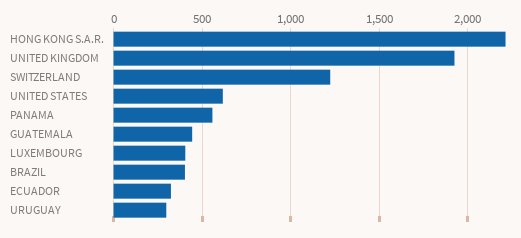
Arguably, the most important graph in the Panama Papers scandal is highlighted below. It shows the number of intermediaries (banks, accountants) in each country.


There is no mention of these by the media or of the numerous huge Western multinational corporations or billionaires, some of whom sit in the House of Lords. Neither does Harding mention by name any of the 12 leaders, past and present, identified in the documents. Instead, the Guardian journalist, in line with the methodological approach adopted by Suddeutsche Zeitung which received the leak, selectively focused on the West’s official enemies – Russia, Syria and North Korea.

Despite the fact that Putin wasn’t personally mentioned in the Panama Papers, I’m in no doubt whatsoever that since he uses Russia as a personal fiefdom, he should not be exonerated. It’s one thing ridding the country of the oligarch’s who were responsible for asset stripping its resources which subsequently turned Russia into a gangster capitalist paradise, but another to pocket a large chunk yourself by getting shot of the competition which is effectively what Putin has done. Putin’s primary interest is Putin himself.

But what the Panama papers reveal is that he’s not alone. The global web of corruption and tax avoidance extends to 72 states, heads or former heads of state. Yet you would be unlikely to have reached this conclusion having read the Guardian article or observed the cover of the paper which sensationally headlined with the words “Exclusive: The Secret $2bn trail of deals that lead all the way to Putin”. Neither would you have reached the conclusion having watched the UK state broadcaster, the BBC, who chose to mention just five of the 72 – Egypt, Iceland, Gaddafi, Putin and Assad.

Central to all this is the pathetic kow-towing to power by our media that’s supposed to be impartial and independent yet they act reflexively en masse by directing their fire at enemies of the state. If you don’t believe me, just look how often Putin has been foregrounded in the coverage of these leaked documents, complete with the requisite ‘shady’ photographs. Naturally, the media cannot be perceived to be so transparently biased which is why the occasional ‘balanced’ message is required. Step forward the Telegraph.

On Monday April 4, the paper dutifully reported:

David Cameron’s father ran an offshore fund which avoided paying tax in Britain by hiring Bahamas residents, including a bishop, to sign paperwork…The fund, which was established in the 1980s with help from the Prime Minister’s late father, continues today. The Guardian says it has confirmed that ‘in 30 years Blairmore has never paid a penny of tax in the UK on its profits.”

Nevertheless, the targeting of a dead man is virtually risk free as will be the ‘outing’ of a senile corrupt Lord to be cynically used a sacrificial lamb for the media hacks to peruse over if and when the time is right. Ultimately, the UK Secret Services will never allow the media to publish anything that is likely to damage the ‘reputations’ of leading establishment figures. The destruction of the Snowden files that the Guardian had in its possession but were requested to destroy by M15, are proof of that.

I had been watching the UK media all day on Monday after the story had broken, and news bulletins prefaced the scandal with either Putin, Cameron’s deceased father or Assad. It’s mainly the first two which are easy and convenient targets intended to deflect away from the crimes that implicate ‘our’ leaders. Almost certainly then, there is a highly motivated political agenda at work here that probably explains why Iceland, who locked up many of its corrupt and criminal bankers, was also named.

Following the revelations that Iceland’s PM was implicated in the scandal, the people of Reykjavik took to the streets in their thousands. At the time of writing, I watched the BBC News at Ten which reported from outside the Icelandic parliament. Following the resignation of the PM, the BBC reporter interviewed some Icelander’s. What the people on the streets of the country are increasingly aware of is that corruption within the corridors of power in Iceland and elsewhere is systemic.

The elites on both sides of the Atlantic are concerned about the effect the revealing of undoubted widespread and systematic corruption within the high echelons of media and politics will have on the body politic of Europe and North America. They don’t want Reykjavik to spread to London, Paris and Washington. This is another reason why the full scale nature of those implicated will never be revealed.

What all this highlights is the public is being cynically deceived by the corporate media in order to get their fellow elites off the hook. Craig Murray’s brilliant expose of the BBC Panorama documentary entitled Tax Havens of the Rich and Powerful Exposed, highlights the extent to which BBC producers and presenters will go to in order to misdirect its audience to this end. Perhaps less subtle than the overt propaganda pieceSaving Syria’s Children, but no less effective, the BBC related at length the stories of the money laundering companies of the Icelandic PM and Putin’s alleged cellist. As Murray said:

“The impression was definitely given and reinforced that these companies were in Panama. [Presenter] Richard Bilton deliberately suppressed the information that all the companies involved were in fact not Panamanian but in the corrupt British colony of the British Virgin Islands. At no stage did Bilton even mention the British Virgin Islands.”

Murray goes on to say:

“Is it not truly, truly, astonishing the British Virgin Islands were not even mentioned when the BBC broadcast their “investigation” of these documents?”

Indeed, Mr Murray, it is.

The BBC and media in general are obscuring the key role British money-laundering via its base in the British Virgin Islands plays in these transactions. This scandal must also be seen within a context in which between £30bn and £120bn a year of UK tax is either avoided, evaded or uncollected (sources (Tax justice/ PCS estimate & HMRC estimates). Meanwhile, £16bn worth of benefits a year remain unclaimed (HMRC estimate) against a backdrop in which benefit fraud amounts to a relatively tiny £1.2bn (DWP estimate).

Which of the above figures do you think the government and their media mouthpieces constantly highlight?

It can never be stated enough that this corruption scandal is mostly centred on the British Virgin Islands. Yes, the corruption is widespread and involves a number of world leaders, some of whom are our official enemies. However, in the broader scheme of things, these political figures are essentially peripheral. The level of corruption is widespread and systemic. As far as the major players are concerned, the media need to focus closer to home.

Assange’s stitch-up is a lesson for us all

By Daniel Margrain

Yesterday’s UN ruling (February 5) that deemed the deprivation of liberty of Julian Assange to be unlawful is a legally binding vindication of all those activists who have supported the quest of the Wikileaks founder to bring into the public domain the illegalities of Western power under the guise of democracy and freedom. Of course, establishment figures who represent the gatekeepers of the said powers, like Phillip Hammond, invariably attempt to undermine the findings of the UN body – of which the UK government is a signatory – when their conclusions fail to go in their favour and thus deny any wrongdoing on the part of the imperial powers that they represent.

On the other hand, praise will be heaped on the UN during the occasions they rule in their favour. This is, perhaps, to be expected. But what was shocking in terms of Hammond’s sheer Kafka-esque dishonesty was the extent to which he was prepared to sink in order to attempt to justify the unjustifiable at the behest of his masters in Washington. According to former UK diplomat, Craig Murray, Hammond’s lies were “utterly astonishing”. The official statement by the UK Foreign Secretary, states: “I reject the decision of this working group. It is a group made up of lay people and not lawyers. Julian Assange is a fugitive from justice. He is hiding from justice in the Ecuadorian embassy.”

Hammond’s statement belies the fact that every single one of the UN panel is an extremely distinguished lawyer. His statement was clearly made in order to undermine the UN ruling which by so doing, as Edward Snowden acknowledges, “writes a pass for every dictatorship to reject UN rulings...and hence sets a “dangerous precedent for UK/Sweden to set.” Craig Murray states that: “Countries who have ignored rulings by this UN panel are rare. No democracy has ever done so. Recent examples are Egypt and Uzbekistan. The UK is putting itself in pretty company.”

Previous rulings by the panel have gone against countries with some of the world’s worst human rights records, such as Saudi Arabia, Myanmar and Egypt. Recent cases where the UN has ruled in circumstances in which individuals have similarly been detained, include the Washington Post journalist, Jason Rezaian in Iran in December last year and former pro-democracy president Mohamed Nasheed last October (both subsequently released).

The contextual underpinning of the ruling vindicating Assange stems from the fact that he has never been charged with any offence. The UN findings confirm that his detention has been unlawful since his very first arrest in the United Kingdom in 2010 and that there has never been any genuine attempt by the Swedish authorities to investigate the allegations against him. For all those commentators who have been following the case closely, it has been obvious that from the outset the establishment have had it in for Assange. The rape allegations were merely the Casus Belli.

This was given credible weight early on by Naomi Wolf, a prominent American writer, feminist and social commentator, who argued that the allegations against Assange bore all the hallmarks of a set-up. This was further elaborated on by Craig Murray who thoroughly demolished the case against Assange. As John Pilger outlined, the reality is, there was no genuine judicial process in train against Assange in Sweden, a point that was advanced by Assange’s lawyers before the UK supreme court:

“The Assange case has never been primarily about allegations of sexual misconduct in Sweden – where the Stockholm Chief Prosecutor, Eva Finne, dismissed the case, saying, “I don’t believe there is any reason to suspect that he has committed rape”, and one of the women involved accused the police of fabricating evidence and “railroading” her, protesting she “did not want to accuse JA of anything” – and a second prosecutor mysteriously re-opened the case after political intervention, then stalled it.”

justice4assange.com provides some background:

Julian Assange, editor-in-chief of WikiLeaks, has been detained without charge in one form or another since 7 December 2010…In Sweden, Julian Assange is not charged with a crime. But in a highly unusual move, Sweden issued an Interpol Red Notice and a European Arrest Warrant, immediately after WikiLeaks began publishing a cache of 250,000 US Diplomatic Cables on 29 November 2010. Such warrants are usually issued for persons whose whereabouts are unknown. But Julian Assange’s whereabouts were known (he had given a press conference and hundreds of interviews in London). His lawyers were in communication with the prosecutor and had communicated that he was available to answer questions from the Swedish prosecutor through standard means.

Questioning people within European borders is a routine and uncomplicated process, which is standardised throughout the European Union. Sweden often uses these means to question people. In the initial ten days after 20 August 2010, the police opened the ’preliminary investigation’, it was assigned to three different prosecutors in quick succession. The penultimate prosecutor found that the case had no basis, and that there were no grounds to place Julian Assange under a criminal investigation.

The final prosecutor however, Marianne Ny, took over on 1 September 2010 and reopened the investigation. The Swedish investigation has been frozen since 2010. In November 2014, Sweden’s Svea Court of Appeal ruled that the prosecutor had failed her professional duty to progress the investigation against Julian Assange.

Given the astounding level of media misinformation, demonization, smears, deceptions and outright lies in the mainstream corporate media’s reporting of Assange, one might be under the impression that the man in question is the devil incarnate, a misogynist, who is using his work as a cover in order to avoid facing justice for the crime of rape that some commentators have seen fit to pronounce a verdict of guilty on the head of the whistle blower in advance of any hypothetical future trial. The self-appointed Witch finder General, Joan Smith of London Women against Violence, for example, was allowed to express her opinion, unchallenged, that he was guilty of the crime he has been accused of.

Much of the vitriol stems, not from the traditional right-wing of the media terrain, but rather from what many people consider to be the liberal-left of the political spectrum. Owen Jones, for example, who appears to be the latest poster boy for left wing opinion throughout the liberal media, penned, in August 2012, an article for the UK’s Independent newspaper, titled “There should be no immunity for Julian Assange from these allegations.”  But Jones’ inference that diplomatic immunity is a feature of the Assange case is, in reality, a red-herring since neither he, his supporters, legal team or anybody else outside the media bubble, have ever suggested that his case is predicated on a claim of immunity.

The lie was repeated by the Guardian’s legal expert, Joshua Rozenberg, presumably in an attempt to add a certain degree of gravitas to the claim. The truth is that all Assange has ever requested from the outset, is a guarantee from the Swedish authorities that if he agrees to travel to Sweden to answer the rape allegations made against him, he won’t be extradited to the United States. Assange’s request for this assurance from Sweden is supported by Amnesty International. However, the Swedish authorities have consistently failed to give Assange such an assurance.

Despite all this, the Sky News journalist and LBC stand-in presenter, Tim Marshall, implied that callers to his programme on February 5 who suggested that should Assange step foot outside the Ecuadorean embassy, he would ultimately be extradited to the U.S predicated on the trumped up charge of rape and subsequently be imprisoned, were mad conspiracy theorists. The incandescent, Marshall, is apparently unaware of the case of Chelsea Manning who was imprisoned for 35 years in 2013 for leaking information to WikiLeaks.

He is also seemingly unaware that, according to Edward Snowden, Assange is on a US “manhunt target list” or that the Independent revealed that both the Swedish and American governments’ have already discussed Assange’s onward extradition. If Marshall had bothered to avail himself of the views of Mats Andenas, the Norwegian chair of the UN Working Group for much of its investigation, he would have realized that the panel had to resist intense pressure from the US and UK to arrive at a decision contrary to the one they actually reached.

Marshall’s tone throughout was one of incredulity that the “liberal” Sweden would place Assange at risk of extradition to the US or for that matter that the latter under the liberal-progressive Obama, could ever preside over an administration that has imprisoned more whistle blowers than all his predecessors combined. In terms of the former (something else that Marshall is apparently oblivious to), is the subject matter of Amnesty International’s 2013 report which highlights Sweden’s damning record of extraditing people to other countries and its cooperation with the US in extraordinary renditions.

Jonathan Cook sums up just how far down the perilous road towards fascism our governments’ and their accomplices in the media are prepared to go in order to augment the interests of the powerful:

“The degraded discourse about the UN group’s decision does not just threaten Assange, but endangers vulnerable political dissidents around the world. The very fact that…[liberal media commentators]… are so ready to sacrifice these people’s rights in their bid to tar and feather Assange should be warning enough that there is even more at stake here than meets the eye.”


Housing crisis created from money produced from thin air

By Daniel Margrain

Switzerland is set to hold a referendum to decide whether to ban commercial banks from creating money. This follows a move by over 110,000 people in that country who signed a petition calling for the central bank to be given the sole power to create money within the financial system. The campaign is designed to limit financial speculation by requiring banks to hold 100 per cent reserves against their deposits.

Banks will no longer be able to create money for themselves (euphemistically termed fractional reserve banking), rather they will only be allowed to lend money that they have accumulated from savers or other banks. Currently banks are able to lend money that they don’t actually have and then command interest on the non-existent money.

This is akin to x offering to loan y a sum of say, £100,000 that the former hasn’t got. The way around this conundrum is for x to then lodge the sum with another financial institution who happens to be in on the scam. Y then pays x interest on the money that x has never been in the position to lend in the first place. Switzerland is now considering whether or not to do something about this fractional reserve banking racket. If successful, the bill will give the Swiss National Bank a monopoly on physical and electronic money creation.

The idea of limiting all money creation to central banks was first touted in the 1930s and supported by renowned US economist Irving Fisher as a way of preventing asset bubbles and curbing reckless spending. It’s the former that most accurately characterizes the current financial system. The rising cost of housing is an example of a major asset bubble underpinned by a Tory government housing policy that is geared towards satisfying the asset diversification needs of the super rich rather than to meet the human need for homes for ordinary people to live in.

So the motivating factor determining the government’s housing policy is not to end the housing crisis but to bolster the investment opportunities of the rich which will make it worse. This is what David Cameron’s announcement yesterday (January 10) regarding the governments’ intention to demolish council homes and replace them with private housing is all about.

This is also the precursor to the newly proposed Housing and Planning Bill (voted on today, January 12) which will force families living in social housing and earning £30,000-£40,000 in London to pay rents nearly as high as those in the private sector. It will also compel local authorities to sell ‘high value’ housing, either by transferring public housing into private hands or giving the land it sits on to property developers.

The 126 MPs who declared that they receive rental income from property, represent over 19 per cent of the house, the vast majority of whom are Conservatives. The voting through of the bill, which almost certainly represents a major conflict of interest, will lead to soaring rents meaning that ordinary people will find it increasingly difficult to afford to live in the capital. As the statement on a flyer that promoted a protest against the bill argued:

It [the bill] takes public funding away from affordable homes for rent and does nothing to improve security or control rents for private renters.

This is turning back the clock, taking away security and pushing up rents. It would force the selloff of council homes on the open market, to pay for housing association ‘right to buy 2’. Councils and housing associations will not be able to build replacement homes for rent.”

The exponential growth in the construction of new tower blocks throughout London and other major cities are not intended for local residents to live in, thereby helping to ameliorate the worst excesses of the housing crisis, rather they are being built for foreign investment funds and billionaires to buy on mass as financial safe havens.

Greenwich Mean Time (GMT), a relatively favourable temperate climate, convenient geographical location, the establishment of law and order, good schools and infrastructure, minimal history of revolution and good transport hubs and networks, means that London is a particularly attractive place for the rich to increase their property investment portfolios.

However, these investments in houses and apartments are essentially made of cards built on sand predicated on a financial illusion of which the Swiss example described is symptomatic. The context of the illusion that the Swiss people are soon to vote on is historically tied the the Swiss National Bank (SNB). Since 1891 when the SNB was established, the bank has had exclusive powers to mint coins and issue Swiss bank notes. But over 90 per cent of money in circulation in Switzerland now exists in the form of electronic cash which is created out of nothing by private banks. In other words, nearly all of the money in Switzerland, and arguably the world, does not in reality exist as a tangible entity.

In modern market economies central banks control the creation of bank notes and coins but not the creation of all money which occurs when a commercial bank offers a line of credit. Iceland, whose bloated banking system collapsed in 2008, has also touted the abolition of private money creation and an end to a practice in which a central bank accepts deposits, makes loans and investments and holds reserves that are a fraction of its deposit liabilities. Fractional banking means the production of money from thin air.

The entire financial system and the laws on which it is governed that many believe to be an exact science is, in reality, based on a gigantic illusion. The fact that Britain’s banks are paying far less in corporation tax than before the crisis, despite their profits improving and global tax payments staying constant, is illustrative of a flawed unscientific system that society has nevertheless hitched itself on to. Rather than the Cameron government investing in a productive based economy in which tangible things are made, bought and sold, it has focused disproportionately on financialization – an abstraction predicated on smoke and mirrors.

The money illusion stems from the Bill of Exchange Act of 1882. Effectively, money is created the moment a loan document from a bank or any other financial institution is signed. Having created a financial instrument as a result of any signature, the bank or financial institution then lends the money created in the form of a bill of exchange which in effect becomes a promissory note. The customer then gives the power of attorney within the signed document to the bank to then lend the said customer the money that has just been created as a result of the signature.

By removing the requirement of the government to insist upon the amount of gold being equal to the amount of currency in circulation (gold exchange), they created a debt based economy (Fiat currency). So by not basing money on anything material whatsoever, central banks are able to create limitless amounts of it effectively by pressing numbers on the keyboard of a computer. The origins of the promissory note stem from the promise to pay a physical sum of silver (subsequently gold) in exchange for the promissory equivalent (sterling was originally based on sterling silver).

The purpose was to prevent individuals from having to carry large sums of silver around with them. A silversmith would simply weigh the silver and give the owner a promissory note which could then be cashed in at a later date to be spent on goods and services. Up until the 1930s, governments’ were required to have in their possession an amount of silver or gold equal in value to the amount of promissory notes issued. This requirement was removed in the 1930s which then gave banks the right to create money out of nothing. This is a legacy that continues today. Will Switzerland be the catalyst for a paradigm shift in this state of affairs?

Barefoot economic values, TTIP & the democratic retreat.

By Daniel Margrain

Equality before the law is one of the most fundamental principles underpinning justice. It is therefore an act of utter insanity to want to roll back the gains that has seen societies’ flourish as a result of the enactment of these principles and yet that’s precisely what the UK government like that of the US and 13 other EU members seem to be sleepwalking into rubber stamping.

Fifteen years ago, George Monbiot analysed the extent to which the UK government – through the dictates of the Private Finance Initiative (PFI)- had essentially become captive to the infiltration of the state by corporations’ on the national level. What is now being proposed transnationally, is essentially the capture of national sovereignty by multi-national corporations.

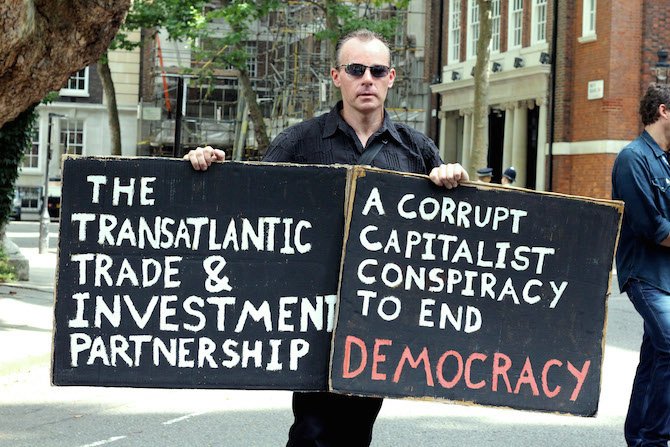
The Investor-state dispute settlement (ISDS), a procedural mechanism that allows foreign investors to sue states’ for damages in a tribunal of arbitration, have in recent years, increased in number and value. They are set to grow exponentially if the Transatlantic Trade and Investment Partnership (TTIP) which sets the provisions for ISDS, is allowed to go ahead as expected next year.

It will effectively mean that corporate lawyers across the EU and US will be allowed to overturn the laws of individual democratic governments’ with a view to them seeking massive compensation claims on behalf of the corporations they represent on the basis that likely “future anticipated profits” would be adversely affected.

The provisions of the draft agreement which was conducted in secret and only came to light after their contents were leaked to the media in March 2014, followed the results of a public consultation undertaken by the European Commission. Neither appears to have done anything to ally public concerns over the proposed deal which, should it end up being finalized in its current form will, as I will attempt to show below, have profound negative implications for Western democracy.

In December 2013, a coalition of over 200 environmentalists, labour unions and consumer advocacy organizations on both sides of the Atlantic sent a letter to the US federal agency responsible for trade policy, the United States Trade Representative (USTR), and European Commission demanding the ISDS be dropped from the trade talks, claiming that it was “a one-way street by which corporations can challenge government policies, but neither governments nor individuals are granted any comparable rights to hold corporations accountable”.

Clearly, the clauses in the trade agreement relating to investment protection are open to abuse, as is the undermining of national sovereignty resulting from this potential for abuse – issues that were tackled in a Guardian article by Owen Jones. Expanding on this, Martti Koskenniemi, professor of International Law, warned that the planned foreign investor protection scheme within the treaty, similar to World Bank Group‘s International Centre for Settlement of Investment Disputes (ICSID), would endanger the sovereignty of the signatory states by effectively allowing for a small circle of legal experts to be given the power to usurp democratic legislative procedures and standards.

Professor Colin Crouch describes TTIP as “post-democracy in its purest form”. By this he means it represents a deficit in democratic accountability in which the structures of the state have ceded their powers to the imperatives associated with multinational capital. Post-democracy in these terms equates to the shifting of power towards corporations’ where deals are often struck in secret out of the reach of public bodies whose democratic role is to scrutinize them in the public interest.

Whenever scrutiny is removed, the burden of both economic and environmental risk relating to deals between political elites and corporate lobbies, tend to tilt towards the public sphere who pick up the pieces by way of what economists euphemistically refer to as “externalities”. Often, for example, deals involve the construction of large infrastructural vanity projects including football stadiums, Olympic villages and the like, that usually come with negative knock-on environmental, ecological, employment and economic impacts.

The London mayor Boris Johnson’s less than transparent involvement in the Olympic Stadium deal between the London Dockland Development Corporation (LDDC) and Premier League football club, West Ham United, brokered by Lady Brady, is an example of how both the political and business elites mutually benefit from these kinds of potentially environmentally and economically (for the tax payer) damaging and secret deals.

As the Blatter scandal, and more recently, Sebastian Coe’s cozy relationship with Nike and his other underhand dealings illustrate, the corporate, government and national authority ties within the high echelons of sport, are indicative of a wider corruption, albeit an informal kind that, unless you happen to be foreigner, is rarely acknowledged within the British establishment.

In such cases, corruption is normally regarded to be an activity restricted to “tin-pot” dictatorships in the developing world rather than something that has arguably become “normalized” and symptomatic of a broader societal and economic malaise conducive to political life within formal Western liberal democracies’.

With virtually every public asset being up for grabs in the era of neoliberal globalization (and hence reduced to a crude form of exchange value by the elites), means that all aspects of our existence are to be potentially ceded to the altar of profit and multilateral economic growth. This is precisely the aim of TTIP.

But of course not all values are perceived in this crude narrow sense. Employment, environmental, and even food standards protection which TTIP is set to undermine, for example, are concomitant to the public good. Within the context of a finite planet, the same cannot necessarily be said of economic growth.

Another value that cannot be measured in strictly economic terms is happiness and contentment. Can it really be said with any conviction that we, in the first world, are generally happier and more content than people in the developing world?

Chilean economist Manfred Max-Neef brings some valuable insights into play within this area. Having worked for many years of his life in extreme poverty in the Sierras, in the jungle and in urban areas of different parts of Latin America, Max-Neef recalls:

“At the beginning of that period, I was one day in an Indian village in the Sierra in Peru. It was an ugly day. It had been raining all the time. And I was standing in the slum. And across me, another guy also standing in the mud — not in the slum, in the mud. And, well, we looked at each other, and this was a short guy, thin, hungry, jobless, five kids, a wife and a grandmother. And I was the fine economist from Berkeley, teaching in Berkeley, having taught in Berkeley and so on. And we were looking at each other, and then suddenly I realized that I had nothing coherent to say to that man in those circumstances, that my whole language as an economist, you know, was absolutely useless. Should I tell him that he should be happy because the GDP had grown five percent or something? Everything was absurd.

He continues:

We have reached a point in our evolution in which we know a lot. We know a hell of a lot. But we understand very little. Never in human history has there been such an accumulation of knowledge like in the last 100 years. Look how we are. What was that knowledge for? What did we do with it? And the point is that knowledge alone is not enough, that we lack understanding….”

The overriding factor that has given Max-Neef hope in the poor communities that he has lived and worked in is:

“Solidarity of people… respect for the others. Mutual aid. No greed. Greed is a value that is absent in poverty. And you would be inclined to think that there should be more there than elsewhere, you know, that greed should be of people who have nothing. No, quite the contrary. The more you have, the more greedy you become, you know. And all this crisis is the product of greed. Greed is the dominant value today in the world. And as long as that persists, well, we are done….”

According to Max-Neef, the best principles of economics are based in five postulates and one fundamental value principle:

“One, the economy is to serve the people and not the people to serve the economy.

Two, development is about people and not about objects.

Three, growth is not the same as development, and development does not necessarily require growth.

Four, no economy is possible in the absence of ecosystem services.

Five, the economy is a subsystem of a larger finite system, the biosphere, hence permanent growth is impossible.

And the fundamental value to sustain a new economy should be that no economic interest, under no circumstance, can be above the reverence of life.”

In developing postulate three, Max-Neef explains:

“Growth is a quantitative accumulation. Development is the liberation of creative possibilities. Every living system in nature grows up to a certain point and stops growing. You are not growing anymore, nor he nor me. But we continue developing ourselves. Otherwise we wouldn’t be dialoguing here now. So development has no limits. Growth has limits. And that is a very big thing, you know, that economists and politicians don’t understand. They are obsessed with the fetish of economic growth” [My emphasis].

Crucially:

“…In every society there is a period in which economic growth, conventionally understood or no, brings about an improvement of the quality of life. But only up to a point, the threshold point, beyond which, if there is more growth, quality of life begins to decline. And that is the situation in which we are now.”

The aim of TTIP, is the promotion of multilateral economic growth (of which the ideology of progress is seen as emblematic). Paradoxically, this corresponds to the decline in the quality of life characterized by runaway climate change and the undermining of environmental protection that this implies.

The law of diminishing returns as inferred by Max-Neef, would suggest that humanity is currently at the threshold point. It’s up to us to determine our future path and those of our children and children’s children. In order to do that we need to break with the current socioeconomic paradigm.


COP21 resolves nothing

By Daniel Margrain

Embedded image permalink

Academic research supports the hypothesis that environmental degradation is linked to economic growth. As economies grow the countries’ in which the growth rates occur pump out correspondingly higher rates of the gas responsible for the greatest single cause of human induced climate change into the earth’s atmosphere. The tendency among humans to consume more and more of the finite resources of our planet, is predicated on capitalism’s inherent drive for growth upon which the maximization of profits is dependent. This is what Naomi Klein talks about when she refers to the capitalist system as one in which the ruthless drive for expansion is kept going by “consumption for consumption’s sake”.

If one accepts this line of reasoning then it follows that in order to ameliorate the affects of climate change by reducing the amount of carbon dioxide in the atmosphere, it’s necessary to challenge the growth based profit seeking logic of capitalism that gives rise to it.

Here we are faced with a major contradiction. The economic growth that is generated by capitalism creates employment opportunities. But in so doing, it also creates an insurmountable environmental and ecological crisis which, taken to its logical conclusion, negates the need for economy and hence employment. It’s this fundamental contradiction that undermines the COP21 in Paris and all of the other UN Climate Summit’s that preceded it.

This rather depressing reality, is underscored by the fact that these summits are primarily concerned with satisfying the demands set by capitalist growth, as opposed to creating the necessary conditions for environmentally sustainable societies’. Although this truism is rarely openly and unambiguously stated, any cursory analysis of the situation reveals that job creation and the “need” to maximize economic growth, overrides environmental sustainability considerations.

The insatiable demands of investors on the one hand, and the urgent need to cut down on global carbon emissions, on the other, are necessarily incongruous concepts. The failure of successive summits, most notably, in Copenhagen, in addressing the incompatibility between economic growth – a factor intrinsic to capitalism – and environmental sustainability that limits it, is a recipe for disaster because it perpetuates the conditions in which further environmental degradation of the planet will occur.

It’s precisely this logic that explains why it is that one of the key players at the COP21 discussions in Paris, Saudi Arabia, attempted to undermine them, even though climate change forecasts suggest that the Gulf region will become uninhabitable as a consequence of the failure of the Arab state agreeing to a radical shift in its negotiating position at the summit.

The rationale for the world’s largest producer of oil in its derailing of negotiations, is based on narrow short-term economic self interest. Saudi Arabia are among the most powerful of the 195 nations who attended the conference in Paris who, alongside their powerful allies, are empowered to block any meaningful negotiations in terms of emissions through a process of informal consensus.

Conversely, the poorer nations, were effectively not in a position to wield sufficient enough power to be able to offset the decision-making processes of the most powerful – the negative impacts of which, as Kumi Naidoo, executive director of Greenpeace International, noted – they will disproportionately be on the end of.

For example, the numerous islands that comprise the small Pacific states’ who are among most likely to be adversely impacted by the worst consequences of climate change, had emphasized the need to act on limiting global warming to 1.5 degrees Celsius over pre-industrial levels, while their powerful counterparts adamantly arrived at a higher “consensual” non-binding figure reviewed once every five years.

All this, and the fact that Saudi Arabia introduced a set of unreasonable negotiating pre-conditions against the emerging economies, are the main factors that arguably, in part, prompted the former Nasa scientist, James Hansen, to comment that the discussions in Paris were “a…fraud… a fake,”. He added: “It’s just bullshit for them to say: ‘We’ll have a 2C warming target and then try to do a little better every five years.’ It’s just worthless words. There is no action, just promises….”.

Meanwhile, the United States used the fact that it has not ratified any human rights statute internationally as a poison ‘divide and rule’ pill against the developing countries with the aim of picking off the most vulnerable as their justification for shifting blame for the crisis on to the smaller nations.

This underhand tactic serves a dual purpose in as much as the source of the problem – the rich elites’ pattern of consumption and their lifestyle – is conveniently admonished. That the ‘1 percent versus the 99 percent’ narrative remained a feature of Paris, is to my mind, the most depressing aspect of the summit. Kenyan political ecologist, Ruth Nyambura summed up the impasse well when she said: “We want to get out of this sinking ship, but countries like U.S. are holding the lifeboats.”

The reality is the settlement that emerged in Paris is an extremely weak one due largely to the negotiated consensual interplay between the most powerful players. This meant they were able to use each other to take things off the table they didn’t want. This interplay, to a great extent, is determined by the influence the oil, coal and gas companies had on proceedings as well as the banks, hedge funds and other financial institutions who fund them.

The giant corporations garner an enormous amount of power in terms of their ability to be able to influence the decision making processes of the most powerful governments’. This often takes the form of the lobbying of leading politician’s of these governments by the giant corporations. Paris was no exception. The issues to do with conflicts of interest remain.

Thus, the potential for corruption is as strong as ever, aided ostensibly by credible figures who misrepresent consensus research. The misrepresentations in Paris included climate change professors who Greenpeace exposed as figures who were willing to produce pro-fossil fuel industry research by concealing the source of their funding.

The denialism also invariably extends to apparently skeptical mainstream journalists like Christopher Booker and James Delingpole whose roles are little more than conduits for the kinds of power they are supposed to hold to account. The reality is that the relationship between fossil fuel emissions and climate change is scientifically indisputable. To quote George Monbiot in his book ‘Heat’: “To doubt today, that manmade climate change is happening, you must abandon science and revert to some other means of understanding the world: alchemy perhaps, or magic.”

Nevertheless, the influence that journalists, powerful corporate lobbyists, former politicians and others within the denial industry are able to exert in order to deceive and mislead the public regarding the science can not be underestimated. One such figure is journalist, Peter Hitchens, who ought to know better.

The writer, who has many credible and sensible things to say about the decision of the UK government to go to war in Syria, apparently bases his authority to deny the reality of climate change on misleading glacier figures published online by the ‘Science and Environmental Policy Project’ (SEPP) run by a discredited environmental scientist called Dr S. Fred Singer.

The data has been reproduced by several other groups and had also found its way into The Washington Post. According to George Monbiot, the figures which were published by these groups, were subsequently used by Hitchens as well as other notable denialists like Melanie Phillips and David Bellamy to support their respective positions. However, the groups have one thing in common: they have all been funded by Exxon.

But this fact hasn’t initiated any retractions. On the contrary, it has resulted in the ‘digging in of heels’. The intention is to create confusion and the impression of uncertainty within the scientific community, when in reality none exists. The science is settled. Even Exxon’s own research conducted decades ago, that was until recently covered up, confirmed the role of fossil fuel in global warming.

Despite this, the damage has arguably already been done. Governments’ can only ameliorate the worst affects of runaway climate change. It’s too late to stop it in it’s tracks. As the consequences of climate change feedback begin to take their toll, we will soon be reaching the tipping point.

If in the year 2030, carbon dioxide concentrations in the atmosphere remain as high as they are today then ecosystems will begin to release carbon dioxide as opposed to absorbing it. At this point climate change will not only be out of our hands, but it will accelerate without our help. If this does indeed come to pass, then the world will be taking to task the complicit role the denialism industry played in it.

Is Western corruption & duplicity fanning the flames of ISIS?

By Daniel Margrain

On October 23 the mainstream media reported the obliteration by both Russian and US coalition forces of an ISIS oilfield and supply routes in the heart of Islamic State territory in Syria. Following the UK government’s decision to extend its military campaign from Iraq into Syria, a subsequent BBC report highlighted an additional bombing raid on December 5 in that country. But it has since transpired that this second raid targeted the precise location hit by the Russian and US coalition forces.

So the question arises, why would RAF warplanes hit a target that had already been obliterated five weeks prior to the second raid? A possible explanation is that the oilfield and supply routes described were in the process of being hastily reconstructed. However, this seems highly unlikely given that the BBC report cites Ministry of Defense claims that the RAFs Tornado and Typhoon warplanes were involved in eight attacks in which Paveway IV bombs were offloaded resulting in the destruction of wellheads….“thus cutting off the terrorists’ oil revenue at the very source”.

The impression given that the UK government had actively engaged in degrading the infrastructural and financial capability of their latest bogeyman, ISIS, appears therefore, to be a deception. In any event, one of David Cameron’s major justifications for his case for more war, was that Brimstone missiles, as opposed to Paveway bombs, were to be deployed against ISIS targets in Syria on account of their greater level of accuracy, thus limiting the possibility of civilian casualties.

It follows that in the unlikely event that what was being bombed was actually a site in the process of reconstruction, as opposed to an already existing obliterated terrain, the use of Paveway bombs would have greatly increased the risk of death to the civilian construction workers working on the site. This totally undermines Cameron’s claim that the UK would not attack civilians.

Whatever the truth of the situation, the fact that the RAF attacked a civilian target rather than a military base, would suggest that the government’s alleged intention to bring closure to this conflict at the earliest opportunity is bogus. The prospect of lengthy war provides a boost to the profits of the arms and weapons companies’. ISIS have gained access to weapons allegedly exported by the UK to the Middle East in the wake of 2003 invasion.

But gaining access to weapons is not possible without the access to money to purchase them. Tackling the flow and source of criminal money which helps sustain the lifeblood of ISIS, is the most effective strategy in dealing with the root cause of the terrorist organization. A second consideration, is ascertaining what the overriding medium to long-term motivation of the great imperial powers and their allies that underpins the strategy for war is. The answers to these questions are most likely to be found within the belly of the beast of the political establishment who, to a large extent, appear to be pulling the financial strings that determine the control, flow and maintaining of oil revenues.

One of the leading figures who allegedly plays a pivotal role in this regard is the British politician Nadhim Zahawi whose financial interests in Genel Energy suggests he is vulnerable to lobbying. As a member of David Cameron’s government, it is alleged that the Conservative MP for Stratford-upon-Avon has traded black market oil derived from ISIS controlled fields in Iraq prior to the black stuff being transported and sold, in part, to European markets through Turkey and the Mediterranean Sea, with the main purchaser said to be Israel.

The allegations against Zahawi come against the backdrop of evidence which indicates that ISIS sell oil emanating from nearly a dozen oil fields in northern Iraq and Syria’s Raqqa province that they control. It then passes through Turkey and Iraq’s Kurdistan region. Back in 2014, David Cohen, US Treasury under-secretary for terrorism and financial intelligence, claimed that middlemen from Turkey and Iraq’s Kurdistan region buy black market oil from ISIS that earns the terror group some $1 million a day.

In September last year, in a briefing to the European Parliament Foreign Affairs Committee, EU Ambassador to Iraq Jana Hybaskova, conceded that some European countries have purchased crude from ISIS from the areas in northern Iraq and Syria they have captured. Given that the most effective way of countering ISIS is to attack the source of their funding rather than using bombs to attack civilians, it was unsurprising that Shadow Foreign Secretary, Hilary Benn’s initial position was to oppose military intervention in Syria. However, inexplicably, two weeks later, he changed his mind and voted in favour of bombing.

Something appeared to have happened in the two week period up to December 2 which influenced Benn’s decision to change his mind. Perhaps it had something to do with the fact that war is good for boosting the profits of those connected to the military-industrial complex and that he had been lobbied by those who stood to gain financially from any change of heart.

Although share prices in the manufacturers of British WMD, BAE Systems, were depressed in late October they subsequently jumped after the announcement to bomb was made. Being in the pocket of the arms industry is concomitant to the notion of being favourable to war, which clearly explains his careful positioning to usurp the anti-war Labour leader Jeremy Corbyn for the Labour leadership.

Across the Atlantic, major defense contractors Raytheon, Oshkosh, and Lockheed Martin assured investors that they stand to gain from the escalating conflicts in the Middle East. Lockheed Martin Executive Vice President Bruce Tanner said his company will see “indirect benefits” from the war in Syria, citing the Turkish military’s recent decision to shoot down a Russian warplane.

Meanwhile, a deal that authorized $607 billion in defense spending brokered by the U.S Congress, was described as a “treat” for the industry. What better way to benefit from this “treat” than for the major powers to secure the “hydrocarbon potential” of Syria’s offshore resources with the aim of reducing European dependence on Russian gas and boosting the potential for an energy independence.

Israel is part of a broader strategy to dismember Syria with a view to toppling Syrian president Bashar al – Assad leading to the annexation of the Golan Heights, captured from Syria during the 1967 war. This is being aided by one of the most concerted media propaganda offensives since the Iraq debacle. At the forefront of this offensive is the Murdoch printed press.

But what are Murdoch’s reasons for pushing so hard for war? The answer is Genie Energy. Israel has granted oil exploration rights inside Syria, in the occupied Golan Heights, to this multinational corporation. Major shareholders of the company – which also has interests in shale gas in the United States and shale oil in Israel – include Rupert Murdoch and Lord Jacob Rothschild. The following is from a 2010 Genie Energy press release

Claude Pupkin, CEO of Genie Oil and Gas, commented, “Genie’s success will ultimately depend, in part, on access to the expertise of the oil and gas industry and to the financial markets. Jacob Rothschild and Rupert Murdoch are extremely well regarded by and connected to leaders in these sectors. Their guidance and participation will prove invaluable.”

“I am grateful to Howard Jonas and IDT for the opportunity to invest in this important initiative,” Lord Rothschild said. “Rupert Murdoch’s extraordinary achievements speak for themselves and we are very pleased he has agreed to be our partner. Genie Energy is making good technological progress to tap the world’s substantial oil shale deposits which could transform the future prospects of Israel, the Middle East and our allies around the world.”

Other players involved include the Israeli subsidiary, Afek Oil and Gas,  American Shale, French Total and BP. Thus there exists a broad and powerful nexus of US, British, French and Israeli interests, encompassing defense, security, energy and media sectors, at the forefront of pushing for the break-up of Syria and the control of what is believed to be potentially vast untapped oil and gas resources in the country, as well as reining in Russian and Iranian influence in the region.

The West’s intention to augment its geopolitical and economic strategic influence in Syria and the region more widely is premised primarily on a militaristic, as opposed to, a political solution. This gives rise to conflicting attitudes to the Assad regime in terms of ascertaining who are, and who are not, terrorists. In this complex web, some players are more motivated to destroy ISIS than others.

NATO member Turkey’s geo-strategic motivation, for instance, is the obliteration by Turkish forces of the Kurdish YPG who conversely happen to be one of the key fighting forces opposed to ISIS on the ground. The YPG are ostensibly supported by the British and American’s who in turn desire the overthrow of Assad whose forces are the only real credible presence on the ground.

On the other hand, it’s in both Russia’s and Iran’s interest to keep Assad in power – the latter on the basis of maintaining a link to Hezbollah in Lebanon. If ever there was an illustration for the need for a properly coordinated and multi-pronged diplomatic approach to solve a complex problem that transcends narrow self interest, then Syria and the wider Middle East is it. But instead the world powers’ are blundering from one major crisis to another with no apparent end point in sight.


‘No one is left to speak for me.’

By Daniel Margrain

The systematic redistribution of wealth from the poorest to the richest which began under Thatcher, continued under Blair and currently is increasing at a pace under Cameron, is emblematic of the relationship between welfare state retrenchment and the notion of the role of the state as facilitator of welfare handouts to the corporate sector.

Farm subsidies, public sector asset stripping, corporate tax avoidance and evasion, government share giveaways and housing benefit subsidies are just some of the ways in which the richest 1,000 people in Britain have seen their wealth increase by a massive £155bn since the economic crisis of 2008.

Meanwhile, in June this year, the UK government announced £12 billion of welfare cuts that included the abolition of working tax credits to the poorest and the top down reorganisation of the NHS brought about by the 2012 Health and Social Care Act which removes the duty of the Secretary of State for Health to provide a comprehensive service. The act requires up to 49 percent of services to be tendered out to “any qualified provider” . This will rapidly lead to the privatisation of the NHS in England and Wales.

The punitive attacks on the unemployed, sick and disabled have been stepped up resulting in 500,000 people using food banks in addition to increasing rates of depression, anxiety and incidences of suicides among those on benefits. In social care, a combination of cuts of around 30 percent to local authority budgets since 2010, increasingly restrictive eligibility criteria for services, and inadequate personal budgets will leave millions without the support they need.

Finally, the reduction in housing benefit to the unemployed allied to the bedroom tax is a double whammy that has resulted in growing rates of homelessness and/or the social cleansing and displacement of entire communities, many of them long established.

What are these attacks on the welfare state about? The government have long argued that they are needed in order to reduce the budget deficit. But on the very same day that the bedroom tax was announced in parliament (estimated to “save” the Treasury £480 million) the top rate of tax in the UK was cut from 50 percent to 45 percent, resulting in a loss of revenue of £1 billion.

The only rational explanation is that “austerity” is being used by the Tory government as a pro-corporate ideological weapon against both the welfare state as a concept and the general population who, in one way or another, rely on it in some shape or form. Those affected are not just the poor and traditional blue collar workers but also the lower ranks of the middle classes highlighted by the fact that the cuts are now beginning to have political repercussions within David Cameron’s own Oxfordshire constituency.

An obvious example of how Tory cuts are beginning to impact on the community at large, is in the field of social care for the elderly. In an increasingly aging society, the pressure on the social care system will become more acute as demand for its services increase. But a service motivated by profit is necessarily compromised in terms of its ability to provide a universal service of care predicated on need.

Another example, are the government’s proposals to cut the police budget by 40 per cent with the predicted loss of some 22,000 front line police officers to be replaced by private security firms. These firms will be drafted in by communities in suburbs and villages to fill the gap in neighbourhood policing left by the budget cuts. In an Essex seaside town, more than 300 residents have effectively been forced to club together to pay for overnight private security patrols.

The implications of the drive towards a privatized police force motivated primarily by profit are clear. The tendency would be for any crime not committed on the patch where customers pay privately for their service to be ignored or underplayed. The potential for the creation of protection rackets and vigilantism exists in situations where people who are not in a position to be able to afford for protection live near to people who can.

Justine Greening’s Kafkaesque contention on last Thursdays (November 5) Question Time programme that the reduction in policing in areas where crime is falling, justifies cuts to those areas, illustrates further the political undermining of the concept of universal provision. It’s my view that outsourcing is part of the Tory strategy to run down public services as the precursor to their dismantling prior to them being sold off. In fact, as Noam Chomsky put it, this process is standard practice:

“[T]here is a standard technique of privatization, namely defund what you want to privatize. Like when Thatcher wanted to defund the railroads, first thing to do is defund them, then they don’t work and people get angry and they want a change…
That’s the standard technique of privatization: defund, make sure things don’t work, people get angry, you hand it over to private capital.”  

What underlies the privatization strategy are the various vested interests involved. For instance, the husband of the woman responsible for cutting police budgets – Home Secretary Theresa May – is a major shareholder in G4S. Moreover, 70 MPs have financial links to private healthcare firms, and more than one in four Conservative peers – 62 out of the total of 216 – and many other members of the House of Lords “have a direct financial interest in the radical re-shaping of the NHS in England.” 

For the Tory government, the ideological crux of the matter is that profit maximization for the corporations they represent is regarded as taking priority over the concept of a properly functioning and accountable welfare state and public sector. Profit has become the guiding principle for the organisation of society from which everything is judged including perceptions of success and happiness.

This is reinforced daily on television programmes and in the lifestyle sections of magazines and newspapers. Moreover, power that profit implies, is linked to the concept of biological determinism in that it tries to convince us that the social order is a consequence of unchanging human biology, so that inequality and injustice cannot be eliminated.

Any rejection of this model is regarded by the apologists for the system as being the fault of the individual and not the social institutions or the way society is structured. The solution is thus to change – or even eliminate – the individuals, not to challenge the existing social structures.

It’s the current form of social organisation that biological determinism reinforces which ensures the David Cameron’s of this world secure their place at the top of the food chain. It also highlights to the rest of us the artificial limits that the system driven by profit imposes.

Benefit Palace: Eight Months In The Life Of A Minor Royal

Photo Credit: Shutterstock

The UK version of a Kardashian, Princess Beatrice, has been been spotted taking to the water on Roman Abramovich’s £1 billion super yacht, Eclipse, which is docked off the Spanish coast near Ibiza. The Royal, who has racked up seventeen holidays in eight months since giving up her 20k a year role at Sony, began with a trip to see the Abu Dhabi Grand Prix back in November.

She has chalked up three skiing holidays on top of multiple hot weather breaks and repeated trips to New York where she visited her sister, Eugenie. In November, she visited the United Arab Emirates for a “business engagement” with her father, the Duke of York (1) that included a lavish party on board a Polynesian themed party yacht.

Later that same week, Beatrice flew to Beijing with her mother, Sarah Ferguson, for a wedding (2). After enjoying Christmas lunch with the Queen at Sandringham (3), Beatrice jetted off to Verbier to stay at her parents £13m ski chalet (4). She then flew off to the Caribbean where she saw in 2015 relaxing on a yacht belonging to billionaire Lakshmi Mittal (5).

Having made a quick trip back to London to hand in her resignation letter to Sony, she spent time on another yacht in the company of, among others, comedian Jimmy Carr. After a double holiday in the Caribbean, she took a trip to New York.

In February this year. Beatrice flew back to Verbier where she attended a St Valentines day party with her boyfriend in the company of Prince Harry and Princess Eugenie (6). She then went off for another skiing holiday, this time in Colorado where all four dined with US investor, Jerry Murdock who helped land her boyfriend with a plum job at taxi firm Uber.

In April, Beatrice went back to her parents place in Verbier. After spending a short time with them, she clearly felt that she needed another break from all the hard work. So she decided to fly out to Florida for her twelve holiday in five months (7).

Beatrice was subsequently spotted in the Gulf State of Bahrain as a guest of it’s Prince (8), whose father helped put down pro-democracy protests. So nice people to hang out with!.

In May, she flew to Florence (9) before jetting off for her third Caribbean jaunt where she was photographed lounging on a beach in Great Guana Cay (10) that’s home to just 150 people. It is also blessed with a five and a half mile stretch of sandy white beach, virgin forest, pristine coral reefs and beach-bloated, useless minor Royals with no taste, too much money and a hugely inflated opinion of themselves.

Isn’t it about time, dear reader, that all mainstream media outlets began to ask searching questions about the activities of the benefit scroungers at Buckingham Palace? They might begin by asking how a man with a modest naval pension can afford a £13m property and pay for regular private jet flights?

“The Royal Family is still guarding secrets that we the people should know about”, says the Guardian.(11).Three guesses as to where they get all of the cash to fund their extravagant lifestyles from. Answers on a post card.