Category: corruption

Burying Bad News in the Killing Fields of Yemen

By Daniel Margrain

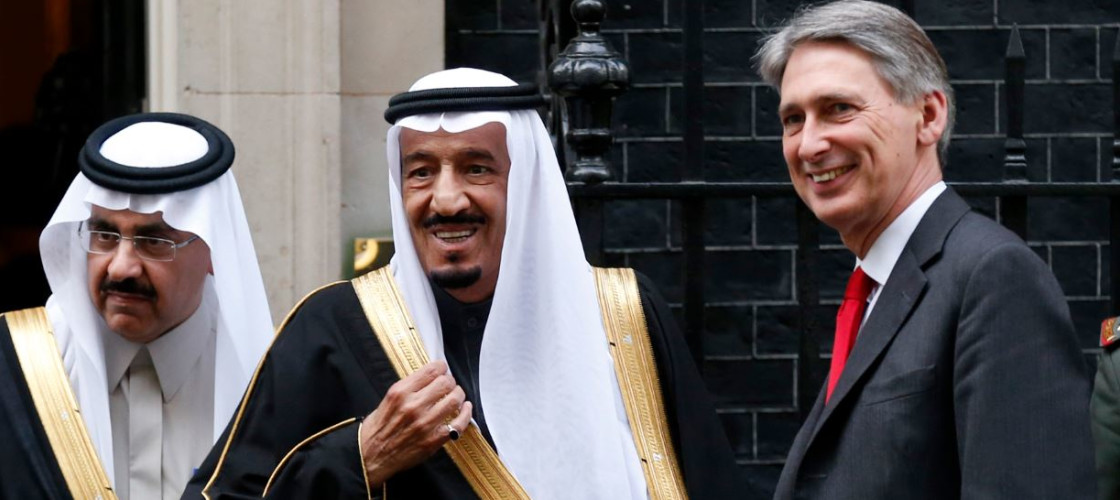
Philip Hammond and Saudi Arabia's Defence Minister Prince Salman bin Abdul-Aziz Al Saud

UNICEF reported at least one child is dying every 10 minutes in Yemen and that there has been a 200 percent increase since 2014 in children suffering from severe acute malnutrition, with almost half a million affected. Nearly 2.2 million are acutely malnourished in need of urgent care. An estimated 21 million people – nearly double the number of people who need aid in Syria – require humanitarian assistance in a country where more than 60 per cent of Yemeni’s, according to the UN, are close to starvation. This comes as the country’s health system is on the verge of collapse, in part due to the ongoing US-UK – backed Saudi bombing of the country which began in March 2015.

During the latest wave of 45 airstrikes across the country that began last Sunday (January 22), a school just outside the capital, Sana’a, was hit and 70 people had reportedly been killed in fresh fighting. According to UN figures reported in Reuters, an estimated 10,000 civilians have so far been killed as a direct result of the Saudi-led coalition bombing. However, as the UK government does not keep a record of Yemen’s ‘unpeople’ killed in airstrikes, nor does it have any record of how many “guided missile kits” it has sold to the Saudi regime, the real figure is likely to be much higher. A UN study found that 60 per cent have died from Saudi-led aerial bombardments in the Houthi-controlled north of the country. Journalist Sharif Abdel Kouddous who was based in this region commented:

“Everything has been hit, from homes to schools, restaurants, bridges, roads, a lot of civilian infrastructure. And with that, of course, comes a lot of the suffering.”

The forgotten war

Despite this humanitarian disaster, Yemen has largely been the mass media’s forgotten war having initially been buried a week after Murtaza Hussain revealed the release of previously suppressed documents contained within a 2002 congressional report that emphasized possible links between high-ranking members of the Saudi royal family and the 9/11 hijackers.

Instead, the focus of the mass media has been their demonization of Russia in relation to the proxy-war being fought in Syria. As terrible as the suffering has been for the Syrian people, the humanitarian situation in Yemen is far worse. Not only is it the poorest country in the Middle East whose people suffered widespread malnutrition before the war, but people have no disposable income in order to be able to pay to get themselves out of the country.

Also, Yemen borders the country that is bombing it which severely hinders the ability of people to flee. Even fishermen have been bombed in their boats off the coasts, which rules out the option of going across the sea to get out of the country. The inability of the people to cope with the restriction on imports, in addition to two years of Saudi-led coalition bombing has culminated in a situation in which 18.8 million people are now in need of some form of humanitarian aid.

Breaking international law

Both the UK and US governments are major backers of Saudi Arabia’s bombing campaign. In August last year, the latter approved more than 1bn in military sales to Saudi Arabia, while UK export licenses to the regime were said to be worth more than £1.7 bn up to the first six months of 2015. According to analysis by eminent international law experts commissioned by Amnesty International UK and Saferworld, by continuing to trade with Saudi Arabia in arms in the context of its military intervention and bombing campaign in Yemen, the British government is breaking national, EU and international law.

The lawyers, Professor Philippe Sands QC, Professor Andrew Clapham and Blinne Ní Ghrálaigh of Matrix Chambers, conclude in their comprehensive legal opinion that, on the basis of the information available, the UK Government is acting in breach of its obligations arising under the Arms Trade Treaty, the EU Common Position on Arms Exports and the UK’s Consolidated Criteria on arms exports by continuing to authorise transfers of weapons and related items to Saudi Arabia within the scope of those instruments, capable of being used in Yemen.

They conclude:

“Any authorisation by the UK of the transfer of weapons and related items to Saudi Arabia… in circumstances where such weapons are capable of being used in the conflict in Yemen, including to support its blockade of Yemeni territory, and in circumstances where their end-use is not restricted, would constitute a breach by the UK of its obligations under domestic, European and international law….The UK should halt with immediate effect all authorisations and transfers of relevant weapons pending an inquiry” (emphasis added).

According to Kate Allen, Director of Amnesty International UK:

“This legal opinion confirms our long-held view that the continued sale of arms from the UK to Saudi Arabia is illegal, immoral and indefensible. Thousands of civilians have been killed in Saudi Arabia-led airstrikes, and there’s a real risk that misery was ‘made in Britain’.”

UK complicity & the targeting of civilians

Iona Craig, who won the 2016 Orwell Prize for Journalism, has investigated numerous Saudi-led airstrike sites in Yemen. In an interview on Channel 4 News in December, 2015, Craig asserted that during these strikes, which she said are a regular occurrence, the Saudi’s targeted public buses and a farmers market.

Remnants from a bomb that Craig pulled from a civilian home that killed an eighteen month old baby as well as a four old and their uncle, were American made. Craig at the time stated that she had not personally uncovered evidence of British made weapons but has since corrected this view in the light of subsequent events.

The fact that, as Craig stated, there are twice as many British made aircraft in the Saudi Royal air force than there are in the British Royal air force, and that the British train and supply them with weapons, is by itself, tantamount to the UK government being complicit in the deaths of innocent Yemeni civilians.

Craig emphasized that she has seen evidence which suggests civilian casualties in Yemen are the result of deliberate targeting rather than “collateral damage”. Among the numerous cases the journalist has examined there have been no Houthi positions or military targets in the vicinity – a contention which she claims is supported by the pro-coalition side.

Britain’s active participation in Yemen began in September, 2015 following the bombing by Saudi Arabia of a ceramics factory in Sana’a close to the Yemeni capital which was confirmed as a civilian target. Fragments of a British made missile that had been built by Marconi in the 1990s had been recovered from the scene. With the British providing technical and other support staff to the Saudi-led coalition, the UK government’s role in the conflict is to augment US support as part of a broad-based coalition.

In December, 2015, the US State Department approved a billion-dollar deal to restock Saudi Arabia’s air force arsenal. The sale included thousands of air-to-ground munitions and “general purpose” bombs of the kind that, in October 2015, the Saudi’s used to target an MSF hospital. On the 15 December, 2015, 19 civilians were killed by a Saudi-led coalition raid in Sana’a.

Double-tap strikes

During a recent interview for LBC, Craig said that one of the tactics the Saudi-led coalition have adopted is to strike locations they had previously bombed which invariably kill first responders at the scene of atrocities who are trying their best to rescue the bodies of survivors. The casualties from such attacks outnumber the original bombings. Craig said she has personally witnessed attacks by coalition forces on a civilian market in which twelve people died in the initial attack and a further fifty or more had been killed in the follow-up attack. According to Craig, houses in Sana’a have been hit multiple times, which contradicts the myth that such targets are errors. Airstrikes of this nature are not isolated incidences as the media often portray. As Craig said in the interview:

“They [airstrikes] happen on a regular basis…The Saudi-led coalition have hit 58 hospitals and 39 markets. Routine targets include petrol stations and public markets. …Between March, 2015 when the war started to the end of August, the Yemen Project gathered all of the figures and calculated that there were 8,600 single incidences and amongst that over 3,000 hit civilian sites.”

Public relations

Facing mounting pressure from human rights groups, last month the Obama administration engaged in what was essentially a public relations exercise by announcing that the US government would halt the sale of precision-guided weapons to the Saudi regime. It’s likely the US government will attempt to get around this by selling them to other members of what is a multinational coalition.

In any case, the US government continues to provide its allies with intelligence and there is no indication that its major US ally, the UK, intends to end its authorization of over £1 billions’ worth of weapons to Saudi Arabia over the course of the war.

But most significantly of all, is that Obama’s announcement will do nothing to prevent the refueling of coalition aircraft. Logistically, without being able to refuel, fighter jets are unable to continue with their sorties. As Craig pointed out, this “would stop the bombing campaign literally tomorrow…If the U.S. government did want to stop the bombing campaign, they could do it…But they’re still heavily involved in the whole campaign carrying on.”

Lying to parliament

Towards the end of July last year, the UK government stood accused of repeatedly misleading parliament about Britain’s role in Yemen – news that was buried until its release in the final hours of the last day of the parliamentary term. Rather than accepting it has contravened International Humanitarian Law (IHL) and as a result says it wants to stop trading in illegal weapons of death with one of the most tyrannical regimes on the planet, the UK governments line has been to assure parliament that assessments into Saudi behaviour have been undertaken and that the country has not been abusing human rights in Yemen.

With talks between the country’s warring factions still deadlocked, the Foreign Office (FO) have retracted a series of statements on the crisis in the country describing them as “an error”, adding that no such assessments of human rights had ever been carried out. However, on July 21 last year, the government admitted misleading parliament on six different occasions telling MPs they had assessed Saudi conduct when they hadn’t, insisting that the Saudi’s weren’t breaking IHL. Amazingly, the UK government is not assessing whether the weapons they sell to the Saudi regime are being used in breach of IHL.

Having previously lied in an attempt to stitch-up Julian Assange in order to please his counterparts on the other side of the Atlantic, the then Foreign Secretary, Philip Hammond went a stage further with his piece of mandarin-speak intended to cover-up his misleading of parliament as a justification to sell weapons that are being used to kill innocent men, women and children in Yemen. Hammond’s signing off weapons of death to one of the most brutal regimes on earth without them having been independently assessed beforehand, is indicative of just how detached Hammond is from the plight of his fellow human beings.

The government statement at the time read:

“We have NOT assessed that there has not been a breach of International Humanitarian Law by the coalition”.

This translates as that on no fewer than six occasions the coalition government misled parliament telling MPs that the Saudi’s were not breaching IHL in Yemen. However, they must of known they were. Late on Friday, June 22, 2016, former Shadow Foreign Secretary, Hilary Benn, MP wrote to then Foreign Secretary, Hammond (now Chancellor):

“I urge Boris Johnson, as the new Foreign Secretary, to ensure that the Government does what you originally said it was doing and immediately assess whether IHL has been breached. A continued failure to undertake such an assessment would be an abdication of responsibility and will serve to further undermine Britain’s standing in the world.”

The jaw-dropping revelations which represent complete u-turns on previous answers that the UK parliament were given, are not just about the correction of six parliamentary answers, but have a direct impact on the people of Yemen and the families of the thousands of civilians who have lost their loved ones in the conflict.

Freedom of information 

The British governments role in the country initially only came to light following a Freedom of Information request that revealed a ‘memorandum of understanding’ (MOU) between the then Home Secretary Theresa May and her Saudi counterpart Crown Prince Muhammad bin Nayef which was signed secretly during the former’s visit to the Kingdom in 2014. The purpose of the MOU is to ensure that, among other secret deals, the precise details of the arms sales between the two countries is kept under wraps.

Questions about the precise role the UK, US and Saudi Arabia are playing in Yemen, as well as the extent to which UK weapons are implicated in the deaths of civilians, will redouble in the months ahead, particularly after activists won their battle to take the government to court over the affair set for next month (February, 2017). No amount of attempts by the media to bury the Yemen conflict from the headlines will alter that fact.

The government tried to bury some very bad news last July and got found out. As long as there exists alternative media to bring the government to account, they will continue to be exposed for their criminal activities.

COPYRIGHT

All original material created for this site is ©Daniel Margrain. Posts may be shared, provided full attribution is given to Daniel Margrain and Road To Somewhere Else along with a link back to this site. Using any of my writing for a commercial purpose is not permitted without my express permission. Excerpts and links, including paraphrasing, may be used, provided that full and clear credit is given to Daniel Margrain and Road To Somewhere Else with appropriate and specific direction to the original content. Unless otherwise credited, all content is the site author’s. The right of Daniel Margrain to be identified as the author of this work has been asserted by him in accordance with the Copyright, Designs and Patents Act 1988.

Kindly make a small donation

If you’ve enjoyed reading this or another posting, please consider making a donation, no matter how small. I don’t make any money from my work, and I’m not funded. You can help continue my research and write independently.… Thanks!


Donate Button with Credit Cards

The Royals Are Making A Killing

Prince Charles does a sword dance while on a trip to Saudi Arabia to help sell UK arms to one of the world's most bruatl regimes. Not the swords, we hope, the Saudi monarchy uses to cut off people's heads and limbs for offences like adultery, blasphemy and homosexuality.:

By Daniel Margrain

Two weeks ago (December 22, 2016), Prince Charles warned against state persecution. This is despite the fact that the House of Saud regime he ingratiates himself with as depicted by the photograph above, executed religious leader, Nimr al-Nimr, earlier in the year and is one of the most barbaric regimes on earth. Millions of Londoner’s who are vehemently opposed to the regime have the opportunity to collectively vent their anger at the kind of duplicitous actions of Charles and the British governments unethical and inexcusable policy towards the Saudi regime that seeks to endorse it, once every two years on the streets of the capital.

It’s during these periods that the arms fairs which host representatives of some of the most authoritarian regimes on earth gather together in what on the surface might appear to some to represent run of the mill trade shows. It’s the attempt by the establishment to normalize killing and state oppression in this way that’s particularly repugnant. Nevertheless, it’s perhaps fitting that the apex of intra-state violence is not only represented in the home of a former empire that straddled the four corners of the globe, but which also has embodied in its future head of state somebody whose values are inherently inseparable from those he purports to despise. Thus it’s in the home of democracy that such luminaries as Saudi Arabia, Egypt, Bahrain and Azerbaijan are given a welcoming embrace as part of London’s Docklands biennial Defence and Security Equipment International (DSEI) exhibition.

Last summer, Britain demonstrated its support for the Saudi government, the biggest market for UK arms companies, by delivering a consignment of 500lb Paveway IV bombs originally earmarked for the RAF, to the House of Saud regime. Saudi Arabia’s fleet of strike aircraft includes British Tornados, Eurofighter Typhoons and US F-15s. “The UK is digging into its own weapons supplies to replenish Saudi stocks,” Michael Stephens, of the Royal United Services Institute (RUSI), told the BBC. Many of the weapons sold to the Saudi’s are being used in airstrikes ostensibly against Houthi rebels in Yemen but in fact are being targeted against civilian infrastructure which amounts to a violation of the laws of war. More than 1,500 companies exhibited their weapons of death wares at the event, including the US and UK giants Lockheed Martin, Boeing, Raytheon and BAE Systems.

At past London arms fairs, campaigners have discovered a variety of illegal torture equipment advertised for sale, including electric shock stun guns and batons, leg-irons, and belly, body and gang-chains. There has also been a range of illegal cluster-munition weaponry advertised. Amnesty said it had identified nine companies that had violated UK law at DSEI events between 2005 and 2013.

The British establishment and royalty know that arms are good investments especially shells, bombs and cruise missiles that are tipped with depleted uranium. Air, water and soil are contaminated when DU is used, and once contaminated there is no way to de-contaminate it. Contaminating the food chain is a crime against humanity for which the Royal Family is complicit, as it was (with the help of Tiny Rowland), in the asset stripping of Africa.

Rowland, who was an unashamed member of Hitler Youth and nicknamed the Royal Buckaneer, was chief executive of the Lonrho conglomerate from 1962 to 1994. Angus Ogilvy, the Queen’s nephew, would sit on Rowland’s Board with Royal approval. The Royal shares would thus finance the arming of Africa in the Lonrho resource wars. African lenders who promised Lohnro their strategic minerals were armed to the hilt by Ogilvy and Rowland.

In 1987, the Anti-Slavery Society reported that in Lohnro’s shanty goldmines 60 boys had to work almost naked in a pool of cyanide at their extractor plant in Ghana. The cyanide, in separating out the gold, enters the body as gas, liquid or acid dust. But for Lohnro and royalty such horror is overlooked if it happens to impinge on profits. With the help and advice of their pet buckaneer, the royal shareholder’s had recolonized Africa by the back door and their uranium holdings are now worth more than 6 billion dollars.

But here’s the catch. No amount of money can deflect from the fact that pollution is democratic. Not only can uranium winds blow back into the faces of their profiteers, but thanks to uranium investors, radioactive isotopes are now found in the flesh of worms. Worms are a pillar of ecosystems in as much as they air-ate the soil and aid the nutrient uptake of plants which Prince Charles reportedly likes to talk to.

Depleted uranium that hardens the tips of shells that can pierce concrete is one of the royal ordinance star exports despite the fact that weapons which contain DU violate the Geneva Convention. The DU shell which the Sovereign has shares in, is not only illegal but it is also a highly mobile discriminate killer described as a “permanent terrain contaminant”.

Unlike any hereditary monarchy, however historic, DU stains the environment forever and rewrites DNA codes. The rates of human deformation in Fallujah, the city in Iraq where the West used DU, exceed those in Hiroshima. While the UK government was undertaking its illegal war in Iraq, it increased the value of the Royal investment. The price of uranium increased 500 percent in six years.

The trading in death by royalty continues apace but has shifted from the Continent they fleeced during the Ogilvy/Rowland years to the Arabian Gulf Peninsula. BAe systems, Britain’s leading arms manufacturer last year sold 72 Typhoon fighter jets to the Saudi Arabian dictatorship. On the eve of the day the deal was signed Prince Charles was in the Saudi capital Riyadh, dressed in traditional robes and joining the Saudi princes in a sword dance.

Andrew Smith from the Campaign Against the Arms Trade said “It is clear that Prince Charles has been used by the UK government and BAe Systems as an arms dealer”. This was Charles’ 10th visit to the Saudi regime and was made at the request of the Foreign Office. A previous investigation into UK-Saudi arms deal, Margaret Thatcher’s sale of Tornado fighters in the Al Yamamah deal, was blocked by Tony Blair on “national security grounds”.

Illegal arms deals involving British royalty extends further afield. In South Africa, for example, Hawk Jets are the preferred killing machines. Former South African MP Andrew Feinstein said “the royal family was involved in trying to persuade South Africa to buy BAE’s Hawk jets, despite the air force not wanting the planes that cost two and a half times the price of their preferred aircraft. As an ANC MP at the time, I was told that £116m in bribes had been paid to key decision-makers and the ANC itself. The royal family’s attitude is part of the reason that BAE will never face justice in the UK for its corrupt practices.”

It’s the hereditary concentration of power and accumulation of wealth through weapons profiteering, corruption and death that is arguably in part the context that explains why the self-proclaimed democrat Jeremy Corbyn refused to sing the national anthem. The monarchy and democracy are simply irreconcilable concepts. It was on this principle that the English people fought a civil war, made a revolution and cut off their king’s head in the 17th century. I’m not suggesting anything of the sort be carried out today, but the inward expression of Corbyn’s republican principles highlight the contradiction at the heart of liberal democratic Britain in the 21st century.

Assange’s stitch-up is a lesson for us all

By Daniel Margrain

December 7, 2010, was the day Wikileaks founder, Julian Assange lost his liberty following the accusation of rape against him in Sweden. Throughout the intervening six years, Assange has been willing to give a statement to the Swedish authorities, either by receiving officials in the UK or over telephone or video link, which is the routine method of carrying out questioning.

Ten months ago, the UN adjudged  that the effective imprisonment of Assange in the Ecuadorian embassy in London was unlawful. This legally binding judgement was a vindication of all those activists who have supported the quest of the Wikileaks founder to bring into the public domain the illegalities of Western power.

Upon the release of the UN ruling, one of the leading political gatekeepers of the said powers, then UK foreign secretary, Phillip Hammond, did his utmost to publicly undermine the findings of the UN body – of which the UK government is a signatory – by attempting to deceive the British people. What was shocking was the extent to which Hammond was prepared to sink in order to attempt to justify the unjustifiable at the behest of his masters in Washington.

In what former UK diplomat, Craig Murray, described  as an “utterly astonishing” statement, Hammond said:

“I reject the decision of this working group. It is a group made up of lay people and not lawyers. Julian Assange is a fugitive from justice. He is hiding from justice in the Ecuadorian embassy.”

Hammond’s statement was a blatant lie. Every single one of the UN panel is an extremely distinguished lawyer. According to Edward Snowden, Hammond is writing “a pass for every dictatorship to reject UN rulings.” Craig Murray stated that, “Countries who have ignored rulings by this UN panel are rare. No democracy has ever done so. Recent examples are Egypt and Uzbekistan. The UK is putting itself in pretty company”, he said.

Previous rulings by the panel have gone against countries with some of the world’s worst human rights records, such as Saudi Arabia, Myanmar and Egypt. Recent cases where the UN has ruled in circumstances in which individuals have similarly been detained, include the Washington Post journalist, Jason Rezaian in Iran in December, 2015 and former pro-democracy president Mohamed Nasheed two months previously (both subsequently released).

On 30 November 2016, the United Nations rejected the UK’s attempt to appeal the UN’s February ruling in favour of Julian Assange. The decision made ten months ago therefore stands. The UN instructed that UK is once again required to immediately put an end to Assange’s arbitrary detention and to take immediate steps to ensure his liberty and enjoyment of fundamental human rights are re-established. Having reached the end of the legal road, the UK government is compelled to release Assange from his six years of illegal detention.

justice4assange.com provides some background to the case:

“Julian Assange, editor-in-chief of WikiLeaks, has been detained without charge in one form or another since 7 December 2010…In Sweden, Julian Assange is not charged with a crime. But in a highly unusual move, Sweden issued an Interpol Red Notice and a European Arrest Warrant, immediately after WikiLeaks began publishing a cache of 250,000 US Diplomatic Cables on 29 November 2010. Such warrants are usually issued for persons whose whereabouts are unknown. But Julian Assange’s whereabouts were known (he had given a press conference and hundreds of interviews in London). His lawyers were in communication with the prosecutor and had communicated that he was available to answer questions from the Swedish prosecutor through standard means.”

“Questioning people within European borders is a routine and uncomplicated process, which is standardised throughout the European Union. Sweden often uses these means to question people. In the initial ten days after 20 August 2010, the police opened the ’preliminary investigation’, it was assigned to three different prosecutors in quick succession. The penultimate prosecutor found that the case had no basis, and that there were no grounds to place Julian Assange under a criminal investigation.”

The final prosecutor however, Marianne Ny, took over on 1 September 2010 and reopened the investigation. The Swedish investigation has been frozen since 2010. In November 2014, Sweden’s Svea Court of Appeal ruled that the prosecutor had failed her professional duty to progress the investigation against Julian Assange.”

The context of the ruling vindicating the Wikileaks founder stems from the fact that he has never been charged with any offence. The UN findings confirm that his detention has been unlawful since his very first arrest in the UK in 2010 and that there has never been any genuine attempt by the Swedish authorities to investigate the allegations against him. For all those commentators who have been following the case closely, it has been obvious that from the outset the establishment have had it in for Assange. The rape allegations were the Casus Belli.

This was given credible weight early on by Naomi Wolf, a prominent American writer, feminist and social commentator, who argued that the allegations against Assange bore all the hallmarks of a set-up. This was further elaborated on by Craig Murray who thoroughly demolished the case against Assange. As John Pilger outlined, the reality is, there was no genuine judicial process in train against Assange in Sweden, a point that was advanced by Assange’s lawyers before the UK supreme court:

“The Assange case has never been primarily about allegations of sexual misconduct in Sweden – where the Stockholm Chief Prosecutor, Eva Finne, dismissed the case, saying, ‘I don’t believe there is any reason to suspect that he has committed rape’, and one of the women involved accused the police of fabricating evidence and ‘railroading’ her, protesting she ‘did not want to accuse JA of anything’ – and a second prosecutor mysteriously re-opened the case after political intervention, then stalled it.”

Finne’s dismissal of the case against Assange has since been vindicated by the release of SMS records which appear to indicate that the Wikileaks founder was, as Stockholm’s Chief Prosector suggested, framed by the police. Indeed, the police themselves admit that the rape allegations were fabricated in what they concede was an elaborate plot against Assange.

Given the astounding level of misinformation, demonization, smears, deceptions and outright lies in the mainstream corporate media’s reporting of Assange, an observer unfamiliar with the case might reasonably form the impression that the man in question is the devil incarnate, who is using his work as a cover in order to avoid facing justice for the crime of rape.

Some of these commentators, it would appear, have seen fit to pronounce a verdict of guilty on the head of the whistle blower in advance of any hypothetical future trial. The self-appointed Witch finder General, Joan Smith from London Women against Violence, for example, virtually alluded to Assange’s guilt with a series of crass pseudo-psychologically-based observations and insinuations.

Much of the vitriol stems, not from the traditional right-wing of the media terrain, but rather from what many people consider to be the liberal-left of the political spectrum. Owen Jones, for example, who appears to be the latest poster boy for left wing opinion throughout the corporate media, penned, in August 2012, an article for the UK’s Independent newspaper, titled “There should be no immunity for Julian Assange from these allegations.”  But Jones’ inference that diplomatic immunity is a feature of the Assange case is, in reality, a red-herring since neither Assange, his supporters, legal team or anybody else outside the media bubble, have ever suggested that his case is predicated on a claim of immunity.

The lie was repeated by the legal expert, Joshua Rozenberg, presumably in an attempt to add a certain degree of gravitas to the claim. The truth is that all Assange has ever requested from the outset, is a guarantee from the Swedish authorities that if he agrees to travel to Sweden to answer the rape allegations made against him, he won’t be extradited to the United States. Assange’s request for this assurance from Sweden is supported by Amnesty International. However, the Swedish authorities have consistently failed to give Assange such an assurance.

Despite all this, the Sky News journalist and LBC stand-in presenter, Tim Marshall, implied that callers to his programme on February 5, 2016, who suggested that should Assange step foot outside the Ecuadorean embassy, he would ultimately be extradited to the U.S predicated on the trumped up charge of rape and subsequently be imprisoned, were mad conspiracy theorists. The incandescent, Marshall, is apparently unaware of the case of Chelsea Manning who was imprisoned for 35 years in 2013 for leaking information to WikiLeaks.

He is also seemingly unaware that, according to Edward Snowden, Assange is on a US “manhunt target list” or that the Independent revealed that both the Swedish and American governments’ have already discussed Assange’s onward extradition. If Marshall had bothered to avail himself of the views of Mats Andenas, the Norwegian chair of the UN Working Group for much of its investigation, he would have realized that the panel had to resist intense pressure from the US and UK to arrive at a decision contrary to the one they actually reached.

Marshall’s tone throughout was one of incredulity that the “liberal” Sweden would place Assange at risk of extradition to the US or for that matter that the latter under the liberal-progressive Obama, could ever preside over an administration that has imprisoned more whistle blowers than all his predecessors combined. In terms of the former (something else that Marshall is apparently oblivious to), is the subject matter of Amnesty International’s 2013 report which highlights Sweden’s damning record of extraditing people to other countries and its cooperation with the US in extraordinary renditions.

Jonathan Cook sums up just how far down the perilous road towards fascism our governments’ and their accomplices in the media are prepared to go in order to augment the interests of the powerful:

“The degraded discourse about the UN group’s decision does not just threaten Assange, but endangers vulnerable political dissidents around the world. The very fact that…[liberal media commentators]… are so ready to sacrifice these people’s rights in their bid to tar and feather Assange should be warning enough that there is even more at stake here than meets the eye.”

In a humane and fair world, it would be incumbent upon the media horde who have unjustly smeared Assange, to admit they were wrong and publicly apologize to him and his supporters, all of whom have been vindicated by events. But not only have no such apologies been forthcoming, the commentariate at the Guardian have actually continued with the smears.


Enemies of the people, friends of democracy

By Daniel Margrain

The ruling last Thursday (November 3) by three High Court judges to allow MPs the right to a vote over the decision to Brexit was welcomed by this writer. Campaigners won their battle to defeat Theresa May’s attempt to use the Royal prerogative as a means of overriding parliamentary sovereignty. The decision of the judges to apply what is a matter of constitutional law, means that the government cannot trigger Article 50 without a vote in parliament. Below is the 2015 Referendum Bill Briefing Paper which appears to be consistent with assertions in the liberal media that the referendum result is advisory, not mandatory:

To reiterate:

“The UK does not have constitutional provisions which would require the results of a referendum to be implemented.”

Following the judges decision, and despite the legal clarity, some of the tabloid printed media ran with inflammatory headlines. The Daily Mail – the paper that in the 1930s supported Hitler fascism, for example (see graphic above) – referred to the judges responsible for upholding the rule of law, as “enemies of the people”. Even some Tory politicians got in on the act. Sajid Javid, for instance, described the decision as “an attempt to frustrate the will of the British people.”

What Javid appears to be unaware of, is that in British law it is not the role of an independent judiciary to uphold and implement the will of the people but to uphold the law. Parliament and elected MPs are subject to the will of the people, not judges.

Javid’s stigmatizing language undermines the important role played by an independent judiciary in terms of its ability to curtail crude populism. The undermining of the independence of the judiciary and the promotion and normalization of referenda, is concomitant to the prevailing hate-driven agendas of the tabloids. But this also fits into a wider right-wing political narrative in which simplistic binary approaches to often complex problems are preferred to process and nuance.

For example, in order to garner the support of right-wing  fringe elements, the former PM, David Cameron, stated that Article 50 would be triggered automatically following any vote to leave. This modus operandi has continued under Cameron’s successor, Theresa May, who continues to argue for a “hard Brexit” claiming that Article 50 should be invoked immediately without any parliamentary scrutiny or oversight.

These kinds of inferences to fascist ‘mob rule’ was effectively what the Conservative MP David Davies was arguing for when, on Twitter, he stated the following:

Nov 3

“Unelected judges calling the shots. This is precisely why we voted out. Power to the people!”

Here Davies is calling for a non-independent judiciary. The one word for a country where the judiciary is not independent, and where the law is expected to reflect the temporary feelings and emotions of the public – often built upon superstitions, lies and exaggerations – is “dictatorship”. The German constitution banned referenda precisely because they know how fascists came to power.

Modern, secular based constitutions that separate the judiciary from parliament exist in order to prevent the drift towards fascism. In order to prevent this from happening, it’s the job of the Conservative Lord Chancellor, Liz Truss MP, to defend the independence of the British judiciary. But instead of coming to their defense by publicly criticising Javid’s or Davies’s comments, or reprimanding the editors of the Daily Mail, she has remained almost silent.

By arguing against the decision of the High Court judges, Javid and Davies are, in effect, arguing against the legitimate right of British judges to enact British law in the context of the British sovereign parliament. From the perspective of the ‘leavers’ this would seem ironical since they were the people who were most anxious to press the point about the need to ensure Britain maintained its sovereign parliamentary status.

In the avoidance of confusion, parliament (legislature) makes laws and the government (executive) implements them. The role of the judiciary is to check the legality of those laws. The separation of these powers is an integral part of the proper functioning of the state. In ‘An Introduction to the Law of the Constitution (1915, 8th edition, p.38), Professor A.V. Dicey explains the precedent by which the principle underpinning British parliamentary sovereignty is set and, consequently, on what basis the Referendum Bill above was formulated.

Professor A.V Dicey’s century-old legal precedent states, “No person or body is recognized by the law as having a right to override or set aside the legislature of parliament” which “has the right to make or unmake any law whatever.” This simple precedent means “that it cannot be said that a law is invalid as opposed to the opinion of the electorate.” 

In this context, referenda are irrelevant because “the judges know nothing about any will of the people except insofar as that will is expressed by an act of parliament.” The point about the separation of powers is that the legislature and the judiciary protect the public from the possibility that the executive will act against the interests of society of which an all-powerful unchecked state is emblematic. But it also exists to protect the public from itself.

How does this play out in terms of the referendum?

Parliament not only has a responsibility to the 17.5 million British people who voted for Brexit, but it is also responsible to the 29 million people who didn’t (see graphic below).

The role of MPs, in which parliament is sovereign, is not to represent the wishes of the public (a common misconception), but rather to represent the interests of the public in their totality. In this sense, therefore, the interests of 29 million people override the wishes of 17 million people. The interests of the people in the country as a whole, in other words, are not served by committing economic suicide.

As almost the entire professional career of elected politicians is based on them scrutinizing legislation, it follows that what they regard as being in the best interests of the public carries more weight in the decision-making process than people who voted in the referendum on the basis of what they read in the Daily Mail or as a result of the lies uttered by politicians like Nigel Farage, Michael Gove and Boris Johnson.

The fundamental nature of British representative parliamentary democracy is that the public elect a representative not a delegate. The sovereign and inviolate aspect of the system, in other words, means that British constituents elect MPs who they think will exercise their best judgement by voting – Whips notwithstanding – on issues that reflect their best interests.

As the majority of MPs supported remain, and the majority of constituents voted to leave, adopting the rationale described means that, logically, the latter voted against their own interests. Ensuring MPs vote in the best interests of their constituents is what parliamentary sovereignty means. In this regard, all of the pro-leave MPs who said the result of the referendum was a reflection of parliamentary sovereignty, were lying.

It is clear that the Tories wanted to by-pass the law in order to initiate a ‘hard Brexit’ without laying out the terms of such a strategy. The fact that the judges have forced a parliamentary vote – barring any successful appeal to the Supreme Court – means there now has to be proper scrutiny of its terms in advance of the vote. This is in sharp contrast to the continuation of the empty and meaningless “Brexit means Brexit” platitude uttered constantly by Theresa May.

David Cameron, called the referendum, clearly in the anticipation that his side would win. He also must of been aware that a victory for leave would not have been triggered automatically as the information contained in the leaflets sent to all households stated. In any event, the former PM resigned following the result of the referendum precisely because he knew he couldn’t fulfill the promise he had made to the electorate prior to the vote. Cameron’s unelected successor, is therefore tasked with clearing up a mess set in motion by the incompetency of her predecessor.

During the previous election campaign, the Tories manifesto promise was to remain in the single-market. Having so far failed to call an election over the debacle, May’s authority is highly questionable. She didn’t have a mandate before the judgement and she has even less of one now. My advise to Jeremy Corbyn and his team is to prepare for an early election.

Why the travails of Apple are symptomatic of a much wider problem

By Daniel Margrain

In the wake of the democratic decision of the British people to exit from the EU, it would paradoxically appear to be highly probable that the UK government will give away the kind of sovereignty the ‘Brexiteers’ claim to covet by signing an unadulterated TTIP deal with the United States government. At a point in time in which the UK government appears set to extricate itself from the ‘bureaucratic and unaccountable’ EU, the multinational conglomerate Apple is availing itself of Ireland’s tax system, the most favourable national tax regime in Europe.

However, the European Commission ordered Apple to pay the Irish government £11bn of back-dated tax that it has avoided. The Irish Cabinet agreed to appeal the European Commission diktat. Irish PM, Enda Kenny, ordered his ministers back from their summer holidays after the European Commission accused Ireland of breaching state aid rules.

But Independent minister John Halligan initially said that the Irish government should take the cash owed by Apple in order to fund hospital services in his constituency before eventually agreeing to the decision to appeal the ruling. The European Commission alleges that Apple’s effective tax rate in 2014 was a mere 0.005 per cent which means that someone earning £30,000 a year at an equivalent rate would pay just £1 a year in tax.

Meanwhile, the reaction of the British government to the impasse, was not to support the EU in its noble endeavor, but rather to remain on the sidelines in the hope that the situation would play out to their advantage, thus providing them with a potential opportunity to entice Apple with a ‘sweetheart’ ‘investment’ deal. Meanwhile, as Alex Callinicos  pointed out “Apple is playing the EU and the US off against each other over which gets the taxes it hasn’t been paying.”

It’s precisely the logic that overrides these kinds of shenanigans that explains one of the reasons why wealth inequality continues to rise to stratospheric levels, and why governments are witnessing a backlash against globalization. Over the past 40 years, the productive capacity that capitalism has engendered, allied to the ability of successive governments to transfer assets and capital from the public to the private sphere, has created an enormous concentration of wealth at the very top of society.

Britain is a country where armies of lawyers and accountants sift through mountains of legal paper work in order to justify on a legal basis those at the very top paying as little tax as possible. This has happened as a result of the restructuring of rules and regulations which provide corporations with legal loopholes with which to jump through.

In the case of Apple, profits are funneled into a ‘stateless company’ with a head office which, according to EU Commissioner, Margrethe Vestager, “has no employees, premises or real activities.” In other words, Apple’s resident European office for tax purposes doesn’t exist. It has no staff and no location so it doesn’t pay any tax on most of the money it earns outside the United States.

Ireland has been told that it must claw back the £11 bn of back taxes from Apple even though Ireland’s ruling politicians say they don’t want it. This is money which could be spent for the benefit of an electorate who these politicians supposedly represent. Irish finance minister Michael Noonan intimated that individual states, not the EU, are responsible for individual taxation policies. “It’s an approach through the back door to try to influence tax policy through competition law.”, he said.

But what use is a tax policy if it is not intended to benefit human kind? If tax havens like Ireland behave in a way that negatively affects the well being of humans by reducing the resources available to fund services and infrastructure of which the functioning of civil society depends, then such a tax policy is not worth the paper it is written on. Does Ireland look like a country that doesn’t need £11 bn?

Apple’s billions worth of profits generated in Europe and the Middle East are transferred to Ireland where the company pays tax on just 50m euros worth. The rest is sent to their non-existent ‘virtual’ head office. As of 2015, the company’s lightly-taxed foreign cash off-shore mountain of $187bn is the biggest of any U.S multinational.


How can Apple defend this state of affairs whilst simultaneously maintaining the moral high ground by claiming that any attempt to prevent such an immoral situation will be bad for the societies in which they operate?

The activities of a virtually non-existent tax-paying company like Apple is already bad for these societies. The reason the masses, as opposed to companies like Apple, are subject to tax at a fixed rate, is because the former, unlike the latter, are not in the financial position to be able to avoid it. Those who are least able to pay taxes are the ones who have it deducted from their wages in full at source.

It’s not the overreaching arm of the EU ‘interfering’ with the tax laws of individual member states that’s the problem, but the fact that multinationals pit one country against another to avoid paying as much tax as possible while availing themselves of everything the rest of us pay for. The ‘race to the bottom’ is one in which corporations are constantly on the look-out to ‘up-sticks’ in the search for ever cheaper tax havens.

The end goal is a scenario in which the corporations pay no tax at all, while the masses pay for civil society because corporations like Apple, Google and Starbucks don’t have to. The upward spiral of money from the many to the few is increasing at a rate of knots due to a form of state-managed capitalism that perpetuates it. Moreover, it is happening to the detriment of the whole of the human race.

Widespread public anger towards this kind of systemic corruption is stymied daily as a result of the distractions associated with TV light entertainment and sports programmes. All this is aided by a largely uncritical corporate-based journalism. The ability of the rich and powerful to lobby governments in support of their own economic narrow interests, often to the detriment of the environment and society at large, exacerbates the problem.

Shortly before becoming the UKs unelected PM, Theresa May, intimated that the Tory government she would go on to lead would instigate greater transparency between government and big business and that she would no longer tolerate the undue influence of corporate power on domestic UK politics and the corruption through the power of lobbying that this implies. However, less than two months later, the Guardian revealed that a £3,150 payment to the government will buy business executives strategic marketplace influence.

The privileging of a tiny minority of the wealthy and corporations in this way, can be regarded as nothing less than the usurping of democracy. The mass of the working poor whose exploited labour creates the wealth from which the rich benefit and who often vote for corporate-funded politicians diametrically opposed to their own interests, is indicative of the propaganda power of a corporate and media-dominated political and economic system.

With a corporate tax rate levied at just 12.5 per cent, Ireland is effectively prostituting itself to Apple who can legally say that legally they are doing nothing legally wrong. The conventional argument goes that if Ireland failed to attract corporations like Apple, then it would be places like Belize, Bahamas or any of the British tax avoidance dependencies who would. But this zero-sum game means that while this situation is great for the CEOs of the corporations and their shareholders, it’s terrible for everybody else.

Because of the unfair competitive advantage the multinationals are able to lever, shops close, factories shut down and local businesses go under. Companies like Apple not only have governments on their side and can buy and manufacture on a vast scale, but they are not subject to the relatively higher rates of tax small businesses are forced to pay.

This situation is compounded by the fact that the typical consumer will tend to look for the cheapest goods and services available which, as a result of economies of scale, the big corporations will be most likely to provide. In such an eventuality, the role that corporations play in society becomes more prevalent at the expense of the small business.

The logical corollary to this is that eventually everything will be sold by a few giant multinational corporations who will come to dominate the marketplace resulting in less choice for the consumer, as well as its monopolization by private capital. This process was predicted by Marx who understood that capitalism was an inherently contradictory system.

In order to gain a competitive advantage over their rivals, capitalists either need to introduce mechanization to speed up the production process, reduce wages or replace their existing workforce with a cheaper one. Here’s where the contradiction comes in: If all capitalists are engaged in this process, their workers will have less and less money so they won’t be able to buy what the capitalists are producing to sell.

The capitalists, therefore, are effectively ‘creating their own gravediggers’ as a consequence of there being less demand in the economy. How has the system managed to have kept going when people don’t have money to buy things? The answer is the emergence and widespread availability of credit. However, the problems of capitalism are now so severe, so systemic, so global, that many people are wondering whether the system is coming to an end.

My travels in Cuba (3/3): Varadero & back to Havana

By Daniel Margrain

Varadero Banner.jpg

In the final part of my ‘traveling experience in Cuba’ trilogy of articles, I will focus on the tourist holiday coastal resort of Varadero. I arrived in the town from Cienfuegos, the contrasts of which couldn’t be more striking. Just like Ancona near Trinidad, the raw and ragged coastal setting is picture-postcard beautiful. I arrived as the sun descended on the horizon, its orb the brightest of tangerine orange. As this gigantic ball of light melted into the Atlantic, a handful of tourists began frantically photographing the afterglow – a kaleidoscope of subtle hues that sank into the sillouette of nearby palms and wooden canopies of the restaurants that adorned the bay.

The pork steak and rice washed down with a bottle of Buckaneroo beer that I consumed at a beach-side restaurant that evening made a pleasant change from the rather predictable food of the Casa’s. Saturday night in Varadero was more subdued than I anticipated. The vast swathes of British package tourists that I thought would be filling the hotels and bars never materialized, having been usurped by their mainly French, Italian and Canadian counterparts.

Varadero, much like other places in Cuba where tourists spend much of their time and money in each others company, is a foreign tourist enclave where small businesses proliferate and operate semi-autonomously from the centralized arm of the Cuban state. This small coastal town is littered with restaurants, bars and numerous plush but sanitized all-inclusive hotels.

As of 2009, Varadero is the only place in the country where it’s illegal for Cuban’s to let out the rooms of their Casa’s, which was presumably intended as a means to avoid the eventuality of undercutting the income of the hotel chains. That’s not to say that these illegal private rooms for rent in shared houses don’t exist. They proliferate in the small back streets. I stayed in one.

In Varadero, hard currency in the form of the Cuban convertible, has replaced the Peso as the international monetary language. It is the place that many Cuban’s come to boost their state salaries. The domination of hard currency in the town has resulted in a distorted local economy altering the dynamic of the community, not necessarily in a good way. Varadero is actually a rather sad and uninspiring place – a kind of miniature version of how I imagine Miami to be without the gregarious trappings that one associates with the latter, but nevertheless is as equally as unsuited to the environment from which it has emerged.

Mass tourism and the tourist ghetto that has accompanied it, has created socioeconomic polarizing fractures within the community. Visible, and at times ostentatious displays of material wealth exist here alongside abject material deprivation – a situation that will almost certainly worsen as the relative trickle of tourists here inevitably turn into a flood in the years to come. The apparent irreconcilable forces that are pulling Varadero apart acts as a warning sign to the rest of the country in a future post-Fidel world.

Wherever large swaths of tourists converge who bring with them hard currency in a two-tier economy in which a dual currency operates, all notions of authenticity correspondingly disappear because without access to the Convertible Cubans are effectively excluded from the social circles, restaurants and bars that tourists engage in. Let me put this into some kind of context. A beer in a hard currency-only bar costs the equivalent of one-twentieth of the monthly salary of a skilled Cuban worker.

If you have access to the Peso (which tourists are able to acquire at any Cuban bank in exchange for the Cuban Convertible or other forms of hard currency like the Euro), a basic meal on the streets of Havana costs the equivalent of 25p. This kind of two-tier economy is not consistent with socialism but rather a highly political bureaucratic state. The revolution that overthrew U.S puppet, Fulgencio Batista in 1959, was in reality an anti-colonial rather than a socialist revolution in which Cuba’s workers were largely onlookers, however sympathetic.

State corruption is the inevitable consequence that flows from this set of relationships. Ordinary Cubans who are not connected to either the high echelons of the bureaucratic state or the tourist sector, today speak endlessly and angrily about the visible and growing gulf – economic, social and political – between this privileged layer and the majority, whose daily life is a struggle. Tourism exacerbates these divisions which explains why politically, socially and economically Cuba is being pulled in different directions.

For many visitors to Cuba, the ‘authentic’ Cuban experience normally means any combination of the following: reading Hemingway, salsa music, Che iconography, the Buena Vista Social Club, 1950s Cadillacs and bustling smoke-filled bars full of folks drinking Mohito’s and smoking Monte Cristo cigars. But for others – myself included – these aspects of Cuban life represent the fetishization of Cuba – a partial and largely superficial depiction perpetuated by of a divisive tourist sector that feeds off these characteristics of Cuban culture.

What capitalist relations does, is it distorts and exploits these aspects of culture for the benefit of the market as if the whole of Cuban society can be reduced to something akin to a composite painting. In this sense, potentially the most marketable aspects of culture are identified, repackaged and then sold for public consumption as the precursor for the expansion of the capital accumulation process.

The sad and ironic truth is that without the hard currency of the tourists, there would be little ‘authentic’ Cuba for whom those who deal in the hard Cuban Convertible currency, believe we, as visitors, want to experience. I’m specifically thinking not about merely the sterile atmosphere of Varadero, but many of the bars, cafes and restaurants in the regenerated Habana Vieja where only the Cuban Convertible is the accepted currency.

This disenfranchises ordinary Cubans from much of the social life of the city frequented by tourists. In this regard, I have a great deal of sympathy for all those visitors –  journalist and writer, Neil Clark included – who have expressed disillusionment with Cuba.

During my last day in Varadero, I met Karolina, a Polish woman who had been living and working in Cuba as a health professional. I asked her about the question of housing and freedom of movement for Cuban’s. She explained to me that the Cuban people are legally allowed to change houses through a kind of swap scheme similar to the principle of council house swaps in Britain. Although she was married to a Cuban and had been living in the country for many years, she claimed she had many unanswered questions about the nature of Cuban society.

As I sat at an outdoor bar in Varadero across the street from one of the outwardly plush but sterile hotels listening to the resident salsa band work through their worn routine, I realized that the version of Cuba fetishized in guide books like Lonely Planet exemplified in a place like Varadero, no more resembles contemporary Cuba than red telephone boxes, city stockbrokers wearing bowler hats or the Houses of Parliament represent contemporary London.

Many of the young Cuban’s in Varadero, are more likely to aspire to what they perceive to be an archetypal capitalist lifestyle and the consumption that comes with it, then they are to keep faith with the ideals of Fidel. The popular musical genre known as reggaeton that is mainly enjoyed by the young, is more Miami then Havana and the majority of Varadero youth want to be seen sporting the latest designer clothes and sipping Red Bull rather then lingering on a Mohito wearing a Panama or propping up the bar puffing on a Cohiba.

Karolina explained to me that many young Cuban’s, when exchanging homes, are often prepared to ‘downgrade’ their places in terms of size and/or condition in order to obtain cash so as to be in a position to be able purchase elements of this Western ‘lifestyle’. In Varadero, I saw many young Cuban’s dressed in expensive designer clothes and trainers and driving new cars either paid for through tourism, the downsizing of accommodation or through the receipt of hard currency from the estimated one in four Cuban’s who live in exile.

Meanwhile, the majority of Cuban’s who live their lives outside of this bubble, and who have no access to the Cuban Convertible, must make do with their small state salaries. Thus, Cuban society is bound to become increasingly fractured and divisive in the years to come.

When I suggested to Karolina that this scenario would likely necessitate a political crackdown by the Cuban state which would probably lead to the likelihood of a counter-revolutionary struggle, she looked at me in a resigned knowing way: “Yes, sadly I think this outcome is almost inevitable”, she said….But then added positively, “We people in Cuba have to find a way of looking to the future, and we must believe we can succeed.”

With that positive message embedded in my head, I eagerly anticipated my return to the bustling city of dreamers and street hustlers amid the chaotic frenzy of the dusty, pot-holed strewn streets of downtown Havana where my journey began. Upon my return, I bumped into many familiar faces that I had met in the streets and bars of a city in which one ex-pat, in particular, had made his home.

Having spent a further two weeks here, my time in the country was drawing to an inevitable end. Of the towns and cities in Cuba I visited, Havana was the place I felt most comfortable and relaxed. After two months, my Cuban odyssey – which left me with as many questions as answers – was a mixed one. I certainly recognized many of the problems associated with the existence of a dual currency outlined by Neil Clark which echoed my trips to Eastern Europe prior to the collapse of the Berlin Wall. Nevertheless, my memories of this beautiful country will linger for many years to come.

The British establishment corrupt? That’s not cricket, old bean

By Daniel Margrain

A year ago last week (30 July) the then Prime Minister David Cameron met with Prime Minister Najib Razak of Malaysia to talk about corruption in the wake of allegations that nearly US$700 million ended up in the latter’s personal accounts. This followed on the heels of Cameron’s stated commitment to clamp down on corrupt money in the UK.

But on the same day he was lecturing the Malaysian’s about corruption, British corporations claimed that the Bribery Act effectively made it difficult for them to bribe people as part of their ‘normal’ export business practices. Thus, business leaders subsequently appealed to Cameron to reverse legislation that is ostensibly intended to prevent corruption.

The then business secretary, Sajid Javid, invited companies’ to comment on whether the ‘tough anti-corruption measures’ are a ‘problem’. Letters sent by the Department of Business, Innovation and Skills invited industry leaders to comment on whether the act has had an impact on their attempts to export. Does the government invite you to comment, dear reader, about regulations that prevent you from making more money? No, I thought not.

Widespread international criticism of the failure of the UK to reform its ineffective anti-bribery laws – which is regarded as one of the most controversial pieces of legislation passed by the last government – soon followed. The coalition boasted that the Bribery Act was the world’s toughest piece of anti-corruption legislation. But the CBI led fierce criticisms of the bill arguing it would restrict business growth at a time of economic recovery.

The potential impact of the legislation is likely to be felt primarily, but not exclusively by, businesses. Why? Because bribery and corruption is an inherent part of big business deal-making.

On Wednesday’s (August 3) edition of the BBC HARDtalk programme, host Stephen Sackur interviewed Nigeria’s Minister for Power, Works and Housing, Babatunde Fashola. During the interview Sackur repeatedly alluded that the Nigerian government was systematically corrupt. At one point Sackur related an ‘off mic’ incident in which Cameron was said to have berated Nigeria, describing the country as one of the two most corrupt countries in the world.

Apparently it hadn’t occurred to Sackur and Cameron that big business in the UK lobbied against the Bribery Act which was intended to undermine corruption, the implication being that corporations would rather be scraping around in the sewer if there was some money to be made among the filth. For the likes of Sackur and Cameron, corrupt practices are something restricted to what African’s and Asian’s engage in. By contrast, the British establishment thinks of itself as occupying the moral high ground.

Three years ago, Cameron visited one of the most corrupt and authoritarian countries on the planet, Kazakhstan. The leader of that country showered him with gratitude and praise. Kazakhstan’s former police chief is linked to the ownership of £147m-worth of London properties which forms part of the UKs status as a safe haven for corrupt capital. Then there was the Straw and Rifkind affair, the ongoing MPs expenses scandal and the long-running PFI saga that’s crippling the NHS.

Simon Jenkins summarized the malaise and hypocrisy at the heart of the British establishment

“The truth is that hypocrisy is the occupational disease of British leaders. They lecture Africans and Asians on the venality of their politics, while blatantly selling seats in their own parliament for cash. I hope some insulted autocrat one day asks a British leader how much his party has garnered from auctioning honours. The government suppresses any inquiry into corrupt arms contracts to the Middle East. And when does lobbying stop and corruption start? The Cameron government is the most susceptible to lobbying of any in history.”

Given these corrupt practices, the fact that the UK is widely perceived to be the world’s 14th least corrupt country in the world would perhaps come as a surprise to many. The gap between perception and reality is clearly indicative of the distorted way in which the media under report the subtle forms of ‘hidden’ systematic corruption that is embedded in the very fabric of the British state, camouflaged by legislation and cushioned by ‘gentlemen’s agreements’.

In bringing together a wide range of leading commentators and campaigners, David Whyte shows that it is no longer tenable to assume that corruption is something that happens elsewhere; corrupt practices are revealed across a wide range of venerated institutions, from local government to big business.

As Penny Green of Queen Mary University of London, contends, “the network of egregious state and corporate corruption in Britain rivals any in the developing world”. By observing our ‘impartial’ corporate-controlled mainstream media, it’s unlikely one would have arrived at the conclusion that one of the most advanced capitalist countries on the planet is also inherently corrupt.


Anti-Corbyn plots & the myth of the un-electable left

By Daniel Margrain


Corbyn speaking at the Tolpuddle Martyrs’ Festival and Rally in 2015


In 1978, the Australian social scientist, Alex Carey, pointed out that the twentieth century has been characterized by three developments of great political importance: “the growth of democracy; the growth of corporate power; and the growth of corporate propaganda as a means of protecting corporate power against democracy.” The corporations that now dominate much of the domestic and global economies recognize the need to manipulate the public through media propaganda by manufacturing their consent in order to defend their interests against the forces of democracy. This is largely achieved as a result of coordinated mass campaigns that combine sophisticated public relations techniques.

The result is the media underplay, or even ignore, the economic and ideological motivations that drive the social policy decisions and strategies of governments’. Sharon Beder outlines the reasoning behind the coordinated political, corporate and media attacks on democracy:

“The purpose of this propaganda onslaught has been to persuade a majority of people that it is in their interests to eschew their own power as workers and citizens, and forego their democratic right to restrain and regulate business activity. As a result the political agenda is now largely confined to policies aimed at furthering business interests.”

This is the context in which the UK political and media establishment are attacking Jeremy Corbyn’s leadership and demeaning the membership who had the temerity to vote for him, securing the biggest electoral mandate of any Labour leader in British political history. It’s the possibility that Corbyn will break the iron-clad neoliberal consensus that scares the establishment the most. As Mike Sivier has shown, the significant role the media have played in undermining Corbyn’s leadership, as well as their failure to explicitly acknowledge the establishment coup against him, can be traced back until at least April.

But arguably, the plot to oust Corbyn began the moment he became leader after a hardcore group that included shadow chancellor Chris Leslie, shadow education secretary Tristram Hunt, shadow communities secretary Emma Reynolds and shadow defence secretary Vernon Coaker, all refused to serve under him. Others included shadow transport secretary Michael Dugher, shadow chief secretary to the Treasury Shabana Mahmood, shadow international development secretary Mary Creagh and shadow Cabinet Office minister Lucy Powell.

The corporate media also played their part in what has arguably been the most vitriolic and biased reportage ever witnessed against any British political figure in history. What Media Lens accurately described as a “panic-driven hysterical hate-fest right across the corporate media spectrum,” actually began during Corbyn’s campaign to become leader. As the media analysts noted at the time, “the full extent of media bias against Jeremy Corbyn can be gauged simply by comparing the tone and intensity of attacks on him as compared to those directed at the other three candidates: Andy Burnham, Yvette Cooper and Liz Kendall.”

The intensity of the media attacks on Corbyn increased after the election despite the fact that he secured ‘the largest mandate ever won by a party leader’. The focus of these attacks included what colour poppy Corbyn would wear, his refusal to sing the national anthem or whether he would wear a tie or do up his top button. All of this was granted national news headlines and incessant coverage. Not to be outdone, in October last year, the BBCs political editor Laura Kuenssberg featured in an almost comically biased, at times openly scornful, attack on Corbyn’s reasonable stance on nuclear weapons. The BBC then broadcast five senior Blairite Labour figures all opposing Corbyn without any opportunity for an alternative viewpoint.

Kuenssberg followed up this hatchet-job three months later when she helped to orchestrate the live resignation of Labour shadow foreign minister Stephen Doughty on the BBC2 Daily Politics show as a pre-requisite to accusing Corbyn’s team of ‘unpleasant operations’ and ‘lies’. Then came the April 12 Telegraph article – a non-story about Corbyn’s state-funded salary and pension.

Allied to all this, have been the attempts by the Blairite Friends of Israel rump within the Parliamentary Labour Party (PLP) to topple Corbyn using the specter of antisemitism as a weapon with which to achieve it. Arguably, among the most comprehensive analyses of the McCarthy-style witch-hunts undertaken so far has been by Tony Greenstein (who remains at the forefront of moves to combat genuine cases of antisemitism on the fringes of the Palestine solidarity movement) in addition to the brilliant investigative work of journalist Asa Winstanley.

In an excellent piece published by the Electronic Intifada (April 28, 2016), Winstanley outlined the links between right-wing, anti-Corbyn and pro-Israel forces within the Labour party. He meticulously showed how this lobby manufactured an ‘antisemitism crisis’, pinpointing the individuals involved, the tactics and dirty tricks used and the connections to powerful individuals whose ties lead to pro-Israel groups both in London and Israel.

The latest attack on Corbyn centred on another contrived ‘antisemitism’ accusation, this time made by Labour MP, Ruth Smeeth who Wikileaks have revealed is a ‘strictly protected’ US informant. Smeeth staged a highly publicised walk-out during Corbyn’s launch of a review into the Labour party’s supposed ‘anti-semitism crisis’ last Thursday (June 30) which, as Jonathan Cook pointed out, was in fact, “a crisis entirely confected by a toxic mix of the right, Israel supporters and the media.”

A few days earlier another manufactured and staged anti-Corbyn story made the headlines. This time it centred around a Corbyn ‘heckler’ at Gay Pride, who in fact, as Craig Murray observed turned out to have been Tom Mauchline who works for the public relations firm, Portland Communications, whose ‘strategic counsel’ is Alastair Campbell, Blair’s former media chief who helped to sell the illegal invasion-occupation of Iraq.

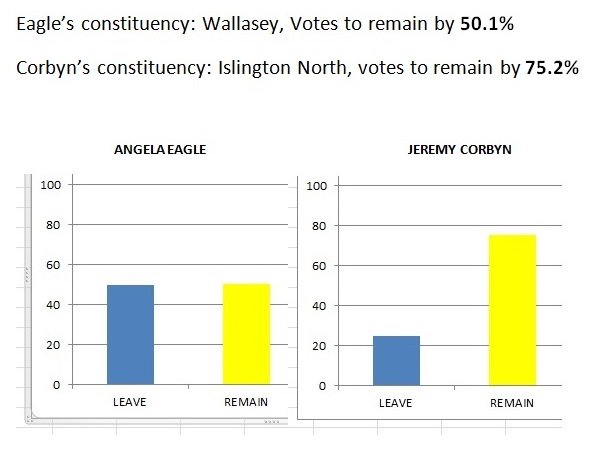
In addition to all of this, Corbyn’s pro-Remain position with respect to the EU referendum provided his critics with the ammunition they needed in their attempts to undermine him further. Chief among these critics is Angela Eagle, one of the many Oxford educated Blairite plotters who resigned her post in order to position herself as a potential replacement for Corbyn and who claimed to be dissatisfied with Corbyn’s performance during the EU referendum campaign. However, as the graphic below would appear to indicate, Corbyn did much better than Eagle in defending their respective Remain positions:

According to a YouGov poll, Eagle commands just 6 per cent support from Labour members while a greater number than last time said they will vote for Corbyn if he were to stand again. In other words, just like last time, Corbyn would likely win more votes than all the other candidates combined. This grass-roots popularity for Corbyn must be seen against a backdrop in which the Labour party gained 60,000 members in one week following the attempted coup against him. Membership of the party currently stands at about 450,000 – a figure that is higher than it’s last peak of 405,000 members last seen under Tony Blair’s leadership.

This would almost certainly translate into Corbyn receiving more votes than his Blairite predecessor Ed Milliband did at the last General Election. With the proportion of the Labour vote increasing under Corbyn, the two main parties are neck-and-neck at 32 per cent. This undercuts the recent claims of elder statesmen like David Blunkett and Neil Kinnock that Corbyn is an electoral liability for Labour.

This narrative is consistent with the notion that the left are un-electable more generally. Such a narrative is a myth. As Craig Murray posited, the idea that you have to be right-wing to win elections is belied by the fact that the SNP under Nicola Sturgeon won the people of Scotland over on a left-wing ticket. Secondly, as he rightly says, there is no point being elected just so you can carry out the same policies as your opponents. Third, the British public’s ‘enthusiasm’ for somebody like Blair in 1997 was not based on policies known as Blairite. As Murray astutely points out:

“The 1997 Labour Manifesto  was not right-wing. It did not mention Academy schools, Private Finance Initiative, Tuition Fees, NHS privatisation, financial sector deregulation or any of the right wing policies Blair was to usher in. Labour actually presented quite a left wing image, and figures like Robin Cook and Clare Short were prominent in the campaign. There was certainly no mention of military invasions. It was only once Labour were in power that Blair shaped his cabinet and his policies on an ineluctably right wing course and Mandelson started to become dominant. As people discovered that New Labour were “intensely relaxed about people getting filthy rich”, to quote Mandelson, their popular support plummeted. “The great communicator” Blair for 90% of his Prime Ministership was no more popular than David Cameron is now. 79% of the electorate did not vote for him by his third election.”

Murray continues:

“Michael Foot consistently led Margaret Thatcher in opinion polls – by a wide margin – until the Falklands War. He was defeated in a victory election by the most appalling and intensive wave of popular war jingoism and militarism, the nostalgia of a fast declining power for its imperial past, an emotional outburst of popular relief that Britain could still notch up a military victory over foreigners in its colonies. It was the most unedifying political climate imaginable. The tabloid demonization of Foot as the antithesis of the military and imperial theme was the first real exhibition of the power of Rupert Murdoch. Few serious commentators at the time doubted that Thatcher might have been defeated were it not for the Falklands War – which in part explains her lack of interest in a peaceful solution. Michael Foot’s position in the demonology ignores these facts. The facts about Blair and about Foot are very different from the media mythology.”

The reality, as one commentator on twitter put it, is that in corporate media and political establishment parlance, “‘un-electable” is media-political code for ‘likely to be highly electable but ‘will not serve elite interests.'”

This description applies to Corbyn. The ‘un-electable left’ meme is likely to intensify the longer Corbyn manages to hang on. In these unsettling and unpredictable times, it’s the one propaganda weapon the establishment is certain to cling to as their means of attempting to prevent democracy from breaking their grip on power.

Britain’s high-debt, low-productivity economy spells long-term disaster

By Daniel Margrain

The collapse of the Berlin Wall which was the trigger that brought the totalitarian dictatorships of the former Soviet Union and those of its satellite states to their knees, came to symbolize for many the triumph of capitalist free market democracy over tyranny and oppression. An adviser to the US State Department, Francis Fukuyama, received international acclaim in 1989 when he reiterated this message by declaring, no less, that the collapse of communism was ‘the end of history‘. Great social conflicts and great ideological struggles were said to have been a thing of the past. Numerous newspaper editors and television presenters agreed.

A little over a decade after Fukuyama made his famous declaration, Islamist terrorists attacked the Twin Towers in New York. The attack was, in part, the result of Wahhabism’s ideological opposition to Western imperialist hegemony. Numerous imperial wars have been launched against Muslim countries since. Thus, Fukuyama’s thesis was trounced on a single day back in September 11, 2001. Anthony Giddens, the former director of the London School of Economics and court sociologist to Britain’s then New Labour Prime Minister, Tony Blair, repeated a similar message to that outlined by Fukuyama in his 1998 book, The Third Way.

Giddens  said“We live in a world where there are no alternatives to capitalism.” He was accepting and repeating a widespread but unsustainable assumption. The earliest merchant-form of capitalism began to emerge in the 17th century and industrial forms of capitalist production developed from the late 18th century. The organizing of the whole production of a country by capitalist means is barely three centuries old. It only began to become a dominant feature in terms of the universal dependence on markets some 60 or 70 years ago. Yet modern humans evolved about 200,000 years ago. In other words, what Giddens argued is that a capitalist economic system which represents a tiny fraction of our species’ life-span is set to last for the remainder of it.

Leaving aside the possibility of global catastrophe resulting from climate change or nuclear war, the notion that capitalism will continue to exist indefinitely into the future, is highly improbable. As the saying goes, ‘forever is a long time in history’. In just under two decades following the publication of The Third Way, capitalism has transformed into a finance-based neoliberal variant predicated on a form of systemic corruption underpinned by booms that zap productivity. The reason why financial booms impact on productivity in this way is in part the result of too much capital being mis-allocated to low productivity sectors which crowds out real economic growth.

Company buybacks illustrate this practice. Take Viacom as an example. The company issued debts of £10 billion and then bought back the shares which had subsequently reduced in value by 55 per cent. Similarly, Amazon issued £5 billion of debt prior to announcing they would also engage in this highly unethical practice. Issuing debt in order to buy-back stock implies an inability to grow companies organically. Rather, increasingly, the approach seems to be to boost the stock price artificially by a process of financial engineering. The problem is that levels of industrial production, the latest figures of which indicate a 0.3 per cent fall from the previous month, are not sufficient to support these kinds of debts.

Another illustration of the mis-allocation of capital to a low productivity sector, is in the realm of housing. Essentially, the UK economy is based on speculative-based property booms that are sustained through zero interest rates. This means that banks have access to almost unlimited credit which enables them to finance enterprises risk-free, underwritten by the tax-payer. The Conservative government under PM David Cameron is not investing in the productive parts of the economy but in financial ‘bubbles’ of which housing plays a significant part.

UK Chancellor, Gideon Osborne’s ‘help to buy scheme’ in which the UK tax-payer provides 40 per cent of the deposit for first-time house buyers, is clearly a policy aimed at the potential Tory voter in London. Many of the properties purchased will be used for the rental market as speculative investments thus boosting the housing bubble. Meanwhile, people who are part of the productive economy and make London tick, are steadily being priced-out and socially cleansed from the city. This is contributing to the decline in UK industrial output which has seen its biggest fall since August 2013. More importantly, this has impacted negatively on the UK’s trade deficit figures which are one of the highest, as a percentage of GDP, of any country within the OECD.

To emphasize this point, the UK’s trade gap with the European Union increased to a record high of £8.6 billion. The government’s suppose aim of re-balancing the economy by allegedly supporting its productive parts, is contradicted by its creation of risk-free speculative property bubbles of the kind described. The concept of free-market capitalism is supposed to be predicated on incentives, not state sanctioned socialism for the wealthy as the means to prop-up unsustainable economic bubbles. Yet the corporate controlled media, with their lurid headlines, continuously promote the latter.

The government’s subsidizing of house purchases is unhealthy for the medium to long-term economic well-being of the country as a whole. The subsidized property speculation bubble outlined is part of a centrally-planned Tory policy, no different in principle, to the socialist planned economies of the former Soviet Union and its satellite states that ‘the end of history’ allegedly supplanted. Low productive sectors within the UK have a knock-on effect in terms of the broader economy which is destined to decline as a result. This is because more needs to be produced for the pound sterling in order to counteract the affects of subsidized speculation which adds no value to the economy.

This principle also applies under conditions in which global investors pour money into government bonds which currently result in negative yields to the tune of some $6 trillion and growing. The infusion of greater amounts of subsidized money into the London economy runs counter to the government’s stated argument that they intend to diversify the wider economy by spreading investment throughout the UK as a whole. As a consequence of the Tory policy of socialism for property speculators, house prices in London are the most over-valued of any major city in the world.

Nevertheless, as long as potential property buyers and those already on the ladder in London have a perception that their homes are worth more than is actually the case, they will more likely be inclined to vote for the kinds of politicians who will perpetuate the bubble by continuing to offer some first-time buyers an injection of a huge cash-free gift as part of their deposit. If this was indeed the Tory plan prior to the London Mayoral election in order to assist the Tory candidate, Zac Goldsmith, then the strategy failed miserably. Whether Labour’s newly elected Mayor, Sadiq Khan, will attempt to scupper any moves by Jeremy Corbyn to put a break on the Tory’s high debt-low productivity economy policy, in order to further his broader opportunistic political ambitions, remains to be seen.