Tag: news

‘I Was Only Following Orders.’

By Daniel Margrain

I was only following orders of my superiors” was a not an adequate defense for Nazi war criminals”. The legal precedent set by the Nuremberg Principle IV states:

“The fact that a person acted pursuant to order of his Government or of a superior does not relieve him from responsibility under international law, provided a moral choice was in fact possible to him.”

Back in December The Poor Side of Life made the following observation:

I was stopped by a homeless chap who wanted to congratulate us on our hard work. He said that he hated this Job Centre. His friend who lived on the streets with him had been sanctioned after being taken off the sickness benefits that he was on and was put on Job seekers Allowance. He had severe mental health and addiction problems. He was sanctioned, and without warm clothes and very little food he fell asleep on the streets and never woke up. He died of hypothermia. People had passed him and thought that he was asleep. He didn’t stand a chance. And what do the Job Centre staff say? “We are only following orders.” 

On August 27 the Department for Work and Pensions (DWP) announced that the number who died while claiming incapacity benefits between January 2011 and February 2014 was a shocking 91,740. This represents an increase to an average of 99 deaths per day or 692 per week, between the start of December 2011 and the end of February 2014 – compared with 32 deaths per day/222 per week between January and November 2011. DWP figures also show that some 2,380 people have died after being found fit for work and losing benefits.

Canadian Disability Studies specialist and disability activist Samuel Miller, has been communicating frequently and voluntarily, since January 2012, to senior United Nations officials, on the welfare crisis for the United Kingdom’s sick and disabled. The campaigning seems to have worked as the U.N seems likely to set up an inquiry into the sheer brutality and callousness of Iain Duncan Smith and his department.

Duncan Smiths attacks on the most vulnerable in society are being undertaken on the basis of the Tory support for austerity which is one of the greatest ever confidence tricks perpetuated on the British public. The reality is austerity under the behest of civil servants’ following orders, kills the poorest whilst the pockets of the wealthiest get fatter.

The Economic Crisis: How Did We Get Here?

An investor watches an electronic board showing stock information at a brokerage office in Beijing, China

The roots of the current crisis go some way back. After the 9/11 attack in New York, instability and fear pervaded financial markets. In order to steer the US and world economy out of a tight corner there was a reduction in interest rates and loosening of credit, encouraging people to borrow to sustain demand.

Banks took advantage of this and started to push mortgages. Initially the banks were lending on fairly good terms but then competition set in and those with money found they could expand their wealth by borrowing at low interest rates in order to lend to those prepared to pay higher interest rates. One of the main groups prepared to pay these higher rates were poorer sections of the population desperate to get somewhere to live. As long as house prices continued rising, they seemed a safe group to lend to, since there was always a profit to be made by repossessing their homes if they failed to pay up on time. This lending became known as the “subprime mortgage market”.

Although on the surface this appeared to be a form of secure lending, in reality it was risky. Why? Because by 2006 the US economy began slowing down and profits in the US started to fall. As profits declined, firms got rid of workers and poor American’s could no longer keep up with their rising mortgage payments. Borrowing at one end of the chain could not be repaid. Repossessions led to falling house prices, and the “collateral” that supposedly guaranteed (provided security) against the loans, fell in value as well. An enormous 400 billion US dollars in lending was suddenly not repayable.

A whole host of new institutions emerged that began specializing in the same manner as the banks. They would obtain cheap credit in the environment of low interest rates after 2001, use it to make loans, and then ‘securitize’ them. Other financial institutions would also use cheap credit to buy the new securities. Other financial institutions would combine several of these securities to create even more complex forms of debt obligations.

In this baroque and opaque world, fueled by cheap credit, it did not take long before just about all the major financial institutions across the world found themselves holding securities that contained bits of subprime mortgages. What was originally a small sickness within the US economy grew enormously because of the way capitalist credit works. In the end, governments’ were forced to intervene by bailing out vast swathes of the capitalist system as a precursor to saving it:

In spring 2008, Bear Sterns became an early high profile casualty of the crisis on Wall Street. Lehman Brothers followed shortly afterwards and the meltdown in Greece shortly after that. These problems emerged on the back of three decades of sustained low profitability.After World War two profit rates held up at about 15 per cent in the US. By the 1980s it was 10 per cent, and today it is just 5 per cent:

This would appear to indicate that the underlying problems of the global economy are systemic.

What is Marx’s explanation?

Marx’s basic line of argument was simple. Individual capitalists can increase their own competitiveness by increasing the productivity of their workforce. The way to do this is by using a greater quantity of the “means of production”—tools, machinery and so on—for each worker. There is a growth in the ratio of the physical extent of the means of production to the amount of labour power employed, a ratio that Marx called the “technical composition of capital”.

But a growth in the physical extent of the means of production will also be a growth in the investment needed to buy them. So this too will grow faster than the investment in the workforce. To use Marx’s terminology, “constant capital” grows faster than “variable capital”. The growth of this ratio, which he calls the “organic composition of capital”, is a logical corollary of capital accumulation.

Yet the only source of value for the system as a whole is labour. If investment grows more rapidly than the labour force, it must also grow more rapidly than the value created by the workers, which is where profit comes from. In short, capital investment grows more rapidly than the source of profit. As a consequence, there will be a downward pressure on the ratio of profit to investment—the rate of profit.

Each capitalist has to push for greater productivity in order to stay ahead of competitors. But what seems beneficial to the individual capitalist is disastrous for the capitalist class as a whole. Each time productivity rises there is a fall in the average amount of labour in the economy as a whole needed to produce a commodity (what Marx called “socially necessary labour”), and it is this which determines what other people will eventually be prepared to pay for that commodity. So today we can see a continual fall in the price of goods such as computers or DVD players produced in industries where new technologies are causing productivity to rise fastest:

As the rate of return on investment declines in its totality, so it is the weakest companies financially – but not necessarily technologically – that go out of business. In turn, this results in an increase in unemployment. Thus workers are able to purchase fewer goods and services. This inevitably leads to a downward spiral of economic slump and crisis within the system as a whole.

But Marx argued that there were counterveiling factors which mitigated against a total collapse of the system. For example, the diversion of investment from the production of goods and services to the production of arms – a process that is governed by states that are in constant competition with one another – provided a very important role in producing the long boom after the Second World War.

Also, Marx argued that profitability could be restored by crisis itself, through what he called “the annihilation of a great part of the capital”. During a recession some companies fail and are bought up by rivals, and others have to sell off parts of their business or dump their stock on the market to meet their obligations. Those companies that survive can take advantage of this, grabbing assets at a fraction of their real value and putting them to highly profitable use in the recovery that follows. Depressed wages and high unemployment also allow capitalists to squeeze more out of workers. A process of “creative destruction” may lead to a boom following a slump.

But this is not some automatic process that pushes the economy back towards some natural equilibrium. The post-war boom followed only after the prolonged horror of the 1930s slump and the destruction of the Second World War, which also forced states to intervene to reorganise whole national economies.

Could we be heading to a repeat of the Great Depression?

This is a difficult question to answer. There are significant differences between the situation that led to the current crisis and the one in 1929. First, state expenditure has for nearly 70 years been central to the system in a way in which it was not in 1929. In that year federal government expenditures represented only 2.5 per cent of GNP but they currently stand at around 20 per cent. And unlike in 1929, the government in 2008 moved quickly to intervene in the economy. The Hoover administration (March 1929-February 1933) did make a few moves aimed at bolstering the economy, so that state spending rose slightly in 1930, and federal money was used to bail out some banks and rail companies through the Reconstruction Finance Corporation in 1932. But the moves were very limited in scope—and the state could still act in ways that could only have exacerbated the crisis in 1931 and 1932.

The Fed increased interest rates to banks and the government raised taxes. It was not until after the inauguration of the Roosevelt administration in March 1933 that there was a decisive increase in government expenditure. But even then the high point for total federal government spending in 1936 was only just over 9 percent of national output—and in 1937 began to decline. There is a base level of demand in the economy of the today that provides a floor below which the economy will not sink that didn’t exist in the early 1930s.

In this way, the growth in military expenditure since the Great Depression, clearly plays a particularly important role guaranteeing markets to giant corporations thereby mitigating the impact of the crisis. But there is an important second difference that operates in the opposite direction. The major financial and industrial corporations operate on a much greater scale than in the inter-war years and therefore the strain on governments of bailing them out is disproportionately larger. The banking crises of the early 1930s in the US was a crisis of a mass of small and medium banks.Very big banks did not often become insolvent and fail, even in periods of widespread bank failures:

This time we have seen a crisis of many of the biggest banks in most major economies. Within a day of Lehman Brothers going bust, banks such as HBOS in Britain, Fortis in the Benelux countries, Hypo Real Estate in Germany and the Icelandic banks were all in trouble. From there the crisis spread to affect other major banks and the “shadow banking system” of hedge funds, derivatives and so on. In October 2008, The Guardian reported the losses to be a staggering $2.8 trillion.

Despite this, global industrial production now shows clear signs of recovering. This is a sharp divergence from experience in the Great Depression, when the decline in industrial production continued fully for three years. Paradoxically, staving off a catastrophic slump has meant that problems have lingered on.

The recovery is also uneven. British growth remains sluggish at just 0.3 percent, the lowest growth rate since the last quarter of 2013. The US is growing faster, and is also faring better than Germany and Japan, which are more export-oriented and have suffered more from the decline in world trade than from the initial financial meltdown. China was also hit by falling demand for its exports but despite its long boom due to a massive state-sponsored domestic investment programme, the crisis has impacted their too.

The weakness of the global recovery means that people will continue to suffer. In some countries this takes the form of high unemployment and attacks on wages, as in the US, Spain and Ireland. In others, such as Germany and Japan, where unemployment has not risen as fast, companies have sought to hold on to workers but have cut pay rates, reduced hours or shifted workers onto part-time contracts. Britain lies somewhere between the two extremes.

Unemployment and underemployment is likely to persist well into any recovery. An IMF report argues that employment falls further and takes longer to recover during recessions that have a significant financial component. The report indicates that it could take a year and a half from the end of the recession for any substantial improvement, assuming that the recession ends.

Finally, any recovery is and will remain uncertain. State interventions replaced private borrowing and investment with mountains of public debt, and falling tax revenues made it difficult to recover the money spent. Now governments everywhere face a dilemma. Do they cut back to pay off their debts, risking a deeper recession or do they continue spending and risk a run on their currencies?

The Austerity Con-Trick

Cash machines targeted by Occupy protesters

Cash machines targeted by Occupy protesters (Pic: Guy Smallman)

The UK government mantra that it’s imperative to reduce the deficit (the difference between the money coming in and going out) is one of the greatest confidence tricks to have ever been fostered on the British people. In reality, the deficit could be wiped out at a stroke. In his documentary film The Spirit of ’45, Ken Loach highlighted that in the decade after the war, the UK government built 300,000 affordable homes a year and brought the NHS into being.

The chart below shows at that time UK national debt – the accumulation of deficits – stood at about 180% of GDP. At present it’s about a third of that.

UK National Debt since 1900.

uk-national-debt
Source: Reinhart, Camen M. and Kenneth S. Rogoff, “From Financial Crash to Debt Crisis,” NBER Working Paper 15795, March 2010. and OBR from 2010.

So why in 2015 are we apparently unable to afford to prevent the most vulnerable in society from committing suicide as a result of cuts to their benefits, yet after the war we were able to build hundreds of thousands of affordable homes for people to live in as well as bring our NHS into being? Why the insistence on getting the deficit down especially since there is no law forcing the government to repay the debt?

The answer to those questions is that since the crisis hit in 2008, there’s been an iron clad consensus between both the Labour Party hierarchy and the Tory right, predicated on neoliberal ideology which is used as a weapon with which to beat the poor with by way of the former’s support for, and the latter’s implementation of, a sustained programme of austerity and cuts. It’s this iron clad consensus that Jeremy Corbyn wants to break.

The notion that it’s imperative the British government “balances the budget” in order to reduce government debt is nonsense, as is the analogy that national budgets need to be treated just like household budgets. The bailiffs won’t be entering the House of Commons or the Bank Of England any time soon. The truth is, unlike personal debt, the deficits and debts of governments’ are not of primary importance.

When he became chancellor in 2010, Gideon Osborne boasted that he would eliminate the deficit by April 2015. But that plan is in tatters. He has now put back the promise to 2018/19. The government had to borrow £3.7 billion more in the first seven months of last year. This was partly because North Sea oil and gas revenues plummeted to a four year low.

The UK is a relatively low wage economy compared to it’s major rivals and its productivity gap with these nations’ is at the widest it’s been for 20 years. Moreover, because many of the new jobs created in Britain are mainly part time (against a backdrop of the longest drop in real wages since records began), means that tax revenues are low.

In order to make up the shortfall between real and expected revenues, the government borrows money by selling bonds which are essentially IOUs with the promise of future repayment. In the meantime, the government pays interest on these bonds which are sold to banks, insurance firms and even pension funds. The total of bonds that have been sold is called “public debt”.

In a crisis like the one we’ve had since 2008, bond buyers can demand higher interest payments which they have done. This explains why the cost to the government in terms of the interest on the national debt has risen since the beginning of the crisis as illustrated in the table below.

uk-debt-interest-payments-total

To appease the bond buyers, the government has imposed austerity on the people. We constantly read in the gutter press about the rail workers allegedly holding the government to ransom, but never the bankers – funny that!

During the peak of the swinging sixties, government debt was greater than it is in 2015 and yet, unlike those golden days, we are told that both the government and the citizens of today have to tighten their belts as though we were living the austere days of the Great Depression in the 1930s.

The truth is the post war Keynesian boom resulted in a steadily declining debt from it’s peak in the 1950s. This is because higher wages and high employment means greater spending power, which in turn means greater economic activity and higher government tax revenues.

This is precisely the kind of argument progressive capitalists like Nick Hanauer point to. The reason billionaires like him argue for a doubling in the national minimum wage is not because they are altruistic but because they understand that it’s in their best interests’ and that of the capitalist system as a whole. That message needs to be relayed to Cameron and Osborne.

Housing Benefits The Rich

Figures shared with the Guardian by Generation Rent suggest landlords could be gaining as much as £2
Figures shared with the Guardian by Generation Rent suggest landlords could be gaining as much as £26.7bn a year from the taxpayer. Photograph: Christopher Thomond/Guardian

It’s been clear for a very long time that the main purpose of the tax system is to provide benefits to the wealthy. The minister responsible for cutting income support for the poor, Iain Duncan Smith, lives on an estate owned by his wife’s family. During the last decade it has received €1.5m in income support by way of farm subsidies from taxpayers.

In what has been dubbed the “Great British Sell-Off” and the “Sale of the Century”, the chancellor, George Osborne, intends to sell off public owned stakes in Royal Mail, RBS, the Met Office, Ordnance Survey and air traffic controller, Nats, which will rake in a one-off windfall of around £31.7 billion in 2016/17 – an amount which surpasses all privatisations since 1993, breaking even Thatcher’s record. To put this into a wider context, the money raised which will benefit the minority of Osborne’s elite friends in the city, will be the largest amount of money raised through the disposal of public assets in any 12-month period in modern history.

The ideology underpinning this public asset stripping is part of a strategy to reduce the role of the state that will do nothing to stimulate growth. On the one hand, Osborne announced £12 billion of cuts – the pain of which will be felt by the most vulnerable. On the other, he rushed through the sale of £2 billion worth of the 79 per cent stake the government has in RBS and as a result it was the taxpayers who lost out on a potential £14 billion return. It should also be noted that the Tory aristocrat, who seems set to be next in line to take the reins of PM from his friend David Cameron, had promised action on tax avoidance in spite of the fact that his family business routinely avoids tax.

Meanwhile, the UK version of a Kardashian, the royal parasite Princess Beatrice, who has been spotted taking to the water on Roman Abramovich’s £1 billion super yacht, Eclipse, has racked up seventeen holidays in eight months at our expense.

The real benefit spongers, then, are not those who feature on low brow documentary programmes, but rather they are the elites who occupy the corridors of power. If the richest 1,000 people in Britain that have seen their wealth increase by a massive £155bn since the current economic crisis began in 2008, were to actually pay their fair share of tax, the deficit the government assures us needs reducing, would be wiped out at a stroke.

But there is no priority within government to insist they cough up. Asda, Google, Apple, eBay, Ikea, Starbucks, Vodafone: all pay minimal tax on massive UK revenues, mostly by diverting profits earned in Britain to their parent companies, or lower tax jurisdictions via royalty and service payments or transfer pricing. The £1 billion that Gideon gave away to his pals in the city on August 4 in the RBS share giveaway would have gone a long way to fund the deficit in the NHS, whose trusts’ claim are “unaffordable”.

However, the redistribution of wealth from the poor to the rich doesn’t end there. After dissecting yesterday’s Guardian piece on welfare spending, Craig Murray highlights how housing Benefit represents another form of massive subsidy and wealth transfer, particularly in London and the South East of England where, in the absence of housing benefit or inheritance, it’s impossible for anyone on the average income to live.

As Murray says, the distortion in house prices in this part of the UK has nothing to do with very wealthy foreign buyers concentrated at the top end of the market, but rather, it’s to do with:

the conjunction of buy to let and state housing benefit. The state pays out 18 billion pounds a year in housing benefit, and the vast majority of that goes straight into the pockets of private landlords in the South East of England. State housing benefit underpins the entire system.”

Now the brilliance of the trick is that, as it is labeled a benefit, the left fight to keep housing benefit as though it benefited poor people. In fact this is a great illusion. It does nothing of the sort. What would truly benefit poor people is lower rent or affordable homes. Housing benefit goes straight into the pockets of the landlord class.

The landlord class of course encompasses the political class, many of whom (including Cherie Blair, famously) are also landlords. As housing benefit is paid for from general taxation, the entire system is a massive transfer of wealth from the poor to the rich, and above all from the North and West to the South and East.

The landlord class benefit not only from the taxpayer giving them enormous rents, but from the possession of artificially inflated property on which they can raise further money for more speculation…. The reason that IDS has not made a serious assault on housing benefit is that it puts money straight into the pockets of most of his Tory chums.

The largest benefit recipients in the UK are the great landlords….[P]umping in 18 billion pounds of state money a year to rents adds 288 billion pounds to property values.That explains how you reach the apparently impossible situation of median property at twelve times median income.

Bankers bankrolled by the taxpayer, as well as local authorities that administer housing benefit – both of whom owe their continuing existence to public funds – should be acting in the public interest not frittering away public money into the pockets of the rich.

Iain Duncan Smith Is A Sociopath

Stuart Chester has Down's syndrome, epilepsy and autism

Stuart Chester has Down’s syndrome, epilepsy and autism
WHO CAN NOW CLAIM WITH A SERIOUS FACE THAT WE LIVE IN A CIVILIZED SOCIETY?
WORDS LITERALLY FAIL ME. 

A SEVERELY disabled young man who is unable to talk, read or write and needs round-the-clock care from his mother is the latest target in Iain Duncan Smith’s campaign against Scotland’s most vulnerable.

Stuart Chester, who has Down’s syndrome, epilepsy and autism and is unable to feed or wash himself, is being told by officers in the Tory minister’s Department for Work and Pensions to prove he is unfit for work.

The 25-year-old has been sent a controversial 20-page work capability assessment form to fill in that will investigate his fitness for work and whether he deserves his Disability Living Allowance (DLA) and Employment and Support Allowance (ESA) benefits.

Last night Social Justice Secretary Alex Neil described Stuart’s case as “absolutely outrageous” and “shameful”.

Stuart has been given a deadline of September 18 to complete the complicated and detailed document and return it to the DWP.

His mother Deborah McKenzie, 51, said receiving the form had caused her “undue stress” and said Duncan Smith’s plan to deliberately target the sick and disabled was tantamount to “genocide”, after shocking DWP figures were released last week showing more than 80 people were dying each month following work capability assessments.

She said: “Stuart gets the high-rate DLA and he was supposed to get that for life because his condition will never change. He also received ESA benefits.

“I cannot understand why he was sent this capability for work questionnaire because he cannot talk, read or write or do anything for himself. There is no way he could work and this is just causing a lot of undue stress and anxiety.

“I was really upset when the form came through the door. I called up the DWP and asked them why they would send it out to someone like my son when he is supposed to to get DLA for life and they told me it was tough luck, that it’s just the way it is and I would just need to fill out the form for him just like everyone else.

“I know other disabled people in wheelchairs with conditions like cerebral palsy, also people like Stuart who cannot do anything for them, are being harassed by the DWP to fill in fit for work forms when there is absolutely no way they could work.

“I used to have to fill in a form for my son every three years but eventually we were told he had the DLA for life because his circumstances were not going to change and he I no longer had to fill in an application for benefits for him.

“I am his full-time carer and there is no way my son could work, no chance. He needs 24/7 care and cannot feed or wash himself and he has a lot of accidents toilet-wise. I have to do everything for him.”

Neil called for the “cruel” assessments on the sick and disabled to be scrapped, and demanded that David Cameron hand over the rights to decide on benefits to the Scottish Government.

He said: “This is absolutely outrageous and these are the kind of cases which highlight that the Tories are out of control and they must hand over running of our benefits system to the Scottish Government.

“It bad enough the DWP sends out these forms to people like Stuart but they don’t seem to understand the stress and worry this causes families in Scotland.

“If someone is clearly unable to work and has a lifelong condition they should not be hounded like this and they should be left alone, not put through the hell of being assessed for work and worrying about whether or not they will get their benefits when they are quite clearly entitled to them.

“It is nothing but bullying, harassment, intimidation and a breach of human rights of the most vulnerable in our society and it has got to stop.

“They have crossed the line and if we had control over these benefits, the first thing we would put an end to this kind of harassment and treat these people with respect and dignity they deserve.”

Last week, disability campaigners spoke to The National and warned more people would die because of work capability assessments unless they were scrapped.

The claim followed the release of figures that revealed 2,380 claimants died between December 2011 and February 2014 shortly after being told to get back to work and that their benefits were being stopped.

In the same period, 50,580 people who received ESA died within two weeks of their benefit claim ending.

Stephen Cruickshank, director of the Scottish Disability Equality Forum, who has spinal neuropathy, said the work capability assessments were unfit for purpose.

Mother-of-two Deborah, of Glasgow, said Duncan Smith had “a lot to answer for” and described him as “the lowest of the low” for targeting disabled people.

She said: “I don’t know how Iain Duncan Smith can sleep at night or live with himself targeting the disabled and most vulnerable in our society like this.

“It is beyond belief and absolutely disgusting considering many of the people being sent these forms were awarded with DLA for life which we had to fight for.”

Deborah said coping with everyday life caring for Stuart was “hard and challenging” and even though she knows that he cannot work, it is the uncertainty of having to fill in the complicated form that is putting her under even more stress.

A DWP spokesman said: “We regularly review people’s conditions to ensure that they are not simply written off and condemned to a life on benefits. That’s why we have improved the work capability assessment since it was introduced in 2008, ensuring that it is fairer and more accurate.

“Decisions are taken following a thorough independent assessment, and consideration of supporting medical evidence provided to us by a claimant’s GP or medical specialist.”

“It’s important that regular assessments are made, as for some people, conditions may improve or worsen.”

Originally posted in The National

Do We Need the U.N To Protect Us From Our Own Government?

Protesters
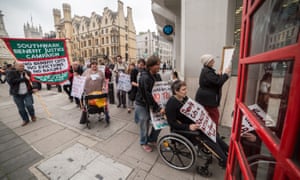
Protesters demonstrate against benefit cuts in London in 2014. Photograph: Guy Corbishley/Demotix/Corbis

The shocking news that in two years up to February last year some 2,380 disabled claimants died within two weeks of being assessed as fit for work as part of the governments Work Capability Assessment Programme (WCAP), is finally beginning to make the mainstream. I am a regular listener to LBC Radio and the issue is now a regular feature of many phone in shows. How long it will take before it makes peak time BBC television news bulletins is another matter, but at least the topic is making some inroads which has to be encouraging.

Such is the sheer brutality and callousness of Iain Duncan Smith, that the U.N now proposes to act in circumstances where the government resists. At the very least, the potential setting up of a U.N inquiry into Tory welfare reforms on the back of the deaths in the manner of, for example, Goldstone, could theoretically, in the longer term, result in the man responsible for causing untold misery and suffering being brought to justice.

But even if the U.N ultimately proves to be toothless as it was in terms of the misnamed Israel-Gaza conflict, the negative publicity they will generate for the government will be invaluable. Secondly, and even more importantly, the WCAP must be stopped in its tracks irrespective of the U.Ns findings. But short of electing an effective opposition into power worthy of the name, how can this be achieved in the short term?

Currently, as Michael Meacher acknowledged, parliament has no power to instigate an immediate emergency debate, Neither has it the power to force an inquiry into the workings of WCAP. So leaving aside the proposed U.N intervention, the options appear to be extremely limited. Questions have been raised in the House regarding the deaths but these were sidestepped. In any case, it’s telling that the questions were only asked in the first place because of a Freedom of Information (FOI) request.

The figures only came to light (conveniently) during the recent bank holiday, clearly in the expectation that they would be forgotten about. But it took nearly four months for them to be released and only then after pressure was applied as a result of a ruling by the Information Commissioner. The DWP had appealed against the Information Commissioner’s ruling and only gave up when campaigning blogger Mike Sivier submitted an application for the appeal to be struck out as an abuse of process. As Mike says, the DWP’s response to his FoI request shows three things very clearly

Firstly, that the DWP is very bad at responding to FoI requests – in terms of both timing and content. The response is deliberately written to make it as opaque as possible, and does not include all the information I requested, and this reflects poorly on both the department and its ministers. Therefore I shall be writing to the First-tier Tribunal (information rights), asking that a hearing scheduled for November 10 should still take place because the DWP has not answered my request.

Secondly, that despite the poor quality of the report, it is clear that the work capability assessment is not fit for purpose and the misallocation of people with long term illnesses – either into the work-related activity group or into the jobs market, classified ‘fit for work’ – has certainly led to needless deaths. Iain Duncan Smith said as much last week but it should not save him. Evidence that this was the case has been available since December 2011, when the number of deaths of people on ESA tripled – yes, tripled – in comparison with the average for the previous 11 months. The DWP and its ministers have been hiding this information from us for nearly four years. In the eyes of the law, that is criminal negligence – corporate manslaughter.

Thirdly, that the principles on which Employment and Support Allowance was designed are causing deaths. When Mrs Mike’s Contributory ESA ran out (she used to be in the work-related activity group), her benefit was cut off with no notification or advice about what to do next. How many others have received the same treatment? Many, it seems, according to the DWP’s statistics which show that the number of ‘unknown’ cases (into which these people are thrown as their NI credits are still paid) has dropped while the proportion of deaths in that group has increased hugely, year on year.

The fact that the issues relating to the WCAP are only now beginning to enter the wider public consciousness and, moreover, almost certainly reveal the tip of a much larger ice berg will, in years to come, be regarded as one of the greatest domestic political scandals of recent times.

The fact that the deaths have been brought into the open should be sufficient justification for the scrapping of the WCAP with immediate effect with a view to bringing a prosecution forward for all those responsible for hiding the facts from us for so long. I wonder if Blair and Duncan Smith like the same prison food?

Useless Mouths

Years before moving towards explicit racial genocide, the Nazis developed the notion of ‘useless mouths’ or ‘life unworthy of life’ to justify its ‘involuntary euthanasia’ program. Theorists argued that certain categories of people were nothing but a burden on society and therefore had no ‘right’ to life.   These ideas were a variant of nineteenth century ‘Social Darwinism’ and eugenicist theories, which adapted Darwin’s notion of the survival of the fittest to describe relationships within society or between nations and races as a perpetual evolutionary struggle in which the supposedly weaker or defective elements were weeded out by the strongest and the ‘fittest’ by natural selection.

Of course there was nothing ‘natural’ about these ideas, or the malignant ways that the Nazis made use of them.   In Nazi ideology, the state killing of the disabled, the sick and the mentally-ill was the beginning of a conveyor belt that led to the wholesale extermination of the Jews and ‘inferior races’ Slavic races during World War II.

Nazism may have been a unique political evil, but the influence of Social Darwinism should remind us that not all of its ideas were entirely original, and that Nazi Germany was not the only country to categorize certain peoples according to strictly utilitarian notions of their perceived usefulness to society.

Consider our own government.  This week it was revealed that nearly 4,000 people died within weeks of being declared fit for work by the DWP.  This ought to be a cause of massive, sustained outrage and disgust, and should certainly be enough to bring down the minister responsible.   Instead Iain Duncan Smith – the sneering face of Tory cruelty –announced new plans to force disabled people into work. Why?  Because Duncan Smith wants ‘to ensure everyone has the opportunity to transform their lives by getting into work’ – even if that transformation only applies to the few days or weeks before they die.

The fact that these deaths have caused very little outcry is a disturbing indication of how low UK society and its political class have sunk these last years.   Quietly, effortlessly, and with very little opposition, Britain has become a society in which certain categories of people are regarded in practice if not in principle, as ‘useless mouths’ whose value to society is measured solely in terms of their perceived negative impact on ‘the taxpayer’.

The government, with the feeble cooperation of a supine opposition, with the help of its tabloid allies and the shameful depravity of TV companies engaging in poverty porn, has been able to characterize people receiving state benefitsas ‘scroungers’  and parasites, rather than people who need the same help from the state that current taxpayers may one day need themselves.

This ideological assault has been so successful that even providing state assistance to the sick and the disabled is regarded as an unnecessary and unfair burden on the taxpayer, and the ability to work is treated as the sole benchmark of social usefulness. Once you begin to accept these parameters, it becomes very easy to force sick people to work, even though their deaths make it clear that they were are so ill that they should not be working at all.

Now some of you ought there might still be naive or sentimental enough to fell a little revulsion at the notion that sick and terminally-ill people should be put through the stress of having to look for work, or losing their state support in the last weeks of their lives.  But you are not getting the point: in the view of this government only people who work have any social value and the state should not be obliged to support the ‘useless mouths’ who don’t work.  Come on now, it’s not rocket science.

I’m not suggesting that we are ruled by Nazis.  Our government doesn’t deliberately kill the people it regards as useless.   Most of the time it merely torments them, and creates a situation in which death becomes more likely.   But its fanatical obsession with measuring usefulness solely in terms of the perceived benefits to ‘the taxpayer’ has created a society in which suffering and death can be regarded with complete indifference and produce nothing more than a collective shrug of the shoulders and a weary shake of the head.

The same ideology also applies to the scroungers who call themselves refugees or asylum seekers, who the government regards as nothing more than ‘health tourists’ and another unjustified burden on ‘the taxpayer’.   That’s why we have just passed a law which will reduce ‘failed’ asylum seekers and their children to destitution and hunger even if they can’t return to their countries of origin.   It’s why the Home Office has declared Eritrea a safe country on the basis of a discredited report by the Danish government.  It’s why we have allowed less than 200 Syrian refugees into the country.

If you enforce restrictions like these, there is always the possibility that people will die trying to evade them.  Our government knew that last year, when it argued against search and rescue operations in the Mediterranean on the grounds that such operations would increase the ‘pull factors’ that brought migrants here.   The unspoken corollary of this argument is an acceptance of death and suffering as a necessary consequence of border enforcement and immigration restrictions.

If you believe, as the government has again and again invited the public to believe, that the men, women and children who are coming to Europe have no other objective or motivation except to take advantage of our ‘generous’ benefits system – another burden on the taxpayer – then it becomes possible to accept any level of death, pain and injury with a sense of tragic equanimity, as though such deaths were the result of a natural disaster or force majeur.

Of course, the government doesn’t want migrants to die.   But like the European Union and so many European governments, it has helped create a situation in which death is likely and almost certain to occur.  In order to justify this,  it has relentlessly dehumanized and caricatured stateless people to the point when they are regarded as ‘surplus people’ whose lives have less value or significance than ours and who somehow threaten us.

This summer we have seen enough unnecessary death to make us sick.  In the last two months eighteen people have died in Calais trying to ‘break into Britain’.   Only this week nearly 200 people drowned in the Mediterranean, some 50 of whom may have suffocated to death in the hold of the boat they were travelling on, and another  71 men, women and children have suffocated to death in the back of a lorry.

In the face of these horrors, the German government has called on European countries to accept quotas of refugees in response to the gravest refugee crisis since World War II.   The British government has not budged, and there is very little possibility that it will budge without serious domestic pressure.

That requires a transformation in the way that migration is perceived.  But for such a transformation to occur we need to reject the neo-liberal variant of Social Darwinism practiced by this government that is turning Britain into something cruel and monstrous, and remember that our society will be defined by the way we treat those who need our help, whether they come from inside our borders or beyond them.

The above article was originally posted on Matt Carr’s Infernal Machine

What’s So Great About ‘Piper At The Gates Of Dawn’?

PinkFloyd-album-piperatthegatesofdawn 300.jpg

Released in the summer of 1967, Pink Floyd’s Piper At The Gates Of Dawn invented a new language that was probably the first of its kind to represent a distinctive and radical break, musically, from the past for the post war generation of young Brits. Prior to hitting the recording studio, the group were already making a name for themselves as one of the leading lights in the London counter-cultural and underground scene of the time. Their gigs at the Marquee, Roundhouse and UFO is the stuff of legend.

The band were the first in Britain to merge electronic effects, elongated jams and light shows into their performances which reflected the personality of band member Syd Barrett. In fact the influence of Barrett on the bands highly original and distinctive work illustrative of Piper and their follow up, A Saucerful of Secrets, cannot be overstated. Pink Floyd were the flag wavers for a new and distinctive unifying variation of the San Francisco psychedelic acid rock scene.

The original group proper that emerged from the ashes of the Barrret and Gilmour folk duo of 1964, comprised Syd Barrett on vocals and guitar, Roger Waters on Bass and vocals, Richard Wright on organ, piano and vocals and Nick Mason on drums. All four were accomplished virtuoso musicians in their own right.

The album opens with.Astronomy Domine whose intermittent radio signal and hissing and throbbing guitar sounds must of sounded as extraordinary to young people when they first heard it as the Sex Pistols’ God Save The Queen did to the British punk generation. This track took psychedelia to a new level where anything and everything seemed possible. With their long and vast notes, Wright and Mason, invented a new style of accompaniment in which eccentric lyricism and space-rock instrumentals coexist.

The guitar sound on Lucifer Sam creates an atmosphere of panic and alienation and the feeling is replicated in the ballad Matilda Mother. The collage of sound effects that permeates Flaming is executed in the style of vaudeville, while Pow R.Toc H is an instrumental with a tribal beat underscored by classical piano that morphs into a sound that’s simultaneously celestial and manic.

Take Up Thy Stethoscope And Walk is a magnificent orgy of guitars and organ interspersed with Bass notes and frantic drums.

The centrepiece of the album is the long instrumental track Interstellar Overdrive which is basically a stream of consciousness tour de force – a masterpiece inside a masterpiece. The track is a beguiling suite that works as a piece of subliminal Freudian psychoanalysis that merges a multitude of literary sources and surreal subliminal messages. The framework for the group’s tonal music crashed into the deafening primordial chaos of free improvisation and bags of instrumental tricks. The performance is both intense and cosmic, celestial and dissonant.

The track seques neatly into The Gnome, one of the group’s most catchy refrains, reminiscent of a classical fairytale. The most serious aspect of Barrett’s psychedelia was documented in Chapter 24, which adapted raga-rock to cosmic and suspenseful organ arrangements.

The Scarecrow, first appeared as the B-side of their second single See Emily Play two months before. The song contains nascent existentialist themes, as Barrett compares his own existence to that of the scarecrow, who, while “sadder” is also “resigned to his fate”.The song contains a baroque, psychedelic folk instrumental section consisting of 12-string acoustic guitar and cello.

Bike ,which closes the album is a surreal sketch, consisting of random noise (sirens, cuckoo clocks, bells, bass drums, rusty chains, and animal sounds) perhaps suggesting the insanity of Barrett.

Pink Floyd’s first two albums epitomised the British psychedelic scene of the late 1960s. ‘Piper’ merges the three strands of US psychedelia – the eccentric melody of Jefferson Airplane, the improvised jam of the Velvet Underground and the abstract freak-out of Red Crayola.

The end result was a new distinctive, highly inventive and groundbreaking form of psychedelic rock music that merged the Dadaism of Syd Barrett with brilliant guitar riffs, wonderfully imaginative arrangements and memorable songs. The influence of Piper on subsequent generations of musicians is palpable.

Katrina, Ethnic Cleansing And The Rise Of Disaster Capitalism

Katrina, the costliest natural disaster in American history, hit the Gulf Coast just as America prepared to mark the fourth anniversary of the 9/11 attacks. This is deeply symbolic since what the aftermath of the disaster highlighted was the extent to which the one dovetailed neatly into the other. The American government’s quest to bring American-style freedom and democracy to other nations exposed their inadequacy in resolving fundamental domestic disparities and inequities closer to home.

Katrina did not create these disparities and inequities, it simply added an important reminder that they are deeply embedded and constitutive of American political, economic, and social life. One of the major legacies of Katrina is that the disaster laid bare the inequalities, not just within New Orleans, but America itself.

It is perhaps naive to think that the catastrophe will provide a longer-term wake-up call to the political establishment in America to set about actively building a more fair and meaningful democracy in the country. Subsequent inaction would indeed appear to indicate that there is some justification for this naivety.

There is little indication a decade down the line that any attention has been paid to the role of American political institutions in addressing contemporary racial, economic, regional, and gendered inequities.The tenth anniversary visit of George Bush to New Orleans recently was emblematic of his administration’s incompetence rather than any cause for gratitude from the people affected by the tragedy.

The visit of Obama was no less irrelevant. In emphasising his apparent commitment to the recovery process, the president said“Part of our goal has always been to make sure not just that we recovered from the storm but also to make sure we dealt with some of the structural inequities that existed long before the storm happened.

It’s strange then that when Harry Shearer took out a full page ad in the local newspaper suggesting that Obama as the commander and chief of the US Army Corp of Engineers acknowledge this agencies’ responsibility for the deaths of 1,800 people, he was met with silence from the president. As usual, Obama offered nothing other than empty rhetorical platitudes as a substitute for tackling real problems.

Shearer, who made a documentary film about Katrina that focused on why the disaster happened, argued on Channel 4 News that Katrina was a man made catastrophe. Quoting one of the co-authors of a Berkeley report, he said that this was the greatest man made engineering catastrophe since Chernobyl.

Are these failed systems still in place a decade later? And if so, what is to prevent a similar catastrophe happening again?

Shearer says that the new improved system that cost the US taxpayer £14 billion has been built to a substantially lower standard than the system that failed. Last week, one of the members of the Levee Authority told Shearer that his advice to the citizens of New Orleans regarding whether they should feel more safe or not, was to maintain a constant skepticism.

None of this would be a surprise to author and activist Naomi Klein who, in her book The Shock Doctrine: The Rise of Disaster Capitalism, views the social breakdown of societies and communities as being a feature of neoliberal economic policies of governments’. This breakdown is not the result of incompetence or mismanagement, therefore, but is integral to the free-market project, which can only advance against a background of disasters.

Disaster is part of the normal functioning of the type of capitalism we have today: “An economic system that requires constant growth, while bucking almost all serious attempts at environmental regulation, generates a steady stream of disasters all on its own, whether military, ecological or financial.”

Media reports in the immediate aftermath of Katrina – for example, hereherehereherehere and here – would tend to support Klein’s thesis. Unnatural disasters such as wars as well as natural ones like tsunamis and Hurricanes, allow governments and multinationals to take advantage of citizen shock and swiftly impose corporate-friendly policies.The result: a wealthier elite and more-beleaguered middle and lower classes. Sri Lankan fishing villages become luxury resorts and public schools along the Gulf Coast become corporate-run “charter” schools.

Three weeks after Katrina, the state sacked all the unionized teachers, disbanded the school board and turned the schools over to a state receiver in Baton Rouge resulting in the loss of community accountability. Margaret Spelling, the secretary of education, dumped $24 million into New Orleans, but it wasn’t allowed to go into public schools. It went to the charter schools thereby resulting in the shifting of power away from people towards the creation of a three-tier privatized system.

The destruction of New Orleans resulting from Katrina, also paves the way for its potential gentrification and social and ethnic cleansing where the city’s working class Black population – the people who are the very soul of the city, and who created its culture and made it famous – are seen as the major obstacle to the city’s economic recovery. A minority of them are necessary to be service workers in casinos and hotels. But the bigger idea has been to shrink the Black population and push the poor out of the city.

This kind of ruthless attitude toward the poor is symptomatic of the statement made by Republican congressman Richard Baker when he was overheard telling lobbyists “We finally cleaned up public housing in New Orleans. We couldn’t do it, but God did.” It’s difficult to believe that the comment could be construed as anything other than informing some of the planning for a disaster in New Orleans. Flood becomes part of an ethnic cleansing process. City politics has been aiming at that for the last 20 or 25 years.

Is The UK Government Deliberately Putting The Lives Of Eritrean’s At Risk?

2014AFR_Ertirea_Immigration

Life in one of the biggest migrant settlement camps in Western Europe in the Calais jungle exemplifies our dysfunctional world, A miniature city of makeshift tents dot the landscape. Men and women of various nationalities undertake their basic day to day activities the best they can while they dream of a better life on the other side of the razor wire fences.

In many ways, the scenes at the settlements conform to many of the dystopian fantasies that permeate the popular culture of many of those, who by nothing more than a simple twist of existential fate, happened to have been born into relative privilege.

These are citizens who, through either business or leisure activities, are able to move freely from the one line of demarcation to the other. Occasionally this might involve confronting the “other” due to the fact that many of their migrant counterparts will be moving in the opposite direction.

As Matt Carr, who travelled from the UK to France recently, eloquently put it:

“There we can find a city that has become a perfect mirror of our dysfunctional world, a place where men and women fuelled by the promise of sanctuary or the hope of a different life collide with the UK’s pitiless and implacable borders, and intersect with the dreams of the citizens of one of the richest countries on earth, heading for their holidays or returning from them.”

The sad reality for the refuges who stay in the camp more than a few days is that they are likely to remain their for the foreseeable future.The Guardian did a very good photo essay of life in the camps which can be seen here. These are the “forgotten” migrants, the poorest of the poor who are near the bottom of the migration food chain because they don’t have neither the sufficient funds to pay the gangs nor the contacts.

The media narrative tends to focus on the migrants who are able to pay the gangs between £1,000 and £4,000 to be put on to lorries bound for the UK hundreds of miles before they reach Calais. If justice prevailed, many of the “forgotten” at the bottom would be at the top, but it doesn’t so they aren’t. The migrants from the horn of Africa country, Eritrea, have a particularly strong case for the top status.

These are people that are fleeing political repression in their home country. A recent UN report outlined systematic human rights violations in Eritrea including torture, imprisonment and forced labour. Many Eritreans come to the UK seeking asylum but there has been a drastic decline in those given refugee status because of a recent change in government guidelines.

Government statistics show that between January and March 2015, 743 Eritrean applications for asylum were made of which 543 were granted. That’s an approval rate of 73%. However, since government guidelines changed in March, the approval rate had dropped to just 34%.

Eritrean’s are the only group, apart from Syrian’s, eligible for re-location from the EU’s bordering states’ because, according to The European Commission, they are deemed “persons in a clear need of international protection.”

So why does the British government appear to be paving the way to send them back to an almost certain death?

It would seem that the government has revised its guidelines on Eritrea based on a report commissioned by the Danish government which suggests that the Eritrean government is reforming. But in June the UN accused Eritrea of crimes against humanity.

According to Dr Lisa Doyle of the Refugee Council,:

“The government are currently basing their decisions on a report that is fundamentally flawed and widely criticised. These are life and death decisions and we need to be giving people the protection that they need”.

The nation who was partly responsible for establishing the boundaries of the present-day Eritrea nation state during the Scramble for Africa in 1869 as part of its imperial ambitions, is the same nation who today is denying fundamental human rights to the people it formerly subjugated.

It’s clear that the government is using the plight of the Eritrean people as a political football in an attempt to hit their immigration target, thereby pandering to a right wing electorate fearful of growing rates of net migration which are currently at record levels. The fact that the British government is playing politics with people’s lives in this way is abhorent but not surprising.