Are the Brady Bunch hammering the public purse?

By Daniel Margrain

I’m sure that I speak for the vast majority of West Ham fans when I say that the start of each season is met with an air of extreme trepidation. The feeling of anxiety in anticipating what is to come in the opening six weeks or so of any campaign is exacerbated if our first game of the season happens to be a home fixture.

From a personal point of view, I can barely get through the hours leading up to the opening Saturday afternoon kick off without exhibiting a combination of cold sweats, nausea and nervous fidgeting. I can only compare the experience to my school days during the hours leading up to the time when my exam results would drop from the letterbox on to the hallway floor.

You know you have to face the proverbial music at some point but don’t want the potential disappointment that comes with it. You tell yourself you want to know the results of your exams but paradoxically, at the same time, you fear the dreaded fail, rather like sitting through a horror movie with your hands “covering” your eyes. Similarly, I dread putting on Final Score, particularly during the opening day of the season and particularly if the game is at home.

The agony is prolonged due to the fact that our home result is invariably the last Premier League one to be read out, just as it was the case that Ardleigh was one of the last streets on our posties Basildon round. Non-football fans are simply unable to comprehend the suffering we football fans have to endure on a Saturday afternoon. Every season has been the same for me since I can remember and the 2015-16 season was no different.

As our pre-season Europe campaign under our new charismatic manager turned out to be nothing less than an unmitigated disaster, expectations for a good premier league start were low. After confounding the football world with our amazing opening league victory against Arsenal away, confidence was high for the next few games.

But West Ham being West Ham, we lost the next two at home on the bounce to less than glamorous opposition before turning it around with three subsequent victories, two of which were nothing less than stunning against Liverpool and Manchester City respectively.

With 12 points in the bag after our opening six games, I felt as though I was, to a degree, in a position to be able to relax. Of course West Ham fans never totally relax. As all life-long Hammers supporters will know, expectations for a successful season are typically medium to non-existent.

If in this current campaign, the Hammers were to finish in a top eight position and have a good cup run I’ll be relatively happy. Despite our recent hiccups in the league, not least in part due to our mounting injury list, I believe our squad is strong enough to secure a top half finish.

With our move away from our spiritual home at the Boleyn into the Olympic Stadium at Stratford in east London from next season, it’s important that we finish high up in the table in order to attract new players to the club while keeping hold of our best.

With a manager and former player (who appears to be finally attuned to the  entertainment ethos of the club that the fans demand) pretty much cemented into place for the foreseeable future, things are as solid as they can be for a club of our size and the relatively limited resources we have at our disposal.

As far as the fans are concerned, off the park shenanigans are, at least on the surface, good as well given that those who run the club plan to substantially reduce season ticket prices in an an attempt to fill the new stadiums 54,000 capacity – a model that other clubs have apparently been encouraged to adopt.

But as I will hopefully be able to argue persuasively in the remainder of the article, this is a double edged sword. Here’s the problem: West Ham United are paying just £15million towards the £272 million cost of converting the Olympic Stadium despite the fact that, should the club still be a Premier League outfit next year (which seems highly likely), it will – under the terms of a new TV deal – be entitled to a payout of at least £99 million.

Small business people, many of whom run their businesses on extremely tight margins, might be scratching their heads as to how it can be that the elite within football, such as multi-millionaire Lady Brady who brokered the deal, are seemingly immune to the kind of market forces that the former are compelled to adhere to?

As far as the super-rich with contacts to the top echelons of political power are concerned – whether they be premier league chairmen or City bankers – it would appear that the kind of business risks the rest of us are prone to, is not applicable to them.

In this regard, it is difficult how one could possibly argue that the Premier League is no different in principle to what happens within the much maligned banking “racket”. Perhaps I’m missing something here and readers will be able to point out to me where I’ve got it wrong.

I’m not one of these obstinate traditionalists who is intent on stifling change. On the contrary, I embrace it. I’m excited as the next man about the move to our shiny new stadium. However, what I’m less than enamoured by is the morally and financially expedient, needless to say potentially corrupt price tag that comes with it.

The reality, however one looks at the situation, is that we, the tax paying fans and non-fans alike, will be subsidizing what essentially is a risk-free big business speculative enterprise on behalf of the super rich. It’s true that in season one ticket prices will be cheaper than our London rivals, but it’s fanciful to suggest that during subsequent seasons ticket prices will remain similarly low.

I have no detailed insight into the medium to long term business plan model that the club has in place, but it would surely be churlish to deny the directors at the club have not been eyeing up something along the lines of the Arsenal model.

Lady Brady and the rest of the high flyers within the club set up are in line to make a financial killing not just from us, the everyday football fan, but also from the wider tax paying public. The various pronouncements made in the media, particularly by David Gold regarding his supposed love for West Ham United Football club, are in part clearly intended at staving off any criticisms of the club over a stadium deal that has been less than transparent.

In my view, what often tends to get overlooked in the rush for on the field success, is the realization that the David Gold’s of this world are multimillionaire, and in some cases, billionaire businessmen and women who are first and foremost motivated by profit. If they happen to be in the position of being able to grab a big slice of these profits by creaming off great swaths of our tax revenues in the process, then all the better for them.

This is not an anti-business stance I’m taking here but an anti-corruption stance – albeit a form of legalized corruption. It’s not good for the reputation of West Ham United Football Club and its fans that we will be perceived as having unfair financial leverage over other similarly sized clubs, predicated on a system of legalized corruption.

I’m not arguing here that these kinds of underhand non-transparent deals and unethical business practices are unique to West Ham United, it’s just that I’m uncomfortable with the idea of us engendering success both on and off the field in a way that is symptomatic of the malaise that seems to have become an accepted, and some might argue, intrinsic aspect of socioeconomic and political life in our country.

That the kinds of informal corruption and unethical business practices described seem to have become a normalizing feature of not only professional football and other sports, but in public life more broadly, is not something West Ham fans, or indeed any other fans, should readily embrace without serious critique.
COP21 resolves nothing

By Daniel Margrain

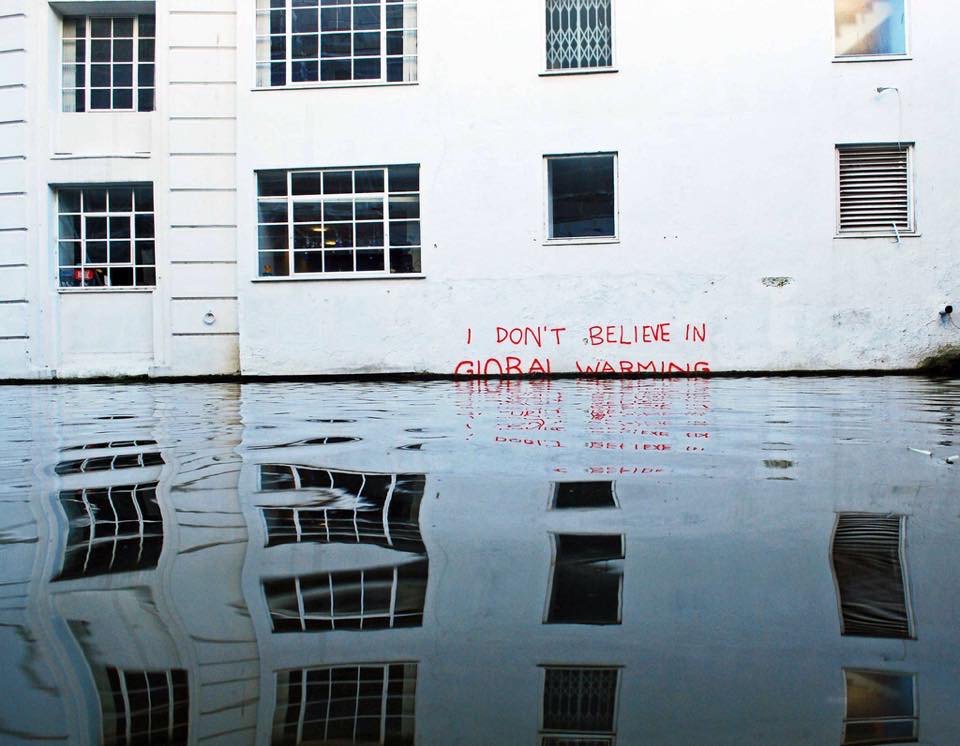
Embedded image permalink

Academic research supports the hypothesis that environmental degradation is linked to economic growth. As economies grow the countries’ in which the growth rates occur pump out correspondingly higher rates of the gas responsible for the greatest single cause of human induced climate change into the earth’s atmosphere. The tendency among humans to consume more and more of the finite resources of our planet, is predicated on capitalism’s inherent drive for growth upon which the maximization of profits is dependent. This is what Naomi Klein talks about when she refers to the capitalist system as one in which the ruthless drive for expansion is kept going by “consumption for consumption’s sake”.

If one accepts this line of reasoning then it follows that in order to ameliorate the affects of climate change by reducing the amount of carbon dioxide in the atmosphere, it’s necessary to challenge the growth based profit seeking logic of capitalism that gives rise to it.

Here we are faced with a major contradiction. The economic growth that is generated by capitalism creates employment opportunities. But in so doing, it also creates an insurmountable environmental and ecological crisis which, taken to its logical conclusion, negates the need for economy and hence employment. It’s this fundamental contradiction that undermines the COP21 in Paris and all of the other UN Climate Summit’s that preceded it.

This rather depressing reality, is underscored by the fact that these summits are primarily concerned with satisfying the demands set by capitalist growth, as opposed to creating the necessary conditions for environmentally sustainable societies’. Although this truism is rarely openly and unambiguously stated, any cursory analysis of the situation reveals that job creation and the “need” to maximize economic growth, overrides environmental sustainability considerations.

The insatiable demands of investors on the one hand, and the urgent need to cut down on global carbon emissions, on the other, are necessarily incongruous concepts. The failure of successive summits, most notably, in Copenhagen, in addressing the incompatibility between economic growth – a factor intrinsic to capitalism – and environmental sustainability that limits it, is a recipe for disaster because it perpetuates the conditions in which further environmental degradation of the planet will occur.

It’s precisely this logic that explains why it is that one of the key players at the COP21 discussions in Paris, Saudi Arabia, attempted to undermine them, even though climate change forecasts suggest that the Gulf region will become uninhabitable as a consequence of the failure of the Arab state agreeing to a radical shift in its negotiating position at the summit.

The rationale for the world’s largest producer of oil in its derailing of negotiations, is based on narrow short-term economic self interest. Saudi Arabia are among the most powerful of the 195 nations who attended the conference in Paris who, alongside their powerful allies, are empowered to block any meaningful negotiations in terms of emissions through a process of informal consensus.

Conversely, the poorer nations, were effectively not in a position to wield sufficient enough power to be able to offset the decision-making processes of the most powerful – the negative impacts of which, as Kumi Naidoo, executive director of Greenpeace International, noted – they will disproportionately be on the end of.

For example, the numerous islands that comprise the small Pacific states’ who are among most likely to be adversely impacted by the worst consequences of climate change, had emphasized the need to act on limiting global warming to 1.5 degrees Celsius over pre-industrial levels, while their powerful counterparts adamantly arrived at a higher “consensual” non-binding figure reviewed once every five years.

All this, and the fact that Saudi Arabia introduced a set of unreasonable negotiating pre-conditions against the emerging economies, are the main factors that arguably, in part, prompted the former Nasa scientist, James Hansen, to comment that the discussions in Paris were “a…fraud… a fake,”. He added: “It’s just bullshit for them to say: ‘We’ll have a 2C warming target and then try to do a little better every five years.’ It’s just worthless words. There is no action, just promises….”.

Meanwhile, the United States used the fact that it has not ratified any human rights statute internationally as a poison ‘divide and rule’ pill against the developing countries with the aim of picking off the most vulnerable as their justification for shifting blame for the crisis on to the smaller nations.

This underhand tactic serves a dual purpose in as much as the source of the problem – the rich elites’ pattern of consumption and their lifestyle – is conveniently admonished. That the ‘1 percent versus the 99 percent’ narrative remained a feature of Paris, is to my mind, the most depressing aspect of the summit. Kenyan political ecologist, Ruth Nyambura summed up the impasse well when she said: “We want to get out of this sinking ship, but countries like U.S. are holding the lifeboats.”

The reality is the settlement that emerged in Paris is an extremely weak one due largely to the negotiated consensual interplay between the most powerful players. This meant they were able to use each other to take things off the table they didn’t want. This interplay, to a great extent, is determined by the influence the oil, coal and gas companies had on proceedings as well as the banks, hedge funds and other financial institutions who fund them.

The giant corporations garner an enormous amount of power in terms of their ability to be able to influence the decision making processes of the most powerful governments’. This often takes the form of the lobbying of leading politician’s of these governments by the giant corporations. Paris was no exception. The issues to do with conflicts of interest remain.

Thus, the potential for corruption is as strong as ever, aided ostensibly by credible figures who misrepresent consensus research. The misrepresentations in Paris included climate change professors who Greenpeace exposed as figures who were willing to produce pro-fossil fuel industry research by concealing the source of their funding.

The denialism also invariably extends to apparently skeptical mainstream journalists like Christopher Booker and James Delingpole whose roles are little more than conduits for the kinds of power they are supposed to hold to account. The reality is that the relationship between fossil fuel emissions and climate change is scientifically indisputable. To quote George Monbiot in his book ‘Heat’: “To doubt today, that manmade climate change is happening, you must abandon science and revert to some other means of understanding the world: alchemy perhaps, or magic.”

Nevertheless, the influence that journalists, powerful corporate lobbyists, former politicians and others within the denial industry are able to exert in order to deceive and mislead the public regarding the science can not be underestimated. One such figure is journalist, Peter Hitchens, who ought to know better.

The writer, who has many credible and sensible things to say about the decision of the UK government to go to war in Syria, apparently bases his authority to deny the reality of climate change on misleading glacier figures published online by the ‘Science and Environmental Policy Project’ (SEPP) run by a discredited environmental scientist called Dr S. Fred Singer.

The data has been reproduced by several other groups and had also found its way into The Washington Post. According to George Monbiot, the figures which were published by these groups, were subsequently used by Hitchens as well as other notable denialists like Melanie Phillips and David Bellamy to support their respective positions. However, the groups have one thing in common: they have all been funded by Exxon.

But this fact hasn’t initiated any retractions. On the contrary, it has resulted in the ‘digging in of heels’. The intention is to create confusion and the impression of uncertainty within the scientific community, when in reality none exists. The science is settled. Even Exxon’s own research conducted decades ago, that was until recently covered up, confirmed the role of fossil fuel in global warming.

Despite this, the damage has arguably already been done. Governments’ can only ameliorate the worst affects of runaway climate change. It’s too late to stop it in it’s tracks. As the consequences of climate change feedback begin to take their toll, we will soon be reaching the tipping point.

If in the year 2030, carbon dioxide concentrations in the atmosphere remain as high as they are today then ecosystems will begin to release carbon dioxide as opposed to absorbing it. At this point climate change will not only be out of our hands, but it will accelerate without our help. If this does indeed come to pass, then the world will be taking to task the complicit role the denialism industry played in it.

Is Western corruption & duplicity fanning the flames of ISIS?

By Daniel Margrain

On October 23 the mainstream media reported the obliteration by both Russian and US coalition forces of an ISIS oilfield and supply routes in the heart of Islamic State territory in Syria. Following the UK government’s decision to extend its military campaign from Iraq into Syria, a subsequent BBC report highlighted an additional bombing raid on December 5 in that country. But it has since transpired that this second raid targeted the precise location hit by the Russian and US coalition forces.

So the question arises, why would RAF warplanes hit a target that had already been obliterated five weeks prior to the second raid? A possible explanation is that the oilfield and supply routes described were in the process of being hastily reconstructed. However, this seems highly unlikely given that the BBC report cites Ministry of Defense claims that the RAFs Tornado and Typhoon warplanes were involved in eight attacks in which Paveway IV bombs were offloaded resulting in the destruction of wellheads….“thus cutting off the terrorists’ oil revenue at the very source”.

The impression given that the UK government had actively engaged in degrading the infrastructural and financial capability of their latest bogeyman, ISIS, appears therefore, to be a deception. In any event, one of David Cameron’s major justifications for his case for more war, was that Brimstone missiles, as opposed to Paveway bombs, were to be deployed against ISIS targets in Syria on account of their greater level of accuracy, thus limiting the possibility of civilian casualties.

It follows that in the unlikely event that what was being bombed was actually a site in the process of reconstruction, as opposed to an already existing obliterated terrain, the use of Paveway bombs would have greatly increased the risk of death to the civilian construction workers working on the site. This totally undermines Cameron’s claim that the UK would not attack civilians.

Whatever the truth of the situation, the fact that the RAF attacked a civilian target rather than a military base, would suggest that the government’s alleged intention to bring closure to this conflict at the earliest opportunity is bogus. The prospect of lengthy war provides a boost to the profits of the arms and weapons companies’. ISIS have gained access to weapons allegedly exported by the UK to the Middle East in the wake of 2003 invasion.

But gaining access to weapons is not possible without the access to money to purchase them. Tackling the flow and source of criminal money which helps sustain the lifeblood of ISIS, is the most effective strategy in dealing with the root cause of the terrorist organization. A second consideration, is ascertaining what the overriding medium to long-term motivation of the great imperial powers and their allies that underpins the strategy for war is. The answers to these questions are most likely to be found within the belly of the beast of the political establishment who, to a large extent, appear to be pulling the financial strings that determine the control, flow and maintaining of oil revenues.

One of the leading figures who allegedly plays a pivotal role in this regard is the British politician Nadhim Zahawi whose financial interests in Genel Energy suggests he is vulnerable to lobbying. As a member of David Cameron’s government, it is alleged that the Conservative MP for Stratford-upon-Avon has traded black market oil derived from ISIS controlled fields in Iraq prior to the black stuff being transported and sold, in part, to European markets through Turkey and the Mediterranean Sea, with the main purchaser said to be Israel.

The allegations against Zahawi come against the backdrop of evidence which indicates that ISIS sell oil emanating from nearly a dozen oil fields in northern Iraq and Syria’s Raqqa province that they control. It then passes through Turkey and Iraq’s Kurdistan region. Back in 2014, David Cohen, US Treasury under-secretary for terrorism and financial intelligence, claimed that middlemen from Turkey and Iraq’s Kurdistan region buy black market oil from ISIS that earns the terror group some $1 million a day.

In September last year, in a briefing to the European Parliament Foreign Affairs Committee, EU Ambassador to Iraq Jana Hybaskova, conceded that some European countries have purchased crude from ISIS from the areas in northern Iraq and Syria they have captured. Given that the most effective way of countering ISIS is to attack the source of their funding rather than using bombs to attack civilians, it was unsurprising that Shadow Foreign Secretary, Hilary Benn’s initial position was to oppose military intervention in Syria. However, inexplicably, two weeks later, he changed his mind and voted in favour of bombing.

Something appeared to have happened in the two week period up to December 2 which influenced Benn’s decision to change his mind. Perhaps it had something to do with the fact that war is good for boosting the profits of those connected to the military-industrial complex and that he had been lobbied by those who stood to gain financially from any change of heart.

Although share prices in the manufacturers of British WMD, BAE Systems, were depressed in late October they subsequently jumped after the announcement to bomb was made. Being in the pocket of the arms industry is concomitant to the notion of being favourable to war, which clearly explains his careful positioning to usurp the anti-war Labour leader Jeremy Corbyn for the Labour leadership.

Across the Atlantic, major defense contractors Raytheon, Oshkosh, and Lockheed Martin assured investors that they stand to gain from the escalating conflicts in the Middle East. Lockheed Martin Executive Vice President Bruce Tanner said his company will see “indirect benefits” from the war in Syria, citing the Turkish military’s recent decision to shoot down a Russian warplane.

Meanwhile, a deal that authorized $607 billion in defense spending brokered by the U.S Congress, was described as a “treat” for the industry. What better way to benefit from this “treat” than for the major powers to secure the “hydrocarbon potential” of Syria’s offshore resources with the aim of reducing European dependence on Russian gas and boosting the potential for an energy independence.

Israel is part of a broader strategy to dismember Syria with a view to toppling Syrian president Bashar al – Assad leading to the annexation of the Golan Heights, captured from Syria during the 1967 war. This is being aided by one of the most concerted media propaganda offensives since the Iraq debacle. At the forefront of this offensive is the Murdoch printed press.

But what are Murdoch’s reasons for pushing so hard for war? The answer is Genie Energy. Israel has granted oil exploration rights inside Syria, in the occupied Golan Heights, to this multinational corporation. Major shareholders of the company – which also has interests in shale gas in the United States and shale oil in Israel – include Rupert Murdoch and Lord Jacob Rothschild. The following is from a 2010 Genie Energy press release

Claude Pupkin, CEO of Genie Oil and Gas, commented, “Genie’s success will ultimately depend, in part, on access to the expertise of the oil and gas industry and to the financial markets. Jacob Rothschild and Rupert Murdoch are extremely well regarded by and connected to leaders in these sectors. Their guidance and participation will prove invaluable.”

“I am grateful to Howard Jonas and IDT for the opportunity to invest in this important initiative,” Lord Rothschild said. “Rupert Murdoch’s extraordinary achievements speak for themselves and we are very pleased he has agreed to be our partner. Genie Energy is making good technological progress to tap the world’s substantial oil shale deposits which could transform the future prospects of Israel, the Middle East and our allies around the world.”

Other players involved include the Israeli subsidiary, Afek Oil and Gas,  American Shale, French Total and BP. Thus there exists a broad and powerful nexus of US, British, French and Israeli interests, encompassing defense, security, energy and media sectors, at the forefront of pushing for the break-up of Syria and the control of what is believed to be potentially vast untapped oil and gas resources in the country, as well as reining in Russian and Iranian influence in the region.

The West’s intention to augment its geopolitical and economic strategic influence in Syria and the region more widely is premised primarily on a militaristic, as opposed to, a political solution. This gives rise to conflicting attitudes to the Assad regime in terms of ascertaining who are, and who are not, terrorists. In this complex web, some players are more motivated to destroy ISIS than others.

NATO member Turkey’s geo-strategic motivation, for instance, is the obliteration by Turkish forces of the Kurdish YPG who conversely happen to be one of the key fighting forces opposed to ISIS on the ground. The YPG are ostensibly supported by the British and American’s who in turn desire the overthrow of Assad whose forces are the only real credible presence on the ground.

On the other hand, it’s in both Russia’s and Iran’s interest to keep Assad in power – the latter on the basis of maintaining a link to Hezbollah in Lebanon. If ever there was an illustration for the need for a properly coordinated and multi-pronged diplomatic approach to solve a complex problem that transcends narrow self interest, then Syria and the wider Middle East is it. But instead the world powers’ are blundering from one major crisis to another with no apparent end point in sight.


Brimstone & bloodied hands


By Daniel Margrain

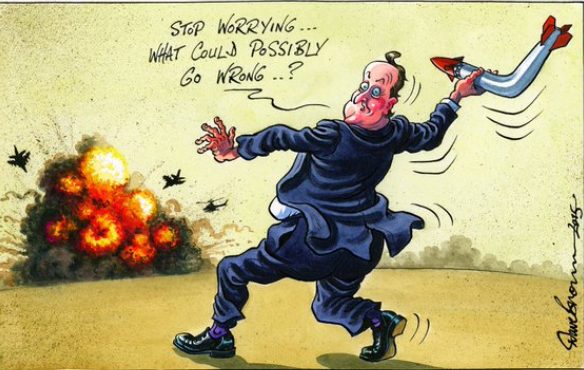
The decision of the UK government yesterday evening (December 2) to extend its war on terror into Syria with no coordinated strategy in place to defeat ISIS, will almost certainly be as catastrophic as Tony Blair’s decision in 2003 to commit British troops to Iraq. The notion that MPs could have genuinely been persuaded by Cameron’s line of reasoning for another illegal war is as inconceivable as MPs during Blair’s reign being unaware of either Scott Ritter’s findings stating that by 1998 Saddam had effectively been disarmed, or the subsequent public pronouncements of Colin Powell and Condaleeza Rice that were made on the back of them that preceded the infamous 45 minute claim.

The Prime Minister’s justification for sending more of our troops into harms way – which, significantly, was rejected by the Foreign Affairs Committee – was predicated on the dubious and frankly laughable claim of the existence of 70,000 “moderate rebels”. On Sunday’s (November 29) edition of the BBCs Marr programme, Defence Secretary, Michael Fallon, when pressed by presenter Andrew Marr to clarify who these rebels were, replied that were comprised solely of anti-Assad, Free Syrian Army forces.

However, early on December 1, Lt Gen Gordon Messenger, the deputy chief of the defence staff, appeared to have contradicted Fallon by refusing to confirm whether any of the alleged 70,000 fighters were members of more extremist groups such as the Islamic Front and Ahrar al-Sham. The fact that no clarification by Cameron was given to MPs regarding the source for the 70,000 figure or its composition, is not a sufficient enough basis for MPs to be able to make an informed decision about such an important life and death issue.

A major argument of those who defend the decision to extend the war, is premised on the claim that the attacks against ISIS in Iraq have not resulted in a single civilian casualty. Numerous conservative MPs have been afforded air time in the media to pontificate such an absurd claim without, to my knowledge, any serious challenge from journalists contradicting it. In under ten minutes of researching credible civilian casualty figures in Iraq resulting from coalition bombs, I learned that eight named children and two women had been killed in just one strike on Fallujah in a single day on November 26.

The public are being denied critical information by the mainstream media in order for them to be able to counter government propaganda and thus to challenge their MPs about their decisions for the case for war. But the same cannot be said of these MPs who themselves ought to be seeking to challenge such fundamental misconceptions and misinformation. Feigned ignorance is not a defence against complicit hands metaphorically covered in the blood of innocent victims.

The use of the government’s “precision” Brimstone missiles that will kill many more innocent men, women and children than the tragedy of Paris that gave rise to their use in Iraq and now Syria, will be the direct consequence of the deceptions of politicians’ and the shortcomings of journalists who failed to challenge their rationale for war.

If the government were serious about obliterating the existential threat they claim ISIS represents, then they would not be aligning themselves with allegedly 70,000 unidentified “moderates” who, as Patrick Cockburn contends “are weak or barely exist”. On the contrary, they would be aligning themselves with the forces on the ground that are resisting ISIS most effectively. These groups, as Peter Hitchens acknowledges, are the Syrian Kurds, the Syrian National Army, Hezzbollah and Iran – all of whom are being backed by Russian air power. However, this sensible coordinated strategy is being usurped by Cameron’s non-existent one, upon which, in their infinite wisdom, the majority of MPs voted.

The second explanation as to why the government’s decision to extend the bombing into Syria is not motivated by the need to destroy ISIS, is the duplicitous approach they have adopted in respect to their dictatorial regional allies in the Gulf peninsula who are among their biggest recipients of weapon deals. There is evidence that powerful actors within Saudi Arabia and Qatar, who are among the most brutal regimes on earth, have been facilitating funds and arms to ISIS and their affiliates that result from these deals.

Consequently, figures suggest ISIS alone has at least 80,000 fighters up from last year’s estimates of around 20,000 to 31,500. No matter how this is spun, the situation can only be interpreted as being an example of state sponsored terrorism that has had serious blow-back consequences. A former US military chief goes as far as to admit that the Iraq invasion had spawned ISIS.

Nafeez Ahmed notes that in his testimony before the Senate Armed Services Committee in September 2014, General Martin Dempsey, then chairman of the US Joint Chiefs of Staff, was asked by Senator Lindsay Graham whether he knew of “any major Arab ally that embraces ISIL”? Dempsey replied: “I know major Arab allies who fund them.” In other words, the most senior US military official at the time had confirmed that ISIS was being funded by the very same “major Arab allies” that had just joined the US-led anti-ISIS coalition.

If the major imperial powers were serious about undermining the terrorists, they would start by ensuring that their regional allies stop providing monetary, military and logistical support to them and their affiliates. Often overlooked is the fact that NATO member Turkey has also played a pivotal role in funneling arms to the various extremist factions as well as actively facilitating ISIS oil sales through the country. The reason Turkey shot down the Russian jet was to deter the Russian bombing in the Nusra Front-controlled border region. All this, as Nafeez Ahmed points out:

“….. begs the question as to why Hollande and other Western leaders expressing their determination to “destroy” ISIS using all means necessary, would prefer to avoid the most significant factor of all: the material infrastructure of ISIS’ emergence in the context of ongoing Gulf and Turkish state support for Islamist militancy in the region. There are many explanations, but one perhaps stands out: the West’s abject dependence on terror-toting Muslim regimes, largely to maintain access to Middle East, Mediterranean and Central Asian oil and gas resources.”

Naturally, both Russia and its allies on the one hand, and the U.S and its allies on the other, have geopolitical interests’ diametrically opposed to one another. But the point is, Russia’s principle motivation leads them to destroying ISIS with the view to maintaining Assad’s grip on power, whereas the West’s motivation lies elsewhere.

The West have spent well over $5 trillion on waging their “war on terror”. Over that period, US State Department data shows that terror attacks have skyrocketed by 6,500 percent, while the number of casualties from terror attacks has increased by 4,500 percent.

*2004 terrorism estimates from CIA figures.

As Nafeez Ahmed pointed out, journalist Paul Gottinger, who analysed the data, noted that spikes in these figures coincided with military intervention: “…. from 2007 to 2011 almost half of all the world’s terror took place in Iraq or Afghanistan – two countries being occupied by the US at the time.” And in 2014, he found, “74 percent of all terror-related casualties occurred in Iraq, Nigeria, Afghanistan, Pakistan, or Syria. Of these five, only Nigeria did not experience either US air strikes or a military occupation in that year.”

This would appear to be consistent with Ken Livingston’s contention, for which he was much maligned, that our military intervention in Iraq in 2003 had a direct bearing on the attacks in London on July 7, 2005. Moreover, it would also tend to support his view that the forthcoming air strikes in Syria will increase the threat of terrorist attacks here. Former British ambassador, Oliver Miles recently commented:

The [current] government seems to be following the example of Tony Blair, who ignored consistent advice from the Foreign Office, MI5 and MI6 that our Middle East policy – and in particular our Middle East wars – had been a principal driver in the recruitment of Muslims in Britain for terrorism here.”

Under such circumstances, it might well be reasonably argued, as former UK ambassador to Syria, Peter Ford has, that Cameron’s warmongering deceit is criminally negligent. It’s absurd to argue that the way to thwart transnational terrorism committed by organised groups of individuals on European soil is to bomb innocent people in nation states’ in the middle east.

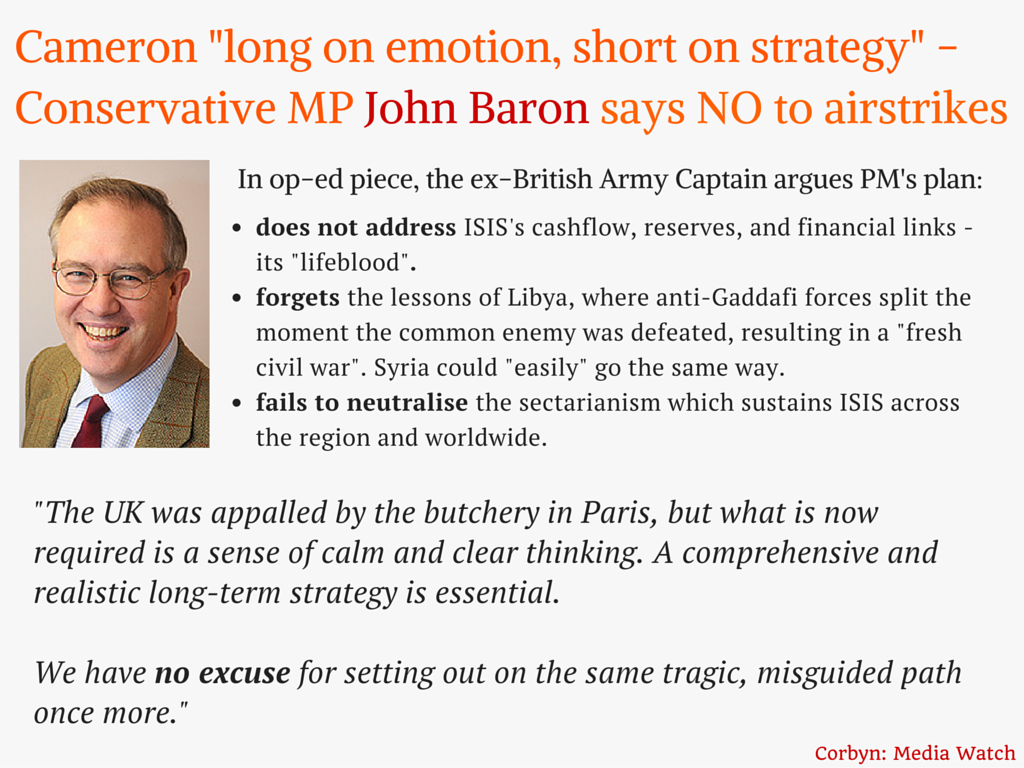
Warmongering Blairites like Hilary Benn are incredulous that anybody should oppose the bombing of the 600,000 population of Raqqa, in the hope, as Craig Murray put it“of hitting 8,000 ISIS personnel carefully dispersed among them.” Conservative MP John Baron’s reasoned arguments and appeal to colleagues, below, ended up being futile but at least he and the minority of other MPs who opposed more war for the benefit of the arms industry who lobby Cameron, appear to have a conscience:

Embedded image permalink

Philip Hammond’s commendation to his opposite number, Hilary Benn, that his pro-war speech was “one of the greatest in parliamentary history”, is illustrative of how democracy is little more than lip service to power underpinned by a self-serving Red-Tory opposition. Craig Murray hit the nail on the head when he said“the odious Blairites are the most self-centred, selfish and indeed sociopathic group ever to have a serious presence in the UK parliament.”

The truth is, the general public are, as was the case with Iraq, being systematically lied to. After numerous hours of debate in parliament, it is clear that Cameron’s case for bombing that will now begin within hours of this article being published, had not been made. The decision by the British parliament to ostensibly bomb ISIS by an overwhelming parliamentary majority of 174, is not supported by the majority of the British people and is based on a charade whose real purpose is illegal regime change.

In a recent article, journalist John Pilger quoted the former French Foreign Minister Roland Dumas who last year revealed that “two years before the Arab spring”, he was told in London that a war on Syria was planned. “I am going to tell you something,” he said in an interview with the French TV channel LPC, “I was in England two years before the violence in Syria on other business. I met top British officials, who confessed to me that they were preparing something in Syria… Britain was organising an invasion of rebels into Syria. They even asked me, although I was no longer Minister for Foreign Affairs, if I would like to participate… This operation goes way back. It was prepared, preconceived and planned.”


The psychology of ISIS and how to combat them.

By Daniel Margrain

Embedded image permalink

“The first step to combating Isis is to understand it. We have yet to do so. That failure costs us dear.” (Anthropologist, Scott Atran).

The lesson from almost a decade and a half of fighting terror with bombs is that the strategy has been an epic failure. And yet the UK government under the leadership of David Cameron seems intent on repeating the misguided foreign policy in Iraq in relation to dealing with ISIS in Syria presumably on the basis that the result will be different even though there is no evidence for this. Doing the same thing over and over again and expecting a different result may be a sign of insanity for most, but not, apparently, if you happen to be motivated by the need to satisfy the financial interests of the lobbyists who profit from war.

Although it is widely understood that bombs and drones are counterproductive, it’s perhaps less understood that the establishment appear to want it that way on the basis, it would seem, that terrorist retaliation justifies the further use of bombs and drones. Ken Livingstone was surely correct in his analysis on BBCs Question Time programme last Thursday (November 26), when he suggested that bombing Raqqa will play into the hands of ISIS from a propaganda perspective enabling them to bolster their number of recruits on the back of it. Indeed, it is clear that the aim of the extremists is to provoke an international bombing campaign precisely in order to achieve this objective.

The “strategy” of indiscriminate bombing of transnational “targets” as a means to ending the cycle of terrorism and counter-terrorism is a policy of despair. What is needed is a total rethink that involves, in the first instance, a serious attempt at addressing the causes that include the historical injustices meted out to the people of the region by the imperial powers. These injustices primarily stem from a series of secret meetings during World War 1 in London and Paris between the French diplomat, François Georges-Picot and the British politician, Sir Mark Sykes.

During these meetings, straight lines were drawn on a map of the middle east intended to effectively outline the control of land that was to be divided between the two countries. The French were to get Syria, Lebanon and parts of northern Iraq, while the British decided on southern Iraq, Jordan and Palestine. The idea was that instead of giving independence to the Arabs which was promised following the collapse of the Ottoman Empire, the imperial powers would run them on their behalf. The ensuing chaos over the next century stemmed from this agreement. ISIS is essentially motivated by power in a post-colonial world in which the artificial imperial borders created by Sykes-Picot are collapsing.

Robert Fisk points out that the first video ISIS produced was of a bulldozer destroying the border between Syria and Iraq. The camera panned down to a piece of paper with the words “End of Sykes-Picot” written on it. The wider “Arab Awakening,” as Fisk puts it, represents a rejection of the history of the region since Sykes-Picot during which time the Arabs have been denied freedom, dignity and justice.

According to Fisk, ISIS is a weapon that’s not primarily aimed at the West but at the Shia which the Sunni Gulf States’ want to keep at bay. This explains why the funding for ISIS is principally coming from the Sunni states’ of Saudi Arabia and Qatar. The possibility of closer U.S-Iranian ties in the future will likely result in pressure being put on these states’ to ‘switch off’ their funding to ISIS which Fisk claims was one of the main topics of discussion at the Geneva nuclear talks between the two countries.

American and French anthropologist, Scott Atran, outlines the underlying ideological glue that binds the followers of ISIS together:

“When you look at young people like the ones who grew up to blow up trains in Madrid in 2004, carried out the slaughter on the London underground in 2005, hoped to blast airliners out of the sky en route to the United States in 2006 and 2009, and journeyed far to die killing infidels in Iraq, Afghanistan, Pakistan, Yemen or Somalia; when you look at whom they idolize, how they organize, what bonds them and what drives them; then you see that what inspires the most lethal terrorists in the world today is not so much the Koran or religious teachings as a thrilling cause and call to action that promises glory and esteem in the eyes of friends, and through friends, eternal respect and remembrance in the wider world that they will never live to enjoy…. Jihad is an egalitarian, equal-opportunity employer: …fraternal, fast-breaking, thrilling, glorious, and cool.”

Atran posits that the appeal of ISIS seems to be their offering of a Utopian society and the sense of belonging and empowerment that they claim is lacking in Western society. The narrative is a future of peace and harmony, at least, under their interpretation, but with the recognition that brutality is also needed to get there. The underlying aspect of this Utopianism is the retreat from the kind of unconditional freedom where many young people feel pressured into certain social actions, towards a different kind of freedom free from ambiguity and ambivalence that, for those concerned, enhances a form of creativity that restraint helps nurture. ISIS exploits this dichotomy by outlining a way towards significance in a society that treats the alienated as insignificant.

It seems to me that the most effective way to counter ISIS propaganda is for governments’ to remove the “pull factors” of ISIS by giving young people a sense of hope for the future, offering them more of the “carrot” of opportunity instead of just the “stick” of despair. One of the major problems is that there is not the same kind of  government investment in prevention by way of guidance and decision making channels that are relevant to young people to avoid them becoming alienated enough to want to seek out ISIS. It seems to me that this is where ISIS have the upper hand, evidenced by the fact that they spend countless hours and cash luring people in.

Instead of spending billions on ineffectual war, the money would be far better spent on effective prevention programmes on the ground. This could involve, as middle east scholar Ed Husain has argued, employing former jihadists to reach out to help educate young people about the dangers of ISIS and other extremists. At some point, channels of communication will have to be opened up with radical Muslim groups who are willing to engage with experts outside the Muslim world to come to some kind of agreement that might even involve the formation of an enclave based on ISIS lines.

What is certain is the current path we are on is the wrong one in terms of the lack of any meaningful attempt to implement any effective strategy to weaken or destroy radical Islamism. Ideologies cannot be defeated by bombs, although the strategic use of broader coalition forces on the ground allied with a serious attempt by the U.S to insist that it’s dictatorial regional allies – Saudi Arabia and Qatar – deplete ISIS of funds, will go a long way to achieving the desired outcome. In order to defeat Hitler, Churchill was prepared to make a pact with the devil. The West might have to come to terms in doing the same with ISIS.


Cameron & Hollande increase the risk to our safety

By Daniel Margrain

That the overtly aggressive Western foreign policy of vengeance and the violent rush to bomb takes priority over the more conciliatory approach of attempting diplomacy, is depressing. But to do so in the knowledge that such a policy is both counterproductive and disproportionate is unconscionable. I’m not suggesting that Cameron and Hollande have deliberately set out to provoke terrorist atrocities on the streets of our cities, but their policies in the middle east unquestionably promote and exacerbate them.

It’s inconceivable that the political establishment are unaware that the violence of terrorists and the violence of the state are mutually reinforcing phenomena. So why, in their infinite wisdom, are the political establishment continuing the discredited ‘war on terror’ strategy if not to perpetuate the vicious cycle of death and destruction that the likes of Cameron and Hollande claim they want to eradicate?

Since the onset of the Iraq debacle, war and terrorism has spread exponentially but judging by the hawkish rhetorical flourishes of Cameron and Hollande one might have been led to believe otherwise. Yesterday, both leaders hardened their warmongering rhetoric as though in denial while the rest of the world looked on with incredulity. Even the right wing commentator Peter Hitchens acknowledges that “rhetoric and militancy have not done very much for us in the past. Why should it be different this time?”

The hardening rhetoric must be seen within a context in which the numbers of armed officers in Britain has fallen over the last five years, in addition to the refusal of ministers to rule out further cuts to the British police in general. It seems undeniable that the combination of more bombs allied to increasing austerity, will potentially put the British people at a greater risk from terrorism .

One might reasonably argue that mistakes at the top of government can be made, but to repeat them over and over again, in the hope that the result will be different, is a sign of madness. Fighting a war with bombs against an unidentifiable and highly mobile enemy whose sleeper cells are spread throughout the planet, is akin to arguing that the Hydra can be obliterated in the marshes of Lerna.

Every time the head of one of the principal beasts is decapitated, it mutates and multiplies into a far bigger entity whose tentacles and reach spread among their martyrs’ in ways that our leaders cannot seem to be able to comprehend.

A 14 year long Western war of terror has terrorized the oppressed to the extent that many more want to fight back than was the case prior to the atrocity in New York. The strategy of invasions and regime change has been an unmitigated disaster and yet our leaders’ are apparently oblivious to the fact that the war can never be won by what is effectively a policy of indiscriminate bombing.

Surely, it’s reasonable to surmise that the purpose of such a misguided foreign policy strategy of state violence that has demonstrably failed time and time again, is to maintain the establishments grip on political power thereby ensuring that the aspiration towards the reordering of society along more egalitarian lines are minimized.

A policy that effectively promotes and exacerbates terrorism means that the question of whether such an outcome is the intention of leaders’ like Cameron and Hollande is moot. The fact is the cycle of violence doesn’t stop with the dropping of ‘precision’ bombs on ‘terrorist targets’ whose collateral damage has historically killed more innocents than did the terrorist atrocities in Paris many times over.

It’s a sad and depressing reality that the kinds of barbaric acts witnessed in the French capital have been exploited politically by the establishment in order to justify their retaliatory rhetoric and subsequent violence. This in turn ensures that a system in which the military elite and arms manufacturers who lobby their governments for the purpose of maintaining their exalted financially privileged position, is sustained.

The logical corollary that arises from this mutually beneficial relationship, is that the protection of civilians on the streets of cities like Paris and London are not necessarily a priority for our leaders. This is because the deaths of civilians by terrorism is arguably regarded by the likes of Cameron and Hollande as a political price that’s ‘worth paying’ in the short term, with the view to securing their geo-strategic interests in the longer term.

Any rational analysis shows that acts of terrorism cannot seriously be regarded as an existential threat to the power of the state. The Paris attacks, for example, killed 0.01 per cent of the population of the city. To put it into context, many more people die each year in traffic accidents in France than were killed in the atrocity.

The disproportionate amount of media coverage devoted to Paris reached saturation point in the days that followed, which is partly a reflection of the nature of rolling 24 hour news. Of course geography and cultural affinity played a major part in the decisions of editors to give so much coverage to the drama, but that doesn’t excuse the fact that only a fraction given over to Paris was given to the terrorist atrocity on the Russian airliner which, it must be reiterated, resulted in more deaths.

The wall to wall coverage serves a political purpose which is the promotion of the idea that the suffering of people in places most of us are more readily able to identify with, matter more than those we don’t. This is all part of a media narrative that reports the victims of war and terrorism as though, as John Pilger put it, they are “worthy and unworthy” – the former being innocents killed on ‘our’ side while the latter are those of our official enemies.

This is all part of a much broader media system of propaganda which consistently conflates inappropriate militarism and its symbols with notions of unflinching patriotism. The displaying of national flags plays a very important role in this regard, especially after national tragedies.

For instance, the public were encouraged to adorn the French flag and sing the French national anthem at the England versus France football international at Wembley Stadium a few days after the Paris atrocity as an act of solidarity. But there were no similar calls following the terrorist atrocities in Beirut that happened just a few days before.

The purpose is to try and convince the public to support yet more ineffectual and immoral bombing of innocent people in a far away country in the hope that the people go along with the lie that this strategy has reduced the number of deaths caused by terrorism and is therefore making us safer.


Under The Bridge with The Magic Band

By Daniel Margrain

Review of The Magic Band, Under The Bridge, Chelsea, London, Friday, November 20. 

It was a bitterly cold night in west London. I had exited the tube at West Brompton and hadn’t taken into account the 20 minute walk to the venue. Yes, I should have got off at Fulham Broadway which, as I later discovered, was two minutes away but I didn’t know that at the time and neither, apparently, did the venues web writers.

The band were due on stage for the first of their two sets at 8.15 and it was already eight. I didn’t have the faintest idea where I was going. On leaving the station I approached the first person I saw and asked him for directions. I was directed the wrong way. I double checked that I hadn’t put on my West Ham top by mistake and that I wasn’t humming the ‘London Bridge is Falling Down’ tune under my breath.

Apart from the one time I had ventured to the Bridge with my nephew, the only other time I had visited the Stamford dump predated the Abramovitch era by years at a time in history when part of Stamford Bridge was literally at the point of collapsing, which, if memory serves me correctly, was the section of the ground near the infamous Shed end.

We lost 2-1 that day and I got soaked through to the skin. The Russian mafia money has of course transformed a crumbling ground into a shiny stadium but I wasn’t going to ever get there walking in the wrong direction.

Eventually realizing that I had been given a ride up the wrong proverbial garden path, I turned around and began pacing frantically in the opposite direction passing the tube station on my right. I hit some lights, did a right and carried on walking for another 15 minutes until I reached the bright neon lights of Under The Bridge which was located, as you might of guessed, under the stadium.

Propped up against a wall by the entrance to the venue stood the author Will Self who was chugging on an e cigarette. I took that as a sign that the band had not yet taken to the stage, so I relaxed. You enter the venue proper by a short narrow passage, the walls on either side are plastered with various framed photos of legendary, and not so legendary, artists that reminded me of the kind of set up they had at Dingwalls in Camden in the 1980s.

Numerous photos of this nature were dotted throughout the venue clearly modelled on the kinds of Blues bars dotted throughout America – open and spacious with a semi-circular design and a raised perimeter section where the bar and comfortable looking stools were located. These faced down towards an impressive stage that was easily visible from wherever you stood.

The omens were looking good. This was certainly one of, if not the, best music venues of its size that I had the pleasure of frequenting and was clearly evidence of criminal money being put to good use. I grabbed myself a bottle of pear cider at the bar and then found a suitable position stage left by a circular pillar.

No sooner had I got comfortable when I was approached by a guy who looked to be his mid to late 60s who proceeded to give me an ear bashing about how he had seen the original Magic Band with the Captain back in the late 1960s and had subsequently seen the group play live in its various incarnations throughout the years.

I have to admit that the gig which was shortly to unfold before my eyes left me with a feeling of trepidation especially as my new found mate was praising the band so much. Since I had deliberately set out to avoid seeing any of their live performances on you tube or reading any of their reviews, I had no idea what to expect.

About seven or eight years ago I had seen The Electric Prunes at Camden’s Underworld only to have wished that I hadn’t had too much to dream the previous night. The gig was a disaster and my memories of the times I had listened in total awe to the bands records had been forever tainted by what I had witnessed live that night.

If ever there was a case for a band calling it a day, the Prunes, sadly, were it. Of course, for every Electric Prune there is an Arthur Lee and Love, so it’s far from necessarily being the case that all bands from the 60’s turn out to be shocking 30 or 40 years down the line.

However, the more my new found companion raved about The Magic Band, the more apprehensive I became and the more I began to think that they might not reach the level beyond that of a tribute band. He told me he last saw the group at the Garage in Islington in 2011 and described the gig as one of the greatest experiences of his life.

My expectations were now being raised whether I wanted this to be the case or not. I decided that it was best just to go with the flow, take whatever comes my way and ride the crest of the wave along with 700 others.

I’ll lay my cards on the table. I first heard Captain Beefheart and His Magic Band back in 1980 on the John Peel Show. The album Peel played to death that year was ‘Doc At The Radar Station’. Peel was a long standing fan of Beefheart and ‘Doc’ represented the rebirth of the man following his creative fallow period during the early 1970s after having arrived in England.

As an impressionable young man I regarded somebody of the stature of Peel as an authority as to what was ‘good’ and ‘cool’. And for Peel, the Captain reigned supreme. He was the Godfather of post-punk and consequently most of the younger generation of bands worth listening to at the time were influenced by Don Van Vliet.

To be honest, at that time, I didn’t understand the music of the Captain because I hadn’t heard anything like it before. Because I didn’t understand it, I didn’t really like it but pretended to because it was cool to like Beefheart and most of the bands I liked referenced him so I got to thinking he must be good.

Nevertheless, I felt as though there was potentially something interesting in the music to explore but I just wasn’t at that moment ready to explore it. But given time, I could be educated, through repeated listens, to appreciate him, just like Peel, John Lydon and Mark E Smith did.

If John Peel had championed him and played him he must be good, I thought. I remember Peel used to regularly play a lifelong hero of mine on his show by the name of Neil Percival Young. But I remember thinking how can it be possible to like Neil Young and Captain Beefheart?

I tried to like the tracks off ‘Doc’ Peel used to play, but couldn’t get to grips with all those off-kilter demented psychedelic-blues rhythms, manic growls and weird lyrics. Then I got to seeing the Fall play at Totnes Civic Hall in 1981 and everything from that moment on fell into place.

The next day, I went into Castle Records in Torquay and to my surprise, I found ‘Doc At The Radar Station’ among the piles of albums. I took it home, put it on the turntable and everything clicked. Don’s cover art work also somehow started to make sense.

I used to play Neil Young loud but turned the volume down for ‘Doc’ because I thought the sound of the record might of alarmed the rest of the house. I’m happy to say that the great man still has that affect today which is as it should be.

Thereafter I began to check out the Captain’s back catalogue and haven’t looked back since. Some 34 years later, I stood cider in hand, looking at the Under The Bridge stage as the lights dimmed and the band hit the stage. Sadly, John “Drumbo” French is the only original member remaining from the band.

French took to his established role as drummer for a couple of songs while also playing the clarinet and harmonica. As expected, French is the glue that holds the rest of the band together but he is aided by brilliant younger musicians, namely guitarists Eric Klerks and Max Kutner, keyboardist Brian Havey and drummer Andrew Niven – all of whom stepped up to the plate admirably.

As one would expect from band members taking on the complex rhythms and odd time signatures that typify Beefheart’s music, the playing throughout was immense and I just couldn’t help but marvel at the musician’s timing and the manner in which they gelled as a tight unit.

Kutner was the perfect foil for Klerks and the drumming was exemplary. The interplay between band members was awesome. Amazingly, French seemed to hit all the right vocal notes and to my ears his range is almost as strong as Beefheart’s. No one can command the stage like the Captain but that’s not to say that French didn’t made a pretty good fist of translating his stage theatrics while adding a personality that was all his own.

In that sense the performance didn’t come across as a tribute act, but on the contrary, highlighted just how relevant the music of Beefheart still is to contemporary audiences, the age group of which crossed the spectrum. On the whole the set list was impressive although for me some songs didn’t quite work.

I could have done without ‘Her Eyes Are A Blue Million Miles’ and ‘Tropical Hot Dog Night’, for example which are just too conventional sounding for any serious Beefheart fan. ‘Click Clack’ from the underrated ‘Spotlight Kid’ and ‘Suction Prints’ were revelations, as was, of course, ‘Moonlight On Vermont’ and ‘Hair Pie Bake’ from Beefheart’s supreme masterpiece, ‘Trout Mask Replica’.

The main highlights were performed during the second set – ‘Stealing Softly Through Snow’ and the tour de force, ‘Electricity’. ‘The relatively obscure ‘Glider’ and the rip roaring ‘Big Eyed Beans From Venus’ from ‘Clear Spot’ wrapped up proceedings on what was a remarkable and unforgettable night.

Democracy & the media.

By Daniel Margrain

Representative democracy is bad for parliamentary democracy because it implies the shifting of power from the elite towards the masses. People power has the potential to tear down the ivory towers of privilege that the rich construct for themselves which is why the establishment is fearful of such an eventuality. The extent to which a political system that functions to support the lifestyles and privileges of the elite ensconced within these towers is determined by the level of passivity and apathy of those on the outside.

Due to the UK’s appalling electoral system, a right wing government in the UK exercise absolute power with just 24.4 percent of those eligible to vote. The attitudes of many of the 38% who did not vote at all in the last general election towards the entire political class, was a combination of indifference, passivity and apoplexy.

Many others who were politically active and mobilized were nevertheless resigned to the fact that the deeply corrupt and flawed ‘winner takes all’ system does not give them a political voice within parliament. The end result of the combination of all these factors, is a system that’s corrupt and rotten to the core.

Although the government’s legality cannot be called into question, it’s legitimacy most certainly can. A government’s legitimacy rests on the popular consent of the governed. It’s clear that the Tories austerity measures that consist of deepening and widespread cuts will do far more harm to far more than the 24.4 per cent of the population that supported the government during the last election. To that extent, there are valid questions to be asked about what right the conservative government has to rule.

With Jeremy Corbyn’s popularity showing few signs of subsiding, we seem to be returning to the feelings of optimism and confidence of the kind witnessed during the 30 year post-war settlement period. Public mobilizations that question and demand more from the system, initiate a crisis in democracy for our unrepresentative leaders, establishment figures and their corporate mainstream echo chambers’ who don’t know quite how to react to the potential threat to their own distorted vision of democracy. This vision can accurately be defined as being reminiscent of the feudal system. As Noam Chomsky put it:

On the one hand, we have the King and Princes (the government). On the other, the commoners. The commoners may petition and the nobility must respond to maintain order… Real participation of “society” in government is nowhere discussed, nor can there be any question of democratic control of the basic economic institutions that determine the character of social life while dominating the state as well, by virtue of their overwhelming power.

Chomsky was actually referring to a 1975 Trilateral Commission report about the nature of American democracy by author Samuel Huntington, but he might as well of been discussing the UK political system of governance in 2015. Political ‘outsiders’ like Jeremy Corbyn and the newly appointed, Ken Livingstone, are regarded as a threat to the narrow careerist interests of not only the Blairite political elite within the Parliamentary Labout Party, but also the metropolitan London media elite of ‘insiders’ who sing to the Blairite-Tory tune.

As Medialens have suggested, this is reflected in an obvious media bias that favours the Red-Tory consensus outlook which can be gauged simply by comparing the tone and intensity of media attacks on both Corbyn and Livingstone against the more conciliatory and friendly approaches of those who don’t rock the metaphorical boat. Of all the preposterous apocalyptic media attacks and McCarthy-style guilt by association smears on Corbyn thus far, the piece titled Will a Corbyn victory be the end of Labour? by Rachel Sylvester in The Times on September 1, written during the build up to the Labour Party leadership election, surely takes the award for the most idiotic. Sylvester comments:

“Just as the Vikings and the Mayans brought about their own extinction by destroying the environment on which their cultures depended, so the Labour party is threatening its survival by abandoning electoral victory as a definition of success. If Labour chooses Jeremy Corbyn – a man who will never be elected prime minister – as leader next week, its end could be as brutal and sudden as those other once great tribes.”

One question arises from Sylvester’s piece. How can an attack by the mainstream media on an authentic voice of Labour values possibly be regarded as the ultimate threat to Labour values?

Sylvester’s smear was just the beginning of a widespread barrage of abuse that has come the way of the ‘outsiders’ since Corbyn’s historic election victory. The Telegraph’s November 18 edition went as far as to use the fascist language of Goebbels when referring to Corbyn’s long-standing ally. “Ken Livingstone is a hate-filled cockroach” was the headline. The latest smear from the Guardian, adding to their already long list, was their description of Corbyn as “like a good Marxist” who “is securing his revolution from within.”

Nick Cohen preposterously claimed that “Jeremy Corbyn is one of the most dishonest politicians you will see in your lifetime”, while the BBC’s political editor Laura Kuenssberg’s transparently biased interview with the labour leader was little more than a scornful attack on his stance on nuclear weapons. Her incredulous responses to his reasonable points, belies the BBC’s claim that it is impartial. Analysis by Medialens show how “mainstream media performance alternates between two distinct modes of reporting”. They point out that:

“the first, ‘fig leaf’, mode presents a view of the world that is overwhelmingly biased in favour of the powerful interests that control, own and support the media, and of which it is a part. Within this bias, room is made for powerful nods and gestures in the direction of honesty and balance.”

An example of this mode was Kuenssberg’s token gesture during the Corbyn interview in which she used the phrase “some voters may think…” which was clearly intended to give the impression of balance as a means of offsetting her aggressive line of questioning in response to Corbyn’s reasonable commitment to the spreading of international law that preceded it. The impression given is that we live in a free and open society where genuine dissent is tolerated.

Medialens continue:

“The second, ‘full propaganda’, mode involves straight forward, no holds barred bias. This is seen in time of war, on royal occasions, on the anniversary of great military victories, and at times when leaders pass away.

On these occasions, balance and impartiality are deemed unnecessary, disrespectful, unpatriotic, irresponsible, even treacherous…Mode 2 reporting, then, sets an essentially totalitarian standard against which public and journalists alike judge media performance…The most powerful weapons in support of mode 2 performance are patriotism and shame…”

Andrew Neil’s impassioned eulogy during the opening sequence of the BBCs flagship political discussion programme, This Week broadcast on November 19 is an example of the second, “full propaganda” mode. Neil’s linking of the nuclear power state to a succession of great French thinkers was his way of showing support for Hollande’s foray into bombing its former colony. Neil’s “inaccurate nonsense in the form of nice memorable words strung together with angry sad words” was critiqued in a brilliant piece of polemical writing by Frankie Boyle.

What both Boyle’s article and the Medialen’s analysis highlight, is that parliamentary democracy in the absence of a democratic media creates the illusion of popular consent while enhancing the power of the state and the privileged interests protected by it.

The battle for media control is akin to the analogy of the fight for territorial domination between two wolves. One is an evil wolf: anger, envy, sorrow, greed, self-pity, guilt, resentment, lies, false pride, superiority and ego. The other is the good wolf: joy, peace, love, hope, serenity, humility, empathy, generosity, truth, compassion and faith.”

The one that wins is the one that is fed. Democracy is that way. The wolf that wins is the one we feed. And media provides the fodder.

Why Picasso’s ‘Les Demoiselles d’Avignon’ still resonates today.

By Daniel Margrain

Commodification and objectification, concomitant to the growth of consumerism in modern society, is the fuel to the engine that drives capitalism on. As I explained in a previous post, the social pressures on young women to conform to certain media expectations that capitalism places upon them and from which these processes are manifested, is immense. As I will outline below, Pablo Picasso’s masterpiece, Les Demoiselles d’Avignon – arguably the greatest piece of art produced in the 20th century – challenged this manifestation of capitalism during the early stages of its development. I will show how the cultural significance of the painting still resonates today.

Les Demoiselles

Les Demoiselles d’Avignon is the most famous examples of cubism. It is an oil painting on canvas begun by Picasso in late 1906 and completed in the summer of 1907. It is eight feet tall, seven feet eight inches wide, and has hung since 1937 in the Museum of Modern Art in New York.

Les Demoiselles d'Avignon, 1907 by Pablo Picasso

In this painting, Picasso abandoned all known form and representation of traditional art. He used distortion of the female body and geometric forms in an innovative way, which challenge the expectation that paintings will offer idealized representations of female beauty. It also shows the influence of African art on Picasso and is said to be a reaction to Henri Matisse‘s Le bonheur de vivre and Blue Nude.

Its resemblance to The Large Bathers of Paul Cezanne, Statue Oviri of Gauguin and Opening of the Fifth Seal of El Greco has been broadly talked about by critics. When it first exhibited in 1916, the painting was regarded as immoral. According to art critic, Leo Steinberg, the reversed gaze, that is, the fact that the figures look directly at the viewer, as well as the idea of the self-possessed woman, no longer there solely for the pleasure of the male gaze, may be traced back to Olympia, 1863 of Manet.

The critic Jonathan Jones described the painting as “marking the birth of modern art” in the sense that it dispensed with the portrayal of the naturalistic or the ‘realism’ as developed during the Renaissance. Modern art either distorts physical appearances or abandons them altogether. This is not to say, of course, that it was possible for the Renaissance painters to ‘realistically’ depict things that do not in reality exist like angels.

The point is, depictions of say, breasts and faces in art during this epoch, were easily recognizable as faces and breasts. Picasso was the first to break from the Renaissance tradition in which a great deal of attention was paid to detail, craft and specific skills – factors which were widely regarded as the true sign of quality.

Although it could be said that impressionism marked a shift in the emphasis on the premium of these ideas as being the marker for great art, it was Les Demoiselles that provided the art world with its decisive break. In 1907 it would have looked like not just a move away from the traditional skills, but a full scale assault on them.

Up until the 19th century, harmony, form and certain subject matter were regarded as the aesthetic marker for beauty in art and anything that didn’t conform to this rationalization was deemed to be of a lower order. Think of A Rake’s Progress, a series of eight paintings by 18th-century English artist William Hogarth, as an for example of this.

In Les Demoiselles, not only does Picasso not attempt to make the women ‘beautiful’ but, by the conventional standards of the day, his use of the African masks, insists on their ugliness. Les Demoiselles was the painting that was the starting point for the development of the revolutionary art of the 20th century.

The significance of Picasso’s innovative painting should be viewed within the wider context of modernist culture as a whole, understood as the emergence of the technological innovations that typified the industrial revoultion, the artistic break from the aristocratic traditions that existed more or less until the early 20th century, and the social revolutions of the period that were linked to them.

Les Demoiselles fits neatly into this schema within the context in which the impressionists and the post-impressionists were all met with derision. The development, and first mass production of, the automobile happened during this time. The Wright Brothers and Santos-Dumont made a public flight in Paris. Marconi established the world’s first radio station in 1897 on the Isle of wight and opened the first wireless factory in Chelmsford in 1898.

All this happened during a period when Europe was pre-occupied by Revolution in Russia. Igor Stravinsky’s Firebird was composed in 1910, and The Rite of Spring between 1912 and 1913, while the Ballet Russes was formed 1909 and first performed L’Aprèsmidi d’un Faune in 1912. In literature Marcel Proust’s A la Recherche du Temps Perdu was begun in 1909, James Joyce’s Dubliners appeared in 1914, Franz Kafka’s In the Penal Colony in 1914 and his Metamorphosis in 1915. Les Demoiselles formal innovations that are indicative of modernism, preceded all of the formal innovative breaks with the past in the artistic fields described.

But the impact of the painting extends beyond the development of modern art in purely formal terms. Perhaps above all, it’s the contemporary relevance of the subject matter which resonates most powerfully today in a society where objectification and commodification inherent to capitalism increasingly permeates popular culture.

It’s perhaps tempting to ignore the fact that the picture is about prostitution let alone about being confronted up close and personal by five prostitutes. However, some journalists recoil from confronting the fact that the core subject is about looking at, and being looked at by, prostitutes and instead replace it with other evasive interpretations. But although the picture is ostensibly about prostitution, to me it’s saying something much deeper that goes beyond the critique of one particular social institution.

The central feature of Les Demoiselles is the confrontation between the artist/brothel client/viewer. As highlighted by the gaze of the central women (second and third from the left), they are one and the same. We are left with a feeling of being gazed at with contempt by the prostitutes which initiates in us a intense discomfort.

In turn, this mutual antagonism reflects a sense of estrangement that the institution of prostitution exemplifies within the formal structures of the state. In my view, the themes that Picasso explored in Les Demoiselles could only be expressed as part of the radical break he made with the traditional forms of naturalistic representation.

What Picasso achieved with his assault on conventional standards of beauty and the use of African masks, was the de-sentimentalization and de-glamorization that capitalism, through objectification, sentimentalizes and glamorizes.

Whether Picasso was intellectually conscious of all of this as he worked on the painting is questionable. The point though, is the picture which revolutionized art cannot plausibly be considered autonomous from the nature of a society from which its creator emerged.

The Paris postmortem.

By Daniel Margrain

President Hollande’s declaration yesterday (November 16) that France is on a war footing is an almost seamless continuation of his rhetorical flourishes that followed the Charlie Hebdo attacks in January. This time, though, they have intensified and are clearly intended to give a signal to Syria’s President Assad that he can expect more bombs to be dropped on his country.

Something similar happened after 9-11 when President Bush announced to the American public, and hence the world, that the price to be paid for the deaths of over 3,000 people on American soil would be the spilling of the blood of Islamist terrorists, which of course, turned out to be a euphemism for the deaths of a million Iraqi civilians. Although the countries’ and time-frames are different, the magnitude of the grandstanding rhetoric and the upcoming violent retributive responses are not.

Hollande said that the terrorist attacks were “orchestrated from abroad”. But so too have been the attacks on Syria by NATO over the last four and a half years. The dropping of Western imperialist bombs under the umbrella of a war based on the responsibility to protect doctrine, is far more deadly and destructive than the collateral damage caused by a handful of psychopathic killers and sadists under the epithet, “terrorism”. The intended aim of the latter was to cause a lasting sense of disorientation and fear among the masses while the purpose of the former is the destabilization of a country as the precursor to the eventual domination of an entire region by a Western elite.

The leaders of the great imperial powers whose whirlwind of destruction throughout the middle east has resulted in the debris blowing back into the symbolic and literal foundations of Parisian culture have, in so doing, struck at the heart of enlightened modernity and bohemian excess. A city whose decadent charms could be best discovered by walking it’s streets in the manner of the flaneur is rapidly becoming a pastime that is out of step with these increasingly coarse times.

What the impact of creeping globalization has managed to do to the cultural landscape of the city is to diminish its collective sense of unity and resistance to the vagaries of market forces that typify many other cities. The political consequences that will almost certainly arise from the terrorism witnessed on the streets of Paris will be a further crackdown on civil liberties, growing suspicion of the “other”, a rising tide of chauvinist nationalism, and the implementation of a strategy of divide and rule.

The panic and fear witnessed on the streets of the city shown on the mainstream news channels in the aftermath of the attacks will, I suspect, be an illustration of what is to come in the future. The fear will likely be whipped up by the French mainstream media and leading politician’s who, as the investigative journalist Gearoid O’Colmain has pointed out, will almost certainly focus their campaigns on undermining attempts by dissidents who publicly question the established order.

For all of the fighting talk by Hollande of how the war will be taken to the terrorists and how they cannot hope to succeed with their strategy of violence, is not borne out by the resulting panic that ensued. The uncomfortable truth is the terrorists are winning. We now live in an era of eternal war fought on the absurd premise that a corresponding everlasting peace is just around the corner. This circular illogicality is underpinned by numerous ongoing conflicts which are being fought on unlimited battlefronts on a global scale.

This scenario isn’t lost on the elite 1 per cent who regard the end game as the emergence of a “peace” predicated on continued injustice and the creation of a wilderness starved of hope and aspiration for the remaining 99 per cent. The combination of an Hobbesian world and the kind of future of the science fiction of Huxley and Orwell  is in truth a mark of the present that somehow we have let happen as though having stepped blindfolded and hypnotized into the pages of the novels of their creators’.

The people of the world are caught in the middle in this disaster while the elite look down on the chaos and carnage from their ivory towers and from the luxurious comfort of their gated communities. The connections between the environmental degradation of our planet which is crumbling around us, and the limits of a system predicated on the unsustainable concept of unlimited economic growth and warfare are clear.

The propaganda that the leading politicians and their mouthpieces in the mainstream media present to the public is the notion that state violence is the default position to counter the terrorism of which the chaos and carnage described is implicit. The BBCs political editor Laura Kuenssberg, for example, constantly gives the impression of being baffled about peace over violence.

In a high-profile piece on the BBC’s flagship News at Ten programme on September 30, Kuenssberg featured in an almost comically biased, at times openly scornful, attack on Jeremy Corbyn’s stance on nuclear weapons.  The overall narrative is that violence is the answer to violence which is presented as normal while diplomacy and peace is regarded as radical and “off message”.

Rarely do the media point out the truth that violence against an ideology can never in practice be a winning strategy or that neoliberal socioeconomic fundamentalism is as extreme as its politically-inspired violent offshoot. One of the causes that has laid waste to alienation and radicalism in Paris is the kind of socioeconomic discord that the racially segregated Muslim ghettos at its periphery and its sterile hollowed out core reflect.

What underpins this socioeconomic discord is the history of French imperialism and colonialism. The root cause of the despair and terrorist depravity that the world witnessed last Friday is not located in the bazaars of Damascus or the cafes of Algiers but in the boardrooms and plush offices of metropolitan cities like London, Paris and Washington.