‘Move along, nothing else to say’: A summary of Cameron’s role in the Panama Paper’s scandal.

By Daniel Margrain

David Cameron’s speech to the House of Commons yesterday afternoon (April 11) was clearly intended to draw a line under the Panama Papers scandal. The Public will keep this in mind when the Tory government remind us all about “belt tightening”, “austerity” and “we’re all in this together”. The government has 92 special advisers on its books whose combined wages costs us, the British taxpayer’s, a massive £8.4 million a year, one of whom we learned this past week is paid £53,000 to “advise” Cameron’s wife about her choice of wardrobe. Maybe the British public should insist these “special advisers” run the country and cut out the middle man?

Cameron was pulled into the Panama Papers debacle last Monday (April 4) after details of Ian Cameron’s (the PMs deceased father’s) dealings featured in the first batch of documents from law firm Mossack Fonseca. This is a problem for David Cameron because he had previously made statements condemning tax reduction schemes by saying they were “wrong”, which is a word he frequently uses to describe problems he appears to have no intention of ever addressing. In 2012 he said “tax avoidance is morally wrong.” Last Monday (April 4) he again stated that those who attempt to hide their money from the UK tax authorities were “wrong”. However, when the tax affairs of his own family were brought into the media spotlight, he appeared to change his tune by claiming that such affairs were “a private matter”.

The next day (Tuesday, April 5) he said:

“In terms of my own financial affairs, I own no shares..I have a salary as a Prime Minister, and I have some savings which I get some interest from and I have a house which we used to live which we now let out while we are living in Downing Street and that’s all I have.”

The British public were supposed to be impressed with this outward selfless expression of personal “frugality”. He continued“I have had no shares, no offshore trusts, no offshore funds, nothing like that. So I think that’s a very clear description”.  This was obviously part of a carefully prepared and scripted speech by his “special adviser’s” that sounded like a hundred lawyers had poured over it into the early hours to ensure its absolute accuracy to the last syllable. Cameron’s statement, in other words, might of been accurate but it wasn’t necessarily clear.

By Tuesday afternoon, Number 10 had sent out another clarification – a clarification of their previous clarification. This third clarification said, “To be clear, the Prime Minister, his wife and their children do not benefit from any offshore funds. The Prime Minister owns no shares.” It then went on to say, “It’s time for people to either put up or shut up in relation to questioning Cameron’s tax affairs.” (adding the word “peasants” to the end of the sentence would not have sounded out of place).

However, it’s clear the people won’t shut up. Cameron will discover that his attempts to draw a metaphorical line in the sand in relation to this ongoing scandal won’t be heeded in quite the way that he and his advisers would like. They have totally underestimated the public mood and the extent to which the British people recognize that a week of Cameron’s shenanigans represents merely the end of the beginning as opposed to the beginning of the end. The public are only now warming up for the long haul as Cameron tries his best to put his role in the scandal to bed.

Meanwhile, on Wednesday (April 6), there was a fourth clarification which stated that “there are no offshore funds or trusts which the Prime Minister, Mrs Cameron or their children will benefit from in future.” Crucially, Cameron’s lawyers and advisers had thus changed the tense. On Thursday (April 7) afternoon, there was a fifth clarification: Cameron maintained that he had nothing to hide. He revealed for the first time that both he and his wife had sold interests worth more than £30,000 in Blairmore which uses bearer shares to protect the privacy of investors’. As with money, whoever bears bearer shares owns them but they are much more portable in that they can be moved around without any paper trail. Consequently, due to the criminal implications associated with them, they have been banned in the UK. Ironically it was the tax swindler, Cameron, who banned them.

Blairmore used more than £30,000 worth of bearer shares to protect the privacy of the Cameron family’s offshore activities. David Cameron insisted that he didn’t personally benefit from any funds from his fathers tax efficient holdings other than the £30,000 described. This is clearly nonsense. As the political satirist Mark Steel in brilliantly comic fashion highlighted, this presupposes that a young David Cameron would have paid for his elite privately funded education at Eton using money he had earned himself after having saved up while undertaking a paper round.

When interviewed by ITVs inscrutable Robert Peston, who sounds like he eats a vowel and pickle sandwich every day for lunch, Cameron said that his father had left him £300,000 and that he couldn’t reveal the source of every bit of the money because his Dad was no longer around to answer any questions about it. Peston asked Cameron how he could of been certain that some of the £300,000 didn’t come from offshore sources. The answer the PM gave was that he and his advisers couldn’t be certain. This, in other words, is code for the money did indeed come from offshore sources. So unless Cameron spent the £300,000 on sweets and comics, then he is currently benefiting from offshore funds.

Let’s make a fairly safe bet and assume that he spent the £300,000 on a relatively secure investment such as property. A decade ago, a £300,000 deposit would have landed a huge investment – particularly in London – in a comfortable family home. The point being, unless Cameron blew the money, on say, cocaine and hookers or otherwise spent it unwisely (which is extremely unlikely), it’s ludicrous to suggest that he will not be benefiting from offshore funds in either the present or the future. It should be remembered that about 15 years ago Cameron bought a house with a mortgage in Oxfordshire with financial help from his father. We, the public, also helped out Cameron by paying the interest on that mortgage for the remainder of what the house cost.

The Cameron family still owns it and its value has increased to over £1 million. It will continue to increase in the foreseeable future. So too will the £300,000 worth of assets from his father increase in value. This £300,000, remember, is a sum Cameron claims neither he, his wife or children have benefited from. So contrary to the assertions of Cameron and his advisers, the notion that he is not benefiting, and will not benefit from, his fathers business in future is also an obvious nonsense. In addition to all this, he owns a second home in Ladbroke Grove in London worth £3.5 million and rising.

It’s inconceivable that Cameron would of been unaware of his father’s financial dealings in Blairmore given that he was himself involved in the Blairmore fund for 14 years (1996-2010). Secondly, the notion that he was somehow oblivious to the fact that Blairmore boasted that it was able to avoid UK tax or, thirdly, that the MPs Code of Conduct compels MPs to declare a financial interest to fellow MPs prior to participating in House of Commons business, are also too far fetched to garner any credibility.

As far as the political and media establishment are concerned, the revelation that Cameron was implicated in the Panama Papers scandal comes down to a question of PR/media mismanagement, as opposed to recognizing that his actions are immoral and, if the law was applied equally, illegal enough to warrant a prison sentence. Let me be clear about this: The super rich elites like Cameron who avoid or evade their taxes, live in the society that the rest of us who do pay our taxes are also a part of. They do not exist as a separate hermetically sealed entity isolated from the rest of humanity.

So they need to be compelled by law to pay their fair share of taxes in order that we are all able to maximize the revenues that accrue for the greatest possible utility. Failing to participate in UK society while presuming to tell the rest of us how it should be run, is incompatible with democracy. What the super rich clearly regard as their inalienable right not to pay tax, is indicative of the fact that 78 per cent of MPs are millionaires compared to just 0.7 per cent of the British population in general. Unfortunately, therefore, democracy has become a by-word for a self-serving system in which MPs effectively represent themselves and the interests of the wealthy.

This explains why the government places a greater emphasis on tackling benefit fraud which represents a relatively tiny proportion of revenue loss compared to the resources that goes into tackling tax evasion and avoidance of the one per cent of the super rich. It might also explain why HMRC chief Edward Troup was a partner at the law firm that acted for Cameron’s offshore fund. What is certain is that these kinds of cozy relationships and practices are contributing to an astounding rate of inequality in which 62 people currently own the same wealth as 3.6 billion people – 50 per cent of the world’s total population.

In terms of Britain, the end result is that tax evasion and avoidance costs the UK treasury a massive £95 billion a year which is enough to fund the entire NHS in England. The surreal irony, in light of all these shenanigans, is that during last Saturday’s London demonstration, tax payer funded police were seen outside Downing Street lining up to protect the one per cent of super rich tax dodgers from the 99 per cent of tax payers.

Another piece of surreal theatre was illustrated by the fact that the demonstration in London last Saturday was barely reported by the BBC but – in the name of impartiality – the demo outside the Iceland parliament received widespread coverage. Despite the efforts of the chattering corporate media class, their counterparts within both the Tory government and the Blairites of Labour’s  PLP, this is a scandal that the public will ensure will not go away any time soon.
The Panama Papers

By Daniel Margrain

The handing over by an anonymous source of massive amounts of data from the Panama-based, German-run law firm Mossack Fonseca which specializes in providing clients with dodgy offshore accounts, had clearly contributed to some unease within the camp of British Prime Minister, David Cameron. Rarely, if ever, do corporate journalists give Cameron a hard time and this was no exception. Having just returned from one of many in a long line of luxury holiday’s on the back of the impending collapse of the UK steel industry, a car crash shambles of a budget, divisions within his own party over Europe and with government policy over schools and health in meltdown, Cameron angrily snapped at reporters in response to feeble attempts to bring him to account regarding the extent to which his father allegedly attempted to shield his wealth from the UK tax authorities.

Cameron was clearly in no mood for such media games especially as both he, the media elite and the Westminster political hierarchy in general, know that due to the specific nature of the leak, much of the potentially incendiary material will never see the light of day within the public domain. It’s disgraceful that Cameron and some Tory ministers are using the ‘privacy prerogative’ to hide behind the morally repugnant and possible criminal activities associated with Cameron’s father which means that the PM is also potentially complicit.

The reason why leaked material that’s likely to be detrimental to the powers that be is hidden from the public on so called privacy grounds can be explained by the fact that the said material is being managed by the International Consortium of Investigative Journalists (ICIJ) who in turn are supported by some of America’s biggest corporate funders. I’m not reassured by the ICIJ when they said they’ll be releasing the full list of people and companies in early May. In any case, the true nature of the revelations won’t be revealed as to who was acting legally and who wasn’t.

Had the leaker approached Wikileaks with the 2.6 terabytes of data consisting of 11.5 millions documents, rather than Suddeutsche Zeitung – and by extension, the Western media more widely – the impact and potential consequences for those concerned would of been far greater. Instead, the largest data leak that journalists have ever worked with will be selectively ‘drip-fed’ with most of the significant amounts implicating Western elites being censored from the public gaze.

We have already seen signs of this with Luke Harding’s Guardian piece published Monday (April 4) which, predictably, focused on Russian individuals and companies whose wealth represents a minority of the money stashed away. Harding’s seriously compromised piece failed to mention that 9,670 UK Companies and over 3,000 US Companies, as well as Cameron’s father, top Tories and some of the UK’s biggest allies, were implicated and/or named in the Panama Papers.

Did the corporate media vilify David Cameron for some serious high-ranking connections to this mother of all leaks? No, it did not. Did the same media publish any damning report that featured Cameron airbrushed alongside global ‘baddies,’ like former Iranian leader Ahmadinejad? No. But it seems as far as Putin and Russia is concerned, anything the media dishes out is regarded by the elites as fair game.

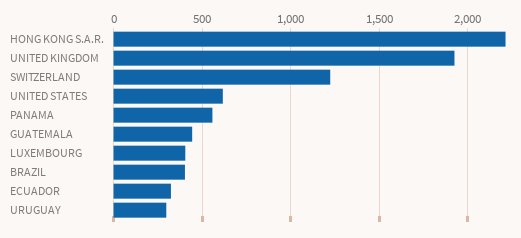
Arguably, the most important graph in the Panama Papers scandal is highlighted below. It shows the number of intermediaries (banks, accountants) in each country.


There is no mention of these by the media or of the numerous huge Western multinational corporations or billionaires, some of whom sit in the House of Lords. Neither does Harding mention by name any of the 12 leaders, past and present, identified in the documents. Instead, the Guardian journalist, in line with the methodological approach adopted by Suddeutsche Zeitung which received the leak, selectively focused on the West’s official enemies – Russia, Syria and North Korea.

Despite the fact that Putin wasn’t personally mentioned in the Panama Papers, I’m in no doubt whatsoever that since he uses Russia as a personal fiefdom, he should not be exonerated. It’s one thing ridding the country of the oligarch’s who were responsible for asset stripping its resources which subsequently turned Russia into a gangster capitalist paradise, but another to pocket a large chunk yourself by getting shot of the competition which is effectively what Putin has done. Putin’s primary interest is Putin himself.

But what the Panama papers reveal is that he’s not alone. The global web of corruption and tax avoidance extends to 72 states, heads or former heads of state. Yet you would be unlikely to have reached this conclusion having read the Guardian article or observed the cover of the paper which sensationally headlined with the words “Exclusive: The Secret $2bn trail of deals that lead all the way to Putin”. Neither would you have reached the conclusion having watched the UK state broadcaster, the BBC, who chose to mention just five of the 72 – Egypt, Iceland, Gaddafi, Putin and Assad.

Central to all this is the pathetic kow-towing to power by our media that’s supposed to be impartial and independent yet they act reflexively en masse by directing their fire at enemies of the state. If you don’t believe me, just look how often Putin has been foregrounded in the coverage of these leaked documents, complete with the requisite ‘shady’ photographs. Naturally, the media cannot be perceived to be so transparently biased which is why the occasional ‘balanced’ message is required. Step forward the Telegraph.

On Monday April 4, the paper dutifully reported:

David Cameron’s father ran an offshore fund which avoided paying tax in Britain by hiring Bahamas residents, including a bishop, to sign paperwork…The fund, which was established in the 1980s with help from the Prime Minister’s late father, continues today. The Guardian says it has confirmed that ‘in 30 years Blairmore has never paid a penny of tax in the UK on its profits.”

Nevertheless, the targeting of a dead man is virtually risk free as will be the ‘outing’ of a senile corrupt Lord to be cynically used a sacrificial lamb for the media hacks to peruse over if and when the time is right. Ultimately, the UK Secret Services will never allow the media to publish anything that is likely to damage the ‘reputations’ of leading establishment figures. The destruction of the Snowden files that the Guardian had in its possession but were requested to destroy by M15, are proof of that.

I had been watching the UK media all day on Monday after the story had broken, and news bulletins prefaced the scandal with either Putin, Cameron’s deceased father or Assad. It’s mainly the first two which are easy and convenient targets intended to deflect away from the crimes that implicate ‘our’ leaders. Almost certainly then, there is a highly motivated political agenda at work here that probably explains why Iceland, who locked up many of its corrupt and criminal bankers, was also named.

Following the revelations that Iceland’s PM was implicated in the scandal, the people of Reykjavik took to the streets in their thousands. At the time of writing, I watched the BBC News at Ten which reported from outside the Icelandic parliament. Following the resignation of the PM, the BBC reporter interviewed some Icelander’s. What the people on the streets of the country are increasingly aware of is that corruption within the corridors of power in Iceland and elsewhere is systemic.

The elites on both sides of the Atlantic are concerned about the effect the revealing of undoubted widespread and systematic corruption within the high echelons of media and politics will have on the body politic of Europe and North America. They don’t want Reykjavik to spread to London, Paris and Washington. This is another reason why the full scale nature of those implicated will never be revealed.

What all this highlights is the public is being cynically deceived by the corporate media in order to get their fellow elites off the hook. Craig Murray’s brilliant expose of the BBC Panorama documentary entitled Tax Havens of the Rich and Powerful Exposed, highlights the extent to which BBC producers and presenters will go to in order to misdirect its audience to this end. Perhaps less subtle than the overt propaganda pieceSaving Syria’s Children, but no less effective, the BBC related at length the stories of the money laundering companies of the Icelandic PM and Putin’s alleged cellist. As Murray said:

“The impression was definitely given and reinforced that these companies were in Panama. [Presenter] Richard Bilton deliberately suppressed the information that all the companies involved were in fact not Panamanian but in the corrupt British colony of the British Virgin Islands. At no stage did Bilton even mention the British Virgin Islands.”

Murray goes on to say:

“Is it not truly, truly, astonishing the British Virgin Islands were not even mentioned when the BBC broadcast their “investigation” of these documents?”

Indeed, Mr Murray, it is.

The BBC and media in general are obscuring the key role British money-laundering via its base in the British Virgin Islands plays in these transactions. This scandal must also be seen within a context in which between £30bn and £120bn a year of UK tax is either avoided, evaded or uncollected (sources (Tax justice/ PCS estimate & HMRC estimates). Meanwhile, £16bn worth of benefits a year remain unclaimed (HMRC estimate) against a backdrop in which benefit fraud amounts to a relatively tiny £1.2bn (DWP estimate).

Which of the above figures do you think the government and their media mouthpieces constantly highlight?

It can never be stated enough that this corruption scandal is mostly centred on the British Virgin Islands. Yes, the corruption is widespread and involves a number of world leaders, some of whom are our official enemies. However, in the broader scheme of things, these political figures are essentially peripheral. The level of corruption is widespread and systemic. As far as the major players are concerned, the media need to focus closer to home.

9/11

By Daniel Margrain

It’s been almost 15 years since the tragic events in New York but the theories which deny the reality of that day keep coming. One of the latest in a long line of articles which attempt to undermine what billions of people saw with their own eyes is by author Frances Shure who asserts that people who critically dismiss the arguments of the 9/11 Truth Movement are unable to engage with reality. Thus the inference is that millions of critics of the denier narrative, including the thousands of witnesses and families who lost loved ones on that day, are mentally ill. But since Shure neither saw anyone, had a protocol for interviews, or engaged in research would suggest that no clinical observations were possible and thus she would of been unable to compare any subject’s mental states to either 9-11 conspiracy theorists nor to a control group.

The introduction to her papers says that they are a “synthesis of reports on academic research as well as clinical observations.” However, her “synthesis of reports on academic research” was not a meta-analysis, did not include even one proper research paper or authors that contradicted her and was sloppily referenced and dated. Shure does not once ask the question, why do people refuse to acknowledge that many people in the world quite justifiably – after years of horrendous war crimes against them – have very valid reasons for attacking the United States? With her blinding ignorance of what evidence and research are, she claims “the 9/11 Truth Movement has been stunningly successful in documenting mountains of evidence.” 

The reality is there has not been a single piece of “evidence” that has not been thoroughly debunked. In 2006, Noam Chomsky gave some helpful advice to people who believe they have physical evidence refuting the official account:

“There are ways to assess that: submit it to specialists . . . who have the requisite background in civil-mechanical engineering, materials science, building construction, etc., for review and analysis. . . . Or, . . . submit it to a serious journal for peer review and publication. To my knowledge, there isn’t a single submission”

The National Institute of Standards and Technology (NIST) who have exhaustively documented the failure of the Twin Towers surmised that far from being impossible, the collapse turns out to have been inevitable. The planes cut some of the support columns and ignited fires sufficient to weaken (but not melt) the remaining steel structures. As the perimeter columns buckled, the weight of the collapsing top stories generated a momentum the rest of the building could not arrest. Puffs of smoke were blown out of the structure by compression as the building fell. In other words, contrary to many of the claims of the conspiracy theorists, melting steel was not required to bring about the collapse. All that was needed were temperatures high enough to heat the steel beyond their tolerance levels.

This thesis was also acknowledged in the immediate aftermath of the attacks on the Twin Towers by numerous structural engineers and experts. Hassan Astaneh, a structural engineering professor at the University of California at Berkeley, for example, explained that the high temperatures in the fires weakened the steel beams and columns, causing them to become “soft and mushy”, and eventually they were unable to support the structure above. Astaneh also suggested that the fireproofing became dislodged during the initial aircraft impacts. Reiterating the subsequent conclusions of NIST, he explained that once the initial structural failure occurred, progressive collapse of the entire structure was inevitable.

The magazine, Counterpunch, commissioned its own expert, an aerospace and mechanical engineer, Manuel Garcia, whose conclusions into the official findings also tallied with NIST. Garcia demonstrated how Building 7 collapsed. Shure takes it as a given that Building 7 collapsed into its own footprint and implies that what everybody saw was a building in free fall indicative of a controlled demolition. But as Garcia shows, Building 7 fell slowly and gradually. This interesting set of videos, which are shot at different angles, clearly show Building 7 does not fall straight down and that Building 1 falls from the top first. It was Galileo who dropped two cannon balls of different mass off the tower of Pisa and found that they both arrived on the ground at the same time. Therefore the Towers did not free fall because debris which was in free fall arrived on the ground first. This is basic physics which denialist websites do not explain.

The final NIST report in November 2008 into the collapse of building 7 explains that fire was the main reason for the collapse, along with lack of water to fight the fire and falling debris which ruptured the oil pipes feeding its emergency generators. The reduction in pressure triggered the automatic pumping system, which poured thousands of gallons of diesel onto fires which continued to burn throughout the afternoon on the lower floors. At 5:20 p.m. a critical column buckled, leading to the collapse of floor 13, which triggered a cascade of floor failures within the building, eventually leading to global collapse. Popular Mechanics magazine polled 300 experts who came to the same conclusions.

The denialists also make false assertions in terms of the pancake theory which they claim has been debunked. But it is has only been “debunked” by the conspiracy believers. Actually, it is not a “theory” at all. It’s the most common sense explanation and has been documented in a number of other high rise buildings around the world. Despite all this, realists are somehow expected to believe that either:

a) “Explosives” were planted when the buildings were erected. That would require the longest conspiracy planning in history.

Or:

b) They were planted later. In which case, who planted them? How did they do that in a building occupied by 50,000 people on a daily basis? Perhaps they did it on weekends when the building only had about 5,000 visitors /day?

As Craig Murray argues, “The notion that a small team at night could plant sufficient explosives embedded at key points, is laughable.”

After reading the various theories of architects and engineers and other “experts” who support the claims of the 9-11 truth movement, one might be left with the impression that their views represent the majority. However, here’s a sober reminder of the context of such “support”.

According to The United States Census Bureau there are 233,000 architects and 2,495,000 engineers in the United States. Only 1,761 out of 2,728,000 joined Architects and engineers for 9/11 truth. That’s 0.065% of the total. And I haven’t even looked at whether the architects and engineers listed were in fields in any way relevant to the WTC. Although the tiny minority of “experts” and others who support the perspective of the denialists might know nothing about physics, structural engineering, ballistics or explosives, they still feel qualified to assert that the vast majority of experts in these fields are wrong.

Alexander Cockburn described these kinds of amateur detectives in the following way:

“[They] proffer what they demurely call “disturbing questions”, though they disdain all answers but their own. They seize on coincidences and force them into sequences they deem to be logical and significant. Like mad Inquisitors, they pounce on imagined clues in documents and photos, torturing the data ­- as the old joke goes about economists — till the data confess. Their treatment of eyewitness testimony and forensic evidence is whimsical. Apparent anomalies that seem to nourish their theories are brandished excitedly; testimony that undermines their theories–like witnesses of a large plane hitting the Pentagon — is contemptuously brushed aside.”

Some might argue that there is a potential conflict of interest issue with respect to the US government and NIST funding. But this presupposes that if NIST conclusions of their findings were based upon falsehoods and lies, then the alleged cover up would extend to a further 200 technical experts and 125 leading experts from the private sector and academia— many of whom worked independently of NIST and whose work involved:

– Reviewing tens of thousands of documents.

– Interviewing more than 1,000 people.

– Reviewing 7,000 segments of video footage and 7,000 photographs.

–  Analysing 236 pieces of steel from the wreckage.

– Performing laboratory tests and sophisticated computer simulations of the sequence of events that occurred from the moment the aircraft struck the towers until they began to collapse, and so on and so forth.

Is the general public seriously expected to believe that if the NIST conclusions were based on falsifications, not one individual among the literally thousands of people who were involved in the NIST project, would not by now have come forward to publicly question any wrongful and misleading interpretation of events attributed to them by NIST? The reality is that too many people would of had to of been involved in any cover up. Moreover, it’s inconceivable that over the course of almost 15 years nobody has objected or come forward to the media.

But even if one thinks that organisations’ or individuals have colluded for reasons of political expediency, how does one explain findings from other investigations that fires alone (without any damage from the planes) were enough to bring down the WTC buildings?

Take a study undertaken by the University of Edinburgh as an example. Edinburgh published a paper in which they concluded that the towers were uniquely vulnerable to the effects of large fires on several floors at the same time. When the NIST report was published, Barbara Lane from the UK engineering firm Arup, criticized its conclusion that the structural damage resulting from the airplane impacts was a necessary factor in causing the collapses.

Cesar Pelli, who designed the Petronas Towers in Malaysia and the World Financial Centre in New York, remarked, “no building is prepared for this kind of stress.” On September 13, 2001, Zdeněk Bažant, professor of civil engineering and materials science at Northwestern University, circulated a draft paper (subsequently expanding the analysis) of the World Trade Centre collapse. Bažant suggested that heat from the fires was a key factor, causing steel columns in both the core and the perimeter to weaken and experience deformation before losing their carrying capacity and buckling. Once more than half of the columns on a particular floor buckled, the overhead structure could no longer be supported and complete collapse of the structures occurred.

Other analyses were conducted by MIT civil engineers Oral Buyukozturk and Franz-Josef Ulm, who also described a collapse mechanism on September 21, 2001. Many who have questioned the official version of events argue that the truth can be found by visiting websites like http://www.911truth.org, http://www.physics911.net and http://www.911scholars.org or by reading articles by the theology professor David Ray Griffin, the physicist Steven E. Jones and others. But in all these cases you will find wild supposition raised to the status of incontrovertible fact; rumour and confusion transformed into evidence; selective editing; the citation of fake experts and the dismissal of real ones.

Rather like climate change deniers, 9/11 “truther’s” cherry-pick their evidence and seize any excuse for ignoring the arguments of the vast majority of the relevant experts in the field.  Naturally, those in positions of power or influence who challenge conspiracy theories are invariably deemed to be part of the conspiracy. As David Robert Grimes, postdoctoral research associate at the University of Oxford, who has used maths to examine conspiracy theories, argues “..those making these charges will descend into accusing one of shilling or being an agent of some malignant entity.” Grimes calculates the greater number of people that are involved in a conspiracy means the shorter its lifespan is likely to be. In response to his work, conspiracy theorists have threatened him and tried to get him removed from his academic position.

The evidence that planes smashed into the twin towers which triggered a set of events that resulted in their collapse, is overwhelming. But all this overwhelming evidence is not enough. Apparently, to qualify as an opponent of the neocons, it’s not sufficient to acknowledge that the Bush administration exploited the attacks on the WTC for their own political ends, but rather, one must also believe that it could blast the Pentagon with a cruise missile while persuading over a hundred witnesses that they saw a plane, wire every floor of the Twin Towers, detonate them in a perfectly timed sequence and make Flight 93 disappear into thin air while ensuring that the relatives of the passengers collaborated with the deception.

In other words, one must believe that an incompetent set of governments,’ who failed to pull off Watergate and who were incapable of faking weapons of mass destruction, are all-seeing and all-powerful. People believe the false arguments of the 9-11 truth movement because it proposes a closed world that’s comprehensible and controllable, as opposed to one that’s chaotic without destination or purpose.

Terrorism & the chronicle of war foretold

By Daniel Margrain

The rolling media coverage that followed the tragic events in Brussels was accompanied by the predictable rhetorical political flourishes from across the spectrum highlighting the need for terrorism to be defeated. After every tragedy of this nature the same kinds of statements are repeated again and again even though the politician’s making them must know that such an eventuality is impossible.

According to the politician’s and the media, terrorism is the new global threat against which global war must be fought. ISIS and their affiliates constitute for them an ubiquitous presence against which the democratic values of civilization must take their fight to the backward forces of reaction and irrationality. But this notion reflects only a partial truth because it ignores an important historical context. The concept underpinning perpetual warfare that the Project for the New American Century evokes, was the precursor to ISIS which emerged from the ashes of the chaos resulting from the US-led slaughter in Iraq and the attack on New York that preceded it. It’s therefore not Islamist terrorism that represents the catalyst for chaos and destruction in the world, but rather the United States, it’s allies and their proxies.

A crucial dimension implicit to this unfolding story regarding the intention of the United States to create a wilderness as the precursor to ‘peace’, are the contemporary and historical links that have developed between American neoconservatives and the Israeli right. Specifically, this relates to the latter’s colonial role in its service to imperial power. This relationship, in the words of Theodor Herzl provided.“a portion of the rampart of Europe against Asia”. In other words, the newly created Israeli state in Palestine would, as part of the tail to the US dog, be part of the system of colonial domination of the rest of the world.

Today, close links exist between leading neoconservatives and the Israeli political elite. Christian fundamentalists – an indispensable element in the rights political base – have also incorporated support for Israel into a worldview in which Palestine is perceived as the land given by God to the Jews in the Old Testament and regard the return of the world’s Jews to a triumphant Israel as a precondition of the Second Coming. A consequence is a close identification by many Republican right-wingers of the strategic interests of Israel with those of the United States, as well as the hostility towards any notion of peace that they share with Likud and Binyamin Netanyahu .

A second dimension is the notion that the destruction of the terrorist demon be exorcised at all costs, even if that cost means the curtailment of civil liberties. The truth is, the global sweep of security services has been an utter failure. Casting the net ever wider by adding millions of names to a digital database in the hope of catching potential terrorists, is less than useless. The whole process seems concerned with targeting people on the assumption that a crime will be committed based on the nature of people’s thought processes rather than what they have done or plan to do.

Ultimately, individuals who are committed to undertaking atrocities in a democracy will always find a way of committing them. To successfully stop them would mean a curtailment to the kinds of civil liberties that the masses take for granted. Wherever large crowds of people gather, the potential for a terrorist to commit an atrocity will be there. Moreover, radicalization is not limited to non-EU or US citizens since many home grown terrorists are motivated to commit their atrocities as a result of them witnessing injustices almost daily on social media.

The disproportionate wall-to-wall media reportage in relation to the aftermath of Western based terrorist atrocities, gives a false impression that terrorist violence in European or American cities is far more of a danger than is actually the case. The reality is that the odds of being killed or injured in an Islamist terrorist attack in Britain, for example, is virtually non-existent. In the last decade, only one person has been killed in the UK by such an attack. Far more people have been killed and far more destruction and chaos caused in countries like Yemen, Syria, Libya and Iraq. This is not to condone the actions of illegal wars/terrorism wherever they occur, but to highlight that the coverage given to European and North American based atrocities is highly selective.

Shortly after the atrocity in Brussels, for example, a suicide bomb exploded in a football stadium near Baghdad killing at least 41 people. The incident received virtually no media coverage. During last Friday’s (March 25) Germany/England football international, both teams wore black arm bands, not paradoxically in memory of the 41 who died at the football match near Baghdad, but in memory of those who died in Brussels. The Baghdad atrocity was followed by a terrorist attack in Lahore, Pakistan, which received just over two minutes of coverage on a subsequent BBC news 24 bulletin.

But not only are the kinds of coverage given to terrorist atrocities highly selective depending on who is killed and where, but the wall-to-wall rolling coverage given to Western-based atrocities are also, I contend, counterproductive. This is because terrorists crave the oxygen of publicity. It says something about the strange times we live in, that a figure as divisive and reactionary as Margaret Thatcher was more radical in her thinking over 30 years ago than the majority of the current crop of corporate controlled robots in Westminster today. This is what Thatcher said in 1985 during a speech to the American Bar Association::

“The terrorist uses force because he knows he will never get his way by democratic means…Through calculated savagery, his aim is to induce fear in the hearts of people. And weariness towards resistance…And we must try to find ways to starve the terrorist and the hijacker of the oxygen of publicity on which they depend. In our societies we do not believe in constraining the media, still less in censorship. But ought we not to ask the media to agree among themselves a voluntary code of conduct, a code under which they would not say or show anything which could assist the terrorists’ morale or their cause while the hijack lasted?”

There is no moral excuse for committing horrific violence upon civilians. This remains true whether they are committed by men in uniforms pressing buttons on computer screens in the cockpits of aircraft that release bombs at the behest of commands from rich men sitting behind desks in plush offices, or if they are committed by alleged alienated Muslims in Brussels. Two wrongs do not make a wrong right. However, just because there is no moral excuse doesn’t necessarily mean that there are no circumstances in which individuals will not rationalize the use of violence.

If your loved ones happened to have been victims of an Obama drone attack or a Blair bomb, your life will be debased and you might feel that you have nothing to lose. I’m not condoning such actions but merely trying to put myself in the shoes of others. It doesn’t make it right or moral but seeking retribution against injustice anyway you can under circumstances where no alternatives are possible, might be reason enough to drive you over the edge. Every human being has a breaking point and seeing the death of your loved ones in terrible circumstances might be the straw that breaks the camels back.

If pushed to extremes, humans are potentially capable of just about anything. This goes far beyond the conventional media reasoning for terrorism which focuses almost exclusively on Islamist fundamentalist rationales but continually fails to make the connection between the foreign policies of Western governments and the consequences of those actions. Terrorism doesn’t emerge out of a metaphorical clear blue sky and so we need to reflect on why people all over the Middle East hate us. And they do hate us. We represent two decades of bombing the hell out of them and they loathe us for that. It doesn’t excuse the outcome but it explains it.

But instead of asking the relevant questions relating to likely causes, journalists tend to focus far more on the effects. Suicide bombings are not some barbaric throwback to pre-modernity. They are a horribly distorted response to the very real horrors of imperialism and capitalism. As Stephen Holmes, in relation to the 9/11 attacks on New York, argued:

“The vast majority of Bin Laden’s public statements provide secular, not religious, rationales for 9/11. The principal purpose of the attack was to punish the ‘unjust and tyrannical America’. The casus belli he invokes over and over again is injustice not impiety. True, he occasionally remarks that the United States has declared war on god, but such statements would carry little conviction if not seconded by claims that the United States is tyrannising and exploiting Muslim people… Bin Laden almost never justifies terrorism against the West as a means for subordinating Western unbelievers to the true faith. Instead, he almost always justifies terrorism against the West as a form of legitimate self-defence.”

In other words, the Muslim extremist goal is no different from other national liberation movements – to achieve independence by forcing the imperialist power to retreat. The terrorists may express themselves in religious terms, but in essence the aim is the same pursuit as that adopted by previous secular-nationalist movements in the Middle East, namely the defeat of US imperialism and its allies in the region. The scale and reach of some present-day attacks is greater than any terrorist organisation has been able to carry out in the past. But the devastation and death toll are still on a massively smaller scale than that routinely inflicted by the armed forces of ‘civilized’ states.

By focusing on the effects of terrorism as opposed to addressing the probable causes, encourages the worst kind of highly politically motivated and bigoted soundbite journalism imaginable. Examples have been the crass responses to the horror of Brussels by the likes of Katie Hopkins and Allison Pearson. Both ‘journalists’ attempted to tie the events in the Belgium capital city with the unfolding refugee crisis by condemning people who suffer terrorism on a daily basis in places like Syria and Iraq for fleeing to Europe where it’s virtually non-existent. The fact that this kind of commentary is widely regarded as part of the acceptable face of journalism within the ‘mainstream’, illustrates just how debased journalism has become.


Osborne’s Budget of Irresponsibility

By Daniel Margrain

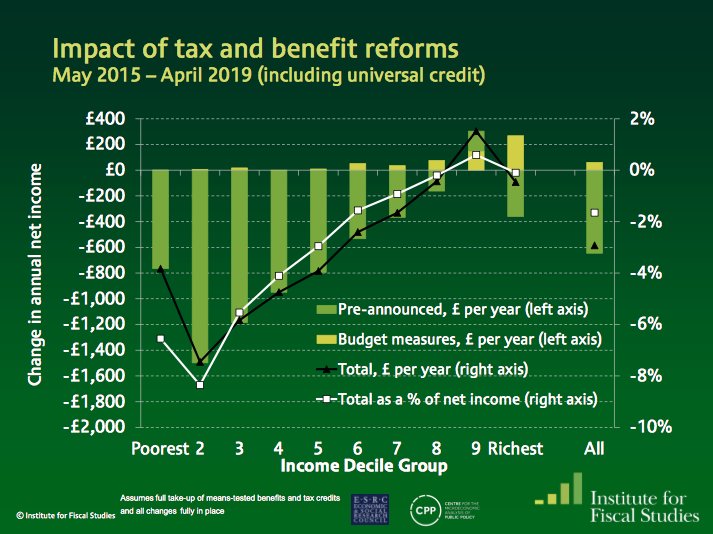
Chancellor Gideon Osborne’s budget last week that represented a culmination of six years of government failures and which slipped the UK into a deeper recession, amounted to another massive transfer of wealth from the poorest to the wealthiest in society. This was reiterated by both the Institute for Fiscal Studies (see chart below) and the Office for Budget Responsibility (OBR). The Economist projects that by the end of this parliament, levels of investment – which are already one of the lowest in Europe – will fall to just 1.4 per cent of GDP, under half of what it was when the coalition government came to power. It is also half of what the OECD said is necessary just for the UK economy to stand still. But despite these facts, an alternative narrative has emerged in many of the editorials of the corporate controlled media which bare no resemblance to reality for the vast majority of the British people. As Shadow Chancellor, John McDonnell put it on LBC last week, “If press releases built things, Cameron would have rebuilt our country.”


The main thrust of the budget was Osborne’s cut in funding to the disabled by £4.2 billion in order to pay for three separate tax cuts to the rich against a backdrop in which the national debt is rising by £45 per second or £2,700 per minute. Paul Mason summed up the mood in the House:

“Osborne’s glum face during Jeremy Corbyn’s speech — an uncharacteristically angry barnstormer — was matched by the glum faces of Blairites as they realised their own party was actually going to inflict moral and political damage on the government.”

Osborne’s inhumane and fiscally irresponsible budget was preceded by the fiscally responsible alternative version outlined by his opposite number, John McDonnell who, in a speech on March 11 (as well as in various interviews to the media and public meetings), laid out his parties fiscal credibility rules. The shadow Chancellor stated that he will eliminate the deficit and tackle the national debt within a five year period on the basis of the implementation of a progressive and ambitious investment programme that he said will provide the stimulus for growth and demand in the economy.

McDonnell insisted that a future Labour government would invest in skills, infrastructure and above all, technology. The speech was subsequently praised by a wide range of economists and some media outlets in addition to business organizations that included the CBI and the Chamber of Commerce. As a committed socialist, McDonnell is aware of the importance planning is to the economy and the ruthlessness that is required to properly monitor how governments’ spend and, more importantly, earn money. The whole debate is how the country earns its future which McDonnell has said ought to be focused on investment.

The difference between McDonnell’s approach and that of one of his often cited predecessor, Gordon Brown, is that the latter never went for an investment-growth strategy and relied too much on unregulated finance sector growth and the revenues generated, as the catalyst for the subsidizing of public services. This policy strategy proved to be an abject failure. Similarly, the approach under McDonnell’s immediate predecessor in opposition, Ed Balls, was firstly to underplay the drive toward investment and, secondly, was marked by his failure to recognize that governments’ have to borrow to invest in the long-term in order to grow the economy.

But equally as important, was Balls’ inability to grasp the important role organizations like the IMF and OECD play in diagnosing economic problems and how best to solve them. Specifically, Balls appeared to have underplayed the scope the combination of fiscal and monetary policy plays in combating low or negative interest rates. In contrast to the incompetence of Balls and Brown, McDonnell has expressed awareness that when government’s reach the limits of monetary policy in terms of low or negative interest rates, they have to combine the monetary with the fiscal. What McDonnell acknowledges, is the importance the building of a balanced economy plays to the modern democratic nation state.

The problem under previous government’s – both Conservative and Labour – has been that the investment in the manufacturing base, predicated on new technology, has been largely sidelined at the expense of the finance sector. On LBC, McDonnell used the analogy of a small company to outline his case. “An owner of a new company will need to invest in new machinery in order to compete against his rivals otherwise he or she will go out of business”, he said. He continued: “Government’s, like businesses, need to invest in the future otherwise their economies will fall behind.” The lack of investment is precisely what has beset the UK economy over recent decades, particularly under the latest Tory government which has overseen a widening productivity gap between the UK and its major European rivals.

McDonnell, correctly in my view, has made it clear that the Office for Budget Responsibility (OBR) should be given the power to monitor the UK’s own application of its fiscal credibility. The OBR, according to McDonnell, should not report to the Chancellor as is currently the case, but instead it should go directly to parliament. The aim is not merely to raise the economic credibility of Labour among the public but to raise it among the political class too. It’s ironical that despite the public perception that Labour governments’ have been more economically incompetent in the 37 years since Thatcher was elected than their Tory counterparts, the reality is there have been only two years – under Nigel Lawson during the boom period of the 1980s – in which the Tories produced a balanced budget. Conversely, Labour produced three years of balanced budgets under Gordon Brown.

 McDonnell has been aided in his approach to countering Tory and media propaganda by some of the world’s renowned and leading economists who have not only openly backed the oppositions anti-austerity economic model but have played an active part in advising the Shadow Chancellor as part of Labour’s Economic Advisory Committee. A central plank of the fiscal responsibility rules that McDonnell and his team set out on March 11, relates to Labour’s intention to reduce debt as a proportion of GDP over the lifetime of the government. This will entail growing the economy over the requisite five year period, allied to a fiscally disciplined and controlled approach to spending. The alternative budget that McDonnell proposed emphasized the application of a process of rigorous budgeting so as to restrict the likelihood of public expenditure spiraling out of control. To this end, the Shadow Chancellor stressed the need for the treasury to return to its former role of managing public finances as opposed to signalling to government departments that they have a license to spend public money in a prodigious manner.

An example of the latter happened two years ago following the Tory government’s much criticised selling off and closing down of the Forensic Science Service (FSS) against the advice of all the relevant parties concerned. The treasury ignored the advice because they envisaged the closing of the service as being financially prudent in the short-term. Two years down the line, they decided to set it up again. It’s this kind of short-term based decision-making predicated on the top down authoritarian micro-managed approach of their principal overseer in number 11 Downing Street that inhibits not only the long term financial credibility of government, but undermines democracy and the well-being of society as a whole.

Then there are the secret and highly wasteful and expensive P F I funded projects that typified the Blair and Brown era that McDonnell says he wants to put an end to. A third example of how short-term policy approaches are counterproductive to the long-term financial well-being of the nation, is within the realm of housing. The most labour intensive form of public spending is affordable council house building which, year on year, since the era of the Thatcher government, has failed to meet the demand for them. Labour’s Housing Minister, John Healey, has stated that he intends, as a starting point, to use savings on housing benefit (which is beneficial mainly to the rich), to build 100,000 affordable homes.

Government investment in housing is not only beneficial to those in need of a home, but it also reduces the housing benefit bill. In addition, the cost of buying a house is reduced due to increasing availability more widely. Although on the surface the intention to bring greater scrutiny and accountability to bare within the public sphere sounds overly bureaucratic, the kinds of attempts to rein in government and treasury short-term excesses are nevertheless fundamental to the successful running of governments’ in the eyes of the electorate. It is this electorate that is increasingly aware of just how callous Gideon Osborne has been in the lead up to the decision to cut disability welfare benefits which allegedly prompted Iain Duncan Smith’s resignation letter.

The letter basically outlined every suspicion that voters, and indeed Tory MPs, have about Gideon Osborne in relation to his obsessive attempts to micro-manage government departments as the prerequisite to his cynical positioning as next in line to succeed David Cameron as Tory leader. In relation to Duncan Smith’s resignation, one theory espoused by former UK diplomat Craig Murray is that his conscience got the better of him and as such Osborne’s budget attack on the disabled was regarded by Duncan Smith as one attack too many. Personally, I don’t buy it.

I’m more inclined to believe John McDonnell’s interpretation as expressed on LBC yesterday (March 19). McDonnell claims that the former Work and Pensions Secretary went through a long consultation exercise which specified the new proposal for the qualification criteria for the Personal Independence Payment (PIP). As a result of pressure from Osborne, McDonnell claims that Duncan Smith had no option other than to tear the agreement up.

In other words, a deal was allegedly done but Osborne is said to have reneged on it. This put pressure on Duncan Smith who, in turn, McDonnell claims, had taken the flack for something that was not ultimately his doing. Osborne had invented a fiscal rule that has been unable to withstand political scrutiny and the public, judging by the latest opinion polls, are wise to it. Let’s hope they will continue to be wise to the government’s various shenanigans prior to the forthcoming local elections and vote accordingly.

The hidden hands that feed racism

By Daniel Margrain

Those who have been following the flamboyant political showman, Donald Trump, whose heavy-handed approach to demonstrators at his rallies and outrageously racist remarks many are familiar with, might be surprised to learn that similar comments, albeit hidden ostensibly under the cover of liberal respectability, have gone largely unnoticed within media circles. Nine years before the widespread condemnation of Trump’s remarks, Douglas Murray, Associate Director of the Henry Jackson Society, echoed Trump when, in an admittedly less demagogic fashion, he argued for the banning of Muslim immigration into Europe.

Murray, who heads the avowedly neoconservative and CIA-funded organization that has links to the US and European far right, has also defended the use of torture by Western intelligence agencies. One might think that leading figures within the political and corporate media establishments – particularly on the liberal-left of the spectrum – would be keen to distance themselves from such a right-wing organization. On the contrary, both the hierarchy within the Parliamentary Labour Party (PLP) and political commentators not only cite the Henry Jackson Society when commenting on Islamic affairs, but actually embrace it as well.

The role call of pro-Syria bombing Blairites within the PLP who sit on the Political Council of the Henry Jackson Society include Margaret Beckett, Hazel Blears, Ben Bradshaw, Chris Bryant and Gisela Stuart, while the BBC regularly give air time to Murray on mainstream political discussion and debating programmes like Question Time, This Week, Today and Daily Politics. The organization also acts as a front for the security services via the Quilliam Foundation think tank whose role, in return for tax payers money, is to publicly denounce Muslim organisations and, with the collaboration of the neo-fascist, Stephen Yaxley-Lennon (AKA Tommy Robinson who heads Pegida UK and was formerly the head of the racist and fascist English Defence League), talk up the Jihadi threat. It’s extremely revealing that establishment figures within the hierarchy of the Labour Party who have in the recent past complained about the alleged infiltration of left wing elements within the party, are willing to align themselves with racists and fascists.

The racist outlook of Murray et al and the means to promote it within media circles are far from unique and rarely, if ever, challenged. Former UK diplomat, Craig Murray quoted the “darling of the Mail and the BBC”, Melanie Phillips’ incitement to religious hatred:

“Romney lost because, like Britain’s Conservative Party, the Republicans just don’t understand that America and the west are being consumed by a culture war. In their cowardice and moral confusion, they all attempt to appease the enemies within. And from without, the Islamic enemies of civilisation stand poised to occupy the void…With the re-election of Obama, America now threatens to lead the west into a terrifying darkness.”

To my knowledge, apart from Murray, not a single prominent commentator alluded to Phillips’ Islamophobia and racism.

Another example was the sympathetic treatment the BBC afforded to the ‘doyen of British fascism’, the BNPs Nick Griffin. In 2009, Griffin appeared on the BBC’s flagship political discussion programme, Question Time despite the fact that the Standards Board for England’s 2005 description of the BNP as Nazi was “within the normal and acceptable limits of political debate”. The European Parliament’s Committee on racism and xenophobia described the BNP as an “openly Nazi party”. When asked in 1993 if the party was racist, its then deputy leader Richard Edmonds, who has been convicted for racist violence, said“We are 100 percent racist, yes.”

Prior to his appearance on the programme, Griffin expressed delight with the decision of the BBC to have granted him a major political platform with which to air his party’s views. These views went unchallenged by the other guests on the show that included Labour’s Jack Straw, who had subsequently insisted that female Muslim constituents visiting his constituency office in Blackburn remove their veils and claimed that Pakistani men saw white girls as “easy meat”. At the time of Griffin’s appearance on Question Time, the BBC attracted an audience of almost 8 million viewers, three times its average. Following the publicity generated by Griffin’s appearance, the Daily Telegraph newspaper revealed the results of a UK Gov opinion poll which indicated that 22 percent of British people would “seriously consider” voting for the BNP and that 9,000 people applied to join them after the programme aired.

Many of the individuals who were directly responsible for overseeing Oxbridge-educated Griffin’s appearance – including BBC director-general, Mark Thompson – had themselves been educated at one of two of Britain’s elite educational establishments – Oxford and Cambridge. Griffin, who graduated in law, told the Guardian newspaper that he admired Thompson’s “personal courage” by inviting him. Nicholas Kroll, then director of the BBC Trust – an organization that supposedly represents the interests of the viewing public – was also educated at Oxford. At the time of writing, at least three of the 12 members of the government-appointed trustees, were educated at either Oxford or Cambridge, while the remainder have a background in either law, business or economics. Two years before the Question Time appearance, Griffin had generated a significant amount of publicity following the controversy surrounding Oxford universities decision to allow him a public platform to address students at the universities campus.

Despite the links the establishment has to fascism, the notion that fascist sympathies are rooted within the high echelons of the former has not been widely recognized within public discourse, even though last July, the British royal family were shown giving Nazi salutes as part of a home movie. The problem for the elites is not that these links exist, rather the concern is the possibility that the media will shine a light on these relationships.

As Craig Murray put it:

“It says a huge amount about the confidence of the royal family, that they feel able to respond to their Nazi home movie with nothing other than outrage that anybody should see it…. The royal family is of course only the tip of the iceberg of whitewashed fascist support.”

Fascist ideology is the bedrock on which our political and media culture is deeply embedded. The reality is right-wing establishment think-tanks like the Henry Jackson Society and MigrationWatch UK use racist based arguments around the issue of immigration as as their justification for arguing either for, on the one hand, British withdrawal from the EU or, on the other, for the implementation of greater neoliberal reforms as a precondition for maintaining the countries continued membership within it. This, in turn, provides the intellectual echo chamber for the racist UKIP and BNP as well as the ultra right-wing factions within both of the main political parties.

What this illustrates is the contradictory nature immigration plays as part of the function of the liberal democratic state within capitalism which transcends party political lines. Both the official ‘left’ and ‘right’ are prepared to use false and contradictory arguments around the issue of immigration in order to whip up divisions within society for naked opportunistic short-term electoral gain. Under the New Labour government of Tony Blair, for example, Gordon Brown opened up the UK labour market to potentially millions of workers from the Accession 8 (A8) countries that comprised the former Soviet Bloc as the basis for restoring Britain’s economic status against a backdrop of sustained industrial decline.

Brown did this as the means of addressing Britain’s demographic problems in terms of its ageing population as well as to fill existing skills gaps. However, by the time he had taken over the reigns of power from Blair, he began using the racist language of division by emphasizing the need to secure “British jobs for British workers”. This was after oil refinery workers in 2009 protested against their replacement by foreign workers that he – Brown – encouraged. Short-term electoral interests encourage politician’s to play the race card which does not necessarily correspond with those of their paymasters in the boardrooms of the corporations whose primary concern is to secure the most plentiful, skilled and cheap workers possible.

In pure economic terms, immigrants make a positive contribution, not least because the state has been spared the considerable expense of educating and training them. Political leaders know this and that is precisely why the shrill talk deployed at elections is invariably at odds with the policies they actually implement when in office. That, in turn, is why it is so easy for the bigots within racist parties like UKIP and the BNP to expose the hypocrisy of the mainstream parties while also providing organisations like the Henry Jackson Society and MigrationWatch UK the ammunition they need as their cover for pursuing a racist agenda of their own.

Too readily, those at the top are quick to exploit voters’ concerns about the supposed threat that immigration poses in terms of undermining ‘social cohesion’. But they do this so as to engender a sense of division to make it easier for them to rule over everybody. When tensions arise from time to time, it’s those at the bottom who are routinely condemned for their prejudice and bigotry in the media, whereas the more significant racism which emanates from the policies of those at the top who foment it, goes virtually unnoticed.

It’s not my intention to absolve working class racists of their actions, but rather to point out that the more significant forms of racism is formed in the corporate and media boardrooms, think-tanks and elite political sphere indicative of ruling class power. Although this racism is given political expression in the form of scare stories almost daily in the gutter press of the Sun, Daily Mail and Daily Express that perpetuate them, it’s not restricted to these tabloids. The Chair of MigrationWatch UK, Sir Andrew Green, for example, is regularly granted a media platform in order to push an anti-immigrant agenda, albeit a subtle one.

Similarly the likes of Douglas Murray and Toby Young who newspaper proprietors and TV executives consistently employ to espouse their right-wing views, do a great deal to distill the more overt expressions of racist scare stories so as to appeal to the realms of their middle and upper middle class viewers and readers. It’s deemed irrelevant by corporate executives that the ‘journalists’ they employ proffer spurious and deliberately misleading information, simply that they give their demographic what they think that want to hear and read to increase their customer base and so boost their profits in order to satisfy the demands placed on them by their advertisers.

And that, I submit, is hardly the foundation on which to build a civilized, multi-cultural and inclusive society. Donald Trump may be an oaf and a racist, but is he really much different to the elite that rule us?


Endless war, Everlasting peace

By Daniel Margrain

The downing by NATO member, Turkey, of a Russian aircraft on the Syrian-Turkish border in November 2015 – the first of its kind since 1952 – brought into sharp focus the complex patchwork of contending geopolitical and strategic allegiances against what is ostensibly a unified military response to ISIS. Turkey’s role in supporting the Al-Qaeda affiliate, the Al Nusra Front, starkly emphasises the risk of a military escalation to the crisis and the undermining of the current ceasefire.

Turkey’s seemingly schizophrenic relationship to the United States and NATO underscores the former’s reluctance in allowing the latter to use it’s military bases in the east of the country to attack ISIS. Instead, the Turkish government under president Erdogan have used these bases to target the Kurdish PKK. According to the United Nations, 30,000 terrorists from one hundred countries that have landed in Syria have arrived through Turkey and the CIA are overseeing the supply of arms to some of them. Meanwhile, Qatar and Saudi Arabia are also supporting Jihadi extremists to the tune of billions of dollars in arms and funds which are being funneled through Turkey.

Since both Russia and Iran are geo-strategically aligned to Syria, it’s in the interests of both countries to ensure that a Russian-friendly regime in Syria remains in power to act as a bullwark against undue US influence in the region. Clearly, given the competing interests of the major powers, and the potential risks of a major resource war between them, it’s an obvious truism that there can be no long-term solution to the conflict that involves a massive escalation of violence. Therefore, the only viable solution to the crisis is a negotiated settlement which the current ceasefire is a potential prelude to.

In addition to the tensions described, is the duplicitous role played by Turkey which has its own narrow anti-Kurdish agenda in the region. The problems are further compounded in that both the Syrian YPG and the Kurdish KPP have mounted effective ground offensives against ISIS while paradoxically both groups remain on the U.S terrorist list. In addition, Hezzbollah and Iran, backed by Russian air power, have also been effective in countering ISIS. But rather than backing these various factions, UK-US policy is predicated – ostensibly at least – on maintaining support for their two partners on the ground – the Iraqi army (which is weak) and the so-called moderate Syrian opposition to Assad and ISIS (which barely exists).

If the allies led by the US government were serious in their intent to obliterate the existential threat they claim ISIS represents, they would be aligning themselves with the first set of fighters mentioned above instead of their powerless and ineffectual “partners”. So given this anomaly, one has to wonder what the key motivating factor guiding US policy in relation to Syria is. The country sits in a region of the world where the US-UK government’s hypocritically covertly support the oppressive actions of some of the most brutal and authoritarian regimes on earth.

The rational answer is that the principle motivation lies not in eradicating ISIS but rather in toppling one of the more relatively tolerant and secular regimes in the region. Indeed, Assad who, just over a decade ago, was wined and dined in the company of British royalty, is currently on the U.S rogue state list primed for regime change. This overriding factor guiding Western policy is the ‘elephant in the room’ to which journalists and commentators within the liberal corporate media, who focus their critique on Assad, tend to overlook.

The widely accepted narrative is that the catalyst for the “civil war” in Syria is one in which Assad is said to have massacred peaceful demonstrators. This is equated with the events that characterized the Arab Spring in countries like Tunisia and Egypt. Both interpretations amount to a serious misreading of the situation. Following the initial outbreak of violence in Daraa, a small border town with Jordan on March 17-18, 2011, professor Michel Chossudovsky recounted the events:

“The protest movement had all the appearances of a staged event involving covert support to Islamic terrorists by Mossad and/or Western intelligence….Government sources pointed to the role of radical Salafist groups (supported by Israel)…In chorus, the Western media described the events in Daraa as a protest movement against Bashar Al Assad.”

Chossudovsky cited Israeli and Lebanese sources in support of his claims. These sources reported on the killing of seven police officers and at least four demonstrators in addition to the torching of the Baath Party Headquarters and courthouse. Chossudovsky commented:

“These news reports of the events in Daraa confirmed that from the very outset this was not a ‘peaceful protest’ as claimed by the Western media….What was clear… is that many of the demonstrators were not demonstrators but terrorists involved in premeditated acts of killing and arson…The title of the Israeli news report summarized what happened: Syria: Seven Police Killed, Buildings Torched in Protest.”

This account was subsequently confirmed five months later by Israeli intelligence sources who claimed that from the outset Islamist “freedom fighters” were supported, trained and equipped by NATO and Turkey’s high command (DEBKAfile, NATO to give rebels anti-tank weapons, August 14, 2011). Media Lens quoted Jeremy Salt, associate professor in Middle Eastern History and Politics at Bilkent University, Ankara, who added some background:

“Since the Soviet-Afghan war, Western intelligence agencies as well as Israel’s Mossad have consistently used various Islamic terrorist organizations as “intelligence assets”. Both Washington and its indefectible British ally have provided covert support to “Islamic terrorists” in Afghanistan, Bosnia, Kosovo and Libya, etc. as a means to triggering ethnic strife, sectarian violence and political instability… The ultimate objective of the Syria protest movement, through media lies and fabrications, is to create divisions within Syrian society as well as justify an eventual “humanitarian intervention”.’

In another article, journalist John Pilger quoted the former French Foreign Minister Roland Dumas who last year revealed that “two years before the Arab spring”, he was told in London that a war on Syria was planned. “I am going to tell you something,” he said in an interview with the French TV channel LPC,“I was in England two years before the violence in Syria on other business. I met top British officials, who confessed to me that they were preparing something in Syria… Britain was organising an invasion of rebels into Syria. They even asked me, although I was no longer Minister for Foreign Affairs, if I would like to participate… This operation goes way back. It was prepared, preconceived and planned.”

The cementing of US hegemony in the region (and beyond), with the backing of its principle European ally, is hardly a secret. In fact, it dates back to at least the the Clinton era when the concept of American supremicism and exceptionalism were coined as the prelude to the setting up by the neoconservative pressure group of the Project for the New American Century (PNAC). This document provided the ideological justification for the bolstering of America’s nuclear first strike capability.

Leading neoconservatives have conceded that the perpetuation of American supremacy, as opposed to defending the country, is what this capability is designed to achieve. Lawrence Kaplan, for example, admitted that missile defence is a tool for global US dominance. The purpose of the PNAC is to provide an overview of US defence strategy from a world-historical perspective within the context of a decade of supposed US neglect.

This perspective led the neoconservatives within the Bush, and later Obama regimes, to conclude the opening, and subsequent extension, of windows of opportunity with which to demonstrate America’s military superiority. In the same vein as the PNAC, the accompanying war manifesto, The National Security Strategy begins with the affirmation,“The United States possesses unprecedented- and unequalled – strength and influence in the world.” It concludes with the warning,“Our forces will be strong enough to dissuade potential adversaries from pursuing a military build-up in the hopes of surpassing, or equalling, the power of the United States.”

A key section warns:

“We are attentive to the possible renewal of old patterns of great power competition. Several potential great powers are now in the midst of internal transition – most importantly Russia, India and China.” 

Reaffirming that the war on terror was just the beginning for the United States, George Bush in his State of Union address on 29 January, 2002, named Iran, Iraq and North Korea as “an axis of evil”. Secretary of State, John Bolton, subsequently extended the net to include Libya, Cuba and Syria. The ‘war on terrorism’ also provided the US with an opportunity to establish a string of military bases in Central Asia.

The reality is that regime change in Syria and elsewhere is predicated on the paradoxical concept of eternal warfare as the precursor to the creation of an everlasting peace borne out of a wilderness wrought of chaos and destruction. Specifically, the definitive article, the New American Century, is about shaping the world for the next hundred years according to the interests and values of American capitalism.

In 2001 when George Bush declared the ‘war on terror’, Al-Qaeda was confined to a small tribal area in north west Afghanistan. Now, thanks largely to the attempt at the imposition of American capitalist democracy delivered at the point of gun, so-called Islamist terrorism has spread worldwide.

The EU referendum: the case for ‘staying in’

By Daniel Margrain

David Cameron’s (failed) attempts at diplomatic arm twisting of European leaders’ was made with a view to appeasing right wing Europhobe factions in order to strengthen the pro-EU position within his party and, by extension, satisfy others outside such as the Henry Jackson Society who lobby it. Any EU concessions offered to Cameron on economic or social policy in return for continued EU membership would undermine whatever vestiges of power the EU has in terms of protecting ordinary people from the rapaciousness of corporations.

Also, in terms of immigration policy, any concessions to Cameron by the other EU member states would play into the hands of neoconservatives and other far right figures like Douglas Murray, associate director of the Henry Jackson Society and the openly racist Stephen Yaxley-Lennon (aka Tommy Robinson), co-founder and former spokesman and leader of the fascist English Defence League (EDL). These figures, and similar within mainstream media circles like Melanie Phillips and Nick Cohen, deliberately conflate immigration with Islamist terrorism in order to pander to the prejudices among aspects of the electorate which Cameron responds to in kind. The implications, we are told, are clear: for as long as the country is part of the EU, “the swamping” of the indigenous British population by alien migrants from the other EU countries cannot be halted.

Unfortunately, this is the neoliberal context that is the dominant narrative shaping the British EU membership referendum campaign terrain. Politically, this is being marked out by the right wing eurosceptic Tories and by their outriders in the UK Independence Party (UKIP). The British electorate has been told in increasingly strident terms that British “national sovereignty” is at stake without informing them what the alternative to national sovereignty could potentially entail.

Everything that has been positive about the EU over the years appears to be in retreat while everything negative seems to be accelerating. Already the EU has ceded a great deal to corporations at the expense of people and this is a process that seems to be ongoing. It’s simply wrong and immoral, for example, that subsidies for the richest landowners in Europe continue to increase apace. It’s also wrong and immoral for the EU to have attempted to negotiate with the United States in secret the Transatlantic Trade and Investment Partnership (TTIP) which effectively represents the undemocratic transfer of power from parliaments to corporations.

Another unwelcome consequence of the direction the EU is moving in, is the way the most powerful countries within it, most notably Germany, have used their economic leverage to weaken the democratic will of the less powerful such as Greece and Portugal. There are many more compelling reasons – including environmental and ecological ones – that can be justifiably argued as to why Britain should pull out of the EU.and why it is not functioning in the way that many on the left think it should. But are these arguments sufficient enough reason for the UK to abandon the project altogether?

Campaigning for the broadest possible opposition to neoliberal EU austerity policies as well as a different, socialist Europe, seem to me to be perfectly compatible with voting in favour of continued EU membership. As John Palmer argued:

“Socialists will want to use the debate about Britain and the European Union to build the widest possible campaign to force a break with the prevailing austerity policies of the euro-area powers. They will want to defend parties on the left—such as Syriza in Greece and possibly Podemos in Spain later this year—from further strong-arm policies designed to undermine their democratic credentials. If the socialists, including Syriza and Podemos are to succeed in radically changing the direction of European Union policy, the left will need to develop much more integrated, supranational forms of political organisation at the European level. This will require profound changes to the almost exclusively national framework in which such parties have traditionally thought and acted. Big capital, for its part, ­certainly understands this.”

For the tide to shift in favour of a different kind of Europe requires a corresponding shift in the relations of political power throughout the countries of Europe that are sympathetic to the ideals of Podemos and Corbynism, both of which are gaining traction in Spain and Britain respectively. This will, in practical terms, mean that the left will have to win arguments on key issues such as the protection of EU social legislation and human rights. This is most likely to be achieved as the result of an organized Europe-wide movement in favour of the kind of workers’ rights and protections’ that the neoconservatives want to opt out of. There can be no doubt that if Britain leaves the EU many European regulations restricting working hours and other employment and social reforms will be scrapped.

The left will also have to argue against the attempts of the anti-EU right to roll back the powers of both the EU Court of Justice (ECJ) and—more urgently—of the European Court of Human Rights (ECHR). The Tory establishment has objected to some of the humane rulings of the ECHR that, in particular, includes the protection of the human rights of immigrants at risk of being deported by the UK. The ECHR is itself outside the remit of the European Union. But the ECJ is bound by the overarching decisions of the ECHR when ruling on matters of specifically EU law. The Tories want a “British” convention on human rights to replace the European convention which if achieved, would further seriously undermine civil liberties and human rights in Britain.

Much of the Tory austerity drive has to do with the systemic and structural limitations associated with state power at the national level. The dual concepts of national sovereignty and the “pooling of sovereignty” are incongruous. The latter implies greater European integration and federalization which is the visionary concept of the EU envisaged by the former president of the European Commission, Jacques Delors. This is no bad thing. Pooling sovereignty that benefits a greater number of people than would otherwise be the case represents a move in the right direction. It seems to me that we need greater European integration, not less.

But this point of view is saddled by the argument – no matter how unfounded it is – that the case for greater European integration is undermined by the lackluster performance of the Euro. In truth, the national schadenfruede that exemplified the British government’s reaction to the problems associated with a currency union viz a vie the Euro was a red-herring. The problem is not currency union, but the lack of any fiscal union. The one is not feasible without the other. The economic argument for the alleged failure of the EU as an economic project, therefore, can not be made on the basis of the relative weakness of the Euro, but rather on the lack of any implementation of a fiscal union.

Despite it’s many faults, I principally view the European Union as an historically progressive project that can, through effective political organization within the EU, be re-orientated to benefit the many as opposed to the few. Any political derailment of the unification and integration process would likely lead to the ‘Balkanization’ of Europe. This would increase the risks to humanity in terms of conflict and war in the nuclear age which is arguably greater now than during any other epoch in history. On balance, the only rational and principled way for progressives on the left to vote in the forthcoming referendum is Yes to stay in.


Is the U.S heading towards military conflict in the South China Sea?

Famously, Albert Einstein defined common sense  as  “the collection of prejudices acquired by age eighteen.” When viewed from the prism of the perspective of the apologists for capitalism, Einstein’s condescending approach to conventional wisdom belied much of the Western prevailing orthodoxy up to the events in New York on September 11, 2001.

The prevailing view, particularly among a large swath of intellectuals, was one in which capitalism was seen as the bedrock of society underpinned by an economic booster model of globalization that supposedly limited the scope for war and conflict. Intellectual proponents of this worldview understanding of capitalism included Third Way ideologues such as Anthony Giddens and Ulrich Beck. For them, globalization was reshaping liberal democracies into states that transcended the need for “enemies”.

The limitations of this thinking was brought sharply into focus following George W Bush’s proclamation of a global state of war on September 20, 2001: “Americans should not expect one battle”, he said , “but a lengthy campaign, unlike any other we have ever seen.” To accept the notion that the capitalist system is shaped purely by economics that under the guise of globalization ameliorates the pressures among states to go to war with one another, is to grossly misunderstand the nature of the beast and what the main catalyst is that drives the war machine forward.

In truth, the system is underpinned by “competitive processes that involve not merely the economic struggle for markets, but military and diplomatic rivalries among states.” In other words, capitalism embraces geopolitics as well as economics. This was first understood during the early 20th century when the expansion and intensification of capitalism began to make its mark. It was during this period that economic rivalries among firms began to take the form of conflicts which spilled over national borders.

Consequently, combatants called upon the military support of their respective states to protect them. Thus, the close and complex interweaving of economic and security competition became geopolitical in nature which was to develop into the tragic era of inter-imperialist war between 1914 and 1945.

The notion that diplomatic and military conflicts among states reflect the more general process of competition that drives capitalism on, is the basis of the classic theory of imperialism formulated by Nikolai Bukharin during the First World War. It’s a theory that provides the best framework for understanding the contemporary American war drive and, pertinent to this article, its ongoing South China Sea dispute with China which the staging of the Association of Southeast Asian Nations (ASEAN) summit in the U.S a few days ago is implicit.

The main purpose of the summit, from a U.S perspective, is to advance what the Obama administration calls its Rebalance to Asia and the Pacific, popularly known as the Asia Pivot which reflects a shift in U.S policy towards China which intimates more of a belligerent approach as opposed to one based on constructive rationality. This is highlighted by the projected deployment of 60 percent of U.S submarines to the region, the purpose of which is to undermine Chinese economic development by limiting its maritime access to markets.

Much has been made about how the U.S wants to “cooperate” with China and to maintain friendly relations. But at the same time, President Obama proposes to undermine bi-lateral relations in the region while China wants to enhance them on an individual basis in much the same way that it would with any other country outside the region.

Another indication that the U.S is not prepared to cooperate, was the summit agenda’s domination by the Trans-Pacific Partnership (TPP). This was in addition to the dispute regarding contested maritime territorial claims and so called “freedom of movement” issues. What the U.S has sought to do is to stifle the development of the South East Asia region in relation to China and therefore seek to undermine the trade agreements China already has in place with various other S.E Asian countries in the bloc – agreements that were formulated at an international level through the auspices of forums like ASEAN.

The crux of the conflict between the U.S and China essentially revolves around the contenting claims and the influence each player is able to exercise in relation to ASEAN. The U.S is attempting to use economic and political leverage to isolate or economically encircle China as a way of counteracting what they perceive to be the expansion of China’s political influence.

The false impression given in much of the Western corporate media is that sovereign nations in the region are under threat from an expansionist and belligerent China and that these nations are necessarily looking to the United States for assistance. How the U.S would likely respond if China were to build military bases throughout the Gulf of Mexico, the Caribbean or the Pacific coast off California is not a question the Western media seem to want to ask.

By reversing the roles, we can begin to understand the situation from the Chinese perspective, particularly given the painful and tragic history it has had over the last two centuries in relation to Western colonial domination of its territory. The contextual reality that underlies the Chinese position is that having emerged from a very dark period in their history, they are looking to assert their sovereignty by creating a regional sphere of influence.

Contrary to Western media propaganda, this doesn’t necessarily involve the domination of their neighbours. The perspective coming from Beijing is an insistence that the U.S respect China’s growing influence as a major political and economic power. This call, however, appears to be largely falling on deaf ears, particularly among the decision makers in Washington that really matter. What  A. J. P Taylor  called “the struggle for mastery” among the Great Powers is understood by Realists within the sphere of international relations in America. However, their views don’t hold significant enough sway within the corridors of power to influence policy.

The signing of the TPP to the exclusion of China, as well as the arm twisting by the U.S administration, appears to be intended to prohibit its European partners from joining the Asian Investment Infrastructure Bank (AIIB) which arguably has the potential to rival the International Monetary Fund (IMF). The dominant force in Washington is one which remains orientated towards greater competition which entails the possibility of greater conflict, not because the U.S wants war with with China, but because they are pushing the envelope which potentially can lead to unintended consequences.

While on the one hand, America pushes for its control of the regional trade and commerce framework through ASEAN, on the other, China is pushing to expand it’s so-called One Belt, One Road policy. This is predicated on growing Chinese economic penetration throughout the entire Eurasian land mass stretching from the Chinese coast on the South China Sea all the way to the Atlantic coast of Europe.

China is increasingly moving towards land-based commerce through Russia and central Asia and into the European space. This must be alarming to many of the strategic planners and paid-for corporate politicians in Washington. Underpinning the conflicts in the China Sea regarding disputed territory and the fomenting of others by the U.S involving China and its neighbours, is the larger geopolitical chess match, what Zbigniew Brzezinski famously referred to as The Grand Chessboard.

In exposing the real motives behind the Clinton administrations stated multilateralist strategy, Brzezinski who was one of the main architects of Nato expansion, presented The Grand Chessboard as one facet of a much broader approach to maintain American dominance over Eurasia through a continent wide policy of divide and rule. Brzezinski openly used the language of imperial power:

“America’s global supremacy is reminiscent in some ways to earlier empires, notwithstanding their confined regional scope. These empires based their power on a hierarchy of vassals, tributaries, protectorates, and colonies, with those on the outside generally viewed as barbarians. To some degree, this anachronistic terminology is not inappropriate for some of the states currently within the American orbit.”

The hosting by the U.S of the latest ASEAN summit, their TPP agenda and their attempts to contain China through the Asian Pivot, represents a worrying trend akin to the clash of imperial interests which led to the conditions from which the carnage of the First and Second World Wars emerged.


New Hampshire rejects establishment politics

By Daniel Margrain

There appears to be a pattern emerging within conventional democratic politics that seems set to break the neoliberal stranglehold that has dominated the said politics over the last few decades that is nothing short of revolutionary. Symptomatic of this radical shift as far as Europe is concerned has been the electoral successes of left parties in countries like Spain, Greece and Britain. Illustrative of the break with the traditional centre-right polity in America has been the ascendancy of Bernie Sanders who surged to victory beating Hillary Clinton resoundingly in the Democratic New Hampshire primary.

Whereas Clinton’s voter demographic is largely restricted to those people who are over the age of 65 and who have a family income of more than $200,000, Sanders carries majorities with nearly all demographic groups that include both men and women and those with and without college degrees. The popularity of Sanders reflects an upsurge in the grass roots opposition to the pro-war neoliberal consensus within the Democratic Party and their framing of a triangulation ideology that began under Bill Clinton and continues with Obama.

A Parallel can be drawn here with the phenomenal rise in grass roots Labour Party membership in Britain that elected Sanders’ equivalent, Jeremy Corbyn as leader on the back of a wave of apoplexy and disenchantment with both the self-interested careerist Blairite rump within the Parliamentary Labour Party and the elite political class in general. What we are witnessing on both sides of the Atlantic is the political and media establishment’s attempt to hold on to the levers of corrupt political and corporate media power and the privileges that come with them.

To this end, the strategy of the latter is to restrict the flow of dissenting information that conflicts in a fundamental way with these powerful interests. Set against this mutually reinforcing system of power and privilege undermining democracy, is a tidal wave of public anger and bitterness. Significantly, during his victory speech, Sanders briefly alluded to the kind of collusion between the media and political establishments’ described and their corrupting influence:

“The people of New Hampshire have sent a profound message to the political establishment, to the economic establishment, and by the way, to the media establishment.”

To my knowledge not a single mainstream media outlet has reported this part of Sanders’ speech. If one happens to be in any doubt that the liberal-left media in Britain is anything other than in thrall to the “feminist-progressive” and warmonger Clinton, than one need to look no further than the opinion pages of the Guardian. How the paper is able to reconcile its support for the neoconservative pro-Israeli hardliner predicated on her “feminism” can only be rationalized from the perspective of it’s usurpation to power.

As Craig Murray put it:

“The stream of “feminist” articles about why it would advance the cause of women to have a deeply corrupt right winger in the White House is steadily growing into a torrent. It is a perfect example of what I wrote of a month ago, the cause of feminism being hijacked to neo-conservative ends.”

In America last Sunday, CNN gave the Republican candidate, Donald Trump about half an hour of air time where he was able to call for waterboarding. He went on to state that he was in favour of much worse forms of illegal torture. Despite this, Trump’s comments went unchallenged by the CNN journalists whose role is clearly to promote him.

But as repugnant as the above is, it’s not the obvious differences between the right-wing extremism of Trump and other Republican’s compared to the democratic socialism of Sander’s that is the core issue voters are faced with in deciding whether to vote Democrat or Republican. Rather it’s the kind of cynical attempts of Clinton to disingenuously hitch on to the coat-tails of Sander’s for electoral gain depending on which way the prevailing wind is blowing, that contributes to left-wing voter fatigue that ultimately can only benefit the right.

Emphasizing the ideological distinction between himself and Clinton, Sanders said:

“What the American people are saying—and, by the way, I hear this not just from progressives, but from conservatives and from moderates—is that we can no longer continue to have a campaign finance system in which Wall Street and the billionaire class are able to buy elections. Americans—Americans, no matter what their political view may be, understand that that is not what democracy is about. That is what oligarchy is about. And we will not allow that to continue. I do not have a superPAC, and I do not want a super PAC.”

Former Democratic nominee, Arnie Arnesen, gives expression to this sentiment:

“What Bernie Sanders showed—and, to some extent, even Donald Trump has shown—is that this is no longer a time for establishment politics, that there is a problem. There is a disconnect between what they do and what they think and what the American people are feeling. Bernie tapped into that, not just in New Hampshire, but around the country.”

Fundamental to the popularity of Sanders has been his attack on the system that gave rise to the Wall Street banking scandal of which nothing short of a political revolution can resolve. He said that the problems in the United States stem from the fact that the country where mainly 62 American billionaires have the wealth of half the entire population of the world, is one of the most unequal and that he intends to do something about it:

“When the top one-tenth of 1% now owns almost as much wealth as the bottom 90%, that’s not fair. It is not fair when the 20 wealthiest people in this country now own more wealth than the bottom half of the American people…. Together we are going to create an economy that works for all of us, not just the 1%. And, when millions of our people are working for starvation wages, yep, we’re going to raise the minimum wage to $15 bucks an hour. And, we are going to bring pay equity for women.

And, when we need the best educated workforce in the world, yes, we are going to make public colleges and universities tuition free. And, for the millions of Americans struggling with horrendous levels of student debt, we are going to substantially ease that burden….The greed, the recklessness, and the illegal behavior drove our economy to its knees. The American people bailed out Wall Street, now it’s Wall Street’s time to help the middle class.”

Other progressive policy messages Sanders outlined in his speech on issues such as healthcare, climate change, foreign policy and minority rights, are similarly resonating within the Democratic Party and arguably further afield. In a desperate attempt to add some kind of (misguided) substance to her campaign, Hillary Clinton’s team called on former Secretary of State, Madeleine Albright. The “feminist” who, under Clinton’s husband during the Iraq debacle, asserted that U.S. policy objectives were worth the sacrifice of half a million Arab children, shamelessly invoked identity politics as a tactic intended to vilify women who voted for her Democrat opponent. “Women’s equality is not done”she said “There’s a special place in hell for women who don’t help each other.”

Almost certainly, what a significant amount of New Hampshire Democrats considered before they cast their votes was to evaluate both candidates’ voting record. Clinton’s record has been dogged by accusations of triangulating flip-flopping. This has been put sharply into focus by her sudden shift to the left on issues such as the Keystone XL pipeline and the Trans-Pacific Partnership soon after Sanders entered the race.

Certainly, her voting record on key issues, unlike that of her rival, has been less than stellar. From supporting the 2001 Patriot Act through to the Iraq and Syria interventions and many other issues there is very little, if anything, to distinguish her record from her Republican rivals.