The Scorpion & the Frog

By Daniel Margrain

Image result for scorpion and the frog, pics

In the famous anti-capitalist fable, a scorpion, eager to get to the other side of a stream and unable to swim, pleads with a frog to allow him to ride on his back, across the stream.“Certainly not,” said the frog. “You would kill me.”

“Preposterous!,” replied the scorpion. “If I stung you, it would kill the both of us.”

Thus assured, the frog invited the scorpion to climb aboard, and halfway across, sure enough, the scorpion delivered the fatal sting.

“Now why did you do that,” said the frog, “you’ve killed us both.”

“I am a scorpion,” he replied, “this is what I do.”

A century ago, the Russian Nicolai Bukharin argued that the growth of international corporations and their close association with national states hollows-out parliaments. The power of private lobbying money draws power upwards into the executive and non-elected parts of the state dominated by corporations.

The growing concentration and internationalization of capital causes economic rivalries among firms to spill over national borders and to become geopolitical contests in which the combatants call on the support of their respective states. As professor Alex Callinicos put it:

“The… system embraces geopolitics as well as economics, and…the competitive processes….involve not merely the economic struggle for markets, but military and diplomatic rivalries among states.”

In refining Bukharin’s classical theory, Callinicos argues that capitalist imperialism is constituted by the intersection of economic and geopolitical competition which, if left unchallenged, will lead to the death of democracy and, ultimately, the capitalist system itself.

What corporations do is strive to maximize the returns on the investments of their shareholders. As Milton Friedman put it, “The social responsibility of business is to increase profits.” Unfortunately, if corporations are unconstrained by law or regulation, they can, by simply “doing what they do”, suck the life out of the economy that sustains them. Like cancer cells, lethal parasites, and the scorpion, unconstrained corporations can destroy their “hosts,” without which they cannot survive, much less flourish.

Society and the environment to the corporations and complicit actions of governments, is what the frog is to the scorpion. The CEOs of the giant corporations, together with governments, compete against each other, globally, for the limited resources of the planet. While the actions of the corporations are beneficial to their CEOs and shareholders, they have detrimental impacts for humanity and society as a whole.

Karl Marx

In his analysis of the capitalist system over a century-and-a half ago, Karl Marx in The Communist Manifesto articulated the processes that were to lead to the growth of the corporations: “The need of a constantly expanding market for its products chases the bourgeoisie over the whole surface of the globe. It must nestle everywhere, settle everywhere, establish connections everywhere” he said. Marx describes, powerfully, the workings, impulses and aggressive dynamism of an economic system in which the units of production increase in size and where their ownership becomes increasingly concentrated.

It takes an effort on the reader’s part to remember that the passage quoted above was written before the search for oil absorbed the Middle East transforming it into a contemporary battlefield, or that globalization began stamping its mark on a thousand different cultures. The accuracy of Marx’s analysis exemplified in the exponential growth of the corporation in the century following his death, is a testament to his magnificent intellectual vigor and groundbreaking dialectical insight.

Where Marx’s analysis has yet to be realized is in terms of his expectation that the working class would become increasingly radical and ultimately revolutionary. What was impossible for him to predict was the emergence of broadcast media and, by extension, the capacity by which it has been able to disorientate the masses by redirecting revolutionary impulses into identity politics, passivity and leisure pursuits.

Also Marx’s analysis has not been borne out in terms of the extent to which workers have been coerced into an acceptance of capitalism by their economic dependence on employment and the repression of revolutionary movements that sought to overthrow the capitalist system. These workers have also been incorporated through their organizations into the political structures of capitalist societies, and are seduced by the flood of inexpensive imported goods often created by sweated labour, that capitalist production has provided.

As bad as the suffering is for many who endure poverty within the countries of the advanced capitalist states today, it is not sufficient enough in scale – as was the case in the 1930s, for example – to threaten the capitalist economic system. But although its true to say Marx’s expectation that oppressed and exploited workers would overthrow capitalism has not been borne out by events, this does not invalidate his analysis. Marx wasn’t deterministic. He viewed the working class from a position of what he perceived they were potentially capable of becoming in the right socioeconomic circumstances.

Contradictions of capitalism

In The Communist Manifesto, Marx describes capitalism at its beginnings as a revolutionary system, because it creates, for the first time in human history, the potential for liberation from want. Through the development of industrial production, it became possible for every human being to be fed, clothed and housed. But as Marx recognized, even in his time, capitalism would never achieve this society of plenty for all, because of the way production is organized, with the means of production controlled by a tiny minority of society – the ruling class – more widely known today as “the one per cent”.

Marx described the ruling class as a “band of warring brothers” in constant competition with each other – giving the system a relentless drive to expand. As Marx wrote in Capital: “Fanatically bent on making value expand itself, he (the capitalist) ruthlessly forces the human race to produce for production’s sake.” Capitalism’s insatiable drive, embodied in the growth of the corporation, has brought us in the 21st century to the edge of climate chaos and environmental destruction. This is the systems Achilles heel.

Marx’s dialectical understanding of how the capitalist system works, therefore, has contemporary relevance both in terms of explaining the growth of the corporation and its competitive drive to extract resources within the context of an environmentally finite planet. Left to it’s own devices, in the absence of any revolutionary struggle, the corporation, like the scorpion, will ultimately end up destroying its host – in the case of the former, humanity and society. In such a scenario, the contradictions of the system couldn’t be more stark.

Prisoner’s Dilemma, altruism & game theory

It should be noted that the frog/scorpion fable that is a metaphor for the propensity of capitalism to destroy the conditions upon which human life depends, does not portray a Prisoner’s DilemmaIn international political theory, the Prisoner’s Dilemma is often used to demonstrate the coherence of strategic realism, which holds that in international relations, all states (regardless of their internal policies or professed ideology), will act in their rational self-interest given international anarchy. A classic example is an arms race like the Cold War and similar conflicts.

During the Cold War the opposing alliances of NATO and the Warsaw Pact both had the choice to arm or disarm. From each side’s point of view, disarming whilst their opponent continued to arm would have led to military inferiority and possible annihilation. Conversely, arming whilst their opponent disarmed would have led to superiority. If both sides chose to arm, neither could afford to attack the other, but at the high cost of developing and maintaining a nuclear arsenal. If both sides chose to disarm, war would be avoided and there would be no costs.

In the frog/scorpion fable, the former had absolutely nothing to gain by carrying the scorpion to safety. From the perspective of the cynical outsider, the frog’s altruism is foolish because he would have lived had he not assisted the scorpion. Similarly, society, the environment and, indeed, the planet have nothing to gain by being accommodating to the corporation. To some, altruistic acts are consistent with the adage, “No good deed goes unpunished.”

But of course this cynical perspective is predicated on their being no mutual trust between two parties. Because the frog believed the scorpion when he said it was irrational to kill him, any intention to find a way to deflect earlier than the scorpion, hadn’t formed a part of the frogs reasoning. The frog’s actions were based purely on good faith and the acceptance of basic norms of behaviour. A rational approach in which both parties were set to benefit was understood by the frog to be a given. The frog hadn’t accounted for the fact that the scorpion was compelled to act in the way he did.

Similarly, corporate capitalists are compelled to ‘externalize’ environmental costs in order to maximize profits. It is the corporation, like the scorpion, that pulls humanity down. This kind of reasoning applies to other related areas. In the field of international relations, for example, the concept of the Responsibility to Protect (R2P) doctrine of ‘pre-emptive retaliation’, expresses nothing other than a strategy based on defecting early and decisively, even though such an action is highly irrational.

The rationale appears to be that any attempts at cooperative actions are, at some point, doomed to be beset by the actions that pertain to that of the scorpion. This presupposes that all potential and/or perceived foes act in a highly irrational manner akin to the pathological actions of psychopaths that lead to unnecessary harmful deflections instead of mutual cooperation that is beneficial to the greater good.

Game theory, on the other hand, does not really take scorpions into account. It holds that people will defect because the future has no shadow and it is in their best interest to do so. Game theory fails as a tool when we are dealing with sociopathology or extreme denial.

The human dilemma is that all progress ultimately fails or at least slides back, that anything once proven must be proven again a myriad of times; that there is nothing so well established that a fundamentalist (of any religious or political stripe) cannot be found to deny it, and suffer the consequences, and then deny that he suffered the consequences.

Theresa May’s authoritarianism and her insistence on putting the short-term narrow self-interests of her party above the wider interests of the country, reflect a psychopathy, narcissism and sense of entitlement. She seems compelled to want to bring society down on its knees in order to satisfy both her own and her parties vanity. Her propensity to fiddle while Rome burns, is comparable to the actions of the scorpion. The British public can only hope she is put out of her misery before sinking the country entirely.

I rely on the generosity of my readers. I don’t make any money from my work and I’m not funded. If you’ve enjoyed reading this or another posting, please consider making a donation, no matter how small. You can help continue my research and write independently..… Thanks


Donate Button with Credit Cards

The corporate media are protecting the establishment from democracy

By Daniel Margrain

Related image

The fact that Theresa May was only able to cling on to power with the help of the knuckle-dragging DUP because of the gains the Tories made from the SNP in Scotland, is extremely frustrating. Had the SNP fought the election primarily on an independence platform, rather than pretending to be all things to all people, the party would have almost certainly maintained its level of support.

What this illustrates is that the strategy to fight elections on the enemy’s chosen ground, is a flawed one. Offering the electorate competent technocratic managerialism rather than principled and ideologically-based policies, is a strategy of despair as the approach of the Blairites under Milliband aptly illustrated.

Yet, disappointingly this was precisely the retrograde step suggested by Paul Mason while arguing the case on the BBC after it became clear that Theresa May would not achieve an overall parliamentary majority. “Corbyn needs to bring Labour’s ‘hard-hitters’ back into the political fold”, argued Mason. Interestingly, the journalist and economist made his comments sitting next to former Blair spin merchant, Alastair Campbell, who was also quick to suggest that Corbyn should use his success to broaden his cabinet and his policy platform in order to bring the Blairites back onboard.

Concession

This kind of concession based on the false premise it will enable Corbyn to win power, should be avoided like the plague. The election proves that the ‘unelectable’ Corbyn who at 40 per cent gained a higher proportion of the vote than his predecessors (Milliband 2015, 30%, Brown 2010, 29%, Blair 2005, 35%), can win the next election on his own terms. In a rare, honest post-election commentary, Owen Jones wrote:

“Labour is now permanently transformed. Its policy programme is unchallengeable. It is now the party’s consensus. It cannot and will not be taken away. Those who claimed it could not win the support of millions were simply wrong. No, Labour didn’t win, but from where it started, that was never going to happen. That policy programme enabled the party to achieve one of the biggest shifts in support in British history – yes, eclipsing Tony Blair’s swing in 1997…The prospect of a socialist government that can build an economy run in the interests of working people – not the cartel of vested interests who have plunged us into repeated crisis – well, that may have been a prospect many of us thought would never happen in our lifetime. It is now much closer than it has ever been.”

It’s astonishing to this writer that Mason and others apparently fail to recognise that the left is desperate for an alternative to neoliberalism which Corbyn’s policies reflect but which Blairism helps augment. Any concessions towards those who have stabbed the Labour leader in the back over the last two years will totally undermine his alternative anti-austerity vision for the country.

Those who are genuine about the need for radical change, understand how important it is to undermine the hold the Blairites have on the party, not encourage them. The huge increase in turnout and votes of the 18-24 year old demographic up (from 58% under Milliband to 72% under Corbyn) that contributed enormously towards Labour’s 30 seat gain, was predicated on a vision of the country that rejects Blairism.

Hamstrung

Had the media not been biased against Corbyn during the election campaign, had he not been hamstrung by two years of almost constant vilification from the liberal corporate media like the Guardian, and reinforced by Blairites within his own party (the kind of calculating careerist opportunists Mason alluded to), Corbyn would almost certainly have got over the finishing line.

The same media-political establishment who were relentlessly vilifying him in lock-step, now claim they all got it wrong. This is a fallback position in an attempt to obfuscate. The truth is, the media didn’t think he was ‘wrong’, rather they opposed him. As Media Lens posited:

“They were ‘wrong’ about his ability to generate support. They still think they’re right to oppose everything he stands for.”

In other words, the corporate media’s mass failure represents a structural flaw. They have virtually zero credibility. The revelation that the exit polls suggested a hung parliament, prompted Cathy Newman to tweet:

“Ok let’s be honest, until the last few weeks many of us under-estimated Jeremy Corbyn.”

This is disingenuous. The reality is rather different. As opposed to underestimating Corbyn, the truth is the media refused to give him a fair hearing because of what he represents to corporate hacks like Newman.

So-called corporate ‘journalists’ and commentators are, as comedian Dom Jolly argued,

“political PR prostitutes to a handful of billionaires with selfish agendas.”

One such political PR prostitute is Dan Hodges who in July, 2016 tweeted the immortal line:

“If Corbyn beats Owen Smith I don’t see how May doesn’t call an election next year. And that would be political armageddon for Labour.”

Agenda

From the day Corbyn was elected as Labour leader, the agenda of political PR prostitutes like Hodges, Aaranovitch, Rentoul, Cohen and McTernan, has been to get rid of him. All those who are now crying wolf are doing so, not as part of a genuine principled display of collective remorse, but as a damage-limitation exercise in order to save their careers.

Ideally, they would have preferred Corbyn to have lost badly on the premise that the existence of the status quo is better than a Corbyn win which would have engendered career uncertainty. In this sense, the Westminster commentariat’s criticisms of the Labour leader were intended as a self-fulfilling prophecy.

A Tory landslide would have given those within the Westminster bubble like Polly Toynbee and Anne Perkins the opportunity to write their Corbyn obituaries and thus create an opening through which they would effectively have been able to take back control of the Labour party and reconfigure it in their own Blairite image.

Achievement

Corbyn’s sensational electoral achievement illustrates how an increasingly informed and sophisticated public are seeing through the deceptions and lies. Consequently, the attempts by the political-media establishment to exercise their dominance over them, using the Labour party as their tool with which to achieve it, back-fired spectacularly.

Social and political historians will look back at the current period in which a mass social media, controlled by the people, overcame the corporate-media propaganda power of the state, as a watershed moment. The fake apologist tones of the liberal elite who used the pulpit of their employers to try to bring Corbyn and his supporters to their knees, are now trying to persuade the public that their supposed change of heart has nothing to do with reining in their loss of control and, by extension, the reduced revenues of their employers.

We see this, for example, in relation to the Guardian’s associate editor, Michael White, whose public back-tracking strategy on Corbyn days before the election that was intended to halt the decline in his papers readership, was as transparent as Claude Rains in the Invisible Man. This is also reflected in additional sympathetic and supportive Corbyn articles and tweets since it became clear that his pre-election poll ratings had dramatically began to improve.

It’s precisely the kind of cynical attitudes outlined, displayed by the corporate media in general towards its target audience, that creates a space for alternative social media of the likes of the Canary to flourish. The corporate press barons are rapidly losing the public’s respect in no small part due to their biased distorted reportage and crude, fake sensationalist headlines designed to demoralize and disorientate their readership. The tabloid depiction of Corbyn as a Jihadist sympathizer is an obvious case in point.

Political weapon

However, it’s a mistake to think that less overt forms of media propaganda do not also function as a political weapon by the state. As Noam Chomsky put it: “Propaganda is to a democracy what the bludgeon is to a totalitarian state.” The kinds of mutually-reinforcing propaganda in the liberal broadsheets are symptomatic of the broader decline in media performance.

Michael Savage, political editor of the Observer, for example, apparently thought nothing of tweeting the views of convicted fraudster and self-serving former MP Denis MacShane. The Blairite, MacShane and the Blairite, Savage were merely reiterating their respective anti-Corbyn views in order to implant in the public’s mind the notion that Corbyn is useless. This is also true of the wider corporate commentariat who reinforce their own prejudices which become a self-fulfilling echo-chamber. Dissenters who challenge this orthodoxy are often ridiculed, smeared or abused.

Investment

The media barons will continue to invest in traditional media propaganda only if at the end of it they can be assured they get the kinds of governments they want. The opportunistic careerist politicians and corporate journalists who operate within the Westminster bubble, know which side their bread is buttered and are only too willing to adjust their views accordingly, particularly if the corporate buck is large enough and the situation demands it.

However, the rise of Corbyn, concomitant to an increasingly politically active citizenship informed by alternative social media and a sincere and incorruptible form of politics, suggests the foundations upon which corporate greed and the establishment view of the world distorts human relations, are shaking.

It’s true the Tories are still the governing party. But their ability to shape domestic policy unhindered, premised on the existence of a corrupt media and democracy, has been greatly diminished. Theresa May is only able to cling to power by her fingertips because she is propped up by the DUP who have close links to loyalist terrorists who murdered 1,016 people between 1969-2001 and who shot someone dead in a car park in an internecine dispute during the election campaign.

The DUP are also climate change deniers, creationists, homophobes and anti-abortionists. There is only so much of this kind of DUP-Tory relationship the public, and even the media, will be willing to endure in the weeks and months ahead.

I rely on the generosity of my readers. I don’t make any money from my work and I’m not funded. If you’ve enjoyed reading this or another posting, please consider making a donation, no matter how small. You can help continue my research and write independently..… Thanks


Donate Button with Credit Cards

This is the main reason why you should vote Labour today


By Daniel Margrain

Image result for pics of boris johnson with saudis

Jeremy Corbyn’s landmark stated intention to tackle not just terrorism in isolation, but its causes, is the potential catalyst for a far wider transformation of society that is desperately needed in Britain and, indeed, the world. This is the reality a Labour victory under Corbyn could realistically usher in, in the years ahead.

In the event of a Labour win, the days in which successive UK governments – both Tory and Labour – have perpetuated endless war and counter-terrorism in order to sustain the profits of the arms and weapons companies and to ensure the privileges and concentration of power of the few at the expense of the many are maintained, will almost certainly begin to come to an end.

This is why the deep state, that includes the corporate media, under the said governments, have consistently, in the words of Media Lens, thwarted the attempt by the public “to shape a genuinely democratic choice out of the sham choices of corporate-owned politics.”

The corporate media’s framing of Syria is a case in point. Back in December 2015, the BBC reported on claims made by the Ministry of Defense that RAF Tornado and Typhoon warplanes had destroyed wellheads in the country….“thus cutting off the terrorists’ oil revenue at the very source”. The impression given to the public was that the UK government had actively engaged in degrading the infrastructural and financial capability of ISIS.

However, this was based on a deception. In reality, the target was the precise location that had been hit by Russian and US coalition forces six weeks earlier. This was confirmed by a report in the Express on October 23, 2015, that highlighted the obliteration by both Russian and US coalition forces of an ISIS oilfield and supply routes in the heart of Islamic State territory in Syria. The Express report, therefore, inadvertently contradicted the UK governments own propaganda.

The deception also underlined the subsequent revelation that ISIS had gained access to weapons exported by the UK to the Middle East in the wake of 2003 invasion of Iraq. The ability of ISIS to access weapons is only possible if they have money to purchase them. Tackling the flow and source of criminal money, is the most effective way to drain them of their ability to function. This is precisely the strategy Corbyn has proposed to undertake in order to tackle the causes of jihadist terrorism.

The reason why the establishment are opposed to the Labour leader is because they realize he cannot be bought off on their terms and hence if elected he is likely to potentially undermine their ability to be able to continue pulling the financial strings that determine the control, flow and maintaining of oil revenues.

Briefing

In September, 2014, in a briefing to the European Parliament Foreign Affairs Committee, EU Ambassador to Iraq Jana Hybaskova, conceded that some European countries have purchased crude from ISIS from the areas in northern Iraq and Syria they have captured. Accepting that the most effective way of countering ISIS is to attack the source of their funding rather than using bombs to kill civilians, appeared to be the rationale behind the then Shadow Foreign Secretary, Hilary Benn’s initial decision to oppose military intervention in Syria.

However, inexplicably, two weeks later, he voted in favour of bombing. Something happened in the two week period up to December 2, 2015, which influenced Benn’s decision to change his mind. Perhaps it had something to do with the fact that war is good for boosting the profits of those connected to the military-industrial complex and that he had allegedly been lobbied by BAE Systems who stood to gain financially from any change of heart.

Sure enough, the depression in their share price in late October, 2015 on the back of Benn’s opposition to war, subsequently jumped after the announcement to bomb was made. Being in the pocket of the arms industry is concomitant to the notion of favouring war, which not only explains the BBCs pro-war stance (BBC Trust vice-chair, Roger Carr is chairman of UK arms manufacturer, BAE Systems), but clearly also explained Benn’s careful positioning in his attempt to usurp the anti-war Jeremy Corbyn for the Labour leadership.

The attempt failed. Corbyn went on to secure a second mandate and Benn was sacked from his post as Shadow Foreign Secretary. Meanwhile, across the Atlantic, major defense contractors Raytheon, Oshkosh, and Lockheed Martin assured investors that they stood to gain from the escalating conflicts in the Middle East. Lockheed Martin Executive Vice President Bruce Tanner said his company will see “indirect benefits” from the war in Syria, citing the Turkish military’s decision to shoot down a Russian warplane.

Tanner was far from being the only beneficiary of the war in Syria. A deal that authorized $607 billion in defense spending brokered by the U.S Congress, for example, was described as a “treat” for the industry. What better way to benefit from this “treat” than for the major powers to secure the “hydrocarbon potential” of Syria’s offshore resources with the aim of reducing European dependence on Russian gas and boosting the potential for an energy independence.

Broader strategy

The broader strategy to dismember Syria involves the annexation of the Golan Heights, captured by Israel during the 1967 war. This is being aided by one of the most concerted media propaganda offensives since the Iraq debacle. The main reason the Murdoch media, in particular, is pushing for regime change in Syria, is because Israel has granted oil exploration rights to the multinational corporation, Genie Energy. Murdoch is a major shareholder in the company. In a 2010 press release, Claude Pupkin, CEO of Genie Oil and Gas stated:

“Genie’s success will ultimately depend, in part, on access to the expertise of the oil and gas industry and to the financial markets. Jacob Rothschild and Rupert Murdoch are extremely well regarded by and connected to leaders in these sectors. Their guidance and participation will prove invaluable.”

Pupkin continued:

“I am grateful to Howard Jonas and IDT for the opportunity to invest in this important initiative….Rupert Murdoch’s extraordinary achievements speak for themselves and we are very pleased he has agreed to be our partner. Genie Energy is making good technological progress to tap the world’s substantial oil shale deposits which could transform the future prospects of Israel, the Middle East and our allies around the world.”

Other players involved in the plan to extract resources from the Golan, include the Israeli subsidiary, Afek Oil and Gas, American Shale, French Total and BP.  Thus there exists a broad and powerful nexus of US, British, French and Israeli interests, encompassing defense, security, energy and media sectors, at the forefront of pushing for the break-up of Syria and the control of what is believed to be potentially vast untapped oil and gas resources in the country. The plans, if successful, will also rein-in Russian and Iranian influence in the region.

The foreign and domestic policies of successive British governments have been integral to the perpetuation of this system of cronyism, war and corruption. A class system built on inequality, injustice and deference, depends on these factors for its continued existence. The election of Corbyn as Prime Minister would potentially scupper this unethical and corrupt system which is why the deep state (that includes the BBC and the rest corporate media), have done their utmost to ensure it doesn’t happen. Let’s prove them wrong today by turning out in large numbers and putting our crosses next to our respective Labour candidates..

The extent to which the corruption at the heart of the British establishment, emblematic of endless war, has been allowed to continue, is reflected by the unwillingness of successive governments’ to tackle the issue. This is probably best exemplified by the decision of the former business secretary, Sajid Javid, in July, 2015, to invite companies’ to comment on whether the “tough anti-corruption measures” contained within the governments 2010 Bribery Act are “a problem.”

Letters sent by the Department of Business, Innovation and Skills invited industry leaders to comment on whether the act has had an impact on their attempts to export. Needless to say, letters inviting small businesses and employees to comment about regulations that prevent them from making more money at any cost to the environment and working conditions, were not forthcoming.

Corruption

On the August 3, 2015, edition of the BBC HARDtalk programme, host Stephen Sackur interviewed Nigeria’s Minister for Power, Works and Housing, Babatunde Fashola. During the interview Sackur repeatedly alluded that the Nigerian government was systematically corrupt. At one point Sackur related an ‘off mic’ incident in which former prime minister, David Cameron, was said to have berated Nigeria, after he described it as one of the two most corrupt countries in the world.

Apparently, it hadn’t occurred to either Sackur or Cameron that big business in the UK lobbied against the Bribery Act which was intended to undermine corruption – the implication being that corporations would rather be scraping around in the sewer if there was some money to be made among the filth. As far as the British establishment are concerned, corrupt practices are something restricted to what dark skinned people in far away countries engage in. By contrast, the former thinks of itself as occupying the moral high ground, despite the fact that the UK was one of the major players heavily implicated in the Panama Papers scandal.

In 2012, Cameron visited one of the most corrupt and authoritarian countries on the planet, Kazakhstan. The leader of that country showered him with gratitude and praise. Kazakhstan’s former police chief is linked to the ownership of £147m-worth of London properties which forms part of the UKs status as a safe haven for corrupt capital. Other corruption scandals to have hit the headlines around that time include the Straw and Rifkind affair, the MPs expenses scandal (ongoing) and the long-running PFI saga that’s crippling the NHS.

Simon Jenkins summarized the malaise and hypocrisy at the heart of the British establishment:

“The truth is that hypocrisy is the occupational disease of British leaders. They lecture Africans and Asians on the venality of their politics, while blatantly selling seats in their own parliament for cash. I hope some insulted autocrat one day asks a British leader how much his party has garnered from auctioning honours. The government suppresses any inquiry into corrupt arms contracts to the Middle East. And when does lobbying stop and corruption start? The Cameron government is the most susceptible to lobbying of any in history.”

In the nearly two years since Jenkins wrote his piece, nothing fundamentally has changed. If anything, corruption is arguably even more endemic under Theresa May than it was under Cameron. Indeed, unethical practices within the British establishment continue to be integral to the workings of the deep state. Take the ongoing seamless links between the Tory establishment, BBC, the intelligence services and HSBC as an example.

The connection between the former and latter go back a long way. David Cameron’s great, great grandfather was the head of HSBC in the UK when they were established in Hong Kong. In November, 2010, a critical report from the Office for Fair Trading (OFT) insisted that the bank refrain from making illegal charges that amounted to some £200m on its customers.

Vindicated

After a successful 13 year-long battle to prove HSBCs guilt, anti-corruption campaigner and whistle blower, Nicholas Wilson, has finally been vindicated. The bank was found guilty and fined a relatively paltry sum of £4m. The background to the case outlined by Wilson in a video on his blog, is a revelation.

During the time of the critical OFT report, the former Prime Minister, David Cameron, decided to make the then head of the bank, Stephen Green, a Lord and to bring him into government as a trade minister. The government state broadcaster, the BBC, buried the story.

But more significantly, HSBC director, Jonathan Evans (formerly head of MI5), supplied – through his company – customer data to every major government department – MI5, MI6, GCHQ, MOD, MOJ. Cameron proceeded to appoint Evans to head the BBC Trust in 2014. He was subsequently made a Lord and, like Green, brought into the government. Another Lord, Lord Janvrin, former chair of HSBC private bank, sits on the committee that oversees the security services.

Another government connection to HSBC concerns the appointment of the head of their Audit Committee, Rhona Fairhead, to the chair of the BBC Trust. According to Wilson, since Fairhead’s appointment at the BBC, there has been no reporting of HSBC criminality which continues to be numerous and has been documented by other journalists around the world as major incidents. This includes a HSBC and Russian- related drug money laundering story.

Wilson points out that journalist Peter Oborne resigned from the Telegraph over its lack of negative coverage of HSBC. In a public letter, Oborne described how the paper had spiked about six negative stories including one by its investigative team over a period of three months because HSBC are “the advertiser you literally cannot afford to offend.”

Wilson has had his attempts to publish his expose of HSBC in the corporate media – Private Eye, the Times, BBC Panorama, Newsnight, Channel 4 News – scuppered by editors who have spiked his version of events. Prior to Cameron’s re-election in 2015, Sunday Times correspondent, Tom Harper, wrote a damning story on HSBC that implicated Cameron in his attempt to cover-up the Stephen Green scandal. But while Harper was investigating, Sunday Times editor, Camilla Cavendish, met with Cameron.

The story was subsequently spiked one day prior to its intended publication. Two months later, it was announced that Cavendish was working at Downing Street in the policy office of Cameron. When he resigned, he gave her a peerage. She is now Baroness Cavendish. That’s the extent of the corruption at the heart of the British establishment. In other words, one of the biggest corporate financial institutions in the UK that illegally stole money from its customers with minimal redress, is embedded within the high echelons of the corporate media and government establishment.

Given the connections HSBC has to many of the High Street chains, the nature of government-corporate corruption is likely to be far more extensive than many people realize. Then there is the extent to which these kinds of manifestations of the deep state are played out in terms of its relationship to the initiation of wars, terrorism and the perpetuation of the arms industry. I discuss these issues (in relation to Syria) here and here.

Jeremy Corbyn’s honest approach to tackling terrorism has brought the topic of corruption sharply into focus and in so doing has exposed the failed war on terror foreign policy strategy of his neoliberal opponents. The fact that Corbyn has wrong-footed the political establishment and the media that back them, is rattling both.

Sophisticated

An increasingly sophisticated electorate are aware that foreign military interventions and the selling of arms to tyrannical regimes like Saudi Arabia, increase the terrorist threat. Craig Murray has cited polls indicating that voters understand the correlation between wars fought abroad and domestic terrorism. Given the establishment themselves admit the connections, the media can no longer smear the left with the terrorist apologist epithet.

That partly explains why the Tories have not gained ground in the polls since Corbyn made his speech. So desperate have the establishment become, that the Home Secretary, Amber Rudd, who was former director of two offshore tax avoidance asset management firms in the Bahamas, resorted to censoring Nicholas Wilson at a Hastings and Rye hustings. Rudd instructed the chair to disrupt his speech. Wilson, who is standing as an independent, had his microphone removed from him, after he commented on Rudd’s alleged political and financial links and actions in Saudi Arabia. The whole thing was captured on video here.

Given the inherent corrupt nature of the British state, the fact that the UK is widely perceived to be the world’s 14th least corrupt country in the world is perhaps a testament to the propaganda power of the corporate media. According to journalist Roberto Saviano, who spent more than a decade exposing the criminal dealings of the Italian Mafia, Britain is the most corrupt country in the world. He told an audience at Hay-on-Wye: “If I asked you what is the most corrupt place on Earth you might tell me well it’s Afghanistan, maybe Greece, Nigeria, the South of Italy and I will tell you it’s the UK.”

The disconnect between perception and reality is clearly indicative of the distorted way in which an organisation like the national state broadcaster under-report the subtle forms of ‘hidden’ systemic corruption that is embedded in the very fabric of the British state, camouflaged by legislation and cushioned by ‘gentlemen’s agreements’.

In bringing together a wide range of leading commentators and campaigners, David Whyte shows that it is no longer tenable to assume that corruption is something that happens elsewhere; corrupt practices are revealed across a wide range of venerated institutions, from local government to big business.

As Penny Green of Queen Mary University of London, contends, “the network of egregious state and corporate corruption in Britain rivals any in the developing world”. This is one reason why the electorate throughout the country in today’s contest, should consider very carefully who they give their vote to.

I rely on the generosity of my readers. I don’t make any money from my work and I’m not funded. If you’ve enjoyed reading this or another posting, please consider making a donation, no matter how small. You can help continue my research and write independently..… Thanks!


Donate Button with Credit Cards

Corbyn’s anti-terrorism strategy expose the flaws in Tory foreign policy

By Daniel Margrain

Image result for theresa may friends with saudi arabia, pics


“Bombs exported from Britain are being dropped on Yemeni children by Saudi pilots trained by Britain. Isn’t it about time this government suspended its arms sales to Saudi Arabia?” (Jeremy Corbyn, 2016).

“The causes of the Manchester atrocity, in which 22 mostly young people were murdered by a jihadist, are being suppressed to protect the secrets of British foreign policy” (John Pilger, 2017).

“If ‘our’ violence is never a justification for ‘their’ violence, why is ‘their’ violence a justification for ‘ours”? (Mark Doran, 2017)

In a 1985 speech to the American Bar Association, Margaret Thatcher said the following:

“The terrorist uses force because he knows he will never get his way by democratic means…Through calculated savagery, his aim is to induce fear in the hearts of people. And weariness towards resistance……And we must try to find ways to starve the terrorist and the hijacker of the oxygen of publicity on which they depend.”

Starving terrorists of the oxygen of media publicity was clearly not what Prime Minister, Theresa May, had in mind on the steps of Downing Street in the aftermath of the Manchester bombing. In the hours that followed what was clearly a rehearsed and scripted speech, May made the decision to replace thousands of police by uniformed soldiers as part of an orchestrated display of defiance.

This was despite the fact that the reassuring terrorist threat level was reduced from “critical” to “severe” and troops were subsequently taken off the streets. So why did May deploy the Army in the first place other than to engender the kind of publicity the terrorists thrive on by creating an invented state of emergency?

Heartfelt and genuine

In contrast to May’s robotic and staged performance which was low on substance and high on rhetoric, the leader of the opposition, Jeremy Corbyn, in a much more low-key approach, not only came across as far more heartfelt and genuine than May, but also expressed a desire to deal with the political causes of terrorism:

“Protecting this country requires us to be both strong against terrorism and strong against the causes of terrorism. The blame is with the terrorists, but if we are to protect our people we must be honest about what threatens our security.”

The Labour leader continued:

Those causes certainly cannot be reduced to foreign policy decisions alone. Over the past fifteen years or so, a sub-culture of often suicidal violence has developed amongst a tiny minority of, mainly young, men…No rationale based on the actions of any government can remotely excuse, or even adequately explain, outrages like this week’s massacre. But we must be brave enough to admit the war on terror is simply not working. We need a smarter way to reduce the threat from countries that nurture terrorists and generate terrorism.”

This was courageous stuff that confronted head-on the underlying issues that all leading British political figures since the bogus war on terror began in 2003 have been reluctant to address.

Faux outrage

Predictably, the speech was followed by faux Tory outrage. Senior minister, James Cleverly, fell apart live on the BBC after journalist Emma Barnett confronted him over his false assertion that Corbyn “could make such an erroneous and casual connection between British foreign policy and international terrorism”.

Foreign Secretary, Boris Johnson slammed the Labour leader for linking terror to foreign policy. But there was a problem. Johnson had already said something similar 12 years previously: “As the Butler report revealed, the JIC assessment in 2003 was that a war in Iraq would increase the terror threat to Britain”, he said.

In a rare display of truth-telling, Johnson acknowledged the link between foreign military interventions and terrorism which is accepted as a given by key figures within the British establishment. Former director-general of M15, Eliza Manningham-Butler, for example, has admitted that “the invasion of Iraq undoubtedly increased the terrorist threat in Britain.”

In the Tories view of the world, Islamic extremism emerged out of a metaphorical clear blue sky. According to this view, the political vacuum left as a direct result of the chaotic US-UK violent interventions in Afghanistan, Iraq and Libya have played no part in the growth of terrorist groups like ISIS and al-Qaeda. However, the notion that no ‘blow-back’ can be expected as the result of well over a century of Western imperialist wars of aggression and the covert support for numerous regional puppet dictators, is ludicrous.

From Afghanistan and Iraq to Libya and Syria, resource wars in the middle east continue to be a key feature of the strategy of the imperial powers, including the UK. Indeed, the corollary between UK foreign policy, the destruction of functioning states and the rise in jihadist terrorism, is supported by the evidence. As historian Mark Curtis points out:

“[The] combination of Anglo-American policies across the region has contributed to further instability and the rise of violent jihadism …While a number of factors operate to contribute to an individual’s radicalisation, it is difficult to avoid the conclusion that one of these contributory factors is British direct and covert action in Iraq, Libya and Syria.”

Corbyn’s ‘crime’ was to simply acknowledge the obvious truth that Britain’s continuing duplicitous foreign policy creates the conditions in which violence flourishes. But acknowledging the need to tackle the causes of terrorism, is not the same as condoning it. As Craig Murray put it: “If I tell you that smoking causes cancer, it does not make me a supporter of cancer.”

Question Time

Predictably, the Manchester bombing issue dominated the May 25, 2017 edition of the BBCs Question Time programme. But rather than providing an opportunity for members of the panel to interrogate the government’s foreign policy, attention shifted towards addressing the symptoms. Incoherent contributions from some of the programme’s guests that totally ignored the ‘elephant in the room’ were preferred. This included a disproportionate focus on the widely discredited Prevent strategy (see below) which Craig Murray described (correctly) on twitter as providing “a major source of income to various right wing cranks.”

Rather than dealing with the root causes of terrorism, the government’s approach which is inextricably linked to it’s middle east foreign policy, is counterproductive. The discredited war on terror approach that began under Blair after 9-11, continued under David Cameron and finally his successor, Theresa May.

In a speech made in Birmingham in July, 2015, that could loosely be termed as a muddled attempt to tackle Islamist extremism in which causal factors such as the Wests endless wars in Muslim lands are ignored, Cameron outlined the Tory five-year vision. The former PM set out four major areas that needed attention: countering the ‘warped’ extremist ideology, the process of radicalisation, the ‘drowning-out’ of moderate Muslim voices and the ‘identity crisis’ among some British-born Muslims.

Cameron then spoke about the need to enforce British values citing “equal rights regardless of race, sex, sexuality or faith” as a core aspect of these values despite the fact that he voted in support of the homophobic Clause 28 as recently as 2003.

Third, the former PM claimed that Islamic extremism can have nothing to do with Western intervention since the invasion of Iraq came after 9/11. He appears to be unaware of a century of imperial interventions before that. This canard was repeated by Michael Fallon in a recent car crash interview.

Pick and choose

The most hypocritical thing is how the establishment pick and choose their Muslims. A well-worn narrative is that the latter are incapable of coping with modern values. However, a succession of British Foreign Secretaries – including the pathological liar, Philip Hammond – are only too happy to be photographed alongside the Saudi royal family who don’t accept any of the values associated with democracy such as fairness, justice and equality.

In his 2015 speech, Cameron inferred what British values were not by referencing forced marriage and female genital mutilation. The implication being that these manifestations of ‘un-Britishness’ are unique to Muslim culture which of course they are not. “No more turning a blind eye on the basis of cultural sensitivities”, he said. Fine! on the basis of consistency, I’ll now wait in eager anticipation for a similar speech by Theresa May to the Jewish community in Stamford Hill.

Cameron continued, “I want to work with you to defeat this poison [of Islamist extremism].” Presumably, ‘defeating’ ISIS doesn’t involve the counterproductive action of bombing to smithereens yet more innocent civilians as the justification for mission creep or unconditionally supporting the Sunni authoritarian regimes, the ideology and funding of which helped spawn the likes of al-Qaeda and ISIS in the first place.

The one (unintended) positive that emerged from the Cameron speech was when he talked about the difference between Islamist extremism on the one hand, and the Islam religion, on the other. As such he brought into sharp focus the wider questions regarding the differing interpretations seemingly inherent to religious doctrine.

This issue was further highlighted by Jon Snow (Channel 4 News) who quoted the Muslim Council of Great Britain saying:

“We need to define tightly and closely what extremism is rather than perpetuate a deep misunderstanding of Islam and rhetoric which invariably facilitates extremists to thrive.”

Missing

In order to tackle the problem associated with certain extremist interpretations of Islam, it makes sense to want to tackle the problem at source. But crucially, this was the aspect missing from Cameron’s speech. If he was to highlight it, it would mean cutting off his nose to spite his face. That’s because Britain has a an extremely cozy relationship with the oppressive totalitarian states’ of the Arab Gulf Peninsula, all of whom without exception, adhere to the extremist theocratic Islamic ideologies described but nonetheless represent extremely good business for Great Britain PLC.

The issues that surround UK foreign policy raise serious questions about the role of Western intelligence services in the conduct of the so-called war on terror. The recent revelation that the Manchester bomber, Salman Abedi, was known by MI5 to have been part of a North African-based cell of ISIS “plotting to strike a political target in the UK”, contradicts May’s assertion that he acted as a “lone wolf”, and adds to the suspicion that operatives are being used by the deep state to foment terrorist acts in Britain in order to perpetuate the cycle of tit-for-tat violence as the justification for the continuation of the war on terror.

The above is what can reasonably be extrapolated from evidence which points to “UK covert and overt action in the region in alliance with states [who are] consistently supplying arms to terrorist groups.” In fact:

“Agencies of the British government itself have, in some senses, become part of the broader ‘terrorist network’ with which the British public is now confronted…Without these actions – by Britain and its close allies – it is conceivable that Abedi might well not have had the opportunity to become radicalised in the way he did.”

Regardless of whether the suspicion ultimately has its basis in conspiracy or cock up, the UK government must be aware that the initiation of wars in Muslim countries is bound to increase, at the very least, the risk of lone wolf attacks by those whose religious and cultural affinities tie them to many of the countries the West are seeking to ‘liberate’. Therefore, rightly or wrongly, many Muslims in Britain who may have family connections to the countries the West are ‘at war with’, regard it as their duty to rectify what they might perceive to be major injustices.

Jihad

The ideology in which perceived injustices are addressed in Islam, is through ‘Jihad’ which takes two basic forms. Some moderate Muslims like Baroness Warsi insist that Jihad is about “self-improvement, self-evaluation, questioning injustice and being prepared to raise your voice when you see injustice.” This contrasts with the extreme interpretation of Jihad in which external factors like the taking of arms are seen as the precursor to the kind of self-evaluation Warsi outlined.

If, has been suggested, “Abedi was part of an extremist group, the Libyan Islamic Fighting Group, that thrived in Manchester and was cultivated and used by MI5 for more than 20 years”, it’s easy to understand the rationale of somebody like him who would be well aware of the foreign policy double-standards of the UK government, to want to turn the tables on his employer as his means of justifying jihad.

The UK government must be alive to the possibility that such a strategy runs the potential risk for blow-back. If this is indeed the case, it raises the question as to whether the UK political establishment regard the deaths of innocent civilians on the streets of British cities, to be ‘a price worth paying’ as part of the governments broader geopolitical and economic strategic interests?


None of this is to suggest that UK foreign policy duplicity is the sole motive for the kinds of terrorist attacks witnessed in Manchester and London, but it would seem to be a contributory factor. Moreover, radical interpretations of the Koran may also play a part, with the probability that in many cases violence in the name of the Islamic religion is the means by which political alienation is expressed.

One of the main problems that needs to be addressed, but tends to be overlooked, relates to the contradictory aspect of religion, in general. Christians, Jews and Muslims will often claim piety with one hand but adopt the role of arm-chair generals holding a metaphorical grenade with the other.

In relation to the latter, irrespective of whether one is a follower of ISIS, or whether one is a part of the vast majority of the wider Muslim community of Sunni or Shia, all groups and sects will self-identify with, and hence, claim accordingly they are the true representatives of Islam. All will justify their opposing positions by cherry-picking appropriate verses from their religious book.

These contradictory positions, in turn, are exploited politically by racists, Islamophobes and, more widely, by governments. Islamophobia is not just a human reaction to cultural difference. It has been purposely perpetuated as a result of the politicisation of religion of which the creation of an Islamophobia industry is a reflection.

Prevent strategy

The Prevent Strategy and the policies of the Henry Jackson Society are integral to the functioning of this industry. Cage, the London-based advocacy organisation, wrote of the Prevent strategy:

“Prevents causal analysis and theory is fundamentally flawed. According to the strategy, the cause of violence in the Muslim world is rooted in ideology. Whereas in reality the cause is the political struggle of Muslims in response to unrepresentative regimes, often aided by Western policy and occupations.”

This assessment appears to be consistent with the analysis of Stephen Holmes, who in relation to the 2001 attacks on New York and the Pentagon, implied that the goal of ISIS and al-Qaeda is no different from other national liberation movements – to achieve independence by forcing the imperialist powers to retreat:

“The vast majority of Bin Laden’s public statements provide secular, not religious, rationales for 9/11. The principal purpose of the attack was to punish the ‘unjust and tyrannical America’. The casus belli he invokes over and over again is injustice not impiety. True, he occasionally remarks that the United States has declared war on god, but such statements would carry little conviction if not seconded by claims that the United States is tyrannising and exploiting Muslim people… Bin Laden almost never justified terrorism against the West as a means for subordinating Western unbelievers to the true faith. Instead, he almost always justified terrorism against the West as a form of legitimate self-defence.”

According to Holmes, then, whilst political objectives may be expressed in religious terms, in essence, the goal of ISIS/al-Qaeda is the same as previous secular-nationalist movements in the Middle East—the defeat of US imperialism and its allies in the region.

Complex interplay

The claim that all instances of jihadist violence exclusively involve either religious or political rationales in isolation is misleading. The truth is, Islamist fanaticism is often the result of a complex interplay between the former and the quest for political and economic justice. This is what Corbyn was brave enough to acknowledge in his speech when he said the causes of terrorism “certainly cannot be reduced to foreign policy decisions alone.”

Nonetheless, the anti-Muslim ideology of the right-wing Henry Jackson Society, alongside the creation of the illiberal Prevent Strategy, has meant that the political establishment have been quick to exploit the media’s often sensationalist reporting as well as the fear and panic Muslim’s generate for their own narrow political propaganda purposes.

The former, for example, set up Student Rights which produced a report that manufactured panic around gender segregation on campuses. Cameron weighed in. Though strangely he never spoke about gender segregation at Eton. Catherine Heseltine of the Muslim Public Affairs Committee UK spoke of how growth in the fear of Islam has gone along with policies pushed by governments. She said:

“Immediately after 9/11 only 10 percent of people in Britain saw Islam as a religion as a threat…Since then that figure has just about tripled.”

According to Bob Ferguson, teacher and convener for Newham Stand Up Against Racism, since the passing of the Counter-Terrorism and Security Act in February, 2015, Islamophobia has been taken to a new level. Teaching staff at universities and schools now have a statutory duty to report people who may be vulnerable to “Islamic non-violent extremism”. One clause that is particularly pernicious, requires teachers and lecturers to report discussions on ‘Grievances to which terrorist organisations claim to have a solution’. That one clause wipes out any possibility of discussing imperialism.

Ferguson adds:

“There was a minute’s silence for the victims of the beach attack in Tunisia. All the Muslims I know at my school thought those murders were a vile, reactionary crime. Many also regard the slaughter of three boys playing football on the beach in Gaza by Israel as a vile, reactionary crime. Expressing the first sentiment proves you are a good Muslim, but expressing the second could get you seen as an extremist.”

In conclusion, the issues are complex and multifaceted and not one aspect, in isolation, explains why some young people join up with terrorist groups like ISIS and al-Qaeda. Although many moderates would deny to their last breath that any religious rationale is involved in the justification of violence undertaken by groups like ISIS and al-Qaeda, these latter groups would insist on the opposite view and accuse the moderates of not representing the true tenets of the faith.

The call by moderate and peaceful Muslims (the vast majority) to condemn their violent and extremist counterparts (the small minority) on the basis that the latter are “not true Muslims” is moot since, crucially, all groups self-identify as Muslims and therefore justify their respective actions as Muslims based on the specific interpretation of passages contained within their holy book.

Some religious followers, cherry pick certain violent quotes from their religious books in order to justify to themselves their beliefs, mainly for political purposes. This is true of religious extremists whether they be Salafist Muslims, Zionist Jews or Christian fundamentalists.

The fact that the tragedy in Manchester meant that Jeremy Corbyn elevated the political dimension to the forefront of the debate on terrorism while individuals like Blair, Cameron, and now May, had sought to relegate it, is a testament to his bravery and commitment to taking on the various vested political, corporate and economic interests that constitute the industrial-military complex of the deep state and the hypocrisy of the establishment that give rise to the perpetuation of these interests.

I rely on the generosity of my readers. I don’t make any money from my work and I’m not funded. If you’ve enjoyed reading this or another posting, please consider making a donation, no matter how small. You can help continue my research and write independently..… Thanks!


Donate Button with Credit Cards

Fraudulent democracy

By Daniel Margrain

Image result for pics of corbyn and may together

In a genuine democracy, contrasting and conflicting ideas would be presented in the media in a fair and balanced way to allow the public to make informed choices at General Elections. But in reality, the media corporations who provide the electorate with ‘news’ are antithetical to the kind of democratic accountability they purport to espouse.

That the growth of democracy in the twentieth century has occurred alongside the growth of corporate propaganda, is concomitant to the lack of genuine democracy which prevents the public from being able to make the kinds of informed political choices described. In short, corporate media propaganda is used to protect corporate media power against genuine democratic forces.

Nowhere is this better illustrated than the media’s negative reaction to Jeremy Corbyn’s rise to the position of Labour party leader which was secured through genuine grass-roots democratic forces. The well documented attacks against Corbyn which are largely ideological, will almost certainly increase in intensity as the General Election gets closer.

The leaking of Labour’s election manifesto pledges by the Tories accompanied by an obliging mass media were intended to form part of the strategy of attack. However, what they didn’t take into account was the extent to which the public were supportive of the proposals. Rather than proving to be unpopular, Corbyn’s plans that include “a series of [viable] proposals on investing in public services, taxing the wealthiest and scrapping tuition fees…are popular with millions of people” [1]. Indeed, the public overwhelmingly support Labour’s nationalization pledges across the board.

Concentration of power

If the election was to be hypothetically decided on the basis of Corbyn’s policies alone, the Labour leader would win it hands down. But the media conglomerates are guided by another agenda which is to ensure their privileges and concentration of power are maintained. As Corbyn potentially prevents them from sustaining this state of affairs, the public’s attention has to be diverted from the core issues, towards the emphasis on the Labour leader’s alleged personal traits.

All things being equal, it’s not the case that Corbyn hasn’t a realistic chance of winning the next General Election, rather, it’s more a case that the corporate political-media establishment will do everything in their power to ensure that he doesn’t. If that means it’s necessary for them to depict him unfairly as a bumbling idiot, then so be it.

The disconnect between the popularity of Corbyn’s policies, and his inaccurate portrayal by the media, is deliberate. The intention is to dis-associate him, as an individual, from his popular policies in the public’s collective mindset.

The strategy appears to have traction. Labour’s gap with the Tories in the polls is huge, albeit steadily closing. Yet, as previously highlighted, Corbyn’s policies on key issues are widely popular with voters. How else to explain this apparent dichotomy other than putting it down to the notion that the media’s demonization of Corbyn is working?

Isabella Stone provides some useful observations:

“It’s hardly difficult to discern how people might be being influenced to a negative view of Jeremy Corbyn and Labour. I’ve just come back from my local Co-op where I had to stand in the checkout queue next to the newspaper stand. Virtually all the papers (except the Mirror) had negative headlines about Corbyn; the Mail, Sun and Express featuring unflattering photos of him and shrieking headlines about how much his policies are going to cost us all.

The Daily Telegraph even stooped to showing a photograph of Len McCluskey sprawled on some steps, having accidentally tripped. The implication of this last was that the man is a clumsy prat, rather than an unfortunate person who may have hurt himself in an accident. Even the Radio 4 Today programme presenters had a little giggle this morning over a joke about Mr McCluskey’s “clumsiness”. You don’t have to be remotely interested in politics to get the message.”

But it’s not just the typical right-wing press who are engaged in the smearing of Corbyn. The corporate media’s hostility towards the Labour leader crosses the traditional left-right divide (in truth, a close-knit ideological consensus of opinion). The “liberal-left” Guardian is no exception. This is despite the fact they are eager to portray themselves as being above the fray in terms of the promotion of the laughable idea their mission is to bring power to account:

“Here at the Guardian, ideas and opinions have the power to change the world for the better. Our independent journalism holds power to account across the globe and brings information that is suppressed into the public domain.”

Presumably, what the Guardian refer to as “holding power to account” includes their demonization of the leader of the opposition in terms professor James Curran described as “an enormously simplifying first draft of history.”

To my knowledge, not once has the Guardian challenged any of the Corbyn propaganda myths reproduced by their market competitors. They include the notion the Labour leader supports Hamas, is a cheerleader for anti-semites, has funded Holocaust deniers, has tolerated anti-semitism in the Labour party, has been on the payroll of state-funded Iranian media and is an apologist for the IRA.

While the media regularly bring up Corbyn’s connections with the latter, they have never mentioned Michael Fallon’s support for apartheid South Africa, his opposition to all international sanctions against the apartheid regime, in addition to British government interventions in individual cases of human rights abuse (see Craig Murray).

This kind of bias and media hypocrisy is consistent with academic research:

  • The London School of Economics and Political Science found strong media bias against Corbyn, claiming the press had turned into an “attack dog” against the opposition leader.
  • The UK’s public service broadcaster gave double the airtime to Corbyn’s critics than to his allies at the start of the 2016 Labour coup, according to content analysis from the Media Reform Coalition.
  • An LSE survey found that 74 per cent of newspaper articles ‘offered either no or a highly distorted account of Corbyn’s views and ideas’ and that only 9 per cent were ‘positive’ in tone.
  •  Research carried out at Birkbeck similarly found a strong bias in ‘mainstream media coverage’.

Battle lines

Given the evidence outlined above, it is clear that battle lines have been drawn, not between left and right competing political factions and policies, but rather what are regarded as the acceptable boundaries by which these contrasting narrative are allowed to be expressed and the lies and misinformation challenged.

What is rarely acknowledged is that the true nature of corporate power would be revealed if these forbidden lines were to be exceeded. But since they are not, the media’s:

“changing contours are seldom explored, its goals and targets seldom identified. This is counterfeit journalism because the surface of events is not disturbed. It is ironic that, while corruption among the system’s managers and subalterns is at times brilliantly exposed by a group of exceptional journalists, the wider corruption is unseen and unreported” [2].

The extent to which counterfeit journalism is able to continue functioning depends largely on its ability to manipulate the public through media propaganda by manufacturing their consent. This is largely achieved through coordinated political and corporate media mass campaigns that combine sophisticated public relations techniques. As Noam Chomsky explains:

“The primary function of the mass media…is to mobilize public support for the special interests that dominate the government and the private sector. The need for the dominant forces in society (a relatively concentrated network of corporations including media), to satisfy their interests, imposes some very sharp constraints on the political and ideological systems”.

The greater Jeremy Corbyn’s perceived threat to the corporate media’s attempts to manufacture the public’s consent, it correspondingly stands to reason the greater will be the media’s personal attacks against him. Under these circumstances, a fair and honest evaluation of Corbyn’s popular policies would, from their perspective, be counter-productive. Far better to undermine his credibility by drowning out his policies.

I rely on the generosity of my readers. I don’t make any money from my work and I’m not funded. If you’ve enjoyed reading this or another posting, please consider making a donation, no matter how small. You can help continue my research and write independently..… Thanks!


Donate Button with Credit Cards

Theresa May’s dictatorship wouldn’t be possible without the complicity of the corporate mass media

By Daniel Margrain

Image result for pics of kim jong-theresa may

In 1978, the Australian social scientist, Alex Carey, pointed out that the twentieth century has been characterized by three developments of great political importance: “the growth of democracy; the growth of corporate power; and the growth of corporate propaganda as a means of protecting corporate power against democracy.”

In order to defend their interests against the forces of democracy, the corporations that now dominate much of the domestic and global economies recognize the need to manipulate the public through media propaganda by manufacturing their consent. This is largely achieved through coordinated mass campaigns that combine sophisticated public relations techniques.

The result is the media underplay, or even ignore, the economic and ideological motivations that drive the social policy decisions and strategies of governments’. Sharon Beder outlines the reasoning behind the coordinated political, corporate and media attacks on democracy:

“The purpose of this propaganda onslaught has been to persuade a majority of people that it is in their interests to eschew their own power as workers and citizens, and forego their democratic right to restrain and regulate business activity. As a result the political agenda is now largely confined to policies aimed at furthering business interests.”

This is the context in which the UK political and media establishment continue to attack Labour leader, Jeremy Corbyn. The establishment are well aware that Corbyn can’t be bought off on their terms. The Labour leader’s sincerity, integrity and incorruptibility, represents a potential threat to these privileges and the gravy train that sustains them.

It’s the possibility that Corbyn will break the iron-clad neoliberal consensus that underscores what has arguably been some of the most vitriolic and biased reportage ever witnessed against any British political figure.

Media hate-fest

What Media Lens accurately described as a “panic-driven hysterical hate-fest right across the corporate media spectrum,” began during Corbyn’s campaign to become leader. As the media analysts noted at the time of the leadership election, “the full extent of media bias against Jeremy Corbyn can be gauged simply by comparing the tone and intensity of attacks on him as compared to those directed at the other three candidates: Andy Burnham, Yvette Cooper and Liz Kendall.”

The level of the media attacks against Corbyn continued after he secured ‘the largest mandate ever won by a party leader’. The focus of these attacks included what colour poppy he would wear, his refusal to sing the national anthem or whether he would wear a tie or do up his top button. All of this was granted national news headlines and incessant coverage.

Not to be outdone, in October 2015, the BBCs political editor Laura Kuenssberg featured in an almost comically biased, at times openly scornful, attack on Corbyn’s reasonable stance on nuclear weapons. The BBC then broadcast five senior New Labour figures all opposing Corbyn without any opportunity for an alternative viewpoint.

Kuenssberg followed up this hatchet-job three months later when she helped to orchestrate the live resignation of Labour shadow foreign minister Stephen Doughty on the BBC2 Daily Politics show as a pre-requisite to accusing Corbyn’s team of ‘unpleasant operations’ and ‘lies’. Then came the April 12, 2016 Telegraph article – a non-story about Corbyn’s state-funded salary and pension.

Not to be outdone, eleven months later (March 5, 2017), the same rag continued with the smears by suggesting Corbyn had paid insufficient tax on his declared annual earnings – a claim subsequently debunked within hours on social media. Meanwhile, the news that Tory Chancellor, Philip Hammond, refused point-blank to publish his own tax returns after being prompted to do so by Shadow Chancellor, John McDonnell, did not receive anything like the same kind of media scrutiny.

The implication was that Corbyn had misled the public. However, similar media outrage was not leveled at PM Theresa May after it was revealed (March 7, 2017) that she had lied to parliament after having falsely claimed that Surrey Council had not engaged in a ‘sweat heart’ deal with the Conservative government.

Academic studies prove that when it comes to criticising Corbyn’s political opponents, a completely different set of media standards are applied:

  • A major content analysis from Cardiff University revealed that the BBC is pro-business and Conservative-leaning in its coverage.
  • The London School of Economics and Political Science found strong media bias against Corbyn, claiming the press had turned into an “attack dog” against the opposition leader.
  • The UK’s public service broadcaster gave double the airtime to Corbyn’s critics than to his allies at the start of the 2016 Labour coup, according to content analysis from the Media Reform Coalition.

The graphic below indicates the extent to which the powerful frame the media agenda:

Image may contain: 14 people, people smiling

Popularity

The evidence of bias outlined by the academic research and the concentration of power above, is proof-positive that the media propaganda against Corbyn is systematic and entrenched. Nevertheless, this is having no negative impact on the Labour leaders popularity among members and supporters. On the contrary, it seems to be having the reverse affect.

The Labour party gained 60,000 members in one week following the attempted coup against Corbyn. Membership is currently higher than it’s previous peak of 405,000 last seen under Tony Blair’s leadership. In his constituency of Islington North, Corbyn inherited a majority of 4,456, which is now 21,194. He’s one of the few Labour MPs whose vote increased between 2005 and 2010, when he added 5,685 to his majority.

Furthermore, LondonBristol and Greater Manchester now have Labour mayors, rolling back years of Tory dominance, while Labour’s majorities in by-elections have generally increased. It must also be remembered that pre-coup, Labour led the Tories in three polls in a row over 41 days. The long-term decline in Labour’s fortunes that preceded Corbyn can hardly be blamed on the Labour leader.

Nevertheless, that hasn’t prevented many opportunistic and self-serving careerists within the party from doing so. Corbyn’s alleged weakness at the dispatch box is presented as evidence of ‘ineffectual opposition’ despite the fact that under his leadership the Tories have been forced into some thirty policy u-turns. In terms of some of the core domestic policy issues, Corbyn has the support of the majority of the British public.

Snap election

Following Theresa May’s surprise decision to call a snap election for June 8, 2017, the media bias against Corbyn appears to have been stepped up yet another notch, particularly by, but not limited to, the gutter Murdoch press.

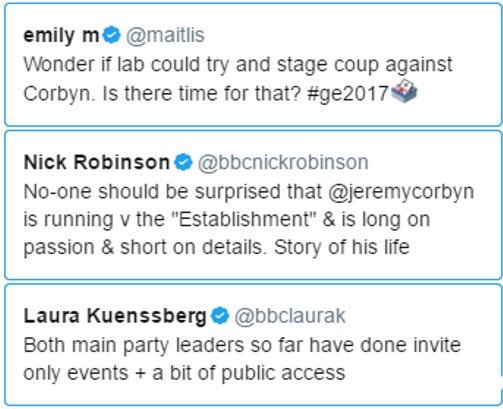
During the build-up to the General Election, the BBC for example, no longer even pretend to be impartial, as the Tweets below illustrate:


The latter, more than any other BBC correspondent, seems to have a particular dislike of Corbyn that borders on the outright contemptuous. This is best summed up by Media Lens who critiqued Kuenssberg’s “subtle insidious use of language” in a hit-piece that “betrays an inherent bias against Corbyn and his policies”:

“…rather than scramble to cover up his past views for fear they would be unpopular.”

The media analysts continue:

“Just putting those words in her piece – ‘scramble’, ‘cover up’, ‘unpopular’ – immediately inserts those words in the reader’s mind along with ‘Corbyn’; it encourages the reader to associate those words with the Labour leader. Consciously or not (likely the latter), she is deploying a well-known propaganda technique.

Moreover, when has Kuenssberg ever pressed May over the PM’s voting record on Kosovo, Afghanistan, Iraq, Libya, Syria, Yemen? There is no need for May to ‘scramble’ to ‘cover up’ her past views because the ‘mainstream’ media rarely, if ever, seriously challenge her about being consistently wrong about her foreign policy choices; not least, decisions to go to war.”

In response to the Media Lens quote above, reader Matthew Alford, remarked on an “equally grotesque” example of BBC bias he witnessed on the BBC 10 O’clock News the previous evening: “This certainly did not look like a manifesto that had been scribbled on the back of a fag packet”. So why not just say “This was a professionally presented manifesto? Is it remotely conceivable that they would have said: ‘Theresa May’s manifesto was definitely not done on the back of a beer mat’?”, exclaimed Alford.

This kind of sustained bias against Corbyn is, as to be expected, the result of an increasingly concentrated foreign ownership of the UK media who favour the Tories at the General Election, not least because of May’s hard Brexit strategy. This the mass media frequently depict as being indicative of the PMs ‘strength and stable’ leadership. Conversely, their antagonistic tone and depiction of Corbyn as weak and calamitous, is the opposite of the truth.

In a rare moment of honesty, The Guardian’s Roy Greenslade wrote:

“Mainstream media as a whole took its gloves off and Corbyn’s electoral hopes have been doomed from day one. He was “a great leap backwards”, said the Mail. Beware this “absurd Marxist”, said the Express, while the Daily Telegraph referred to his “divisive ideology” and “atavistic hostility to wealth and success”. And the Sun? It just called him “bonkers”. There was scepticism too from the liberal left. The Independent thought he would not persuade middle England to accept his policies.

Neither the Daily Mirror nor the Guardian greeted him with open arms. Support for Corbyn on social media made no impact. Meanwhile, the overall anti-Corbyn agenda, repeated week upon week, month after month, was one that broadcasters were unable to overlook, despite their belief in balance and adherence to impartiality. News bulletin reports reflected the headlines. Current affairs programmes picked up on the themes. That’s how media narratives are constructed.”

Strategies

The election campaign strategies of the two leaders couldn’t be more different. While May’s robotic and lacklustre performance overseen by Lynton Crosby’s single issue Brexit strategy is being engineered to avoid public and media scrutiny, Jeremy Corbyn’s campaign has been marked by a willingness to engage with the public. While Corbyn has been open, transparent and accountable, May has been robotic, secretive and aloof.

While May comes across as cold, calculating and lacking in human empathy, Corbyn comes across as being totally at ease with the public, smiling and relaxed in their company. Corbyn has openly espoused his philosophy and numerous policy initiatives, many of them significant. May, by contrast, appears to have no policies to discuss and comes across as somebody who is instinctively autocratic and awkward.

Whereas Corbyn’s campaigning has been marked by spontaneity and his willingness to reply to previously unseen questions in public meetings and press conferences, May’s series of stage-managed PR stunts are exemplified by an eagerness to rely on focus groups and a carefully selected media who provide her with questions pre-vetted and selected in advance by the Tory Party.

The attempts by the Tories to restrict the media from asking May any probing questions, was highlighted by Channel 4 News journalist, Michael Crick, after he admitted to apparently being shocked that “reporters collaborate with May’s press team by agreeing to reveal their questions to them in advance.”

In contrast to Crick’s realism, the BBCs Eleanor Garnier is clearly of the opinion that she is not subject to this kind of overt media censorship. Garnier tweeted: “I didn’t discuss question or topic of question with May’s team. If I was ever asked to give my question there is no way I would. Ever.”

Whatever is being taught on journalism courses these days, the work of Chomsky and Herman is clearly not on the syllabus. My advice to Garnier is to spend 30 minutes watching the formers demolition of Andrew Marr before taking on her next journalistic assignment. That Garnier, as a BBC journalist, fails to recognise that access is determined by the lack of difficult or challenging questions indicative of how the media works, is frankly staggering.

What is equally staggering, is the fact that lack of access and the closing of journalistic ranks with the governments complicity, is not seen as an outrageous attack on civil liberties, democratic accountability and press freedom.

Dictatorship

In Britain in 2017, we are faced with a situation in which the public are being denied information to enable them to be able to make an informed choice ahead of the General Election. This is totally outrageous. As Craig Murray puts it:

“The idea that the head of the government both gets to choose what they have asked, and gets advance warning of every question so they can look sharp with their answer, is totally antithetical to every notion of democratic accountability. If we had anything approaching a genuine free media, there would be absolute outrage. All genuine media organisations would react by boycotting such events and simply refusing to cover them at all.”

It should be remembered that Theresa May was not elected as PM. She is silent about what her policies are, refuses to engage with the public and be open with journalists, and finally, is denying the opportunity of a face-to-face TV debate with the leader of Her Majesty’s official opposition.

This is akin to a dictatorship. If the UK media were to report on a similar scenario in North Korea they would be describing the government their as authoritarian or similar. What is happening in Britain, under the guise of a free media, is that basic democratic norms are being trampled on by the government and there media accomplices, and hardly anybody in the British establishment is blinking an eyelid.


I rely on the generosity of my readers. I don’t make any money from my work and I’m not funded. If you’ve enjoyed reading this or another posting, please consider making a donation, no matter how small. You can help continue my research and write independently..… Thanks!


Donate Button with Credit Cards

Why my vote for Corbyn on June 8, will *not* be an endorsement of the Labour candidate

By Daniel Margrain

Image result for pics of jeremy newmark

On May 4, 2017, the free weekly newspaper, Barnet Press, reported on the announcement of the three Labour candidates who are to contest the seats in my area at the forthcoming General Election.

The candidate standing for the Finchley and Golders Green constituency is Jeremy Newmark, who the paper describes as a “former chief executive of the Jewish Leadership Council” and “former spokesman for Jonathan Sacks, who was Chief Rabbi from 1991 to 2013.”

Currently, Newmark chairs the Labour party-affiliated, Jewish Labour Movement (JLM). The JLM is also affiliated to the Israeli Labor Party and the World Zionist Organization. According to the UN, the latter pumps millions into building in the occupied West Bank through its settlement division.

In my view, Jeremy Corbyn as Labour leader is the best thing to have happened to the party and, potentially, to the people of the country, in decades. But I’m going to find it extremely hard, on a matter of principle, to vote for my selected Labour constituency candidate whose credentials I regard to be highly questionable.

A great deal has been written and covertly filmed about how the Israel lobby and the JLM are using both journalists and the Blairite fringe of Labour MPs within the Parliamentary Labour Party (PLP) to undermine Jeremy Corbyn’s leadership with a view to his eventual toppling using the specter of antisemitism as a weapon with which to achieve it.

Journalist Asa Winstanley contends that no mainstream journalists “have disclosed Newmark’s long-standing role in the Israel lobby, or his record of lying about anti-Semitism.”

In an excellent piece published by the Electronic Intifada (April 28, 2016), Winstanley comprehensively analyses the McCarthy-style witch-hunts by the JLM against Israel’s critics and outlines the links between right-wing, anti-Corbyn Labour and the Israel lobby within the party.

Bogus antisemitism crisis

Winstanley meticulously shows how the Israel lobby manufactured an ‘antisemitism crisis’, pinpointing the individuals involved, the tactics and dirty tricks used and the connections to individuals whose ties lead to pro-Israel groups both in London and Israel.

The investigative journalist also shows how media outlets such as the Telegraph, Huffington Post and the Jewish Chronicle have been complicit in the systematic attempt to disorientate Labour party members and supporters by either printing misinformation or reproducing unsubstantiated accusations and antisemitic smears against individuals. This in turn, has contributed to a false media narrative.

Among the individuals who instigated the fake antisemitism row highlighted by Winstanley, are David Klemperer who opposed Corbyn’s run for the labour leadership (but has since been kicked out of the party), and former Israel lobby intern, Alex Chalmers. But it is Newmark who is arguably the most influential.

The intention of the lobby is to create the impression that antisemitism is not only more prevalent within the Labour party compared with other political parties, but that it’s also more widespread compared to other forms of racism in UK society.

Neither claim stands up to scrutiny. In relation to the latter, a 2015 survey by Pew found that seven percent of the UK public held ‘unfavourable’ views of Jews. By contrast, about a fifth held negative views of Muslims and almost two-fifths viewed Roma people unfavourably.

In the aftermath of the massacres in Gaza in 2014, the London Metropolitan police recorded 358 anti-Semitic offences. Two hundred and seventy three of these were online, 36 involved criminal damage and 38 constituted “harassment”. Eleven cases of assault were recorded in which four resulted in personal injury.

One hundred and eighty thousand offences in these categories were recorded within the wider population throughout Metropolitan London. In other words, attacks against Jews in 2014 against a backdrop in which Gaza was being pulverized, made up only one in 500 of the total, while they made up around one in 86 of the population of London as a whole.

Community Security Trust (CST) figures for the first six months of last year show a rise of 15 per cent above those from the previous year. But this is from an extremely low base. The actual number of such incidents recorded for the first half of 2016 was 557. And that figure is still below that for 2014 when the Israeli assault on Gaza occurred. So claims that there has been a ‘surge’ in antisemitic incidences in recent years are false and misleading.

In terms of the former, there is no evidence to suggest that antisemitic views are any more prevalent in the Labour party which historically has been at the forefront of anti-racist and anti-fascist campaigns. On the contrary, racism and fascism is more likely to be symptomatic of far-right politics then left-wing politics.

Take the far-right ideology of Zionism as an example. Far-right political parties court the Zionist vote because Zionism is a far-right and racist political movement which, as Tony Greenstein put it, “sought to establish a Jewish state by accepting the anti-Semitic notion that Jews don’t belong in the countries they were born in.”

As a Labour supporter of Jeremy Corbyn, the decision of whether to put my cross next to the name of a hard-line Zionist and member of the Israel lobby who has lied about antisemitism and, in my view, seeks to undermine the democratic process from within, by prioritizing the interests of a foreign power over and above those of his own constituents, is not a difficult one. Zionists like Newmark have about as much in common with Corbyn as Gandhi has with Pol Pot.

Campaign Against Antisemitism (CAA)

The cynical attempts to weaponize antisemitism for right-wing political purposes is also the role of the Campaign Against Antisemitism, a British propaganda organization and registered “charity”. Formed in August 2014 during a major Israeli offensive against Gaza, the aim of the CAA is to paint Palestine solidarity campaigning and opposition to Zionism as antisemitic.

The organisation is chaired by Gideon Falter, who is also a board member of the Jewish National Fund which has a long history of supporting ethnic cleansing in Palestine. The CAAs preferred McCarthyite tactic appears to be to target left-wing political activists, Corbyn supporters and journalists who are critical of Israel by abusing and smearing them with unsubstantiated allegations.

Among those who have been libeled by the group include Rebecca Massey, a prominent Labour Party activist in Brighton and Hove, Labour parliamentary and council candidate, Dinah Mulholland and the campaigning journalist and Labour party activist, Mike Sivier.

In relation to the latter, the CAA submitted an article to the press that contained “lies, doctored quotes and misinterpretations” of Sivier’s work. This resulted in his subsequent suspension from the Labour party without a proper investigation of the facts having taken place.

If the role of the CAA is to expose genuine cases of antisemitism and to promote social harmony, one would expect it to condemn far-right fascist organisations and their supporters. But as Tony Greenstein, who has himself been a victim of CAA smears, highlighted, a search of the campaign’s archive revealed just two articles that mention Britain’s main fascist organizations – the British National Party, the English Defence League and the National Front. Those groups include Holocaust deniers within their ranks.

By contrast, Greenstein pointed out there are some 77 articles attacking Jeremy Corbyn and 32 articles in the archive that attack Shami Chakrabarti, a civil liberties campaigner and now a prominent Labour politician serving as shadow attorney general.

It is obvious that the activities of the CAA and other Zionist and pro-Israel lobbying groups such as the CST and Board of Deputies of British Jews are designed to achieve the exact opposite of what they purport to set out to do. Rather than create peace and harmony between people, they actually create tension, discord and antagonism.

This, of course, serves a political and ideological purpose. The promotion of the idea that Jews within the diaspora are under threat of antisemitism, intimidation and violence is intended to encourage their emigration to Israel thereby helping to further reinforce Zionism’s role as Israel’s state ideology.

Groups like the CAA and CST need “antisemitism” to flourish in order to justify their continued government funding and hence their existence. That’s why the latest figures released by the latter suggesting attacks against Jewish people have rocketed to record levels, should be taken with a pinch of salt. In order to establish an accurate picture, we need not only to compare levels of racist attacks more widely, but to break down the 767 antisemitic hate crimes recorded by the CST in the first six months of 2017 into categories.

While all racism is abhorrent, it should be noted that 80 violent antisemitic attacks were recorded during this period. While this is 80 too many, it’s important to look at the wider political and historical context in which these attacks have taken place and compare them with the level of violent racist attacks against other groups. But CST do not provide any context because it does not serve their narrow political and ideological interests.

The Israel lobby, who have a significant financial stake in the Labour party and further afield, clearly see Corbyn as an anathema to the realization of these interests. A Newmark victory in Golders Green and Finchley would almost certainly strengthen the Zionist position within the political establishment and thus help to bring the Zionist dream closer to fruition.

The disproportionate power the Israel lobby is able to exert is a major concern for anybody who values the principles of democracy. While it is wrong to suggest that Zionism and Judaism are synonymous, it is nevertheless apposite to point out that the majority of the Jewish demographic (59 per cent), which in its totality represents just 0.5 per cent of the British population, identify politically as Zionists.

The democratic process is not best served in a situation in which such a tiny section of the population supposedly has a disproportionately powerful lobby at its disposal. Although the majority of the world’s Zionists are non-Jewish, Zionism is at its core unquestionably a Jewish movement – indeed the major Jewish communal movement.

Over-representation

It’s the over-representation of Jews in the capitalist ruling class that gives the Israel- Zionist lobby it’s power. This is a historical phenomenon that actually explains the Zionist project itself and it’s purpose – to create a state expression for this distinctive bourgeois layer. The history of different peoples, of the relation of oppressed and oppressor peoples, is class based and linked to the different evolved class structures of those peoples.

The Jews have a more distinctive historically evolved class structure than many other groups. An understanding of the issues concerning questions of material reality and historical fact, is crucial to evaluating where we are today. The exploitation by racists of the facts, don’t make these facts less valid. As a society we need to talk about them as opposed to having them suppressed within the cloak of ‘antisemitism’.

The suppression of such questions risks their monopolization by the small minority of antisemites who have a racialised hatred of Jewish people. They are thankfully very rare. It’s important to keep talking about Zionism as a political category in order to refute the conflation between Zionism and Judaism that public figures such as Chief Rabbi Mirvis and others have so scandalously made.

Given the attempts to conflate the two, it should not come as any surprise why people would make the innocent mistake of using the term the ‘Jewish lobby’ in discussions or debates. Under such circumstances, it is easy to see how others with nefarious motives are able to exploit this misunderstanding for political and sectarian- racist purposes.

One such individual is the Zionist antisemite, Rupert Murdoch, who has complained that “Jewish-owned” newspapers are too critical of Israel. This illustrates how Zionists who loathe and resent Jews as Jews, unless they support a pro-Zionist political stance, are able to perpetuate the Jewish global conspiracy trope for their own narrow political objectives.

This rationale is used to explain why the JLM are able to prevent non-Zionist Jews from affiliating to their organisation while conversely accepting that non-Jewish Zionists are welcome to join. Significantly, in this sense, the JLM are more accurately described as a Zionist movement as opposed to a movement of Jews.

Arguably, nowhere is this dichotomy best illustrated than by the treatment meted out by the JLM to the Jewish anti-Zionist activist, Jackie Walker. The controversy that surrounds Ms Walker and others, as Mike Sivier posited “is not about antisemtism, but removing a person who does not support Zionism from a position of influence.”

The media attacks on Jeremy Corbyn, Ken Livingston, Jackie Walker and others, are politically motivated and represent a determined effort by the Israel lobby to make Britain’s Labour Party ‘a safe pair of hands’ for Israel and Zionism.

Defining antisemitism

The confusion that surrounds antisemitism could be easily clarified if the widely used definition of the term was simplified. But as a result of their decision to adopt the long and convoluted European Union Monitoring Centre (EUMC) definition of antisemitism, groups like the CAA, CST and the JLM are deliberately muddying the waters.

This deeply flawed 500 word ‘new antisemitism’ or even ‘antisemitic anti-zionism’ definition authored by attorney Kenneth Stern (strangely accepted by Jeremy Corbyn), intended to combat political criticisms of Israel, is so wide in scope that it’s essentially meaningless.

The EUMC definition, amid much opposition, was subsequently dropped by the UK government in December, 2016. Instead, the non-legally binding working definition formulated by the International Holocaust Remembrance Alliance (IHRA), was formally adopted seven months later. The IHRA definition states:

“Antisemitism is a certain perception of Jews, which may be expressed as hatred
toward Jews. Rhetorical and physical manifestations of antisemitism are directed
toward Jewish or non-Jewish individuals and/or their property, toward Jewish
community institutions and religious facilities.”

While an improvement on the EUMC definition, the IHRA is also similarly flawed. “Physical manifestations”, for example, might include the targeting of the state of Israel.

Brian Klug, an Oxford academic who specializes in the study of antisemitism, manages it in 21 words: “Antisemitism is a form of hostility to Jews as Jews, where Jews are perceived as something other than what they are”.

This seems to me to be a perfectly adequate definition. But preventing genuine antisemitic instances is not the objective of Zionist organisations like the CAT or the CAA. Their real purpose is to undermine a Corbyn-led Labour Government, which they view as a very real threat to the Eretz (Greater) Yisrael project of a territory stretching from the River Nile to the River Euphrates.

Both the EUMC and IHRA definitions embolden Zionists in their political attacks against Jews and non-Jews alike who are rightly critical of the illegal actions of the state of Israel. I can only assume that there is still a long way to go before the corrupting influence of Zionism is removed from the democratic institutional structure of the Labour party once and for all.

The suspension from the party of the likes of millionaire Zionist donor, Michael Foster, who compared Corbyn supporters to Nazi storm troopers, is insufficient and clearly more needs to be done. Corbyn’s apparent cosying up to Zionists like Newmark and others within the party who are among the first in line to stab him in the back, while leaving long-term comrades like Ken Livingston out to dry, is a situation that ultimately, can only end in tears for the Labour leader. Corbyn’s lack of a principled stand on this matter reflects a serious weakness in his leadership.

The kind of democratic socialism espoused by the Labour leader on the one hand, and the political ideology of Zionism on the other, are irreconcilable concepts and if he fails to get a grip on the situation it could ultimately contribute to his downfall.


I rely on the generosity of my readers. I don’t make any money from my work and I’m not funded. If you’ve enjoyed reading this or another posting, please consider making a donation, no matter how small. You can help continue my research and write independently..… Thanks!


Donate Button with Credit Cards

The UK government’s failure to answer questions relating to the alleged sarin gas attack hints at a cover-up

By Daniel Margrain

Image result for pics of sarin gas attack claims

On April 4, 2017, the Syrian government of President Bashar al-Assad was accused of intentionally deploying poison gas in Khan Seikhoun in Idlib province in the north of the country, In response to the alleged attack, and with near-unanimous journalistic support, the United States government launched an illegal missile strike on Syria’s al-Shayrat airbase three days later (April 7, 2017).

Cathy Newman on Channel 4 News (April 10, 2017) stated as if it was a fact that President Trump’s unauthorized attack on the airbase was “in retaliation to a sarin gas attack by president Assad”. Among those joining in the chorus proclaiming Assad’s ‘guilt’ as if they were as one, was the New York Times. Reporter, Michael B Gordon, who co-authored that papers infamous fake aluminum tube story of September 8, 2002 as part of the media’s propaganda offensive leading up to the 2003 U.S-led Iraq invasion, published (along with co-author Anne Barnard) another propaganda piece.

Showing no scepticism that the Syrian military was responsible for the gas attack, the authors cited the widely discredited $100m-funded terrorist-enablers, the White Helmets, as the basis for their story. Meanwhile, Jonathan Freedland, without a shred of evidence, wrote in the Guardian: “We almost certainly know who did it. Every sign points to the regime of Bashar al-Assad”. Three days later on twitter (April 7, 2017) George Monbiot exclaimed: “We can be 99% sure the chemical weapons attack came from Syrian govt.”

In an attempt to get to the bottom of the alleged attack amid the fog of anti-Assad propaganda, I wrote an extensive article which raises a number of issues regarding the authenticity of the various claims made. More recently, journalist Peter Hitchens announced to his readers in his Mail on Sunday column (April 30, 2017), that he had sent a series of questions to the Foreign Office (FCO) about their apparent confidence with regards to Assad’s guilt over the sarin gas attack claims. In Hitchen’s view, the answers he received – which he has been prevented from publishing – were “useless, unrevealing and unresponsive”.

Three days later (May 3, 2017), Hitchens published the said questions, which the FCO “won’t or can’t answer”, in his Mail column. The questions the journalist poses are thoughtful, perceptive and often detailed. They include legitimate requests to the UK government to clarify contradictory statements and accounts. The fact that the FCO refused to answer them satisfactorily, or allow them to be published, hints very strongly at a government cover-up.

These are the questions Hitchen’s asked upon which he received worthless replies:

“In his article in the Sunday Telegraph of 16th April 2017, the Foreign Secretary states that:

‘British scientists have analysed samples from the victims of the [Khan Sheikhoun] attack.’

Where and when did they do this?

What assurances did they have of the provenance of the samples?

Who controlled the custody chain, and vouched for it?

How did they know that the samples were at no stage handled by persons with a propaganda interest in a certain outcome?

Were they at any stage under the control of Tahrir al-Sham, formerly Jabhat Fateh Al Sham (previously the Jabhat Al-Nusra), or any other part of that faction?

If not, how did they leave Syria?

Under whose custody were they between Khan Sheikhoun and the Syrian border?

How do we know?

He also says : ‘These have tested positive for sarin or a sarin-like substance.’

Eyewitness reports (cited in evidence by the Foreign Secretary) speak of ‘clouds of smoke’ (Independent 05/04/2017) and say ‘We could smell it from 500 metres away.’(Guardian 07/04/2017) and ‘The smell reached us here in the centre; it smelled like rotten food.’ (Daily Telegraph 06/04/2017).

Sarin is odourless and invisible. Videos of the attack also show responders without protective clothing, handling victims, which would be highly dangerous in dealing with victims of sarin. Does the Foreign Secretary have any view on the apparent contradiction here?

The Foreign Secretary also writes:

The UK, the US and all our key allies are of one mind: we believe that this was highly likely to be an attack by Assad, on his own people, using poison gas weapons that were banned almost 100 years ago, under the 1925 Geneva protocol. In view of this horrific evidence, the world last week once again had a choice, just as we did after the gas attack at Ghouta in 2013.

This is doubly interesting.

‘Highly likely’ is well short of a declaration that the matter is in fact proven. Yet the United Kingdom has endorsed a missile attack on a sovereign country by the United States, the pretext or reason for which was given as the alleged gas attack, which the Foreign secretary himself categorises not as proven fact but as ‘highly likely’, allegedly by the Assad government on Khan Sheikhoun.

What is the status of this attack under international law? Under which part of the UN charter is it lawful? If it *is* lawful in the case of such an action being proven, then is a belief that the alleged action by the Syrian state is ‘highly likely’ sufficient?

Who, if anybody, does the Foreign Secretary say is responsible for the Ghouta attack? On what basis does he say this?”

These are extremely important questions that need answering in order for the public to ascertain what the UK government’s role was in the events that led to the illegal US attack on Syria. The public need and demand answers to these legitimate questions to avoid a potential eventuality in which Theresa May’s government drags the country into yet another unnecessary war based on false pretenses.

I rely on the generosity of my readers. I don’t make any money from my work and I’m not funded. If you’ve enjoyed reading this or another posting, please consider making a donation, no matter how small. You can help continue my research and write independently..… Thanks!


Donate Button with Credit Cards

“Time to trash the Tories” by *not* voting: Steve Topple intends to spoil his ballot paper at the General Election

Image result for pics of steve topple

By Daniel Margrain

It came as a complete bolt out of the blue for this writer to learn that one of the most politically astute, articulate, insightful and widely respected journalists in a generation is to abstain from voting at the forthcoming General Election.

Steve Topple, who in many ways I saw as mentor, and who has often promoted my work on twitter where many others ignored it, yesterday (May 1, 2017) came out publicly on social media to effectively state that he sees no political value in voting at elections.

According to Topple, placing a cross next to the name of a candidate at elections is akin to endorsing a corrupt capitalist system.

In response to criticisms from readers, Topple announced the following on Facebook (May 1, 2017):

“Oh dear.

So, seemingly because I’m going to spoil my ballot at the election, I must have come to this decision from a position of privilege.

NOPE. I’ve spent years at the hands of the DWP, living off crisis loans, money people have dropped in the street, hand-outs and generally eating thin air.

I now live on a council estate with my GF and her ten-year-old son, the former who has just had all her benefits stopped. So we’re living off my Canary wage.

SO DON’T COME ONTO MY TL TELLING ME THAT BY SPOILING MY BALLOT I DON’T CARE ABOUT ALL THE BAD SHIT THAT WILL HAPPEN IF THE TORIES GET IN AGAIN.

I’ve spent 12 years living at the hands of Labour and Tory governments. And the DWP. So probably know far better than half the people commenting just how FUCKING BAD things can be.

So you can take your assumptions about ‘virtue signaling’ journalists and shove them up your prolier-than-thou arses. Or come to my estate, knock my door and try telling it to my face.”

To a certain extent, I understand and sympathize with Topple’s predicament, particularly as I learned through recent exchanges on twitter (May 3, 2017), that Steve lives in a safe Tory constituency. Just for the record, I’ve not spent twelve years living in the hands of successive Labour and Tory governments like Topple has, but thirty-eight years having first voted in 1979. So if anyone can claim to feel embittered and disillusioned, it’s people of my age who have suffered for far longer.

I, like Topple, have abstained at elections in the past in situations where no meaningful choices have been offered to the electorate. I understand the arguments that override his rejection of a capitalist system that benefits the elite ruling class minority at the expense of the rest of us.

Under normal circumstances, his arguments could be seen as a legitimate response to the actions of corrupt Labour party leaders who have put the interests of the establishment above the electorate. But these are not normal circumstances and Corbyn is far from being the usual Labour leader.

Those who have argued that the reason Topple intends to spoil his ballot paper on the basis that he is doing so from a position of privilege, are barking up the wrong tree. Anybody who has followed Steve’s journalistic career, will know that his various articles focusing on political and current affairs issues that rally against injustice and inequality are sincere and heartfelt.

This makes it all the more perplexing why Topple hadn’t decided to make an exception by refraining from spoiling his paper this time around given circumstances in which a Labour government under Corbyn would almost certainly usher in a much needed transformative kind of politics.

Apart from what I regard as Steve’s lack of wisdom in relation to his decision to spoil his ballot paper, I also reject his justification that underpins this decision. Topple’s apparent insistence that the inherent structural failings of capitalism cannot be reconciled with a democratic polity to help rein-in the systems worst excesses is, in my view, indicative of a narrow defeatist outlook.

There is no reason to believe that engaging in the political process and putting the case for a revolutionary transformation of society cannot go hand in hand. It might not be the kind of revolution Steve imagines, but that is cold comfort to those who have lost loved ones as a direct consequence of Tory austerity.

The notion that increased hardship and suffering is a necessary prerequisite to the onset of revolution, which is what Topple seems to be implying is, I would argue, ultimately selfish and, should in my view, be rejected. Too many people who are suffering untold pain under the Tories, cannot afford to wait for people like Steve Topple to be awoken from their slumber at the point at which the revolution begins.

People are suffering under the Tories in ways not witnessed since the Victorian era and they are desperately hoping for some light in what is a very long tunnel. Corbyn is the first Labour leader in decades that provides them with some much needed optimism for the future.

What we are currently seeing unfold, is potentially one of the greatest periods in British political history. An honourable and decent man who has fought off two coups against him, has too many decent folk riding on his success at the election for him to be dismissed out of hand by people who should know better.

In the hope that Steve might reconsider his decision to spoil his ballot paper, Corbyn supporter, Felicity A Wright, wrote on Facebook (May 1, 2017):

“Listen, Steve, I get it. I’m a crip and on benefit and I felt so let down by Labour that I spoiled my ballot last time by writing “None” across it. My husband, who is my full-time carer, spoiled his with more panache by writing “Clement Attlee” across it. And that’s the thing: I believe Jeremy Corbyn IS the new Clement Attlee. Have you seen his record? He’s been on the side of the poor, the weak, the voiceless from the beginning. He has been arrested for protesting against Apartheid & for refusing to pay the Poll Tax. I believe he is a genuinely good man and that, unlike the Kinnock/Blair side of the Labour Party, he cares about making a fairer society. So I’m voting Labour & so is my husband, in the hope that Jeremy really is what he seems to be. Please do the same! The Canary is one of the things which has given me this hope and is the only news outlet I actually subscribe to. Keep the faith. xxx”

Felicity is right.  There are literally millions of voters out there who see in Corbyn somebody who is not just another self-serving careerist politician, but a man who is sincere and whose is motivated by a need to make society better for the many as opposed to the few.

Having read Topple’s often brilliant polemical articles, it would seem highly improbable that he is oblivious to the differences between New Labourism exemplified by Blair and the old Labour of Corbyn. Moreover, given the political landscape since Thatcher, the notion he intends to abstain from voting, particularly as his anti-Tory polemics are so incisive, means that I’m at a loss to rationalize his thought process.

The truth is, as ill-judged as I think Topple’s decision to spoil his ballot paper is, it’s not my main point of contention. What I find particularly strange are the contents of a recent tweet of his in which the slogan “Time to trash the Tories” is invoked. It’s bizarre that “trashing the Tories” is seen by Steve as being concomitant to spoiling ones ballot paper.

Topple is not just any old bloke, but a highly influential and respected journalist who many people look up to for inspiration and guidance. In short, in the age of social media where more people than ever rely on alternative sources of information to counter the fake news of the mass media, opinions of the calibre of investigative journalists like Steve Topple matter.

Despite it’s supposed non-corporate credentials, the on-line publication Topple often writes pieces for, the Canary, is still heavily dependent on advertising revenue streams for its existence. As such, the news outlet is interwoven into the very fabric of a system Steve purports to hate.

Further, it is reasonable from the perspective of his many readers, to deduce that his effective absolving of responsibility of the election outcome, is undermined by the content of his polemical articles in which he consistently prosthelytizes against the Tories. Unfortunately, because of the contrarian position he has taken, Topple’s visceral attacks on the Tories from here on in, will lack credibility.

Yesterday (May 1, 2017) was a very sad day for me personally having learned that a writer I have long admired and respected made the incredulous decision to spoil his ballot paper – a decision that can only benefit the Tories.

I sincerely hope Steve changes his mind in the days ahead.

I rely on the generosity of my readers. I don’t make any money from my work and I’m not funded. If you’ve enjoyed reading this or another posting, please consider making a donation, no matter how small. You can help continue my research and write independently..… Thanks!


Donate Button with Credit Cards

In whose hands is the system safer -Corbyn or May? The views of a venture capitalist might surprise you

By Daniel Margrain

hanauer copy

“Inequality and the rise of a super rich elite is undermining the foundations of capitalism. The trappings of capitalism could be swept away by the pitchfork of revolution unless capitalism is fundamentally re-imagined”, so says American venture capitalist Nick Hanauer,

In a BBC interview with journalist Stephen Sakur in front of a live audience as part of the Hard Talk series of programmes (since removed from the BBCs i player service), one of America’s wealthiest individuals argues that capitalism, as currently configured, is not working. The thing that is said to drive Hanauer on is status not money:

“I’m not driven by money but by the need to be king of the hill. If capitalism doesn’t change fundamentally, it will destroy itself. If you allow wealth to concentrate in fewer and fewer hands over time, in the end it cannot be good for anybody, particularly people like me”, he says. “You show me a highly unequal society and I’ll show you a police state or a revolution.”

According to Hanauer, there is truth in the notion that in ‘go get’ societies like the U.S people are able to crawl out of the clutches of poverty. However, there are limits: “Aspiration is a good thing”, he says, “But aspiration in the absence of opportunity creates resentment, anger and violence. The idea that if the disenfranchised are given more incentives, they would magically become software engineers or Wall Street executives isn’t true.”

Fundamental

For Hanauer, the problems are more fundamental: “If we don’t get inequality under control then it’s likely to lead to war – a similar pattern that followed the last period of massive inequality between 1925 and 1940. The most capitalist thing you can do to prevent war is to build up the middle class. From a capitalists perspective, although it may seem a good idea in the short-term to impoverish the typical family, in the long-term it’s a catastrophe.”

Although Hanaeur posits that as an economic system capitalism has been beneficial to millions of people and “is the greatest system ever produced for lifting people out of poverty”, he nevertheless accepts it’s flaws. It fails, for example, to sufficiently “knit together agreements” thereby undermining the potential for a more equitable and sustainable distribution of the wealth that growth brings:

“In my state”, he says, “since 1990, close to 100 per cent of growth has been accrued to just 1 per cent of the top earners. People are beginning to get angry and increasingly less patient with a system that rewards nearly all of the benefits of growth to a tiny minority at the top.”

According to Hanauer, the crisis of capitalism is more acute than ever before and its problems are exacerbated by any lack of purpose which capitalism encourages: “Because we are social creatures, the only thing that gets to define society is our capacity to cooperate. In the absence of a shared purpose, people will not cooperate at which point the society will dissolve”, he says.

Trickle-down

“Trickle down economics – the idea that the money of people who become rich – permeates down to the poor, is nonsense. How can it be anything other than nonsense given the fact that inequality is on the rise and socioeconomic mobility is in reverse? I’m not arguing against capitalism but simply saying that there are ways to optimize it – to make it better for everybody.”

Hanaeur is clear that his argument isn’t intended to be a moral one: “I’m not saying that we capitalists should pay workers more because we feel sorry for them, But the more they get paid, the better it will be for venture capitalists like me. The more money ordinary folks’ make, the greater the opportunity people like me have to innovate, create enterprises and sell them stuff. The better they do, the better I do.”

Hanauer is quick to point out that the converse isn’t true: “A thriving middle class causes growth, not the other way round”, he suggests. “You can’t drive a consumer-based economy – which our economies are based on – with only the extreme wealth of the few. What we need to do is to boost the minimum wage in the U.S to 15 dollars an hour.”

The venture capitalist then goes on to suggest that capitalism needs to be further controlled through a system of planned and coordinated regulation:

“Capitalists have the idea that their things will be bought by everybody else as a result of higher wages paid by other capitalists. But this logic of paying higher wages to staff to help improve business activity more generally, doesn’t seem to apply equally to them since they will insist on paying their own workers next to nothing thereby not absorbing the costs themselves.”

Hanauer continues:

“The simple truth is, if a higher minimum wage was introduced universally, not only would it be affordable, but something like 40 per cent of American’s would be able to buy more products from everybody thus benefiting all capitalists across the board. Business is challenged today because fewer and fewer people are able to buy things.”

In other words, Hanauer is arguing here that the actions of capitalists’ need to be reined-in through a system of planned and coordinated regulation in order that the system be saved from the rapacious actions of competing capitalists who are driven, as Marx put it, by their need to “accumulate for accumulations sake”.

Contradictions

Hanauer’s pragmatic arguments are similar to those being suggested by Labour leader Jeremy Corbyn and shadow chancellor, John McDonnell. What all three understand – but the Tories don’t – is that the ability to accumulate for accumulations sake doesn’t necessarily lead to higher profits. One of the contradictions inherent to capitalism is that the system as a whole needs to spend money to make profits, yet every individual capitalist wants to spend as little as possible. The lengths to which giant companies like Amazon, Google and Starbucks will go in order to avoid paying tax shows how that dilemma is played out.

In theory, insisting employees work 14 or 16 hours a day for peanuts correlates to higher profits for capitalists. But in reality such an approach is very wasteful – like over-exploiting the soil. Accumulating for accumulations sake is concomitant to a deregulated economy in which the absence of relevant legislation means that capitalists will insist their workers are worked to the bone for as little money as possible for fear of the former losing their competitive advantage over their rivals.

What Hanauer and the Labour party under Corbyn are able to grasp is that the introduction of labour and wage regulations that the Tories try their utmost to resist, actually improves productivity, that from the perspective of the capitalist system, is beneficial to everybody.

This brings me back to the wisdom implicit in the Nick Hanauer quote above. Hanaeur’s argument about the necessity of the United States government to substantially increase the legal minimum wage across the board in order to save capitalism from itself, is in principle, no different from the minority of capitalists in 19th century Britain who argued in favour of the introduction of the Factory Acts of the 1830s and 1840s which set down a maximum length for the working day.

Re-think

In reality, an advanced low wage and minimal welfare provision capitalist state like Britain is the modern equivalent of its counterpart during the industrial revolution prior to the introduction of the Factory Acts. What enlightened capitalists like Hanauer, as well as pragmatic socialists like Corbyn and McDonnell grasp, is the necessity to radically re-think the failed neoliberal ‘trickle up’ economic model of austerity – in which, for example, huge subsidies are paid to rich landowners – and instead reconfigure policy towards a Keynesian demand-led strategy which redistributes wealth towards the bottom.

The former is what economist Paul Krugman describes  bluntly as “a con that does nothing but harm the wealth of this nation. It has been discredited everywhere else: only in Britain do we cling to the myth.”

As inequality continues to rise, so does the potential for public disorder. At present, the richest tenth pay 35 per cent of their income in tax, while the poorest tenth pay 43 per cent. Is it too much to ask that those with the deepest pockets pay their way, thus creating the potential for the kind of equitable society in which everybody wins?

This is not pie in the sky stuff but a pragmatic solution to the problems we face. Politicians like Jeremy Corbyn, John McDonnell and Caroline Lucas, as well as economists like Paul Krugman and Joseph Stiglitz – all of whom are ideologically as far apart as its possible to be from venture capitalist Nick Hanauer –  are nevertheless in agreement that the direction of travel the Tories are on is wrong.

As far as the possibility for change in the future is concerned, Hanauer says:

“Most American’s (and by extension, British) have accepted this bankrupt idea of how you create growth in capitalist economies. If you think that wealth trickles down from the top; if you think that the rich are the wealth creators, and if you think that the more rich people you have the more jobs you will create, then the notion that the introduction of a high rate of tax for rich people makes no sense.”

Hanauer adds:

“However, if you reject that false idea of how capitalism works and you accept a more realistic 21st century notion that the more workers earn, the more customers’ businesses have and the greater the level of jobs that will be created, then you will understand that it’s part of a feedback loop in which everybody wins. The battle ahead is to change the parameters of debate around these things. At the moment we are on the wrong track.”

One might reasonably and instinctively assume that the interests of Hanauer, whose wealth runs into hundreds of millions of dollars, would be closely aligned with the right-wing government of Theresa May. But such a notion is counter-intuitive given that politically, he is closer to Labour’s Jeremy Corbyn.

The fact that Hanauer’s political outlook and approach to dealing with the challenges society faces, has more in common with Corbyn than May, completely undermines the arguments of those who smear Corbyn with the communist epithet.

Contrary to popular mythology, Corbynism and capitalism are, in reality, congruous concepts. It’s not only the social aspects like the health service and social care that’s safer in Labour’s hands, but from the perspective of capitalism’s longevity, its the economy too.

I rely on the generosity of my readers. I don’t make any money from my work and I’m not funded. If you’ve enjoyed reading this or another posting, please consider making a donation, no matter how small. You can help continue my research and write independently..… Thanks!


Donate Button with Credit Cards