Category: politics

My travels in Cuba (3/3): Varadero & back to Havana

By Daniel Margrain

Varadero Banner.jpg

In the final part of my ‘traveling experience in Cuba’ trilogy of articles, I will focus on the tourist holiday coastal resort of Varadero. I arrived in the town from Cienfuegos, the contrasts of which couldn’t be more striking. Just like Ancona near Trinidad, the raw and ragged coastal setting is picture-postcard beautiful. I arrived as the sun descended on the horizon, its orb the brightest of tangerine orange. As this gigantic ball of light melted into the Atlantic, a handful of tourists began frantically photographing the afterglow – a kaleidoscope of subtle hues that sank into the sillouette of nearby palms and wooden canopies of the restaurants that adorned the bay.

The pork steak and rice washed down with a bottle of Buckaneroo beer that I consumed at a beach-side restaurant that evening made a pleasant change from the rather predictable food of the Casa’s. Saturday night in Varadero was more subdued than I anticipated. The vast swathes of British package tourists that I thought would be filling the hotels and bars never materialized, having been usurped by their mainly French, Italian and Canadian counterparts.

Varadero, much like other places in Cuba where tourists spend much of their time and money in each others company, is a foreign tourist enclave where small businesses proliferate and operate semi-autonomously from the centralized arm of the Cuban state. This small coastal town is littered with restaurants, bars and numerous plush but sanitized all-inclusive hotels.

As of 2009, Varadero is the only place in the country where it’s illegal for Cuban’s to let out the rooms of their Casa’s, which was presumably intended as a means to avoid the eventuality of undercutting the income of the hotel chains. That’s not to say that these illegal private rooms for rent in shared houses don’t exist. They proliferate in the small back streets. I stayed in one.

In Varadero, hard currency in the form of the Cuban convertible, has replaced the Peso as the international monetary language. It is the place that many Cuban’s come to boost their state salaries. The domination of hard currency in the town has resulted in a distorted local economy altering the dynamic of the community, not necessarily in a good way. Varadero is actually a rather sad and uninspiring place – a kind of miniature version of how I imagine Miami to be without the gregarious trappings that one associates with the latter, but nevertheless is as equally as unsuited to the environment from which it has emerged.

Mass tourism and the tourist ghetto that has accompanied it, has created socioeconomic polarizing fractures within the community. Visible, and at times ostentatious displays of material wealth exist here alongside abject material deprivation – a situation that will almost certainly worsen as the relative trickle of tourists here inevitably turn into a flood in the years to come. The apparent irreconcilable forces that are pulling Varadero apart acts as a warning sign to the rest of the country in a future post-Fidel world.

Wherever large swaths of tourists converge who bring with them hard currency in a two-tier economy in which a dual currency operates, all notions of authenticity correspondingly disappear because without access to the Convertible Cubans are effectively excluded from the social circles, restaurants and bars that tourists engage in. Let me put this into some kind of context. A beer in a hard currency-only bar costs the equivalent of one-twentieth of the monthly salary of a skilled Cuban worker.

If you have access to the Peso (which tourists are able to acquire at any Cuban bank in exchange for the Cuban Convertible or other forms of hard currency like the Euro), a basic meal on the streets of Havana costs the equivalent of 25p. This kind of two-tier economy is not consistent with socialism but rather a highly political bureaucratic state. The revolution that overthrew U.S puppet, Fulgencio Batista in 1959, was in reality an anti-colonial rather than a socialist revolution in which Cuba’s workers were largely onlookers, however sympathetic.

State corruption is the inevitable consequence that flows from this set of relationships. Ordinary Cubans who are not connected to either the high echelons of the bureaucratic state or the tourist sector, today speak endlessly and angrily about the visible and growing gulf – economic, social and political – between this privileged layer and the majority, whose daily life is a struggle. Tourism exacerbates these divisions which explains why politically, socially and economically Cuba is being pulled in different directions.

For many visitors to Cuba, the ‘authentic’ Cuban experience normally means any combination of the following: reading Hemingway, salsa music, Che iconography, the Buena Vista Social Club, 1950s Cadillacs and bustling smoke-filled bars full of folks drinking Mohito’s and smoking Monte Cristo cigars. But for others – myself included – these aspects of Cuban life represent the fetishization of Cuba – a partial and largely superficial depiction perpetuated by of a divisive tourist sector that feeds off these characteristics of Cuban culture.

What capitalist relations does, is it distorts and exploits these aspects of culture for the benefit of the market as if the whole of Cuban society can be reduced to something akin to a composite painting. In this sense, potentially the most marketable aspects of culture are identified, repackaged and then sold for public consumption as the precursor for the expansion of the capital accumulation process.

The sad and ironic truth is that without the hard currency of the tourists, there would be little ‘authentic’ Cuba for whom those who deal in the hard Cuban Convertible currency, believe we, as visitors, want to experience. I’m specifically thinking not about merely the sterile atmosphere of Varadero, but many of the bars, cafes and restaurants in the regenerated Habana Vieja where only the Cuban Convertible is the accepted currency.

This disenfranchises ordinary Cubans from much of the social life of the city frequented by tourists. In this regard, I have a great deal of sympathy for all those visitors –  journalist and writer, Neil Clark included – who have expressed disillusionment with Cuba.

During my last day in Varadero, I met Karolina, a Polish woman who had been living and working in Cuba as a health professional. I asked her about the question of housing and freedom of movement for Cuban’s. She explained to me that the Cuban people are legally allowed to change houses through a kind of swap scheme similar to the principle of council house swaps in Britain. Although she was married to a Cuban and had been living in the country for many years, she claimed she had many unanswered questions about the nature of Cuban society.

As I sat at an outdoor bar in Varadero across the street from one of the outwardly plush but sterile hotels listening to the resident salsa band work through their worn routine, I realized that the version of Cuba fetishized in guide books like Lonely Planet exemplified in a place like Varadero, no more resembles contemporary Cuba than red telephone boxes, city stockbrokers wearing bowler hats or the Houses of Parliament represent contemporary London.

Many of the young Cuban’s in Varadero, are more likely to aspire to what they perceive to be an archetypal capitalist lifestyle and the consumption that comes with it, then they are to keep faith with the ideals of Fidel. The popular musical genre known as reggaeton that is mainly enjoyed by the young, is more Miami then Havana and the majority of Varadero youth want to be seen sporting the latest designer clothes and sipping Red Bull rather then lingering on a Mohito wearing a Panama or propping up the bar puffing on a Cohiba.

Karolina explained to me that many young Cuban’s, when exchanging homes, are often prepared to ‘downgrade’ their places in terms of size and/or condition in order to obtain cash so as to be in a position to be able purchase elements of this Western ‘lifestyle’. In Varadero, I saw many young Cuban’s dressed in expensive designer clothes and trainers and driving new cars either paid for through tourism, the downsizing of accommodation or through the receipt of hard currency from the estimated one in four Cuban’s who live in exile.

Meanwhile, the majority of Cuban’s who live their lives outside of this bubble, and who have no access to the Cuban Convertible, must make do with their small state salaries. Thus, Cuban society is bound to become increasingly fractured and divisive in the years to come.

When I suggested to Karolina that this scenario would likely necessitate a political crackdown by the Cuban state which would probably lead to the likelihood of a counter-revolutionary struggle, she looked at me in a resigned knowing way: “Yes, sadly I think this outcome is almost inevitable”, she said….But then added positively, “We people in Cuba have to find a way of looking to the future, and we must believe we can succeed.”

With that positive message embedded in my head, I eagerly anticipated my return to the bustling city of dreamers and street hustlers amid the chaotic frenzy of the dusty, pot-holed strewn streets of downtown Havana where my journey began. Upon my return, I bumped into many familiar faces that I had met in the streets and bars of a city in which one ex-pat, in particular, had made his home.

Having spent a further two weeks here, my time in the country was drawing to an inevitable end. Of the towns and cities in Cuba I visited, Havana was the place I felt most comfortable and relaxed. After two months, my Cuban odyssey – which left me with as many questions as answers – was a mixed one. I certainly recognized many of the problems associated with the existence of a dual currency outlined by Neil Clark which echoed my trips to Eastern Europe prior to the collapse of the Berlin Wall. Nevertheless, my memories of this beautiful country will linger for many years to come.

My travels in Cuba (2/3): Cienfuegos

By Daniel Margrain

Cienfuegos Banner.jpg


In this, the second of three ‘travel in Cuba’ installments as part of my ‘authenticity series’ of posts, I will discuss the events that followed my two hour bus journey from Trinidad to the French-influenced fortress port city of Cienfuegos. As I highlighted previously, many Cuban’s have a kind of resigned pragmatism regarding the countries likely future transition to capitalism.

The then recently-elected Obama was widely regarded to be the catalyst for change in the country. But these changes were envisaged as only being possible within the context of a transitional Cuban government of which the lifting of the embargo would be the first step in the cooling of US-Cuban relations.

Due to the 1996 US Helms-Burton Act, the tightening of the embargo was pulled up a notch not loosened. The hope – which has yet to materialize – was that under Obama, Helms-Burton would be repealed. But even if a radical shift in Cuban politics occurs following Fidel’s death, it is unlikely – given the perilous state of the US economy – that an effectively lame-duck president or either of his successors – Trump or Clinton – will make Cuba one of their main priorities in the immediate future.

During my time spent in the country, I stayed in a variety of different sized accommodations from the small apartment to the large family house and I wondered how this disparity could be explained given the nature of Cuban society. I also wondered how in practical terms, Cuban people managed to move home and set up new lives in new cities and towns within the context of a country where private property is non-existent.

I discussed these topics, as well as the comparative notions of democracy and human rights in Cuba, with some British travelers whilst on a boat trip around the crescent shaped coast of the ‘Jewel of the Caribbean’ on a cloudy and relatively cold night in December 2009. Like myself, my fellow travelers had been unable to get any answers to these questions. It was clear that I was not going to be able to satisfy my inquisitive mind in the charming laid back atmosphere of Cienfuegos where the notion of time had appeared to have come to a standstill.

What struck me most about this beautiful country, is that the things we in the West take for granted, like the notion of time, appear to have no real meaning or relevance in Cuban society. This apparent irrelevance of time, squares with Peter Linebaugh’s contention that the essence of time and the spaces it fills in the vacuum left over from unprofitable ‘surplus’ free time, are necessarily constrained by a capitalist economic logic that prioritizes the accumulation of profit above all other human activity.

As Linebaugh asserts, the emergence of the mass-produced time-piece during the 18th century, reflects this overriding obsession with time and its coersive affects in perpetuating and reproducing the disciplining of workers as part of the prevailing capitalist order.

The Cuban people’s disrespect for time was no more evident than in the streets of Cienfuegos – arguably the most authentic of all Cuban cities. The relatively well-maintained streets, squares and open spaces in the centre of the city, provide the backdrop for idle chatting, drinking, eating, the playing of dominoes, chess, baseball and general relaxation. Cuban’s of all ages embrace, kiss, talk and laze about – it’s an intrinsic part of the way Cuban folk spend their time together.

I witnessed joy and happiness, as well as sadness and despair on the faces of the people on the streets of Cienfuegos, much like anywhere else on the planet. But of all people in ‘third world’ countries, the Cuban’s are by a country mile, some of the most humble and dignified of any people that I met on my travels. This is despite the fact that they suffered terribly following the break-up of the Soviet Union during the three years 1991-94.

The current crisis in the Cuban economy can be traced back to this period as a result of the ending of Soviet subsidies that had effectively sustained the economy for 30 years. By the end of the decade there was growth based on a rapidly expanding tourist industry. But this growth was fragile because it did not reflect any deep transformation of the economy.

However, despite this, I saw no evidence of the horrors which characterized that particular period of Cuban history. In Cuba, unlike for example,’democratic’ India, I did not see emaciated and starving people, neither did I see vast inequalities of economic wealth, or witness the social fabric of a country at the point of collapse. Civil society in Cuba – albeit limited by Western standards – functions relatively well when compared to many other countries that we prefer to call third world ‘democracies’.

Further, the perception of street safety and well-being was, in my experience, a reality in the towns and cities I visited throughout the country. Whilst widespread alcoholism, drug addiction, petty theft of property and other social misdemeanors, are a regular feature of everyday life in a modern country like Britain, in Cuba this is not the case. During the odd occasion that I had brought up this particular topic with Cuban people, the response was often one of total dismay and incomprehension.

Women can, and frequently do, walk the streets of Cuban cities alone and in safety. This may appear to some folks to be somewhat of a caricature, but in 2009 it happened to have been true. It is also true that Cuba places a high priority on education which is 100 per cent subsidized by the government, meaning that Cuban students at all levels can attend school for free. The government also operates a national health system and assumes monetary and administrative responsibility for the health care of all its citizens. In addition, housing and utility costs throughout the country are minimal to non-existent.

Cuba ranks as having among the world’s best patients per doctor ratios and has levels of infant mortality and life expectancy rates that compare favourably with many of the first world nations of the industrial world. As of 2012, infant mortality in Cuba had fallen to 4.83 deaths per 1,000 live births compared with 6.0 for the United States and just behind Canada with 4.8. I will remind readers, all this has been achieved within the context of an extremely damaging and punitive US-initiated trade embargo which has seen Cuba marginalized and isolated – both economically and politically – from much of the world.

It is also a nation that remains effectively at war with the most powerful country on earth. It is true that democracy as we have come to understand it in the West, has been ‘suspended’ in Cuba on the pretext that it is a country at war, in much the same way that democracy was suspended in Britain during WW2. The draconian embargo is a reflection of this war-footing, which goes a long way to explaining the queues and food stamps.

In keeping with tradition, my Cuban hosts in Cienfuegos were friendly, charming and hospitable. I would often eat dinner at the home of my hosts who occupied a rather grand house close to the centre of town. While staying there, I occasionally took the opportunity to watch some television. Cuban television output is not unlike most national media throughout the world in terms of its targeting of a specific demographic at different times of the day.

In London, I have the potential to be able to tune into approximately 100 virtually identical channels. In Cuba the number is a diverse four. During my stay, I managed to watch an episode of The Sopranos and the movie Goya’s Ghosts. News and current affairs output and debate in Cuba is clearly more incisive and truthful than its British state broadcasting counterpart, the BBC. For example, there appears to be none of the fake probing and bating in the interviewing style of Paxman, or any of the dubious claims of impartiality and objectivity that typify the BBC.

In terms of the Cuban news media more broadly, the emphasis appears to be focused on Latin American affairs as one might expect. Studio debates seem, by and large, to be genuinely heated, spontaneous and passionate which, at least as far as I was concerned, made for a refreshing change from the kind of bland European and North American-focused, and often contrived, output that passes for news in much of the West. My hosts allowed me to peruse the TV output late into the night while they were asleep.

The income generated by travelers like me was highly valued by my hosts who not only ensured that my every need was catered for but being a guest of theirs, also provided their young son and daughter with the opportunity to practice their English. As there was a big gap in my hosts future bookings they seemed reluctant to let me go. But this was not the only reason. I felt that a genuine mutual friendship had developed between us.

Nonetheless, as much as I enjoyed Cienfuegos, my time in Cuba was limited and I felt the time had now come for me to move on. I wanted to get a taste of the Cuban experience within a tourist package environment. This meant only one word – ‘Varadero’ – a relatively developed ‘package resort’ 184 kilometres from Cienfuegos on the Atlantic side of the island.

Final part to follow: Varadero and my trip back to Havana.


My travels in Cuba (1/3): Havana, Trinidad & Cienfuegos

By Daniel Margrain

Havana Banner.jpg

In my previous article, I discussed the egalitarian nature of politics and society on the Island of Cuba and its relationship to the authentic urban experience as played out within a sea of capitalism. In an attempt to contextualize the piece, I want to express some thoughts about my experiences after spending two months traveling independently throughout this beautiful Caribbean Island during late 2009 and early 2010.

I arrived in Havana from Madrid in the late evening on November 17, 2009 and settled in at the famous Plaza Hotel which had all of the grace and fading colonial splendour of similar hotels I had frequented in India many years previously. The wooden shutters in my room opened up to a small balcony that overlooked a dusty dimly lit street below whose initial appearance had a sense of serene calmness about it like I had stepped into a Edward Hopper painting. Except for the sound of the occasional taxi that passed in the street directly below me and the flickering echo of distant voices, the streets remained eerily quiet.

It wasn’t until the following morning from the rooftop of the hotel that the aromas of the city, bustling street life and clogged roads below – set against a backdrop of crumbling tenement buildings and colonial edifices – became evident in this unique metropolis. The vivaciousness, eclecticism and atmospheric energy of the Caribbean’s largest city has survived everything that has been thrown at it throughout its 500 year history and continues to stand as a beacon of resistance against U.S imperialism today.

For this writer, it was the visceral and abstract, as opposed to conventional notions of beauty, that was Havana’s main appeal. The overriding sense of a city that forms part of an Island of quasi-socialism within a sea of capitalism, and all of the contradictions and potential opportunities that this entails, is palpable for the first time visitor. Graham Greene was right when he said that Havana is a city where “anything is possible”.

The opportunity to be mesmerized by the hustle and bustle of all that surrounds you whilst constantly reminding yourself of the historical significance of the city in both time and place, opens up a potential space in which you can lose yourself in the melee and embrace the cities earthly authenticity. No other city in the world that I have visited has quite the aesthetic seductiveness for the flaneur as Havana has.

Traditional sites aside, at no time did I feel that the city was some kind of trussed-up tourist resort or cynically concocted amusement park, although some of the bars in the renovated parts of Habana Vieja did tend to be frequented by some tourists enamored with a Hemingway fetish. This is perhaps understandable. In a city like Havana, it’s difficult to fully set aside the vibrant and colourful cultural preconceptions associated with the city from a life-time of images ingrained in the consciousness of visitors. Some of these images have an objective basis in reality, while others are mainly subjective or fantasies and caricatures. The Havana experience in its totality, though, is never less than alluring.

To what extent you allow yourself to be immersed within either aspect is largely dependent on the individual. “Habana is very much like a rose”, said Fico Fellove, in the movie The Lost City, “it has petals and it has thorns….so it depends on how you grab it. But in the end it always grabs you.” If you fail to be grabbed by Havana’s eclectic charms, then just like somebody who tires of London, it’s perhaps your life that needs to be questioned.

As culturally stimulating as Havana is, I made the decision to journey further afield in order to broaden my Cuban experience. After eight days in Havana (to which I was to return at the end of my Cuban trip), I decided to take a bus to the old Spanish colonial town of Trinidad (pop. 50,000) 375km to the south side of the island.

After an eye-opening bus journey along near-deserted ‘highways’ interspersed with lush green paddy fields and remote villages, I was in the end relieved to arrive at my destination, particularly as the bus driver insisted on playing a music video of what seemed like the entire works of Boney M on repeat throughout the entire length of the journey.

I was met at the local bus station in Trinidad by my host Dr Carlos, a dermatology specialist who made me feel very welcome at his ‘Casa Particulare’ (Hermanos Albalat) on nearby Frank Pais Street. During the day, I would spend my time relaxing on Playa Ancon, 12km south of the town, and during the evening I would stroll aimlessly around this quaint old town, drinking copious amounts of dark rum and listening to live music or people-watching at the Casa de la Musica situated at the top of a wide stairway just off the central plaza.

It was on the steps of the Casa dela Musica on my last night in Trinidad that my overriding lingering memories of the town remain. Nearby, a musician played solo flute and a small child flew a kite overhead as a quarter moon emerged flickering on the palm-fringed horizon in the distance below. For one brief moment I had thought I had gone to heaven.

My next destination was the two hour bus journey to the French-influenced fortress port city of Cienfuegos in the province of the same name, home of the ‘The Barbarian of Rhythm’, Benny More.

The city sits on a beautiful bay surrounded by the lush-green and fertile Las Villas Plain that opens into the Caribbean Sea. The legacy of French migrations to the city is evident both in terms of its neoclassical architecture and the wide grid-like street layout. Cienfuegos is an industrial city that appears to rely less on tourism then either Havana or Trinidad, largely because much of the region is devoted to the cultivation of sugarcane and the growing of coffee in the mountains to the southeast of the city.

Upon my arrival, I was struck by how the city reminded me of Penang or Bangalore. Its billing as ‘The Pearl of the South’ is one that has not been over-hyped. In fact the city lives up to its tourist brochure description as consisting of a “world compromised of a multiplicity of shapes, colors and aromas that seduces the visitor….” This is a city where one can enjoy local ‘crooners’ belting it out at the Cafe Cantante More well into the early hours, or witness the sight of young Cuban’s reveling at the Club Costa Sur and walking arm in arm by the Malecon.

A typical afternoon involved strolling about town where I would regularly see local people queuing, ration stamps in hand, for essentials like sugar, butter, milk and rice, before I would return ‘home’ to my fully equipped CFC-free refrigerated and energy-saving light generated ‘Casa’ for a siesta. Such are the contradictions of Cuban society.

But then I am reminded that Fidel is in a state of effective war with his neighbour 90 miles away. Under these circumstances, the normal functioning of society is an impossibility and the suspension of ‘formal’ democracy the norm. The US trade embargo with Cuba has hit the country hard. The US-imposed 1992 Torricelli Act prevents foreign subsidiaries of US companies trading with Cuba and prohibits ships that had called at Cuban ports from docking at US ports for six months.

The end result of this draconian attack on the country, is the effective banning of virtually the entirety of the rest of the world trading with Cuba. This explains why ninety per cent of banned goods consist of food, medicine and medical equipment which naturally is causing terrible suffering, even death, in Cuba.

Cuba has been left adrift by what are widely considered to be the major players within what is often euphemistically referred to as the ‘international community’, but nevertheless is a ‘modern miracle’ which had, as I was about to discover, emerged defiant and strong.

Within Cuba a two-tier economy appears to have emerged. Professional and skilled workers like doctors and engineers, whose monthly state salaries are barely enough to pay for a pair of trainers, look elsewhere – usually the tourism sector – for a means to supplement their small incomes. It would appear that the tourist dollar and the hefty taxes and supplements the Cuban government generate from visitors, is an insufficient source with which to pay the Cuban people a decent salary.

It was clear to me, that many Cuban professionals, particularly many of the young, are hungry for change. It was also clear to me that some, but by no means all, want out of Cuba, while many more wait patiently for Fidel to pass away. From my experience though, the majority of Cuban’s adore their leader and would do anything to defend the revolution. But there also exists a kind of resigned pragmatism regarding the countries likely future transition to capitalism.

To be continued


Black Friday & the Red Scare

By Daniel Margrain

The decision last Friday (August 12) by three Appeal Court judges to overturn High Court judge Hickinbottom’s determination four days earlier, ostensibly to prevent the right of 130,000 members to vote in the forthcoming Labour leadership election, is arguably among the most strangest of decisions to have been made in an English court. The five Labour members – Christine Evangelou, Edward Leir, Hannah Fordham, Chris Granger and an unnamed minor – who initially brought the case and whose legal fees were crowdfunded, had claimed that Labour’s rulebook made no provision for treating them differently and none had ever been made in any of the party’s previous leadership elections.

They also argued that when they joined, the Labour website and other communications said they would be ‘a key part of the team’, and thus eligible to vote in any leadership election as the graphic below illustrates:

Mr Justice Hickinbottom agreed. In last Monday’s initial written judgment on the six-month cut-off point, Hickinbottom said:

“At the time each of the claimants joined the party, it was the common understanding as reflected in the rule book that, if they joined the party prior to the election process commencing, as new members they would be entitled to vote in any leadership contest. That was the basis upon which each claimant joined the party; and the basis upon which they entered into the contract between members. For those reasons, the claimants’ claim succeeds.”

Hickinbottom said that a refusal to allow the 130,000 a vote was an unlawful breach of contract, adding that any attempt to reverse the decision “would have no chance of success at appeal”. And yet four days later after Labour’s general secretary, Iain McNicol had used Labour members’ money to fund the appeal to challenge the right of members to vote, the anti-Corbyn plotters were celebrating the reinstatement of a six-month cut-off point.

The bizarre nature of the judgement that is widely acknowledged to disadvantage Corbyn and to vindicate McNicol – at least temporarily – effectively endorses ballot rigging and gerrymandering as well as setting a precedent in terms of allowing the retrospective altering of contracts. Announcing the appeal court’s decision last Friday, Lord Justice Beatson said:

“On the correct interpretation of the party rules, the national executive committee has the power to set the criteria for members to be eligible to vote in the leadership election in the way that it did.”

This announcement came on the back of revelations by Wikileaks that the second of the three Appeal Court judges, Sir Philip Sales QC, who overruled the previous High Court decision, had been a Blair insider for years, having been recruited as Junior Counsel to the Crown in 1997.

The literature cited by WikiLeaks  reveals that Sales used to be a practising barrister at law chambers 11KBW, of which Tony Blair was a founder member and, as a key part of Blair’s legal team, he defended the Government’s decision against holding a public inquiry into the Iraq War in the High Court in 2005.

The conflict of interest issue that is raised by Sales’ close connection to Blair is bound to raise eyebrows given the nature of what clearly amounted to a breach of contract which was nevertheless overruled in favour of the NEC of which the Blairite establishment is embedded.

It has since come to light that the Labour machine broke the Advertising Standards Association (ASA) code after having advertised that a promise to vote for a leader was a condition of membership. There are also serious questions to be answered in terms of the basis in which the appeal which was instigated by the ‘NEC Procedures Committee’ was brought. But, as Eoin has highlighted, no such Committee is mentioned on the official list of NEC Committees.

The wider context to all these shenanigans stems from the moment Corbyn was elected leader of the party. From the outset, the intention of the Labour Party establishment has been to depose Corbyn through a sustained strategy of subversion and attrition. The latest wave of attacks began following the failed attempt – instigated by multi-millionaire donor, Michael Foster – to keep Corbyn off the ballot paper.

This was followed by ballot rigging in which 130,000 members who joined the party after Corbyn’s election victory were prevented from voting. The Labour machine did this by invoking a back-dated retrospective six month rule. Members were then informed that there was a legal problem with that because these members were told when they joined they had a right to vote in leadership elections.

In order to get around this, the machine introduced a 48 hour window in which anybody at all could join if they paid £25. Then they discovered that an enormous amount of people had paid the £25 and so began to ‘weed out’ anybody who they discovered had used the word ‘Blairite’ on social media sites. This was regarded as sufficient enough reason to debar members from voting.

Finally, the 130,000 members got justice in the High Court last Monday only to be confounded four days later. The attempt by Labour members of parliament to overthrow their democratically elected leader using this kind of war of attrition strategy will start all over again the day after Corbyn is re-elected next month.

We know this because Blair apologist John Rentoul – who is himself heavily implicated in the propaganda offensive against Corbyn – conceded as much on George Galloway’s Talk Radio Show last Friday evening when he insisted that Corbyn will continue to be subjected to a war of attrition including yearly elections that “will result in his eventual defeat.”

Rentoul tripped up on his own propaganda after admitting to Galloway that there are no more than 4,000 Trotskyite entryists out of a total of 600,000 members who have joined the party under Corbyn. He then contradicted himself by claiming that the small minority of ‘dormant’ Trotskyist members had ‘flooded back’ into the party having “taken advantage of naive and idealistic new members.” This is classic ‘reds under the bed’ scare politics.

The notion that hundreds of thousands of disenfranchised, social media savvy members are having their arms twisted by a relatively tiny handful of ‘shady individuals’ influenced by a revolutionary political figure who died more than a century ago, is clearly ludicrous.

Nevertheless, this is all part and parcel of a far reaching ‘scorched earth’ media propaganda offensive against Corbyn and his supporters, the latest and arguably the most repugnant of which was the recent Mail on-line edition in which anti-Corbyn Labour donor, Michael Foster, was quoted as describing Corbyn’s team as ‘Nazi Stormtroopers’. Clearly the irony is lost on Foster that during the 1930s, the Daily Mail supported Hitler and campaigned against the admission of Jewish refugees into the UK.

The establishments demonization of the left is not new. It fits into a wider media narrative that depicts all those who oppose the neoliberal hegemony of the state as subversive, dangerous and an inherent threat to civilization  As Craig Murray argues:

“A key weapon of the neo-liberal establishment in delegitimising the emergence of popular organisation to the left, is to portray all thinkers outside the Overton window as dangerous; actively violent, misogynist and racist.”

Murray illustrates, by recourse to various evidence-based case studies, “the obvious and glaring disparity” between what the media purports are the kinds of violent actions activists supposedly engage in, and the actual peaceful protests they collectively involve themselves in.

George Galloway emphasized that the kind of biased anti-Corbyn propaganda, which he claims is an integral part of a coup that has been coordinated by Tony Blair, Alastair Campbell and Peter Mandleson is:

“unremitting, it is Goebbelian; it is a shame and a disgrace on anyone who calls themselves a journalist or a broadcaster. All rules have been thrown to the wind; all journalistic norms have been abandoned. It is open season on a good and honest man. It fills me with disgust.”

The abandonment of journalistic rules outlined by Galloway is not restricted to what is considered by many to be the tabloid end of the spectrum. On the contrary, it often includes the ‘respectable’ and ‘liberal’ journalism of which Channel 4 News, for example, is part. The analysis of the Cathy Newman interview below is an excellent dissection and exposition of the propaganda system as it operates as part of the latter:

Whether, the media will wear Corbyn down leading to his eventual removal as Rentoul suggests, or whether the former wins the war is an open question. The fact that Corbyn has recently secured a majority of his supporters on the NEC is a massive boost to his leadership and would seem to indicate that Corbyn’s arch enemy, Iain McNicol’s days are numbered. Nevertheless, it’s clear to me that the time has now come for Corbyn to come down much harder than he has done thus far on the traitors who are unremitting in their determination to undermine his authority.


The British establishment corrupt? That’s not cricket, old bean

By Daniel Margrain

A year ago last week (30 July) the then Prime Minister David Cameron met with Prime Minister Najib Razak of Malaysia to talk about corruption in the wake of allegations that nearly US$700 million ended up in the latter’s personal accounts. This followed on the heels of Cameron’s stated commitment to clamp down on corrupt money in the UK.

But on the same day he was lecturing the Malaysian’s about corruption, British corporations claimed that the Bribery Act effectively made it difficult for them to bribe people as part of their ‘normal’ export business practices. Thus, business leaders subsequently appealed to Cameron to reverse legislation that is ostensibly intended to prevent corruption.

The then business secretary, Sajid Javid, invited companies’ to comment on whether the ‘tough anti-corruption measures’ are a ‘problem’. Letters sent by the Department of Business, Innovation and Skills invited industry leaders to comment on whether the act has had an impact on their attempts to export. Does the government invite you to comment, dear reader, about regulations that prevent you from making more money? No, I thought not.

Widespread international criticism of the failure of the UK to reform its ineffective anti-bribery laws – which is regarded as one of the most controversial pieces of legislation passed by the last government – soon followed. The coalition boasted that the Bribery Act was the world’s toughest piece of anti-corruption legislation. But the CBI led fierce criticisms of the bill arguing it would restrict business growth at a time of economic recovery.

The potential impact of the legislation is likely to be felt primarily, but not exclusively by, businesses. Why? Because bribery and corruption is an inherent part of big business deal-making.

On Wednesday’s (August 3) edition of the BBC HARDtalk programme, host Stephen Sackur interviewed Nigeria’s Minister for Power, Works and Housing, Babatunde Fashola. During the interview Sackur repeatedly alluded that the Nigerian government was systematically corrupt. At one point Sackur related an ‘off mic’ incident in which Cameron was said to have berated Nigeria, describing the country as one of the two most corrupt countries in the world.

Apparently it hadn’t occurred to Sackur and Cameron that big business in the UK lobbied against the Bribery Act which was intended to undermine corruption, the implication being that corporations would rather be scraping around in the sewer if there was some money to be made among the filth. For the likes of Sackur and Cameron, corrupt practices are something restricted to what African’s and Asian’s engage in. By contrast, the British establishment thinks of itself as occupying the moral high ground.

Three years ago, Cameron visited one of the most corrupt and authoritarian countries on the planet, Kazakhstan. The leader of that country showered him with gratitude and praise. Kazakhstan’s former police chief is linked to the ownership of £147m-worth of London properties which forms part of the UKs status as a safe haven for corrupt capital. Then there was the Straw and Rifkind affair, the ongoing MPs expenses scandal and the long-running PFI saga that’s crippling the NHS.

Simon Jenkins summarized the malaise and hypocrisy at the heart of the British establishment

“The truth is that hypocrisy is the occupational disease of British leaders. They lecture Africans and Asians on the venality of their politics, while blatantly selling seats in their own parliament for cash. I hope some insulted autocrat one day asks a British leader how much his party has garnered from auctioning honours. The government suppresses any inquiry into corrupt arms contracts to the Middle East. And when does lobbying stop and corruption start? The Cameron government is the most susceptible to lobbying of any in history.”

Given these corrupt practices, the fact that the UK is widely perceived to be the world’s 14th least corrupt country in the world would perhaps come as a surprise to many. The gap between perception and reality is clearly indicative of the distorted way in which the media under report the subtle forms of ‘hidden’ systematic corruption that is embedded in the very fabric of the British state, camouflaged by legislation and cushioned by ‘gentlemen’s agreements’.

In bringing together a wide range of leading commentators and campaigners, David Whyte shows that it is no longer tenable to assume that corruption is something that happens elsewhere; corrupt practices are revealed across a wide range of venerated institutions, from local government to big business.

As Penny Green of Queen Mary University of London, contends, “the network of egregious state and corporate corruption in Britain rivals any in the developing world”. By observing our ‘impartial’ corporate-controlled mainstream media, it’s unlikely one would have arrived at the conclusion that one of the most advanced capitalist countries on the planet is also inherently corrupt.


In the court of the claret and blue king

By Daniel Margrain

Moore kisses the World Cup

Moore kisses the World Cup CREDIT: HULTON ARCHIVE


Last Saturday (July 30) marked the 50th anniversary of one of the most historic sporting moments in history – when England beat West Germany 4-2 after extra-time to lift the World Cup. Avid football fans from all over the country joined legends Geoff Hurst, Gordon Banks, George Cohen and others from the 1966 team at Wembley for a special celebration. Ill-health kept others away.

Martin Peters, Nobby Stiles and Ray Wilson have all been diagnosed with Alzheimer’s amid fears that their condition was caused by years of heading heavy footballs. Both Alan Ball and Captain Bobby Moore, the latter who raised the Jules Rimet Trophy aloft on that memorable day, have died.

As a West Ham fan, my memories of the mercurial Moore are vague. I remember, at age eleven seeing him play one of his last games in a West Ham shirt against Arsenal at Upton Park. It is widely accepted among West Ham fans and the wider football fraternity that with the English trio of Moore, Hurst and Peters acting as the spine of the England team, it was West Ham who effectively won the World Cup for England in 1966.

Few people would have envisaged that four years after lifting the most prestigious of all football trophies, England’s world cup winning captain, West Ham United legend and international football superstar, Bobby Moore, would have had a major accusation of theft hanging over him. The accusations against Moore would last for a further two years.

The weight must of been hanging heavily on Bobby’s shoulders and that of his family during that period. In an era when colour hit many of our television screens for the first time in which a new decade premised upon optimism and hope was ushered in, professional football had become elevated to the kind of media spectacle that we have become accustomed to today.

In many ways, the changing face of football during this era became the defining feature of a society in a state of flux that had finally shaken off its post-war shackles of conformity and austerity. For the first time, foreign travel was to become the mainstay of the many not just for the ‘exclusive’ few.

No aspiring jet-setter could be seen without the trappings that came with it. For many of the working class beneficiaries of the post war boom who were fortunate enough to be in the financial position of being able to enjoy a yearly foreign holiday, this was a golden period.

It was the first time that I can remember excess being celebrated in such a gregarious, if at times, ostentatious manner. The media jumped on the bandwagon with their promotion of the ‘exotic’ lifestyles of the rich and famous most notably on the travel documentary programme, ‘Wicker’s World’.

The BBC sister travel guide show, ‘Holiday’, fronted by Cliff Michelmore was the zeitgeist of the period in as much as it brought home to the masses that foreign travel was now no longer the exclusive privilege of the rich, but was something that many ordinary people could do too.

Very few celebrities would have been seen photographed without the accompanying and obligatory ‘bling’. This captured the imagination of the public who also aspired to the demands set by the new mass consumption environment. For the first time in history, the profile of the top level professional footballer was akin to the movie star – and the ordinary working class garish man about town aspired for a piece of the action.

Each component part of the jigsaw shoehorned into one another fitting into place as smoothly as the velvet glove on the hand of Audrey Hepburn. Bobby Moore was very much the poster boy of his generation for this new socially mobile working class in much the same way that David Beckham was for his.

It was perhaps fitting, then, that if anybody with such a high profile as that of any footballing superstar in the world at that time was to be fitted up for a crime, then it was the handsome and photogenic captain of the world champions.

It was symptomatic of the times that Bobby Moore would be set up, not with stealing a painting or cash, but with bling. Its somewhat ironic that the last person most people would associate with bling is Bobby Moore who was so self-deprecating a public figure; so humble and unconscious of his ability and of his star status, that he regularly communicated personally with fans during the height of his fame.

But here Moore was in a Bogota Jewelry shop located close to the foyer of the plush Bogota Hotel in May 1970, the purpose of which was clearly to satisfy the media hordes’ need for a photo opportunity prior to the world’s biggest sporting event. Bobby was merely performing what he perceived was his role as an ambassador for a sport which he loved and was the poster boy for.

Set against this was the ‘bling’ which provided the backdrop for a scandal that was whipped up by an obliging media circus. The notion that one of the most famous and high profile athletes in the world at that time could be detained by the authorities for four days for allegedly stealing a bracelet in the context of somebody who was about to lead his county in the defence of the world cup that he had won four years previously, is incomprehensible – especially when viewed through the lens of today’s more enlightened social media age.

But it’s perhaps a sign of the times, that it was taken seriously, so much so that Bobby Moore, widely recognized as the most consummate professional in the game – both on and off the pitch – was accused, and subsequently arrested, for being a jewel thief.

Interest in the incident was stoked by the fascination the media had in Moore’s wife Tina, who at the time, was due to go out and watch England play in Mexico. Reminiscent of the subsequent ‘wag’ fiasco’s that have dogged subsequent England teams, wherever Tina went the media pack would be close behind.

What followed was an international media story on such a scale that it was to provoke diplomatic intervention at the behest of Prime Minister, Harold Wilson. The British establishment were so concerned by Moore’s arrest that Wilson requested repeated lobbying of the Colombian government by the British embassy in Bogota. It’s no exaggeration to say that a major diplomatic incident could easily have ensued.

Moore was kept under house arrest and although he was allowed to train to maintain his fitness levels, he was constantly followed by armed police guards. Within the high echelons of the football world, the accusations against Moore were treated with more than a heavy dose of incredulity, most predictably, perhaps, by his manager Alf Ramsay.

But it was to be the coach of Brazil who publicly proclaimed Moore’s innocence that was to arguably lend most weight particularly after he described a similar incident that involved his team Botafogo. It’s hard to believe that it got to the stage that Moore was actually tried before a judge in Bogota, where a re-enactment of the incident occurred, but that’s precisely what happened.

Needless to say, the case was thrown out due to the contradictory testimony of the plaintiff. According to Jeff Dawson in his book Back Home: England and the 1970 World Cup (2002) cries of “Viva Bobby” could be heard from the streets of Bogota.

Even harder to comprehend, is the fact that the case wasn’t formerly closed until two years after the incident, following a hearing at Bow Street Magistrates Court. Despite being cleared, the incident continued to dog Moore, and it has been suggested it was a major reason why he was never awarded a knighthood.


Why religion can’t be absolved of all responsibility for violence

By Daniel Margrain

Stock photo of surveillance cameras

In light of the recent spate of terror attacks, it’s worth reminding readers to this blog of a speech that former UK Prime Minister, David Cameron made in Birmingham a year ago this month. The speech, which was ostensibly low on substance and high on rhetoric, unveiled what could loosely be termed as a less than coherent strategy to tackle Islamist extremism. Cameron’s nonsense would have almost certainly gone down well with many of his core Friends of Israel Tory MPS, some of whose constituents have left the UK to fight for Israel against the occupied and oppressed Palestinian’s whilst others have gone to fight alongside the Kurdish Peshmerga.

Are we ever likely to have a future UK Prime Minister talking condescendingly to the Jewish community in the Golder’s Green district of North London about strategies to tackle Jewish-Zionist extremism? Moreover, is a future leader likely to debate in leafy Surrey, the Christian-Zionist fundamentalism of Blair and Bush which resulted in the deaths of at least half a million Iraqi’s on the basis of a pack of lies? The questions of course are rhetorical since we know the answer.

Unlike the Tory-voting wealthy middle classes and Friends of Israel, mostly anti-Tory Muslims within a de–industrialized urban landscapes like Birmingham are regarded as political fair game for Tory shenanigans. Ignoring many of the causal factors that drive a small minority of mainly young Muslims to ISIS, such as the Wests endless wars in Muslim lands, Cameron outlined the Tory five-year vision to defeat home-grown extremism. The former PM set out four major areas that needed attention: countering the ‘warped’ extremist ideology, the process of radicalisation, the ‘drowning-out’ of moderate Muslim voices and the ‘identity crisis’ among some British-born Muslims.

The then PM spoke about the need to enforce British values citing “equal rights regardless of race, sex, sexuality or faith” as a core aspect of these values despite the fact that he voted in support of the homophobic Clause 28 as recently as 2003. Cameron then claimed that Islamic extremism can have nothing to do with Western intervention since the invasion of Iraq came after 9/11. He appears to be unaware of a century of imperial intervention before that. In the Tories vision ISIS popped out of thin air. It had nothing to do with a vacuum left as a direct result of US-British intervention in Iraq.

The most hypocritical thing is how the establishment pick and choose their Muslims. A well-worn narrative is that Muslims are incapable of coping with modern values. However, a succession of British Foreign Secretaries – including the latest, the pathological liar, Philip Hammond – are only too happy to be photographed and dined alongside the Saudi royal family who don’t accept any of the values the establishment call British. And when the likes of the current PM, Theresa May, talk about the British values we should accept, she’s not talking about the values her lot used to build an empire on.

In his speech, Cameron went on to conflate what British values were not by referencing forced marriage and female genital mutilation. The implication being that these manifestations of ‘un-Britishness’ are unique to Muslim culture which of course they are not. “No more turning a blind eye on the basis of cultural sensitivities”he said. Fine! I’ll now wait in eager anticipation for a similar speech by Theresa May to the Jewish community in Stamford Hill.

Cameron continued, “I want to work with you to defeat this poison [of Islamist extremism]”he said. Presumably, ‘defeating’ ISIS doesn’t involve the counterproductive action of bombing to smithereens yet more innocent civilians as the justification for mission creep or unconditionally supporting the Sunni authoritarian regimes, the ideology and funding of which helped spawn the likes of Al-Qaida and ISIS in the first place.

The one (unintended) positive that emerged from his speech was when he talked about the differentiation between Islamist extremism on the one hand, and Islam the religion, on the other. As such he brought into focus the wider questions regarding the differing interpretations seemingly inherent to religious doctrine.

Jon Snow of Channel 4 News quoted the Muslim Council of Great Britain saying:

“We need to define tightly and closely what extremism is rather than perpetuate a deep misunderstanding of Islam and rhetoric which invariably facilitates extremists to thrive.”

Do we know what Islamic extremism is exactly? Is there a distinction between Islam and extremism peddled in the name of Islam? Can a distinction be made between the Wahabbi version of Islam in Saudi Arabia and extremism? Surely the former is indistinguishable from the latter?

In order to tackle the problem associated with certain extremist interpretations of Islam, it makes sense to want to tackle the problem at source. But crucially, this was the aspect missing from Cameron’s speech. For if he was to highlight it, he would have been cutting off his nose to spite his face. That’s because Britain has a an extremely cozy relationship with the oppressive totalitarian states’ of the Arab Gulf Peninsula, all of whom without exception, adhere to the extremist theocratic Islamic ideologies.described but nevertheless represent extremely good business for Great Britain PLC.

Is it the duty of Muslims living, in say, Birmingham to defend other Muslims living, in say, Baghdad? Conversely, can the killing of innocent people in Western liberal democracies’ ever be considered justifiable on the basis that theoretically the populations within these nations often elect governments’ who initiate wars of aggression against Muslims in their name? Can violent acts in these circumstances ever be justified? Does this, in the minds of extremists, justify Jihad against Westerners by Muslims irrespective of where either reside in the world?

Some moderate Muslims like Baroness Warsi insist that Jihad is about “self-improvement, self-evaluation, questioning injustice and being prepared to raise your voice when you see injustice.” This contrasts with the more extreme interpretation of Jihad in which external factors like the taking of arms are seen as the precursor to the kind of self-evaluation outlined by Warsi. How can these seemingly irreconcilable differences be reconciled?

One of the main problems that needs to be addressed, but tends to be constantly evaded, relates to the contradictory aspect of religion itself. Christians, Jews and others of all denominations will often claim piety with one hand but adopt the role of arm-chair generals holding a metaphorical grenade with the other. Moreover, irrespective of whether one is a follower of ISIS, or whether one is a part of the vast majority of the wider Muslim community of Sunni or Shia, all groups and sects will self-identify with, and hence, claim they are the true representatives of Islam and all will justify their opposing positions by cherry-picking appropriate verses from their religious book.

These contradictory positions, in turn, are exploited politically by racists and Islamophobes. Islamophobia is not just a human reaction to cultural difference. It has been purposely perpetuated as a result of the politicisation of religion of which the creation of an Islamophobia industry is a reflection. The governments Prevent Strategy and the policies of the Henry Jackson Society are integral to the functioning of this industry. Cage, the London-based advocacy organisation, wrote of the Prevent strategy:

“Prevents causal analysis and theory is fundamentally flawed. According to the strategy, the cause of violence in the Muslim world is rooted in ideology. Whereas in reality the cause is the political struggle of Muslims in response to unrepresentative regimes, often aided by Western policy and occupations.”

This assessment appears to be consistent with the analysis of Stephen Holmes, who in relation to the attacks on New York and the Pentagon, implied that the goal of ISIS and Al Qaida is no different from other national liberation movements – to achieve independence by forcing the imperialist powers to retreat:

“The vast majority of Bin Laden’s public statements provide secular, not religious, rationales for 9/11. The principal purpose of the attack was to punish the ‘unjust and tyrannical America’. The casus belli he invokes over and over again is injustice not impiety. True, he occasionally remarks that the United States has declared war on god, but such statements would carry little conviction if not seconded by claims that the United States is tyrannising and exploiting Muslim people… Bin Laden almost never justified terrorism against the West as a means for subordinating Western unbelievers to the true faith. Instead, he almost always justified terrorism against the West as a form of legitimate self-defence.”

According to Holmes then, whilst political objectives maybe expressed in religious terms, in essence, the goal of ISIS/Al Qaida is the same as previous secular-nationalist movements in the Middle East—the defeat of US imperialism and its allies in the region.

However, as I will outline below, to claim that that all instances of jihadist violence do not have religious rationales is misleading. Nevertheless, the anti-Muslim ideology of the right-wing Henry Jackson Society, alongside the creation of the illiberal Prevent Strategy, meant that the establishment have been quick to exploit the media’s often sensationalist reporting as well as the fear and panic Muslim’s generate for their own narrow political propaganda purposes.

The former, for example, set up Student Rights which produced a report that manufactured panic around gender segregation on campuses. Cameron weighed in. Though strangely he never spoke about gender segregation at Eton. Catherine Heseltine of the Muslim Public Affairs Committee UK spoke of how growth in the fear of Islam has gone along with policies pushed by governments. She said:

“Immediately after 9/11 only 10 percent of people in Britain saw Islam as a religion as a threat…Since then that figure has just about tripled.”

According to Bob Ferguson, teacher and convener for Newham Stand Up Against Racism, since the passing of the Counter-Terrorism and Security Act in February last year, Islamophobia has been taken to a new level. Teaching staff at universities and schools now have a statutory duty to report people who may be vulnerable to “Islamic non-violent extremism”. One clause that is particularly pernicious, requires teachers and lecturers to report discussions on ‘Grievances to which terrorist organisations claim to have a solution’. That one clause wipes out any possibility of discussing imperialism.

Ferguson says :

“There was a minute’s silence for the victims of the beach attack in Tunisia. All the Muslims I know at my school thought those murders were a vile, reactionary crime. Many also regard the slaughter of three boys playing football on the beach in Gaza by Israel as a vile, reactionary crime. Expressing the first sentiment proves you are a good Muslim, but expressing the second could get you seen as an extremist.”

In conclusion, the issues are complex and multifaceted and not one aspect by itself is the reason why some young people join up with groups like ISIS. Although many moderates would deny to their last breath the religious rationale that underpins the violence of groups like ISIS and Al Qaeda, these groups would make similar claims against them. Whether moderate and peaceful Muslims disagree with their violent counterparts is a moot point since all groups self-identify as Muslims and justify their respective actions as Muslims based on the interpretation of passages contained within the holy book.

In Iraq, religious Sunni/Shia sectarian violence was unleashed following the illegal allied invasion of that country. Saddam had kept a lid on it up until that point. That’s just one example where religion is a major contributory cause of violence. Similarly, Zionist Jews justify continued illegal settlement building predicated on the Biblical imperative, and Bush and Blair were alleged to have got down on their knees in the name of their Christian God prior to the invasion of Iraq.

Some religious followers who interpret their books literally, cherry pick certain violent quotes from them in order to justify to themselves their beliefs, mainly for political purposes. This is true of religious extremists whether they be Salafist Muslims, Zionist Jews or Christian fundamentalists.


Why Trident is a useless waste of public money

By Daniel Margrain

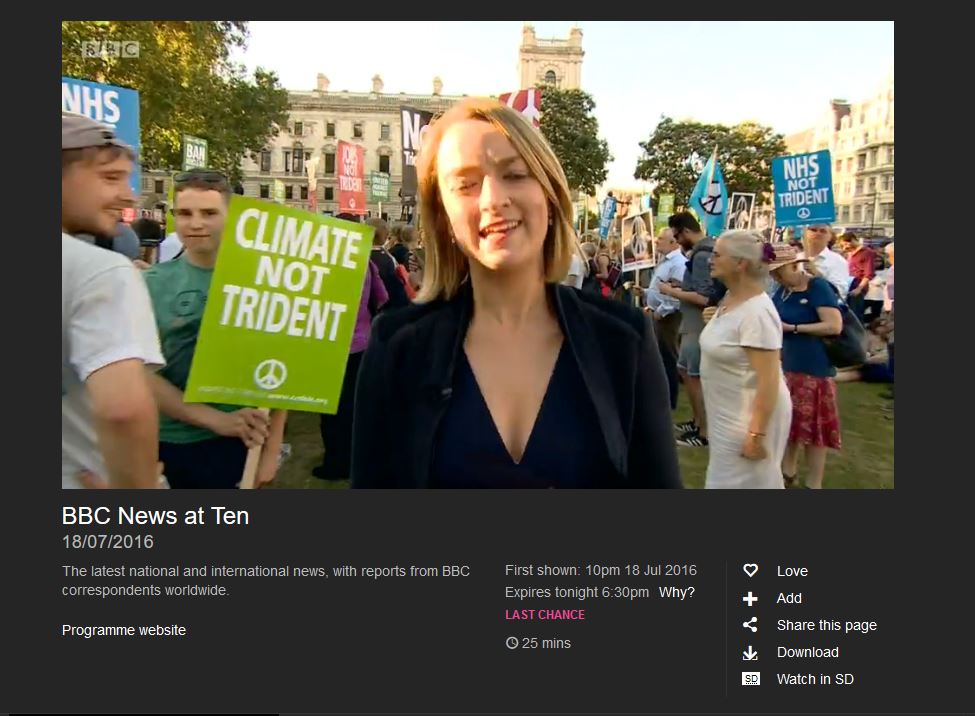
Monday evenings vote by the UK parliament to renew the Trident nuclear weapons programme which is planned to begin in the early 2030s at an estimated cost of £205 billion, speaks volumes about the malaise at the heart of British parliamentary democracy. The disconnect between Labour members and the Parliamentary Labour Party (PLP) is, in part, indicative of this broader schism in liberal social democracy more generally.

This is highlighted, for example, by the fact that the democratically-elected leader of the Labour party, Jeremy Corbyn, who commands a 20 point lead over his rival, Owen Smith in the renewed challenge to his leadership set for September, voted against the renewal of Trident, while 60 per cent of Labour MPs, the vast majority of whom are opposed to Corbyn’s leadership, voted in favour.

The replacement of the current stock of nuclear submarines is predicated on the 2006 White Paper, The Future of the United Kingdom’s Nuclear Deterrent, which asserts that the UK needs nuclear weapons in order:

to deter and prevent nuclear blackmail and acts of aggression against our vital interests that cannot be countered by other means.

The assumed logic underpinning this reasoning is that nuclear weapons provide states with the protection they need against potential adversaries. On the basis of this reasoning, it is impossible to avoid the conclusion that theoretically and, as an issue of consistency, every state should be allowed to obtain nuclear weapons. But contrary to state propaganda, this eventuality will inevitably make the world less, not more, safe. As Caroline Lucas eloquently and succinctly put it when she addressed PM, Theresa May, during the parliamentary debate:

“If keeping and renewing our nuclear weapons is so vital to our security and safety, does she accept the logic of that position must be that every other single country must seek to acquire nuclear weapons? And does she really think that the world would be a safer place if it did? Our weapons are driving proliferation, not the opposite.”

One only needs to look at the example of Iraq, which was attacked on the basis that Saddam was said to have had in his possession a functioning weapons programme that could be used to attack Britain within 45 minutes, in order to underline the truth of Lucas’ argument.

Secondly, both the Conservative and New Labour establishments’ claim that the Trident system is an ‘independent’ nuclear deterrent doesn’t stand up to scrutiny either. The reality is that Britain is currently only one among nine states ­in the world that does not possess an independent functional nuclear weapons system and the means to deliver it.

The notion then, that a U.S-supplied UK missile system is free to strike any target in the world is fanciful, particularly as its functionality is dependent upon the vagaries of US-UK relations at any given time. Of course, all of this is underscored by the fact that under the terms of the Nuclear Non-Proliferation Treaty Britain has an obligation to disarm.

The third illustration why Trident renewal is unsound, relates to the nature of the threats societies’ face in the 21st century. The 2015 National Security Strategy sets out the tier-one threats faced by the UK. These are international terrorism, climate change and cyber-crime. The obvious reality is that nuclear weapons are not a deterrent against any of these threats. How is it the case that over 180 countries in the world don’t feel the need to acquire this ‘deterrent’?

As the governments own Strategic Defence Review suggests, the threat of nuclear war is rated a two-tier level risk below international terrorism, climate change and cyber crime. It’s precisely because we live in an uncertain world where more countries aspire to get nuclear weapons, that the opportunity for terrorists to get hold of nuclear material becomes greater. The fact that nuclear weapons make the world less safe is the central premise which determines an ongoing UN process involving some 130 countries who are engaged in discussions about banning nuclear weapons. Unsurprisingly, the UK government is not a party to these discussions.

The arguments for maintaining Trident fall like a house of cards whose foundations are built on sand. The theory that having nuclear weapons makes the country safer is an entirely unproven one, and nor can it be proven. In logic, one cannot prove a negative insofar that doing something causes something else not to happen. The reason why nuclear attacks haven’t happened since the U.S attack on Japan, may be the result of any number of factors, or simply may be due to exceptionally good fortune. Indeed, many military experts argue that nuclear weapons make the country less safe, primarily because it increases the likelihood of them being used.

Britain’s possession of nuclear weapons exacerbates uncertainties and leads to the very scenario it is designed to avoid. If Trident is so effective in protecting the British people, why is it also not the case for every other country in the world? How can the UK government possibly try to deny the right of other countries to acquire them under circumstances where the UK government upgrades its own nuclear weapons?

The one argument that the proponents of Trident renewal frequently cite is the supposed loss of jobs that would allegedly result from any decision to de-commission or not to renew Trident. But, as SNP MP Mhairi Black argued in an erudite and passionate speech to the House of Commons, there is no evidence to suggest, given any political will to examine likely alternative employment opportunities, that job losses would inevitably be the result in any decision not to renew.

The billions that the government is proposing to spend on Trident renewal could conceivably be spent on utilizing the skilled engineers, scientists and other workers elsewhere by investing in energy, engineering and other alternative specialist areas. In addition, greater sums could be invested in preventing climate change. This latter diversification alternative would, as Black emphazises, seem to be particularly pertinent given that climate change is a tier-one threat. The notion that the Trident renewal argument as a defence against a two-tier threat trumps the threat posed by climate change which is a tier-one threat, defies all logic. As Peter Hitchens put it:

“Trident is like spending all your money on insuring against alien abduction, so you can’t afford cover against fire and theft.”

Furthermore, the decision to renew is both counter-intuitive and counter-productive. This is because such a process, as Caroline Lucas contends:

“gives out an incredibly negative message to the rest of the world that if you want to be secure then you have to acquire nuclear weapons. To that extent this vote will drive nuclear proliferation.”

Britain’s nuclear weapons capability does nothing to tackle the real threats the country faces. Rather, it has more to do with augmenting the perception throughout the rest of the world that a faded imperial power is still a significant player on the world stage. Maintaining a nuclear ‘deterrent’ is, in other words, about sending a message to the rest of the world that the projection of power by any means is necessary. Central to maintaining this illusion, is the assurance that the UK secures its permanent member status on the UN Security Council. The Trident nuclear weapons programme serves no other purpose than to satisfy the ego of the British establishment and the propping up of the arms industry.

In the context of an era of welfare retrenchment and austerity, the public are constantly being told by politicians that ‘difficult decisions’ have to be made in terms of the ‘necessity’ to cut disability, unemployment benefits and pensions, while the spending of billions on Trident is essential for their safety and security. The conservative political commentator and television personality, Michael Portillo, manages to cut through the spin as the graphic below illustrates:

As Portillo correctly implies, spending obscene amounts on what are frankly useless, unnecessary and immoral weapons of mass destruction, is an indefensible act of self-serving and short-sighted political narcissism.


The carnage in Nice didn’t emerge from a metaphorical clear blue sky

By Daniel Margrain

Bullet imacts are seen on the heavy truck the day after it ran into a crowd at high speed killing scores celebrating the Bastille Day July 14 national holiday on the Promenade des Anglais in Nice, France, July 15, 2016. © Eric Gaillard

There is something deeply unsettling about the manner in which President Hollande and other leading political leaders and powerful establishment figures responded in the aftermath of the violent carnage that occurred in Nice on Thursday evening. The rolling media coverage that followed this tragic event, was accompanied by the predictable rhetorical flourishes from across the political spectrum highlighting the need for terrorism to be defeated. After every tragedy of this nature the same kinds of statements are repeated again and again even though the politicians making them must know that such an eventuality is impossible. The kind of crude public pronouncements that invariably follow tragedies of this kind are, in other words, seemingly inevitable as they are intellectually indolent.

It would appear that the establishment’s intention after these kinds of appalling acts of violence occur is to reinforce the invocation of ‘loyalty oaths’ as part of a broader strategy to marginalize and isolate minority Muslim communities. Whenever, for example, an atrocity is committed by those who self-identify as Muslims, the wider Muslim community are effectively urged to pledge an allegiance to the country of their birth or, alternatively, they are encouraged to collectively condemn the violence ostensibly undertaken in their name. Often it’s both of those things.

Any attempts to resist apology projection is deemed by the establishment to be akin to a form of treachery in which tacit support for an official enemy is implied. Crude loyalty binaries are invoked. Opposition to this sort of binary analysis often evokes the specter of the ‘enemy within’ trope among significant sections of the corporate-controlled media and the political establishment. Thus, whether implicitly or explicitly, the result is that the Muslim community often ends up being tarnished with the ‘terrorist sympathizers’ epithet. Consequently, over time the Muslim community in France, and elsewhere, has tended to become less trustful and more fearful of the wider community and vice-versa.

It has been the inability of successive French governments to successfully integrate its Muslim community minority within wider mainstream French society that has in part contributed to feelings of alienation among this community which is exacerbated as a result of the mainstream media’s response to it. The alienation that Muslims experience in France cannot be separated from the broader sociological context in which the political situation described above also plays a significant role. In relation to how the sense of alienation has manifested in Nice, Sky News’ Sam Kiley remarked:

“In the emergence of an active criminal underworld there exists a natural synergy between organised crime and violent Jihadism. …A number of people from Nice have gone to fight in Syria and Iraq alongside Islamic State…The killer in this case, wasn’t one of them. This is somebody who was a petty criminal and who was possibly radicalized on the internet as opposed to somebody who had direct relationships with terror groups.”

Kiley continued:

“Many immigrants feel left behind and excluded from the opportunities in a way that some of the wealthier residents in the city don’t. This makes them easy prey for the radicalized programme which is very effectively campaigned by Al-Qaida and IS, both of whom have been encouraging their followers and disciples to be these lone-wolf characters to use vehicles to mow people down….We need to recognize that Tunisia is the single biggest foreign fighter volunteers that go to join the Islamic State. This has been the case for well over a year.”

The misplaced notion that any long-term sense of community cohesion has been overstated, has resulted in an intellectual and media narrative in which the great social conflicts and ideological struggles were said to have been a thing of the past. This notion gained intellectual credence following Francis Fukuyama’s End of History thesis. Numerous newspaper editors and television presenters agreed.

A little over a decade after Fukuyama wrote his thesis, it’s premise had been shattered by real life events when Islamist obscurantists attacked the Twin Towers in New York. The attack was, in part, the result of Wahhabism’s ideological opposition to Western imperialist hegemony. Anthony Giddens, the former director of the London School of Economics and court sociologist to Britain’s then New Labour Prime Minister, Tony Blair, repeated a similar message to that outlined by Fukuyama in his 1998 book, The Third Way.

Giddens who, by uncritically accepting a widespread but unsustainable assumption  said“We live in a world where there are no alternatives to capitalism.” Numerous imperial wars as well as counter-insurgent violence on Western soil have been launched since Giddens and Fukuyama made their remarks. Leaving aside the possibility of global catastrophe resulting from climate change or nuclear war, the notion that capitalism will continue to exist indefinitely into the future, is highly improbable. Moreover the notion that Islamist extremist violence does not represent an ideological challenge to Western imperialist hegemony in light of the numerous atrocities since 9-11, is clearly wishful thinking. The violence in Nice is, in part, indicative of the continuation of the reactionary forces who are opposed to Western imperialism.

It took the UK corporate media some 15 hours following the atrocity in Nice to actually address the likely causes of the attack. Speaking on Sky News, Anna Guidicelli, former security analyst at the French Foreign Office, was explicit in her assertion that the state of emergency system in France is politically motivated as opposed to operationally motivated, the intentions of which, she claimed, are to undermine civil liberties. Guidicelli stated that the state of emergency in France would do nothing to address the issue of prevention or to aid justice. “I’m convinced that the underlying problems are geopolitical”, she said. “I’m trying to stress to the government the significance external foreign policy plays in these kinds of attacks.”

Guidicelli continued:

“People are radicalized, not only because they are crazy and lost but because they have a political view. While we have to recognize that the launching of war abroad has an effect domestically, the real question we have to address, is what are the interests, as part of the coalition, does our government have in places like Iraq and Syria? We have to address this issue in parliament. When we launch war we say we are doing so in order to protect our territory. But it’s exactly the contrary to what is happening. Our contribution as a country to the coalition is lethal.

In emphazising the sociopolitical context highlighted previously, Guidicelli remarked:

The attacks in France are a consequence of a complex combination of both sociological and political factors. The problems are deep-rooted and in order to address them long-term in any fundamental way it is necessary to go beyond the five year mandated electoral cycle which is dependent upon short-term ‘solutions’. What we can do now as part of a long term mix is to withdraw our troops from the Middle East. What is disappointing is that the government is not addressing this external aspect.”

On the contrary, French foreign policy predicated on the concept of endless warfare, appears to be perpetuating the kind of violence witnessed in Nice that the establishment claims it wants to prevent. This concept evokes the Project for the New American Century which predates the US-led slaughter in Iraq, the emergence of Al-Qaida and IS and the attacks in New York that preceded them. It’s therefore not Islamist terrorism that represents the catalyst for chaos and destruction in the world, but rather the United States, it’s allies and their proxies.