
By Daniel Margrain
In 1978, the Australian social scientist, Alex Carey, pointed out that the twentieth century has been characterized by three developments of great political importance:
“the growth of democracy; the growth of corporate power; and the growth of corporate propaganda as a means of protecting corporate power against democracy.”
In order to defend their interests against the forces of democracy, the corporations that now dominate much of the domestic and global economies recognize the need to manipulate the public through media propaganda by manufacturing their consent. This is largely achieved through coordinated mass campaigns that combine sophisticated public relations techniques.
The result is the media underplay, or even ignore, the economic and ideological motivations that drive the social policy decisions and strategies of governments’.
Sharon Beder outlines the reasoning behind the coordinated political, corporate and media attacks on democracy:
“The purpose of this propaganda onslaught has been to persuade a majority of people that it is in their interests to eschew their own power as workers and citizens, and forego their democratic right to restrain and regulate business activity. As a result the political agenda is now largely confined to policies aimed at furthering business interests.”
This is the context in which the UK political and media establishment undermined former Labour leader, Jeremy Corbyn. The plot to oust Corbyn began the moment he became leader after a hardcore group that included shadow chancellor Chris Leslie, shadow education secretary Tristram Hunt, shadow communities secretary Emma Reynolds and shadow defence secretary Vernon Coaker, all refused to serve under him.
Others included shadow transport secretary Michael Dugher, shadow chief secretary to the Treasury Shabana Mahmood, shadow international development secretary Mary Creagh and shadow Cabinet Office minister Lucy Powell. These figures as well as the establishment in general were aware that Corbyn could not be bought off on their terms. The former Labour leader’s incorruptibility represented a potential threat to the gravy train that sustains them.
In other words, it’s not merely Corbyn who the establishment regard as a democratic threat to their hold on power, but what he represents as an example to others following in his foot steps which is the reason why, even now, they want to shut him up. It’s the potential of breaking the iron-clad neoliberal consensus that underscores what has arguably been some of the most vitriolic and biased reportage ever witnessed against any British political figure in history.
Media hate-fest
What Media Lens accurately described as a “panic-driven hysterical hate-fest right across the corporate media spectrum,” began the moment the plotting against him by members of his own party began. As the media analysts noted at the time of the leadership election, “the full extent of media bias against Jeremy Corbyn can be gauged simply by comparing the tone and intensity of attacks on him as compared to those directed at the other three candidates: Andy Burnham, Yvette Cooper and Liz Kendall.”
The level of the media attacks against Corbyn continued after he secured ‘the largest mandate ever won by a party leader’. The focus of these attacks included what colour poppy he would wear, his refusal to sing the national anthem or whether he would wear a tie or do up his top button. All of this was granted national news headlines and incessant coverage.
Not to be outdone, in October 2015, the BBCs political editor Laura Kuenssberg featured in an almost comically biased, at times openly scornful, attack on Corbyn’s reasonable stance on nuclear weapons. The BBC then broadcast five senior New Labour figures all opposing Corbyn without any opportunity for an alternative viewpoint.
Kuenssberg followed up this hatchet-job three months later when she helped to orchestrate the live resignation of Labour shadow foreign minister Stephen Doughty on the BBC2 Daily Politics show as a pre-requisite to accusing Corbyn’s team of ‘unpleasant operations’ and ‘lies’. Then came the April 12, 2016 Telegraph article – a non-story about Corbyn’s state-funded salary and pension.
Eleven months later (March 5, 2017), the same rag continued with the smears by suggesting Corbyn had paid insufficient tax on his declared annual earnings – a claim subsequently debunked within hours on social media.
Meanwhile, the news that then Tory Chancellor, Philip Hammond, refused point-blank to publish his own tax returns after being prompted to do so by his opposition counterpart, John McDonnell, did not receive anything like the same kind of media scrutiny.
The implication was that Corbyn had misled the public. However, similar media outrage was not leveled at then PM Theresa May after it was revealed (March 7, 2017) that she had lied to parliament after having falsely claimed that Surrey Council had not engaged in a ‘sweat heart’ deal with the Conservative government.
Academic studies indicate that when it came to criticising Corbyn’s political opponents, a completely different set of media standards were applied: A major content analysis from Cardiff University revealed that the BBC is pro-business and Conservative-leaning in its coverage. The London School of Economics and Political Science found strong media bias against Corbyn, claiming the press had turned into an “attack dog” against the opposition leader.
Popularity
According to content analysis from the Media Reform Coalition, the UK’s public service broadcaster gave double the airtime to Corbyn’s critics compared to his allies.
The anti-Corbyn propaganda was systematic and entrenched within both the legacy media and the Labour party hierarchy. Both were determined to topple Corbyn, using ‘anti-Semitism’ as a weapon to achieve it. Journalists Tony Greenstein and Asa Winstanley were among the first to highlight the politically-motivated smears of the pro-Israel lobby against Corbyn.
In an excellent piece published by the Electronic Intifada (April 28, 2016), Winstanley outlined the links between right-wing, anti-Corbyn and pro-Israel forces within the Labour party. Winstanley meticulously showed how this lobby manufactured an ‘antisemitism crisis’, pinpointing the individuals involved, the tactics and dirty tricks used and the connections to powerful individuals whose ties lead to pro-Israel groups both in London and Israel.
One of key contrived ‘antisemitism’ accusations levelled at Corbyn during this period was by Labour MP, Ruth Smeeth who Wikileaks revealed is a ‘strictly protected’ US informant. Smeeth staged a highly publicised walk-out on June 30, 2016 during Corbyn’s launch of a review into the Labour party’s supposed ‘anti-semitism crisis’ which, as Jonathan Cook pointed out, was in fact, “a crisis entirely confected by a toxic mix of the right, Israel supporters and the media.”
A few days earlier another manufactured and staged anti-Corbyn story made the headlines. This time it centred around a Corbyn ‘heckler’ at Gay Pride, who in fact, as Craig Murray observed, turned out to have been Tom Mauchline. At that time Mauchline worked for the public relations firm, Portland Communications, whose ‘strategic counsel’ is Alastair Campbell, Blair’s former media chief who helped to sell the illegal invasion-occupation of Iraq.
In addition, Corbyn’s pro-Remain position with respect to the EU referendum provided his critics with the ammunition they needed in their attempts to undermine him further. Chief among these critics was Angela Eagle.
Eagle was one of the many Oxford-educated Blairite plotters who resigned her post in order to position herself as a potential replacement for Corbyn and who claimed to be dissatisfied with his performance during the EU referendum campaign. However, as the graphic below indicates, Corbyn did much better than Eagle in defending their respective Remain positions:
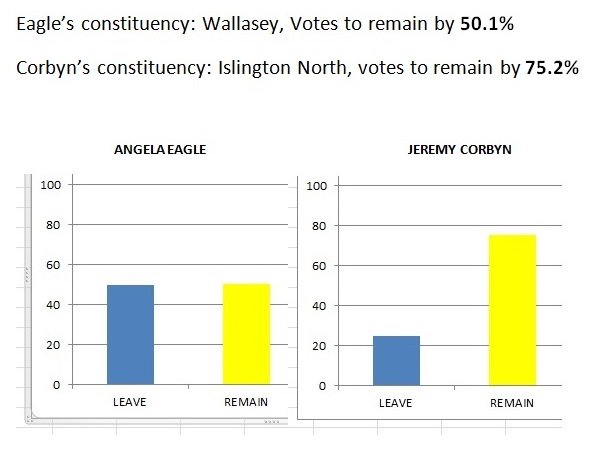
The Labour party gained 60,000 members in one week following the attempted coup against Corbyn. Membership levels were higher under Corbyn than the previous peak of 405,000 last seen under Tony Blair’s leadership. In his constituency of Islington North, Corbyn inherited a majority of 4,456, which increased to 21,194. He’s one of the few Labour MPs whose vote increased between 2005 and 2010, when he added 5,685 to his majority.
Furthermore, under Corbyn’s leadership, London, Bristol and Greater Manchester ushered in Labour mayors, rolling back years of Tory dominance, while Labour’s majorities in by-elections had generally increased.
It should also be remembered that pre-coup, Labour led the Tories in three polls in a row over 41 days. The long-term decline in Labour’s fortunes that preceded Corbyn can hardly be blamed on the then Labour leader. Nevertheless, these positive Corbyn statistics didn’t stop any attempts by opportunistic and self-serving careerists within the party to undermine him.
Corbyn’s alleged weakness at the dispatch box was presented as evidence of ‘ineffectual opposition’ despite the fact that under his leadership the Tories had been forced into some thirty policy u-turns. In terms of some of the core domestic policy issues, Corbyn maintained the support of the majority of the British public.
However, the establishment insisted he was ‘unelectable’. As one commentator on twitter put it, ”un-electable is media-political code for ‘likely to be highly electable but ‘will not serve elite interests.’”
Snap election
Following Theresa May’s surprise decision to call a snap election for June 8, 2017, the media bias against Corbyn ramped-up another notch particularly by, but not limited to, the gutter Murdoch press.
During the build-up to the General Election, the BBC for example, no longer even pretended to be impartial, as the Tweets below illustrate:
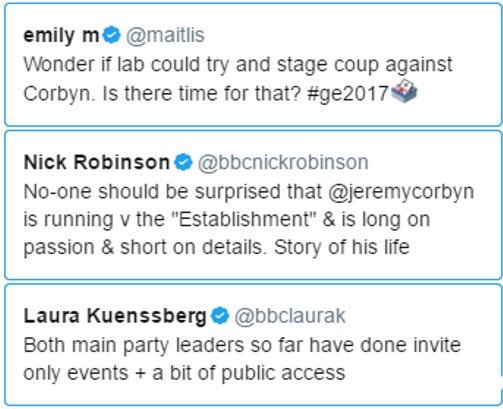
Laura Kuenssberg, more than any other BBC correspondent, appeared to have had a particular dislike for Corbyn that bordered on the outright contemptuous. This hatred was best summed up by Media Lens who critiqued Kuenssberg’s “subtle insidious use of language” in a BBC hit-piece.
It was hardly a surprise to learn that the kind of sustained attacks against Corbyn were the result of an increasingly concentrated foreign ownership of the UK media. This media made it clear they supported the Tories in the build-up to the General Election, not least because of Theresa May’s hard Brexit strategy at that time.
The mass media frequently depicted May’s stance as indicative of her ‘strength and stable’ leadership. Conversely, their antagonistic tone and depiction of Corbyn as weak and calamitous, was the opposite of the truth.
In a rare moment of honesty, The Guardian’s Roy Greenslade wrote:
“Mainstream media as a whole took its gloves off and Corbyn’s electoral hopes have been doomed from day one. He was “a great leap backwards”, said the Mail. Beware this “absurd Marxist”, said the Express, while the Daily Telegraph referred to his “divisive ideology” and “atavistic hostility to wealth and success”. And the Sun? It just called him “bonkers”. There was scepticism too from the liberal left. The Independent thought he would not persuade middle England to accept his policies.”
Greenslade continued:
Neither the Daily Mirror nor the Guardian greeted Corbyn with open arms. Support for him on social media made no impact. Meanwhile, the overall anti-Corbyn agenda, repeated week upon week, month after month, was one that broadcasters were unable to overlook, despite their belief in balance and adherence to impartiality. News bulletin reports reflected the headlines. Current affairs programmes picked up on the themes. That’s how media narratives are constructed.”
Strategies
The election campaign strategies of the two leaders couldn’t have been more different. While May’s robotic and lacklustre performance overseen by Lynton Crosby’s single issue Brexit strategy was engineered to avoid public and media scrutiny, Jeremy Corbyn’s campaign was marked by a willingness to engage with the public. While Corbyn had been open, transparent and accountable, May had been robotic, secretive and aloof.
While May came across as cold, calculating and lacking in human empathy, Corbyn came across as being totally at ease with the public, smiling and relaxed in their company. Corbyn openly espoused his philosophy and numerous policy initiatives, many of them significant. May, by contrast, appeared to have no policies to discuss and came across as instinctively autocratic and awkward.
Whereas Corbyn’s campaigning had been marked by spontaneity and a willingness to reply to previously unseen questions in public meetings and press conferences, May’s series of highly evasive stage-managed PR stunts were exemplified by an eagerness to rely on focus groups and a carefully selected media who provided her with pre-vetted questions by the Tory Party.
The attempts by the Tories to restrict the media from asking May any probing questions, was highlighted by Channel 4 News journalist, Michael Crick, after he admitted to apparently being shocked that “reporters collaborate with May’s press team by agreeing to reveal their questions to them in advance.”
The BBCs Eleanor Garnier, on the other hand, was clearly of the opinion that May was not subject to this kind of overt media censorship. Garnier tweeted: “I didn’t discuss question or topic of question with May’s team. If I was ever asked to give my question there is no way I would. Ever.”
Whatever is being taught on journalism courses these days, the work of Chomsky and Herman is clearly not on the syllabus. My advice to Garnier is to spend 30 minutes watching Chomsky’s demolition of Andrew Marr before taking on her next journalistic assignment.
That Garnier, as a BBC journalist, failed to recognise that access is determined by the lack of difficult or challenging questions indicative of how the media works, is frankly staggering.
What is equally staggering, is the fact that lack of access and the closing of journalistic ranks with the governments complicity, is not seen as an outrageous attack on civil liberties, democratic accountability and press freedom.
In Britain in 2017, arguably for the first time, the public were faced with a situation in which they were denied information to enable them to be able to make informed choices ahead of a General Election. Craig Murray, succinctly expressed his outrage at that time:
“The idea that the head of the government both gets to choose what they have asked, and gets advance warning of every question so they can look sharp with their answer, is totally antithetical to every notion of democratic accountability. If we had anything approaching a genuine free media, there would be absolute outrage. All genuine media organisations would react by boycotting such events and simply refusing to cover them at all.”
It should be remembered that Theresa May, like Rishi Sunak, was not elected as PM. This was a period that mainstream political historians and journalists ought to reflect on with some degree of humility. The obtusiveness, obfuscations, evasiveness and total disregard for democracy and public accountability often associated with Boris Johnson, didn’t begin with him. Rather, Britain’s descent into authoritarianism began under the Cameron administration but mushroomed under May’s leadership.
If the UK media at that time had reported the British political and media system with honesty, then they would have acknowledged similarities to North Korea. What has happened in Britain from the Cameron, and particularly the May years, is that basic democratic norms have been trampled on.
Unfortunately, those who believe the situation will change for the better under a future Labour government led by Keir Starmer are sadly mistaken. It is not widely known that the Labour leader and establishment stooge, Sir Keir, is a member of the Trilateral Commission, an organisation that thinks the problems of governance “stem from an excess of democracy.”
As Britain’s descent into authoritarianism continues apace, hardly anybody, either within the political and media establishments, or among the wider public more generally, appear to have blinked an eyelid at the prospect.

 Road To Somewhere Else