
New Media & Censorship

By Daniel Margrain

During the height of the anti-capitalist movement in 2002, I wrote a paper as part of my MA in which I said:

“The growth of new (physical) technologies allied with the development of the (virtual) media, is resulting in the revival and reworking of the classical ideal of an actively engaged and responsible citizenship. It is my contention that established media and virtual media will increasingly contest for spheres of influence in ‘cyberspace’. The extent to which one or the other establishes spatial dominance is likely to shape the nature of politics in the new century and therefore determine a new set of socio-political relationships.”

Global village

The development of new media corresponded to what Marxist geographer, David Harvey, referred to as “time-space compression” brought about by the growth in global communication networks which has its genesis as part of a concept of what became known as the “global village” – a term first coined by Marshall McLuhan in 1962. Having since become a cliche of global communications, it describes, in the loose sense, how citizens of the world who have communication tools at their command, can communicate and share interests across the world, just as they might across a village street.

More importantly, however, McLuhan claimed that the dominant mode of communication in the earlier part of the century had been written and printed. Even modes like the telegraph message and air letter were communication in print. This was formal communication typical of the hierarchical and procedurally bound societies of the time.

Conversely, in the global village, television, telephone and other electronic communication restored a formal oral culture in which informality and impermanence were the characteristics. This cut across the formal structures of existing political organisations.

The significance of McLuhan was that he anticipated the phenomena of virtuality and interactivity, the dissolving of traditional structures and patterns and the compression of time and space. One of the main technological manifestations that facilitate the latter is the growth of telecommunications infrastructure.

Power structure

It is the integration of global communication networks – telecommunications, computing and media technologies – that forms the basis of the internet and ISDN traffic. From its small military beginnings in the 1970s and 1980s, the former has opened up the possibility of a genuine new form of community. Over twenty years ago, John Allen and Chris Hamnett even went as far as to argue that the internet would bring about the “death of geography.”

But what McLuhan and Allen and Hamnett overestimated was the extent to which the global village would remove old hierarchies and social gradients. Correspondingly, they underestimated the ability of the new technology to reinforce existing socioeconomic patterns of inequality and structures of power.

Not only has the the new technology installed a new form of communicative apartheid as evidenced by the uneven global spread of internet hosts and web users, but the nature of this trend also gives the illusion of empowerment. In their 1997 book, The Global Media,  Edward Herman and Robert McChesney are rightly critical of the notion that the growth in internet use results in the ability of humanity to leapfrog over existing forms of corporate communication, citing the internet’s rapid commercialization which functions in sharp contrast to it.

While in theory, the development of the internet is the potential catalyst for an active, responsible and informed citizenship to grow, the reconciling of technology with a democratic utopianism presupposes that those who control communications technology are politically and ideologically impartial in a way that the British state broadcaster, for example, is not.

The notion that BBC news journalists are impartial and that their role is to bring power to account, is based on a collective delusion. In Inventing Reality: The Politics of the Mass Media, political scientist, Michael Parenti argues that these kinds of journalists:

“Rarely doubt their own objectivity even as they faithfully echo the established political vocabularies and the prevailing politico-economic orthodoxy. Since they do not cross any forbidden lines, they are not reined in. So they are likely to have no awareness they are on an ideological leash” (1986, p.25).

But surely establishment journalists are free to say what they want in a democracy?

In 1996, Noam Chomsky challenged the assertion made by the BBCs Andrew Marr that his views were not the product of a form of self-censorship. Chomsky said:

“I’m sure you believe everything you are saying. But what I’m saying is, if you believed something different, you [Marr] wouldn’t be sitting where you are sitting.”

In other words, as Michael Parenti commenting on how media bias manifests, said of establishment journalists like Marr: “[Journalists] say what [they] like because they [their proprietors] like what [they] say.”

Propaganda

If the internet is to successfully leapfrog over what John Pilger describes as “the best, most sophisticated propaganda service in the world”, it must free itself from the forms of control indicative of its traditional counterparts.

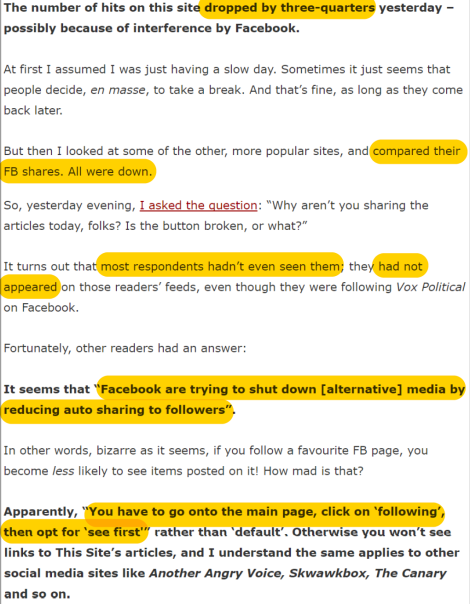
Launched in February, 2004, the on-line social media site, Facebook, looked like it offered a genuine avenue for alternative forms of information to flourish freely. But recent evidence uncovered by the website Vox Political points to attempts by the corporation to suppress this free flow of information (see graphic below):
vox.png

According to another popular left-wing site, Skawkbox, statistics for its blog “show a ratio of around four or five visitors via Facebook for every one via Twitter. Over the last few days that has dropped to around one and a half Facebook referrals to every Twitter visitor.”

This is in line with additional analysis which suggests that new Google algorithm’s are restricting access to other left-wing progressive web sites.

The question of whether the cultural globalization of virtual space will result in the homogenization and neutralization of public and political discourse in similar ways that have befallen the traditional media, is likely to depend on the extent to which it is subject to the same distorted relations of economic power. For a liberal democracy like the UK that boasts about its plurality, the signs do not appear to be encouraging:

“Frank Beacham who enthused about the internet as a public sphere outside of corporate or government control in early 1995, lamented one year later that the internet was shifting ‘from being a participatory medium that serves the interests of the public to being a broadcast media where corporations deliver consumer-orientated information. Interactivity would be reduced to little more than sales transactions and e mail.” (Herman, E. & McChesney, R. (1997) ‘The Global Media’, p.135).

Commercial values

The implication is that the nature of the new, as with old, media content is implicitly and explicitly determined or influenced by advertising and commercial values. A key issue relates to whether information that is not influenced by the above factors is freely accessible in other forms. The main problem with liberal democracies is not necessarily that information is unavailable to the public, or that voting procedures, for example, are too cumbersome, rather it is the public’s lack of scepticism and desire to root out the facts (See for example, Hirschkop, K. in Capitalism and the Information Age, 2000).

The spread of the internet in such a situation, therefore, increases the access to far more information that would otherwise be the case with traditional forms of media. But access by itself is not the principal problem. Knowledge is not the base of its authority but its instrument. It is within this context that new media is unlikely to prove qualitatively different from the old. However, it is by its nature, likely to alter our perceptions of political space, relations to power and historical forms of rule.

In terms of production networks, global media output and global multinational capital both need technology in order to expand, just as much as technology needs multinationals and governments to globalize spaces of capital and new media through economic liberalization. Thus, globalization, technology, new media and the dominant relations of economic power are inter-connected. Moreover, as Robert McChesney asserts, these factors are reinforced by an uneven balance of power for the benefit of corporate-media political culture:

“A market dominated political economy tends to produce exactly such a political culture, to some extent because commercial penetration tends to undermine the autonomous social organisations that can bring meaning to public life…A capitalist society works most efficiently when the bulk of the population is demoralized and effectively depoliticised…As the Financial Times put it, ‘capitalist democracy can best succeed to the extent that it is about ‘the process of depoliticising the economy.’ The global commercial media are integral to this depoliticization process” (1997, pp.16-17).

Whether virtual space can bring about a new democratic polity based upon notions of social, economic and political justice, will depend on whether networked technologies are able to break free from the grip of the distortions that reflect the overriding interests associated with traditional forms of media proprietorship.

Ultimately, new media is shaped by the ideology of power, not democracy. In the context in which a Guardian editorial recently argued that “censoring the internet is necessary”, and a mainstream media which historian Mark Curtis contends, “keeps the public in the dark about virtually every important current and historical policy”, the stakes could hardly be higher.

I rely on the generosity of my readers. I don’t make any money from my work and I’m not funded. If you’ve enjoyed reading this or another posting, please consider making a donation, no matter how small. You can help continue my research and write independently..… Thanks!


Donate Button with Credit Cards

Bony & Clyde

By Daniel Margrain

My first distinct memory of being a West Ham United fan was in 1971. More specifically, it was the brief appearances for the Hammers of the young Nigerian cult figure, Ade Coker, that first excited me the most as a nine year. That said, it was his occasional striking partner, Clyde Best, who is the player I most fondly remember from this period. I was rather proud of my club for having been one of the first in the top tier of the professional English game to have brought through the ranks both African and a wind rush generation of players from the Caribbean.

This was a period in time when white TV entertainers ‘blacked up’ as part of their role as performing minstrels on what passed for peak time Saturday night light family entertainment on the BBC. It’s also a time when people laughed at unfunny comedies of the ilk of ‘Mind Your Language’ and ‘On The Buses’ – the former having played on the crudest forms of racial stereotyping imaginable for its ‘laughs’.

As a skinny nine year old boy I remember seeing much older and bigger gangs of “suede headed” Doc Martin booted bovver boys on TV and remember seeing them on the streets of Barking and Upminster during times when we used to visit our relatives. I sometimes used to have nightmares that these older lads were Chelsea fans and would find out I was a West Ham fan and West Ham had black players playing for them who they hated.

This hatred of the ‘other’ was an integral feature of everyday life, not only in Basildon, my hometown, but throughout other working class communities up and down the country. It was normal for my parents’ generation at that time to openly address ‘concerns’ they had of ‘coloured’ people moving into their streets on mass for fear of the ‘locals’ being ‘taken over’ and thereby potentially reducing the value of their homes.

This was of course nonsense, but hopefully it does give the reader a sense of what growing up was like for many in the early 1970s. The truth is, in all my formative years living in this post-war version of somebody else’s notion of egalitarian Utopianism, I rarely, if ever, crossed paths with a black person.

To this day, I’ve not experienced a time when the gap between perception and reality has been wider. Ignorance and irrational fear is the food racism feeds on and it was difficult to envisage any group of people that were more ignorant and irrationally fearful than post-war white working class communities fed on an almost daily diet of ‘rivers of blood’ that helped sustain the National Front’s appetite for violence.

These were, then, strange and confusing, but also extremely happy times for an impressionable young boy trying to make his mark within an Essex new town in which celebrities as diverse as Bob Marley, David Bowie and Dick Emery played a strangely equal, but significant, part.

As black people began to increasingly make inroads in public life, professional football became the most visible and positive representation of this change for my class and generation. As hard as it is to imagine nowadays, black players in England, right up to the era of John Barnes and Viv Anderson, were still targeted by hooligans on the basis of the colour of their skin.

As a 10 year old, I remember being called a ‘traitor’ for supporting a club that had black players playing for it – the same club that six years previously had essentially won England the world cup. It was generally the case that West Ham United fans at that time used to get a lot of stick from the fans of other London clubs for no other reason than we had black players playing for us. I loved the fact that the club were different in that regard.

My memories of the young Nigerian striker, Adi Coker, have been largely clouded by the passing of time, but Clyde who played for us longer, and was a more regular feature in the teams line-up, I remember well. For some reason I used to refer to him as Clive Best (probably because I confused him with one of the other black players, Clive Charles) for quite a time. It was only when I read the team line-ups on the back of the match day programmes, that I realized his name was in fact ‘Clyde’.

Of course, there was another Best earning his living for some other team in some other strange and mysterious city in another part of the country somewhere up north where the people spoke funny, and which at that time seemed like the equivalent in distance to what London is to Berlin now. Sadly, Clyde was overshadowed by George which peeved me off, but then again the same applied to every other football fan in the country, whose players were overshadowed by the Belfast genius. I took a great deal of consolation from that.

I recently saw a George Best documentary on TV where they showed the famous clip where the ball wizard turned West Ham defender John McDowell inside out. That’s one of my first memories of a football match and I can say that I saw one of the greatest players of all time at the peak of his powers.

Anyway, I digress. Best (that’s Clyde not George), was born in Somerset, Bermuda, in 1951 having played 218 games and netting 58 goals for West Ham over seven seasons between August 1969 and January 1976. Long before John Barnes was pelted with bananas by knuckle-dragging morons, Best was the brunt of racist chanting from the terraces, not just by opposing fans but I remember him being abused regularly by a sizeable minority of West Ham fans too. They weren’t abusing him because of any perceived lack of footballing ability.

This happened regularly but it gradually subsided when the racists began to cotton on that he actually played better when they stopped abusing him. For one thing, Clyde put in 100 per cent on the pitch during almost every game. One of the reasons why Best still resonates with me all these years later is that then, as now, I have a tendency to empathize with the trials and tribulations of the underdog fighting against seemingly insurmountable odds.

I think Clyde fell into that category, although one against one, he was big enough, I’m sure, to have handled himself quite adequately off the pitch. On the pitch he was no slouch either. What he lacked in pace and a certain degree of technical ability, he gained in physical strength, power and on the field presence. This was a guy who wasn’t afraid to get stuck in and work hard.

In that sense, he was similar to Andy Carroll, that is to say, he possessed the kind of skills of the traditional English centre forward. He held the ball up well and was tough to dispossess when he had it at his feet. Like Carroll, he was particularly good in the air.

I often thought that he was underrated by critics at the time who by and large, in my view, tended to overlook the finer points in his game like deftness of touch and finesse which, for a big man, I thought he combined very well with his power.

Older readers who are familiar with Best and saw him play, will probably think I’m over-egging the point when I say that he reminds me to a large extent of the currently on-loan Manchester City striker Wilfried Bony (which is in anybody’s book is high praise indeed).

In general, it is arguably an exercise in futility to try to compare the quality of teams or players from different eras other than perhaps to focus on certain characteristics and styles of playing that made them similar. Physically Bony appears to have a similar build to Best at his peak and, I would argue, plays a similar type of game.

Although Bony’s current record of 43 goals in 77 premier league appearances thus far, is double that of Best’s career at West Ham, it’s the former attributes that remind me of Clyde. Overall, though, I think that Bony is a much more technically gifted player than Best was. Like Clyde, Bony is not a regular on his managers team sheet. After going seven games without a goal for his on-loan team, Stoke, he scored twice in a 3–1 victory over his former club Swansea City on 31 October 2016. After turning down a transfer to a Chinese club, the Stoke manager, Mark Hughes, left Bony out of his squad.

Personally, I would love to see West Ham put in a bid for Bony at some point before the transfer window closes. Seeing him play upfront at the Olympic Stadium with a creative midfield play-maker providing him with the ammunition would, in my view, suit the team down to the ground, particularly as the tactical trend seems to be reverting back to good old 4-4-2.

During an era when black players were virtually unknown at the top tier of the game, a great deal of credit has to be given to Ron Greenwood who brought Clive Charles, Ade Coker and Clyde Best to the fore by playing them alongside legends like Bobby Moore and Geoff Hurst. Greenwood was among the first managers to realize that football was becoming a form of entertainment as opposed to merely a sport.

Of course, it was the late, great, Jimmy Hill who was one of the central pioneering figures that combined many other factors together to provide the conditions for the current premier league football to thrive. With the third week of the season beginning today (August 26) and with the Hammers currently bottom of the league, the killer instinct of an unsettled Bony will be the perfect addition to the West Ham squad, who would likely be far more clinical in front of goal than Clyde was.

I rely on the generosity of my readers. I don’t make any money from my work and I’m not funded. If you’ve enjoyed reading this or another posting, please consider making a donation, no matter how small. You can help continue my research and write independently..… Thanks!


Donate Button with Credit Cards

Incontroverti-Bull

By Daniel Margrain

The intention of successive US governments since the mid-1990s has been to shape the world for the next hundred years according to the interests and values of American free-market capitalism. This agenda was codified in the Project for the New American Century many years before obscurantist Islamist terrorists flew planes into the Twin Towers in New York – an event that many conspiracy theorists claim was an ‘inside job’.

The contention the American’s did not plan and execute 9/11 is of course different to suggesting that they didn’t exploit the event, politically, for their own nefarious ends. The tendency among the truth movement is to seize upon, and brandish, anomalies and coincidences as if they were facts and then present them as being indicative of the majority of expert opinion.

The notion that a huge volume of evidence trump relatively small anomalous evidenced-based details, and that planes laden with jet fuel smashing into the World Trade Center in New York is the most probable explanation for the buildings subsequent collapse, are scornfully dismissed.

The Bush government’s secrecy, belligerence and dishonesty, in addition to the numerous proven conspiracies from previous historical events are also invoked as evidence of the veracity that one of the most inept governments in US history who were incapable of faking WMD, masterminded the attack while wiring every floor of the Twin Towers so that they would detonate in a perfectly timed sequence. If you reject one particular theory, there are plenty of others, many of which emanate from Architects and Engineers for 9/11 Truth – the bible for the truth movement.

According to The United States Census Bureau there are 233,000 architects and 2,495,000 engineers in the United States. Only 1,761 out of 2,728,000 joined Architects and engineers for 9/11 truth. That’s 0.065 per cent of the total. And I haven’t even looked at whether the architects and engineers listed were in fields in any way relevant to the Twin Towers.

Experts

Although the tiny minority of ‘experts’ and others who support the perspective of the truth movement might know nothing about physics, structural engineering, ballistics or explosives, they still feel able to assert that the vast majority of experts in these fields are wrong and that they are the only ones qualified to assess probability, with the elevation of remote possibility to cast iron certainty. Taking into consideration the balance of probability, the notion that the neocons planned and executed 9/11 is remote.

Given that over 99 per cent of the experts in the field have not endorsed the position of 9-11 truth, its reasonable to assume that the former, with justification, do not want to be seen as endorsing the latter for fear of undermining their own credibility.

In 2006, Noam Chomsky gave some helpful advice to people who believe they have physical evidence refuting the collective judgment, position, and opinion of the community of scientists in this particular field of study (ie scientific consensus):

“There are ways to assess that: submit it to specialists . . . who have the requisite background in civil-mechanical engineering, materials science, building construction, etc., for review and analysis. . . . Or, . . . submit it to a serious journal for peer review and publication. To my knowledge, there isn’t a single submission.”

Philip Roddis points to some of the epistemological aspects of 9-11 conspiracy theories:

  • Evidential cherry-picking and egregious ‘quote mining’, hallmarks of evidence seized on or rejected according to how well it supports a priori conclusions.
  • Disproportionate emphasis on anomaly. One left critic… of 9/11 Truthism likens this to a death penalty defence team seizing on the anomolies even the best prepared and damning of prosecution cases must – such is life – contain, in order to sow the all important ‘reasonable doubt’. Such narrow tactics can backfire though, blinding the team to the overall strength of the case against its imperilled client.
  • Disproportionate attention to maverick voices and ‘outlier’ findings. This minds me of the way books for the lucrative miracle cure market emblazon their covers with references to The Study THEY Don’t Want YOU to Know About! while staying silent – ignorance or mendacity; it’s all the same to me – on the fact their killer study is at odds with every other finding in the field, and lacks peer review status.
  • Citing experts in disciplines only superficially connected. Loose Change is full of this: ‘mining experts’ – disquietingly affiliated to far right holocaust deniers – who not only pronounce on matters, like engineering and munitions, outside their fields but have a nasty habit of cross referencing one another in a cosy little circle.
  • Faulty logic, like presenting inductive possibility (inference) as deductive fact.
  • Failures re Occam’s Razor and the parsimony principle. One consequence of theory-expansion of the kind that draws Dylan Avery into the 9/11 conspiracy is a burgeoning complexity, jerry-built and inelegant, in explanatory power.

Building 7

The above represents the important ‘elephant in the room’ context frequently overlooked by the 9/11 truth movement. All of the theories have been roundly debunked here but I have been tasked with focusing on building 7 (WTC 7).

In his documentary film, Incontrovertible, Tony Rooke argues that the notion WTC 7 was brought down by a controlled demolition on September 11, 2001 is “incontrovertible”. Extraordinary claims like this demand extraordinary evidence. Rooke doesn’t present any.

The veracity of the claims made are in doubt from the opening few seconds after Rooke presents a caption that proclaims: “the views and conclusions in this film are those of your own colleagues (ie police, fire fighters and armed forces) all of whom have seen information and hard evidence that has been deliberately withheld from you by a so-called free press.”

Rooke does not explain that many of these workers are not qualified to be able to evaluate mountains of complex data, are not structural engineers or architects, have not written a peer-reviewed paper between them, that their views represent a small minority of opinion and have, in many instances, been cherry picked and edited.

The narrator, veteran British actor Michael Culver, who intones an air of a combination of gravitas, menace and emotion, imbues the announcement in the media of the collapse of WTC 7 before it happened as a “miracle”, when in truth it is nothing of the sort.

The BBC and others were monitoring the news from different outlets and that’s where they learned of WTC 7. According to the fire department, by 2 p.m there was a strong possibility the building would soon collapse, so its imminent demise was picked up by reporters. The fire department relayed information to reporters that the building was going to collapse. By the time it reached the BBC and CNN it may have simply been mis-communicated from “about to collapse” to “has collapsed”. The female BBC reporter even starts out by saying “details are very, very sketchy.” This is a clear case of journalistic incompetence which wouldn’t be the first time.

Culver then says WTC 7 “hit the ground within seven seconds.” This is factually incorrect. The evidence supports the NIST contention that the building collapse progressed from the penthouse out as columns were weakened by the fires. The slow sinking of the penthouses, indicating the internal collapse of the building behind the visible north wall, took 8.2 seconds according to a NIST preliminary report. Seismograph trace of the collapse of WTC 7 indicates that parts of the building were hitting the ground for 18 seconds. This means the collapse took at least 18 seconds, of which only the last approximately 15 seconds are visible in videos: 8 seconds for the penthouses and 7 seconds for the north wall to come down.

It was Galileo who dropped two cannon balls of different mass off the tower of Pisa and found that they both arrived on the ground at the same time. Therefore WTC 7 did not free fall because debris which was in free fall arrived on the ground first. This is basic physics which truther websites do not explain. NIST surmised that far from being impossible, the collapse turns out to have been inevitable. This was confirmed as a result of the findings of a peer-reviewed paper – the only paper which passed the scrutiny of peer review process regarding the WTC tragedy.

Explosions & controlled demolition

Claims of explosions are pure supposition. As very few people have experienced the sound of real-life explosions, how is it possible for the untrained ear to determine definitively that what was heard on 9/11 were the sound of explosions? Could transformers or other electrical equipment explain some of what the firemen saw and heard? What about an acre of concrete floor slamming into another? Would steel bolts snapping under tremendous tension make a pop or explosive sound? Assuming the towers weren’t in the vacuum of space, we can be fairly safe to say the things I mentioned are good candidates to explain what the firemen heard. I’ve viewed other clips where this is what some fireman have concluded as what they heard. This is a simple case of selective editing which is a common trick.

Testimonies from firefighters inside and outside of the building in relation to the damage caused are consistent, and demolitions experts who saw WTC 7 collapse neither saw nor heard anything indicating an explosive demolition. Nothing can be seen or heard in videos that resembles explosive charges going off before the collapse. Seismic data from multiple sources indicates that, as with the Twin Towers, the collapse of WTC 7 began slowly, completely unlike an explosive demolition but consistent with internal failures leading to global collapse (Source: Lamont-Doherty Earth Observatory).

Any detonation of explosives within WTC 7 would have been detected by multiple seismographs monitoring ground vibration in the general area. No such telltale “spike” or vibratory anomaly was recorded by any monitoring instrument. Explosive demolitions would not be very controlled, or likely to work at all, if they involved slamming tons of skyscraper debris through a building and then setting it on fire for seven hours. Precision explosives, timers, and wiring don’t like that sort of treatment (Source: Brent Blanchard of Protec http://tinyurl.com/z6zyc).

Controlled demolition expert, Danny Jowenko, who is quoted at 09.55, claiming definitively that what he saw, at that moment for the first time, was a controlled demolition is the view of one man who was asked to comment in an instance. The final NIST report in November 2008 into the collapse of WTC 7 proffers a more realistic explanation, namely, that fire was the main reason for the collapse, along with lack of water to fight the fire and falling debris which ruptured the oil pipes feeding its emergency generators.

The reduction in pressure triggered the automatic pumping system, which poured thousands of gallons of diesel onto fires which continued to burn throughout the afternoon on the lower floors. At 5.20 p.m. a critical column buckled, leading to the collapse of floor 13, which triggered a cascade of floor failures within the building, eventually leading to global collapse. The lack of water to fight the fire was an important factor. The fires, which were fueled by office contents and burned for seven hours, along with the lack of water were the key reasons for the collapse. Popular Mechanics magazine polled 300 experts who came to the same conclusions.

Although it wasn’t completely obvious to the untrained eye at the time, WTC 7 had been seriously compromised by a 20-story gash in one corner facing Ground Zero, and by the time the evacuation order of the building was given it was visibly sagging. Another claim by the truthers in the film is that “pull” is standard jargon within the demolition industry to fire off demolition charges within the building. Demolition experts have denied this; the usual term would be “shoot it” or “blow it.” “Pulling” refers to a procedure of attaching hauser cables to a building and using heavy vehicles to pull it over, something that would have been fairly easy for observers to detect.

Truthers also make false assertions in terms of the pancake theory which they claim has been debunked. But it is has only been “debunked” by the conspiracy believers. Actually, it is not a “theory” at all. It’s the most rational explanation and has been documented in a number of other high rise buildings around the world. Despite all this, realists are somehow expected to believe that either:

a) “Explosives” were planted when the buildings were erected. That would require the longest conspiracy planning in history.

Or:

b) They were planted later. In which case, who planted them? How did they do that in a building occupied by 50,000 people on a daily basis? Perhaps they did it on weekends when the building only had about 5,000 visitors /day?

This interesting set of videos, which are shot at different angles, clearly show Building 7 does not fall straight down. Culver announces that for 2.5 seconds, the WTC7 collapse was in free fall as if this was significant. This is another inaccurate statement – it was actually 2.25 seconds. Semantics aside, it isn’t significant and was even conceded by the official 2008 inquiry.

WTC 7 was not the first ever steel frame structure to collapse from fire, as many truthers claim. In addition, the building did not fall into its own footprint but left substantial debris scattered across the entire WTC complex site. The damage to WTC 7 was actually caused by debris from WTC 1, 370 feet away. A controlled demolition would presumably try to avoid such behaviour. If one accepts that WTC 7 was burning for many hours, it’s illogical to also propose the controlled demolition thesis because the one precludes the other.

The man at 11:10 who said he saw a “flash” inferring that it was indicative of an explosion, is mistaken. This is the flash in slow motion. It isn’t an explosion. What you see is window glass popping out as the floors collapse and compress the air inside. The sun is momentarily reflected in each pane of glass as it falls.

Larry Silverstein

Also featured in the film is the Larry Silverstein conspiracy theory which is roundly debunked here. To clarify the main points: Silverstein (the new leaseholder for the WTC) had been going to the Twin Towers “Windows on the World” restaurant (there were no survivors on this level) to dine and meet with his new tenants; he had been doing this straight since July 26, 2001. But on 9/11 he didn’t go because he claimed his wife made a dermatologist appointment for him. Many truthers also point out that in the interview which he is asked where he was on 9/11 he appears to be showing signs of lying.

It is very likely he was indeed simply going to a dermatologist appointment. Out of the thousands of people who worked at the site during the day, many dozens at any one time would have been on holiday, off sick or simply slacking on September 11th (a good half dozen well-known celebrities were involved in and avoided a potential end in the attacks). That one of these happened to be the owner isn’t remarkable. There are plenty of important traders who did die in the attack — by the logic that one escaped suggests a conspiracy, the fact that many died should discredit it, right?

Also going against the idea of advanced-knowledge is that Neil D. Levin, the head of the Port Authority of New York and New Jersey (which presumably would be “in” on any conspiracy), was killed on 9/11- while dining in the Widows of the World, no less. If there was advance knowledge, why was Silverstein informed while Levin wasn’t?

It has been repeatedly reported that Silverstein had insured the Twin Towers a year earlier, and it is more than “coincidental” that this insurance covered terrorist attacks. Further, Silverstein had numerous legal disputes that aimed to increase the payout by arguing that there were two separate attacks. To a first approximation, this was successful and Silverstein managed to claim approximately $4.6 billion.

But what conspiracy theorists don’t mention about this is that the total cost of the towers was significantly in excess of this — the insurance value was way below what it should have been. Most of the legal wrangling after the fact was also due to the insurance contracts being incomplete. The total cost of the attack would be in the region of $7 billion or more, leaving a considerable loss once the relatively measly insurance payout was claimed. With too low an insurance value and less-than-solid contracts, literally none of the insurance-based activities seem to point to the actions of people who knew exactly what was going to happen in advance. If it was an insurance scam, it was the worst ever.

The World Trade Center had already been bombed once before in 1993, and that several major terror plots against U.S. landmarks had been uncovered since then. In light of this, an anti-terrorism insurance policy would appear to be an entirely logical purchase.

Conclusion

All of the arguments and counter arguments presented in the documentary are well known. I could go on and demolish (excuse the pun) the remainder but I didn’t plan to write a book and the subject bores the pants off me. What I have presented in this article are the key points arguing against the notion that the destruction of WTC 7 was a planned controlled demolition. The film includes several well and lesser known clips of figures including John Kerry, members of the fire service on the day and much else all of which have rational explanations.

Rather like climate change deniers, 9/11 truthers cherry-pick their evidence and seize any excuse for ignoring the arguments of the vast majority of the relevant experts in the field including the only peer reviewed scientific paper that passed the peer review process. The evidence that planes smashed into the twin towers which triggered a set of events that resulted in their collapse, is overwhelming. But all this overwhelming evidence is not enough. Apparently, to qualify as an opponent of the neocons, it’s not sufficient to acknowledge that the Bush administration exploited the attacks on the WTC for their own political ends, but rather, one must also believe that it could blast the Pentagon with a cruise missile while persuading over a hundred witnesses that they saw a plane, wire every floor of the Twin Towers, detonate them in a perfectly timed sequence and make Flight 93 disappear into thin air while ensuring that the relatives of the passengers collaborated with the deception.

Further, one must also believe that it’s reasonable that none of the 16,000 uniformed or civilian members of the FDNY, or anyone else who was involved in this huge conspiracy, would, after 16 years, have come forward about these issues, or that a set of incompetent governments who failed to pull off Watergate and who were incapable of faking weapons of mass destruction, are all-seeing and all-powerful. People believe the false arguments of the 9/11 truth movement because it proposes a closed world that’s comprehensible and controllable, as opposed to one that’s chaotic without destination or purpose. That is my last word on this subject.

I rely on the generosity of my readers. I don’t make any money from my work and I’m not funded. If you’ve enjoyed reading this or another posting, please consider making a donation, no matter how small. You can help continue my research and write independently..… Thanks!


Donate Button with Credit Cards

Championing racism?

By Daniel Margrain

“For too long we have ignored the race of these abusers and, worse, tried to cover it up. No more. These people are predators and the common denominator is their ethnic heritage.”

These are not the words of Nigel Farage, Nick Griffin or Tommy Robinson, but allegedly those of former Shadow Secretary of State for Women and Equalities, Sarah Champion, writing in the Sun (August 12, 2017) in response to the recent Operation Shelter grooming case in Newcastle.

If Champion was quoted correctly in the article, it would appear that the Labour MP implied that there is something specific among Muslims or Pakistanis that makes them more likely to commit the crime of grooming and raping of girls and young women. Over recent years, this has become a common theme that is not restricted to those on the right of the political spectrum.

Political correctness?

The previous high profile case to make the headlines that involved the systematic abuse of white girls by a gang of Muslim men occurred in Rochdale from 2008. When then Tory Children’s minister Tim Loughton was asked about the subsequent trial, he said, “Political correctness and racial sensitivities have in the past been an issue.” Echoing Champion, Loughton added that the authorities still “have to be aware of certain characteristics of various ethnic communities”.

What is being impugned with the “certain characteristics” charge is the stereotypical notion that Pakistani, and by extension Muslim, men have a cultural predilection to child abuse, grooming and rape. It’s also difficult to square the notion that a police force that was sympathetic to the National Front during the 1980s could also be operating in “politically correct” or “racially sensitive” ways.

The unproven notion that questions relating to the cultural background of perpetrators inhibit the ability of the process of law to follow its proper course resulting from “political correctness”, adds to the stereotyping. Following the Rochdale case, for example, Baroness Warsi said:… “Cultural sensitivity should never be a bar to applying the law.” 

Warsi added:

“There is a small minority of Pakistani men who believe that white girls are fair game. And we have to be prepared to say that. You can only start solving a problem if you acknowledge it first… This small minority who see women as second-class citizens, and white women probably as third-class citizens, are to be spoken out against… Communities have a responsibility to stand up and say: “This is wrong; this will not be tolerated.”

Cultural norms

Among the mainstream media liberal commentariat who have responded to the reported spate of grooming cases, is right-wing TV historian David Starkey who proclaimed:

“If you want to look at what happens when you have no sense of common identity, look at Rochdale and events in Rochdale… Those men were acting within their own cultural norms.”

It is credit to Starkey that by specifically alluding to those men he potentially raised an important issue. The same can be said of Warsi’s careful use of language. In this context, it is worth recalling that Badrul Hussain, 37, who on August 16, 2017, was found guilty as part of ‘Operation Sanctuary’, said, “White women are good for only one thing – for people like me to f*** and use as trash.”

Is there a religious and/or cultural aspect that underpins this kind of mentality and is the literal translation of specific texts within the Koran used to justify the raping of white women by Hussain and other Muslim gang rapists?

LBC broadcaster, Maajid Nawaz, himself a Muslim, argues:

“There is a disproportionate problem with rape gangs in this country coming from people like me and my cultural background. That is something we simply have to talk about.”

Nawaz continues:

“Sarah Champion’s constituency, where she’s representing people in South Yorkshire, was the home to more than 1,400 hundred child victims of sexual exploitation between 1997 and 2013. A report into this grooming scandal, this rape scandal, found quote almost all of the perpetrators were of Pakistani origin. We simply cannot pretend this problem doesn’t exist and try and bury our heads in the sand.”

Whether these kinds of Muslim gangs are inspired by a literal (fundamentalist) translation of the Koran, or there are other cultural issues at play, what cannot be denied is the anti-white racism of Hussain, and by extension the other perpetrators of the crime.

This view was echoed by the head of the Crown Prosecution Service, Lord Macdonald, who following the conviction of 17 men and one woman in Newcastle, described the case as “profoundly racist.”

Despite this, however, there has not been the same denouncing of the “cultural norms” of how women are treated when it comes to non-Muslim sex attackers. Look no further than the number of footballers in cases of alleged rape. The gross custom of footballers or their representatives cruising the shops of Manchester picking up women to have sex with even has its own term, “harvesting”. These women are brought to clubs and hotels where they are then assumed to be willing to have sex with numbers of footballers—coined “roasting”, often while being filmed.

Misogyny

Following the five year jail term for the crime of rape by Welsh international footballer, Ched Evans, his sister and a group of fans tried to organize a public tribute to him as a show of support at a match. We do not see front pages devoted to denouncing the misogynist culture of football, or calls for footballers as a collective to examine why a number of their colleagues have been accused of sex crimes. Yet all the time Muslim representatives are called upon to denounce the crimes as if in some way by nature of a shared religion they are collectively responsible.

This notion of assumed collective responsibility is shared by Mail columnist, Melanie Phillips who suggested that:

“The police maintain doggedly that this has nothing to do with race. What a red herring. Of course it doesn’t! This is about religion and culture – an unwesternised Islamic culture which holds that non-Muslims are trash and women are worthless. And so white girls are worthless trash”.

This kind of crass generalization was reiterated by Labour’s Jack Straw in January 2011, after a case in which two Asian men were convicted of rape and sexual abuse in Nottingham Crown Court. Straw declared that young Muslim men were “fizzing and popping with testosterone” and saw young white women as “easy meat”.

The perpetuation of the kind of racist stereotypes and generalizations outlined are not only wrong but they do nothing to solve the broader question of why some men within all communities and from all backgrounds abuse women and girls.

Research

Sarah Champion bemoans what she perceives is the lack of research into this area. But research has been undertaken. One study in particular examines the nature of social networks of the culprits and victims in two cases that involved groups of Pakistani men. It explains that gangs and paedophile rings are rare.

It goes on to say, “Contrary to stereotypes of sinister paedophile rings, most child sex offenders act alone,” and quotes research on child sex offenders showing that “only 4 per cent were involved in an organised network and 92 per cent had no contact with other offenders prior to arrest”.

Crucially, of the cases studied, there was no evidence that white girls were targeted by offenders, adding, “though the majority were white, so too were the majority of local inhabitants.”

The same logic works in reverse. Where there are large concentrations of Muslim men, for example, it follows that this particular demographic are more likely to be the offending group. In other words, as Assistant Chief Constable Steve Heywood of Greater Manchester Police was careful to point out, in relation to the Rochdale case, that race was not the issue but “adults preying on vulnerable young children”.

There is no evidence that intrinsically links Pakistani men to child abuse and yet prominent figures from both the left and right like Straw, Phillips, Loughton and Champion have all used generalities in emphasizing the cultural, ethnic or religious backgrounds of the perpetrators in a way they wouldn’t if the said perpetrators happened to have been white.

Champion allegedly opined that “Britain has a problem with British Pakistani men raping and exploiting white girls.” The Labour MP is reported to have added, “There. I said it. Does that make me a racist? Or am I just prepared to call out this horrifying problem for what it is?”

Yes, there is a problem. But the crime of sexual abuse of women and girls in Britain is not exclusively a problem within the Pakistani community. If the Sun had accurately interpreted that Champion singled out this community in the way they reported it, it’s difficult to conclude that her comments are not racist. If she was misquoted, then she should clarify matters.

I rely on the generosity of my readers. I don’t make any money from my work and I’m not funded. If you’ve enjoyed reading this or another posting, please consider making a donation, no matter how small. You can help continue my research and write independently..… Thanks!


Donate Button with Credit Cards

North Korea is *not* the provocateur

By Daniel Margrain

Now is the Time for Talks with North Korea

As each day passes, a major conflict between the United States and North Korea looks increasingly likely. The ratcheting-up of tensions between Washington and Pyongyang is being perpetuated by a corporate media that is reinforcing the myth that North Korea is provoking the conflict and is a barrier to peace. The solution is one that is deemed to require a military response from the Trump administration. The Council on Foreign Relations, appear to reaffirm this is the consensus position in Washington.

According to Chinese Foreign Minister Wang Yi, we’re moving toward a collision on the Korean Peninsula, that’s like two trains rushing toward each other. Furthermore, William Perry, the former defense secretary and Bill Clinton’s ambassador for North Korea in the late 1990s, also said that he thought a train wreck was coming.

The backdrop to these shenanigans was the test last month by North Korea of a intercontinental ballistic missile (ICBM). The country is being characterized as an existential threat to the US – a characterization that has been massively exaggerated for propaganda purposes.

Tim Beal adds some flesh to the bones:

“The balance of military power between the US and its ‘allies’ (the imperial alliance structure is a major part of American power) scarcely needs elaboration or documentation. South Korea on its own has a military budget perhaps 30 times that of the North, has, generally speaking, much more advanced and modern equipment (it buys more weapons from the US than even Saudi Arabia) and, according to the International Institute for Strategic Studies (IISS), can field two and a half times more troops (standing army plus reservists) than the North. Bring in the US and its allies, including especially Japan, and the imbalance is astounding: a combined military budget of roughly $1 trillion against North Korea’s $1.2 to $10 billion.  The portrayal of North Korea as a threat to the US is not merely wrong, it is preposterously and diametrically at variance with reality.”

That the government in Pyongyang undertook the ICBM test against a situation in which China and North Korea offered a plan to de-escalate tensions, subsequently rejected by the US, was a scenario that had been quietly overlooked by the media. North Korean foreign minister, Bang Kwang Hyok said that unless the US fundamentally abandons its hostile policy towards his country, its weapons programme “will never be up for negotiation.”

The war of words continued a month later (August 8, 2017), after Trump promised North Korea “will be met with fire and fury like the world has never seen” in response to reports that the country had developed the ability to miniaturize a nuclear warhead so that it can be placed on a missile.

Tensions were further escalated two days later when Trump said that his ‘fire and fury’ comments were perhaps not “tough enough” and refused to rule out what he called a “preventive” strike against the country.

Historical context

The context underlying the continuing US hostility towards North Korea, stems from June, 1950 when the US imposed sanctions on the country and engaged in military exercises that involved the flying of nuclear warheads over Korean air space after the American administration had actually dropped nuclear bombs on Hiroshima and Nagasaki.

These ‘war games’ are also the context in which the US dropped napalm and white phosphorus on North Korea completely destroying it from 1950-53. Up to 4 million Koreans would have lived had not the US instigated their war of aggression.

US General Douglas MacArthur testified to Congress in 1951 that:

‘The war in Korea has already destroyed that nation of 20,000,000 people. I have never seen such devastation. I have seen, I guess, as much blood and disaster as any living man, and it just curdled my stomach, the last time I was there. After I looked at that wreckage and those thousands of women and children and everything, I vomited.”(‘Napalm – An American Biography’ by Robert Neer, Belknap Press, 2013, p. 100, quoted by Media Lens).

US Air Force General Curtis LeMay wrote:

“We burned down just about every city in North Korea and South Korea both…we killed off over a million civilians and drove several million more from their homes, with the inevitable additional tragedies bound to ensue.” (Ibid., p. 100, quoted by Media Lens).

This, and the imposition by the US of a military dictatorship on South Korea that imprisoned, tortured and killed political opponents, is also the reason why many people in Korea view Pyongyang’s relationship with the Americans from a position of defense rather than offense.

The ‘war games’ continue to be played decades later as a result of the expansion by the US of its military bases throughout the pacific region. From North Korea’s perspective, Washington’s provocation is akin to Russia or China deploying strategic nuclear weapons and thousands of their troops on the US-Mexico border and rehearsing military exercises that simulate the potential collapse of Washington.

Numerous other countries test their nuclear weapons – the United States included – but none elicit the kind of punishment that’s being meted out to North Korea. Pyongyang has done nothing to threaten Washington, rather the threats are the other way around. The aggressive US stance is, of course, in no way related to the probability, as Business Insider pointed out, that North Korea’s “mountainous regions are thought to sit on around 200 different minerals, including, crucially, a large number of rare earth metals… thought to be worth more than $6 trillion.

China

Trump has attempted to divert US culpability by insisting that China has not played a sufficient enough role in trying to de-escalate the situation. But China does not have the leverage to prevent North Korea from developing its nuclear weapons programme.

Writer Hyun Lee raised the legitimate point that China does not want a pro-US Korea led by the south because that would result in US troops “pushing up to the Chinese border.” North Korea has always acted as a convenient buffer state for China in much the same way that the former Soviet Union provided a counter-balance to US imperial ambitions. In other words, it makes no sense to expect China to resolve the impasse because both the US and China have very different strategic interests in the region.

From China’s perspective, a nuclear weapons-free Korea clearly presents a potential threat to its interests. It is worth reminding readers that twenty years ago North Korea didn’t possess any ICBM weapons. It was only from the Bush administration onward that tensions were once again ratcheted up between the two nations as part of Washington’s geopolitical agenda of full-spectrum dominance.and the “war on terrorism” narrative that accompanied it.

Bush Doctrine

Critical in widening the focus of this narrative has, of course, been the policy of associating terrorism with states that are then presented as legitimate targets of military action. In his State of the Union address on January 29, 2002, G W Bush reaffirmed that “our war on terror is just the beginning.” In addition to attacking terrorist networks, he said, “our second goal is to prevent regimes that sponsor terror from threatening America or our friends and allies with weapons of mass destruction”, and named Iran, Iraq and North Korea as “an axis of evil”.

John Bolton subsequently extended the net, identifying Libya, Syria and Cuba as “state sponsors of terrorism that are pursuing or have the potential to pursue weapons of mass destruction.” The full scale of Bush’s “axis of evil” speech was revealed four months later in an address he made at West Point in what the Financial Times announced as “an entirely fresh doctrine of pre-emptive action.” This Bush Doctrine of (as one administration official put it) “pre-emptive retaliation” is enshrined in the National Security Strategy:

“While the United States will constantly strive to enlist the support of the international community, we will not hesitate to act alone, if necessary, to exercise our right of self-defense by acting pre-emptively.”

Central to the strategy of the US throughout the Cold War was a policy of containment – that is, the resistance by America of any attempts to extend the bloc carved out by the Soviets in Central and Eastern Europe during the latter phases of the Second World War. Containment survived the collapse of the Soviet Union.

The same logic applies to Trumps strategy in relation to North Korea. Any future Pre-emptive “retaliatory” strike by the US against the country is premised on the notion that any state foolish enough to mount a nuclear, chemical or biological strike against America would be committing national suicide. Assuming that Kim Jong Un is not insane (there is no evidence to suggest he is), therefore, makes the argument that a pre-emptive strike against Korea is imperative, somewhat redundant.

Might is right

The country learned from the experiences of Iraq and Libya and from its negotiations with Washington, that the only thing the US appears to respond to is military might and so logically determined that only the threat of nuclear weapons would deter the world’s biggest nuclear superpower from a hostile attack.

There was some hope for a lasting peaceful resolution to the conflict between the two countries following a deal brokered by former president Jimmy Carter in 1994 under the Clinton administration only for this to subsequently be scuppered by G W Bush.

Noam Chomsky provides some detail:

“George W. Bush came in and immediately launched an assault on North Korea—you know, “axis of evil,” sanctions and so on. North Korea turned to producing nuclear weapons. In 2005, there was an agreement between North Korea and the United States, a pretty sensible agreement. North Korea agreed to terminate its development of nuclear weapons. In return, it called for a nonaggression pact. So, stop making hostile threats, relief from harsh sanctions, and provision of a system to provide North Korea with low-enriched uranium for medical and other purposes—that was the proposal. George Bush instantly tore it to shreds. Within days, the U.S. was imposing—trying to disrupt North Korean financial transactions with other countries through Macau and elsewhere. North Korea backed off, started building nuclear weapons again. I mean, maybe you can say it’s the worst regime in history, whatever you like, but they have been following a pretty rational tit-for-tat policy.”

Against a situation in which North Korea continues to adopt a rational policy to defend its sovereignty from the hostile acts and sanctions of an overarching aggressor, and with a US president remaining bellicose by refusing to engage in diplomacy, it’s clear that the world is currently at the edge of a precipice.

I rely on the generosity of my readers. I don’t make any money from my work and I’m not funded. If you’ve enjoyed reading this or another posting, please consider making a donation, no matter how small. You can help continue my research and write independently..… Thanks!


Donate Button with Credit Cards

The media’s characterization of Venezuela’s president Maduro as a dictator, follows a familiar pattern

By Daniel Margrain

The corporate mass media are well aware what side of the class war their bread is buttered. Their reporting of the events in Venezuela is a case in point. “Venezuela Leaps Towards Dictatorship” said The Economist. “Venezuela Flirts With Outright Dictatorship”, exclaimed The Independent. The New York Times headlined with “Venezuela’s Descent Into Dictatorship”, while The Guardian’s “Let’s Call Venezuela What it is under Maduro: a Dictatorship”, was even more forthright in it’s message. To top it all, Newsweek went for the double whammy, “Putin Steps In To Bolster Venezuelan Dictator, Maduro.”

The sensationalist headlines that present a totally distorted picture of the events unfolding in the country, illustrate the extent of the anti-Venezuela government propaganda witnessed since president Nicolas Maduro augmented the Venezuelan constitution spearheaded by his predecessor, Hugo Chavez, in 1999.

We have been here before. In May, 2006, The Independent stoked up fear of the rise in grass roots democracy throughout Latin America with their headline: ‘The Big Question: Should we be worried by the rise of the populist left in South America?”

Rather than emphasizing the widespread growth in bottom-up democracy throughout the region as a positive development, the paper instead implied that this popular movement of the left represented a threat to democracy. The unspoken assumption is that Washington has a right to intervene in a country like Venezuela to curtail these “threats.”

Then, as now, the aim, is to divert public attention away from the fact that, historically, the US and its proxies have wrought terrible destruction on the country. Instead, the media continue to characterize democratic forces that are resisting the external meddling in Venezuela’s internal affairs and attempts to undermine its sovereignty, as the enemy within.

Meanwhile, opposition forces who are tearing the country apart, are depicted as true democrats fighting an illegitimate fascist government. Since Maduro’s Constituent Assembly election victory last week, this inverse of reality has been peddled as a stated fact almost daily in the corporate media. Joe Emersberger writes:

“Readers will not also know that the convening of a Constitutional Assembly is provided for under Venezuela’s 1999 constitution which was ratified in a referendum. The debate over its constitutional validity hinges on whether an initiating referendum is required. The relevant articles (347, 348) are far from explicit or clear that either an initiating or final referendum is required. The indirect constitutional arguments for a final referendum, for obvious reasons, are much stronger, but Maduro has committed to one. Also, the opposition did not just boycott the vote: its supporters perpetrated lethal acts of violence to prevent people from voting.”

The Constituent Assembly process initiated by Maduro has mass popular support among Venezuelans, a majority think the process will defend social gains of recent years, and 65 per cent agree that elections should take place in 2018.

Pejorative labels

One of the ways the establishment media set out to deceive the public is through their use of pejorative labels. For instance, the popular support for Maduro among the Venezuelan people, has been termed “Populist”. After the Russian Revolution, “Bolshevik” or “Bolshie” became, for a short while, the buzz word of choice. Then, especially during the Cold War, the favoured propaganda word became “Communist”, which was particularly effective in ensuring Washington’s bloodbath throughout Central America under Reagan continued during the 1980s.

Often used to justify the kind of mass murder outlined, these words are also used when the establishment – who are characterized as being of the centre – perceive themselves losing ground to mainly left-wing forces. Populist has become almost universal and used without explanation and as if it were a politically neutral statement of fact.

The purpose is to depict ordinary people on the left angered by injustice and inequality, as naive and irresponsible. By contrast, the implication is that those on the right are responsible citizens and that the hardships people face are the result of foreseen and preventable socioeconomic circumstances. Any pain and suffering is thus depicted as being the fault of both the individuals concerned and the political forces on the left they vote for, not the fault of a corrupt corporate controlled media and government that systematically undermine both.

Ever since Chavez’s Bolivarian revolution in 1999 became established, attempts have been made by the corporate media to systematically demonize the Venezuelan leadership and its supporters as justification for the US to procure the natural resources of the country and to crush any resistance towards regional self-determination. John Pilger observed that western media attacks “resemble uncannily those of the privately owned Venezuelan television and press, which called for the elected [Chavez] government to be overthrown”.

Myth

The attempt to justify Chavez’s overthrow largely stemmed from the myth that the former Venezuelan president came to power as a result of an illegal coup and therefore had no democratic legitimacy. This myth continues today. However, the truth, as Media Lens observed, is “that Chavez actually came to power in the general election of 1998, taking 56 per cent of the vote.”

Citing the December 7, 1998, Post-Election Statement on Venezuela, the media analysts go on to describe how the Carter Centre – a human rights organisation which monitored the election – described the process as “transparent and peaceful that clearly reflected the will of the Venezuelan people”. Chavez was re-elected in 2000 with an increased share of the vote (60 per cent) and won again by a similar majority in 2006. He won a fourth term in the October 2012 election, five months before his death in Caracas on 5 March 2013.

Craig Murray points out that “Hugo Chavez’ revolutionary politics were founded on two very simple tenets:

1) People ought not to be starving in dreadful slums in the world’s most oil rich state
2) The CIA ought not to control Venezuela.”

What the Bolivarian revolution in Venezuela inspired by Chavez represents to the establishment – as is the case with Jeremy Corbyn in Britain and Podemos in Spain – is the threat of a good example. Of the hundreds of media reports on Chavez, almost none depicted events in Venezuela as a fundamentally positive and urgently needed attempt to improve the condition of impoverished people who had been exploited by a succession of right-wing Washington-friendly governments that asset-stripped the country and reduced vast swaths of the population to paupers.

According to John Pilger, three years before Chavez was elected, the rate of poverty in the country increased from 18 per cent in 1980 to 65 per cent in 1995. The renowned investigative journalist cited 95 year old Mavis Mendez who said that Chavez “planted the seeds of true democracy, and I am full of joy that I have lived to witness it.”

Cultivate

The seeds of Chavez’s legacy are what current president Nicolas Maduro is continuing to cultivate. But this is what the fascist opposition want to destroy so that the fabulously wealthy corrupt elites who own politics and control the corporate media, can enrich themselves even more. Maduro, represents a threat to this form of socialized wealth usurpation.

As Media Lens point out, for many decades “Washington have funneled money, weapons and US-trained death squads battling independent nationalism across Central America” to achieve their nefarious objectives. John Pilger argued that as part of this process, Venezuela was being “softened up” as a precursor to its subsequent destruction. According to the journalist “a US army publication, Doctrine for Asymmetric War against Venezuela, described Chávez and the Bolivarian revolution as the ‘largest threat since the Soviet Union and Communism‘.”

With the death of Chavez and the election of Maduro in 2013, the opposition have seized their opportunity to up the ante. This has been bolstered by what US senator Marco Rubio absurdly described as Maduro’s attempt to “permanently change the democratic order”. In reality, the purpose of the newly constituted assembly is to make the democratic gains made by Chavez irreversible.

As independent investigative journalist, Abby Martin shows, the calls to defend the gains of the revolution refer mainly to the social programmes known as “Missions” which cover everything from infrastructure investment and affordable housing, through to free education, healthcare and cultural and art projects for the poorest.

The gains have been phenomenal. Since the Bolivarian revolution was established, poverty has fallen from 43 per cent in 1999 to 26 per cent in 2017 and extreme poverty from 17 per cent to less than 7 per cent. Moreover, children’s attendance at school  increased from 6m to 13m, while college attendance has more than quadrupled. Because of the expanding free universal healthcare in the country, infant mortality dropped by 50 per cent.

Preserving gains

The constituted assembly under Maduro is about preserving these gains, not advancing the revolution in any significant way. But rather than viewing these gains as a positive, the opposition seem determined to reverse them no matter what. Their method of achieving this is to overthrow the elected government through violent insurrection and thereby assume absolute control of the apparatus of the state.

Since April, organized violent attacks have included the use of explosives directed against the National Guard, and the targeting of constituent assembly members. Last week, a lawyer working for the assembly was killed in the middle of the night in his home in the southeastern city of Ciudad Bolivar and another burned alive.

The tally of the protest related deaths (as of August 8, 2017) are below:

Deaths caused by authorities: 14

Direct victims of opposition political violence: 23

Deaths indirectly linked to opposition barricades*: 8

Accidental deaths: 3 

People killed in lootings**: 14

Deaths attributed to pro-gov’t civilians: 3

Deaths still unaccounted for / disputed: 61

The end game for the fascist opposition and their allies in Washington, is regime change in Venezuela. Rex Tillerson admitted as much after Wikileaks revealed that the US Secretary of State said:

“Either Maduro decides he doesn’t have a future and wants to leave of his own accord, or we can return the government processes back to their constitution.”

In other words, Tillerson is threatening to remove Maduro if he doesn’t “leave on his own accord.”

With millions of US dollars flowing into the country to fund opposition groups, this is the clearest signal yet that Washington is preparing for an illegal coup to oust another democratic leader of a sovereign state. Regardless, the Western corporate media will continue in their Orwellian fashion to depict the opposition fascists as democrats and the democrat Maduro as a dictator.

Thankfully, we have alternative social media to enable us to make better sense of the situation. RT did a particularly good job of presenting both sides of the story, while independent investigative journalist Abby Martin, who was in the midst of opposition demonstrations, exposed the regime change agenda for what it is.

I rely on the generosity of my readers. I don’t make any money from my work and I’m not funded. If you’ve enjoyed reading this or another posting, please consider making a donation, no matter how small. You can help continue my research and write independently..… Thanks!


Donate Button with Credit Cards

Sam Shepard & the Holy Modal Rounders

By Daniel Margrain

On July 27, 2017, the world lost a prestigious talent. The US actor, playwright and musician. Sam Shepard, had written at least 55 plays, acted in more than 50 films and had more than a dozen roles on television. His play Buried Child, won him the Pulitzer prize for drama in 1979.

As a key figure in helping to rejuvenate American theatre in the 1960s, Shepard is perhaps best known for Philip Kaufman’s The Right Stuff (1983) where he received a best supporting actor nomination, and Terrence Malick’s Days of Heaven (1978).

What first drew my attention to Shepard was not so much his acting, as great as that was, but his writing, particularly the screenplay he had part-penned for the Wim Wender’s film Paris Texas (1984), a fascinating metaphysical study of self-discovery and disillusionment.

Ry Cooder’s haunting score and the superlative performances from a terrific ensemble cast, provided the space for Shepard’s hallucinatory words to breath. In my view the interplay between Harry Dean Stanton and Nastassja Kinski in the following scene is one of cinemas finest moments.

The above scene has Shepard’s underlying naturalistic and suspended sense of trauma, mystery and grief written all over it. These ghostly and introspective themes, reminiscent of Samuel Beckett, haunt Shepard’s work.

Probably less well known was that Shepard collaborated with John Cale and Bob Dylan, notably his part-penning of “Brownsville Girl,” from the latter’s 1986 album “Knocked Out Loaded”. But arguably his most creatively fertile inroad into music was as a drummer with The Holy Modal Rounders, one of the most obscure and underrated groups of the 1960s.

The band also comprised Peter Stampfel on vocals and electric fiddle, Steve Weber on guitar and vocals and Lee Crabtree on piano and organ. Probably best known for their beautiful expression of freedom, “If you want to be a bird” that was included in the Easy Rider (1969) road movie soundtrack, the band were one of the most distinctive and original sounding artists of the time.

Their inventive deconstruction of US country-folk traditions and blithe send-up of musical Americana, was even more eccentric and anarchic in terms of its execution in their masterpiece, Indian War Whoop (1967).

While mining the Americana tradition, the group introduced wild and zany virtuoso turns on acoustic guitar, banjo and violin. “If you want to be a bird” was one of their later relatively conventional sounding records highlighting the vocal dexterity of Stampfel and Weber in addition to the haunting piano of Crabtree.

Dissonant and chaotic, with a cutting political edge that underscored a deliberate lack of respect for the vocal harmony tradition, the groups Fug’s style acid-folk had a devoted live following across the United States.

“Soldiers Joy” from Indian War Whoop is a masterpiece of irreverent and maniacal abandon. Stampfel’s electric fiddle is a political weapon in his hands. Country-folk traditions are fused with epileptic-sounding psychedelic marching band music with Shepard’s brilliant, frenetic drumming driving the madness along nicely.

https://www.youtube.com/watch?v=LXc4hLNl7JM

Hardly any of the mainstream obituaries mentioned Shepard’s contribution to one of America’s greatest bands, and the few that did only mentioned it in passing.

I rely on the generosity of my readers. I don’t make any money from my work and I’m not funded. If you’ve enjoyed reading this or another posting, please consider making a donation, no matter how small. You can help continue my research and write independently..… Thanks!


Donate Button with Credit Cards

Green washing & the psychology of denial

By Daniel Margrain

null

In 1978, the Australian social scientist, Alex Carey, pointed out that the twentieth century has been characterized by three developments of great political importance: “the growth of democracy; the growth of corporate power; and the growth of corporate propaganda as a means of protecting corporate power against democracy.”

In order to defend their interests against the forces of democracy, the giant polluting corporations that dominate much of the domestic and global economies recognize the need to manipulate the public through media propaganda by manufacturing their consent. This is largely achieved through coordinated mass campaigns that combine sophisticated public relations techniques which ensure business interests take precedence over environmental and social justice issues.

Following on from my previous article, in which I alluded that to deny the science linking carbon emissions to global warming is akin to denying the links between smoking and lung cancer and HIV and Aids, I want in this piece to focus on some of the techniques multinational corporations use that manage to convince some of us that these kinds of links are bogus.

The 97 per cent consensus among climate scientists that warming is real and man-made, is one of the most effective tools for persuading the public about the need to take action to prevent it. This is why, from the denier industry perspective, the corresponding need to counter it with false propaganda is imperative. As I explained, one of the denier strategies is to cynically exploit the space that exists between public perception and scientific fact, sometimes referred to as the “consensus gap.”

Fomenting uncertainty & cherry-picking

One of the ways in which corporate deniers set out to achieve this, is to deceive the public through media campaigns and lobbying strategies. The standard line organisations take is to foment uncertainty in relation to the science. This involves the claim that the science is contradictory, the scientists are split, environmentalists are charlatans, liars or lunatics and that if governments took action to prevent global warming, they would be endangering the global economy for no good reason.

The website Exxonsecrets.org, using data found in the company’s official documents, lists 124 organisations who have taken this approach. They have either taken money from Exxon or have worked closely with those that have.

Some of the other tactics deniers adopt is the cherry-picking of evidence, their citing of fake experts, the misrepresentation of the findings of others and the deflection of arguments away from the relevant topic. The mass media also play a part in the deception by constantly amplifying the views of the tiny minority of climate scientists who argue that man-made global warming is not happening, whilst ignoring and marginalizing the vast majority of experts who say it is.

As one writer put it:

“[They] proffer what they demurely call ‘disturbing questions’, though they disdain all answers but their own. They seize on coincidences and force them into sequences they deem to be logical and significant. Like mad Inquisitors, they pounce on imagined clues in documents and photos, torturing the data ­- as the old joke goes about economists — till the data confess. Their treatment of eyewitness testimony and forensic evidence is whimsical. Apparent anomalies that seem to nourish their theories are brandished excitedly; testimony that undermines their theories…is contemptuously brushed aside.”

Green washing

One of the more systematic approaches is the adoption by the corporations of an indoctrination technique known as green washing. The green washing of products and lifestyles is a public relations strategy used to divert public attention away from unethical environmental practices, thus seeking to legitimize decisions that would otherwise expose corporations to intense public scrutiny. Almost two decades ago, the Transnational Resource and Action Centre, for instance, highlighted how carbon polluting corporations pay lip service to eliminating fossil fuels by using renewable energy investments to give themselves a “clean and green” image.

The following insightful commentary involving an exchange between an elderly customer and a young cashier at a shop in the UK posted to the Neil Young Times by an anonymous writer, highlights with clarity the extent to which the green washing phenomena has been successful in deceiving a young generation of environmental activists and “socially and environmentally aware” individuals:

“Checking out at the store, the young cashier suggested to the older woman that she should bring her own shopping bags because plastic bags weren’t good for the environment. The woman apologized and explained, “We didn’t have this green thing back in my earlier days.”

The cashier responded, “That’s our problem today. Your generation did not care enough to save our environment for future generations.”

The old woman replied: “You’re right — our generation didn’t have the green thing in its day. Back then, we returned milk bottles, pop bottles and beer bottles to the store. The store sent them back to the plant to be washed and sterilized and refilled, so it could use the same bottles over and over. So they really were recycled. We refilled writing pens with ink instead of buying a new pen, and we replaced the razor blades in a razor instead of throwing away the whole razor just because the blade got dull. But we didn’t have the green thing back in our day.”

“We walked up stairs, because we didn’t have an escalator in every shop and office building. We walked to the grocery store and didn’t climb into a 300-horsepower machine every time we had to go two blocks. But she was right. We didn’t have the green thing in our day.”

“Back then, we washed the baby’s nappies because we didn’t have the throw-away kind. We dried clothes on a line, not in an energy gobbling machine burning up 220 volts — wind and solar power really did dry our clothes back in our early days. Kids got hand-me-down clothes from their brothers or sisters, not always brand-new clothing. But that young lady is right. We didn’t have the green thing back in our day.”

“Back then, we had one TV, or radio, in the house — not a TV in every room. And the TV had a small screen the size of a handkerchief (remember them?), not a screen the size of the county of Yorkshire . In the kitchen, we blended and stirred by hand because we didn’t have electric machines to do everything for us. When we packaged a fragile item to send in the post, we used wadded up old newspapers to cushion it, not Styrofoam or plastic bubble wrap.”

“Back then, we didn’t fire up an engine and burn petrol just to cut the lawn. We used a push mower that ran on human power. We exercised by working so we didn’t need to go to a health club to run on treadmills that operate on electricity. But she’s right. We didn’t have the green thing back then.”

“We drank water from a fountain or a tap when we were thirsty instead of demanding a plastic bottle flown in from another country. We accepted that a lot of food was seasonal and didn’t expect that to be bucked by flying it thousands of air miles around the world. We actually cooked food that didn’t come out of a packet, tin or plastic wrap and we could even wash our own vegetables and chop our own salad. But we didn’t have the green thing back then.”

“Back then, people took the tram or a bus, and kids rode their bikes to school or walked instead of turning their mothers into a 24-hour taxi service. We had one electrical outlet in a room, not an entire bank of sockets to power a dozen appliances. And we didn’t need a computerized gadget to receive a signal beamed from satellites 2,000 miles out in space in order to find the nearest pizza joint.”

“But isn’t it sad that the current generation laments how wasteful we old folks were just because we didn’t have the green thing back then?”

The fact that human actions have resulted in a planet that is warmer than it has ever been in the last 100 years and that the public appear to be indifferent to the likely catastrophic consequences, would seem to suggest, that the displacement strategies of the corporations described above are succeeding.

David Bellamy

They have been ably assisted in this endeavor over the last decade not least as a result of the publicity to the denialist cause that was generated by the world renowned ecologist, David Bellamy. In April, 2005, Bellamy claimed in a letter to New Scientist that “555 of all the 625 glaciers under observation have been growing since 1980.”

Environmentalist, George Monbiot checked Bellamy’s claim with the World Glacier Monitoring Service who responded with four words: “This is complete bullshit.” A few hours later, they sent Monbiot an email:

“Despite his scientific reputation, he [Bellamy] makes all the mistakes that are possible. He had cited data that was simply false, he had failed to provide references, he had completely misunderstood the scientific context and neglected current scientific literature. The latest studies show unequivocally that most of the world’s glaciers are retreating.”

Monbiot then challenged Bellamy in a TV studio debate. During the extraordinary exchange, Monbiot revealed that Bellamy had reproduced falsified and fabricated data and accused the Botanist of committing scientific fraud.

Cognitive psychology

The kinds of corporate denialism, deception and green washing outlined raise some interesting related psychological issues. It seems highly probable that most people, if asked, would admit to being concerned about global warming and would accept that increasing the rate at which carbon dioxide and other greenhouse gases are released into the atmosphere changes the climate.

When, however, people are asked at elections what issues they are most concerned about, climate change barely features. So there appears to be a disconnect, on the one hand, between how people feel about climate change, and on the other, the extent to which it is at the forefront of their minds.

Environmentalist George Marshall attempts to make sense of this apparent dichotomy:

“It’s clear that we form our opinions on the basis of the science, but also that the process is more complex than that. In order to understand people’s needs in terms of the science of climate change, we also need to draw on the science of cognitive psychology, the science of sociology or social anthropology. We have to recognize that in terms of the former, there are different processes of the brain for processing information and that there are parallel processes. One deals with information and data – the rational side – and the other is what psychologists refer to as ‘affective reasoning’ which dominates our decision-making driven by cues, signals and above all, bias.”

Marshall continues:

“The process of attention and dis-attention is extremely important to how we operate. Increasingly, the research is suggesting that the process of dis-attention is more important to our functioning than attention. So it’s our ability to not pay attention to things that’s fundamental to the way we operate.”

It’s this latter process that’s particularly important in terms of how climate change is often perceived in terms of social signals. People have a tendency to conform to the views of their peer groups and it’s this kind of social pressure that can lead to confirmation bias. Also, it’s these kinds of false perceptions that lead people to accept that whilst climate change is acknowledged as a problem, it’s nevertheless perceived as a future problem rather than a problem in the present.

Thinking Fast and Slow

This is what psychologist Daniel Kahneman describes in his book Thinking Fast and Slow, as “a perfect combination of biases.” Not only are we biased against the future because we are short-sighted but, according to Kahneman, we are also cost-averse against a backdrop in which solutions to climate change involve huge financial costs. He also says that climate change invokes uncertainty.

However, as Marshall infers, as real as the perfect combination of biases outlined by Kahneman are to people, they only reflect a perception. They are not an illustration of reality. The truth is climate change is happening in the present and was happening in the past. Moreover, as Marshall argues, the cost issue is debatable, and with every scientific institution agreeing about man-made climate change, it’s certainties are unquestionable.

What appears to emerge from Kahneman’s analysis is that attempts to tackle climate change have been deliberately set up to fail. We make excuses not to confront it because it’s perceived to be a problem that exists somewhere in the future, is open to interpretations of biases and is regarded as having a multitude of potential interpretive causes.

Ultimately, climate change won’t be tackled because we have never recognized in any serious way, the need for it to be tackled. We live in a bubble of self-delusion in which the perceived short-term imperatives of the market have been prioritized above the need for the existence of a sustainable planet to ensure our long-term future.

The penetration of the market into all our lives and forms of thinking, is indicative of a self-obsessed culture guided by narrow short-term economic interests which will almost certainly lead to catastrophic social and environmental costs.

I rely on the generosity of my readers. I don’t make any money from my work and I’m not funded. If you’ve enjoyed reading this or another posting, please consider making a donation, no matter how small. You can help continue my research and write independently..… Thanks!


Donate Button with Credit Cards

Climate Change: Truth, Deception & Denial

By Daniel Margrain

The 2015 National Security Strategy sets out the tier-one threats faced by the UK. These are international terrorism, cyber-crime and climate change. The characteristics of the latter are extreme weather patterns and rising temperatures. These are becoming more frequent and unpredictable.

Nine days before the world’s largest populated city, Shanghai, experienced its hottest day in its recorded history, the planets biggest ice berg, Larsen C, broke away from the Antarctic ice shelf. This followed the collapse of the more northerly Larsen A ice shelf in 1995 and Larsen B in 2002.

Climate change is likely to be contributing to the altering of wind patterns and weather throughout the world. With temperatures in the Arctic rising at twice the rate of the planet as a whole, the sea ice area is already below what would have been a yearly low in the 1980s with nearly two months still left in the melt season remaining.

The comparison highlighted in the graphic below shows the clear long-term decline of Arctic sea ice fueled by the global rise in heat-trapping greenhouse gases. The dramatic shrinkage of sea ice over the past few decades is driving major changes, from the loss of crucial Arctic habitat, to the potential influence of weather patterns around the world.

Current Arctic sea ice area compared to the averages from the 1980s, 1990s, and 2000s. Sea ice level in mid-July is already below the annual low of the 1980s.
Source: Zack Labe/JAXA

Arctic sea ice reflects incoming solar rays back to space, helping to regulate the planet’s temperature. But as human activities have released more and more greenhouse gases into the atmosphere, the ensuing warming has caused ice to melt. That melt means more of the ocean is open and absorbs solar energy, raising temperatures more and driving more melt in a vicious cycle.

The potential consequences are that at some point (possibly rapidly, on a timescale of years and decades), raised sea levels could submerge areas that are now land, wiping out whole states from Bangladesh to the Netherlands, and destroying major world cities, including New York and London.

The poor nations of the developing world are particularly vulnerable, These are places where millions live on the edge, directly impacted by climate change, dealing with the effects, from cyclones and droughts to erosion and floods. Tuvalu, near Fiji, and other island nations, for example, are concerned that rising sea levels will wipe their countries off the map.

The concentration of greenhouse gases in the atmosphere, the most important of which is carbon dioxide, is the cause of global warming which leads to the kind of destruction outlined. The gasses act as a blanket trapping the suns heat. The main source of the extra carbon dioxide is the burning of fossil fuels such as coal, oil and gas in power stations and in internal combustion engines.

Deforestation, which accounts for more than 10 per cent of the global carbon dioxide emissions, also plays a role in driving climate change. Dense tropical forests are critical to keeping the climate stable because they suck up large amounts of human carbon pollution from the atmosphere, storing it in tree trunks, leaves, roots and soil.

But according to a new study, a chunk of the world’s forests the size of Mississippi was decimated in 2015 because of wildfire, logging and expanding palm oil plantations. About 49 million acres of forest disappeared worldwide in 2015, mainly in North America and the tropics, putting the year’s global deforestation level at its second-highest point since data gathering began in 2001. In all, the globe lost 47 percent more forested land in 2015 than it did 16 years ago.

Greenhouse gases, particularly carbon dioxide, have increased at an unprecedented rate as measured by air samples taken year-on-year in Hawaii over recent decades, and further back from ice core samples taken in polar regions. This growing concentration of carbon dioxide is directly correlated to the rise in global mean surface temperatures over the last century, and especially over the last few decades.

Beyond question, the general effect of heating up a system like the earth’s climate will be an increase in extreme weather events of the kind witnessed in recent months in countries like Spain, Iran and Pakistan. The consequences of global warming are already evident. The science informs us that even if all greenhouse gas emissions were halted tomorrow, global temperatures are likely to rise by another half a degree Celcius and sea levels could be two or three times as great as the Intergovernmental Panel on Climate Change (IPPC) has predicted by 2100. This equates to between approximately 20-30 centimetres.

As far back as 2005, leading climate scientist, Gerald Meeh, argued:

“Many people don’t realise that we are committed right now to a significant amount of global warming and sea level rise because of the greenhouse gases we have already put into the atmosphere.”

A paper from 2008 showed that “climate change is largely irreversible for 1,000 years after emissions stop.”

Floods and water quality problems are likely to be amplified by climate change in most regions of the US, for example., while major incidences involving storms, heatwaves, droughts, floods and hurricanes across the planet, with all the human and social consequences that brings, will be among the major challenges facing humanity.

But far from halting all carbon dioxide emissions, the world’s major states and corporations are pumping out ever-increasing amounts with little meaningful sign that global warming will not exceed 2°C (3.6°F) above pre-industrial levels — the primary goal of the Paris Climate Agreement, There is a direct correlation between industrialization (what the Western world calls development) and carbon emissions.

Seventy-five per cent of the historical carbon emissions have been produced by only 20 per cent of the world’s population. The geographical irony to this, is that the effects of climate change are felt overwhelmingly in the developing world and the parts of the world that are least responsible for creating the crisis. According to the World Bank, 75-80 per cent of the effects of climate change are being felt in the developing world. So, there is an inverse relationship between cause and effect.

Continued global warming will at some point have large-scale, relatively sudden and unpredictable impacts on global rainfall, wind and temperature and on the related ocean water and heat circulation patterns. The details of these shifts are inherently unpredictable, but that they will occur with dramatic impact on global and local climate, agriculture and much else.

Changing climate will also see shifts in the global distribution of disease-carrying insects, with potentially huge impacts on human health. The consequences of all of these effects could be catastrophic causing untold misery and immense social upheaval with the threat to the future viability of human civilization on the planet a real possibility.

The realities and potential consequences posed by runaway climate change and the science underpinning it is clear, and yet the translation of the science into affirmative action – the reduction of carbon dioxide emissions by 60 per cent by 2050 – required to combat it, is not happening.

The international framework by which countries are legally bound to cut C02 emissions is the Kyoto protocol which came into effect in February, 2005. By November 2009, 187 states had signed and ratified the protocol. Its centrepiece was the general commitment by signatories to cut carbon dioxide emissions by 5.2 percent from their 1990 levels by 2012.

A major problem is that the state responsible for more carbon dioxide emissions than any other, the US, with a quarter of all global emissions, refused to sign the Kyoto agreement or any other international agreement on climate change.

But that is not the only thing wrong with Kyoto. All the fanfare around the deal is reminiscent of Hans Christian Andersen’s tale of the Emperor’s New Clothes. It is utterly worthless. The cuts in carbon dioxide emissions envisaged under Kyoto have done nothing significant to halt climate change.

The European Union claims to be leading the rest of the world on the issue, yet when its governments met during the time of Kyoto’s implementation in 2005, they too refused to set any post-2012 targets for emissions cuts at all.

The catalyst for even greater failure was probably the Copenhagen conference in December, 2009. What emerged from the debacle was the realization that the global warming the rich world is largely responsible for, will continue to be disproportionately paid for by the poor nations in the global south.

The politicians failed to deliver on activists demands, which included large emissions cuts, the payment of ecological debt to climate victims, and the decommissioning of carbon markets. No binding agreement was forthcoming. In this sense, it was “business as usual”.

The fault for this can be laid fairly and squarely with the rich world who sidelined the developing world from the discussions from the beginning. Thus, the limitations of a non-transparent decision-making process which granted a disproportionate amount of leverage to the former – principally the US – was brought to bear on the conference from the outset.

As the Indian environmentalist and activist Sunita Narain put it:

“The breakdown” [in the negotiations] happened because “the United States…wants to dismantle the Kyoto Protocol. They want to dismantle the Framework Convention on Climate Change, which is based on the notion of equity…and replace it with a completely different multilateral system [designed to suit their interests].”

This much was apparent to the discerning observer. In this regard, it was clear the rich world were motivated by a very different set of negotiating conditions than the poor world – the template for the former being the implementation of a non-binding arrangement that the poor were urged to sign up to. This explains why, for example, the US was able to put on the table a very small number, three percent cut in emissions below 1990 levels, when it needed to cut 40 per cent.

The next major conference that promised much but delivered nothing, was the Paris conference 2015 (COP 21). Former Nasa scientist, James Hansen remarked that the discussions were “a…fraud… a fake,”. He added: “It’s just bullshit for them to say: ‘We’ll have a 2C warming target and then try to do a little better every five years.’ It’s just worthless words. There is no action, just promises….”.

Meanwhile, the United States used the fact that it hadn’t ratified any human rights statute internationally as a poison “divide and rule” pill against the developing countries. The aim was to pick off the most vulnerable as their justification for shifting blame for the crisis on to the smaller nations.

Kenyan political ecologist, Ruth Nyambura summed up the impasse well when she said:

“We want to get out of this sinking ship, but countries like U.S. are holding the lifeboats.”

The settlement that emerged in Paris was extremely weak due largely to the negotiated consensual interplay between the most powerful players. This meant they were able to use each other to take things off the table they didn’t want. This interplay, to a great extent, was determined by the influence the oil, coal and gas companies had on proceedings as well as the banks, hedge funds and other financial institutions who fund them.

The giant corporations garner an enormous amount of power in terms of their ability to be able to influence the decision making processes of the most powerful governments’. This often takes the form of the lobbying of leading politician’s of these governments by the giant corporations. Conflict of interest issues remained a feature of Paris.

Thus, the potential for corruption was as strong as ever, aided ostensibly by credible figures who misrepresented consensus research. Those involved in the scandal included climate change professors who Greenpeace exposed as individuals who were willing to produce pro-fossil fuel industry research by concealing the source of their funding.

The rejection of legitimate climate science research also extends to corporate mainstream journalists like Christopher Booker and James Delingpole whose roles are little more than conduits for the kinds of power they are supposed to hold to account.

The leverage that climate change denying journalists, powerful corporate lobbyists, former politicians and others within the denial industry are able to exert in order to deceive and mislead the public regarding the science, can not be underestimated.

One such figure is journalist, Peter Hitchens, who ought to know better. The writer, who has many credible and sensible things to say about the conflict in Syria, apparently bases his authority to deny the reality of climate change on misleading glacier figures published online by the ‘Science and Environmental Policy Project’ (SEPP) run by a discredited environmental scientist called Dr S. Fred Singer.

The data has been reproduced by several other groups and had also found its way into The Washington Post. According to George Monbiot, the figures which were published by these groups, were subsequently used not only by Hitchens but other notable denialists like Melanie Phillips and David Bellamy to support their respective positions.

However, the groups have one thing in common: they have all been funded by Exxon. The intention is to create confusion and the impression of uncertainty within the scientific community, when in reality none exists. The science is settled. Even Exxon’s own research conducted decades ago, that was until recently covered up, confirmed the role of fossil fuel in global warming.

But this fact hasn’t initiated any retractions. On the contrary, it has resulted in the “digging in of heels” and the questioning of the consensus that underlies the science of man-made climate change. The strategy of those who deny the reality, is to cynically exploit the space that exists between public perception and scientific fact (ie the “consensus gap”).

In response to the misinformation campaign to deny the existence of the expert consensus, the authors of seven climate consensus studies — including Naomi OreskesPeter DoranWilliam AndereggBart VerheggenEd MaibachJ. Stuart Carlton, and John Cook — co-authored a 2016 paper that nails the attempt to disseminate fake news on the issue once and for all.

Lead author, John Cook, explains:

Despite this, the damage has arguably already been done. Governments’ can only ameliorate the worst affects of runaway climate change. It’s too late to stop it in it’s tracks. As the consequences of climate change feedback begin to take their toll, we will soon be reaching the tipping point. This will almost certainly be hastened by US president Donald Trump’s decision to withdraw the US from the Paris accord.

If by 2030, carbon dioxide concentrations in the atmosphere remain as high as they are today, then ecosystems will begin to release carbon dioxide as opposed to absorbing it. At this point climate change will not only be out of our hands, but it will accelerate without our help. With our dependency on fossil fuels continuing to increase year-on-year, it appears that this scenario will indeed come to pass. The complicit role denialists like Hitchens and Bellamy played in it must never be forgotten.

I rely on the generosity of my readers. I don’t make any money from my work and I’m not funded. If you’ve enjoyed reading this or another posting, please consider making a donation, no matter how small. You can help continue my research and write independently..… Thanks!


Donate Button with Credit Cards

The twentieth anniversary of Radiohead’s ‘Ok Computer’. But is it any good?

By Daniel Margrain

Image result for pics of ok computer

I stopped reading the New Musical Express (NME) not long after writers of the caliber of Julie Burchill, Steven Wells, Nick Kent and Charles Shaar Murray stopped writing for it. Anton Corbijn’s stunning and memorable monochrome photography added to the mix of art, politics and music that made the paper special. For many people my age, the post-punk and new wave era, corresponded to a golden age in rock music and rock music journalism.

The NME seemed to have more credibility than its main rivals, the Melody Maker and Sounds. It’s music journalism was acerbic, if at times irreverent and pretentious, but as teenager and twenty-something I couldn’t do without my weekly fix.

Indicative of a great deal of what continues to pass for rock music journalism in Britain, it’s flaws were that it was probably too colloquial in its outlook, disproportionately praising UK bands at the expense of those in the USA.

The emergence of the stupefying Brit-pop scene in the early 1990s marked a nadir for the paper. The genres iconography was as reactionary as the music was derivative and bombastic. The paper’s content began to reflect this superficiality. Among the ubiquitous genre of Britpop artists to emerge during this period were the British band, Radiohead, who unlike many of their contemporaries, the NME were largely indifferent to.

Proving to be more of a critical and commercial success outside Britain than in it during the early 1990s, it wasn’t until the release of their third album, OK Computer in 1997 that the group received widespread critical acclaim. The album initiated a stylistic shift toward a more atmospheric and melancholic sound of rock music whose abstract lyrics touched on themes of urban living, alienation, technology and modernity.

The music journalist at the NME whose words I paid close attention to more than any other during my youth, Nick Kent, wrote in Mojo about Ok Computer:

“Others may end up selling more, but in 20 years time I’m betting [the album] will be seen as the key record of 1997, the one to take rock forward instead of artfully revamping images and song structures from an earlier era.”

Twenty years since Kent wrote his piece, it’s perhaps worth considering whether his enthusiasm for the album is justified? I listened to it again for the first time for many years yesterday (July 19, 2017). My indifference to the work hasn’t changed.

The recording opens with Airbag, a kind of meticulously crafted and structured post-modern form of psychedelia updated for a generation unfamiliar with Pink Floyd’s Dark Side of the Moon. Musically, the piece is rather dull, a theme that sets the tone for much of the album.

Paranoid Android is marked by the shift towards early Roxy-Music-esque prog-rock, hard rock and Gothic and blues elements that invoke a curious merging of Van der Graaf Generator and the Rolling Stones Beggar’s Banquet. Although its a slight departure from the opening track, it’s no less boring.

The self-confessed attempts by the group to emulate the disturbing atmosphere of Miles Davis’ Bitches Brew in Subterranean Homesick Alien fails to capture the dense and chaotic magma of that piece, but instead is closer to the relatively conventional jazz of Herbie Hancock sprinkled with the transcendentalism of Pink Floyd.

The Romeo and Juliet-inspired Exit Music (For a Film) illustrates quite a clever use of vocal, acoustic guitar, mournful choir, electronics, renaissance-sounding mellotron and distorted trip-hop bass that is quite effective in its way, but hardly innovative. Nevertheless, this solemn requiem is one of the few successful and interesting moments on the album.

Let Down is basically a trance track featuring a subtle use of electronica that overlays some of the bands David Crosby-ian influences from their second album, The Bends. With a melodic chord progression reminiscent of the Beatles Sexy Sadie, the albums sixth track, Karma Police (inspired by Sgt Pepper), includes a pleasant Elton John-style romantic piano motif that eventually dissipates into a black hole of effects. Again, not a bad piece, but it’s not something I would necessarily have any desire to hear again either.

Fitter Happier is a short throwaway piece of sampled musique concrete, while Electioneering is heavy rock reminiscent of the groups debut, Pablo Honey. The next track, Climbing Up the Walls, is layered with a string section, ambient noise and repetitive, metallic percussion, while the renaissance-infused mournful hymn of the Beach Boys-inspired No Surprises, whose use of glockenspiel in the refrain reminiscent of a music box, is probably the best known cut on the album.

The penultimate apocalyptic, orchestral and choral, Lucky, is as languid and overblown a piece as the worst excesses of Pink Floyd. The album closes with The Tourist, a meandering waltz for the blues.

The album has its moments but there is simply a lack of quality in the structure of the songs and too much of it is filler. The melodramatic dirges and vocals are too hard to take after a while, especially during a single sitting. Ultimately, there is not enough interest to justify its length.

Production values can only sustain interest up to a point before the limitations of what lies underneath are exposed. This was true of Sgt Pepper and Dark Side as it is with Ok Computer.

Ultimately, Radiohead’s “art” in Ok Computer, like David Bowie’s, is the personification of artifice. As one independent critic, Piero Scaruffi, argued:

“[Ok Computer] embodies the quintessence of artificial art, raising futility to paradigm, focusing on the phenomenon rather than the content…of concentrating on ‘sound’ to the expense of “music”.

The leading creative force of the band, Thom Yorke, openly admitted in an interview in Mojo that the appropriation of other artists ideas – The Beatles, REM, Beach Boys, P J Harvey, Can and others – acted as the catalyst and provided the inspiration that culminated in the creation of the records “sound”.

There is nothing wrong in artists admitting  influences and sources. On the contrary, it is an admirable position to take. But as influential as the work of peers might be to an artist, it doesn’t necessarily follow that great art emerges from these influences. OK Computer, whose whole is not, in my view, greater than the sum of its parts, is a case in point.

That the album is regarded by many critics to be the best of the last 25 years; is included in many of the ‘best of’ lists including Rolling Stone and is even ranked by some to be the best rock album of all-time, is in my view, a gross overstatement of the albums artistic historical significance.

According to Tim Footman:

“Not since 1967, with the release of Sgt. Pepper’s Lonely Hearts Club Band, had so many major critics agreed immediately, not only on an album’s merits, but on its long-term significance, and its ability to encapsulate a particular point in history.”

This kind of a simplified critique arguably says more about how corporate music journalism operates and the limited parameters it sets, than it does about genuine creative and artistic worth of pieces of music.

The “artistic merits” of Ok Computer relate to the extent to which the public and critics alike buy into the illusion that its production excesses are art and that these excesses don’t detract from the mediocre quality of the content.

The concept of style over substance embodied in pop and rock music can be traced back to the Beatles Sgt Pepper album in 1967 where the role of producer, George Martin (the fifth Beatle), was widely regarded as being at least an equal, if not a more important figure, than the musicians.

It’s no coincidence that Thom Yorke (who outlined how important producer Nigel Godrich, characterised as Radiohead’s “sixth member”, was to Ok Computer), cited Sgt Pepper, particularly, A Day In the Life, as a major influence on him. It also explains why Tim Footman cited above, holds both Sgt Pepper and Ok Computer in equally high esteem. 

Radiohead upped the ante. But beneath the artifice there really isn’t much substance to their “art” and precious little for critics to write about the groups songs or the competency of the musicians who perform them.

The fact that twenty years on from the release of Ok Computer, not a single corporate critic has alluded to the fact that the album is a masterpiece of “faux avantegarde”, as Piero Scaruffi put it, or that the group who made it are one of the most hyped and overrated bands probably since U2, is a reflection of the lack of good quality independent music journalism in this country and abroad,

I rely on the generosity of my readers. I don’t make any money from my work and I’m not funded. If you’ve enjoyed reading this or another posting, please consider making a donation, no matter how small. You can help continue my research and write independently..… Thanks!


Donate Button with Credit Cards