

Hell of a state: What the tragic story of Don Lane tells us about Tory Britain

By Daniel Margrain

Don Lane

Don Lane, who suffered from diabetes, earned his living by delivering parcels to peoples’s homes and businesses throughout the country. Although Mr Lane was paid a salary by the giant courier company he worked for, according to the law, he was “self-employed”.

The amount he was paid depended on how many parcels he delivered. Mr Lane received no holiday or sick pay and was under constant pressure to meet targets. Drivers for the company get fined by them for rounds they miss. Mr Lane was recently fined for attending a medical appointment to treat his diabetes where tragically he collapsed and died.

The scandal that underlies the story is one which the bosses and shareholders of giant multinational companies like the one Don Lane worked “self-employed” for, have seen their dividends and pay go through the roof, while workers at the bottom, have experienced a real terms drop in their income over many years. The ideology that drives this “gushing up” of wealth towards the top, is called neoliberalism.

Before its onset four decades ago, the UK was a much more equal society than it is at present. The available data shows that the share of income going to the top 10 per cent of the population fell over the 40 years to 1979, from 34.6 per cent in 1938 to 21 per cent, while the share going to the bottom 10 per cent rose slightly.

As measured by the Gini Coefficient (see below), the redistribution of wealth from the poorest to the richest, rose sharply under the Thatcher government in 1979. The trend continued, albeit less drastically, under successive Tory and Labour governments where it reached a peak in 2009-10.

Figures show that GDP, adjusted for inflation, has grown over the last 60 years from £432bn in 1955 to £1,864bn in 2016. This increase in wealth, however, has become increasingly concentrated in fewer hands.

Inequality

SourceIFS 2016

Impact of inequality

report by Oxfam highlights the significant role neoliberalism plays in perpetuating inequality and suggests that the societies most affected are more prone to conflict or instability. The report also points out that extremes of inequality are bad for economic growth, as well as being related to a range of health and social problems including mental illness and violent crime.

Moreover, Richard Wilkinson and Kate Pickett, authors of the book, The Spirit Level. argue that other impacts of inequality include drug addiction, obesity, loss of community life, imprisonment, unequal opportunities and poorer well-being for children.

Left Foot Forward has cited studies that illustrate the close correlation between inequality and unhappiness. The tendency to equate outward wealth with inner worth means that inequality colours our social perceptions. It invokes feelings of superiority and inferiority, dominance and subordination – which affect the way we relate to, and treat, each other.

But rather than introducing socioeconomic policies that help reduce inequality, the Conservative government under Theresa May, has deliberately and consciously continued with the failed high borrowing-low investment/high debt economic neoliberal model that gives rise to it. Under the guise of austerity, the government have instead turned on workers, the sick and the disabled. The result has been increasing rates of depression, anxiety and suicides.

Fragmented

The existence of fragmented and atomised communities outside the confines of the workplace, the reduction in organised labour within it (illustrated by the long-term decline in trade union membership) and the lack of any safety net, means that ordinary people are increasingly vulnerable to the vagaries of “market forces”.

The ideology that underpins the neoliberal assault is the pseudo-science concept known as biological determinism, the legitimacy of which rests on the assertion that the social order is a consequence of unchanging human biology, as opposed to the result of inherited economic privilege or luck.

Thus, biological determinism reinforces the notion that inequality, injustice and the existence of entrenched hierarchical social structures of government, media and commerce are “natural”.

But it also highlights the artificial limits that a system driven by profit imposes. Any rejection of biological determinism and the rigged market system that reinforces it, is regarded by its promoters as being the fault of the individual, not the social institutions or the way society is structured.

Thus, according to evolutionary psychologists, sociobiologists and those within the elite political and media establishment, the solution to overcoming inequality and injustice is not to challenge existing social structures upon which “reality” is based, but rather to alter the chemical composition of the human brain to accommodate it to this reality.

In extreme circumstances it has been used to justify the elimination of individuals altogether who challenge the prevailing orthodoxy and/or whose values are perceived to be a “drain on the taxpayer”.

Social Darwinism

Years before moving towards explicit racial genocide, the Nazis developed the notion of ‘useless mouths’ or ‘life unworthy of life’ to justify its killing of ‘undesirables’ or ‘low hanging fruit’. These ideas are a variant of nineteenth century ‘Social Darwinism’ and eugenicist theories.

The said theories adapted Darwin’s notion of the survival of the fittest to describe relationships within society or between nations and races as a perpetual evolutionary struggle in which the supposedly weaker or defective elements were weeded out by the strongest and the ‘fittest’ by natural selection.

Intellectual challenges to neoliberalism and evolutionary psychology help undermine the notion that rigid social stratification, inequality and injustice used to justify them, are inevitable. Indeed, prominent economists such as Joseph Stiglitz, Paul Krugman, Dani Rodrik and Jeffrey Sachs have for a long time been raising their voices against the neoliberal experiment.

What is self-evidently clear is that the current rigged economic system in which power is increasingly concentrated at the top, is not sustainable. The only thing preventing our ability to tackle extreme inequality is political will.

At the next election voters will be faced with a clear choice – either to maintain the status quo by returning the Conservatives to power or, alternatively, to engender a paradigm shift by electing a Labour government. If future Don Lane’s are to be avoided, then we have no alternative other than to ensure a Corbyn victory.

Please make a small donation

If you’ve enjoyed reading this or another posting, please consider making a donation, no matter how small. I don’t make any money from my work, and I’m not funded. You can help continue my research and write independently.… Thanks!


Donate Button with Credit Cards

The on-going stitch-up against Julian Assange

By Daniel Margrain

Two years ago this month, the UN ruled that the deprivation of Julian Assange’s liberty was unlawful. The ruling stated that Assange is being “unlawfully and arbitrarily detained by UK authorities—and must be released & compensated—under international law and treaties the UK has signed.”

The decision was a legally binding vindication of all the activists who have supported the quest of the Wikileaks founder to bring into the public domain the illegalities of Western power in the name of democracy and freedom.

What was shocking was the then UK Foreign Secretary Phillip Hammond’s reaction to the decision. In the view of the former UK diplomat, Craig Murray, Hammond’s lies were “utterly astonishing”. The official statement by Hammond reads:

“I reject the decision of this working group. It is a group made up of lay people and not lawyers. Julian Assange is a fugitive from justice. He is hiding from justice in the Ecuadorian embassy.”

Hammond’s statement belies the fact that every single one of the UN panel is a distinguished lawyer and was clearly made in order to undermine the UN ruling.

Even Iran puts the UK to shame

Previous rulings by the panel have gone against countries with some of the world’s worst human rights records, such as Saudi Arabia, Myanmar and Egypt. High profile cases where the UN has ruled in circumstances in which individuals have similarly been detained and subsequently released, include the Washington Post journalist, Jason Rezaian in Iran in December, 2014..

Given that countries like Egypt and Iran have released detainees based on the decisions of the UN, the latest court judgement (6 February 2018) in London that re-affirmed the arrest warrant against Assange, is therefore surprising to say the least. The decision of senior district judge Emma Arbuthnot would appear to fly in the face of international norms.

Speaking outside Westminster magistrates court, following the judges decision, Assange’s lawyer stated:

“Mr Assange remains willing to answer to British justice” – but “not at the risk of injustice in America. This case has, and will always be, about the risk of extradition to the United States and that risk remains real. Nobody can credibly deny that risk.”

The judgement effectively means that the UK authorities still have the right to seize Assange for jumping bail and taking refuge in the Ecuadorian embassy in London back in 2012, despite the fact that the statute of limitation ran out on the Swedish sex assault case against him.

Responding to judge Arbuthnot’s decision, Craig Murray tweeted:

“I have grown tired of the polite fictions of British society where we pretend Justice Arbuthnot is in any sense acting independently of government and particularly the security services. I saw the inside of the system.”

Set-up

The UN findings confirmed that Assange’s detention has been unlawful since his very first arrest in the United Kingdom in 2010 and that there has never been any genuine attempt by the Swedish authorities to investigate the allegations of rape made against him which were merely the Casus Belli.

This was given credible weight early on by Naomi Wolf, a prominent American writer, feminist and social commentator. Wolf argued that the allegations against Assange bore all the hallmarks of a set-up. This was further elaborated on by Craig Murray who thoroughly demolished the case against Assange.

As John Pilger outlined, the reality is, there was no genuine judicial process in train against Assange in Sweden, a point that was advanced by Assange’s lawyers before the UK supreme court.

All Assange has ever requested from the outset, is a guarantee from the Swedish authorities that if he agrees to travel to Sweden to answer the rape allegations made against him, he won’t be extradited to the United States.

Assange’s request for this assurance from Sweden is supported by Amnesty International. However, the Swedish authorities have consistently failed to give Assange such an assurance despite the fact that he has not been charged with any offence.

Justified fears

Assange’s fears of being extradited to the U.S and subsequently imprisoned their are justified. Chelsea Manning was imprisoned for 35 years in 2013 for leaking information to WikiLeaks. Moreover, according to Edward Snowden, Assange is on a US “manhunt target list” . The Independent revealed that both the Swedish and American governments have already discussed Assange’s onward extradition.

The reality is that under the ‘liberal-progressive’ presidency of Barrack Obama, the United States had imprisoned more whistle blowers than all US presidents combined. What also needs to be emphasized is Sweden’s damning record of extraditing people to other countries and its cooperation with the US in extraordinary renditions.

Then there is Assange’s justified fear of a complicit corporate mainstream media. Recently on Twitter, for example, Assange revealed a series of fake news stories against him. Much of the vitriol stems, not from the traditional right-wing of the media terrain, but from the liberal-left. Owen Jones, for example, inferred that diplomatic immunity is a feature of the Assange case.

Red herring

But this is a red-herring since neither Assange, his supporters, legal team or anybody else outside the media bubble, have ever suggested that his case is predicated on a claim of immunity. The lie was repeated by the Guardian’s legal expert, Joshua Rozenberg, presumably in an attempt to add a certain degree of gravitas to the claim.

Jonathan Cook sums up just how far down the perilous road towards fascism our governments’ and their accomplices in the media are prepared to go in order to augment the interests of the powerful:

“The degraded discourse about the UN group’s decision does not just threaten Assange, but endangers vulnerable political dissidents around the world. The very fact that…[liberal media commentators]… are so ready to sacrifice these people’s rights in their bid to tar and feather Assange should be warning enough that there is even more at stake here than meets the eye.”

Please make a small donation

If you’ve enjoyed reading this or another posting, please consider making a donation, no matter how small. I don’t make any money from my work, and I’m not funded. You can help continue my research and write independently.… Thanks!


Donate Button with Credit Cards

The bizarre world of Peter Hitchens

By Daniel Margrain

Peter Hitchens Says Tories Should 'Call Themselves the ...

Author and journalist, Peter Hitchens, is probably the most enigmatic and controversial public figure currently working in the corporate mainstream media today. Most noted for his six published books and his Mail on Sunday newspaper column, Hitchens seemed to be destined for a life of controversy at an early age, when in his youth, he was arrested for breaking into a government fall-out shelter in Cambridge.

While studying Politics and Philosophy at the University of York, Hitchens became embroiled in what is now the Socialist Workers Party. While publicly admonishing himself from what he described in later life as a Trotskyite “disease”, he nevertheless recognized the important role that the analytical rigour associated with Marxism was to play in formulating what he perceives are his critical thought processes.

Hitchens is a great example of the quote “If a man is not a socialist by the time he is 20, he has no heart. If he is not a conservative by the time he is 40, he has no brain,” even if a great many of conservative utterances put the second conclusion in doubt.

The media commentators journalistic career began with the Daily Express in 1977. This was also the first of six years he spent in the Labour Party. Having moved to Communist eastern Europe where he worked as a foreign affairs reporter (he became the Daily Express resident Moscow Correspondent in June 1990), he soon become disillusioned with the movement he ingratiated himself with, eventually embracing the Thatcherite critiques of the Soviet satellite bureaucracies of the Cold War period.

Hitchens left Moscow in 1992 basing himself for a brief period in London. He then reported from South Africa during the last days of apartheid, and from Somalia at the time of the US-led military intervention in the country. In September 1993 he became the Daily Express resident Washington correspondent, and during the next two years he reported from all over the United States, as well as from Canada, Haiti and Cuba.

After having completed a five year stint as commentator and columnist for the Daily Express from 1995-2000, Hitchens quit joining The Mail on Sunday, where he has a weekly column and weblog. In 1997 he joined the Conservative Party but left in 2003. Hitchens has authored and presented several documentaries for British television.

In addition, he has been a regular contributor to numerous UK TV discussion and debating programmes in which many of his controversial views – teenage pregnancy, drugs, sexuality, religion, public health and morality, education, international relations etc  –  have been aired.

Particular pet hates of the Mail on Sunday columnist include, abortionhomosexuality, birth control, feministsleftists, all pop and rock music in totality, human-induced climate changeevolutionIslam, secularism, neoliberalism and the metric system.

Among his core believes are that women who are raped should be denied anonymity; that woman’s place is in the home; that women should not have access to contraception; that women should not have premarital sex and that women should not have the right to an abortion.

He has also posited that homosexuality is something that should be kept “in the bedroom” and, in a January 2009 column, propagated the ‘just world fallacy’ by claiming that there is no objective poverty in the UK only that people suffer from “moral poverty”. According to Hitchens, the poor are being punished because there is “an almost total absence of good examples in their lives”, while the middle class are “better off because they are good.”

In addition to fanning hatred of women and gay people while helping to legitimize poverty, Hitchens also helped fan the flames of the anti-MMR vaccine hysteria. He has consistently promoted and attempted to justify his pseudo-scientific outlook by citing the disgraced former physician and medical researcher, Andrew Wakefield, who was one of the modern movements originators.

In terms of the debates around immigration, Hitchens paints himself as a defender of ‘traditional English values’ characteristic of a ‘return’ to a ‘lost’ quasi-religious idyllic past imbued with a yearning for nostalgia. The illogical inference made by Hitchens that rural England (in which only a minority of the population has lived since the great expansion of the 19th Century) is inherently more English than urban England (even though England was the world leader in mass urbanisation), has palpably racist overtones that cannot be nullified by reference to a romanticised rose-tinted view of the past that never existed.

But it’s Hitchens denial of the reality of the science underpinning man-made climate change that is the basis of arguably his most bizarre thesis. The fact-based debate on this is as one-sided as bringing an 8-inch atomic artillery piece to a knife fight. So Hitchens denial of the science inevitably involves a barrage of bad-faith misdirection tactics that do nothing to rebut the scientific consensus at issue.

Whilst it is encouraging that Hitchens opposed the war on Iraq; has challenged the media propaganda on Syria and is in favour of the re-nationalization of Britain’s railways, the vast majority of his views which the media barons are happy for him to espouse to millions of people, are not only insane, but are highly inflammatory, dangerous and misinformed.

Please make a small donation

If you’ve enjoyed reading this or another posting, please consider making a donation, no matter how small. I don’t make any money from my work, and I’m not funded. You can help continue my research and write independently.… Thanks!


Donate Button with Credit Cards

Masters of war: How the corporate media deceive the public

By Daniel Margrain

Mainstream <b>Media</b> <b>Lies</b> About Charleston, Guns & Racism With ...

In September, 2016, UK Foreign Secretary, Boris Johnson, effectively announced that the British government had channeled £2.3 billion in support of propaganda campaigns in Syria of which charities and NGOs like Hand in Hand, the Syria Campaign and the funding of terrorist mercenary forces, are an integral part.

It has been noted that the British Foreign and Commonwealth Office (FCO), working with the Ministry of Defence (MoD), the Home Office and the Prime Minister’s Office, formed contracts companies for the express purpose of creating ‘targeted information’.

The means by which this is achieved is through the production of videos, photos, military reports, radio broadcasts, print products and social media posts branded with the logos of fighting groups. One of the most prominent of the groups allegedly overseen by the MoD, are the White Helmets, who Johnson named, and whose members are affiliated to Islamist terrorist groups.

The corporate mainstream media are failing in their duty to reveal what the true foreign policy objectives of Johnson and his government are in Syria and the wider middle east region, nor have elite corporate journalists critically evaluated their own integration within the state apparatus.

By acting as echo chambers for Western imperial power, the role of the said journalists when reporting on foreign affairs is akin to stenography. Examples include the Telegraph’s reaction to the Houla massacre of May 25, 2012 which cast Syria into the ‘civil war’ and the widespread misrepresentation of the UN report into the Ghouta chemical attack of August 21, 2013.

Then there has been the rush to judgement by Guardian and New York Times journalists in relation to the alleged April 4, 2017 sarin attack in the Syrian town of Khan Seikhoun, and the media’s failure to follow-up on allegations made by investigative journalist, Seymour Hersh, that the CIA, with the support of M16, was responsible for ensuring the transportation of arms by Islamist groups from Libya to Syria.

The BBC Panorama documentary, Saving Syria’s Children, Channel 4 News, Up Close With the Rebels and the fake The Caesar Torture Photos story,  illustrate the extent to which the media has attempted to disorientate the public. These examples of ‘news’ functioning as propaganda in the service of power in relation to Syria, however, represent the tip of a huge iceberg.

Independent researcher and investigative journalist, Vanessa Beeley, has meticulously documented numerous occasions where the BBC and Channel 4 News have relied solely on unsubstantiated and biased Syrian opposition ‘rebel’ sources for its reports, and where dissenters of the official narrative have been smeared and abused by Guardian journalists simply for asking ‘difficult’ questions.

Moreover, the heavy reliance on what were clearly fake reports by al-Jazeera and CNN,  intended to sway public opinion in support of foreign intervention in Syria, adds fuel to the fire of those who accuse the elite media of being nothing more than conduits for  state power when it comes to their reporting of foreign affairs that involves the interests of the imperialist nations and their proxies.

Recent reports of protests throughout Iran, which investigative journalist Nafeez Ahmed stated were fomented by the U.S State Department, are the consequence of harsh U.S economic sanctions of the sort used against Iraq and Syria. But this kind of ’cause and effect’ analysis is totally absent from mainstream news reportage. In short, the inability of elite journalists to report critically on foreign affairs which have the potential to cast the empire in a bad light, is indicative of a democratic deficit.

This is reflected in the highly concentrated nature of media ownership. Writer Tom London points out that almost 48% of the combined print and online press is owned by just two billionaires – Rothermere and Murdoch – and 75.1% is owned by just six billionaires. These media barons have shared economic interests with the military and political establishment that perpetual war helps facilitate. The securing of these narrow interests are antithetical to the notion of a fair, free and open media.

Author Ed Jones points to other factors that are symptomatic of the lack of democracy at the heart of the media system. These include its domination by privately-educated white men, the politicisation of sources and the manipulation of the press by the intelligence services.

The billionaire media barons understand the importance, not only of spending huge amounts of money on advertising and public relations, but also of employing ‘liberal-left’ journalists whose apparent principal role is to function as ‘gate-keepers’ for established power. Indeed, what John Pilger referred to as “counterfeit journalism” in which “the surface of events is not disturbed”, is central to the ability of the media barons to engineer the public’s consent.

As Jones points out, it’s the billionaires who own the press that set the news agenda. The BBC, who are among the forefront of news agenda-setting media in the UK, play a particularly pernicious role in the propaganda process by amplifying it due to their reputation for alleged impartiality.

However, the central role of the British state broadcaster is to spread ‘British values’ to a global market in much the same way the U.S government spends hundreds of millions annually on outfits like RFE/RL in order to spread ‘American values’.

In other words, the default position of the British state broadcaster is their false sense of entitlement to report selectively on international affairs in order to protect perceived “British interests”. Thus, embedded journalism that ignores ‘our’ criminality is deemed to be acceptable based on the flawed premise that elected politicians serve the people, and that it is the task of the BBC to support, not undermine, democracy.

The founder of the BBC, Lord Reith, was more honest in his assessment of the structural bias of the media, the BBCs role within it, and its relationship to the elite political-media class: “[The establishment] know they can trust us not to be really impartial”, he said.

The recent willingness by the BBC to offer an uncritical platform to the head of the CIA is an example of the corporations dual function role as purveyor of state propaganda in which both Westminster and Washington benefit. Apparently, propaganda only becomes a “problem” when Russia’s state broadcaster, Russia Today (RT), are themselves accused of actively promoting it.

As historian Mark Curtis pointed out, the simple truth is elites do not believe the public has a right to know what is being done in their name. The questioning of prevailing narratives leads critics open to smears and abuse. In relation to Syria, Louis Allday posited that to express “even a mildly dissenting opinion … has seen many people ridiculed and attacked [by liberal-left journalists] … These attacks are rarely, if ever, reasoned critiques of opposing views”.

Please make a small donation

If you’ve enjoyed reading this or another posting, please consider making a donation, no matter how small. I don’t make any money from my work, and I’m not funded. You can help continue my research and write independently.… Thanks!


Donate Button with Credit Cards

My tribute to Mark E Smith

By Daniel Margrain

  • CAKE POLICE: WHY <b>MARK</b> <b>E</b>. <b>SMITH</b> IS COOLER THAN KURT COBAIN

Yesterday (January 24, 2018) the music world lost one of it’s most prolific, inimitable, distinctive and impenetrable characters. I first saw The Fall at Totnes Civic Hall in 1981. It was one of the greatest gigs I have ever seen – the best stay with you. Uncompromising to the last, the bands front man, Mark E Smith, was a much maligned and misunderstood artist and poet who maintained an aura that exuded menace combined with a characteristic dry and dark acerbic wit.

The Fall created a musical language that echoed the anti-conformism of the punks but was far more radical and authentic rooted in England’s northern suburban streets and smoke-filled pubs. The bands raw sound, and Smiths maniacal, unorthodox delivery and scowling on-stage presence, was indicative of the alienation felt by suburban youth of the period.

The Fall re-invented the anti-establishment language of Captain Beefheart and the Magic Band for a post-industrial generation of music fans who had grown up with the likes of Roxy Music, Lou Reed and the Stooges. Unlike many of their respective contemporaries, both Beefheart and Smith were genuine outsiders.

Whereas the musical aesthetic of the former closely resembled the marginal aspects of Freak Culture, The Fall faithfully expressed the anxieties of the punks. Both had a desecrating vision of the world, and both were not averse to intellectualism. Smith’s adoption of the famous Albert Camus novel, for example, was a deliberate invocation to something more profound than just music intended for estranged kids.

Smith emphasized that the underlying philosophy of the groups music was far closer to the aesthetic of the garage bands of the 1960s than it was to the simplistic profanity of the ’70s punks. Mark E Smith’s art can essentially be construed as a cryptic game imbued with pathos and humour but at the same time, darkly sinister.

Audience and band members alike were rarely able to relax during a Fall performance. As with Zappa and Beefheart – his key mentors – Smith had a clear artistic vision that required a musical discipline and devotion to the craft necessary to pull off the level of sustained musical repetition often associated with The Fall.

A self-confessed non-musician, Smith would sometimes berate his band when he felt the vision slipping. He knew what he wanted musically, and artistically, and pushed the band hard because he felt he had a certain responsibility to the public. He almost certainly wasn’t the kind of pathological dictator many have claimed.

Luke Turner on Twitter put it well when he said, “Smith didn’t rule The Fall, he wasn’t the dictator of cliché. He saw it as an entity outside of himself, of which he was the curator, the caretaker, the hip priest.”

Smith’s ability to play tricks on the public and his band is what kept both on their toes. His playful characteristic cackle and biting wit often underpinned a more serious side. He seemed to have an incredible ability to be able to tap into the psyche of people and displayed an innate sense of when he felt they were going too far, reining them in with apparent consummate ease. He appeared to understand what passes for human nature more than most people. If he hadn’t succeeded as a “musician”, Smith could of been a professional street hustler.

Indeed, the sound of the early Fall has more in common with the rambling street lo-fi music of David Peel than it does with any of the music trends of the period. Smith’s often deadpan and ironic lyrics were delivered in a manner that merged Iggy Pop with William Burroughs. The result was often primitive and tribal, but also Swiftian in terms of its intellectual endeavor.

The real critical successes of this early period, were the albums ‘Live at the Witch Trials’ (1979), the humorous singles, ‘Totally Wired’ (1980), ‘Elastic Man’ (1981) and the EP ‘Slates’ (1981). It was slightly later when the band first grabbed my attention.

The groups third session for the John Peel show – recorded on September 16, 1980 (first broadcast on the 24 September 1980) – was when the band really began to leave their mark. With the classic line up of Smith on vocals, Marc Riley (guitar), Craig Scanlon (guitar), Steve Hanley (bass) and Paul Hanley (drums), the band excelled with rockabilly infused tracks like ‘New Puritan’ and ‘New Face in Hell’.

But it wasn’t until March 21, 1983 that Smith and the group would produce their tour de force session for Peel – a cacophonous tribal rock masterpiece. The seminal ‘Smile’ from the session, later to appear on ‘Perverted By Language’ (1983), was performed live on Channel 4s ‘Tube’ show and to this day remains one of the greatest  performances by any British group seen on TV.

Other outstanding works include ‘Hex Enduction Hour’ (1982) and ‘This Nations Saving Grace’ (1985). The latter contains the muscular ‘Gut of the Quantifier’, the voodoobilly infused ‘Cruisers Creek’ and ‘Spoilt Victorian Child’. Of the bands later works, ‘The Real New Fall LP’ (2003) and ‘Your Future, Our Clutter’ (2010) stand out. The latter contains three Fall classics – ‘OFYC Showcase’, ‘Cowboy George’ and ‘YFOC Slippy Floor’.

Please make a small donation

If you’ve enjoyed reading this or another posting, please consider making a donation, no matter how small. I don’t make any money from my work, and I’m not funded. You can help continue my research and write independently.… Thanks!


Donate Button with Credit Cards

Why capitalism is safer in Corbyn’s hands

By Daniel Margrain

“If we don’t get inequality under control then it’s likely to lead to war. Inequality and the rise of a super rich elite is undermining the foundations of capitalism. The trappings of capitalism could be swept away by the pitchfork of revolution unless capitalism is fundamentally re-imagined.”

The above is not a quote by Jeremy Corbyn, Nicolas Maduro or Bernie Sanders, but by American venture capitalist, Nick Hanauer. During a 2015 interview with BBC journalist Stephen Sakur, Hanauer said, “If capitalism doesn’t change fundamentally, it will destroy itself.”

“In my state”, he said, “since 1990, close to 100% of growth has been accrued to just 1% of the top earners. People are beginning to get angry and increasingly less patient with a system that rewards nearly all of the benefits of growth to a tiny minority at the top.”

This ‘gushing upwards’ of capital towards the top of the socioeconomic pyramid is not indicative of regulated free-markets, but an extreme form of crony capitalism in which the publicly owned assets of the state are systematically stripped and the spoils distributed to an elite economic and political class.

The potential bailing-out of Carillion, farm, housing and rail subsidies, public sector retrenchment, quantitative easing and share giveaways, are some of the ways in which corporate welfare continues to greatly enrich the wealthiest in society. Figures reported in the Guardian indicate that the richest 1% in Britain have as much wealth as the poorest 57% combined.

No morality

Hanaeur is clear that his argument isn’t intended to be a moral one but a pragmatic solution to a growing crisis: “I’m not saying that we capitalists should pay workers more because we feel sorry for them. But the more they get paid, the better it will be for venture capitalists like me”, he said.

Hanaeur added:

“The more money ordinary folks make, the greater the opportunity people like me have to innovate, create enterprises and sell them stuff. The better they do, the better I do.”

When Theresa May recently described capitalism as the “greatest agent of collective human progress ever created”, what she failed to grasp, but what Hanaeur understands, is that economic growth is the culmination of collective human labour. In other words, it’s the latter that gives rise to what Hanaeur terms a “thriving middle class”, not the other way round.

Similarly, in her critique of the austerity myth, author of The Production of Money, Ann Pettifor, argues cogently that “taxes are a consequence of investment and spending. They are not its cause.” The cornerstone of Tory economic policy is not to invest to stimulate the economy in order to boost growth and generate tax revenues, but on the contrary, to attack the welfare state and public sector which has the reverse affect.

What Theresa May and other apologists for the existing system really mean, is not that capitalism is the “greatest agent of collective human progress ever created”, but rather that neoliberalism is the best economic model through which the elite class are able to financially enrich themselves by manipulating the institutions of society.

It is not only leading politician’s on the political right of the spectrum who apparently have difficulty in untangling socio-environmentally protected notions of free trade from the cronyism associated with its neoliberal capitalist variant, but mainstream political commentators also. On Twitter (January 17), for example, radio presenter Julia Hartley-Brewer, spectacularly mischaracterized Jeremy Corbyn’s correct evaluation at PMQ of the Carillion crisis.

He means “capitalism”. It isn’t perfect, that’s for sure, but it’s a millions times better than the alternative Corbyn is proposing.

Julia Hartley-Brewer added,

Presumably, Hartley-Brewer is of the opinion that consumer-based capitalist economies can be driven with only the extreme wealth of the few and that any attempts to buck the market by ensuring that employers pay their staff a minimum wage of say £10 an hour will bring the said economies to their knees?

Reining-in

Hanaeur, whose primary motivation is to make money, recognises the absurdity of this kind of ‘booster of globalization’ argument. In the BBC interview outlined above, the venture capitalist argues that rather than being set free by deregulation, capitalism needs to be controlled through a system of planned and coordinated regulation:

“Capitalists have the idea that their things will be bought by everybody else as a result of higher wages paid by other capitalists”, he said.

Hanaeur added:

“But this logic of paying higher wages to staff to help improve business activity more generally, is resisted since capitalists will insist on paying their own workers next to nothing thereby not absorbing the costs themselves.”

Hanaeur’s argument can essentially be summarized thus: There is a need for capitalism to be reined in, in order to save the system from the rapacious actions of competing capitalists who are driven, as Marx put it, by their need to “accumulate for accumulations sake”.

In principle, Hanaeur’s view is no different from the minority of capitalists in 19th century Britain who argued in favour of the introduction of the Factory Acts of the 1830s and 1840s which set down a maximum length for the working day.

Hanauer’s pragmatism is closer to Jeremy Corbyn’s vision for society than it is to Theresa May’s and underscores the undeniable truth that the ability to accumulate for accumulations sake doesn’t necessarily lead to higher profits.

Contradiction

One of the contradictions inherent to capitalism is that the system as a whole needs to spend money to make profits, yet every individual capitalist wants to spend as little as possible. The lengths to which giant companies like Amazon, Google and Starbucks will go in order to avoid paying tax shows how this dilemma is played out.

The failed neoliberal austerity experiment is what economist Paul Krugman describes  bluntly as “a con that does nothing but harm the wealth [of nations]. It has been discredited everywhere else: only in Britain do we cling to the myth”, he said.

Contrary to mainstream media mythology, Corbynism and the notion of a reformed capitalism are, counter-intuitively, congruous concepts. It’s not only aspects like health and social care that are safer the further they are, ideologically, from neoliberalism, but from the perspective of capitalism’s longevity, so is the economy.

Please make a small donation

If you’ve enjoyed reading this or another posting, please consider making a donation, no matter how small. I don’t make any money from my work, and I’m not funded. You can help continue my research and write independently.… Thanks!


Donate Button with Credit Cards

The systematic destruction of the NHS

By Daniel Margrain

Dr Bob Gill who has worked for the NHS for 24 years, and is currently seeking crowdfunding for his documentary filmThe Great NHS Heist, was interviewed as part of a short video presentation produced by the UK journalist co-operative, Real Media.

In the interview, Dr Gill discusses how the move towards privatizing the NHS has been an agenda-driven project continued over many years by successive Conservative and Labour governments’.

Over the course of the twelve minute talk, Dr Gill highlights some of the issues the NHS faces. These are the key 23 assertions he makes in the presentation:

  • The intention of successive governments’ has been to transform a publicly-funded free at the point of delivery healthcare system into something that is driven by the need for profit.
  • The privatization agenda has been a well-planned long-term project.
  • Successive governments’ have understood NHS privatization is not in the public interest and thus they have devised alternative narratives in order to deceive the public.
  • A key component of this deception has been the deliberate cultivation of a ‘scapegoating’ culture in which the elderly, immigrants, overweight etc are blamed for government under-investment in the NHS.
  • This lack of investment is portrayed in the media as NHS Trust ‘overspending’.
  • The hospital network has been deliberately saddled with toxic loans.
  • In legal terms, the 2012 Health and Social Care Act abolished the NHS.
  • The result was the emergence of a Quango headed by NHS England’s Simon Stevens who has the day-to-day power of managing the service.
  • In 2014 Steven’s introduced a five year ‘Sustainability and Transformation’ Plan (STP).
  • The STP will move the NHS closer to the private US insurance system through a process of re-structuring, dismantling, integration, means-testing and merging of existing NHS services.
  • Both the NHS workforce and the general public are largely unaware of these plans which have been made deliberately complex and drawn-out over many years.
  • This drawn-out complexity is yet another part of the plan to deceive the general public and NHS staff alike.
  • NHS reforms are reported in the media in a positive way. This is despite the fact that the said reforms will result in the destruction of the service.
  • The British Medical Association (BMA) is largely complicit in the privatization agenda.
  • Jeremy Hunt, whose powers are limited, is being used by the media as a distraction.
  • Simon Stevens, who has the real power, has been deliberately set-up by the media as a ‘saviour’ for the NHS, whereas Hunt is portrayed as the ‘bad guy’.
  • Simon Stevens ambition for the NHS is to hand it over to his former colleagues at United Health in the U.S and the U.S insurance industry.
  • Stevens is “the most dangerous public servant in the country.”
  • The NHS is subject to competition law and is under constant threat from internationally negotiated trade deals.
  • The service is geared-up to work against the interests of the patient.
  • The NHS is heading in a direction in which doctors will be incentivized to deny patient care.
  • The introduction of the principle of private insurance will result in a more expensive system with worse outcomes.
  • The plan to fully privatize the NHS is “endemically fraudulent”.

Dr Gill alludes that the deliberate asset-stripping of the NHS ranks as one of the greatest crimes inflicted on the British people. The jewel in Britain’s crown is being whittled away in front of the public’s eyes.

All the while the Conservative government has convinced large swaths of the public that Simon Stevens is the saviour of the service when in truth he is its principal destroyer. Like a TV illusionist, the government is involved in an incredible sleight of hand – some may say, collective hypnosis – of the British people.

The Health Secretary, Jeremy Hunt, is essentially a public relations figure for the government and the corporations it represents. Where the blows of both NHS workers and the public alike would arguably be better targeted is towards NHS England boss, Simon Stevens, whose power to be able to shape the future direction of the NHS far exceeds that of Hunt.

Although it’s highly encouraging that an estimated 250,000 people attended one of the biggest national demonstrations against NHS cuts in London in March last year, it is somewhat perplexing to this writer why Labour’s Jeremy Corbyn in his otherwise excellent post-demo speech, failed to mention the nefarious role played by Stevens which is crucial to the entire NHS debate.

How is it possible for activists and campaigners to get anywhere near the bulls eye with their arrows when the correct target hasn’t even been identified by the leader of the opposition?

Please make a small donation

If you’ve enjoyed reading this or another posting, please consider making a donation, no matter how small. I don’t make any money from my work, and I’m not funded. You can help continue my research and write independently.… Thanks!

Donate Button with Credit Cards

Moving full steam ahead towards the disastrous U.S healthcare model?

By Daniel Margrain

Image result for NHS is breaking, pics

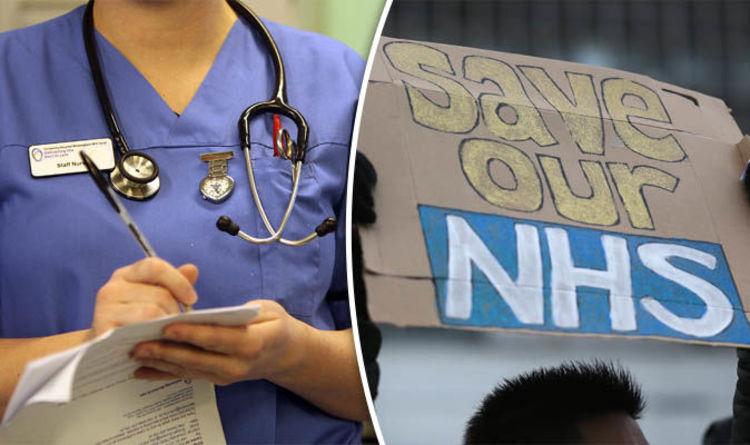
The shocking indifference shown by Theresa May towards the plight of stroke victims in the NHS and the systems ongoing crisis in which patients have been photographed sleeping on a hospital floor, is indicative of a public service that the UK government is determined to break. As Dr Bob Gill cogently argued, the Tories are deliberately under-funding the NHS to erode public confidence in order to manufacture consent for privatisation. The governments aim is to reconfigure the service from a free at the point of use healthcare system, towards a fee-paying US model.

In their 2017 election manifesto, the Conservative government said they would increase NHS spending by at least £8 billion in real terms until 2022. But King’s Fund, Nuffield Trust and Health Foundation figures show that NHS spending per person is set to fall by 0.3% in 2018/19 compared to the year before. Research undertaken by the former, indicates that UK funding for the health service is falling by international standards.

The think tanks have argued that even based on the government’s current spending plans, there is likely to be a spending gap of over £20 billion by 2022/23. They have also said that the NHS will need an extra £4 billion next year alone “to stop patient care deteriorating”. In 2013, NHS England said it faced a funding gap of £30 billion by the end of the decade, even if government spending kept up in line with inflation.

Under-funding has inevitably impacted on staffing levels. The shortage of nurses within the NHS has reached dangerous levels in 90 per cent of UK hospitals, and the amount of doctors per capita is the second lowest among eleven European countries.

On six out of nine measures of varying sorts, the UK did worse than any other advanced country in the world. Under the Tories, the erosion of the principle of a free at the point of delivery service is undermining what Sir Michael Marmont refers to  as “the optimal allocation of resources.”

However, despite all the problems the government has thrown at the NHS, the UK is still ranked a relatively respectable 10th in the world in terms of efficiency compared to the U.S ranking of 44. The latter reflects the fact that the marketization of health care in the United States is long established.

Given the figures, one might reasonably ask why the UK government appears to be insistent on dismantling something that, despite its faults, essentially works for the mass of the population, by subsequently restructuring it in the image of a system that doesn’t? The answer to this rhetorical question is, of course, that the said restructuring is intended to maximize profits for the few.

Shortly after president Trump’s inauguration this time last year, UK Health Secretary, Jeremy Hunt made a fleeting visit to the U.S. It was rumored that Hunt took this opportunity to discuss with US financiers moves to carve up the NHS in order to bring it closer to the US insurance-based model.

The U.S model the UK is moving towards

The requirement of the US Affordable Care Act (which was signed into law in March 2010 but in reality is unaffordable for large swaths of the US population), is that people are forced to buy private health care insurance if they fail to qualify for public health programmes – namely Medicare and Medicaid. However, the insurers have created plans that restrict the number of doctors in hospitals.

These “ultra narrow networks” have resulted in the reduction of at least 70% of health facilities within communities throughout the U.S, thereby restricting access to care for people with serious health problems. This means that increasingly Americans are paying higher premiums but are not getting sufficient access to services they need. They are, therefore, having to find money upfront, largely because their insurance policies do not provide adequate cover for their injuries or illnesses.

So America is still seeing high rates of people who are either delaying, avoiding getting access to the care they need, or are being confronted with medical debts. Research shows that tax-funded expenditures account for 64.3 percent of US health spending, with public spending exceeding total spending in most countries with universal care. Yet, 33 million people in the US do not have access to health insurance cover.

The delivery of a NHS-style healthcare system in the U.S is hamstrung by the narrow commercial interests of the corporations who lobby Congress. The conflicting interests that a succession of American presidents face relates to the close relationship they have to members of Congress who need to get reelected. If Congress speak out against the interests who are funding their campaigns, they’re not going to get that funding.

Dysfunctional

Tiny efforts to try and patch together what is clearly a dysfunctional U.S healthcare system is further undermined by the Heritage Foundation. This conservative Think Tank came up with the model of forcing people to buy private insurance and to use public tax dollars to subsidize the purchase of this insurance. In other words, as a result of a process of publicly funded corporate welfare, billions of funds are shifted into the hands of private insurance companies.

America’s healthcare costs are the highest per capita of any country in the world with some of the worst outcomes. Attempts to reform the US system are undermined by the insurance companies whose only function is to be middlemen between the patients and the health professionals.

The U.S government’s treatment of healthcare as a commodity instead of a public good is out of sync with the rest of the developed world and illustrates the extent to which, more broadly, the giant corporations have usurped democracy in the United States.

Currently, the U.S is the only industrialized nation on the planet that has used a market-based model for healthcare. Alarmingly, whether the British public want to admit it or not, this is the direction of travel both the Tories and NHS England, under Simon Stevens, are taking the system of healthcare provision in the UK.

If you’ve enjoyed reading this or another posting, please consider making a donation, no matter how small. I don’t make any money from my work, and I’m not funded. You can help continue my research and write independently.… Thanks!


Donate Button with Credit Cards

How the establishment have engineered the NHS crisis

By Daniel Margrain​

A century or so ago, the Russian Marxist Nicolai Bukharin understood that the growth of international corporations and their close association with national states was symptomatic of how both aspects hollow out the parliamentary system. It is now widely recognized that the power of private lobbying money draws power upwards into the executive and non-elected parts of the state dominated by corporations. Consequently this leads to a reduction in democratic accountability and public transparency.

Internal markets, market testing, contracting out, privatization, encouraging private pensions and all the rest, are mechanisms that are intended to depoliticise the process of social provision, so making it easier to refuse it to those deemed not to deserve it on the one hand, and to clamp down on the workers in the welfare sector on the other. This ethos became established in the late 1980s under Margaret Thatcher during her third term in office.

Removing the foundations of the welfare state

Following the advice of the then chief executive of Sainsbury’s, Sir Roy Griffiths in 1987, the Thatcher government set about removing the foundations upon which the welfare state had been built. Camouflaged in the language of ‘public-private partnerships’, Tony Blair’s New Labour took this one stage further as a result of his envisaging the state as the purchaser rather than direct provider of services. Whole entities within the public sector have increasingly been outsourced, health and social care services privatized and competition and the business ethos introduced into public services in the form of managerialism and New Public Management.

Thus, within residential care, patients have been recast as customers. The aim is to ensure the domination of the market by a small number of very powerful multinational corporations whose primary concern is not the welfare of the residents in care homes which they own or patients in hospitals but with maximizing profits.

The carving up of the NHS opens up one of the worlds biggest investment opportunities. Indeed, its exploitation by private interests is proceeding at a pace. This is hardly surprising given the 2014 revelation that 70 MPs have financial links to private healthcare firms while hundreds of private healthcare corporations have donated to Tory coffers.

There exists a symbiotic relationship between privatization and what Noam Chomsky refers to as a policy strategy of “defunding”. In line with Chomsky’s notion, the aim over the last three decades has been to shrink the NHS and bring it to the point of collapse as the basis for then claiming the only solution is more privatization. In Orwellian terms, health under-funding is portrayed in the media as “unprecedented levels of overspending by hospitals and NHS trusts.” 

Health and Social Care Act

The 2012 Health and Social Care Act removes the duty on the Secretary of State for Health to provide a comprehensive health service and requires that up to 49 percent of services can be tendered out to “any qualified provider.” As early as 2013, between a quarter and a half of all community services were run by Virgin Care. Three years later, the corporation had won £700m worth of NHS and social service contracts.

The retreating by the state from the principle of universal health care provision, free at the point of delivery, can be pin-pointed to 1988 when Tory politician, Oliver Letwin, wrote a ‘blueprint’ document called ‘Britain’s Biggest Enterprise’ where he set out the stages governments’ would have to go through to achieve a US model of health care without the public noticing. The New Labour government under Tony Blair adopted Letwin’s principles. But prior to the 1997 General Election, Blair had to disguise the strategy by using dissembling language in order to get elected.

Once in power, Blair took several steps towards privatization. For example, he broke up the hospital network into foundation trusts which are essentially separate business entities. He also deliberately saddled hospitals with Private Finance Initiative (PFI) liabilities which involved the government borrowing £11 billion from private banks and financiers in order to justify the sale and breakdown of the NHS further down the line.

This culminated with the New Labour government introducing in 2009 what was termed the “unsustainable provider regime” which is a fake bankruptcy framework to justify closing hospitals. The £11 billion of PFI public money borrowed from the banks and injected into the NHS is, in the words of ‘Save Our NHS’ activist Dr Bob Gill, intended to “set up the infrastructure for the whole scale hand-over of our NHS to American corporations.”

Simon Stevens

Arguably, the most influential individual currently working in the NHS is former Labour councillor, Simon Stevens, chief executive of NHS England. After having served under the Blair government, Stevens went on to work for the US private health care provider, United Health, where he campaigned against Obama Care prior to campaigning for the Transatlantic Trade and Investment Partnership (TTIP) to be included within the UK health care remit. Those encouraged by the election of Jeremy Corbyn are still waiting to hear something from the shadow health team about this troubling development.

Controversially, Stevens introduced NHS England’s ‘Sustainability and Transformation Plans’ which form part of the annual HHS Planning Guidance. ‘Sustainability and transformation’ is Orwellian-speak for the move towards the total reorganization of the NHS predicated on more privatizations and cuts.

Two years ago this month, Dr Bob Gill attended a meeting to get some insight into what the position of the then Shadow Secretary of State for Health, Heidi Alexander, was in relation to the direction NHS England was moving in under Stevens. What he heard were narratives that fitted into the ongoing privatization agenda. According to Gill, Alexander expressed support for Simon Stevens, despite his appalling track record. There is no indication that neither the Labour leader, nor current Shadow Health minister, Jon Ashworth, intend to take Stevens to task.

This is extremely worrying given that Stevens appears to be less committed to ethics and patient care, and more concerned with perpetuating the notion that medicine is a profit-based ‘conveyor belt’ service. Could it be the case that Corbyn has underestimated the extent to which the corrupting influence of corporations and the power of lobbying money have hollowed out the parliamentary system as outlined by Bukharin a century ago?

If you’ve enjoyed reading this or another posting, please consider making a donation, no matter how small. I don’t make any money from my work, and I’m not funded. You can help continue my research and write independently.… Thanks!


Donate Button with Credit Cards

Are the ‘liberal’ media betraying the people of the middle east?

By Daniel Margrain


Fake images about Aleppo circulate on social media

In this article I will argue that the corporate mainstream media uncritically promulgate regime change narratives in the middle east that coincide with the interests of Western imperial power whose latest goal is the removal of president Bashar- al-Assad from power. As with Iraq, this goal preceded the stated justifications which were retrofitted to an act of aggression.

In 2011, Time reporter, Rania Abouzeid, announced the March 4 and 5, “Day of Rage” against the Syrian president, which was intended as an invocation to the masses in Syria to rise up against their “brutal dictator”. However,  the planned action ended up a complete failure.

At this stage, the empire pinned its hopes on the fact that the culmination of eight years of crippling U.S-led economic sanctions would be sufficient enough a catalyst for mass protests against the Assad government. However, the said sanctions had the reverse affect. On the March 29, 2011, tens of thousands of Syrians gathered at Central Bank Square in Damascus in support of their president.

Nevertheless, the pro-government rally was inaccurately portrayed in the Western media as an anti-government demonstration. The Guardian, for instance, reported the rally, not as a celebration, but as a “military crackdown [by the state] against civilians.”

A year later, on March 27, 2012, president Assad accepted in good faith the six-point Annan peace plan which was ostensibly intended to secure a diplomatic solution to end the growing violence in the country that escalated on March 17, 2011 in the Syrian-Jordanian town of Daraa.

The mainstream media collectively failed in their duty to report the fact the imperial powers reneged on their obligations. To my knowledge, not a single prominent journalist brought to the public’s attention that the U.S and its allies broke their “crystal-cut commitment” to stop aiding rebel fighters which was an integral part of the agreement between the respective parties.

The jihadists continued to rain shells down on the cities of Hama and Homs despite Syria’s commitment that it would abide by the terms of the ceasefire on the condition that the West stop arming the rebels.

That the Western imperial powers have shown no intention of reaching a genuine peaceful outcome to the regional mess they instigated, has never been the preferred media narrative. In Iraq, for example, the evidence that NATO did everything they could to obstruct a peaceful resolution in the country is overwhelming but, to my knowledge, has not been reported as such.

The same can be said of Libya. According to the text of UNSCR 1973, the aim was to facilitate dialogue between the various factions in the country. But this was rendered absurd by the subsequent rejection by the West of proposals put forward by the African Union.

So why wasn’t this reported?

A rare voice of dissent was Seumas Milne who observed:

“If stopping the killing had been the real aim, NATO states would have backed a ceasefire and a negotiated settlement, rather than repeatedly vetoing both.”

This is not a theoretical point. NATO flatly rejected all ceasefire and peace proposals in Libya and demanded that Gaddafi “step down” in much the same way they demanded it of Assad in Syria. The motives of the imperial powers and their proxies in the middle east are characterized as benign. But this is an illusion.

The fomenting of war and chaos in Iraq and Libya by the U.S and its allies, from which spawned al-Qaida and ISIS, are the same forces that are tearing Syria and, at the time of writing, Iran apart. Recent reports of widespread protests throughout the latter are the consequence of U.S economic sanctions of the kind used against Iraq and Syria. As journalist Nafeez Ahmed reported, the said protests were fomented by the U.S State Department.

Iran is being punished for fighting Western-backed jihadists and standing in the way of US-Israeli hegemony in the region. But it’s unlikely the public would be able to reach this conclusion by reading the so-called progressive liberal press.

The BBC Panorama documentary, Saving Syria’s Children, Channel 4 News, Up Close With the Rebels and The Caesar Torture Photos represent far more overt attempts at disorientating the public. The former, in particular, is arguably the greatest single piece of state-sanctioned propaganda to have been produced anywhere in the world.

By repeating the propaganda of Western governments, the media have consistently acted as stenographers. Examples include the Telegraph’s reaction to the Houla massacre of May 25, 2012 which cast Syria into the ‘civil war’ of the Wests making, and the widespread misrepresentation of the UN report into the Ghouta chemical attack of August 21, 2013.

One day after the attack, a Guardian editorial claimed there was not “much doubt” who was to blame for the incident, as it simultaneously assailed its readers with commentary on the West’s “responsibility to protect”.

Journalist Jonathan Freedland’s reaction in the Guardian to the alleged chemical attack on April 4, 2017 in the Syrian town of Khan Seikhoun, was a virtual carbon copy of the papers reaction to Ghouta almost four years previously.

Freedland wrote a day after the incident:

“We almost certainly know who did it. Every sign points to the regime of Bashar al-Assad.”

What these ‘signs’ are were not specified in the article.

Freedland’s rush to judgement, was similarly adopted by George Monbiot. On Twitter (April 7, 2017) the writer claimed:

“We can be 99% sure the chemical weapons attack came from Syrian govt.”

Three days later, media analysts Media Lens challenged Monbiot by citing the views of two former UN weapons inspectors, both of whom contradicted Monbiot’s assertion. “What do you know that Hans Blix and Scott Ritter don’t know?”, inquired the analysts. Monbiot failed to reply.

Conclusion

Corporate mainstream journalism is predicated on sustaining the illusion that ‘progressive’ writers fundamentally challenge the status quo. The reality is, if journalists in highly influential positions really posed a threat to established power, they wouldn’t be in the positions they are in.

As Upton Sinclair famously remarked:

“It is difficult to get a man to understand something, when his salary depends on his not understanding it.”

Thus, highly paid corporate journalists are akin to gatekeepers. Their role is to manipulate public opinion in the service of power rather than to fundamentally challenge it.

One of the key signs of a healthy democracy is the extent to which both the state and corporate media encourage a genuine diversity of opinions and the conditions for alternative narratives to flourish. On both counts, the mainstream corporate media have failed not only the Syrian’s but the people of Iraq, Libya and Iran.

The inability of corporate journalists to report truthfully, is indicative of a structural and systematic media bias. Its highly concentrated nature has resulted in a sustained narrative of misinformation, deceptions and outright lies.

If you’ve enjoyed reading this or another posting, please consider making a donation, no matter how small. I don’t make any money from my work, and I’m not funded. You can help continue my research and write independently.… Thanks!


Donate Button with Credit Cards