Why is Tory economic dogma seen as mainstream, but Corbynism extreme?

Sixty-six years after the foundation of the welfare state, under the current Conservative government, every aspect of it is under attack. The 2012 Health and Social Care Act, for example, will remove the duty on the Secretary of State for Health to provide a comprehensive health service, while the requirement in the act that up to 49 percent of services can be tendered out to “any qualified provider” will rapidly lead to the privatisation of the NHS in England and Wales. Already between a quarter and a half of all community services are now run by Virgin Care [1].

In social care, a combination of cuts of around 30 percent to local authority budgets since 2010, increasingly restrictive eligibility criteria for services, and inadequate personal budgets will leave millions without the support they need and increasingly dependent on the family, and in particular women family members [2].

And in place of what was once called social security, unprecedented cuts across all areas of benefits, especially disability benefits, the introduction of sanctions regimes which have contributed to 500,000 people being forced to use food banks, and a bedroom tax affecting around 600,000 people will increase the number of children living in poverty by 200,000 [3].

All of this has been underpinned by a brutal ideological offensive against people on benefits which explains the reason for the growing rates of sickness benefit claims are for those who suffer from depression and anxiety [4], as well as the increase in the rate of suicide among those on benefits [5].

The ideological attack on the poor is predicated on the governments’ insistence that those able to defend themselves least, pay the costs for a global economic crisis which began in 2008 but was not of their making [6].

Over the last forty years, successive Labour and Tory governments’ have been committed to rolling back the post-war welfare settlement under the guise of debt reduction premised on neoliberalism which involves a change to the function of the state as less ‘welfare provider’ to more ‘pro-business facilitator’.

Many people believe that the neoliberal assault that embody these changes began with the 1979 Thatcher governments’ limited (by today’s standards) publicly-owned asset stripping. But this is a myth. It was actually under the Callaghan administration that preceded Thatcher that the initial structural changes happened  As Colin Leys (p.41) notes:

From 1976 onwards Labour…. became “monetarist”. It’s leaders accepted that full employment could no longer be achieved by government spending but must be sought through private sector growth. For the necessary private investment to take place, prices must reflect real values, and this in turn required “squeezing” inflation out of the system and permitting the free movement of capital. In 1978 Treasury officials began preparing to abolish capital controls

But it is the assault by the trio of Cameron, Duncan Smith and Osborne on, not just the welfare state, but the entire ethos of the public sector in general, that has taken things to a new level. This is demonstrated, in part, by Osborne’s intention to sell off £31bn of public assets in 2015-16. It is clear that the Tories are using austerity and the neoliberal ideology that underpins it, as an excuse to expand the pro-business facilitator model to areas within the public sector that Thatcher could only in her wildest of dreams imagined.

That said, this approach has limits in terms of maximizing utility to capitalists within a modern state. It is precisely this kind of rationale that explains why the former governor of the Bank of England announced that the current situation is “the worst crisis at least since the 1930s” [7].   

As this writer has pointed out previously, even venture capitalists realize that proper welfare provision for those not working as well as a substantial increase in the the minimum wage for those in work, is necessary to prevent the capitalist system that they benefit from collapsing in on itself [8].

In 1943, the Tory MP Quintin Hogg warned that “If you don’t give the people social reform, they will give you social revolution” [9]. This is as relevant today as it was then.

It’s therefore in nobody’s interest that wages are kept depressed and the unemployed and sick are continually made to suffer. The fact they continue to suffer unnecessarily is the reason why a political space has opened up for the likes of Jeremy Corbyn to move into.

Although much of the mainstream media are characterizing Corbyn’s policies as unworkable, misguided and extreme – and seemingly doing everything in their power to undermine and discredit him -, these are nevertheless policies that are, in truth, mainstream and pragmatic. This explains why an increasing number of economists have publicly come out in support of the kinds of economic policies Corbyn articulates [10].

These policies are economically credible, popular with the public and, for most of the world, regarded as mainstream:

In 2009, most of the world was following mainstream economics of the kind that Corbyn is proposing today in undertaking a fiscal stimulus to combat the impact of the financial crisis. But in the UK a certain politician decided to ignore ‘economic credibility’, and instead proposed doing the opposite: what has subsequently become known as austerity [11].

The imposition of 40 years of neoliberal economic dogma pursued by successive Labour and Tory governments’ has failed the people of Britain who rightly, in my view, see Corbyn as the catalyst for change. As time goes on there will be increasing pressure not just from below, but from the top, for the Tories to change course.

As the open letter to the Guardian by over 40 leading economists illustrates, this is already starting to happen. If the government refuse to acknowledge that austerity and neoliberalism have failed, and thus continue to stick rigidly to their failed ideology of cuts and austerity, the British people will eventually elect a figure like Corbyn into power on a mandate to do something about it. That time is coming closer with every passing day.

That joke isn’t funny anymore: from Tories4Corbyn to a Very British Coup

corbyn2

One day, someone like the Glasgow Media Group, will do an analysis of this leadership election and how the attitude of the right-wing press has changed towards Jeremy Corbyn. It will be fascinating. 

Stage 1: Laughter

It seems like an age ago when it was all jolly larks and #Tories4Corbyn. Smugly and patronisingly, they laughed into their sleeves, safe in the knowledge that Corbyn even being on the ballot would show that the loony left (guffaw) was very much alive and kicking and the Labour Party at large hadn’t changed. By not having changed, of course, they mean not accepting all the tenets of the disgustingly unequal and brutal society that their chums in the city had created. That self-satisfied superiority complex, which seemingly couldn’t be shifted, had been aided and abetted by the Labour Party in Parliament, filled with New Labourites who did just that – who had “changed” and had accepted the rules of the club.

Stage 2: Confusion

Then came the period of incredulity, as the madness of “Corbynmania” seemed to be sweeping the country. What on earth was going on, they wondered? Hadn’t this stuff – like collective values, solidarity, compassion – been left behind in the 80s where it belonged? Andy Burnham, Yvette Cooper and Liz Kendall they understood: they too played by the rules. The deal was, they would let us keep the fundamentals of the Thatcherite settlement in place as long as they could play with the ball occasionally. The “fun” being had at the Labour Party’s expense became a little less sure footed. #Tories4Corbyn faded and turned into “Shock! Horror! Look what the oiks are up to!” They actually believe this crap? Rent controls? Public ownership? Democracy in our education system? Whatever next? Fake indignation and incredulity ruled, but now with a frown.

Stage 3: Anger

Latterly, the terms of reference have turned around completely. As arrogant bullies do, no public acknowledgement of this volte face was to be allowed. But to anyone who has been paying attention, it’s obvious that things have shifted dramatically as the election campaign has gone on and Jeremy Corbyn’s campaign has gathered real momentum, not just in the Labour heartlands, but in the Tories’ own backyards. The chuckles have been swallowed back and been replaced with anger. What the hell? As the movement around Jeremy Corbyn has become a “thing”, evidenced by the enormous crowds turning up all over the country and the rapturous welcome that Corbynite policies were receiving, things have taken a nasty turn. Quietly at first, but then gathering momentum, the word was put out that “this has to be stopped”. As that lad from Manchester once said:

“That joke isn’t funny anymore. It’s too close to home and it’s too near the bone.”

At the time of writing, this latest phenomenon has morphed into an almost a pathological obsession for many in the right wing press. Whereas previously, the writings on Corbyn positively oozed condescension, now you can smell the fear and a strange lack of confidence. It’s starting to resemble something out of a Very British Coup, but every smear story, every outright lie and every petty, personalised attack on Corbyn, his family, or his army of supporters betrays how petrified they are at the thought that, for the first time in three decades, they might actually face a real opposition to their project – not just to this detail, or that policy, but to their whole individualist, consumer-orientated, callous ideology.

Thanks to Ben Sellers

Former Tory Donor Gave Yvette Cooper £75,000 Donation

The largest single donation to Yvette Cooper’s Labour leadership campaign comes from a former donor to the Conservative party.

Businessman Peter Hearn gave Cooper £75,000 to support her campaign for the Labour leadership. According to the latest listing Cooper made in the register of MPs’ interests, Hearn’s donation makes up over a quarter of the £260,000 she has raised to fund the “Yvette for Labour Leader” campaign.

However, figures given to the Electoral Commission show that Hearn also gave £10,000 to the Conservative party in the run-up to the 2010 election.

Hearn is a multi-millionaire accountant behind PSD Group, an executive recruitment firm specialising in high-level jobs in banking, finance, and other sectors. His donation was registered this month, although the actual donation was made in July.

Since donating to the Conservatives in 2009-10, Hearn has become a major Labour donor: He gave the Labour head office donations worth £279,000 over 2014-15.

Hearn has switched his donations between parties more than once. Before his Conservative donations, back in 2007 he gave Labour £5,000.

Labour headquarters is currently working to make sure the leadership election “is not for those who support other parties and is only for those who support the Labour party”, with many would-be voters complaining they have been wrongly excluded from taking part in the vote.

BuzzFeed News asked the Cooper campaign if they had any concerns about taking money from a man who has switched support between different parties.

A spokesperson for the campaign said that Hearn was a longstanding Labour supporter:

We are very grateful to Peter Hearn and all those who have donated to the Yvette For Labour campaign. To characterise Peter as a Tory switcher is plain wrong. He has been a major donor to the Labour party for several years and a Labour voter all his life.

In 2010 he was so keen to stop the divisive and unpleasant politics of George Galloway that he supported both the local Labour and Conservative candidates fighting to prevent George Galloway’s Respect party gaining his local seat. He is unequivocally a Labour supporter.

Electoral Commission records do show Hearn giving £5,000 to the Tower Hamlets Labour party in 2007. However, they also show that he gave more money, and more often, to the Conservative party in 2009-10.

He helped fund the Conservative election campaign in Poplar, where George Galloway was standing against Labour’s Jim Fitzpatrick and Tim Archer for the Conservatives. Fitzpatrick won the seat, with Archer coming second and Galloway third.

Solomon Hughes / Electoral Commission

Hearn’s political donations are registered at the Electoral Commission under a variety of spellings – Peter Hearn, Peter J Hearn, and even a misspelled Peter Hearne. The Electoral Commission confirmed to BuzzFeed News that all these donations are registered to the same address and that they are all from the same man.

Thanks to Solomon Hughes who wrote the above article originally published on the Buzz Feed News blog on August 21.

We Don’t Need Chilcot To Tell Us Blair Lied

Embedded image permalink

In his book The New Rulers Of The World, the renowned investigative journalist John Pilger (p.65-67) describes his stay at Baghdad’s Al-Rasheed Hotel shortly before the allied invasion of Iraq in March 2003:

“I met an assistant manager who had been at the hotel since the 1980s, and whose sardonic sense of western double standards was a treat. “Ah!, a journalist from Britain”, he said. “Would you like to see where Mr Douglas Hurd stayed, and Mr David Melon [sic] and Mr Tony Newton, and all the other members of Mrs Thatcher’s Government…These gentlemen were our friends, our benefactors.”

He has a collection of the Baghdad Observer from ‘the good old days’. Saddam Hussein is on the front page, where he always is. The only change in each photograph is that he is sitting on his white presidential couch with a different British government minister, who is smiling or wincing.

There is Douglas Hurd, in 1981, then a Foreign Office minister who came to sell Saddam Hussein a British Aerospace missile system and to ‘celebrate’ the anniversary of the coming to power of the Ba’ath (Redemption) Party, a largely CIA triumph in 1968 that extinguished all hope of a pluralistic Iraq and produced Saddam Hussein.

There is Hurd twice: on the couch and on page two, bowing before the tyrant, the renowned interrogator and torturer of Qasr-al-Nihayyah, the ‘palace of the end’. And there is the corpulent David Mellor, also a Foreign Office man, on the same white couch in 1988.

While Mellor, or ‘Mr Melon’ as the assistant manager preferred, was being entertained, his host ordered the gassing of 5,000 Kurds in the town of Halabja, news of which the foreign office tried to suppress…..As the subsequent inquiry by Sir Richard Scott revealed, these celebrities of the Baghdad Observer knew they were dealing illegally with the tyrant. “Please give Mr Melon my greetings”, said the assistant manager.

Twenty seven years later, ‘Mr Melon’ can be heard presenting a phone in show alongside Ken Livingstone every Saturday morning on LBC Radio. I phoned the programme a few weeks ago to remind Mellor of this unfortunate episode in his career. Needless to say, I was cut off immediately.

In Chapter 13 of his book, Web Of DeceitBritish historian, Mark Curtis highlights – with reference to the views expressed in the Scott inquiry mentioned above – that elites do not think the public are entitled to know what the decision-making processes are that give rise to their decisions.

They are especially keen to deflect criticism away from the ruthless and violent nature of the British state towards the perpetuation of the myth that British foreign policy is historically predicated on the idea of benevolence. This involves the promotion of high and noble principles – democracy, peace, human rights and development – in its foreign policy.

Any critiques of Britain’s role in wars within the mainstream media are normally marginalized or presented within narrow limits which show “exceptions” to, or “mistakes” in, promoting the rule of basic benevolence. Curtis believes that overall:

“People are being indoctrinated into a picture of Britain’s role in the world that supports elite priorities. This is the mass production of ignorance. It actively works against our interests, which is precisely why the ideological system is critical to the elite, who essentially see the public as a threat…. As the chapters on Kenya, Malaya, British Guiana, Iran and others have shown, the reality of British policy is systematically suppressed” [1].

Has anything fundamentally changed since BBC founder Lord Reith wrote of the establishment: “They know they can trust us not to be really impartial”? [2] Why did the British and American mass media fail to challenge even the most obvious government lies on Iraqi weapons of mass destruction before the invasion in March 2003? Why did the media ignore the claims of UN weapons inspectors that Iraq had been 90-95 per cent “fundamentally disarmed” as early as 1998? [3].

What Curtis convincingly shows is that Blair’s contempt for international law in relation to Iraq is part of an historical continuum. As Caroline Lucas put it: “By imposing regime change in Iraq… Tony Blair is not so much following the US as continuing a national tradition.”[4].

After studying declassified British government files, Curtis concluded that:

“British ministers’ lying to the public is systematic and normal…In every case I have ever researched on past British foreign policy, the files show that ministers and officials have systematically misled the public. The culture of lying to and misleading the electorate is deeply embedded in British policy-making” [5].

Just as the public didn’t need the Scott Inquiry to tell them that the Thatcher government illegally sold weapons of mass destruction to Saddam that were used to deadly effect against the Kurds, so we don’t need £10 million (and counting) of our money wasted in a whitewash of an inquiry into Blair’s deceptions in relation to Iraq.

All that is required is a cursory glance at the contents of the Downing Street memo which provides the public with an invaluable record of a meeting in July 2002, between Blair and Sir Richard Dearlove. The memo reveals that Dearlove, director of the UK’s foreign intelligence service MI6, told Blair that in Washington military action was now seen as inevitable

Bush wanted to remove Saddam, through military action, justified by the conjunction of terrorism and WMD. But the intelligence and facts were being fixed around the policy [6]. In other words, what this memo shows is Blair knew that the decision to attack Iraq had already been made; that it preceded the justification.

What’s So Great About ‘Roxy Music’?

The first of Roxy Music’s opening trilogy of masterpieces sounds as original and fresh today as it did on its release back in 1972. Comprising Bryan Ferry on vocals and piano, Graham Simpson on bass, Andrew Mackay on oboe and sax, Paul Thompson on drums, Phil Manzanera on guitar and Brian Eno on tapes and synths, the sound on the album is simultaneously futuristic, conceptual and mannered.

The album opens with Re-make/Re-model which is probably their archetype sound comprising hypnotic sax riffs, frantic, cacophonous dissonance and  abstract effects. Ladytron is an electronic psychedelic overture sang by a baritone Ferry complete with sax riffs, distorted guitars and rhythmic synths. 2 H.B is a kind of decadent serenade and one of the trademarks of Ferry’s vocal deliveries.

Roxy Music-Roxy Music.jpg

If There Is Something  is a combination of a jazz-rock jam and chamber music, whilst the catchy hit single Virginia Plain (not originally included in the album) is one of the greatest masterpieces of all rock. Here, Eno’s pulsating but methodical synths that embellish the fractured sound of clarinet, guitars and honky tonk piano, steal the show.

The Bob (Medley) is more avante-garde and abstract, whilst Chance Meeting is basically a free-jazz psychodrama-based chamber music. No less chameleon, is the rock and roll of Would You Believe that encompasses pounding piano boogie, wild sax and guitar solos.

Sea Breezes is a bleak and melancholic merging of neoclassical elements and distorted keyboards, sax and guitar. In the finale, Bitters End, Ferry sings in the languid crooning style that was later to become his trademark against a backdrop of flamenco rhythms and doo-wop.

Merging King Crimson-style pathos, jazz-rock and electronic elements, Roxy Music revolutionized prog rock by linking it to both the punk rock and new wave movements of the late 1970s and the post-punk and synthpop of the 1980s. Roxy Music are one of Britain’s greatest and most influential bands, and their self-titled debut is, in my view, their best album.

Dismaland

disma-8

Dismaland Bemusement Park is a theme park with a difference – a dystopian playground created by the anonymous artist, Banksy in the derelict Lido in Weston-Super-Mare. The artist has assembled the work of fifty other artists from around the world as far apart as Palestinian painters to the British writer Julie Burchill. The latter was commissioned to write a modern Punch and Judy whose theme is domestic violence which Burchill was a victim of:

“Good day to you my audience, you seem a smashing bunch, let me introduce myself, my name is Mr Punch. I’m part of your folk history like saucy Jack the Ripper. We both like a bit of fun like beating up a stripper” says Burchill in her opening poetic refrain.

Other installations that represent just a few of the park’s attractions include a fairy tale castle with a grizzly grotto, a boating lake full of refugees and a model village running riot.

As you enter the theme park, you are confronted by a security screening room manned by officious looking security guards, as fabricated as the threats its protecting us from, In reality, this happens to be an installation by American artist Bill Barminsky. “Any guns grenades or unicorns on you today”?, inquires one of the guards, all of whom look like they have just stepped out of the set of Kubrick’s A Clockwork Orange.

Dismaland is a very different kind of family day out, one which presents a more appropriate message to the next generation faced with the lack of meaningful work and global injustice. A step away from street art, this show is Banksy’s graffiti rendered into three dimensions. In addition to the representation of some of his traditional themes, he also presents some other new and shocking ones.

The refugee crisis off the shores of Europe, for example, becomes the subject of remote controlled motor boats. Miniature model boats crammed full with desperate looking replica humans drift on the water while some other less fortunate figures lie face down arms stretched and bloated floating on its surface.

Dismaland was perhaps part inspired by the pessimistic themes of the artist Jeff Gillette who, from his home in California, has been subverting Disney for many years. Jimmy Cauti, formerly of the pioneering UK acid House band, KLF. has presented a very different kind of street art at the show – a model of a town after a riot in which the only people remaining on the streets are 3,000 police and media standing around doing nothing looking at each other after the riot has happened.

Other pieces include Crazy Gulf -,A War About Oil – where you can hit a golf ball through a pipeline. You can also play Hook A Duck out of thick black water resulting from the aftermath of an oil slick. Children in need of more cash can borrow against their pocket money at just 5,000% APR from a nearby stall.

The climax of the exhibition is Banksy’s Castle. What he has done with an upturned carriage and a fairy princess is an extraordinary and evocative experience that’s funny, poignant and ultimately controversial which is precisely its point. You leave the exhibition, predictably, via the gift shop.

Banksy told Channel 4 News:

“For this show I didn’t deliberately set out to snub street art, I just found other stuff a lot more interesting. I seem to have reached the point where an art show is more interesting the less I’m in it.”

Dismaland Bemusement Park is open for six weeks.

The Rich Get The Carrot And The Poor Get The Stick

The juxtaposition and double standards in our society between those at the top and those at the bottom is stark. The gap between the rich and poor continues to increase to the extent that the top earners in the footsie 100 companies’ earn a massive 183 times more than the average earner [1].

The argument of some of those who attempt to justify this massive discrepancy is that the top of society have to be incentivized in order to increase their performance. That’ll be news to the bosses of the publicly subsidized privatized railways and loss making banks whose performances in many instances are found wanting.

Nevertheless, those at the top are invariably given inducements to work better. But that rule of thumb never seems to apply to those at the bottom. Why don’t we try, as Jeremy Corbyn has proposed, “a bit of quantitative easing” for the poorest instead of the richest [2] so that the former will be incentivized to kick start the economy?

But to do so would be an admission of defeat and would therefore undermine the ideological consensus that exists between the New Labour hierarchy and the Tory establishment. If there are good and well paid jobs for people to go into, it would mean that the Tories proposed introduction of their inappropriately named “boot camps”, would not be necessary.

Chris Grayling, the Tory welfare spokesman, has stated that these “boot camps” are in reality compulsory community service programmes for young welfare claimants aged between 18 and 21 aimed at improving work discipline and giving them basic skills to get a job [3].

The term “boot camp” is intended as a soundbite whose aim is to give reassurance to the Tories’ natural constituency of middle England Daily Mail reading voters that they intend to come down hard on “benefit scroungers”.

Why does the establishment always appear to give the impression of using the “stick” approach when it comes to inducing a prescribed behaviour among the poorest in society, whilst the rich are incentivized with the carrot?

If you were to look beyond the headline, the boot camp proposals are, to a limited extent, likely to be beneficial to young people who have difficulty with numeracy, literacy and basic communication skills. But that’s as far it goes. The boot camp idea, in other words, is necessary but not sufficient.

What the concept does not address is the fundamental issue relating to the lack of government investment in proper training and apprenticeship programmes that lead to the opportunity for stable, skilled and well paid jobs, thus giving hope to our young people instead of alienating them.

The Tory language is invariably about “toughness” and “coming down hard” on young people as opposed to the language and policies of hope. Not so for the richest in society who are always offered the “carrot”..

Cathy Newman’s Hatchet Job

An indication of how desperate the mainstream media have become over Jeremy Corbyn’s runaway lead in the opinion polls was no better illustrated by Cathy Newman, the Channel 4 journalist who went into a panic on social media for implying in February that the mosque she visited displayed (falsely) a culture of intolerance and sexism [1]. Newman has been criticised on Twitter by attempted to dig up dirt in her smearing of Corbyn in relation to reports he had links with Holocaust deniers and people with anti-Semitic views.  The Independent reported that:

“The Channel 4 journalist interviewed the Labour leadership hopeful in an alleyway about his connections with Deir Yassin Remembered, a group founded by self-declared Holocaust denier Paul Eisen, and the cleric Raed Salah, who was convicted for inciting violence and racism after accusing Jews of using children’s blood to bake bread.

Corbyn denied her repeated suggestion that he had made “misjudgements” by attending events by Deir Yassin Remembered and describing Salah as an “honoured citizen” some years ago, accusing Newman of putting words in his mouth.

He insisted that Eisen was not a Holocaust denier when he met him 15 years ago, telling Newman: “Had he been a Holocaust denier, I would have had absolutely nothing to do with him. I was moved by the plight of people who had lost their village in Deir Yassin.

Corbyn said he was unaware Salah had been convicted of racial incitement when he met him. The interview, which was broadcast on Monday evening, quickly sparked a backlash against Newman, with many accusing her of trying to smear him.” [2].

TrutherTom in the Independent comments section commented:

“Now Jeremy Corbyn has dozens of Jewish academics writing a open letter to the Jerusalem Chronicle stating that he is not anti-semitic and so another expose backfires against anti Corbyn media. I did not see him getting angry but I was certainly feeling it myself as she kept repeating “Was it a misjudgement Mr Corbyn” ad nauseum.

Totally pathetic attempt to try and stitch him up while hoping to make a name for herself but all she has done is make herself look foolish and unprincipled and extremely arrogant. Full marks to Jeremy Corbyn for keeping his cool when others may have reacted hastily but his constant denial and refusal to be baited, made her look very superficial and rather stupid.”

Taken For A Ride By The Fat Cats

uk rail fares

The recent lambasting of private rail company SouthWest Trains by the populist left-wing revolutionary rag, the Daily Mail, for exploiting VJ veterans by ramping up the fares during the VJ day commemorations [1], highlights more than ever the fact that Britain needs a modern, safe, cheap and efficient railway.

The way to get that is not to have a jigsaw puzzle in every railway station of different private companies, particularly when we have to subsidize them at a rate five times greater in real terms compared to when they were nationalized [2]. What is the logic of giving privateers like the private rail companies this massive increase in subsidy?

Not only is Jeremy Corbyn promising to bring the railways back into public ownership, but his ‘flip-flopper’ rival for the leadership, Andy Burnham, has promised the same. Cynical appropriations of the public mood by the latter in this way, is of course, not new among the Labour Party establishment. In the New Labour manifesto of 1997, for example, Tony Blair promised that the railways would be put into public ownership only to do a massive u turn after becoming elected [3].

Nationalization of the railways was a major platform (pun not intended) upon which he gained power, thus reinforcing the ‘left-wing policies are electoral suicide myth’ meme propagated by his critics.

So Blair was elected in 1997 on a left-wing ticket of nationalization of the kind the right-wing warmonger is criticising Jeremy Corbyn for now. In other words, for Blair, nationalization was regarded as being electable. But Corbyn who is proposing the same is regarded by the New Labour hierarchy as being unelectable despite the fact that a majority of British people of all political persuasions believe that the railways should be in public hands [4].

It’s worth mentioning that although the rail stock and the running of the rail system has been privatized, much of the infrastructure including the rails upon which the trains run, have not. This begs the question: Why should we be allowing people to print money by obtaining franchises to run on publicly owned track that we’ve paid for?

Although the rail companies are getting massive subsidies, are the trains five times less overcrowded than on the old British Rail? There are now less train carriages than there were under British Rail and the platforms are shorter despite the fact that capacity throughout the network is increasing exponentially. This is reflected in public opinion polls that conclude a high dissatisfaction with the railways since they became privatized [5].

Clearly then, the rail companies are not five times as sensitive to public needs. Are they cheaper in real terms? Again, that’s a negative: Since privatization, rail fares have trebled while earnings have remained largely stagnant [6]. We are paying three times more to stand in overcrowded trains compared with our counterparts in Germany and France [7].

It’s also.difficult to sustain the argument that a privatized system is likely to be safer given the ‘passing the buck,’ culture that the patchwork quilt and largely unaccountable private railway system implies.

At, present the railways are too expensive and fragmented and don’t serve the public interest, despite the fact that we, the British people, are paying exorbitantly for it in order to boost the profits of the fat cats who run it. Why should profits be privatized and losses nationalized in this way?

It makes no economic and rational sense unless, of course, you happen to be somebody like Richard Branson whose concept of market forces is very different from yours or mine. For too long passengers have been taken for a ride on this issue. It’s encouraging that Corbyn has put the nationalization of the railways back on the political agenda.

Jeremy Corbyn and the Jews

August 17, 2015  /  Gilad Atzmon

By Gilad Atzmon

The relationship between Jeremy Corbyn and British Jews can be summarized into a brief observation:

While Corbyn’s success represents a hugely popular shift within British political thinking, the orchestrated Jewish campaign against him is there to suggest that once again, Jews set themselves against the people they dwell upon.

The vastly growing popularity of Jeremy Corbyn amongst Brits can be easily explained. Following decades of cultural Marxist, divisive Identiterian politics and Zionist-Neocon domination within the British Left, Corbyn brings along a refreshing ideological alternative. Corbyn seems to re-unite the Brits. He cares for the weak. He opposes interventionist wars. He represents the return of the good old left as opposed to New Labour’s affinity with big money, choseness  and exceptionalism. He cares for the students and the youth. He thinks about the future and promises to undo the damage created by Blair and Cameron. But as Britain sees the rise of a hugely popular ideological movement, many Jewish institutions see Corbyn as an arch enemy. They would prefer to see him gone and have used nearly every trick in the book to discredit him.

In the last few days we have noticed a tidal wave of Jewish institutional opposition to Corbyn. First it was the Daily Mail that attempted to throw Zionist mud in the direction of the man who is destined to take over what is left out of the Labour party. Surprisingly, not a single British media outlet picked the Mail’s dirt for a few days. Eventually the notorious Zionist Jewish Chronicle had to take the gloves off just ahead of Sabbath and lead the battle against the emerging socialist leader.

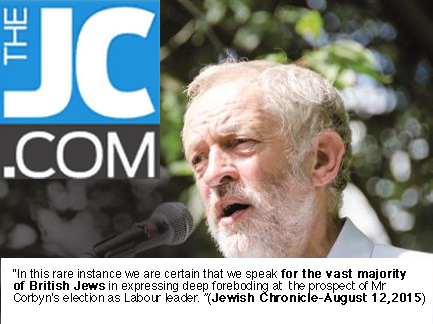
In the weekend the Jewish Chronicle (JC) outlined its problems with Corbyn while claiming to “speak for the vast majority of British Jews… expressing deep foreboding at the prospect of Mr Corbyn’s election as Labour leader.”

Apparently, on behalf of ‘the vast majority of British Jews,’ The JC wanted to know whether it is true that Corbyn donated money to Dier Yassin Remembered (DYR), an organisation that was founded to commemorate the brutal massacre of an entire Palestinian village by right wing Jewish paramilitary fighters in 1948. I guess that the tens of thousands who joined the labour party in the last weeks just to support the first true British labour ideologist for generations were delighted to learn that their favourite candidate supported DYR and truly opposes Zionist barbarism.

On behalf of the “vast majority of British Jews” the JC demanded to be fully informed about the non-existent relationship between Corbyn and British DYR chairman Paul Eisen. The JC didn’t approve of the connection between Corbyn and pro-Palestinian Rev Stephen Sizer either. Corbyn was also asked to clarify his association with the Hamas, the Hezbollah and Palestinian cleric Raead Salah. I guess that the JC editorial would like to define the list of kosher ‘friends’ eligible for British elected politicians. Until this happens, the message that is delivered by the Brits is lucid: it is actually Corbyn’s firm stand on justice and his ability to befriend true freedom fighters and humanists which makes him into the most popular politician in Britain at the moment.

If someone in the JC fails to read the picture, I will outline it in the clearest form. British people are expressing a clear fatigue of corrupted party politics as much as they are tired of Zionist interventionist wars. They are begging for a change, they demand equality and the prospect of a better future and a leader with ethical integrity. Whether Corbyn can provide these qualities, time will tell. But the British yearning for a radical change has been formally established.

Disrespectfully and outrageously, in the open and on behalf of “the vast majority of British Jews”, the JC set an ultimatum to the most popular man in British politics.

“If Mr Corbyn is not to be regarded from the day of his election as an enemy of Britain’s Jewish community, he has a number of questions which he must answer in full and immediately.”

One would expect the JC editorial to learn something from Jewish history. Those British Jews who insist to speak ‘on behalf’ of their people should at least pretend to uphold some minimal respect to British good manners.

The JC, however, admitted that Corbyn ignored them for over a week – “No response has been forthcoming” from Corbyn or his office, the JC wrote.  Though I do not have any reason to believe that Corbyn has a cell of hatred in his body, I wouldn’t like to see him bowing to Jewish political pressure. What we need is a firm British leader dedicated to equality, justice, peace and British interests instead of just another Sabbos Goy and servant of the Lobby as well as big money.