The Velvet Underground & Nico

By Daniel Margrain

The music and the synthesis of ideas that the Velvet Underground represented broke new ground in the 1960s. The group didn’t produce ‘songs’ that were indicative of popular music of the time but rather they were Freudian expressions of a lust for deviant but seductive behaviour; they were exotic, decadent and perverse fantasies.

This was allied to a form of hyper-urban realism that emerged from a combination of traditions – Pop artGerman ExpressionismFrench Existentialism and La Monte Young’s Minimilism. The group were about as far apart from their contemporaries as British Music Hall is to American Hardcore.

The groups debut, their supreme masterpiece, The Velvet Underground And Nico (1967)Velvet Underground and Nico.jpg, was recorded in two days in the spring of 1966 and released in January of the following year. Andy Warhol produced the album, managed the group and created the now iconic banana album cover artwork.

Lou Reed composed the melodies, wrote the lyrics and ‘drone strummed’ his rhythm guitar. John Cale arranged the sound and created the avant-garde atmospheres with his innovative use of a viola and keyboards interspersed with his bass playing. Maureen Tucker played the drums with an obsessive and frenzied, yet exotic, tribal repetitiveness and Stirling Morrison’s rhythm and blues or country-influenced guitar playing kept the sound grounded in the style of The Byrds.

All of this was embellished by the icy vocals of Nico who sang lead on three of the album’s tracks – the cold, spectral, autumnal odes of Femme Fatale, All Tomorrow’s Parties, I’ll Be Your Mirror – and back-up on Sunday Morning, all of them masterpieces.

But the songs Nico had no part in are equally, if not more mesmerizing – in particular, Black Angel’s Death Song, the percussive boogie of Waiting For My Man, the orgasmic chaos of Heroin, and the dissonant tribalism of European Son. If I had to pick a standout, it would be the Indian raga-imbued and decadent Venus In Furs which, in my view, is one of the masterpieces of all rock. Judge for yourselves:

https://www.youtube.com/watch?v=iLQzaLr1enE

But to single out one track for praise on an album where there is no weak link, is to do the album an injustice. The truth is, each individual piece on the album is a masterpiece in its own right culminating in a work that transcends the sum of its individual parts. All of the songs are immersed in an atmosphere that’s dark and oppressive but beguiling, epic and cool. It’s an album that fuses music and words in a manner that perfectly captures the tension of modernist metropolitan reality in all of its dark and decadent secrets. This manifests, as one critic puts it:

in sexual fetishes and cathartic sadism, in latent orgasms and unnerving noises;and in the living contrast between the urban ways of Reed and the patrician ways of Nico, between Berlin in the 30s and the 60s in New York, between the subculture of crisis and that of the apocalypse. The seduction of the album is derived not only from the quantity of ideas in it, but from the fusion of so many strong artistic personalities, all directed by Lou Reed, who functions as catalyst.”

The overriding feeling one gets after listening to this album is of a group who set out to produce a creative work of art as opposed to a commercial product. In these less enlightening times, that’s a legacy worth preserving. Arguably, punk aesthetics, alternative art rock and indie rock were born the moment the Velvet Underground walked into a recording studio. The influence of the Velvet’s debut can be heard in almost everything interesting that followed – from the new wave movement of the late 1970s through to the post-punk and shoegazing movements of the 1980s and 1990s.

Emerging from the UK indie scene generation of this latter period were the bands signed to the seminal Postcard record label, many of whom would not have started a band if it were not for this album. That’s an illustration of how significant The Velvet Underground And Nico was to my generation. But this is not only true of my generation but subsequent generations. It was Brian Eno who famously stated that while The Velvet Underground & Nico initially only sold 30,000 copies, “everyone who bought one of those 30,000 copies started a band.”


In the court of the claret and blue king

By Daniel Margrain

Moore kisses the World Cup

Moore kisses the World Cup CREDIT: HULTON ARCHIVE


Last Saturday (July 30) marked the 50th anniversary of one of the most historic sporting moments in history – when England beat West Germany 4-2 after extra-time to lift the World Cup. Avid football fans from all over the country joined legends Geoff Hurst, Gordon Banks, George Cohen and others from the 1966 team at Wembley for a special celebration. Ill-health kept others away.

Martin Peters, Nobby Stiles and Ray Wilson have all been diagnosed with Alzheimer’s amid fears that their condition was caused by years of heading heavy footballs. Both Alan Ball and Captain Bobby Moore, the latter who raised the Jules Rimet Trophy aloft on that memorable day, have died.

As a West Ham fan, my memories of the mercurial Moore are vague. I remember, at age eleven seeing him play one of his last games in a West Ham shirt against Arsenal at Upton Park. It is widely accepted among West Ham fans and the wider football fraternity that with the English trio of Moore, Hurst and Peters acting as the spine of the England team, it was West Ham who effectively won the World Cup for England in 1966.

Few people would have envisaged that four years after lifting the most prestigious of all football trophies, England’s world cup winning captain, West Ham United legend and international football superstar, Bobby Moore, would have had a major accusation of theft hanging over him. The accusations against Moore would last for a further two years.

The weight must of been hanging heavily on Bobby’s shoulders and that of his family during that period. In an era when colour hit many of our television screens for the first time in which a new decade premised upon optimism and hope was ushered in, professional football had become elevated to the kind of media spectacle that we have become accustomed to today.

In many ways, the changing face of football during this era became the defining feature of a society in a state of flux that had finally shaken off its post-war shackles of conformity and austerity. For the first time, foreign travel was to become the mainstay of the many not just for the ‘exclusive’ few.

No aspiring jet-setter could be seen without the trappings that came with it. For many of the working class beneficiaries of the post war boom who were fortunate enough to be in the financial position of being able to enjoy a yearly foreign holiday, this was a golden period.

It was the first time that I can remember excess being celebrated in such a gregarious, if at times, ostentatious manner. The media jumped on the bandwagon with their promotion of the ‘exotic’ lifestyles of the rich and famous most notably on the travel documentary programme, ‘Wicker’s World’.

The BBC sister travel guide show, ‘Holiday’, fronted by Cliff Michelmore was the zeitgeist of the period in as much as it brought home to the masses that foreign travel was now no longer the exclusive privilege of the rich, but was something that many ordinary people could do too.

Very few celebrities would have been seen photographed without the accompanying and obligatory ‘bling’. This captured the imagination of the public who also aspired to the demands set by the new mass consumption environment. For the first time in history, the profile of the top level professional footballer was akin to the movie star – and the ordinary working class garish man about town aspired for a piece of the action.

Each component part of the jigsaw shoehorned into one another fitting into place as smoothly as the velvet glove on the hand of Audrey Hepburn. Bobby Moore was very much the poster boy of his generation for this new socially mobile working class in much the same way that David Beckham was for his.

It was perhaps fitting, then, that if anybody with such a high profile as that of any footballing superstar in the world at that time was to be fitted up for a crime, then it was the handsome and photogenic captain of the world champions.

It was symptomatic of the times that Bobby Moore would be set up, not with stealing a painting or cash, but with bling. Its somewhat ironic that the last person most people would associate with bling is Bobby Moore who was so self-deprecating a public figure; so humble and unconscious of his ability and of his star status, that he regularly communicated personally with fans during the height of his fame.

But here Moore was in a Bogota Jewelry shop located close to the foyer of the plush Bogota Hotel in May 1970, the purpose of which was clearly to satisfy the media hordes’ need for a photo opportunity prior to the world’s biggest sporting event. Bobby was merely performing what he perceived was his role as an ambassador for a sport which he loved and was the poster boy for.

Set against this was the ‘bling’ which provided the backdrop for a scandal that was whipped up by an obliging media circus. The notion that one of the most famous and high profile athletes in the world at that time could be detained by the authorities for four days for allegedly stealing a bracelet in the context of somebody who was about to lead his county in the defence of the world cup that he had won four years previously, is incomprehensible – especially when viewed through the lens of today’s more enlightened social media age.

But it’s perhaps a sign of the times, that it was taken seriously, so much so that Bobby Moore, widely recognized as the most consummate professional in the game – both on and off the pitch – was accused, and subsequently arrested, for being a jewel thief.

Interest in the incident was stoked by the fascination the media had in Moore’s wife Tina, who at the time, was due to go out and watch England play in Mexico. Reminiscent of the subsequent ‘wag’ fiasco’s that have dogged subsequent England teams, wherever Tina went the media pack would be close behind.

What followed was an international media story on such a scale that it was to provoke diplomatic intervention at the behest of Prime Minister, Harold Wilson. The British establishment were so concerned by Moore’s arrest that Wilson requested repeated lobbying of the Colombian government by the British embassy in Bogota. It’s no exaggeration to say that a major diplomatic incident could easily have ensued.

Moore was kept under house arrest and although he was allowed to train to maintain his fitness levels, he was constantly followed by armed police guards. Within the high echelons of the football world, the accusations against Moore were treated with more than a heavy dose of incredulity, most predictably, perhaps, by his manager Alf Ramsay.

But it was to be the coach of Brazil who publicly proclaimed Moore’s innocence that was to arguably lend most weight particularly after he described a similar incident that involved his team Botafogo. It’s hard to believe that it got to the stage that Moore was actually tried before a judge in Bogota, where a re-enactment of the incident occurred, but that’s precisely what happened.

Needless to say, the case was thrown out due to the contradictory testimony of the plaintiff. According to Jeff Dawson in his book Back Home: England and the 1970 World Cup (2002) cries of “Viva Bobby” could be heard from the streets of Bogota.

Even harder to comprehend, is the fact that the case wasn’t formerly closed until two years after the incident, following a hearing at Bow Street Magistrates Court. Despite being cleared, the incident continued to dog Moore, and it has been suggested it was a major reason why he was never awarded a knighthood.


Why religion can’t be absolved of all responsibility for violence

By Daniel Margrain

Stock photo of surveillance cameras

In light of the recent spate of terror attacks, it’s worth reminding readers to this blog of a speech that former UK Prime Minister, David Cameron made in Birmingham a year ago this month. The speech, which was ostensibly low on substance and high on rhetoric, unveiled what could loosely be termed as a less than coherent strategy to tackle Islamist extremism. Cameron’s nonsense would have almost certainly gone down well with many of his core Friends of Israel Tory MPS, some of whose constituents have left the UK to fight for Israel against the occupied and oppressed Palestinian’s whilst others have gone to fight alongside the Kurdish Peshmerga.

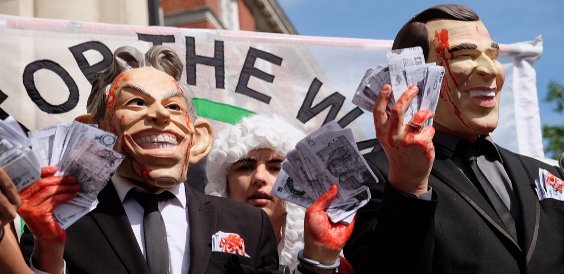
Are we ever likely to have a future UK Prime Minister talking condescendingly to the Jewish community in the Golder’s Green district of North London about strategies to tackle Jewish-Zionist extremism? Moreover, is a future leader likely to debate in leafy Surrey, the Christian-Zionist fundamentalism of Blair and Bush which resulted in the deaths of at least half a million Iraqi’s on the basis of a pack of lies? The questions of course are rhetorical since we know the answer.

Unlike the Tory-voting wealthy middle classes and Friends of Israel, mostly anti-Tory Muslims within a de–industrialized urban landscapes like Birmingham are regarded as political fair game for Tory shenanigans. Ignoring many of the causal factors that drive a small minority of mainly young Muslims to ISIS, such as the Wests endless wars in Muslim lands, Cameron outlined the Tory five-year vision to defeat home-grown extremism. The former PM set out four major areas that needed attention: countering the ‘warped’ extremist ideology, the process of radicalisation, the ‘drowning-out’ of moderate Muslim voices and the ‘identity crisis’ among some British-born Muslims.

The then PM spoke about the need to enforce British values citing “equal rights regardless of race, sex, sexuality or faith” as a core aspect of these values despite the fact that he voted in support of the homophobic Clause 28 as recently as 2003. Cameron then claimed that Islamic extremism can have nothing to do with Western intervention since the invasion of Iraq came after 9/11. He appears to be unaware of a century of imperial intervention before that. In the Tories vision ISIS popped out of thin air. It had nothing to do with a vacuum left as a direct result of US-British intervention in Iraq.

The most hypocritical thing is how the establishment pick and choose their Muslims. A well-worn narrative is that Muslims are incapable of coping with modern values. However, a succession of British Foreign Secretaries – including the latest, the pathological liar, Philip Hammond – are only too happy to be photographed and dined alongside the Saudi royal family who don’t accept any of the values the establishment call British. And when the likes of the current PM, Theresa May, talk about the British values we should accept, she’s not talking about the values her lot used to build an empire on.

In his speech, Cameron went on to conflate what British values were not by referencing forced marriage and female genital mutilation. The implication being that these manifestations of ‘un-Britishness’ are unique to Muslim culture which of course they are not. “No more turning a blind eye on the basis of cultural sensitivities”he said. Fine! I’ll now wait in eager anticipation for a similar speech by Theresa May to the Jewish community in Stamford Hill.

Cameron continued, “I want to work with you to defeat this poison [of Islamist extremism]”he said. Presumably, ‘defeating’ ISIS doesn’t involve the counterproductive action of bombing to smithereens yet more innocent civilians as the justification for mission creep or unconditionally supporting the Sunni authoritarian regimes, the ideology and funding of which helped spawn the likes of Al-Qaida and ISIS in the first place.

The one (unintended) positive that emerged from his speech was when he talked about the differentiation between Islamist extremism on the one hand, and Islam the religion, on the other. As such he brought into focus the wider questions regarding the differing interpretations seemingly inherent to religious doctrine.

Jon Snow of Channel 4 News quoted the Muslim Council of Great Britain saying:

“We need to define tightly and closely what extremism is rather than perpetuate a deep misunderstanding of Islam and rhetoric which invariably facilitates extremists to thrive.”

Do we know what Islamic extremism is exactly? Is there a distinction between Islam and extremism peddled in the name of Islam? Can a distinction be made between the Wahabbi version of Islam in Saudi Arabia and extremism? Surely the former is indistinguishable from the latter?

In order to tackle the problem associated with certain extremist interpretations of Islam, it makes sense to want to tackle the problem at source. But crucially, this was the aspect missing from Cameron’s speech. For if he was to highlight it, he would have been cutting off his nose to spite his face. That’s because Britain has a an extremely cozy relationship with the oppressive totalitarian states’ of the Arab Gulf Peninsula, all of whom without exception, adhere to the extremist theocratic Islamic ideologies.described but nevertheless represent extremely good business for Great Britain PLC.

Is it the duty of Muslims living, in say, Birmingham to defend other Muslims living, in say, Baghdad? Conversely, can the killing of innocent people in Western liberal democracies’ ever be considered justifiable on the basis that theoretically the populations within these nations often elect governments’ who initiate wars of aggression against Muslims in their name? Can violent acts in these circumstances ever be justified? Does this, in the minds of extremists, justify Jihad against Westerners by Muslims irrespective of where either reside in the world?

Some moderate Muslims like Baroness Warsi insist that Jihad is about “self-improvement, self-evaluation, questioning injustice and being prepared to raise your voice when you see injustice.” This contrasts with the more extreme interpretation of Jihad in which external factors like the taking of arms are seen as the precursor to the kind of self-evaluation outlined by Warsi. How can these seemingly irreconcilable differences be reconciled?

One of the main problems that needs to be addressed, but tends to be constantly evaded, relates to the contradictory aspect of religion itself. Christians, Jews and others of all denominations will often claim piety with one hand but adopt the role of arm-chair generals holding a metaphorical grenade with the other. Moreover, irrespective of whether one is a follower of ISIS, or whether one is a part of the vast majority of the wider Muslim community of Sunni or Shia, all groups and sects will self-identify with, and hence, claim they are the true representatives of Islam and all will justify their opposing positions by cherry-picking appropriate verses from their religious book.

These contradictory positions, in turn, are exploited politically by racists and Islamophobes. Islamophobia is not just a human reaction to cultural difference. It has been purposely perpetuated as a result of the politicisation of religion of which the creation of an Islamophobia industry is a reflection. The governments Prevent Strategy and the policies of the Henry Jackson Society are integral to the functioning of this industry. Cage, the London-based advocacy organisation, wrote of the Prevent strategy:

“Prevents causal analysis and theory is fundamentally flawed. According to the strategy, the cause of violence in the Muslim world is rooted in ideology. Whereas in reality the cause is the political struggle of Muslims in response to unrepresentative regimes, often aided by Western policy and occupations.”

This assessment appears to be consistent with the analysis of Stephen Holmes, who in relation to the attacks on New York and the Pentagon, implied that the goal of ISIS and Al Qaida is no different from other national liberation movements – to achieve independence by forcing the imperialist powers to retreat:

“The vast majority of Bin Laden’s public statements provide secular, not religious, rationales for 9/11. The principal purpose of the attack was to punish the ‘unjust and tyrannical America’. The casus belli he invokes over and over again is injustice not impiety. True, he occasionally remarks that the United States has declared war on god, but such statements would carry little conviction if not seconded by claims that the United States is tyrannising and exploiting Muslim people… Bin Laden almost never justified terrorism against the West as a means for subordinating Western unbelievers to the true faith. Instead, he almost always justified terrorism against the West as a form of legitimate self-defence.”

According to Holmes then, whilst political objectives maybe expressed in religious terms, in essence, the goal of ISIS/Al Qaida is the same as previous secular-nationalist movements in the Middle East—the defeat of US imperialism and its allies in the region.

However, as I will outline below, to claim that that all instances of jihadist violence do not have religious rationales is misleading. Nevertheless, the anti-Muslim ideology of the right-wing Henry Jackson Society, alongside the creation of the illiberal Prevent Strategy, meant that the establishment have been quick to exploit the media’s often sensationalist reporting as well as the fear and panic Muslim’s generate for their own narrow political propaganda purposes.

The former, for example, set up Student Rights which produced a report that manufactured panic around gender segregation on campuses. Cameron weighed in. Though strangely he never spoke about gender segregation at Eton. Catherine Heseltine of the Muslim Public Affairs Committee UK spoke of how growth in the fear of Islam has gone along with policies pushed by governments. She said:

“Immediately after 9/11 only 10 percent of people in Britain saw Islam as a religion as a threat…Since then that figure has just about tripled.”

According to Bob Ferguson, teacher and convener for Newham Stand Up Against Racism, since the passing of the Counter-Terrorism and Security Act in February last year, Islamophobia has been taken to a new level. Teaching staff at universities and schools now have a statutory duty to report people who may be vulnerable to “Islamic non-violent extremism”. One clause that is particularly pernicious, requires teachers and lecturers to report discussions on ‘Grievances to which terrorist organisations claim to have a solution’. That one clause wipes out any possibility of discussing imperialism.

Ferguson says :

“There was a minute’s silence for the victims of the beach attack in Tunisia. All the Muslims I know at my school thought those murders were a vile, reactionary crime. Many also regard the slaughter of three boys playing football on the beach in Gaza by Israel as a vile, reactionary crime. Expressing the first sentiment proves you are a good Muslim, but expressing the second could get you seen as an extremist.”

In conclusion, the issues are complex and multifaceted and not one aspect by itself is the reason why some young people join up with groups like ISIS. Although many moderates would deny to their last breath the religious rationale that underpins the violence of groups like ISIS and Al Qaeda, these groups would make similar claims against them. Whether moderate and peaceful Muslims disagree with their violent counterparts is a moot point since all groups self-identify as Muslims and justify their respective actions as Muslims based on the interpretation of passages contained within the holy book.

In Iraq, religious Sunni/Shia sectarian violence was unleashed following the illegal allied invasion of that country. Saddam had kept a lid on it up until that point. That’s just one example where religion is a major contributory cause of violence. Similarly, Zionist Jews justify continued illegal settlement building predicated on the Biblical imperative, and Bush and Blair were alleged to have got down on their knees in the name of their Christian God prior to the invasion of Iraq.

Some religious followers who interpret their books literally, cherry pick certain violent quotes from them in order to justify to themselves their beliefs, mainly for political purposes. This is true of religious extremists whether they be Salafist Muslims, Zionist Jews or Christian fundamentalists.



Addressing the motivations that drive Islamist obscurantists will help defeat them

By Daniel Margrain

Motivation guides behaviors

“The first step to combating Isis is to understand it. We have yet to do so. That failure costs us dear.” (Anthropologist, Scott Atran).

The murder of 85-year-old parish priest, Father Jacques Hamel during morning mass in Saint-Etienne-du-Rouvray,  northwest of Paris, by two adherents to the religious-based cult ISIS was yet another illustration of not only the depravity that this cult represents, but of the failure of domestic and international strategy of governments to deal with them. The lesson from almost a decade and a half of fighting terror with bombs is that the strategy has been an epic failure.

After the mass killings by ISIS in Paris, each subsequent attack on French soil has been marked by familiar-sounding televised addresses of condemnation of the perpetrators by president, Hollande followed by a determination to defeat them militarily. Meanwhile, French foreign policy in the Middle East continues along the same trajectory, presumably based on the premise that only through fighting fire with fire will the war against ISIS be won.

However, it would appear that with the exception of world leaders like Hollande and Britain’s Theresa May, most rational thinking people believe this eventuality to be an unrealistic proposition. ISIS are not like a traditional army and therefore can’t be fought as though they are one. Indeed, it’s the unpredictability and the random nature of their attacks in an era of globalisation which transcend the limitations associated with the traditional armies embedded within the structure of the nation-state, that sets them apart.

Although repeating the same failed foreign policy objectives undertaken by state actors in order to address the threat posed by an international terror network and ‘lone-wolf’ killers may be regarded as a sign of insanity by most, it nevertheless doesn’t appear to deter those who are motivated by the need to satisfy the financial interests of the lobbyists who profit from war.

Although it is widely understood that bombs and drones are counterproductive, it’s perhaps less understood that the establishment appear to want it that way on the basis, it would seem, that terrorist retaliation justifies the further use of bombs and drones. Ken Livingstone was surely correct in his analysis on BBCs Question Time programme last November when he suggested that bombing Raqqa will play into the hands of ISIS from a propaganda perspective enabling them to bolster their number of recruits on the back of it.

Indeed, it is clear that the aim of the religious-based cultists is to provoke an international bombing campaign precisely in order to achieve this objective. The ‘strategy’ of indiscriminate bombing of transnational ‘targets’ as a means of ending the cycle of terrorism and counter-terrorism is a policy of despair. What is needed is a total rethink that involves, in the first instance, a serious attempt at addressing the ideological motivations that drive ISIS as an organisation as well as the reasons why mainly young people are driven into the hands of this murderous cult.

The motivations seem to be varied and complex, embracing historical, theological, psychological and ideological factors. The first of these relates to the injustices meted out to the people of the region by the imperial powers. These injustices primarily originate from a series of secret meetings during World War 1 in London and Paris between the French diplomat, François Georges-Picot and the British politician, Sir Mark Sykes.

During these meetings, straight lines were drawn on a map of the middle east intended to effectively outline the control of land that was to be divided between the two countries. The French were to get Syria, Lebanon and parts of northern Iraq, while the British decided on southern Iraq, Jordan and Palestine. The idea was that instead of giving independence to the Arabs which was promised following the collapse of the Ottoman Empire, the imperial powers would run them on their behalf.

The ensuing chaos has largely stemmed from this agreement. What drives ISIS is their need to fill power vacuums in a post-colonial world in which the artificial imperial borders created by Sykes-Picot are collapsing. Robert Fisk made the astute point that the first video ISIS produced was of a bulldozer destroying the border between Syria and Iraq. The camera panned down to a piece of paper with the words “End of Sykes-Picot” written on it.

The wider “Arab Awakening,” as Fisk puts it, represents a rejection of the history of the region since Sykes-Picot during which time the Arabs have been denied freedom, dignity and justice. According to Fisk, ISIS is a weapon that’s not primarily aimed at the West but at the Shia which the Sunni Gulf States’ want to keep at bay. This explains why the funding for ISIS is principally coming from the Sunni states’ of Saudi Arabia and Qatar.

The possibility of closer U.S-Iranian ties in the future will likely result in pressure being put on these states’ to ‘switch off’ their funding to ISIS which Fisk claims was one of the main topics of discussion at the Geneva nuclear talks between the two countries. A couple of months ago, the goal of ISIS was to maintain the Caliphate, but they now realize that this objective is in jeopardy. Consequently they are attempting to re-organise. This involves them reverting back to a guerilla-style organisational structure. The purpose of directly commanded attacks, is to prove to their followers throughout the world that despite the set-backs described, they still remain a strong fighting force.

French-American anthropologist, Scott Atran, widens the net further by suggesting that the young are motivated more by excitement and a sense of belonging than theology or political ideology:

“When you look at young people like the ones who grew up to blow up trains in Madrid in 2004, carried out the slaughter on the London underground in 2005, hoped to blast airliners out of the sky en route to the United States in 2006 and 2009, and journeyed far to die killing infidels in Iraq, Afghanistan, Pakistan, Yemen or Somalia; when you look at whom they idolize, how they organize, what bonds them and what drives them; then you see that what inspires the most lethal terrorists in the world today is not so much the Koran or religious teachings as a thrilling cause and call to action that promises glory and esteem in the eyes of friends, and through friends, eternal respect and remembrance in the wider world that they will never live to enjoy…. Jihad is an egalitarian, equal-opportunity employer: …fraternal, fast-breaking, thrilling, glorious, and cool.”

Atran posits that the appeal of ISIS seems to be their offering of a Utopian society and the sense of belonging and empowerment that the religious obscurantists claim is lacking in Western society. The narrative is a future of peace and harmony, at least, under their interpretation, but with the recognition that brutality is also needed to get there.

The underlying aspect of this Utopianism is the retreat from the kind of unconditional freedom where many young people feel pressured into certain social actions, towards a different kind of freedom free from ambiguity and ambivalence that, for those concerned, enhances a form of creativity that restraint helps nurture. ISIS exploits this dichotomy by outlining a way towards significance in a society that treats the alienated as insignificant.

Maajid Nawaz depicts ISIS as akin to a brand that in order to be defeated needs to be discredited as part of a long-term strategy. This involves the creation of alternative narratives and the engendering of alternative forms of belonging and identity. Nawaz argues that the mission statement, as part of a generational struggle, has to be that the kind of obscurantist ideology that ISIS adhere to, is made as un-appealing as Stalinism or Hitler fascism is today. “We’ve got to be careful that we don’t become fixated about destroying the organization itself as part of a long-term strategy, but rather to focus on destroying the ISIS brand”, he says.

Irrespective of whether the discourse emanates from either the left or the right of the political spectrum, Nawaz argues that it needs to be more nuanced than has hitherto been the case:

“We seem to focus too much on binary approaches which on the one hand suggest that no problem exist within Islam [the perspective of many within the political left], or on the other, where all Muslims are perceived as the problem [the perspective of the far-right]. I would argue that to address the root problem we need to find a pathway between sensationalism and denialism.”

This approach will surely need to be run alongside a recognition by Western governments that their foreign policy strategies are not working. Instead of spending billions on ineffectual and counterproductive war, the money would be far better spent on effective prevention programmes on the ground. This could involve, as middle east scholar Ed Husain has argued, employing former jihadists to reach out to help educate young people about the dangers of ISIS and other extremists.

At some point, channels of communication will have to be opened up with radical Muslim groups who are willing to engage with experts outside the Muslim world to come to some kind of compromise agreement. This might even involve the formation of an Caliphate-type enclave based on ISIS lines. What is certain is the current path we are on is the wrong one.

The lack of any meaningful attempt to implement an effective strategy to weaken or destroy radical Islamism is self-evident. Ideologies cannot be defeated by bombs. Any U.S insistence that it’s dictatorial regional allies and proxies – Saudi Arabia and Qatar – deplete ISIS of funds, will go a long way to achieving desired short-term goals.

The West might have to come to terms with making a short-term pact with the devil as part of a long-term strategy that undercuts the kind of psychological and ideological motivations that drive young people into the arms of religious obscurantists in the first place.


Why Trident is a useless waste of public money

By Daniel Margrain

Monday evenings vote by the UK parliament to renew the Trident nuclear weapons programme which is planned to begin in the early 2030s at an estimated cost of £205 billion, speaks volumes about the malaise at the heart of British parliamentary democracy. The disconnect between Labour members and the Parliamentary Labour Party (PLP) is, in part, indicative of this broader schism in liberal social democracy more generally.

This is highlighted, for example, by the fact that the democratically-elected leader of the Labour party, Jeremy Corbyn, who commands a 20 point lead over his rival, Owen Smith in the renewed challenge to his leadership set for September, voted against the renewal of Trident, while 60 per cent of Labour MPs, the vast majority of whom are opposed to Corbyn’s leadership, voted in favour.

The replacement of the current stock of nuclear submarines is predicated on the 2006 White Paper, The Future of the United Kingdom’s Nuclear Deterrent, which asserts that the UK needs nuclear weapons in order:

to deter and prevent nuclear blackmail and acts of aggression against our vital interests that cannot be countered by other means.

The assumed logic underpinning this reasoning is that nuclear weapons provide states with the protection they need against potential adversaries. On the basis of this reasoning, it is impossible to avoid the conclusion that theoretically and, as an issue of consistency, every state should be allowed to obtain nuclear weapons. But contrary to state propaganda, this eventuality will inevitably make the world less, not more, safe. As Caroline Lucas eloquently and succinctly put it when she addressed PM, Theresa May, during the parliamentary debate:

“If keeping and renewing our nuclear weapons is so vital to our security and safety, does she accept the logic of that position must be that every other single country must seek to acquire nuclear weapons? And does she really think that the world would be a safer place if it did? Our weapons are driving proliferation, not the opposite.”

One only needs to look at the example of Iraq, which was attacked on the basis that Saddam was said to have had in his possession a functioning weapons programme that could be used to attack Britain within 45 minutes, in order to underline the truth of Lucas’ argument.

Secondly, both the Conservative and New Labour establishments’ claim that the Trident system is an ‘independent’ nuclear deterrent doesn’t stand up to scrutiny either. The reality is that Britain is currently only one among nine states ­in the world that does not possess an independent functional nuclear weapons system and the means to deliver it.

The notion then, that a U.S-supplied UK missile system is free to strike any target in the world is fanciful, particularly as its functionality is dependent upon the vagaries of US-UK relations at any given time. Of course, all of this is underscored by the fact that under the terms of the Nuclear Non-Proliferation Treaty Britain has an obligation to disarm.

The third illustration why Trident renewal is unsound, relates to the nature of the threats societies’ face in the 21st century. The 2015 National Security Strategy sets out the tier-one threats faced by the UK. These are international terrorism, climate change and cyber-crime. The obvious reality is that nuclear weapons are not a deterrent against any of these threats. How is it the case that over 180 countries in the world don’t feel the need to acquire this ‘deterrent’?

As the governments own Strategic Defence Review suggests, the threat of nuclear war is rated a two-tier level risk below international terrorism, climate change and cyber crime. It’s precisely because we live in an uncertain world where more countries aspire to get nuclear weapons, that the opportunity for terrorists to get hold of nuclear material becomes greater. The fact that nuclear weapons make the world less safe is the central premise which determines an ongoing UN process involving some 130 countries who are engaged in discussions about banning nuclear weapons. Unsurprisingly, the UK government is not a party to these discussions.

The arguments for maintaining Trident fall like a house of cards whose foundations are built on sand. The theory that having nuclear weapons makes the country safer is an entirely unproven one, and nor can it be proven. In logic, one cannot prove a negative insofar that doing something causes something else not to happen. The reason why nuclear attacks haven’t happened since the U.S attack on Japan, may be the result of any number of factors, or simply may be due to exceptionally good fortune. Indeed, many military experts argue that nuclear weapons make the country less safe, primarily because it increases the likelihood of them being used.

Britain’s possession of nuclear weapons exacerbates uncertainties and leads to the very scenario it is designed to avoid. If Trident is so effective in protecting the British people, why is it also not the case for every other country in the world? How can the UK government possibly try to deny the right of other countries to acquire them under circumstances where the UK government upgrades its own nuclear weapons?

The one argument that the proponents of Trident renewal frequently cite is the supposed loss of jobs that would allegedly result from any decision to de-commission or not to renew Trident. But, as SNP MP Mhairi Black argued in an erudite and passionate speech to the House of Commons, there is no evidence to suggest, given any political will to examine likely alternative employment opportunities, that job losses would inevitably be the result in any decision not to renew.

The billions that the government is proposing to spend on Trident renewal could conceivably be spent on utilizing the skilled engineers, scientists and other workers elsewhere by investing in energy, engineering and other alternative specialist areas. In addition, greater sums could be invested in preventing climate change. This latter diversification alternative would, as Black emphazises, seem to be particularly pertinent given that climate change is a tier-one threat. The notion that the Trident renewal argument as a defence against a two-tier threat trumps the threat posed by climate change which is a tier-one threat, defies all logic. As Peter Hitchens put it:

“Trident is like spending all your money on insuring against alien abduction, so you can’t afford cover against fire and theft.”

Furthermore, the decision to renew is both counter-intuitive and counter-productive. This is because such a process, as Caroline Lucas contends:

“gives out an incredibly negative message to the rest of the world that if you want to be secure then you have to acquire nuclear weapons. To that extent this vote will drive nuclear proliferation.”

Britain’s nuclear weapons capability does nothing to tackle the real threats the country faces. Rather, it has more to do with augmenting the perception throughout the rest of the world that a faded imperial power is still a significant player on the world stage. Maintaining a nuclear ‘deterrent’ is, in other words, about sending a message to the rest of the world that the projection of power by any means is necessary. Central to maintaining this illusion, is the assurance that the UK secures its permanent member status on the UN Security Council. The Trident nuclear weapons programme serves no other purpose than to satisfy the ego of the British establishment and the propping up of the arms industry.

In the context of an era of welfare retrenchment and austerity, the public are constantly being told by politicians that ‘difficult decisions’ have to be made in terms of the ‘necessity’ to cut disability, unemployment benefits and pensions, while the spending of billions on Trident is essential for their safety and security. The conservative political commentator and television personality, Michael Portillo, manages to cut through the spin as the graphic below illustrates:

As Portillo correctly implies, spending obscene amounts on what are frankly useless, unnecessary and immoral weapons of mass destruction, is an indefensible act of self-serving and short-sighted political narcissism.


Gods & monsters

By Daniel Margrain

Brideoffrankenstein.jpg

During the dark pre-enlightenment days before science, the earth was widely perceived as a stable force at the centre of the universe overseen by a God who envisaged humanity as having a fixed set of roles within it. To step outside this framework of ‘stability and order’ was to challenge the prevailing orthodoxy that shaped society. By challenging the existence of God (and hence the nature of society) through science, Galileo and others paid the ultimate price with their lives.

For man to disobey God by tasting the fruit of the forbidden tree was deemed to have brought evil into the world. Thus theology and the clergy explained the existence of wrongdoing as a primordial human condition that had to be controlled by a deity for whom the wrongdoers were required to seek salvation. This salvation took root in a system of ideas that underpinned the philosophical writings of Aristotle who conceived a world in which everything had a purpose.

The purpose of individual beings, and the places they naturally occupy, all dovetailed together, according to Aristotle, to form the pattern of the universe in order to give everything its place in the world. Religion and Aristotlian philosophy are therefore mutually reinforcing concepts that helped maintain uneven relations of power, centred on order.

Although the enlightenment and the emergence of science was a great leap forward from the idea that the power of Kings was historically fixed predicated on a grand purpose and design ordained by God, it nevertheless remained tied to the concept of progress as being that of the development of the human mind and of human nature as unchanging. So just as the church regarded stability and order as a primordial human condition, the classical economists that arose out of the enlightenment treated private property also as a fixed primordial human condition.

The religious and political establishment continue to blind the masses with this propaganda today. Hierarchical structures are as rigid in class stratified modern Britain (where social mobility is actually in reverse) as they have ever been. The masses of ordinary people have been conditioned to know their place within an ‘unchanging’ society even though the great changes wrought by the Industrial Revolution prove that power had transferred from feudal landlords to corporate grandees.

The supplanting of the aristocracy of land with money in this way led to the reduction of the great estates to commodities in which almost everyone and everything became “objectified”. The worker devotes his life to producing objects which he does not own or control. The labour of the worker, according to Karl Marx, thus becomes a separate, external being:

“Man’s labour exists outside him, independently of him and alien to him, and begins to confront him as an autonomous power, the life which he has bestowed on the object confronts him as hostile and alien.”

In the year of Marx’s birth in 1818, a young English author called Mary Wollstonecraft Shelley published, in London, the first edition of the Gothic and Romantic science fiction novel, Frankenstein – the tale of a monster which turns against its creator. It’s the externalizing and uncontrollable force that provides the catalyst for change that Shelley describes in her masterpiece which draws parallels with the daily lot of workers. It’s these workers who continually produce what they cannot keep until eventually, as was the case with the Luddites, they rebel against the machines that churn out the fruits of their alienated labour by smashing them to pieces.

In dialectical terms, change in nature is reality. But as Marx understood, the dialectic also applies to the social world in which alienation is considered to be a material and social process. Since humans are an integral part of nature, they can not be excluded from the forces that govern it. The forces that determine changes in nature also, therefore, apply to the social world. At some point quantitative change results in fundamental qualitative change. An acorn, in becoming an oak, for example, will have ceased to be an acorn. Yet implicit within the acorn is the potential to become an oak. The economic system of capitalism, in potentially becoming something else, will similarly, cease to be.

The rise of Jeremy Corbyn is indicative of the kind of transformation from quantitative to qualitative change outlined. This explains why the establishment are doing their utmost to prevent it. Just as Dr Frankenstein couldn’t control the monster he created and the machines couldn’t ultimately control the impulses of workers in the factories wrought by the impacts of industrial capitalism, so it is the case that the establishment won’t be able to control the forces which Corbynism has unleashed.

What has typified the history of colonial and imperialist oppression thus far, has been the ability of the oppressors to suppress opposition to their rule using monsters as part of their strategy of divide and conquer based on the concept of “my enemies enemy is my friend”. However, what the oppressors rarely appear to factor in to their strategies, is the potential for both the monsters and ordinary people alike, to break free from their chains. The brainwashing techniques of the corporate media, as well as the Machiavellian politicians who sing to the tune of their paymasters, is not sustainable. Corbyn is leading a movement that potentially will be at the forefront of tearing the entire edifice down.

Not only are monsters able to break free from the oppressors who create and nurture them, but paradoxically they also create the conditions in which a greater number of other monsters emerge. This was, for example, the case in Afghanistan during the 1980s following president Carter’s 1979 authorization of a $500 million covert action programme in support of tribal groups known as the mujahedin.

The kinds of monsters which successive US governments help nurture have managed to either strain at the leash (as in the case of Israel), or completely break free from their masters grip (as was the case with the mujahedin in Afghanistan). In terms of the former, as a result of the law of unintended consequence, the US-dependent monster often bites the financial hand that feeds it. This is rooted in uncontrollable and unpredictable geopolitical forces.

However, there are other monsters which their creators manage to exert a tight control of. An example, is the extent to which the the US government have managed to maintain leverage over the terrorist fighters that continue to emerge from what was formerly known as the School of the Americas (SOA). Since 1946, the SOA has trained over 60,000 Latin American soldiers and policemen as well as torturers, mass murderers, dictators and state terrorists who, according to SOA Watch, have “ripped the continent apart.” Two-thirds of the El Salvador army who committed some of the worst atrocities in its civil war had been trained at the SOA.

Moreover, the school has been complicit in numerous other dirty wars – particularly throughout the 1980s – fought on behalf of the US as well as training various other dictators from all over central and south America. More recently, the school was almost certainly responsible for training the killers who were a component part of the brutal regime that overthrew the Honduran government headed by Manuel Zelaya on June 28, 2009. Media Lens pointed out in early March this year, that those responsible for the coup d’etat – which was supported by successive U.S administrations – assassinated the leading grass-roots Honduran environmental activist, Berta Caceres.

These kinds of Faustian pacts with the devil have, largely by way of ‘blow back’, contributed significantly to the exponential spread of terrorism worldwide, as well as the destabilization of entire countries and even regions. This is evidenced by the emergence of Al-Qaeda in Iraq following the 2003 illegal US-led invasion, the chaos that is unfolding in Honduras and the spread of ISIS in Libya and beyond. The latter were spawned in the Wests favoured regional client, Saudi Arabia – the authoritarian religious extremist state that has been bombarding Yemen for the last 19 months using, as journalist Iona Craig has documented, weaponry sold to them by the UK-US governments’.

Given that the FBI defines terrorism as “violent acts …intended to intimidate or coerce a civilian population, influence the policy of a government, or affect the conduct of a government”, it’s difficult to rationalize how violations of international law in this way, under the guise of illegal war, is not illustrative of anything other than the kinds of terrorism the Western powers accuse their official enemies of committing.

Famously, Peter Ustinov eloquently articulated the conflation of war with terrorism. “War”, he said, “is the terrorism of the rich and powerful, and terrorism is the war of the poor and powerless.” In other words, the wars initiated by the powerful represent the substantial terror. Under such circumstances, the greater monsters are closer to home than many of us would perhaps care to admit. If God does exist, maybe he will be at the gates of Heaven to pass judgement on our rulers.

In the meantime, ordinary people are trying to establish the number to the combination lock to the chain that binds them to the Gods and monsters created by imperial power. Jeremy Corbyn has the number to the combination in the jacket pocket of his unkempt suit.

The carnage in Nice didn’t emerge from a metaphorical clear blue sky

By Daniel Margrain

Bullet imacts are seen on the heavy truck the day after it ran into a crowd at high speed killing scores celebrating the Bastille Day July 14 national holiday on the Promenade des Anglais in Nice, France, July 15, 2016. © Eric Gaillard

There is something deeply unsettling about the manner in which President Hollande and other leading political leaders and powerful establishment figures responded in the aftermath of the violent carnage that occurred in Nice on Thursday evening. The rolling media coverage that followed this tragic event, was accompanied by the predictable rhetorical flourishes from across the political spectrum highlighting the need for terrorism to be defeated. After every tragedy of this nature the same kinds of statements are repeated again and again even though the politicians making them must know that such an eventuality is impossible. The kind of crude public pronouncements that invariably follow tragedies of this kind are, in other words, seemingly inevitable as they are intellectually indolent.

It would appear that the establishment’s intention after these kinds of appalling acts of violence occur is to reinforce the invocation of ‘loyalty oaths’ as part of a broader strategy to marginalize and isolate minority Muslim communities. Whenever, for example, an atrocity is committed by those who self-identify as Muslims, the wider Muslim community are effectively urged to pledge an allegiance to the country of their birth or, alternatively, they are encouraged to collectively condemn the violence ostensibly undertaken in their name. Often it’s both of those things.

Any attempts to resist apology projection is deemed by the establishment to be akin to a form of treachery in which tacit support for an official enemy is implied. Crude loyalty binaries are invoked. Opposition to this sort of binary analysis often evokes the specter of the ‘enemy within’ trope among significant sections of the corporate-controlled media and the political establishment. Thus, whether implicitly or explicitly, the result is that the Muslim community often ends up being tarnished with the ‘terrorist sympathizers’ epithet. Consequently, over time the Muslim community in France, and elsewhere, has tended to become less trustful and more fearful of the wider community and vice-versa.

It has been the inability of successive French governments to successfully integrate its Muslim community minority within wider mainstream French society that has in part contributed to feelings of alienation among this community which is exacerbated as a result of the mainstream media’s response to it. The alienation that Muslims experience in France cannot be separated from the broader sociological context in which the political situation described above also plays a significant role. In relation to how the sense of alienation has manifested in Nice, Sky News’ Sam Kiley remarked:

“In the emergence of an active criminal underworld there exists a natural synergy between organised crime and violent Jihadism. …A number of people from Nice have gone to fight in Syria and Iraq alongside Islamic State…The killer in this case, wasn’t one of them. This is somebody who was a petty criminal and who was possibly radicalized on the internet as opposed to somebody who had direct relationships with terror groups.”

Kiley continued:

“Many immigrants feel left behind and excluded from the opportunities in a way that some of the wealthier residents in the city don’t. This makes them easy prey for the radicalized programme which is very effectively campaigned by Al-Qaida and IS, both of whom have been encouraging their followers and disciples to be these lone-wolf characters to use vehicles to mow people down….We need to recognize that Tunisia is the single biggest foreign fighter volunteers that go to join the Islamic State. This has been the case for well over a year.”

The misplaced notion that any long-term sense of community cohesion has been overstated, has resulted in an intellectual and media narrative in which the great social conflicts and ideological struggles were said to have been a thing of the past. This notion gained intellectual credence following Francis Fukuyama’s End of History thesis. Numerous newspaper editors and television presenters agreed.

A little over a decade after Fukuyama wrote his thesis, it’s premise had been shattered by real life events when Islamist obscurantists attacked the Twin Towers in New York. The attack was, in part, the result of Wahhabism’s ideological opposition to Western imperialist hegemony. Anthony Giddens, the former director of the London School of Economics and court sociologist to Britain’s then New Labour Prime Minister, Tony Blair, repeated a similar message to that outlined by Fukuyama in his 1998 book, The Third Way.

Giddens who, by uncritically accepting a widespread but unsustainable assumption  said“We live in a world where there are no alternatives to capitalism.” Numerous imperial wars as well as counter-insurgent violence on Western soil have been launched since Giddens and Fukuyama made their remarks. Leaving aside the possibility of global catastrophe resulting from climate change or nuclear war, the notion that capitalism will continue to exist indefinitely into the future, is highly improbable. Moreover the notion that Islamist extremist violence does not represent an ideological challenge to Western imperialist hegemony in light of the numerous atrocities since 9-11, is clearly wishful thinking. The violence in Nice is, in part, indicative of the continuation of the reactionary forces who are opposed to Western imperialism.

It took the UK corporate media some 15 hours following the atrocity in Nice to actually address the likely causes of the attack. Speaking on Sky News, Anna Guidicelli, former security analyst at the French Foreign Office, was explicit in her assertion that the state of emergency system in France is politically motivated as opposed to operationally motivated, the intentions of which, she claimed, are to undermine civil liberties. Guidicelli stated that the state of emergency in France would do nothing to address the issue of prevention or to aid justice. “I’m convinced that the underlying problems are geopolitical”, she said. “I’m trying to stress to the government the significance external foreign policy plays in these kinds of attacks.”

Guidicelli continued:

“People are radicalized, not only because they are crazy and lost but because they have a political view. While we have to recognize that the launching of war abroad has an effect domestically, the real question we have to address, is what are the interests, as part of the coalition, does our government have in places like Iraq and Syria? We have to address this issue in parliament. When we launch war we say we are doing so in order to protect our territory. But it’s exactly the contrary to what is happening. Our contribution as a country to the coalition is lethal.

In emphazising the sociopolitical context highlighted previously, Guidicelli remarked:

The attacks in France are a consequence of a complex combination of both sociological and political factors. The problems are deep-rooted and in order to address them long-term in any fundamental way it is necessary to go beyond the five year mandated electoral cycle which is dependent upon short-term ‘solutions’. What we can do now as part of a long term mix is to withdraw our troops from the Middle East. What is disappointing is that the government is not addressing this external aspect.”

On the contrary, French foreign policy predicated on the concept of endless warfare, appears to be perpetuating the kind of violence witnessed in Nice that the establishment claims it wants to prevent. This concept evokes the Project for the New American Century which predates the US-led slaughter in Iraq, the emergence of Al-Qaida and IS and the attacks in New York that preceded them. It’s therefore not Islamist terrorism that represents the catalyst for chaos and destruction in the world, but rather the United States, it’s allies and their proxies.


Blair damned. But did the Chilcot report go far enough?

By Daniel Margrain

Having mounted sustained attacks on Jeremy Corbyn since he became the Labour leader, the Blairite factions within the right of the party stepped-up their campaign of vilification and hostility in the wake of the much anticipated release of the Chilcot report in what they hoped would be one last concerted push to depose him. With Corbyn remaining defiant and showing no indication that he plans to step-down, the strategy has clearly been a monumental failure. With grass-roots membership of the party set to increase to an estimated 600,000, Corbyn currently heads the biggest movement of the left in Europe.

The Chilcot report was utterly damning of Blair and, by extension, was also critical of the plotters opposing Corbyn who either abstained or voted in favour of the Iraq war. However, the report fell woefully short of offering any justice for the families of British soldiers who lost loved ones or for the hundreds of thousands of Iraqi civilians who were killed. For many, it wasn’t necessary for Chilcot to have taken seven years to oversee a report comprising 2.6 million words at a cost of £10m, in order for the public to grasp the fact that the war amounted to what the Nuremberg Tribunal defined as the “supreme international crime differing only from other war crimes in that it contains within itself the accumulated evil of the whole.”

Under the UN Charter, two conditions must be met before a war can legally be waged. The parties to a dispute must first “seek a solution by negotiation” (Article 33). They can take up arms without an explicit mandate from the UN Security Council only “if an armed attack occurs against [them]” (Article 51). Neither of these conditions applied to the US and UK. Both governments rejected Iraq’s attempts to negotiate. At one point, the US State Department even announced that it would “go into thwart mode” to prevent the Iraqis from resuming talks on weapons inspection.

Iraq had launched no armed attack against either nation. We also know that the UK government was aware that the war it intended to launch was illegal. In March 2002, the Cabinet Office explained that a legal justification for invasion would be needed: “Subject to Law Officers’ advice, none currently exists.” In July 2002, Lord Goldsmith, the attorney-general, told the Prime Minister that there were only “three possible legal bases” for launching a war: “self-defence, humanitarian intervention, or UNSC [Security Council] authorisation. The first and second could not be the base in this case.”

Bush and Blair later failed to obtain Security Council authorisation. A series of leaked documents shows that the Bush and Blair governments knew they did not possess legal justification. Chilcot repeated the lie outlined in the Butler Inquiry that the intelligence was not knowingly fixed. The contents of the Downing Street memo, puts that lie to rest. The memo, which outlines a record of a meeting in July 2002, reveals that Sir Richard Dearlove, director of the UK’s foreign intelligence service MI6, told Blair that in Washington:

“Military action was now seen as inevitable. Bush wanted to remove Saddam, through military action, justified by the conjunction of terrorism and WMD. But the intelligence and facts were being fixed around the policy.”

The Downing Street memo reveals that Blair knew that the decision to attack Iraq had already been made; that it preceded the justification, which was being retrofitted to an act of aggression; that the only legal reasons for an attack didn’t apply. The legal status of Bush’s decision had already been explained to Blair. In March 2002, as another leaked memo shows, the UK foreign secretary, Jack Straw, had reminded him of the conditions required to launch a legal war:

“i) There must be an armed attack upon a State or such an attack must be imminent;
ii) The use of force must be necessary and other means to reverse/avert the attack must be unavailable;
iii) The acts in self-defence must be proportionate and strictly confined to the object of stopping the attack.”

Straw explained that the development or possession of weapons of mass destruction “does not in itself amount to an armed attack; what would be needed would be clear evidence of an imminent attack.” A third memo, from the Cabinet Office, explained that:

“there is no greater threat now than in recent years that Saddam will use WMD … A legal justification for invasion would be needed. Subject to Law Officers’ advice, none currently exists.”

Apologists for Blair often claim that war was justified by recourse to UN resolution 1441. But 1441 did not authorise the use of force since:

“there is no ‘automaticity’ in this resolution. If there is a further Iraqi breach of its disarmament obligations, the matter will return to the Council for discussion as required in paragraph 12.”

In January 2003, the attorney-general reminded Blair that “resolution 1441 does not authorise the use of military force without a further determination by the security council” Such a determination was never forthcoming. UN Secretary General Kofi Annan reaffirmed that the Iraq War was illegal having breached the United Nations Charter. The world’s foremost experts in the field of international law concur that “…the overwhelming jurisprudential consensus is that the Anglo-American invasion, conquest, and occupation of Iraq constitute three phases of one illegal war of aggression.”

As well as their being no legal justification for war, it’s also worth pointing out that the invasion was undertaken in the knowledge that it would cause terrorism – a point amplified by Craig Murray:

“The intelligence advice in advance of the invasion he received was unequivocal that it would increase the threat to the UK, and it directly caused the attacks of 7/7.”

Nevertheless, this determination was followed by a benevolent course of action. As Chilcot made clear, the process for coming to the conclusion that Saddam had in his possession WMD as the basis for Blair’s decision to go to war, was one in which his Cabinet was not consulted. Chilcot also revealed that flawed intelligence assessments were made with certainty without any acknowledgement of the limitations of the said intelligence. Third, that the UK undermined the authority of the UN Security Council, and fourth, that Blair failed the Cabinet about Lord Goldsmith’s rather perilous journey by saying the war was actually legal having previously said it was illegal having mulled over it for over a year.

However, even though Chilcot can be applauded for the fact that it did something that most other societies in the world didn’t do, ultimately the report can be defined by the fact that it fudged the legal question. Chilcot didn’t explicitly say that the war was illegal. As such, Blair in his post-Chilcot speech was still able to dishonestly depict the invasion as an effort to prevent a 9/11 on British soil in the knowledge that the real culprits of 9-11 were the Saudi elite who finance him.

In the run up to the report being published in which various worthies were wheeled out, Chilcot said“the circumstances in which a legal basis for action was decided were not satisfactory.” In other words, the establishment, which Chilcot and his team represent, hid behind processes as opposed to stating loudly and clearly that the British government at that point was hell-bent on going to war with Iraq irrespective of what the evidence said about WMD or anything else.

It’s quite astonishing that the comments made by an authoritative figure such as General Wesley Clark who tells how the destabilization of the Middle East was planned as far back as 1991, was not mentioned by Chilcot nor has been examined and debated in the mainstream media. Perhaps just as pertinently, both Chilcot and the media ignored the claim made by Scott Ritter who ran intelligence operations for the United Nations from 1991 to 1998 as a United Nations weapons inspector in Iraq, that by the time bombing began, Iraq had been “fundamentally disarmed”.

In the post-Chilcot context, it’s clear that no lessons from the guardians of power in the media have been learned, despite claims to the contrary. This can be seen, for example, in the reluctance of the media to allow the expression of dissenting voices that extend beyond the restrictive parameters of debate the media create. In highlighting the inherent bias, Craig Murray said:

“The broadcast media seem to think the Chilcot report is an occasion to give unlimited airtime to Blair and Alastair Campbell. Scores of supporters and instigators of the war have been interviewed. By contrast, almost no airtime has been given to those who campaigned against the war.”

Similarly, Stop the War’s Lindsey German pointed to the lack of balance on the BBCs ‘Today’ programme. For the most part, the guardians of power are only too eager to fall into line by acting as establishment echo-chambers rather than challenging the premises upon which various stated government positions and claims are based.

Anti-Corbyn plots & the myth of the un-electable left

By Daniel Margrain


Corbyn speaking at the Tolpuddle Martyrs’ Festival and Rally in 2015


In 1978, the Australian social scientist, Alex Carey, pointed out that the twentieth century has been characterized by three developments of great political importance: “the growth of democracy; the growth of corporate power; and the growth of corporate propaganda as a means of protecting corporate power against democracy.” The corporations that now dominate much of the domestic and global economies recognize the need to manipulate the public through media propaganda by manufacturing their consent in order to defend their interests against the forces of democracy. This is largely achieved as a result of coordinated mass campaigns that combine sophisticated public relations techniques.

The result is the media underplay, or even ignore, the economic and ideological motivations that drive the social policy decisions and strategies of governments’. Sharon Beder outlines the reasoning behind the coordinated political, corporate and media attacks on democracy:

“The purpose of this propaganda onslaught has been to persuade a majority of people that it is in their interests to eschew their own power as workers and citizens, and forego their democratic right to restrain and regulate business activity. As a result the political agenda is now largely confined to policies aimed at furthering business interests.”

This is the context in which the UK political and media establishment are attacking Jeremy Corbyn’s leadership and demeaning the membership who had the temerity to vote for him, securing the biggest electoral mandate of any Labour leader in British political history. It’s the possibility that Corbyn will break the iron-clad neoliberal consensus that scares the establishment the most. As Mike Sivier has shown, the significant role the media have played in undermining Corbyn’s leadership, as well as their failure to explicitly acknowledge the establishment coup against him, can be traced back until at least April.

But arguably, the plot to oust Corbyn began the moment he became leader after a hardcore group that included shadow chancellor Chris Leslie, shadow education secretary Tristram Hunt, shadow communities secretary Emma Reynolds and shadow defence secretary Vernon Coaker, all refused to serve under him. Others included shadow transport secretary Michael Dugher, shadow chief secretary to the Treasury Shabana Mahmood, shadow international development secretary Mary Creagh and shadow Cabinet Office minister Lucy Powell.

The corporate media also played their part in what has arguably been the most vitriolic and biased reportage ever witnessed against any British political figure in history. What Media Lens accurately described as a “panic-driven hysterical hate-fest right across the corporate media spectrum,” actually began during Corbyn’s campaign to become leader. As the media analysts noted at the time, “the full extent of media bias against Jeremy Corbyn can be gauged simply by comparing the tone and intensity of attacks on him as compared to those directed at the other three candidates: Andy Burnham, Yvette Cooper and Liz Kendall.”

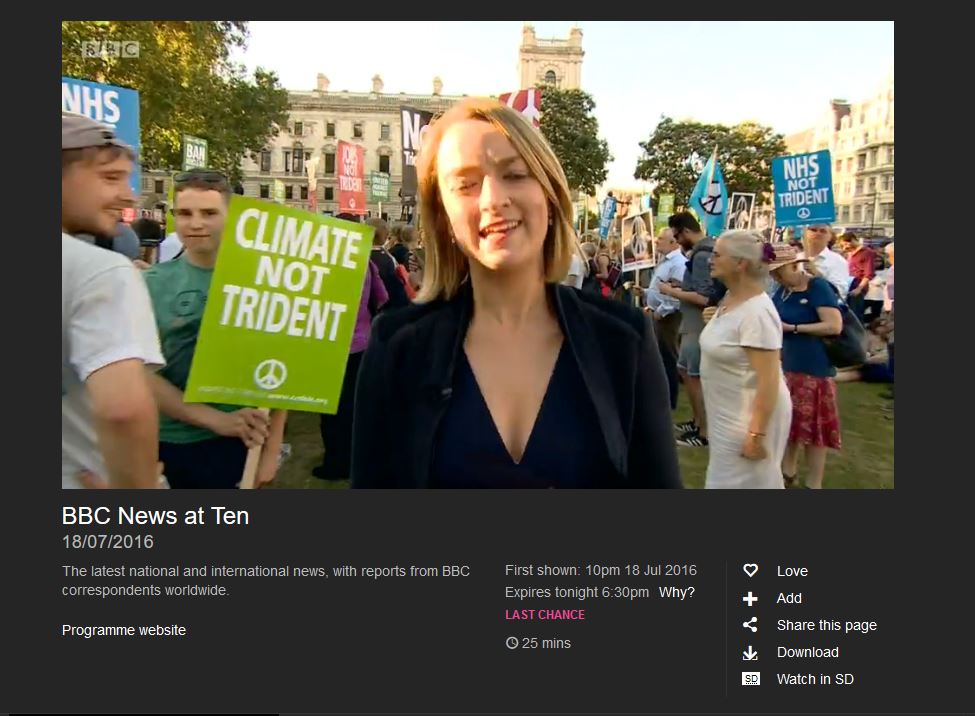
The intensity of the media attacks on Corbyn increased after the election despite the fact that he secured ‘the largest mandate ever won by a party leader’. The focus of these attacks included what colour poppy Corbyn would wear, his refusal to sing the national anthem or whether he would wear a tie or do up his top button. All of this was granted national news headlines and incessant coverage. Not to be outdone, in October last year, the BBCs political editor Laura Kuenssberg featured in an almost comically biased, at times openly scornful, attack on Corbyn’s reasonable stance on nuclear weapons. The BBC then broadcast five senior Blairite Labour figures all opposing Corbyn without any opportunity for an alternative viewpoint.

Kuenssberg followed up this hatchet-job three months later when she helped to orchestrate the live resignation of Labour shadow foreign minister Stephen Doughty on the BBC2 Daily Politics show as a pre-requisite to accusing Corbyn’s team of ‘unpleasant operations’ and ‘lies’. Then came the April 12 Telegraph article – a non-story about Corbyn’s state-funded salary and pension.

Allied to all this, have been the attempts by the Blairite Friends of Israel rump within the Parliamentary Labour Party (PLP) to topple Corbyn using the specter of antisemitism as a weapon with which to achieve it. Arguably, among the most comprehensive analyses of the McCarthy-style witch-hunts undertaken so far has been by Tony Greenstein (who remains at the forefront of moves to combat genuine cases of antisemitism on the fringes of the Palestine solidarity movement) in addition to the brilliant investigative work of journalist Asa Winstanley.

In an excellent piece published by the Electronic Intifada (April 28, 2016), Winstanley outlined the links between right-wing, anti-Corbyn and pro-Israel forces within the Labour party. He meticulously showed how this lobby manufactured an ‘antisemitism crisis’, pinpointing the individuals involved, the tactics and dirty tricks used and the connections to powerful individuals whose ties lead to pro-Israel groups both in London and Israel.

The latest attack on Corbyn centred on another contrived ‘antisemitism’ accusation, this time made by Labour MP, Ruth Smeeth who Wikileaks have revealed is a ‘strictly protected’ US informant. Smeeth staged a highly publicised walk-out during Corbyn’s launch of a review into the Labour party’s supposed ‘anti-semitism crisis’ last Thursday (June 30) which, as Jonathan Cook pointed out, was in fact, “a crisis entirely confected by a toxic mix of the right, Israel supporters and the media.”

A few days earlier another manufactured and staged anti-Corbyn story made the headlines. This time it centred around a Corbyn ‘heckler’ at Gay Pride, who in fact, as Craig Murray observed turned out to have been Tom Mauchline who works for the public relations firm, Portland Communications, whose ‘strategic counsel’ is Alastair Campbell, Blair’s former media chief who helped to sell the illegal invasion-occupation of Iraq.

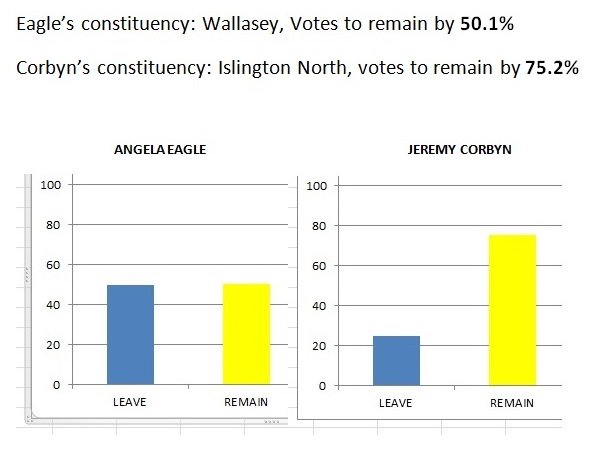
In addition to all of this, Corbyn’s pro-Remain position with respect to the EU referendum provided his critics with the ammunition they needed in their attempts to undermine him further. Chief among these critics is Angela Eagle, one of the many Oxford educated Blairite plotters who resigned her post in order to position herself as a potential replacement for Corbyn and who claimed to be dissatisfied with Corbyn’s performance during the EU referendum campaign. However, as the graphic below would appear to indicate, Corbyn did much better than Eagle in defending their respective Remain positions:

According to a YouGov poll, Eagle commands just 6 per cent support from Labour members while a greater number than last time said they will vote for Corbyn if he were to stand again. In other words, just like last time, Corbyn would likely win more votes than all the other candidates combined. This grass-roots popularity for Corbyn must be seen against a backdrop in which the Labour party gained 60,000 members in one week following the attempted coup against him. Membership of the party currently stands at about 450,000 – a figure that is higher than it’s last peak of 405,000 members last seen under Tony Blair’s leadership.

This would almost certainly translate into Corbyn receiving more votes than his Blairite predecessor Ed Milliband did at the last General Election. With the proportion of the Labour vote increasing under Corbyn, the two main parties are neck-and-neck at 32 per cent. This undercuts the recent claims of elder statesmen like David Blunkett and Neil Kinnock that Corbyn is an electoral liability for Labour.

This narrative is consistent with the notion that the left are un-electable more generally. Such a narrative is a myth. As Craig Murray posited, the idea that you have to be right-wing to win elections is belied by the fact that the SNP under Nicola Sturgeon won the people of Scotland over on a left-wing ticket. Secondly, as he rightly says, there is no point being elected just so you can carry out the same policies as your opponents. Third, the British public’s ‘enthusiasm’ for somebody like Blair in 1997 was not based on policies known as Blairite. As Murray astutely points out:

“The 1997 Labour Manifesto  was not right-wing. It did not mention Academy schools, Private Finance Initiative, Tuition Fees, NHS privatisation, financial sector deregulation or any of the right wing policies Blair was to usher in. Labour actually presented quite a left wing image, and figures like Robin Cook and Clare Short were prominent in the campaign. There was certainly no mention of military invasions. It was only once Labour were in power that Blair shaped his cabinet and his policies on an ineluctably right wing course and Mandelson started to become dominant. As people discovered that New Labour were “intensely relaxed about people getting filthy rich”, to quote Mandelson, their popular support plummeted. “The great communicator” Blair for 90% of his Prime Ministership was no more popular than David Cameron is now. 79% of the electorate did not vote for him by his third election.”

Murray continues:

“Michael Foot consistently led Margaret Thatcher in opinion polls – by a wide margin – until the Falklands War. He was defeated in a victory election by the most appalling and intensive wave of popular war jingoism and militarism, the nostalgia of a fast declining power for its imperial past, an emotional outburst of popular relief that Britain could still notch up a military victory over foreigners in its colonies. It was the most unedifying political climate imaginable. The tabloid demonization of Foot as the antithesis of the military and imperial theme was the first real exhibition of the power of Rupert Murdoch. Few serious commentators at the time doubted that Thatcher might have been defeated were it not for the Falklands War – which in part explains her lack of interest in a peaceful solution. Michael Foot’s position in the demonology ignores these facts. The facts about Blair and about Foot are very different from the media mythology.”

The reality, as one commentator on twitter put it, is that in corporate media and political establishment parlance, “‘un-electable” is media-political code for ‘likely to be highly electable but ‘will not serve elite interests.'”

This description applies to Corbyn. The ‘un-electable left’ meme is likely to intensify the longer Corbyn manages to hang on. In these unsettling and unpredictable times, it’s the one propaganda weapon the establishment is certain to cling to as their means of attempting to prevent democracy from breaking their grip on power.

A second referendum?: The Tories continue to fiddle while Britain stumbles into the abyss

By Daniel Margrain

Last Wednesday afternoon I took the Eurostar from a grey and dismal London to a sunny Paris. I decided that I would try to ignore the news while I was away. However, by Friday, temptation got the better of me. While sitting at a restaurant table in the small picturesque Parisian commuter-belt town town of St Germaine en Laye enjoying my lunch, I asked the waiter if he knew what the result of the EU referendum was. He expressed his shock at the decision of the British public to renounce their membership of the 28 member club. “That’s it”, he said, “the European project is dead”. I asked him whether he thought that this was a good thing or a bad thing? “It’s a bad day for Europe”, he exclaimed. “I’m not sure the project can continue to be run effectively with Britain gone but your heart was never really in it anyway”, he continued.

He claimed that Britain had already negotiated for itself numerous concessions and any more would have effectively made the Federalist vision for Europe he was in favour of, a redundant concept. The British position he said was selfish in as much as the government appeared reluctant to use its economic muscle as leverage in order to help improve the living standards of the working classes within poorer nations of the EU which, according to him, was the ethos at the heart of the project. In other words, for the poorer nations to gain something, and for the European project to work, as he saw it, it was necessary for richer nations like Britain, to concede some financial ground at the expense of the poorer nations.

He blamed David Cameron for triggering “an unnecessary referendum based upon unfair criticism of the EU and many years of misinformation about how it actually works”, which in turn was perpetuated by some of the most right-wing media in the whole of Europe. He also claimed that vast swaths of working class people were further disorientated by some political commentators and politician’s on the left of the spectrum who he said, “ought to have known better” than, for example, to effectively blame immigrant workers for allegedly undercutting British workers. All of this, he claimed, had eventually – from a Brexit perspective – “bore fruit”.

It was difficult for me to disagree with any of this. The news that the British people had decided to leave the EU appeared to have been as much of a shock to him as it was to me. The statistics show that the demographic of those who voted to leave were mainly the elderly age group and those who voted to remain were from the younger age group. However, the elderly will not be around for long compared to the young. It therefore, follows, the former will experience the consequence of a decision that they made to a far lesser degree than the latter who didn’t.

It does seem strange that an ageing population who were allowed to vote but statistically are less able to make an informed decision with regards to issues that have long-term ramifications, are considered to be a better judge for what is best for the country than people who are, say, 16 or 17 years old but are prevented from voting on something that will effect them to a far greater degree and for far longer. For this and other reasons, it makes sense why younger people might be furious with older people. The latter, for example, have overseen the ruination of the environment that includes the spreading of poisons throughout the atmosphere, sea and soil. They have also overseen climate change, the ruination of entire economies and been at the forefront of the shift in wealth from the many to the few, which will mean that the generation to come will not only be poorer than the preceding one, but will die sooner.

In short, the older generation have run the world for their own selfish short-term gain. The younger generation are suffering, and will continue to suffer, the consequences wrought by a post-war generation that were virtually guaranteed socioeconomic protections that will be denied to their young counterparts. This includes the concept of a job for life, free higher education and gold-plated, index-linked pensions that the elderly have taken for granted. Relatively speaking, the post war-generation have never had it so good, although one will be hard pressed to draw such a conclusion from the mainstream media. And to top it all, by disproportionately voting to leave, the older generation have now given a future to the young that they specifically do not want – problems that will be further compounded by the imminent growth in automation and increasing global competition.

What is also bizarre is that countries and regions like London, Scotland and Gibralter wanted to stay in the EU within a context in which some of the most deprived parts of England and Wales were intent on leaving. In Boston, in North East England, for example, 75.6 per cent voted to leave the EU. Paradoxically, given that Brexit means that no more EU funds will be forthcoming to these deprived regions, it’s the poorest who will be most adversely affected as a result of this decision to leave. Consequently, it would appear that the poorest have been persuaded to make the decision to leave for the worse reasons, predicated largely on lies. These lies included the amount of money they were told the government spends on the EU and what amount, by contrast, it spends domestically.

The leave campaign also understated the positives of continued membership in terms of the amount of funds Britain receives from the EU as well as insisting that by leaving the British people would have the prospect of being surrounded by fewer foreigners. On all these points, and more, the public were lied to by the leave campaign. In terms of the second of these issues, for example, UKIPs Nigel Farage has already back-tracked in relation to his assertion that the £350 million a week that he wrongly claimed was spent on the EU would, instead, be spent on the NHS. The more likely scenario is the correct £161 million net figure will be used to pay for more tax cuts for the rich. Apparently leave have deleted their promises from their website. This is a useful aide-memoire.

Almost a week has passed since the referendum result was announced and the Conservative government under PM David Cameron is in disarray. With the PM still not having made any definitive legal commitment to leave, the political consequences for the remaining 27 members is far from certain. With Britain’s new status outside the EU yet to be legally formalized, its legal sequestration remains uncertain. For all those who thought that the Brexit vote would have meant a hasty political decision to leave based on a legal determination, might need to think again. As I said in my previous post, in legal terms, the referendum is advisory not mandatory. What happens next is a matter of politics, not law – a determination that’s dependent upon whether the government decides to invoke Article 50 of the Lisbon Treaty.

Even though I supported the remain camp, I respect the democratic decision the British people made when they voted to leave. Any decision to either seriously delay invoking Article 50, or any attempt at backtracking on the referendum result would, in my view, be totally unacceptable. Nevertheless, delaying the democratic decision of the majority is what the government appears to be intent on doing. Seemingly, this will involve the implementation of a possible second referendum. The government intends to respond to calls for it within the next few days. This will likely take the form of a debate in parliament following the signing of a government petition by four million people to that affect.

In many other democracies throughout the world, four million signatures would guarantee a vote on the issue. But in Britain, a similar amount of signatures only guarantees that the government will consider talking about the possibility of a vote. The governments petition committee is currently considering the protest following a meeting they held yesterday (June 28). The petition entitled EU Referendum Rules Triggering A Second EU Referendum, reads:

“We the undersigned call upon HM government to implement a rule that if the remain or leave vote is less than 60 per cent based on a turnout less than 75 per cent, there should be another referendum.”

Will the government give in to the demands set by the petition and thereby allow a second referendum to take place?

The wider issue seems to be that unless the government can find a way of presenting simple solutions to a complex set of problems, people on the whole will not understand them. However, the problem is there are no simple solutions to such complex problems. Ultimately, David Cameron will go down in history as the man who set in motion the chaos and uncertainty that will almost certainly ensue in the coming days, weeks, months and possibly years.

Because Cameron attempted to assert his authority over the Tory party, he assumed that by offering the people a referendum and winning it, would cement this authority and garner the UKIP vote as a consequence. But by losing, he has bolstered the xenophobic fringe within the UKIP and Tory parties, unleashed the potential for a rise in racist attacks and hastened the rush for Scotland to break from the UK. But perhaps most significantly of all, is that a final decision to leave, will prompt the 60 per cent of companies outside the EU who have their EU HQs in the UK and who trade with the EU, to re-locate elsewhere. If you headed a company that was based outside the EU but was big enough to have a EU HQs and you selected to be in a country that is now potentially going to be outside the EU, what would you do?

It’s a no brainer. You would have to up-sticks and move to the EU. Having an EU HQs in a country that is no longer in the EU, makes about as much sense as having a US HQs in London. So in the event of Britain definitively leaving the EU both politically and legally, tens of thousands of jobs will be lost. This is a bare minimum of the chaos that is likely to occur set against a backdrop of increasing resentment, suspicion, xenophobia and racism. Buckle up, it’s going to be a bumpy ride ahead.