Category: Uncategorized

Taken For A Ride By The Fat Cats

uk rail fares

The recent lambasting of private rail company SouthWest Trains by the populist left-wing revolutionary rag, the Daily Mail, for exploiting VJ veterans by ramping up the fares during the VJ day commemorations [1], highlights more than ever the fact that Britain needs a modern, safe, cheap and efficient railway.

The way to get that is not to have a jigsaw puzzle in every railway station of different private companies, particularly when we have to subsidize them at a rate five times greater in real terms compared to when they were nationalized [2]. What is the logic of giving privateers like the private rail companies this massive increase in subsidy?

Not only is Jeremy Corbyn promising to bring the railways back into public ownership, but his ‘flip-flopper’ rival for the leadership, Andy Burnham, has promised the same. Cynical appropriations of the public mood by the latter in this way, is of course, not new among the Labour Party establishment. In the New Labour manifesto of 1997, for example, Tony Blair promised that the railways would be put into public ownership only to do a massive u turn after becoming elected [3].

Nationalization of the railways was a major platform (pun not intended) upon which he gained power, thus reinforcing the ‘left-wing policies are electoral suicide myth’ meme propagated by his critics.

So Blair was elected in 1997 on a left-wing ticket of nationalization of the kind the right-wing warmonger is criticising Jeremy Corbyn for now. In other words, for Blair, nationalization was regarded as being electable. But Corbyn who is proposing the same is regarded by the New Labour hierarchy as being unelectable despite the fact that a majority of British people of all political persuasions believe that the railways should be in public hands [4].

It’s worth mentioning that although the rail stock and the running of the rail system has been privatized, much of the infrastructure including the rails upon which the trains run, have not. This begs the question: Why should we be allowing people to print money by obtaining franchises to run on publicly owned track that we’ve paid for?

Although the rail companies are getting massive subsidies, are the trains five times less overcrowded than on the old British Rail? There are now less train carriages than there were under British Rail and the platforms are shorter despite the fact that capacity throughout the network is increasing exponentially. This is reflected in public opinion polls that conclude a high dissatisfaction with the railways since they became privatized [5].

Clearly then, the rail companies are not five times as sensitive to public needs. Are they cheaper in real terms? Again, that’s a negative: Since privatization, rail fares have trebled while earnings have remained largely stagnant [6]. We are paying three times more to stand in overcrowded trains compared with our counterparts in Germany and France [7].

It’s also.difficult to sustain the argument that a privatized system is likely to be safer given the ‘passing the buck,’ culture that the patchwork quilt and largely unaccountable private railway system implies.

At, present the railways are too expensive and fragmented and don’t serve the public interest, despite the fact that we, the British people, are paying exorbitantly for it in order to boost the profits of the fat cats who run it. Why should profits be privatized and losses nationalized in this way?

It makes no economic and rational sense unless, of course, you happen to be somebody like Richard Branson whose concept of market forces is very different from yours or mine. For too long passengers have been taken for a ride on this issue. It’s encouraging that Corbyn has put the nationalization of the railways back on the political agenda.
Jeremy Corbyn and the Jews

August 17, 2015  /  Gilad Atzmon

By Gilad Atzmon

The relationship between Jeremy Corbyn and British Jews can be summarized into a brief observation:

While Corbyn’s success represents a hugely popular shift within British political thinking, the orchestrated Jewish campaign against him is there to suggest that once again, Jews set themselves against the people they dwell upon.

The vastly growing popularity of Jeremy Corbyn amongst Brits can be easily explained. Following decades of cultural Marxist, divisive Identiterian politics and Zionist-Neocon domination within the British Left, Corbyn brings along a refreshing ideological alternative. Corbyn seems to re-unite the Brits. He cares for the weak. He opposes interventionist wars. He represents the return of the good old left as opposed to New Labour’s affinity with big money, choseness  and exceptionalism. He cares for the students and the youth. He thinks about the future and promises to undo the damage created by Blair and Cameron. But as Britain sees the rise of a hugely popular ideological movement, many Jewish institutions see Corbyn as an arch enemy. They would prefer to see him gone and have used nearly every trick in the book to discredit him.

In the last few days we have noticed a tidal wave of Jewish institutional opposition to Corbyn. First it was the Daily Mail that attempted to throw Zionist mud in the direction of the man who is destined to take over what is left out of the Labour party. Surprisingly, not a single British media outlet picked the Mail’s dirt for a few days. Eventually the notorious Zionist Jewish Chronicle had to take the gloves off just ahead of Sabbath and lead the battle against the emerging socialist leader.

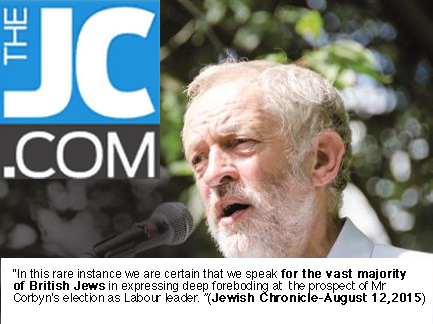
In the weekend the Jewish Chronicle (JC) outlined its problems with Corbyn while claiming to “speak for the vast majority of British Jews… expressing deep foreboding at the prospect of Mr Corbyn’s election as Labour leader.”

Apparently, on behalf of ‘the vast majority of British Jews,’ The JC wanted to know whether it is true that Corbyn donated money to Dier Yassin Remembered (DYR), an organisation that was founded to commemorate the brutal massacre of an entire Palestinian village by right wing Jewish paramilitary fighters in 1948. I guess that the tens of thousands who joined the labour party in the last weeks just to support the first true British labour ideologist for generations were delighted to learn that their favourite candidate supported DYR and truly opposes Zionist barbarism.

On behalf of the “vast majority of British Jews” the JC demanded to be fully informed about the non-existent relationship between Corbyn and British DYR chairman Paul Eisen. The JC didn’t approve of the connection between Corbyn and pro-Palestinian Rev Stephen Sizer either. Corbyn was also asked to clarify his association with the Hamas, the Hezbollah and Palestinian cleric Raead Salah. I guess that the JC editorial would like to define the list of kosher ‘friends’ eligible for British elected politicians. Until this happens, the message that is delivered by the Brits is lucid: it is actually Corbyn’s firm stand on justice and his ability to befriend true freedom fighters and humanists which makes him into the most popular politician in Britain at the moment.

If someone in the JC fails to read the picture, I will outline it in the clearest form. British people are expressing a clear fatigue of corrupted party politics as much as they are tired of Zionist interventionist wars. They are begging for a change, they demand equality and the prospect of a better future and a leader with ethical integrity. Whether Corbyn can provide these qualities, time will tell. But the British yearning for a radical change has been formally established.

Disrespectfully and outrageously, in the open and on behalf of “the vast majority of British Jews”, the JC set an ultimatum to the most popular man in British politics.

“If Mr Corbyn is not to be regarded from the day of his election as an enemy of Britain’s Jewish community, he has a number of questions which he must answer in full and immediately.”

One would expect the JC editorial to learn something from Jewish history. Those British Jews who insist to speak ‘on behalf’ of their people should at least pretend to uphold some minimal respect to British good manners.

The JC, however, admitted that Corbyn ignored them for over a week – “No response has been forthcoming” from Corbyn or his office, the JC wrote.  Though I do not have any reason to believe that Corbyn has a cell of hatred in his body, I wouldn’t like to see him bowing to Jewish political pressure. What we need is a firm British leader dedicated to equality, justice, peace and British interests instead of just another Sabbos Goy and servant of the Lobby as well as big money.

The Establishment Fiddles While Chilcot Burns Holes In Our Pockets

Anger at the mounting sums of money paid to Sir John Chilcot and his committee have prompted calls for the government to stop any further payments amid demands by politicians for the publication of the Iraq inquiry report without further delay (1). Will we ever see it? Unlikely.

Analysis of the accounts released by the inquiry reveal that Sir John Chilcot, committee members and advisers have shared more than £1.5 million in fees since the inquiry began in 2009 (2).  If it does finally get released, it will likely either be heavily redacted or those implicated in the Iraq war crime, would have died rendering the inquiry meaningless in terms of justice having been seen to have been done.

Last year, tax payers spent £892,000 on the wages of the eleven civil servants and three support staff (3). The inquiry has not sat for the last four years and the last eminent session was in February 2011. Yet it has cost the taxpayer £5.5 million in that time in wages (4). A massive £10 million has so far been spent in total on the inquiry and we haven’t seen a word of it (5). In the past year alone, £119,000 has been shared between the four committee members and its two advisers – Sir General Roger Wheeler and Dame Rosalind Higgins (6). Given the number of days they worked, it amounts to a combined day rate for six people of £3,615.

Liberal Democart peer Lord Dykes said, “I’m concerned about this report. Myself, like many others, are concerned that there might be a kind of cover up going on – not by Sir John Chilcot himself, but maybe by other people who are trying to delay it”, he said. Asked which individuals may be involved, Dykes replied, “people who might be connected at a senior level with the perpetration of an illegal war” (7). Can you think of anybody like that? A spokesperson for the Iraq inquiry refused to comment further.

Calais: Let Them In

Evoking Churchill’s ‘We Shall Fight Them On the Beaches’ speech of June 4 1940, Prime Minister Cameron, while visiting Vietnam a few days ago emphasized the “need to protect our borders” from the “swarm of people” trying to enter the UK.from Calais. That was his characterization of the humanitarian crisis currently enveloping Calais.

In the June 29 Mail on-line edition, journalist Dominic Sandbrook described migrants storming the Channel Tunnel in the catastrophe [my emphasis] that has beset Calais. Reiterating something of a siege mentality, Sandbrook remarked: “We kept out Hitler. Why can’t our feeble leaders stop a few thousand exhausted migrants?”

The message from the government and their mouthpieces in the gutter press is clear: Desperately poor migrants, many of whom have been traumatized by brutal dictatorships, war and sectarian violence that to a large extent have been caused or exacerbated due to our imperialist adventures, are not welcome here.

Predictably, Nigel Farage of UKIP joined in the fray by suggesting to Cameron that he sends in the army to “protect” holiday makers. Presumably, the many migrants who have died or been injured on route are not worthy of being protected because they are the wrong kind of foreigner – poor and black.

The reactionary response to perceived hordes “invading” good old Blighty is not, of course, new but rather symptomatic of both the establishment and the right-wing press discourses of which the Daily Mail is a significant player.

The papers founder, anti-Semite Lord Rothermere, was friends of Hitler and Mussolini. He was also editorially sympathetic to Oswald Mosley and the British Union of Fascists (1) .

The Daily Mail that Rothermere in January 1934 wrote an article titled “Hurrah for the Blackshirts”, and praised Mosley for his “sound, commonsense, Conservative doctrine” (2) for, is the paper that Sandbrook in July 2015 talked about keeping ‘Johnny Foreigner’ out.

The Daily Mail has form in this regard. In the 1940s, for example, the editorial line of the paper was to oppose the arrival of Jewish refugees escaping Germany, describing their arrival as “a problem to which the Daily Mail has repeatedly pointed” (3).

Seven decades later we have a media that perpetuates the right wing political narrative of demonizing those less fortunate than us with the aim of garnering potential short-term political capital.

Blogger Matt Carr describes the experiences he and his family had while on a recent trip to France:

“On the other side of the channel were men, women, and children with nothing at all, trying to get to our side of the water in order to continue their lives or find a life raft steady enough to hold them……

…The journeys they made were infinitely harder and tougher. They had crossed deserts and oceans, maybe a hundred or more in a boat. Some will have seen their friends and loved ones die in front of their eyes. Others will have fled the destruction of their cities, homes and neighborhoods” (4).

These people need our help and we should be helping them. There is both an economic and moral case for Britain to take these people in. There is also the question of European solidarity. The French have taken in 60,000 migrants, the Germans 180,000. Britain has only taken in a small fraction of that. We should be taking our fair share of the burden. 85% of all the refugees are in poor countries. A decade ago it was only 70%. Turkey, for example has nearly 2 million refugees. We are talking about places with the least amount of resources who are taking in the most (5). So why is fortress Britain raising its barriers?

The problem is that British politicians’ of both the left and right play into the prejudices of the electorate in the hope of grabbing their votes. Fears that migrants undercut wages and are a drain on society are myths mainly peddled by the political right, but my no means exclusively so. General misinformation and false propaganda feeds into a public perception that belies reality (6).

It’s shameful that one of the richest countries on the planet is turning it’s back on people who have, in many cases, risked their lives fleeing persecution and wars that we largely helped foment. Instead of setting dogs on migrants, repairing fences and building higher ones, we should be supporting those who tear them down.


Cecil And Anthropomorphism

The killing of Cecil the lion at the Hwange National Park on July 1, was of course tragic. However, the public response to his death reflects a deeper tendency for humans to want to humanize animals. Because we ascribe human-like appearances and behaviours to them – what’s known as anthropomorphism –  conservation movements’ are more easily able to recruit people to their cause on the back of it. Similar in principle to the concept of corporate environmental Greenwashing, conservation movements’, whether intentional or not, tend to focus their resources on areas where there exists the human compulsion to empathize with animals that we perceive to be cuddly or cute to the detriment of other species (1).

I don’t want to make any excuses for people who kill wild animals for fun. I think recreational big game hunters like the American Walter Palmer are the pits and I disagree fundamentally with the concept of killing animals in the wild. I personally find this kind of activity and the people who engage in and enjoy it, as repugnant as those who engage in, and enjoy say, bullfighting or fox hunting.

In the sad case of Cecil, he was lured by Palmer with food. Palmer proceeded to kill him with a cross bow from relatively close range compared with the more common use of a telescopic rifle from afar. In that sense, Palmer’s actions could reasonably be construed as being more dangerous for him, therefore paradoxically increasing the chances of Cecil surviving.

The hypocrisy of many of those who condemned Palmer cannot be overlooked. On the day that Cecil died, Cameron was demonizing humans at Calais by describing them as a “swarm” and a Palestinian baby was murdered by Jewish extremist fanatics. But the plight of an animal gets most of the media’s attention. The vast majority of the public will think nothing of eating animals that would have arrived at their plate after having been slaughtered in an industrial fashion on mass by agribusinesses.

Many of these animals would have died in worse circumstances and had a worse life than Cecil. Unlike, for example, the said beast who we have collectively ascribed a name to, an anonymous cow prior to being slaughtered in a slaughter house would have been artificially inseminated and forcibly crammed into a lorry along with other cows having spent most of it’s life in a cage.

Sometimes the level of hypocrisy can be astounding. I heard a self-confessed carnivore and angler on the radio the other evening spitting with rage at the actions of Palmer. Apparently, it hadn’t crossed his mind that the hobby he undertakes on a regular basis – luring fish with food for fun – is essentially no different from the actions of somebody like Palmer who lured poor Cecil with food for fun as the precursor to his killing. In both cases, living things are killed or maimed for fun.

The moral equivalent here is that for those who participate in both pursuits the basis for their participation is one of enjoyment as opposed to necessity. The aspect that tends to get people upset is that as opposed to nameless and indistinct fish, Cecil was given a name and looked like a cuddly stuffed child’s toy. But both live in the wild and both are lured from their natural habitat for the enjoyment of humans.

Bee Killers

Bee

When I was young it used to be a common sight to see cars splattered with insects and numerous species of bees collecting nectar from plants. Bees and insects are wonderful and part of the connectivity of living processes in our world. Nothing human beings do, and nothing that takes place in the natural world, occurs in isolation. And yet we are using pesticides that kill pollinators whose role is essential to the human food chain.

Neurotoxins that kill much of life on earth on both land and in water, and degrade entire foodchains, are resulting in the ‘colony collapse disorder’ (ie the sudden disappearance) of honeybees (1). In the United States, half the colonies of bees exposed to neonicotinoids disappeared in the course of one winter. The findings of an analysis of 800 scientific papers show that worldwide contamination is indiscriminately wiping out wild animals, including those on which farming depends (2).

The use of pesticides that impact negatively on bees and soil animals seriously threaten the food supplies of humans. So why is Secretary of State for Environment, Food and Rural Affairs, Elizabeth Truss, seemingly subservient to chemical companies like Bayer and Syngenta to the detriment of the science?

The UK government appears to want to throw everything it has against an EU proposal to suspend their use on flowering crops. Last year the Department of the Environment commissioned a study claiming to show that bees were not being harmed (3). It was so flawed that no journal would take it. The lead author soon left to work for Syngenta (4).

The government’s lifting of the ban on neonicotinoid pesticides and their seemingly appeasing of the chemical corporations who are clearly in their pocket, would suggest that Cameron and Truss are prioritizing the interests of these corporations over and above the sustainability of the eco-system.

This is the take of the BBC who imply that the National Farmers Union (NFU) are complicit:

The government has temporarily lifted a ban on neonicotinoid pesticides in certain parts of the country.

An EU-wide moratorium was put in place after some studies showed the pesticide caused significant harm to bees.

But following a second emergency application by the National Farmers Union, two neonicotinoid pesticides can now be used for 120 days on about 5% of England’s oilseed rape crop.

Environmental and wildlife groups have called the decision “scandalous”.

‘We have fully applied the precautionary ban on the use of neonicotinoids introduced by the EU’
Defra spokesperson

The areas where farmers will be allowed to use neonicotinoids has not yet been decided. According to the NFU, it will be those areas where there are records over the last season or so that the pests – primarily the cabbage stem flea beetle – have inflicted most damage on oilseed rape crops.

Farming Minister George Eustace MP told BBC’s Farming Today that it was “predominantly farmers in Suffolk” who would now be able to use neonicotinoids. He said that the government was approaching the issue “with an open mind” and that there was “a lot of ambiguity” about the evidence (4).

Meanwhile on 23 July 2015, the independent British not-for-profit political-activism organisation 38 Degrees issued an emergency petition:

“Fresh batches of bee-killing pesticides are on their way to British farms right now. Prime Minister David Cameron could stop these toxic chemicals before they are spread across our fields and wreak havoc on bees. But he’ll only do it if enough of us pile on the pressure.

Environment minister Liz Truss has just approved this fresh use of bee-killing pesticides. It’s no surprise – she’s been exposed holding cosy meetings with chemical industry lobbyists. If our environment minister won’t protect bees, we need to turn the pressure onto David Cameron. He’s her boss – and that means he has the power to overturn her decision.

Please can you sign the emergency petition to Cameron now, asking him to overrule his minister and act to protect the bees? It will only take a few seconds.(5).

People Socially Cleansed As ‘Dirty Money’ Floods Into London

“There is no place for dirty money in Britain”, so says UK Prime Minister, David Cameron, who has promised to crack down on dodgy offshore companies that buy up luxury properties in the UK. Cameron says he will introduce a public land registry of properties owned by foreign investors. Channel 4 News has access to the data which highlights the problem is particularly acute in London.

“London must not become a safe have for corrupt money from around the world”, says Cameron. “We need to stop corrupt officials or organized criminals using anonymous shadow companies to invest their ill-gotten gains in London property without being tracked down.”

The figures are staggering. Some £122 billion worth of property in England and Wales is owned by foreign companies. Around 100,000 UK property titles are registered to them. Most are in Greater London where almost 43,000 properties are owned by overseas firms. “There is no place for dirty money in Britain. Indeed, there should be no place for dirty money anywhere. That is my message to foreign forces. London is not a place to stash your dodgy cash”, he said.

Undercover reporters’ working as part of the Dispatches documentary, From Russia With Cash, discovered just how easy it is to buy property in London with no questions asked. Chido Dunn from Global Witness says that “the presence of corrupt money in the London property market props up corrupt regimes overseas and means that a lot of people are stuck in poverty and violence and don’t have access to education.

So concretely, how is Cameron proposing to deal with the problem?

In the Autumn, data will be released that will highlight which foreign companies are buying up property in England and Wales. Although the data already exists within the public domain, Downing Street says it will now be more easily available.

In Westminster, where one in ten homes are owned by foreign investors, Channel 4 asked  Transparency International about the changes that are being consulted on.  A TI spokesman said that if enacted, the proposals would require foreign owners to declare their interests at the same standard as UK companies. The unanswered question is why the discrepancy in the first place?

That aside, over last 10 years a suspected £180 million of laundered money has been investigated by the authorities. However, according to Global Witness, that’s merely the tip of a very large ice berg. What these new measures will do if enacted will be to identify where the corrupt money is and prevent it from coming in to the country in the future. Currently the government is able to identify who owns a property on an individual and company basis but crucially not who the real people are who hide behind these companies.

People can still use offshore companies to structure their investments in order to benefit from things like inheritance tax and capital gains tax. But, if the consultation process succeeds, people hiding money for a criminal reason will no longer be able to hide it in property.

This appears on the surface to be an important first step. The question is, should the proposals go through, will law enforcement be empowered to properly investigate the practice of money laundering in the UK?

In a speech to Muslims in Birmingham on July 20, Cameron said “that people can grow up and go to school and hardly ever come into meaningful contact with people from other backgrounds and faiths”.

But money laundering is a major contributory factor (as is the failure to tax property effectively) in house price rises which in turn results in the kind of social cleansing I discussed here. Any failure by Cameron to get to grips with the problem will increase the problem of social exclusion he claims he wants to redress.

As with much else in the area of social and economic policy, the UK government appear to be tugging at the coat tails of the United States. What applies across the Atlantic is of as much relevance in New York as it is London. But at least in the former, rent controls to some degree ameliorate the problem. That said, UK government policy is geared towards increasing the disconnect between the rich and poor in much the same way the United States is.

As George Monbiot astutely puts it:

“The rich disconnect themselves from the civic life of the nation and from any concern about its well being except as a place to extract loot. Our plutocracy now lives like the British in colonial India: in the place and ruling it, but not of it.” We suffer the same curse: a ruling class whose wealth lies offshore, and which identifies more readily with a transnational elite than with the other people of this nation. On behalf of this elite, the government now gives away £93bn a year in corporate welfare: a sum bigger than the deficit. It champions the Transatlantic Trade and Investment Partnership; a graver threat to the interests of this nation than Islamic extremism presents.”

The failure to tax property effectively has fuelled a rise in house prices so severe that entire English regions are becoming almost uninhabitable to the poor. The situation is made all the worse by the announcement from the head of the National Crime Agency who said there is a direct link between money laundering in property and the massive rise in London house prices.

Jobs For The Boys

Whilst a ‘glass floor’ protects the children of higher income middle class families from any reversal in social mobility, the same cannot be said for the children from poorer working class families. What research from The Social Mobility and Child Poverty Commission reveals is that not only are the poor disadvantaged by a glass ceiling but their wealthier peers are less likely to fall through the trap door on the floor. The commission found less able, richer children were 35% more likely to become high earners than brighter, poorer peers.

That must be the kind of emphasis on social cohesion David Cameron keeps lecturing us about.

Here’s more from the BBC:

The report for the commission, which advises the government on social mobility issues, was based on a long-term study of 17,000 British-born children born in a single week in 1970 that measured their ability at the age of five….It said wealthier families helped their children accumulate skills valued by the labour market and they also used social networks to secure internships and employment. That meant poorer, but more able children were often blocked from the finite number of top jobs, it added.

The research suggests there is a clear correlation between the social background of a child’s grandfather and eventual labour market success.

The report also highlighted a “private school wage premium”, where recruitment to high-earning occupations is biased towards those educated in private schools.”

http://www.bbc.co.uk/news/education-33655791

Holding On: London

The final eulogy from the BBC’s ‘Holding On’ aired in September 1997. Written by Tony Marchant, is one of the best British drama series ever produced.

“Leave town and after a bit you just can’t wait to get back again – in the thick of it. London casts that sort of spell.There’s nowhere like it for meeting old friends and making new ones. The possibilities just multiply every time you walk down the street. If you let it, London will open up for you like an oyster, throw your head back and swallow it all down. Sometimes not everything you experience here will agree with you but you can object. Speakers Corner ain’t just in Hyde Park, you know, It’s everywhere.

There’s still that frightening division between the haves and the have not’s, and I certainly wouldn’t dream of waving my Gold Card at people who live in Newham – well not anymore. Anyway, in the world of work, job insecurities have become a way of life and you can throw your year planner away because you may not be needing it. What’s ’round the corner these days is usually a nasty shock. After the brash and confident ’80s, the ’90s have been a time of insecurity and uncertainty. After the ball is over – you know what I mean? Negative equity, downsizing, credit debt, black Tuesday or Wednesday or Thursday. There’s no shortage of ways to come a cropper. But while some people are scratched from the urban rat race, some pull up lame or just drop out quietly, voluntarily. No one minds. Cities are too busy to be judgmental – just do your own thing

In our crime-infested, decaying and paranoid capital, it’ll come as no surprise to know that most of us are Mr and Mrs Average trying to keep ourselves to ourselves, trying to get by doing nothing more reprehensible than moaning about our car insurance. We lead pretty simple lives really, even me, in a complicated city. You have to. Boil things down to their essentials – love and the mortgage – otherwise it all just gets too much. Sometimes it’s all too much and you need a helping hand. In a city like ours, there’s plenty of helping hands. We’ve got the best emergency services in the world.

There’s a few ways London can make you breathless. One is the sheer size of the place. Another is just environmental. Be careful where you breath. Asthma, pollution, lead poisoning, traffic fumes – I’m afraid so. But outdoors isn’t all bad. Healthy pursuits abound and I’m no stranger to a pair of trainers myself. Forget the great English countryside for a bit of recreation – it’s all carved up by the National Trust and the farmers anyway. In the London parks they let anyone in, which is probably just as well. This city is very democratic here and there.

Look, I know there’s nothing more boring than one of those urban eulogists who start droning on about how you can get anything from a bagel in Brick Lane to a bruchetta in Balham; how on the way to the Purcell Rooms you can hear ragga tunes coming out of a Y-reg BMW. But you have to admit, it’s a pretty rich canvas; and unlike the shires and the green belt you don’t see ‘No Trespassing’ signs anywhere – not in black and white anyway. You want nature? Look outside your window, there’s probably a tree in your street. Anyway, I ended up in the country once. Couldn’t get a cab anywhere.”

Objectification kills

By Daniel Margrain

The 30 minute documentary film Killing Us Softly (1979) based on a lecture by Jean Kilbourne focuses on the effects of advertising on women’s self-image and the objectification of women’s bodies. Kilbourne argues that the superficial, objectifying and unreal portrayal of women in advertising lowers women’s self-esteem and that Sexualized images of women are being used to sell virtually all kinds of goods (1). Kilbourne argues that they degrade women, encourage abuse, and reinforce the patriarchal, sexist society whilst also drawing connection between advertising and pornography, stating that “the advertisers are America’s real pornographers”.(2).

Thirty six years after the release of Killing Us Softly, yesterday evenings Channel 4 News (July 23) reported on the inquest of 21 year old bulemia sufferer Eloise Perry who on the April 12 died at the Royal Shrewsbury Hospital one week after having swallowed eight unlicensed fat-burning pills that she purchsed from the internet. The pills, which the Food Standards Agency describe as being illegal to sell for human consumption, contained DNP which is an industrial chemical historically used in the manufacture of explosives and fungicides. Website companies who sell this chemical depict DNP as a fat burning product and some even use the tag line “getting leaner through chemistry” as a marketing tool.

No sooner were attempts made by the authorities to close down these sites, they reappeared under different names.  It’s clearly a battle that the authorities are losing. The fact that informed young people like Ms Parry who are aware of the risks are so desperate to lose weight that they are prepared to go to such extreme lengths raises wider questions about the nature of the society we live in.

The social pressures for young women to conform to certain expectations placed upon them by the media are immense. The upshot is that they are involved in a constant psychological battle between myth and reality. In Britain, for example, the average size of a woman is now 16 but the aspirational size is zero – an unobtainable goal for the vast majority.

The contradiction between reality and aspiration is undermining many of the gains that women made in the feminist debates of the 1960s and 1970s. What Ariel Levi terms “raunch culture” is another symptom of the undermining of the gains made. A tour by High Street Honey’s that involves women employed by lads mags touring the various university campuses throughout the country dressed as porn stars, is about as debased as it gets.

The notion that pole dancing which is sold as exercise classes at some universities and widely regarded as being empowering for women in terms of getting them in touch with their inner sexuality, is in reality, setting back women’s rights decades.

Activities like this inhibit the way both men and women feel about their bodies and therefore cannot be disentangled from the tragic case of Ms Parry. The normalization of sexist imagery in pop videos and television commercials and the sexualization of young girls clothes is another illustration of raunch culture in which fantasies, desires and ambitions are transformed into commodities to make money.

The growth in cosmetic surgery is another factor that increases expectations on women’s appearances. Ninety-one per cent of surgery is undertaken on women of which the most popular is breast enhancement. In America it’s normal practice for girls to be given breast enlargement as a graduation present. The fact that a growing number of girls suffer low self-esteem is a sad and depressing indictment on our society at large.