Category: Uncategorized

Believing in Miracles

By Daniel Margrain

Bob Dylan once said: “Every pleasure’s got an edge of pain, pay your ticket and don’t complain.” Following my previous article about WTC building 7 [1], I promised to myself I wouldn’t write another word about the subject, but the temptation turned out to be too much – not that I’m complaining. Like a gambling addict, I can’t resist the temptation to feed the slot machine one more coin in my attempt to persuade others to see reason, particularly as the debate about what happened that fateful day on September 11, 2001, has once again surfaced in light of its recent anniversary.

Official narrative

The gist of the broad official narrative is that on the morning of September 11, 2001, 19 men, mostly from Saudi Arabia – under the direction of Osama bin Laden – hijacked four planes out of Boston, New York City, and Washington, DC, and without giving away their intentions redirected the planes on kamikaze missions towards four American landmarks on the east coast — the Twin Towers of the WTC in New York, the Pentagon, and an unknown fourth location theorized by some to have been the White House or the Capitol building (the last plane was brought down through passenger interference, in an open field outside of Shanksville, Pennsylvania).

The attacks resulted in the complete collapse of the World Trade Center twin towers in New York City (now known as Ground Zero), heavy damage to one side of the Pentagon and the deaths of just under 3000 people, some 400 of whom were police and firefighters [2].

This narrative seems highly plausible. Indeed, all alternative versions have been comprehensively debunked and rebutted [3][4][5][6][7]  Commenting on the notion 9/11 was an ‘inside job’, Noam Chomsky said:

“The Bush administration would have had to have been insane to plan anything like that. If it had, it is almost certain it would have leaked…It’s a very porous system. Secrets are very hard to keep. You couldn’t control an event like that. It’s very unpredictable.”

Chomsky continued:

“There are plenty of coincidences and unexplained phenomena. But if you look at controlled scientific experiments, the same is true….If you want to get a sense of it, take a look at the letters columns in the technical scientific journals. They are commonly about unexplained properties of reports of technical experiments carried out under controlled conditions which are going to leave a lot of things unexplained – it’s the way the world is. When you take a natural event – something that isn’t controlled – most of it will be unexplained….The belief it [9/11] could of been planned has such a low level of credibility, I don’t think it’s serious. It’s diverting people from serious issues” [8].

Conjecture-based assertions presented as facts

Unexplained phenomena and coincidences of the kind alluded to by Chomsky, have been seized upon by the 9/11 truth movement who have filled in the gaps of uncertainty with unsubstantiated and conjecture-based assertions. They then present these assertions as evidence based facts.

Accounts from the 9/11 truth movement are remarkably similar to the accounts of many of those who experienced the sinking of the Titanic. As the vessel was sinking into the ocean, passengers heard explosions in the ship. In this case, the ‘official story’ would be wrong, according to the truth movement. To this day, no one really knows what exactly caused the sound, only that it sounded like an explosion. Some say it was the steel snapping as the ship broke in two. Others say it was the hot steam engines hitting the cold water which exploded. Using truth movement logic, it was blown up because some witnesses characterized the sound as an ‘explosion’.

The point is, appearances can often be deceiving. Indeed, As Karl Marx said: ”If essence and appearance coincided, there would be no need for science”, as our observations of earth as a static entity viewed from the perspective of our planet, attest.

When the truth movement view videos of the twin towers collapsing in what they claim is free fall speed, what they actually see are versions of the collapse at angles that reinforce their own prejudices. This is commonly referred to as confirmation bias. The claims made on the basis of what is contained in these videos have no basis in factual scientific-based evidence.

Of course, it’s the controlled demolition explosion theory that the truth movement cling to in order to explain the collapse of WTC 7 (and depending on which particular conspiracy theory one believes, the other two towers). For the sake of brevity, it’s the questioning of the theory in relation to the former, I want to return to here.

In terms of the WTC collapse, George Galloway was among the first to popularize the notion that “if it walks like a duck and quacks like a duck, the chances are it’s a duck” thesis.

Elephant in the room

The blank spot among those who propose the controlled demolition thesis is their inability to acknowledge the ‘elephant in the room’, namely, cause and affect. It is incomprehensible to realists how otherwise rational people refuse to accept the most probable explanation that two planes travelling at high velocity laden with jet fuel smashing in to the WTC complex, was the most likely catalyst for WTC 7s collapse.

The claim that the building was brought down as a result of a controlled demolition, given the circumstances that preceded it, is about as extraordinary a proposition as it’s possible to get. It’s not necessary to be an expert to arrive at such a conclusion. Given the available evidence, on the balance of probability alone, the notion that it was a controlled demolition that brought the building down, does not stack up by any logical measure. Those honest enough to look at the claims and counter claims in an objective and rational manner, could not arrive at any other conclusion.

Controlled demolition?

To believe, for example, that a controlled demolition took place one would have to ignore the testimony of FDNY chief, Daniel Nigo [9], 16,000 uniformed and civilian members of the FDNY [10], or anyone else who was involved in this apparent huge conspiracy, at least one of whom after 16 years – as post-doctoral researcher, David Grimes, implies [11], would have, by now, come forward.

You would have to believe that WTC 7 was wired for explosives, either when the building was erected (which would require the longest conspiracy planning in history), or that they were planted later. If the latter scenario is to be believed, how could it be possible to wire a high rise building occupied by 50,000 people on a daily basis?

You would have to believe that a set of incompetent governments who failed to pull off Watergate and who were incapable of faking weapons of mass destruction, are all-seeing and all-powerful. You would have to believe in an incredible motive such as the Larry Silverstein insurance scam theory, which has been comprehensively debunked [12].

You would have to believe the building fell at free fall speed into its own footprint, and discredit the notion the damage to WTC 7 was actually caused by debris from WTC 1, 400 feet away [13]. A controlled demolition would obviously try to avoid such behaviour. If one accepts that WTC 7 was burning for many hours, it’s illogical to also propose the controlled demolition thesis because the one precludes the other.

You would have to ignore the notion that the explosive demolition would not be very controlled, or likely to work at all, if it involved slamming tons of skyscraper debris through a building and then setting it on fire for seven hours. You would also have to ignore the experts in the field who insisted that precision explosives, timers, and wiring don’t like that sort of treatment [14].

Witness testimonies & unreliable experts

Testimonies from firefighters inside and outside of the building in relation to the damage caused are consistent, and demolitions experts who saw WTC 7 collapse neither saw nor heard anything indicating an explosive demolition [15].

You would have to ignore the notion that nothing can be seen or heard in videos that resembles explosive charges going off before the collapse or that seismic data from multiple sources indicates that the collapse of WTC 7 began slowly, completely unlike an explosive demolition but consistent with internal failures leading to global collapse [16].

You would have to believe the citations of experts in disciplines only superficially connected to structural engineering, ballistics, nano-thermite and other specialist fields, like David Ray Griffin and Lynn Margolis who the truth movement regularly cite. Griffin is professor of philosophy of religion and theology [17], and Margolis specializes in evolutionary theory and biology [18].

Some epistemological aspects of 9/11 conspiracy theories include evidential cherry-picking and egregious ‘quote mining’, disproportionate emphasis on anomaly and attention to these kinds of maverick voices [19]. The truth movement consistently cite experts in irrelevant disciplines. Loose Change is full of this, for example [20].

Alexander Cockburn accurately described 9/11 truthers as amateur detectives:

“[They] proffer what they demurely call “disturbing questions”, though they disdain all answers but their own. They seize on coincidences and force them into sequences they deem to be logical and significant. Like mad Inquisitors, they pounce on imagined clues in documents and photos, torturing the data ­- as the old joke goes about economists — till the data confess. Their treatment of eyewitness testimony and forensic evidence is whimsical. Apparent anomalies that seem to nourish their theories are brandished excitedly; testimony that undermines their theories–like witnesses of a large plane hitting the Pentagon — is contemptuously brushed aside” [21].

The notion that WTC 7 free fell for 2.25 seconds is not controversial. But the truth movement extrapolate from that as evidence the building was brought down by controlled explosives, on the basis that a professor of religion and theology believes it to be the case. Experts in theology also believe that scripture in the Old Testament is evidence of the existence of Jesus. But the existence of Jesus is, in fact, highly contested.

Denying agency

But perhaps the biggest argument of all against the notion of conspiracy is that it denies agency. By claiming WTC 7 was brought down by explosives, and by extension the broader belief 9/11 was an ‘inside job’, the truth movement deny that those who suffer at the hands of US imperialism have a legitimate grievance against decades of US military aggression sufficient enough to warrant a terrorist attack on the US.

Until the 9/11 truth movement get beyond the stage in which they have made the leap from assertion and conjecture to testable hypothesis and plausible theory, their unsubstantiated claims are worthless. The burden of proof is with them.

Sources:

Noam Chomsky Debunks 9/11 and JFK Murder @ https://www.youtube.com/watch?v=m7SPm-HFYLo

Noam Chomsky Has No Opinion on Building 7 @ https://www.youtube.com/watch?v=3i9ra-i6Knc

http://debunking911.com/

http://rationalwiki.org/wiki/9-11

http://www.911myths.com

http://screwloosechange.blogspot.com

http://www.jod911.debunking911.com

Lamont-Doherty Earth Observatory

Brent Blanchard of Protec: http://tinyurl.com/z6zyc

Incontrovertible – the ‘truth’ about 9/11 by Philip Roddis @ https://off-guardian.org/2016/09/05/incontrovertible-the-truth-about-911/

NIST WTC Disaster Study: https://www.nist.gov/topics/disaster-failure-studies/world-trade-center-disaster-study

Why Did the World Trade Center Collapse?—Simple Analysis By Zdenˇek P. Baˇzant1: http://www-math.mit.edu/~bazant/WTC/WTC-asce.pdf

Testimonies: https://answers.yahoo.com/question/index?qid=20061221064623AA01qch&page=2

Collapse Symmetry: http://ae911truth.info/wordpress/ae911truths-case/collapse/collapse-symmetry/

The 9/11 Conspiracy Nuts by Alexander Cockburn: https://www.counterpunch.org/2006/09/09/the-9-11-conspiracy-nuts/

How To Tell If Conspiracy Theories Are Real – Here’s The Math by Taylor Kubota: https://www.livescience.com/53494-how-to-tell-if-conspiracy-theories-are-real.html

Bayoneting A Scarecrow by George Monbiot: http://www.monbiot.com/2007/02/20/bayoneting-a-scarecrow/

My Tribute to Gordon Lightfoot

Canadian Gordon Lightfoot was arguably the greatest and most underrated folk artist of his generation and possibly of all-time. Many folk singers before and since have embodied the melancholic troubadour as a key component of their personas – most notably, Pete Seeger – but Lightfoot took this to a new level of artistic refinement.

His songs were as touching and moving as they were austere and elegant. Lightfoot was discovered by the American folk circuit and some of his songs were covered by established artists.

Lightfoot’s first album, Lightfoot, recorded in 1966 when he was 28 years old, was notable for its delicate country ballads such as Early Morning Rain and Ribbon Of Darkness. The albums The Way I Feel (1968), Did She Mention My Name (1968), and Back Here On Earth (1969) continued in that melancholic style.

But it was the 1970 album, If You Could Read My Mind, particularly the title track, that proved to be a huge creative leap forward for the artist. The song is a mature testament to love lost, a romantic elegy full of symbolic meaning and tenderness and a singer-songwriter tour de force. Few artists can claim to evoke the universal themes of love and of the human condition in such a poignant and tender way as Lightfoot achieves in this song.

His richness of prose combined with such wonderful introspective story-telling drama is revelatory. The melancholy is enhanced by a sublime baritone voice which is offset by a light acoustic guitar counterpoint that few singer-songwriters have been able to equal.

The beautiful reflective melody of Summer Side Of Life and the realist triptych of Nous Vivons Ensemble, Same Old Loverman and Cotton Jenny, reiterated Lightfoot’s contemplative personal vision of modern life and his quest to probe the fragile recesses of the human psyche.

Lightfoot continued with these themes on the album, Don Quixote (1972), cementing the musician’s stature as a dignified craftsman. Lightfoot’s follow-up, Sundown (1973), largely abandons the depressed tone of his past glories for a melodic and passionate country, exemplified by the title track. However, Carefree Highway is a more solemn song of freedom, individualism. and fatalism. Lightfoot’s golden period continued with the albums Cold On The Shoulder (1975) and Summertime Dream (1976).

Even though the artists creative decline began with Shadows (1982), the album still boasts the brilliant Heaven Help The Devil and 14 Karat Gold. The tracks Ghosts of Cape Horn and Sea Of Tranquility are the stand outs on Dream Street Rose (1980).

After the creative disappointments of Salute (1983) and East of Midnight (1986), Lightfoot’s reputation as a majestic chronicler of the human condition returned with the albums, Waiting For You (1993) and Painter Passing Through (1998).

Gordon Lightfoot will be remembered as one of the greatest singer-songwriters of all-time.

WTC7 : Were the sound of ‘explosions’ evidence of a controlled demolition?

In my previous article, I rebutted the key claims of those who propose that WTC7 collapsed due to a controlled demolition. Despite this many critics of the official narrative continue to maintain that a controlled demolition occured on the basis of what witnesses claimed they heard.

I explained why the controlled demolition thesis is illogical but some critics on twitter skate over this and have instead moved onto the issue of thermite as part of the ‘controlled demolition’ process as an apparent explanation for what happened. l will endeavour to deal with this below.

That commercial aircraft laden with jet fuel travelling at high velocity struck the World Trade Center on 9-11 is incontrovertible. Commercial aircraft contain enormous amounts of aluminum, and WTC7 was an aluminum-clad, steel-cored building. Although airliners didn’t crash into WTC7, the enormous explosions and collapse of nearby towers generated as a result of planes that did, inevitably impacted on WTC7.

As I explained in my article, debris from WTC 1, 370 feet away struck WTC7 causing a gash in one corner facing Ground Zero, and by the time the evacuation order of the building was given it was visibly sagging. With debris strewn all around, we can expect to find aluminum and iron oxide and aluminum oxide and metallic iron in the debris without any thermite charges being required to explain it.

Thermite would not be practical for the demolition of WTC7. It would have spontaneously detonated at under 1000°F and would not have been controllable; no signal receiving device could have survived the fires and continued receiving the destruct command.

A more recent claim of critics is that traces of red-gray chips and iron-rich microspheres in the WTC rubble are best explained by thermite. This is held as their “smoking gun“. A study of the dust from Ground Zero contradicts this: “There is no evidence of individual elemental aluminum particles of any size in the red/gray chips…”

The chips are epoxy resins. More specifically, after further study, the red/gray chips were found to be Laclede Standard Primer by late polymer chemist Ivan Kminek, who demonstrated that they have the same chemical composition, identical XEDS spectra, and nearly identical ignition point.

Some witnesses and critics of the official narrative claim that the sound of explosions coming out the windows of WTC7 are indications of an explosive demolition. There is a simple explanation for this phenomenon: What happens to the air inside when you squeeze a balloon too much? These side-jets of air and dust were not explosions, but debris was expelled from the buildings as the floors pancaked on each other. There is a lot of air in a quarter-mile-tall office building; it has to go somewhere when compressed.

In addition, the WTC complex contained plenty of water in water mains, toilets, sinks, and beverage machines. Water heated to boiling temperatures expands violently and expands explosively if contained. Water has a high heat capacity, which usually precludes rapid heating to boiling temperatures. Still, the heat of burning jet fuel will force water to heat rapidly to boiling, which causes explosions of such objects as unopened soft drink cans or whiskey bottles. This explains many of the explosions that survivors heard.

Many things explode in fires: transformers, gas lines, water lines, air compressors, fire extinguishers, propane tanks, and refrigeration systems. An “explosion sound” is different from the high-brisance detonation necessary to cut even one 14″ x 22″ steel column of a major skyscraper (let alone 58–82 of them), which would exceed 140 decibels a half-mile away and be clearly audible from New Jersey.

Meanwhile, seismographs picked up the collapse of the interior (preceding the collapse of the exterior frame) but no detonations.Any detonation of explosives within WTC 7 would have been detected by multiple seismographs monitoring ground vibration in the general area. No such telltale “spike” or vibratory anomaly was recorded by any monitoring instrument.

As I explained in my previous article, claims by witnesses that the ‘explosions’ they heard were the sound of controlled explosives, are pure supposition. Testimonies from firefighters inside and outside of the building are consistent, and demolitions experts who saw WTC 7 collapse neither saw nor heard anything indicating an explosive demolition. 

Explosive demolitions would not be very controlled, or likely to work at all, if they involved slamming tons of skyscraper debris through a building and then setting it on fire for seven hours. Precision explosives, timers, and wiring don’t like that sort of treatment. Regardless, such blasts would be loudly audible on the camera footage seconds before the collapse began; there’s nothing on the tapes.

Here’s what a controlled demolition really sounds like. Here are 12″ steel pins failing, producing “explosion” sounds (at 0:40). No videos of the fall of WTC 7 provide audio of a demolition. If there was a controlled demolition, you would hear a series of closely spaced, thunderous bangs.

Finally, claims by critics that “pyroclastic flows” of dust appatrently indicating that explosives must have been used, have no basis in fact. A pyroclastic flow is a movement of hot gas. In the context of a volcano, it’s usually hot gases containing hot dust and other chunks spreading out. In this context, these flows were claimed to be the cloud of dust that dispersed during the collapse and when WTC7 hit the ground.

Aside from not being hot enough to qualify as a pyroclastic flow (see volcanoes and shuttle launches), most claims try linking it with the controlled demolition theory. This debris flow indicates a fast vertical compression that caused air inside the building to push dust outward over a large area. The same flows can also be seen during controlled demolitions, but are usually much smaller than what happened at WTC7. It’s been estimated that the total mass of sheetrock in the internal walls was 1,000 tons (US). An enormous cloud of white dust is, therefore, not entirely surprising or unexplainable.

Why the WTC7 Controlled Demolition Thesis Is Absurd

Over recent days and weeks on Twitter, I’ve witnessed the re-emergence of the theory that Building 7 at the World Trade Center on 9-11 was brought down by controlled explosives. Geopolitical analyst, Patrick Henningsen and artist, Daniel Fooks are among those commentators who appear to support this theory. I will challenge the theory by unpacking each claim in turn.

The first theory relates to the announcement in the media of the collapse of WTC 7 before it happened as evidence of establishment collusion. Those who challenge the official narrative cite a BBC report in support of their thesis. However, the BBC and others were monitoring the news from different outlets and that’s where they learned of WTC 7.

According to the fire department, by 2 p.m there was a strong possibility the building would soon collapse, so its imminent demise was picked up by reporters. The fire department relayed information to reporters that the building was going to collapse. By the time it reached outlets like the BBC and CNN it may have simply been mis-communicated from “about to collapse” to “has collapsed”.

The female BBC reporter even starts out by saying “details are very, very sketchy.” This is a clear case of journalistic incompetence which wouldn’t be the first time for a BBC reporter.

The second claim that WTC 7 collapsed as the result of a controlled demolition is that it was said to have been in freefall and collapsed into its own footprint. However, the evidence supports the NIST contention that the building collapse progressed from the penthouse out as columns were weakened by the fires. The slow sinking of the penthouses, indicating the internal collapse of the building behind the visible north wall, took 8.2 seconds according to a NIST preliminary report.

Seismograph trace of the collapse of WTC 7 indicates that parts of the building were hitting the ground for 18 seconds. This interesting set of videos, which are shot at different angles, clearly show that WTC7 does not fall straight down. The assertion by critics that the building was in freefall for 2.25 seconds state this as if it is somehow significant to their argument even though this fact was conceded by the official 2008 inquiry.

The reality is, WTC7 did not fall into its own footprint but left substantial debris scattered across the entire WTC complex site. The damage to WTC 7 was actually caused by debris from WTC 1, 370 feet away. A controlled demolition would presumably try to avoid such behaviour. If one accepts that WTC 7 was burning for many hours, it’s illogical to also propose the controlled demolition thesis because the one precludes the other.

The third claim relates to the apparent sound of explosions. But such claims are pure supposition. Testimonies from firefighters inside and outside of the building are consistent, and demolitions experts who saw WTC 7 collapse neither saw nor heard anything indicating an explosive demolition. Nothing can be seen or heard in videos that resembles explosive charges going off before the collapse.

Seismic data from multiple sources indicates that, as with the Twin Towers, the collapse of WTC 7 began slowly, completely unlike an explosive demolition but consistent with internal failures leading to global collapse. Any detonation of explosives within WTC 7 would have been detected by multiple seismographs monitoring ground vibration in the general area. No such telltale “spike” or vibratory anomaly was recorded by any monitoring instrument.

Crucially,  explosive demolitions would not be very controlled, or likely to work at all, if they involved slamming tons of skyscraper debris through a building and then setting it on fire for seven hours. Precision explosives, timers, and wiring don’t like that sort of treatment (Source: Brent Blanchard of Protec http://tinyurl.com/z6zyc).

Fourth, many of those who propose the controlled demolition thesis cite controlled demolition expert, Danny Jowenko, in support of their case. Jowenko was on record as asserting, definitively, that what he saw, at that moment for the first time, was a controlled demolition. However, this is the view of one man who was asked to comment in an instance.

The November 2008 NIST report into the collapse of WTC 7 proffers a more realistic explanation, namely, that fire was the main reason for the collapse, along with lack of water to fight the fire and falling debris which ruptured the oil pipes feeding its emergency generators. The reduction in pressure triggered the automatic pumping system, which poured thousands of gallons of diesel onto fires which continued to burn throughout the afternoon on the lower floors.

At 5.20 p.m. a critical column buckled, leading to the collapse of floor 13, which triggered a cascade of floor failures within the building, eventually leading to global collapse. The lack of water to fight the fire was an important factor. The fires, which were fueled by office contents and burned for seven hours, along with the lack of water were the key reasons for the collapse. Popular Mechanics magazine polled 300 experts who came to the same conclusions.

Although it wasn’t completely obvious to the untrained eye at the time, WTC 7 had been seriously compromised by a 20-story gash in one corner facing Ground Zero, and by the time the evacuation order of the building was given it was visibly sagging.

Fifth, critics of the official theory claim that “pull” is standard jargon within the demolition industry to fire off demolition charges within buildings. But demolition experts have denied this; the usual term would be “shoot it” or “blow it.” “Pulling” refers to a procedure of attaching hauser cables to a building and using heavy vehicles to pull it over, something that would have been fairly easy for observers to detect.

Sixth, WTC 7 was not the first ever steel frame structure to collapse from fire, as many critics of the official theory claim.

Seven, some critics have remarked on the fact that some witnesses saw “flashes” inferring that it was indicative of an explosion. However, these witnesses are mistaken. This is one of the flashes in slow motion. It isn’t an explosion. What you see are window glass popping out as the floors collapse and compress the air inside. The sun is momentarily reflected in each pane of glass as it falls.

Despite all of this evidence, we are somehow expected to believe that either:

a) “Explosives” were planted when the buildings were erected. That would require the longest conspiracy planning in history.

Or:

b) They were planted later. In which case, who planted them? How did they do that in a building occupied by 50,000 people on a daily basis? Perhaps they did it on weekends when the building only had about 5,000 visitors /day?

Finally, many critics cite the events surrounding Larry Silverstein as their ‘smoking gun’. However, the theory is roundly debunked here.

To clarify the main points: Silverstein (the new leaseholder for the WTC) had been going to the Twin Towers “Windows on the World” restaurant (there were no survivors on this level) to dine and meet with his new tenants; he had been doing this straight since July 26, 2001. But on 9/11 he didn’t go because he claimed his wife made a dermatologist appointment for him.

Many critics of the official narrative point out that in the interview which Silverstein is asked where he was on 9/11 he appears to be showing signs of lying. It is, however, very likely he was indeed simply going to a dermatologist appointment.

Out of the thousands of people who worked at the site during the day, many dozens at any one time would have been on holiday, off sick or simply slacking on September 11th (a good half dozen well-known celebrities were involved in and avoided a potential end in the attacks).

That one of these happened to be the owner isn’t remarkable. There are plenty of important traders who did die in the attack — by the logic that one escaped suggests a conspiracy, the fact that many died should discredit it, right?

Also going against the idea of advanced-knowledge is that Neil D. Levin, the head of the Port Authority of New York and New Jersey (which presumably would be “in” on any conspiracy), was killed on 9/11- while dining in the Widows of the World, no less. If there was advance knowledge, why was Silverstein informed while Levin wasn’t?

It has been repeatedly reported that Silverstein had insured the Twin Towers a year earlier, and it is more than “coincidental” that this insurance covered terrorist attacks. Further, Silverstein had numerous legal disputes that aimed to increase the payout by arguing that there were two separate attacks. To a first approximation, this was successful and Silverstein managed to claim approximately $4.6 billion.

But what critics don’t mention about this is that the total cost of the towers was significantly in excess of this — the insurance value was way below what it should have been. Most of the legal wrangling after the fact was also due to the insurance contracts being incomplete. The total cost of the attack would be in the region of $7 billion or more, leaving a considerable loss once the relatively measly insurance payout was claimed.

With too low an insurance value and less-than-solid contracts, literally none of the insurance-based activities seem to point to the actions of people who knew exactly what was going to happen in advance. If it was an insurance scam, it was the worst ever.

The World Trade Center had already been bombed once before in 1993, and that several major terror plots against U.S. landmarks had been uncovered since then. In light of this, an anti-terrorism insurance policy would appear to be an entirely logical purchase.

My tribute to Mark Stewart

Mark Stewart’s most significant contribution to rock music was as the vocalist for the Pop Group, arguably the most quintessential experimental rock band in history. Around this time, bands of comparable artistic importance based overseas were probably Pere Ubu and the Contortions. But I would argue that the Pop Group, led by Stewart, were creating a far more dazzling and daring primitive musical mega-fusion than their contemporaries.

Hailing from Bristol, the group were formed in 1977 and produced two seminal 45 rpm singles, She is Beyond Good and Evil and We Are All Prostitutes. The former emerged in the wake of the punk explosion in the UK but in reality both recordings were about as close to punk rock as Captain Beefheart was to the blues.

The combo recorded two brilliant albums. The best of these, and one of the greatest artistic achievements in rock music history, is the 1979 album Y, a genuinely revolutionary intense tour de force fusion of agit-prop punk, funk, jazz and dub syncopation.

Stewart’s subversive and anarchic singing style was the perfect vehicle for the nihilistic lyrics and slogans that hinted at an apocolyptic future. Each piece on Y embodies a ferocious synthesis of primitive rhythms and dissonances.

An underlying tension unfolds which is heightened by Stewart’s violent, anxious metaphysical screams and politically-charged lyrics while the music evokes a scary vision of a barbarous post-apocalyptic humanity.

Y is the punk generations equivalent of Soft Machine 3 that emerged from the Canterbury school a generation before.

The groups second masterpiece, For How Much Longer Do We Tolerate Mass Murder (Rough Trade, 1980) places a greater emphasis on the rhythmic and funk aspects of the music than its predecessor. The records heavy use of wind and percussion instruments gives more space for the anger, torrent of noise and anarchic verbosity in the songs to emerge and, in some cases, dominate. 

The record utilizes a dogged rhythm accompanied by unhinged keyboards which is repeated from the beginning to the end. It is music made, as with Y, through syncope, screams and noises, and a collapsing sound wiped out by high-voltage discharge.

Within three years of the release of this masterpiece, the band had dissolved. Four new, separate, and important musical happenings spawned in its place – Rip Rig and Panic, Maximum Joy, Pig Bag, and Mark Stewart’s solo career.

Stewart went on to be a key part of the influential collective, Tackhead, who invented a unique and powerful style of rap, funk, dub and soul music and whose legacy can be found in the trip-hop genre of the nineties. Stewart also operated under the pseudonym, Maffia, continuing the programme launched with the Pop Group.

Stewart’s creative high points during this period included the albums, Learning To Cope With Cowardice (Rough Trade, 1983) which accentuated the experimentation and Friendly As A Hand Grenade (TVT, 1989), with a sound that often mimics the refined and explosive funky-soul of Was Not Was. 

If the average tone is that of a hybrid between rap and soul, the most significant innovations are represented by the pressing and insane Demolition House and the brutality of Airborn Ranger, obtained by stratifying the electronics to obtain a symphonic effect and grafting heavy metal guitars on top.

Sadly, neither Stewart or the Pop Group after they reformed, were able to repeat the artistic highs of their past glories. Nevertheless, Stewart and the band that he led, made a significant mark within the cultural landscape of the UK.

More broadly, the significant contribution Stewart made to rock music history worldwide cannot be overstated. With For How Much Longer Do We Tolerate Mass Murder and particularly Y, Stewart helped pioneer a completely new militant musical language and he can be considered to be one of the main innovators of funk, trip-hop and dub music. His influence among successive generations of musicians will continue long after his passing.

Is Something Fishy Going On With Greta?

For a very long time, I have strongIy suspected that something wasn’t quite right with the media’s Greta Thunberg narrative. Then on March, 16 I was very much taken by the recent comment on twitter by Dr Simon Goddek – @goddeketal.

Dr Goddek wrote the following:

Could the narrative constructed around Greta finally be crumbling?

Here’s the full text:

”The more I dug into @GretaThunberg‘s story, the more I realized that something stinks here. It’s no COINCIDENCE that her first appearance was on August 20, 2018, with a sit-in protest in front of the Swedish Parliament, followed COINCIDENTALLY four days later by the release of a book she co-authored with her mother.

But that’s not all – the PR machine for her was already in full swing on August 20, thanks to a man named Ingmar Rentzhog, who financed and drove the campaign through his company, @WeDontHaveTime.

And guess what? Rentzhog is also COINCIDENTALLY the chairman of the think tank “Global Challenge” (@ChallengesFnd), which is now COINCIDENTALLY fully financed by a billionaire named Kristine Person, a member of the Swedish Social Democratic Workers’ Party and former minister in the government under Stefan Löfven.

And if that’s not enough, Rentzhog purely COINCIDENTALLY happened to walk by the Swedish Parliament on August 20 and encounter Greta during her sit-in protest, taking a photograph of her.

But wait, there’s more – Rentzhog and Greta’s mother had already met before at a climate conference on May 4, 2018, which is COINCIDENTALLY the exact date when Rentzhog became CEO of the aforementioned think tank.

And here’s something interesting – both Kristine Person and Stefan Löfven happen to be members of Klaus Schwab’s @WEF.

It’s amazing how all these connections seem to come full circle, isn’t it?

It’s clear to me that something fishy is going on behind the scenes here. These people are manipulating the public and abusing their power for their own political gain. We need to be aware of their tactics and warn everybody we know about the Great Reset and the Fourth Industrial Revolution.”

Very well said, Dr Goddek.

Talking of coincidences:

Greta’s function is to warn of impending doom for the planet if we do not do something about CO2, is COINCIDENTALLY the same message pumped out by the WEF that’s intended to further empower the United Nations and helps pave the way for global government.

Greta’s social media accounts are completely focused on the task in hand – creating ‘climate panic’ in defiance of the facts. Her Facebook account is series of self-promotional posts with no interraction with comments. The list of people that Greta follows on twitter are world leaders and major political figures, climate and environment accounts like Soros-funded Greenpeace, the WEF and celebrities.

Over the past five years, the political and media establishment have helped galvanise the world’s youth in her support. ‘Independent analysts’, Media Lens, who falsely portray themselves an an alternative to the corporate media, heavily promote Greta’s climate catastrophism, as does the Guardian’s, George Monbiot.

Greta works in tandem with Extinction Rebellion (XR), which appears to be the climate cult’s Antifa, promoting civil disobedience in order to force action on the ‘climate emergency’.

Within a few short months Greta’s stature was such that she was invited to address the UN’s Climate Change Conference at Katowice, making her plea for ‘climate justice’.

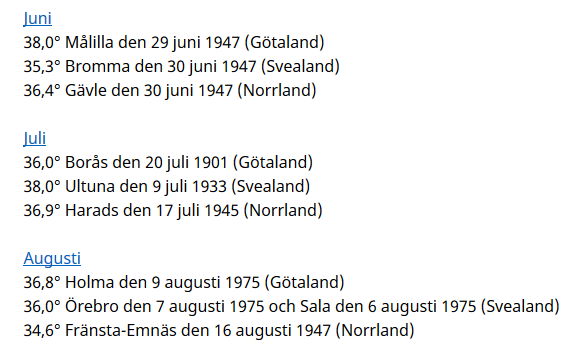
Greta was motivated, it seems, by a heatwave in Sweden, due of course to “climate change” -never mind the fact that Swedish high temperature records go back many decades::

Sweden June July August high temperature records

Greta’s very first tweet back in June 2018 – which has since been deleted – was to post an article (in English of course) which warned that climate change will wipe out all of humanity unless we stop using fossil fuels over the next five years.

This is what Greta said in her tweet, dated June 21, 2018:

“A top climate scientist is warning that climate change will wipe out all of humanity unless we stop using fossil fuels over the next five years.”https://t.co/AOr2DDZORc— Greta Thunberg (@GretaThunberg).

For the first time in 33 million years, it seems, we are almost at a point where there is no ice at either pole:

The chance that there will be any permanent ice left in the Arctic after 2022 is essentially zero,[…] with 75 to 80 percent of permanent ice having melted already in the last 35 years’‘.

How did that turn out, Greta?

Greta’s obvious claptrap underscores the fact that the Arctic was never anywhere melting away. The earth has not returned to the temperatures of the Medieval Warm Period when Greenland was colonised – how can we be approaching temperatures not seen in 33 million years?

The spectacle of the legacy media using a young girl in order to panic the world into giving more power to the WEF is, to say the least, bizarre. Thousands of the world’s scientists (see here and here) have called climate alarmism a hoax.

However ludicrous as it may seem, we are expected to ignore the facts about geological history, Co2 and global climate, and to follow the lead of a young woman who, since the age of 15, has parroted arrant nonsense embedded in unending cliché, on the say-so of the likes of George Monbiot and Media Lens.

This same media not only continue to parrot Thunberg’s nonsense, but seemingly have absolutely no qualms about having callously exploitated and manipulated a child in order to further the goal of world government.

Investigative journalist and researcher, Whitney Webb summed-up what is behind the prevailing climate change orthodoxy and the media’s fetishization of Greta.

Webb highlighted the fact that the twin phenomena are intimately tied to corporate interests embodied in the UN’s climate change agenda:

“COP26 is about setting up the financial infrastructure for a completely new economic system based on CBDCs and the financialization of ‘natural capital’ and ‘human capital’ into new asset classes. It’s about complete economic domination of the planet, not about ‘saving’ it.”

Webb revealed the nefarious Malthusian underpinnings that drive the UNs climate change agenda and that legitimate environmental concerns have been usurped in pursuit of this agenda.

That the UNs position on climate change is motivated by political and ideological factors is outlined in The Club of Rome’s 1992 book, The First Global Revolution which says:

”In searching for a common enemy against whom we can unite, we came up with the idea that pollution, the threat of global warming, water shortages, famine and the like, would fit the bill. In their totality and their interactions these phenomena do constitute a common threat which must be confronted by everyone together. But in designating these dangers as the enemy, we fall into the trap, which we have already warned readers about, namely mistaking symptoms for causes. All these dangers are caused by human intervention in natural processes, and it is only through changed attitudes and behavior that they can be overcome. The real enemy then is humanity itself.”

A Jeremy Corbyn Retrospective: The Cameron/May Years

Image result for pics of kim jong-theresa may

By Daniel Margrain

In 1978, the Australian social scientist, Alex Carey, pointed out that the twentieth century has been characterized by three developments of great political importance:

“the growth of democracy; the growth of corporate power; and the growth of corporate propaganda as a means of protecting corporate power against democracy.”

In order to defend their interests against the forces of democracy, the corporations that now dominate much of the domestic and global economies recognize the need to manipulate the public through media propaganda by manufacturing their consent. This is largely achieved through coordinated mass campaigns that combine sophisticated public relations techniques.

The result is the media underplay, or even ignore, the economic and ideological motivations that drive the social policy decisions and strategies of governments’.

Sharon Beder outlines the reasoning behind the coordinated political, corporate and media attacks on democracy:

“The purpose of this propaganda onslaught has been to persuade a majority of people that it is in their interests to eschew their own power as workers and citizens, and forego their democratic right to restrain and regulate business activity. As a result the political agenda is now largely confined to policies aimed at furthering business interests.”

This is the context in which the UK political and media establishment undermined former Labour leader, Jeremy Corbyn. The plot to oust Corbyn began the moment he became leader after a hardcore group that included shadow chancellor Chris Leslie, shadow education secretary Tristram Hunt, shadow communities secretary Emma Reynolds and shadow defence secretary Vernon Coaker, all refused to serve under him. 

Others included shadow transport secretary Michael Dugher, shadow chief secretary to the Treasury Shabana Mahmood, shadow international development secretary Mary Creagh and shadow Cabinet Office minister Lucy Powell. These figures as well as the establishment in general were aware that Corbyn could not be bought off on their terms. The former Labour leader’s incorruptibility represented a potential threat to the gravy train that sustains them.

In other words, it’s not merely Corbyn who the establishment regard as a democratic threat to their hold on power, but what he represents as an example to others following in his foot steps which is the reason why, even now, they want to shut him up. It’s the potential of breaking the iron-clad neoliberal consensus that underscores what has arguably been some of the most vitriolic and biased reportage ever witnessed against any British political figure in history.

Media hate-fest

What Media Lens accurately described as a “panic-driven hysterical hate-fest right across the corporate media spectrum,” began the moment the plotting against him by members of his own party began. As the media analysts noted at the time of the leadership election, “the full extent of media bias against Jeremy Corbyn can be gauged simply by comparing the tone and intensity of attacks on him as compared to those directed at the other three candidates: Andy Burnham, Yvette Cooper and Liz Kendall.”

The level of the media attacks against Corbyn continued after he secured ‘the largest mandate ever won by a party leader’. The focus of these attacks included what colour poppy he would wear, his refusal to sing the national anthem or whether he would wear a tie or do up his top button. All of this was granted national news headlines and incessant coverage.

Not to be outdone, in October 2015, the BBCs political editor Laura Kuenssberg featured in an almost comically biased, at times openly scornful, attack on Corbyn’s reasonable stance on nuclear weapons. The BBC then broadcast five senior New Labour figures all opposing Corbyn without any opportunity for an alternative viewpoint.

Kuenssberg followed up this hatchet-job three months later when she helped to orchestrate the live resignation of Labour shadow foreign minister Stephen Doughty on the BBC2 Daily Politics show as a pre-requisite to accusing Corbyn’s team of ‘unpleasant operations’ and ‘lies’. Then came the April 12, 2016 Telegraph article – a non-story about Corbyn’s state-funded salary and pension.

Eleven months later (March 5, 2017), the same rag continued with the smears by suggesting Corbyn had paid insufficient tax on his declared annual earnings – a claim subsequently debunked within hours on social media.

Meanwhile, the news that then Tory Chancellor, Philip Hammond, refused point-blank to publish his own tax returns after being prompted to do so by his opposition counterpart, John McDonnell, did not receive anything like the same kind of media scrutiny.

The implication was that Corbyn had misled the public. However, similar media outrage was not leveled at then PM Theresa May after it was revealed (March 7, 2017) that she had lied to parliament after having falsely claimed that Surrey Council had not engaged in a ‘sweat heart’ deal with the Conservative government.

Academic studies indicate that when it came to criticising Corbyn’s political opponents, a completely different set of media standards were applied: A major content analysis from Cardiff University revealed that the BBC is pro-business and Conservative-leaning in its coverage. The London School of Economics and Political Science found strong media bias against Corbyn, claiming the press had turned into an “attack dog” against the opposition leader.

Popularity

According to content analysis from the Media Reform Coalition, the UK’s public service broadcaster gave double the airtime to Corbyn’s critics compared to his allies.

The anti-Corbyn propaganda was systematic and entrenched within both the legacy media and the Labour party hierarchy. Both were determined to topple Corbyn, using ‘anti-Semitism’ as a weapon to achieve it. Journalists Tony Greenstein and Asa Winstanley were among the first to highlight the politically-motivated smears of the pro-Israel lobby against Corbyn.

In an excellent piece published by the Electronic Intifada (April 28, 2016), Winstanley outlined the links between right-wing, anti-Corbyn and pro-Israel forces within the Labour party. Winstanley meticulously showed how this lobby manufactured an ‘antisemitism crisis’, pinpointing the individuals involved, the tactics and dirty tricks used and the connections to powerful individuals whose ties lead to pro-Israel groups both in London and Israel.

One of key contrived ‘antisemitism’ accusations levelled at Corbyn during this period was by Labour MP, Ruth Smeeth who Wikileaks revealed is a ‘strictly protected’ US informant. Smeeth staged a highly publicised walk-out on June 30, 2016 during Corbyn’s launch of a review into the Labour party’s supposed ‘anti-semitism crisis’ which, as Jonathan Cook pointed out, was in fact, “a crisis entirely confected by a toxic mix of the right, Israel supporters and the media.”

A few days earlier another manufactured and staged anti-Corbyn story made the headlines. This time it centred around a Corbyn ‘heckler’ at Gay Pride, who in fact, as Craig Murray observed, turned out to have been Tom Mauchline. At that time Mauchline worked for the public relations firm, Portland Communications, whose ‘strategic counsel’ is Alastair Campbell, Blair’s former media chief who helped to sell the illegal invasion-occupation of Iraq.

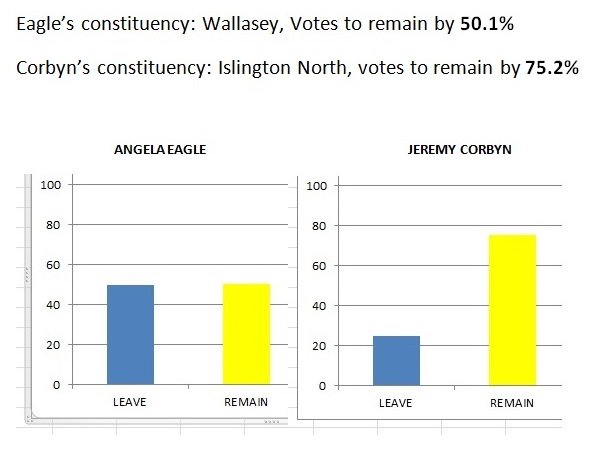
In addition, Corbyn’s pro-Remain position with respect to the EU referendum provided his critics with the ammunition they needed in their attempts to undermine him further. Chief among these critics was Angela Eagle.

Eagle was one of the many Oxford-educated Blairite plotters who resigned her post in order to position herself as a potential replacement for Corbyn and who claimed to be dissatisfied with his performance during the EU referendum campaign. However, as the graphic below indicates, Corbyn did much better than Eagle in defending their respective Remain positions:

The Labour party gained 60,000 members in one week following the attempted coup against Corbyn. Membership levels were higher under Corbyn than the previous peak of 405,000 last seen under Tony Blair’s leadership. In his constituency of Islington North, Corbyn inherited a majority of 4,456, which increased to 21,194. He’s one of the few Labour MPs whose vote increased between 2005 and 2010, when he added 5,685 to his majority.

Furthermore, under Corbyn’s leadership, LondonBristol and Greater Manchester ushered in Labour mayors, rolling back years of Tory dominance, while Labour’s majorities in by-elections had generally increased.

It should also be remembered that pre-coup, Labour led the Tories in three polls in a row over 41 days. The long-term decline in Labour’s fortunes that preceded Corbyn can hardly be blamed on the then Labour leader. Nevertheless, these positive Corbyn statistics didn’t stop any attempts by opportunistic and self-serving careerists within the party to undermine him. 

Corbyn’s alleged weakness at the dispatch box was presented as evidence of ‘ineffectual opposition’ despite the fact that under his leadership the Tories had been forced into some thirty policy u-turns. In terms of some of the core domestic policy issues, Corbyn maintained the support of the majority of the British public.

However, the establishment insisted he was ‘unelectable’. As one commentator on twitter put it,  ”un-electable is media-political code for ‘likely to be highly electable but ‘will not serve elite interests.’”

Snap election

Following Theresa May’s surprise decision to call a snap election for June 8, 2017, the media bias against Corbyn ramped-up another notch particularly by, but not limited to, the gutter Murdoch press.

During the build-up to the General Election, the BBC for example, no longer even pretended to be impartial, as the Tweets below illustrate:

Laura Kuenssberg, more than any other BBC correspondent, appeared to have had a particular dislike for Corbyn that bordered on the outright contemptuous. This hatred was best summed up by Media Lens who critiqued Kuenssberg’s “subtle insidious use of language” in a BBC hit-piece.

It was hardly a surprise to learn that the kind of sustained attacks against Corbyn were the result of an increasingly concentrated foreign ownership of the UK media. This media made it clear they supported the Tories in the build-up to the General Election, not least because of Theresa May’s hard Brexit strategy at that time.

The mass media frequently depicted May’s stance as indicative of her ‘strength and stable’ leadership. Conversely, their antagonistic tone and depiction of Corbyn as weak and calamitous, was the opposite of the truth.

In a rare moment of honesty, The Guardian’s Roy Greenslade wrote:

“Mainstream media as a whole took its gloves off and Corbyn’s electoral hopes have been doomed from day one. He was “a great leap backwards”, said the Mail. Beware this “absurd Marxist”, said the Express, while the Daily Telegraph referred to his “divisive ideology” and “atavistic hostility to wealth and success”. And the Sun? It just called him “bonkers”. There was scepticism too from the liberal left. The Independent thought he would not persuade middle England to accept his policies.”

Greenslade continued:

Neither the Daily Mirror nor the Guardian greeted Corbyn with open arms. Support for him on social media made no impact. Meanwhile, the overall anti-Corbyn agenda, repeated week upon week, month after month, was one that broadcasters were unable to overlook, despite their belief in balance and adherence to impartiality. News bulletin reports reflected the headlines. Current affairs programmes picked up on the themes. That’s how media narratives are constructed.”

Strategies

The election campaign strategies of the two leaders couldn’t have been more different. While May’s robotic and lacklustre performance overseen by Lynton Crosby’s single issue Brexit strategy was engineered to avoid public and media scrutiny, Jeremy Corbyn’s campaign was marked by a willingness to engage with the public. While Corbyn had been open, transparent and accountable, May had been robotic, secretive and aloof.

While May came across as cold, calculating and lacking in human empathy, Corbyn came across as being totally at ease with the public, smiling and relaxed in their company. Corbyn openly espoused his philosophy and numerous policy initiatives, many of them significant. May, by contrast, appeared to have no policies to discuss and came across as instinctively autocratic and awkward.

Whereas Corbyn’s campaigning had been marked by spontaneity and a willingness to reply to previously unseen questions in public meetings and press conferences, May’s series of highly evasive stage-managed PR stunts were exemplified by an eagerness to rely on focus groups and a carefully selected media who provided her with pre-vetted questions by the Tory Party.

The attempts by the Tories to restrict the media from asking May any probing questions, was highlighted by Channel 4 News journalist, Michael Crick, after he admitted to apparently being shocked that “reporters collaborate with May’s press team by agreeing to reveal their questions to them in advance.”

The BBCs Eleanor Garnier, on the other hand, was clearly of the opinion that May was not subject to this kind of overt media censorship. Garnier tweeted: “I didn’t discuss question or topic of question with May’s team. If I was ever asked to give my question there is no way I would. Ever.”

Whatever is being taught on journalism courses these days, the work of Chomsky and Herman is clearly not on the syllabus. My advice to Garnier is to spend 30 minutes watching Chomsky’s demolition of Andrew Marr before taking on her next journalistic assignment.

That Garnier, as a BBC journalist, failed to recognise that access is determined by the lack of difficult or challenging questions indicative of how the media works, is frankly staggering.

What is equally staggering, is the fact that lack of access and the closing of journalistic ranks with the governments complicity, is not seen as an outrageous attack on civil liberties, democratic accountability and press freedom.

In Britain in 2017, arguably for the first time, the public were faced with a situation in which they were denied information to enable them to be able to make informed choices ahead of a General Election. Craig Murray, succinctly expressed his outrage at that time:

“The idea that the head of the government both gets to choose what they have asked, and gets advance warning of every question so they can look sharp with their answer, is totally antithetical to every notion of democratic accountability. If we had anything approaching a genuine free media, there would be absolute outrage. All genuine media organisations would react by boycotting such events and simply refusing to cover them at all.”

It should be remembered that Theresa May, like Rishi Sunak, was not elected as PM. This was a period that mainstream political historians and journalists ought to reflect on with some degree of humility. The obtusiveness, obfuscations, evasiveness and total disregard for democracy and public accountability often associated with Boris Johnson, didn’t begin with him. Rather, Britain’s descent into authoritarianism began under the Cameron administration but mushroomed under May’s leadership.

If the UK media at that time had reported the British political and media system with honesty, then they would have acknowledged similarities to North Korea. What has happened in Britain from the Cameron, and particularly the May years, is that basic democratic norms have been trampled on.

Unfortunately, those who believe the situation will change for the better under a future Labour government led by Keir Starmer are sadly mistaken. It is not widely known that the Labour leader and establishment stooge, Sir Keir, is a member of the Trilateral Commission, an organisation that thinks the problems of governance “stem from an excess of democracy.”

As Britain’s descent into authoritarianism continues apace, hardly anybody, either within the political and media establishments, or among the wider public more generally, appear to have blinked an eyelid at the prospect.

Stepping Barefoot Into Mud: A New Economic Paradigm

By Daniel Margrain

There appears to be a serious dereliction of duty on the part of the panoply of economic analysts and commentators within the legacy media to discuss the limitations of economic neoliberalism. On the contrary, these commentators and analysts regard the existing growth model as a panacea rather than the death knoll for society and the environment it undoubtably is.

Economic ‘experts’ who extol the virtues of the prevailing orthodoxy are discussed by the media commentariat in reverential tones and the discipline is viewed as if it is an exact science. Mainstream economists, chancellors of the exchequer, prime ministers, heads of the Bank of England and other ‘pillars of the establishment’, are widely regarded in this light.

What all these ‘experts’ agree on is their belief in the deluded notion that sustained economic growth is emblematic of societal progress. Very rarely are the premises upon which these ‘experts’ promote neoliberal economics challenged by commentators.

The UKs current chancellor, Jeremy Hunt, is part of a political establishment that continues to perpetuate the myth that the neoliberal economic growth model is the best way to curtail the threat of further economic crisis as opposed to recognizing it’s the major cause. Consequently, Hunt will continue to systematically push for policies that fly in the face of all available evidence.

The problems are as much to do with ideology and dogma as they are to do with incompetence. Rather than the global financial crisis of 2008 acting as a wake up call, Hunt and the likes of Kwarteng, Zahawi, Hammond and Osborne who preceded him, continue with the same poisonous model until the next crisis comes along, by which time they will continue with it until the one after that. And so it goes on. This is the economics of the madhouse.

Radical visions – development not growth

What is required is a radical alternative vision for society – a break from the concept by which everything has become a commodity to be bought and sold for profit. But who, other than a handful of creative thinkers in the academic sphere, are proposing alternative, imaginative visions?

One of the most ambitious ideas I’ve come across is that postulated by Pat Devine, whose thesis is closely aligned to that of the Chilean economist, Manfred Max-Neef. While recognizing the importance, geographically, of bringing production closer to consumption, Max-Neef argues that the root of the existing problem stems from how establishment economists perceive their academic discipline as being above, and separate from, nature and the biosphere.

According to Max-Neef, mainstream economists are ignorant about ecosystems, thermodynamics and biodiversity and regard nature as a subsystem of the economy.

Max-Neef argues that economics needs to be taught in a different way based in five postulates and one fundamental value principle:

1) The economy is to serve the people and not the people to serve the economy.

2) Development is about people and not about objects.

3) Growth is not the same as development, and development does not necessarily require growth.

4) No economy is possible in the absence of ecosystem services.

5) The economy is a subsystem of a larger finite system, the biosphere, hence permanent growth is impossible.

The fundamental value to sustain a new economy, says Max-Neef, should be that no economic interest, under no circumstance, can be above the reverence of life.

For far too long, humanity and the natural world has been subordinate to the imperatives associated with an economic growth paradigm that’s perceived by mainstream economists and politicians as being separate and distinct from them.

What Max-Neef is saying in the first point above is that the dialectical relationship between economy and people has to be restored in order for society and nature to function properly.

The distinction Max-Neef makes between growth and development in point three, is particularly significant. As the economist from Berkeley points out:

“Growth is a quantitative accumulation. Development is the liberation of creative possibilities. Every living system in nature grows up to a certain point and stops growing. You are not growing anymore, nor he nor me. But we continue developing ourselves… So development has no limits. Growth has limits. And that is a very big thing that economists and politicians don’t understand. They are obsessed with the fetish of economic growth.”

This fetishization of economic growth is arguably explained, in part, by the fact that the monetary offshoots that accrue as a consequence of this growth have, since the onset of ‘trickle-down’ neoliberalism, increasingly ‘gushed upwards’ towards the top of the socioeconomic pyramid.

Statistics indicate, for instance, that economic output (GDP) in the UK, adjusted for inflation, doubled during the peak of neoliberalism, from £687bn in 1979 to £1,502bn in 2011. However, over the same period, income inequality, as measured by the Gini coefficient, increased from 0.25 to 0.34.

In other words, during the peak era of neoliberalism, working people who have created the sustained increase in wealth in society, have seen their slice of the pie reduced. Max-Neef understands that the ruling class obsession with the fetish of economic growth is underscored by the fact that this is the class that disproportionately benefits the most from it.

The threshold hypothesis

One of the later works Max-Neef authored was the famous threshold hypothesis. This states that in every society there is a period in which economic growth brings about an improvement in quality of life. But only up to a point – the threshold point – beyond which, if there is more growth, quality of life begins to decline.

According to Max-Neef, the U.S, which he terms an “undeveloping nation” is already at that point with the UK not far behind. The logic of diminishing returns applies to other parts of the system that eventually results in net costs over the long-term.

These costs are quantified, not only in strict monetary terms, but also involve human capital – something which the economic-growth fetishists rarely factor in to their cost-benefit calculations.

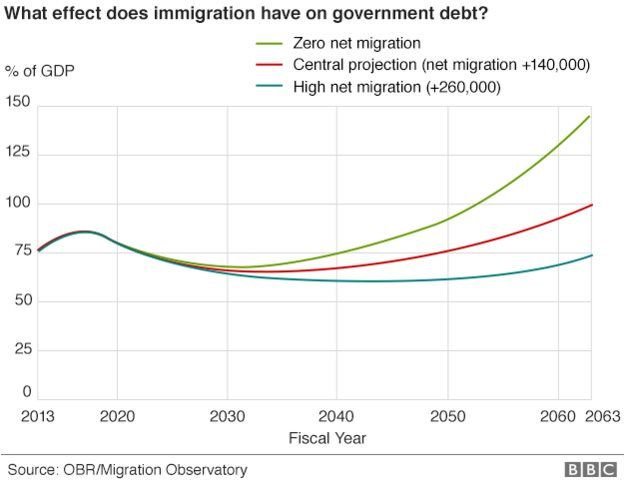
The graph below, highlighting the impact of immigration on UK debt, is an example of how the mainstream economists of the OBR have failed to take into account Max-Neef’s threshold hypothesis:

It would appear that the OBR is suggesting the existence of a causal link between the reduction in government debt and the notion that immigration is a net economic benefit.

However, the ORB analysis doesn’t take into account the uneven distribution of wealth which negate the benefits accrued. It also omits other indicators such as reduced quality of life resulting from, for example, a lack of school places or other pressures on public services that mass immigration potentially brings.

Walking barefoot

It’s the apparent inability of politicians to view the economic growth paradigm as destructive that opens up spaces for alternative narratives of the likes of Max-Neef to fill.

After winning the Right Livelihood Award in 1983, two years after the publication of his bookOutside Looking In: Experiences in Barefoot Economics, the Chilean economist’s metaphor was inspired as a result of the ten years he spent working in extreme poverty in the Sierras, jungles and urban areas of different parts of Latin America.

It was during this period that the economist from Berkeley began to view his profession in a different light. What subsequently happened was to change his life for ever:

“I was one day in an Indian village in the Sierra in Peru”, recalls Max-Neef. “It was an ugly day. It had been raining all the time. And I was standing in the slum. And across me, another guy also standing in the mud…This was a short guy, thin, hungry, jobless, five kids, a wife and a grandmother. And I was the fine economist from Berkeley. We looked at each other, and then suddenly I realized that I had nothing coherent to say to that man in those circumstances, that my whole language as an economist was absolutely useless.”

Max-Neef continued:

”Should I tell him that he should be happy because the GDP had grown five percent or something? Everything was absurd. I discovered that I had no language in that environment and that we had to invent a new language. And that’s the origin of the metaphor of barefoot economics, which concretely means that is the economics that an economist who dares to step into the mud must practice.”

Max-Neef argues that economists are divorced from the kind of poverty that’s central to their theories:

“The point is, economists study and analyze poverty in their nice offices, have all the statistics, make all the models, and are convinced that they know everything that you can know about poverty. But they don’t understand poverty. And that’s the big problem. And that’s why poverty is still there. And that changed my life as an economist completely. I invented a language that is coherent with those situations and conditions.”

The ‘language’ Max-Neef alludes to relates to how human beings in developed countries have lost the capacity to understand. Despite our ability to accumulate knowledge, this capacity, in the absence of empathy, love and understanding is, according to Max-Neef, insufficient:

“You can only attempt to understand that of which you become a part. If we fall in love, as the Latin song says, we are much more than two. When you belong, you understand. When you’re separated, you can accumulate knowledge. And that is the function of science. Now, science is divided into parts, but understanding is holistic.”

For Max-Neef, poverty from the perspective of economists, can only be understood by living among people who are poor. Only then can economists understand that in such an environment there exists a different set of values and principles that are alien to the world of academia that cannot be learned or understood their.

“What I have learned from the poor is much more than I learned in the universities. The first thing you learn…is you cannot be an idiot if you want to survive. Every minute, you have to be thinking, what next? What do I know? What trick can I do here? What’s this and that? And so, your creativity is constant. But very few people have that experience. They look at it from the outside, instead of living it from the inside”, says Max-Neef.

The Berkley economist, continued:

“In addition, you have networks of cooperation, mutual aid and all sorts of extraordinary things which you’ll no longer find in our dominant, individualistic, greedy and egotistical society. It’s the opposite of what you find there. And it’s sometimes so shocking that you may find people much happier in poverty than what you would find in your own environment. This also means that poverty is not just a question of money. It’s a much more complex thing.”

What underlines Max-Neef’s message, perhaps more than anything else, is that mainstream economists in the ‘developed’ world see themselves as sophisticated, educated and cultured. They do this while building walls, pushing away to the margins the poor of the ‘developing’ world.

Ultimately, mainstream economists fail to acknowledge that the inherent contradiction of the neoliberal economic paradigm is such that it’s undermining the very foundations upon which ‘progress’ can be sustained in the long-term.

Lost In New Imaginings

dreams about people from your past

Groups of young parents huddle in a hallway, making plans. Old men nap on couches, waiting for dessert. It’s the extended family in all its tangled, loving, exhausting glory.

This particular family is the one depicted in Barry Levinson’s 1990 film,  Avalon, based on the film directors own childhood in Baltimore. But it’s also one that could equally be played out in any post-war town or city in a smog drenched Keyensian Britain.

Battle-fatigued young men who fought for God and country were in no mood for the platitudes of politician’s who had sent many of their comrades to the battlefields where the stench of death still lingered. Hitler fascism, although defeated had, through the passing of time, left indelible scars on the faces of generations of young men ravaged by its consequences.

The fraternity among men who returned to Blighty from war in the hope that society back home could be transformed for the better, was a hope not lost on the ruling class. The establishment were to suffer the torment of a disillusioned nation tired of being used as cannon fodder for the interests of Whitehall pen-pushers.

‘No more war’ was the cry of the huddled, restless, masses. Churchill had underestimated the level of the nations discontent. The epithet ‘war hero’ would have to wait for the writings of historians as the war statesman was rejected at the polls by the very people who had put him into power seven months after Germany’s fascists invaded Poland.

By 1945 it was widely understood by the ruling class that the amelioration of the antagonistic relations between capital and labour was a necessary price to pay to stave off revolutionary levels of proletarian discontent. Churchill, considered by many to be an historical footnote by the working classes who fought a war ostensibly for the vanity of others, were now in a position to force the hand of their rulers.

The Red Army paid the heaviest price for fascisms defeat. Russian revolutionary sentiment still lingered in the air on the streets of London, Birmingham and Belfast. The British working class hadn’t forgotten the toll the war had on the Soviet people, nor had generations before them forgotten the gains of the bolshevik revolution. British prols were in no mood to genuflect at the feet of their ‘betters’.

Perhaps, somewhat ironically, it was the poetic realism of the film, Brief Encounter, that managed to unify a nation distraut by war. David Lean’s 1945 masterpiece about a middle-class woman’s imagined confession of a extramarital love affair, was an allegory for a society in a state of flux, hamstrung by conformity.

The key message of the film was that the ‘free time’ available to the films protaganists, Laura and Alec, that involved their chance encounters at Boots chemist, the Palladium cinema and at a railway station refreshment room, represented newly formed spaces in the public imagination that only an immediate post-war world borne out of servitude was capable of filling. Underlying the poetic sense of realism was a quest for balance and harmony in an otherwise fractured world.

In post-war Britain, nothing less than fair play was acceptable to the masses. Brits weren’t demanding the best cut steak, caviar or smoked salmon but neither were they content with the breadcrumbs from their rulers banquetting table. People needed and demanded homes. Not dilapidated, damp-ridden, rat infested hovels, but ‘homes fit for heroes’. And they got them, three hundred thousand of them, year on year.

But widespread access to post-war housing and the consumerism that followed in its wake, marked the beginning of a societal shift. Family bonds, once close and extended, began to split apart as the desire for more convenience, privacy and mobility represented a shrinking of time and space within the newly booming capitalism.

The time-piece which was popularized at least a generation before, was now a means by which the ruling class would attempt to remind British workers that showing up at the factory gates on time was the necessary price to be paid in order for them to enjoy the exuberent excesses experienced by their counterparts across the Atlantic.

”You’ve never had it so good” was the cry of the Westminster hordes. The young had time on their hands and money with which to spend it. Full employment and ‘jobs for life’ weren’t merely the mantras of dinner partying socialists, but were the realities for millions of working class people. It wouldn’t be long before the public’s appetite for convenience and increasing levels of consumption that money and time implied, would feed into the realm of leisure.

The young bedraggled by war became increasingly hungry for entertainment. They found it in the restaurants, football terraces, shopping malls and movie theatres. American consumerism in all of it’s unbridled excesses was depicted in the latter and Brits demanded some of the action.

Food, entertainment and their corollary, leisure time, perfectly encapsulated the rapid pace of change that was beginning to take hold amid the rubble of bombed neighbourhoods. These shifts in society gave way to new antagonisms across dinner tables the length and breadth of the country as family loyalties began to be questioned.

The violation of well-established protocols was not only seen as a sign of disrespect but more broadly as a metaphor for the beginning of the collapse of the entire family structure and the speeding-up of the pace of life.

As the 1960s beckoned, the extended family began to play an ever diminishing role. In his film, Avalon, Levinson depicts the total destruction of the extended family. What we witness is a young father and mother and their son and daughter eating turkey off trays in front of the television.

In the final scene, the main character is living alone in a nursing home, wondering what happened. “In the end, you spend everything you’ve ever saved, sell everything you’ve ever owned, just to exist in a place like this.”

The scene Levinson depicts is reminscent of the famous parable about materialism and contrasting values in which an American investment banker sits at the pier of a small coastal Mexican village. After meeting a local fisherman, the banker begins to reflect on the meaning of his life, and starts to question notions of success and capitalist values to which he had become accustomed. The American begins to understand that a simpler, slow paced life experienced by the fisherman was far more enriching and fullfilling than his own urban ‘rat race’ life as a banker.

The author, Milan Kundera, said:

”To sit with a dog on a hillside on a glorious afternoon is to be back in Eden, where doing nothing was not boring – it was peace.”

Kundera’s evocation of being at peace with life is like a dream in time and space. It’s akin to the days where people told family stories, of the stable, centralized, family and the dense cluster of many siblings and extended kin. It’s like the phantasmagorical experience when watching a colourized film clip of an early twentieth century Paris street scene and a sense of stepping into that world.

The serenity of time and place thus imbued is intensified by the imagination, prolonged by a multitude of echoes. But imagination is also an expression of pain for that which has been lost and can never be recaptured. Today, such visions of historical memory are routinely mocked like a rust that corrodes all it touches. The truth is, the world of reality has its limits; the world of imagination is boundless. It will take you everywhere.

.

Media Lens Under the Spotlight

Aboriginal self determination

Founded in 2001 by Cromwell and David Edwards, Media Lens is a media analysis website which monitors the broadcast and the print media in the UK, attempting to show evidence of bias, distortions and omissions on such issues as climate change, Iraq and the “war on terror”.

The founders of Media Lens draw on the Propaganda Model of media control advanced by Edward S. Herman and Noam Chomsky. As a ‘media analysis site’ Media Lens portrays itself as providing an alternative view to the increasingly mistrusted corporate media.

They claim to focus on calling to account the ‘liberal media’, e.g. the Guardian and the Observer and want us to believe Media Lens are a corrective to the ‘mainstreams’ ‘distorted vision’. Their aim, they claim, ”is to raise awareness of the systemic failure of the corporate media to report the world honestly and accurately.”

Scrutiny of Media Lens output, however, indicates that rather than being objective analysts of the media, they strongly promote their own agenda which has much in common with that of the establishment media they claim to be critiquing.

Media Lens state on their website:

”We also hope to encourage the creation of non-corporate media – good examples are Democracy Now!, The Real News Network and ZNet – that offer genuine alternatives to the corporate mainstream.” 

ZNet appears to have folded. But Democracy Now and The Real News Network are hardly ‘ corporate alternatives’ since both are corporate financed. The former is funded by the Carnegie Foundation, George Soros’s Open Society and Tides Foundations, and the Ford Foundation. The latter is funded by the the Ford Foundation and the MacArthur Foundation.

The corporate hand

Both DN and TRNN claim to be independent and progressive. However, the corporate hand has shown itself very clearly, for example, on the issue of the Syrian war, where both DN and TRNN are firmly squarely on the side of imperialism and regime change.

The public’s ”trust” in Media Lens’ analysis is premised on the false assumption that journalism is a vital component of our democracy. The position of Media Lens seems to be that they and their corporate outlets of choice who they have a number of shared interests with, are best placed to determine which sources are deserving of this “trust”.

Media Lens rely heavily on social media for impact, especially twitter, rather than a high volume of articles (termed ‘Alerts’). The two editors, David Cromwell and David Edwards, have also authored some books, most recently, Propaganda BlitzThey tweet, retweet and write about failings of the media on issues where the corporate media see their role as propaganda or suppression rather than fact.

They are seen as progressive and anti-imperialist, as they largely make the right noises about, for example, Gaza, Yemen and Syria. However, the Media Lens response to the wars on first Libya, then Syria, as well as the Russia-Ukraine conflict, appears dutiful rather than enthusiastic, even compromised. They are seemingly unaware that the tradition of the brutality of Gaddafi and Bashar al-Assad owes more to Western propaganda than to evidence.

Media Lens aspires ‘to show evidence of bias, distortions and omissions on such issues as climate change, Iraq and the “war on terror’.  As well as stressing their left-wing credentials, the three major issues that are arguably utmost on the Media Lens agenda is their promotion of Noam Chomsky, climate change alarmism and their rejection of the sceptical arguments in relation to the Covid event.

Media Lens and Noam Chomsky

Noam Chomsky, often hailed as America’s premier dissident illectual, fearless purveyor of truth-fighting against media propaganda, murderous US foreign policy and the crimes of profit-hungry transnational corporations, enjoys a worldwide slavish cult-like following from students, journalists and activists.

Media Lens are among those who fawn over Chomsky’s every utterence and written word as if they were scripture and prophetical. To them, Chomsky is the supreme deity, a priestly master whose logic cannot be questioned. Chomsky has a reputation for being a ‘progressive’, a critic of government and the corporations, and an advocate of democracy. This is also the position of Media Lens.

The implication is that democratic principles are underscored by ‘trusted’ news reportage sanctioned by the likes of Media Lens and their chief advocates and therefore we should trust them, unquestioningly, to the exclusion of dissenting ‘others’.

Chomsky has been strongly criticised as suppressing discussion on any issue that threatens globalist interests, from the Kennedy assassinations, the activities of the CIA, the Federal Reserve and above all the Covid narrative and the plan for global government. The organisations mostly closely involved with global government, the Trilateral Commission, the WEF, the Committee of Foreign Relations are ignored or dismissed as ‘nothing organisations’.

Chomsky facilitated the invasion of Libya by whitewashing the rebels and demonising Gaddafi, and went on to support the United States with regard to the war on Syria. Chomsky pushes the NATO propaganda line of the popular Syrian uprising, the brutal response first by ‘Assad’ and then ‘Assad’ in conjunction with the Russians, and the necessity for regime change, by negotiation if possible and if necessary by arming ‘rebels’.

Media Lens, however, has steadfastly ignored the growing disillusionment with Noam Chomsky on part of anti-imperialists, and lose no opportunity to promote him as a cult figure. Media Lens and Chomsky mutually resent the charge they are pro-Assad and reject the arguments of those who are critical of the anthropogenic climate warming narrative.

Anthropogenic global warming

David Cromwell , we are told, has a PhD (1987) in solar physics from Glasgow University and then carried out post-doctoral research in Boulding Colorado at the National Center for Atmospheric Research (NCAR). NCAR is a partner of the World Bank in the Climate Change Knowledge Portal, and also carries out research on geoengineering).

Cromwell subsequently worked for Shell in the Netherlands (four years) and then for 17 years in a research post at  National Oceanography Centre, Southampton, United Kingdom, before leaving in 2010 to work full-time on Media Lens. Cromwell’s impressive qualifications both explain an interest in global warming and give credibility to his position. However, his manner of engagement on the issue is hardly consistent with a scientific interest.

While Media Lens claims to be scrutinising the mainstream media, they are actually in lockstep with the corporate media who are pushing the same message. The media analysts, for example, constantly promote the globalist position by uncritically tweeting mainstream media articles such as this one and this one, as well as tweets from alarmists like Michael Mann on December 5, 2018 and Bill McGuire on February 21, 2023, both of whom blocked me for no apparent reason other than I reject their thesis that human activity is driving catastrophic climate change.

Media Lens have also quoted, uncritically, Inger Andersen, the executive director of the UN Environment Programme (UNEP) in the Guardian.

Anderson said:

”We had our chance to make incremental changes, but that time is over. Only a root-and-branch transformation of our economies and societies can save us from accelerating climate disaster.”

In a November, 14, 2022, Media Alert, Media Lens said:

”Scientists are now admitting more often that they are ‘scared’ about the climate crisis.”

The media analysts added:

”Record high temperatures this summer in the UK alone prompted Professor Hannah Cloke, from Reading University, to say: ”This sort of thing is really scary. It’s just one statistic amongst an avalanche of extreme weather events that used to be known as “natural disasters”.

No room for debate

There is no room for scientific debate with Media Lens on any point. The analysts frequently praise campaigns‘ of vandalism committed by climate activists like Extinction Rebellion and Just Stop Oil. Their alerts consistently and uncritically report from the alarmist perspective.

In this alert which could well have come from the Guardian, they cited the Daily Mail who they previously condemned as a ‘mainstream climate sceptic‘, apparently quoting the US’s National Oceanic and Atmospheric Administration.

The Daily Mail article claims that ”normally chill Norway, Sweden and Finland all saw temperatures they have never seen before on any date, pushing past 90 degrees”. Oddly enough, July high temperature records for Sweden, for one, have remained unchallenged since 1901 (Götaland), 1933 (Svealand) and 1945 (Norrland). Climate alarmists have been warning of an ice-free Arctic for decades, and continue to do so, but the ice is, if anything,  increasing.

Media Lens’ in their alert also state:

”In Greece, 80 people died in terrible wildfires.”

This completely overlooks the fact that in 2007 there were fires which killed 84 people, and that then as now, Greeks blamed arson, as do many in California. The Media alert is sensationalist popular journalism of the worst kind, designed to uncritically push the corporate agenda.

Their position is totally partisan. What happened to the objective ‘media analysis’ website?

Investigative journalist and researcher, Whitney Webb summed-up the prevailing climate change orthodoxy in a single tweet, highlighting the fact that it’s intimately tied to corporate interests embodied in the UN’s climate change agenda formulated at the annual ‘COP’ gatherings:

“COP26 is about setting up the financial infrastructure for a completely new economic system based on CBDCs and the financialization of ‘natural capital’ and ‘human capital’ into new asset classes. It’s about complete economic domination of the planet, not about ‘saving’ it.”

Webb’s remark was in response to a speech at the 26th UN Climate Change Conference – COP26 – in Glasgow by the UN Special Envoy for Climate Action and Finance, Mark Carney, who remarked:

‘The architecture of the global financial system has been transformed to deliver net-zero. We now have the essential plumbing in place to move climate change from the fringes to the forefront of finance so that every financial decision takes climate change into account.”

Webb had revealed in her tweet the true nature of power and its interconnectedness which extends beyond the limited confines that the media analysts are prepared to admit.

To be fair to Media Lens, they did quote quite extensively from an article of Webb’s in their 22 October, 21 alert where they acknowledged the endless corporate drive to privatise the planet and the tendency for capitalists to both seek control of ecosystems as ‘financial assets’, and the rights people around the world have to ‘ecosystems services’. These include the benefits that humans receive from Nature such as food production, tourism, clean water, biodiversity, pollination and carbon sequestration.

Malthusian agenda

But the problem is, Media Lens are seemingly unable to grasp that legitimate issues and concerns like these are intrinsically linked to a nefarious decades-long Malthusian climate change agenda.

This agenda is outlined in The Club of Rome’s 1992 book, The First Global Revolution which says:

”In searching for a common enemy against whom we can unite, we came up with the idea that pollution, the threat of global warming, water shortages, famine and the like, would fit the bill. In their totality and their interactions these phenomena do constitute a common threat which must be confronted by everyone together. But in designating these dangers as the enemy, we fall into the trap, which we have already warned readers about, namely mistaking symptoms for causes. All these dangers are caused by human intervention in natural processes, and it is only through changed attitudes and behavior that they can be overcome. The real enemy then is humanity itself.”

Perhaps Media Lens can be forgiven for their various shortcomings and ommisions on climate change on the basis of good intentions, no matter how misplaced. But their response to arguably the biggest event in decades, the Covid debacle, is unforgiveable.

Having positioned themselves as analysts who regard media and government propaganda-busting as their raison d’etre, the fact that they have had little or nothing to say in the face of a government and media propaganda blitz, arguably unrivalled in peace time, can only be explained if you happened to be following an agenda consistent with power and accept promoting harmful societal and economic measures.

What little they have said, cannot possibly be reconciled with their stated or implied values. During the early days of the alleged pandemic, in March, 2020, Media Lens had nothing to say about either the fact that Covid was ”no longer considered to be a high consequence infectious disease (HCID) in the UK”, or that the global IFR published in the European Journal of Clinical Investigation is 0.15‐0.20%. 

Excess death rates were another reliable indicator that nothing exceptional was happening. According to a paper published in the European Journal of Clinical Investigation, “the excess deaths from the measures taken is likely to be much larger than the COVID‐19 deaths”. 

Cure worse than the disease

That the cure had the vast potential to be far worse than the disease was patently obvious to many before the lunacy of lockdowns became reality. When Peter Hitchens questioned this fundamental principle on 22 March in his Mail on Sunday column, Media Lens responded with ill-informed emotional-based vitriol, devoid of facts:

They agreed wholeheartedly, however, with Paul Mason’s authoritarian advocacy of caging a population that could not be trusted to make sensible decisions based on facts which ought to have been calmly provided by the government. 

The science always was and still is clear that locking populations down to address this particular threat is ineffective. Sweden, the smoking-gun ignored by Media Lens, followed an almost identical trajectory in its timeline of infections and deaths, did not lock down and yet achieved better outcomes.

To make matters worse, Media Lens’ effectively attacked, by extension, one of the world’s most cited and respected scientists, Professor John Ioannidis of Stanford University who, in the absense of any cost-benefit analysis, was also asking similar questions and voicing similar doubts as Hitchen’s.

So much for Media Lens adhering to their own stated philosophy: ”Our aim is to increase rational awareness, critical thought and compassion. Our goal is not at all to attack, insult or anger individual journalists…” 

Public bodies significantly downgraded the threat of Covid on 19 March, 2020. In addition, many eminent experts cautioned against lockdowns. These facts, in tandem with the speed and aggression with which Media Lens uncritically embraced wholesale imprisonment – the efficacy of which was plainly questionable and the harms all too apparent – is crucial to understanding that the response of Media Lens cannot be regarded as an error of judgement based on lack of knowledge about the threat.

Mike Yeadon

It is reasonable to conclude, that at least as far the Covid event is concerned, Media Lens agree with, and support, the authoritarian diktats of the state. If anybody should doubt this, their subsequent lack of response to the revelations of Dr Mike Yeadon, should end all these doubts.

Dr Mike Yeadon has a degree in biochemistry and toxicology and a research-based PhD in respiratory pharmacology. He has spent over 30 years leading new medicines research in some of the world’s largest pharmaceutical companies, leaving Pfizer in 2011 as Vice President & Chief Scientist for Allergy & Respiratory, the most senior research position in this field in Pfizer.

Yeadon demonstrated prior to Lockdown 2 that:

“the pandemic was over by June 2020 and herd immunity was the main force which turned the pandemic and pressed it into retreat.”

Yeadon’s conclusion demolished the 7 per cent immunity claim made by the government’s chief scientists. So how was was it possible that Media Lens, who claim to ”check the media’s version of events against credible facts and opinion provided by journalists, academics and specialist researchers”, fail to challenge the 7 per cent claims or, at the very least, show any indication that they were even remotely curious about this propaganda and the potential impact of it on society?

Masks, advertising and SAGE

Then there is the issue of masks. In November 2020, the most comprehensive randomised controlled trial to date targeting Covid infection specifically was published confirming that mask wearing in the general population was ineffectual.

Why wouldn’t Media Lens regard it to be an approriate course of action to investigate,in the public interest, the claims made by BBC journalist, Deborah Cohen, that the World Health Organisation changed it’s advice on masks, from ‘don’t wear them’ to ‘do wear them’ due to lobbying pressure from governments’?

Not once has Media Lens challenged the pseudo science underpinning the State’s line on masks. On the contrary, they label those who use scientific-based arguments to challenge the alleged effectiveness of masks, as ”conspiracy theorists”.

Neither have Media Lens questioned why, from 23 March to 30 June 2020, the government intensified its media propaganda campaign by increasing its spending on media advertising by 5000% nor have they written an Alert about the nefarious activities of the Scientific Advisory Group for Emergencies (SAGE) who used unethical behavioural ‘nudge’ techniques to manipulate the public, mostly by engendering fear, shame and blame.

Not once, to my knowledge, have Media Lens tweeted about the fact that the far more measured and appropriate response was the approach taken by the Swedish authorities who actually did calmly follow the science.

This kind of a rational approach was identified by the World Health Organisation as being “just as dangerous” as an alleged global pandemic, included any and all information that questioned the diktats of our “democratic” policymakers.

Pfizer

But arguably, most importantly of all, Media Lens have failed abjectly to inform their readers about Pfizer’s history of corruption, lies, and fraud. This dates back to at least 1994 when the corporation agreed to pay $10.75 million to settle allegations from the Justice Department that they “lied to get Federal approval for a mechanical heart valve that has fractured, resulting in over 600 deaths”.

Media Lens have also failed to inform their readers about how Pfizer manipulated studies to bolster the use of its epilepsy drug Neurontin for other disorders, while suppressing research that did not support those uses.

In September of 2009, the U.S Justice Department announced a $2.3 billion fine on Pfizer, the largest healthcare fraud settlement in American history.

The best available data on the adverse event rate of the Pfizer vaccine showed a serious adverse event rate of 1 per 10,000 vaccinees. According to renowned Harvard biostatician Dr. Martin Kuldorff, these figures are unacceptably high (compared to other vaccines on the market which produce adverse event rates in the ballpark of 1 per million).

Given Pfizer’s dark and sordid history, their attempts to withhold data the public relied on to license its COVID-19 vaccine, as well as the corporations admission that they never tested whether it would prevent transmission, followers of Media Lens might think that these important topics are a worthy subject for an Alert.

Sadly, for them, Media Lens have totally swept these scandals under the carpet. It would appear, then, that Media Lens, along with much of the Left in general, are more concerned with defending Big Pharma than they are with defending the public interest against the criminality of Big Pharma.

Resisting dissent

Rather than attempting to counteract government and media hysteria as part of their role within the so-called ‘alternative’ media, Media Lens instead joined in with the legacy media by attacking or ommitting all dissent and looked askance at sceptical scientific papers on behalf of the establishment.

They also looked askance at the millions of people who raised their voices in mass protests. These protests were either ignored by Media Lens or the protestors views were distorted and their peaceful demonstrations labelled “extremist” or ”right wing”.

The lack of any critical engagement in relation to the Covid event, the denial of, and refusal to engage with, the science and their actual support of some of the most draconian, illiberal and authoritarian measures ever enacted by the state, is evidence that Media Lens deliberately and consciously filtered out a relentless campaign that manipulated the public into believing that Covid was the most catastrophic public health threat since the Black Death.

Of course, it would subsequently take their cult leader in crime, Noam Chomsky, to effectively validate Media Lens for their belittling, or at least censoring, of dissenting voices that dared challenge the prevailing Covid narrative.

In this sense, by censorsing by omission dissenting voices that do not conform to their restrictive Chomskyian narrative but, rather, by promoting what have been referred to as the ‘cruise-missile left’, Media Lens are essentially no different from any other ‘news’ outlet. Their main objective is to reaffirm a specific world view ‘brand’ and business plan model.

With Media Lens we don’t get any critiques of ‘net zero’, Agenda 30, of global institutions like the WEF and the WHO, of indiscriminate mandatory vaccination policies, the tyranny associated with lockdowns or the move towards technocratic authoritarianism.

Instead, readers are subjected to anti-Assad propaganda, lip service to anti-imperialism, and the perpetuation of the Club of Rome’s anthropogenic climate change and WEF ‘build back better’ global agendas that, paradoxically, are consistent with the ‘manufacturing of consent’ accusation Media Lens level at many of their ‘mainstream’ media critics.