Category: politics

Osborne’s Budget of Irresponsibility

By Daniel Margrain

Chancellor Gideon Osborne’s budget last week that represented a culmination of six years of government failures and which slipped the UK into a deeper recession, amounted to another massive transfer of wealth from the poorest to the wealthiest in society. This was reiterated by both the Institute for Fiscal Studies (see chart below) and the Office for Budget Responsibility (OBR). The Economist projects that by the end of this parliament, levels of investment – which are already one of the lowest in Europe – will fall to just 1.4 per cent of GDP, under half of what it was when the coalition government came to power. It is also half of what the OECD said is necessary just for the UK economy to stand still. But despite these facts, an alternative narrative has emerged in many of the editorials of the corporate controlled media which bare no resemblance to reality for the vast majority of the British people. As Shadow Chancellor, John McDonnell put it on LBC last week, “If press releases built things, Cameron would have rebuilt our country.”
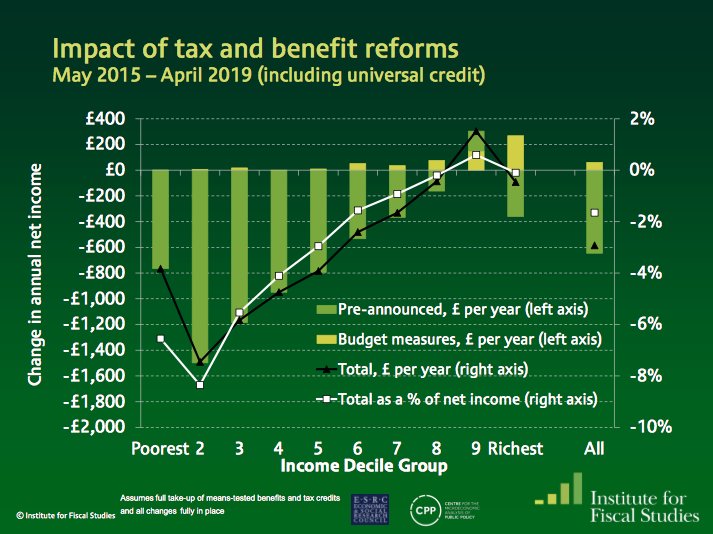
 

The main thrust of the budget was Osborne’s cut in funding to the disabled by £4.2 billion in order to pay for three separate tax cuts to the rich against a backdrop in which the national debt is rising by £45 per second or £2,700 per minute. Paul Mason summed up the mood in the House:

“Osborne’s glum face during Jeremy Corbyn’s speech — an uncharacteristically angry barnstormer — was matched by the glum faces of Blairites as they realised their own party was actually going to inflict moral and political damage on the government.”

Osborne’s inhumane and fiscally irresponsible budget was preceded by the fiscally responsible alternative version outlined by his opposite number, John McDonnell who, in a speech on March 11 (as well as in various interviews to the media and public meetings), laid out his parties fiscal credibility rules. The shadow Chancellor stated that he will eliminate the deficit and tackle the national debt within a five year period on the basis of the implementation of a progressive and ambitious investment programme that he said will provide the stimulus for growth and demand in the economy.

McDonnell insisted that a future Labour government would invest in skills, infrastructure and above all, technology. The speech was subsequently praised by a wide range of economists and some media outlets in addition to business organizations that included the CBI and the Chamber of Commerce. As a committed socialist, McDonnell is aware of the importance planning is to the economy and the ruthlessness that is required to properly monitor how governments’ spend and, more importantly, earn money. The whole debate is how the country earns its future which McDonnell has said ought to be focused on investment.

The difference between McDonnell’s approach and that of one of his often cited predecessor, Gordon Brown, is that the latter never went for an investment-growth strategy and relied too much on unregulated finance sector growth and the revenues generated, as the catalyst for the subsidizing of public services. This policy strategy proved to be an abject failure. Similarly, the approach under McDonnell’s immediate predecessor in opposition, Ed Balls, was firstly to underplay the drive toward investment and, secondly, was marked by his failure to recognize that governments’ have to borrow to invest in the long-term in order to grow the economy.

But equally as important, was Balls’ inability to grasp the important role organizations like the IMF and OECD play in diagnosing economic problems and how best to solve them. Specifically, Balls appeared to have underplayed the scope the combination of fiscal and monetary policy plays in combating low or negative interest rates. In contrast to the incompetence of Balls and Brown, McDonnell has expressed awareness that when government’s reach the limits of monetary policy in terms of low or negative interest rates, they have to combine the monetary with the fiscal. What McDonnell acknowledges, is the importance the building of a balanced economy plays to the modern democratic nation state.

The problem under previous government’s – both Conservative and Labour – has been that the investment in the manufacturing base, predicated on new technology, has been largely sidelined at the expense of the finance sector. On LBC, McDonnell used the analogy of a small company to outline his case. “An owner of a new company will need to invest in new machinery in order to compete against his rivals otherwise he or she will go out of business”, he said. He continued: “Government’s, like businesses, need to invest in the future otherwise their economies will fall behind.” The lack of investment is precisely what has beset the UK economy over recent decades, particularly under the latest Tory government which has overseen a widening productivity gap between the UK and its major European rivals.

McDonnell, correctly in my view, has made it clear that the Office for Budget Responsibility (OBR) should be given the power to monitor the UK’s own application of its fiscal credibility. The OBR, according to McDonnell, should not report to the Chancellor as is currently the case, but instead it should go directly to parliament. The aim is not merely to raise the economic credibility of Labour among the public but to raise it among the political class too. It’s ironical that despite the public perception that Labour governments’ have been more economically incompetent in the 37 years since Thatcher was elected than their Tory counterparts, the reality is there have been only two years – under Nigel Lawson during the boom period of the 1980s – in which the Tories produced a balanced budget. Conversely, Labour produced three years of balanced budgets under Gordon Brown.

 McDonnell has been aided in his approach to countering Tory and media propaganda by some of the world’s renowned and leading economists who have not only openly backed the oppositions anti-austerity economic model but have played an active part in advising the Shadow Chancellor as part of Labour’s Economic Advisory Committee. A central plank of the fiscal responsibility rules that McDonnell and his team set out on March 11, relates to Labour’s intention to reduce debt as a proportion of GDP over the lifetime of the government. This will entail growing the economy over the requisite five year period, allied to a fiscally disciplined and controlled approach to spending. The alternative budget that McDonnell proposed emphasized the application of a process of rigorous budgeting so as to restrict the likelihood of public expenditure spiraling out of control. To this end, the Shadow Chancellor stressed the need for the treasury to return to its former role of managing public finances as opposed to signalling to government departments that they have a license to spend public money in a prodigious manner.

An example of the latter happened two years ago following the Tory government’s much criticised selling off and closing down of the Forensic Science Service (FSS) against the advice of all the relevant parties concerned. The treasury ignored the advice because they envisaged the closing of the service as being financially prudent in the short-term. Two years down the line, they decided to set it up again. It’s this kind of short-term based decision-making predicated on the top down authoritarian micro-managed approach of their principal overseer in number 11 Downing Street that inhibits not only the long term financial credibility of government, but undermines democracy and the well-being of society as a whole.

Then there are the secret and highly wasteful and expensive P F I funded projects that typified the Blair and Brown era that McDonnell says he wants to put an end to. A third example of how short-term policy approaches are counterproductive to the long-term financial well-being of the nation, is within the realm of housing. The most labour intensive form of public spending is affordable council house building which, year on year, since the era of the Thatcher government, has failed to meet the demand for them. Labour’s Housing Minister, John Healey, has stated that he intends, as a starting point, to use savings on housing benefit (which is beneficial mainly to the rich), to build 100,000 affordable homes.

Government investment in housing is not only beneficial to those in need of a home, but it also reduces the housing benefit bill. In addition, the cost of buying a house is reduced due to increasing availability more widely. Although on the surface the intention to bring greater scrutiny and accountability to bare within the public sphere sounds overly bureaucratic, the kinds of attempts to rein in government and treasury short-term excesses are nevertheless fundamental to the successful running of governments’ in the eyes of the electorate. It is this electorate that is increasingly aware of just how callous Gideon Osborne has been in the lead up to the decision to cut disability welfare benefits which allegedly prompted Iain Duncan Smith’s resignation letter.

The letter basically outlined every suspicion that voters, and indeed Tory MPs, have about Gideon Osborne in relation to his obsessive attempts to micro-manage government departments as the prerequisite to his cynical positioning as next in line to succeed David Cameron as Tory leader. In relation to Duncan Smith’s resignation, one theory espoused by former UK diplomat Craig Murray is that his conscience got the better of him and as such Osborne’s budget attack on the disabled was regarded by Duncan Smith as one attack too many. Personally, I don’t buy it.

I’m more inclined to believe John McDonnell’s interpretation as expressed on LBC yesterday (March 19). McDonnell claims that the former Work and Pensions Secretary went through a long consultation exercise which specified the new proposal for the qualification criteria for the Personal Independence Payment (PIP). As a result of pressure from Osborne, McDonnell claims that Duncan Smith had no option other than to tear the agreement up.

In other words, a deal was allegedly done but Osborne is said to have reneged on it. This put pressure on Duncan Smith who, in turn, McDonnell claims, had taken the flack for something that was not ultimately his doing. Osborne had invented a fiscal rule that has been unable to withstand political scrutiny and the public, judging by the latest opinion polls, are wise to it. Let’s hope they will continue to be wise to the government’s various shenanigans prior to the forthcoming local elections and vote accordingly.

The hidden hands that feed racism

By Daniel Margrain

Those who have been following the flamboyant political showman, Donald Trump, whose heavy-handed approach to demonstrators at his rallies and outrageously racist remarks many are familiar with, might be surprised to learn that similar comments, albeit hidden ostensibly under the cover of liberal respectability, have gone largely unnoticed within media circles. Nine years before the widespread condemnation of Trump’s remarks, Douglas Murray, Associate Director of the Henry Jackson Society, echoed Trump when, in an admittedly less demagogic fashion, he argued for the banning of Muslim immigration into Europe.

Murray, who heads the avowedly neoconservative and CIA-funded organization that has links to the US and European far right, has also defended the use of torture by Western intelligence agencies. One might think that leading figures within the political and corporate media establishments – particularly on the liberal-left of the spectrum – would be keen to distance themselves from such a right-wing organization. On the contrary, both the hierarchy within the Parliamentary Labour Party (PLP) and political commentators not only cite the Henry Jackson Society when commenting on Islamic affairs, but actually embrace it as well.

The role call of pro-Syria bombing Blairites within the PLP who sit on the Political Council of the Henry Jackson Society include Margaret Beckett, Hazel Blears, Ben Bradshaw, Chris Bryant and Gisela Stuart, while the BBC regularly give air time to Murray on mainstream political discussion and debating programmes like Question Time, This Week, Today and Daily Politics. The organization also acts as a front for the security services via the Quilliam Foundation think tank whose role, in return for tax payers money, is to publicly denounce Muslim organisations and, with the collaboration of the neo-fascist, Stephen Yaxley-Lennon (AKA Tommy Robinson who heads Pegida UK and was formerly the head of the racist and fascist English Defence League), talk up the Jihadi threat. It’s extremely revealing that establishment figures within the hierarchy of the Labour Party who have in the recent past complained about the alleged infiltration of left wing elements within the party, are willing to align themselves with racists and fascists.

The racist outlook of Murray et al and the means to promote it within media circles are far from unique and rarely, if ever, challenged. Former UK diplomat, Craig Murray quoted the “darling of the Mail and the BBC”, Melanie Phillips’ incitement to religious hatred:

“Romney lost because, like Britain’s Conservative Party, the Republicans just don’t understand that America and the west are being consumed by a culture war. In their cowardice and moral confusion, they all attempt to appease the enemies within. And from without, the Islamic enemies of civilisation stand poised to occupy the void…With the re-election of Obama, America now threatens to lead the west into a terrifying darkness.”

To my knowledge, apart from Murray, not a single prominent commentator alluded to Phillips’ Islamophobia and racism.

Another example was the sympathetic treatment the BBC afforded to the ‘doyen of British fascism’, the BNPs Nick Griffin. In 2009, Griffin appeared on the BBC’s flagship political discussion programme, Question Time despite the fact that the Standards Board for England’s 2005 description of the BNP as Nazi was “within the normal and acceptable limits of political debate”. The European Parliament’s Committee on racism and xenophobia described the BNP as an “openly Nazi party”. When asked in 1993 if the party was racist, its then deputy leader Richard Edmonds, who has been convicted for racist violence, said“We are 100 percent racist, yes.”

Prior to his appearance on the programme, Griffin expressed delight with the decision of the BBC to have granted him a major political platform with which to air his party’s views. These views went unchallenged by the other guests on the show that included Labour’s Jack Straw, who had subsequently insisted that female Muslim constituents visiting his constituency office in Blackburn remove their veils and claimed that Pakistani men saw white girls as “easy meat”. At the time of Griffin’s appearance on Question Time, the BBC attracted an audience of almost 8 million viewers, three times its average. Following the publicity generated by Griffin’s appearance, the Daily Telegraph newspaper revealed the results of a UK Gov opinion poll which indicated that 22 percent of British people would “seriously consider” voting for the BNP and that 9,000 people applied to join them after the programme aired.

Many of the individuals who were directly responsible for overseeing Oxbridge-educated Griffin’s appearance – including BBC director-general, Mark Thompson – had themselves been educated at one of two of Britain’s elite educational establishments – Oxford and Cambridge. Griffin, who graduated in law, told the Guardian newspaper that he admired Thompson’s “personal courage” by inviting him. Nicholas Kroll, then director of the BBC Trust – an organization that supposedly represents the interests of the viewing public – was also educated at Oxford. At the time of writing, at least three of the 12 members of the government-appointed trustees, were educated at either Oxford or Cambridge, while the remainder have a background in either law, business or economics. Two years before the Question Time appearance, Griffin had generated a significant amount of publicity following the controversy surrounding Oxford universities decision to allow him a public platform to address students at the universities campus.

Despite the links the establishment has to fascism, the notion that fascist sympathies are rooted within the high echelons of the former has not been widely recognized within public discourse, even though last July, the British royal family were shown giving Nazi salutes as part of a home movie. The problem for the elites is not that these links exist, rather the concern is the possibility that the media will shine a light on these relationships.

As Craig Murray put it:

“It says a huge amount about the confidence of the royal family, that they feel able to respond to their Nazi home movie with nothing other than outrage that anybody should see it…. The royal family is of course only the tip of the iceberg of whitewashed fascist support.”

Fascist ideology is the bedrock on which our political and media culture is deeply embedded. The reality is right-wing establishment think-tanks like the Henry Jackson Society and MigrationWatch UK use racist based arguments around the issue of immigration as as their justification for arguing either for, on the one hand, British withdrawal from the EU or, on the other, for the implementation of greater neoliberal reforms as a precondition for maintaining the countries continued membership within it. This, in turn, provides the intellectual echo chamber for the racist UKIP and BNP as well as the ultra right-wing factions within both of the main political parties.

What this illustrates is the contradictory nature immigration plays as part of the function of the liberal democratic state within capitalism which transcends party political lines. Both the official ‘left’ and ‘right’ are prepared to use false and contradictory arguments around the issue of immigration in order to whip up divisions within society for naked opportunistic short-term electoral gain. Under the New Labour government of Tony Blair, for example, Gordon Brown opened up the UK labour market to potentially millions of workers from the Accession 8 (A8) countries that comprised the former Soviet Bloc as the basis for restoring Britain’s economic status against a backdrop of sustained industrial decline.

Brown did this as the means of addressing Britain’s demographic problems in terms of its ageing population as well as to fill existing skills gaps. However, by the time he had taken over the reigns of power from Blair, he began using the racist language of division by emphasizing the need to secure “British jobs for British workers”. This was after oil refinery workers in 2009 protested against their replacement by foreign workers that he – Brown – encouraged. Short-term electoral interests encourage politician’s to play the race card which does not necessarily correspond with those of their paymasters in the boardrooms of the corporations whose primary concern is to secure the most plentiful, skilled and cheap workers possible.

In pure economic terms, immigrants make a positive contribution, not least because the state has been spared the considerable expense of educating and training them. Political leaders know this and that is precisely why the shrill talk deployed at elections is invariably at odds with the policies they actually implement when in office. That, in turn, is why it is so easy for the bigots within racist parties like UKIP and the BNP to expose the hypocrisy of the mainstream parties while also providing organisations like the Henry Jackson Society and MigrationWatch UK the ammunition they need as their cover for pursuing a racist agenda of their own.

Too readily, those at the top are quick to exploit voters’ concerns about the supposed threat that immigration poses in terms of undermining ‘social cohesion’. But they do this so as to engender a sense of division to make it easier for them to rule over everybody. When tensions arise from time to time, it’s those at the bottom who are routinely condemned for their prejudice and bigotry in the media, whereas the more significant racism which emanates from the policies of those at the top who foment it, goes virtually unnoticed.

It’s not my intention to absolve working class racists of their actions, but rather to point out that the more significant forms of racism is formed in the corporate and media boardrooms, think-tanks and elite political sphere indicative of ruling class power. Although this racism is given political expression in the form of scare stories almost daily in the gutter press of the Sun, Daily Mail and Daily Express that perpetuate them, it’s not restricted to these tabloids. The Chair of MigrationWatch UK, Sir Andrew Green, for example, is regularly granted a media platform in order to push an anti-immigrant agenda, albeit a subtle one.

Similarly the likes of Douglas Murray and Toby Young who newspaper proprietors and TV executives consistently employ to espouse their right-wing views, do a great deal to distill the more overt expressions of racist scare stories so as to appeal to the realms of their middle and upper middle class viewers and readers. It’s deemed irrelevant by corporate executives that the ‘journalists’ they employ proffer spurious and deliberately misleading information, simply that they give their demographic what they think that want to hear and read to increase their customer base and so boost their profits in order to satisfy the demands placed on them by their advertisers.

And that, I submit, is hardly the foundation on which to build a civilized, multi-cultural and inclusive society. Donald Trump may be an oaf and a racist, but is he really much different to the elite that rule us?


Endless war, Everlasting peace

By Daniel Margrain

The downing by NATO member, Turkey, of a Russian aircraft on the Syrian-Turkish border in November 2015 – the first of its kind since 1952 – brought into sharp focus the complex patchwork of contending geopolitical and strategic allegiances against what is ostensibly a unified military response to ISIS. Turkey’s role in supporting the Al-Qaeda affiliate, the Al Nusra Front, starkly emphasises the risk of a military escalation to the crisis and the undermining of the current ceasefire.

Turkey’s seemingly schizophrenic relationship to the United States and NATO underscores the former’s reluctance in allowing the latter to use it’s military bases in the east of the country to attack ISIS. Instead, the Turkish government under president Erdogan have used these bases to target the Kurdish PKK. According to the United Nations, 30,000 terrorists from one hundred countries that have landed in Syria have arrived through Turkey and the CIA are overseeing the supply of arms to some of them. Meanwhile, Qatar and Saudi Arabia are also supporting Jihadi extremists to the tune of billions of dollars in arms and funds which are being funneled through Turkey.

Since both Russia and Iran are geo-strategically aligned to Syria, it’s in the interests of both countries to ensure that a Russian-friendly regime in Syria remains in power to act as a bullwark against undue US influence in the region. Clearly, given the competing interests of the major powers, and the potential risks of a major resource war between them, it’s an obvious truism that there can be no long-term solution to the conflict that involves a massive escalation of violence. Therefore, the only viable solution to the crisis is a negotiated settlement which the current ceasefire is a potential prelude to.

In addition to the tensions described, is the duplicitous role played by Turkey which has its own narrow anti-Kurdish agenda in the region. The problems are further compounded in that both the Syrian YPG and the Kurdish KPP have mounted effective ground offensives against ISIS while paradoxically both groups remain on the U.S terrorist list. In addition, Hezzbollah and Iran, backed by Russian air power, have also been effective in countering ISIS. But rather than backing these various factions, UK-US policy is predicated – ostensibly at least – on maintaining support for their two partners on the ground – the Iraqi army (which is weak) and the so-called moderate Syrian opposition to Assad and ISIS (which barely exists).

If the allies led by the US government were serious in their intent to obliterate the existential threat they claim ISIS represents, they would be aligning themselves with the first set of fighters mentioned above instead of their powerless and ineffectual “partners”. So given this anomaly, one has to wonder what the key motivating factor guiding US policy in relation to Syria is. The country sits in a region of the world where the US-UK government’s hypocritically covertly support the oppressive actions of some of the most brutal and authoritarian regimes on earth.

The rational answer is that the principle motivation lies not in eradicating ISIS but rather in toppling one of the more relatively tolerant and secular regimes in the region. Indeed, Assad who, just over a decade ago, was wined and dined in the company of British royalty, is currently on the U.S rogue state list primed for regime change. This overriding factor guiding Western policy is the ‘elephant in the room’ to which journalists and commentators within the liberal corporate media, who focus their critique on Assad, tend to overlook.

The widely accepted narrative is that the catalyst for the “civil war” in Syria is one in which Assad is said to have massacred peaceful demonstrators. This is equated with the events that characterized the Arab Spring in countries like Tunisia and Egypt. Both interpretations amount to a serious misreading of the situation. Following the initial outbreak of violence in Daraa, a small border town with Jordan on March 17-18, 2011, professor Michel Chossudovsky recounted the events:

“The protest movement had all the appearances of a staged event involving covert support to Islamic terrorists by Mossad and/or Western intelligence….Government sources pointed to the role of radical Salafist groups (supported by Israel)…In chorus, the Western media described the events in Daraa as a protest movement against Bashar Al Assad.”

Chossudovsky cited Israeli and Lebanese sources in support of his claims. These sources reported on the killing of seven police officers and at least four demonstrators in addition to the torching of the Baath Party Headquarters and courthouse. Chossudovsky commented:

“These news reports of the events in Daraa confirmed that from the very outset this was not a ‘peaceful protest’ as claimed by the Western media….What was clear… is that many of the demonstrators were not demonstrators but terrorists involved in premeditated acts of killing and arson…The title of the Israeli news report summarized what happened: Syria: Seven Police Killed, Buildings Torched in Protest.”

This account was subsequently confirmed five months later by Israeli intelligence sources who claimed that from the outset Islamist “freedom fighters” were supported, trained and equipped by NATO and Turkey’s high command (DEBKAfile, NATO to give rebels anti-tank weapons, August 14, 2011). Media Lens quoted Jeremy Salt, associate professor in Middle Eastern History and Politics at Bilkent University, Ankara, who added some background:

“Since the Soviet-Afghan war, Western intelligence agencies as well as Israel’s Mossad have consistently used various Islamic terrorist organizations as “intelligence assets”. Both Washington and its indefectible British ally have provided covert support to “Islamic terrorists” in Afghanistan, Bosnia, Kosovo and Libya, etc. as a means to triggering ethnic strife, sectarian violence and political instability… The ultimate objective of the Syria protest movement, through media lies and fabrications, is to create divisions within Syrian society as well as justify an eventual “humanitarian intervention”.’

In another article, journalist John Pilger quoted the former French Foreign Minister Roland Dumas who last year revealed that “two years before the Arab spring”, he was told in London that a war on Syria was planned. “I am going to tell you something,” he said in an interview with the French TV channel LPC,“I was in England two years before the violence in Syria on other business. I met top British officials, who confessed to me that they were preparing something in Syria… Britain was organising an invasion of rebels into Syria. They even asked me, although I was no longer Minister for Foreign Affairs, if I would like to participate… This operation goes way back. It was prepared, preconceived and planned.”

The cementing of US hegemony in the region (and beyond), with the backing of its principle European ally, is hardly a secret. In fact, it dates back to at least the the Clinton era when the concept of American supremicism and exceptionalism were coined as the prelude to the setting up by the neoconservative pressure group of the Project for the New American Century (PNAC). This document provided the ideological justification for the bolstering of America’s nuclear first strike capability.

Leading neoconservatives have conceded that the perpetuation of American supremacy, as opposed to defending the country, is what this capability is designed to achieve. Lawrence Kaplan, for example, admitted that missile defence is a tool for global US dominance. The purpose of the PNAC is to provide an overview of US defence strategy from a world-historical perspective within the context of a decade of supposed US neglect.

This perspective led the neoconservatives within the Bush, and later Obama regimes, to conclude the opening, and subsequent extension, of windows of opportunity with which to demonstrate America’s military superiority. In the same vein as the PNAC, the accompanying war manifesto, The National Security Strategy begins with the affirmation,“The United States possesses unprecedented- and unequalled – strength and influence in the world.” It concludes with the warning,“Our forces will be strong enough to dissuade potential adversaries from pursuing a military build-up in the hopes of surpassing, or equalling, the power of the United States.”

A key section warns:

“We are attentive to the possible renewal of old patterns of great power competition. Several potential great powers are now in the midst of internal transition – most importantly Russia, India and China.” 

Reaffirming that the war on terror was just the beginning for the United States, George Bush in his State of Union address on 29 January, 2002, named Iran, Iraq and North Korea as “an axis of evil”. Secretary of State, John Bolton, subsequently extended the net to include Libya, Cuba and Syria. The ‘war on terrorism’ also provided the US with an opportunity to establish a string of military bases in Central Asia.

The reality is that regime change in Syria and elsewhere is predicated on the paradoxical concept of eternal warfare as the precursor to the creation of an everlasting peace borne out of a wilderness wrought of chaos and destruction. Specifically, the definitive article, the New American Century, is about shaping the world for the next hundred years according to the interests and values of American capitalism.

In 2001 when George Bush declared the ‘war on terror’, Al-Qaeda was confined to a small tribal area in north west Afghanistan. Now, thanks largely to the attempt at the imposition of American capitalist democracy delivered at the point of gun, so-called Islamist terrorism has spread worldwide.

Is the U.S heading towards military conflict in the South China Sea?

Famously, Albert Einstein defined common sense  as  “the collection of prejudices acquired by age eighteen.” When viewed from the prism of the perspective of the apologists for capitalism, Einstein’s condescending approach to conventional wisdom belied much of the Western prevailing orthodoxy up to the events in New York on September 11, 2001.

The prevailing view, particularly among a large swath of intellectuals, was one in which capitalism was seen as the bedrock of society underpinned by an economic booster model of globalization that supposedly limited the scope for war and conflict. Intellectual proponents of this worldview understanding of capitalism included Third Way ideologues such as Anthony Giddens and Ulrich Beck. For them, globalization was reshaping liberal democracies into states that transcended the need for “enemies”.

The limitations of this thinking was brought sharply into focus following George W Bush’s proclamation of a global state of war on September 20, 2001: “Americans should not expect one battle”, he said , “but a lengthy campaign, unlike any other we have ever seen.” To accept the notion that the capitalist system is shaped purely by economics that under the guise of globalization ameliorates the pressures among states to go to war with one another, is to grossly misunderstand the nature of the beast and what the main catalyst is that drives the war machine forward.

In truth, the system is underpinned by “competitive processes that involve not merely the economic struggle for markets, but military and diplomatic rivalries among states.” In other words, capitalism embraces geopolitics as well as economics. This was first understood during the early 20th century when the expansion and intensification of capitalism began to make its mark. It was during this period that economic rivalries among firms began to take the form of conflicts which spilled over national borders.

Consequently, combatants called upon the military support of their respective states to protect them. Thus, the close and complex interweaving of economic and security competition became geopolitical in nature which was to develop into the tragic era of inter-imperialist war between 1914 and 1945.

The notion that diplomatic and military conflicts among states reflect the more general process of competition that drives capitalism on, is the basis of the classic theory of imperialism formulated by Nikolai Bukharin during the First World War. It’s a theory that provides the best framework for understanding the contemporary American war drive and, pertinent to this article, its ongoing South China Sea dispute with China which the staging of the Association of Southeast Asian Nations (ASEAN) summit in the U.S a few days ago is implicit.

The main purpose of the summit, from a U.S perspective, is to advance what the Obama administration calls its Rebalance to Asia and the Pacific, popularly known as the Asia Pivot which reflects a shift in U.S policy towards China which intimates more of a belligerent approach as opposed to one based on constructive rationality. This is highlighted by the projected deployment of 60 percent of U.S submarines to the region, the purpose of which is to undermine Chinese economic development by limiting its maritime access to markets.

Much has been made about how the U.S wants to “cooperate” with China and to maintain friendly relations. But at the same time, President Obama proposes to undermine bi-lateral relations in the region while China wants to enhance them on an individual basis in much the same way that it would with any other country outside the region.

Another indication that the U.S is not prepared to cooperate, was the summit agenda’s domination by the Trans-Pacific Partnership (TPP). This was in addition to the dispute regarding contested maritime territorial claims and so called “freedom of movement” issues. What the U.S has sought to do is to stifle the development of the South East Asia region in relation to China and therefore seek to undermine the trade agreements China already has in place with various other S.E Asian countries in the bloc – agreements that were formulated at an international level through the auspices of forums like ASEAN.

The crux of the conflict between the U.S and China essentially revolves around the contenting claims and the influence each player is able to exercise in relation to ASEAN. The U.S is attempting to use economic and political leverage to isolate or economically encircle China as a way of counteracting what they perceive to be the expansion of China’s political influence.

The false impression given in much of the Western corporate media is that sovereign nations in the region are under threat from an expansionist and belligerent China and that these nations are necessarily looking to the United States for assistance. How the U.S would likely respond if China were to build military bases throughout the Gulf of Mexico, the Caribbean or the Pacific coast off California is not a question the Western media seem to want to ask.

By reversing the roles, we can begin to understand the situation from the Chinese perspective, particularly given the painful and tragic history it has had over the last two centuries in relation to Western colonial domination of its territory. The contextual reality that underlies the Chinese position is that having emerged from a very dark period in their history, they are looking to assert their sovereignty by creating a regional sphere of influence.

Contrary to Western media propaganda, this doesn’t necessarily involve the domination of their neighbours. The perspective coming from Beijing is an insistence that the U.S respect China’s growing influence as a major political and economic power. This call, however, appears to be largely falling on deaf ears, particularly among the decision makers in Washington that really matter. What  A. J. P Taylor  called “the struggle for mastery” among the Great Powers is understood by Realists within the sphere of international relations in America. However, their views don’t hold significant enough sway within the corridors of power to influence policy.

The signing of the TPP to the exclusion of China, as well as the arm twisting by the U.S administration, appears to be intended to prohibit its European partners from joining the Asian Investment Infrastructure Bank (AIIB) which arguably has the potential to rival the International Monetary Fund (IMF). The dominant force in Washington is one which remains orientated towards greater competition which entails the possibility of greater conflict, not because the U.S wants war with with China, but because they are pushing the envelope which potentially can lead to unintended consequences.

While on the one hand, America pushes for its control of the regional trade and commerce framework through ASEAN, on the other, China is pushing to expand it’s so-called One Belt, One Road policy. This is predicated on growing Chinese economic penetration throughout the entire Eurasian land mass stretching from the Chinese coast on the South China Sea all the way to the Atlantic coast of Europe.

China is increasingly moving towards land-based commerce through Russia and central Asia and into the European space. This must be alarming to many of the strategic planners and paid-for corporate politicians in Washington. Underpinning the conflicts in the China Sea regarding disputed territory and the fomenting of others by the U.S involving China and its neighbours, is the larger geopolitical chess match, what Zbigniew Brzezinski famously referred to as The Grand Chessboard.

In exposing the real motives behind the Clinton administrations stated multilateralist strategy, Brzezinski who was one of the main architects of Nato expansion, presented The Grand Chessboard as one facet of a much broader approach to maintain American dominance over Eurasia through a continent wide policy of divide and rule. Brzezinski openly used the language of imperial power:

“America’s global supremacy is reminiscent in some ways to earlier empires, notwithstanding their confined regional scope. These empires based their power on a hierarchy of vassals, tributaries, protectorates, and colonies, with those on the outside generally viewed as barbarians. To some degree, this anachronistic terminology is not inappropriate for some of the states currently within the American orbit.”

The hosting by the U.S of the latest ASEAN summit, their TPP agenda and their attempts to contain China through the Asian Pivot, represents a worrying trend akin to the clash of imperial interests which led to the conditions from which the carnage of the First and Second World Wars emerged.


New Hampshire rejects establishment politics

By Daniel Margrain

There appears to be a pattern emerging within conventional democratic politics that seems set to break the neoliberal stranglehold that has dominated the said politics over the last few decades that is nothing short of revolutionary. Symptomatic of this radical shift as far as Europe is concerned has been the electoral successes of left parties in countries like Spain, Greece and Britain. Illustrative of the break with the traditional centre-right polity in America has been the ascendancy of Bernie Sanders who surged to victory beating Hillary Clinton resoundingly in the Democratic New Hampshire primary.

Whereas Clinton’s voter demographic is largely restricted to those people who are over the age of 65 and who have a family income of more than $200,000, Sanders carries majorities with nearly all demographic groups that include both men and women and those with and without college degrees. The popularity of Sanders reflects an upsurge in the grass roots opposition to the pro-war neoliberal consensus within the Democratic Party and their framing of a triangulation ideology that began under Bill Clinton and continues with Obama.

A Parallel can be drawn here with the phenomenal rise in grass roots Labour Party membership in Britain that elected Sanders’ equivalent, Jeremy Corbyn as leader on the back of a wave of apoplexy and disenchantment with both the self-interested careerist Blairite rump within the Parliamentary Labour Party and the elite political class in general. What we are witnessing on both sides of the Atlantic is the political and media establishment’s attempt to hold on to the levers of corrupt political and corporate media power and the privileges that come with them.

To this end, the strategy of the latter is to restrict the flow of dissenting information that conflicts in a fundamental way with these powerful interests. Set against this mutually reinforcing system of power and privilege undermining democracy, is a tidal wave of public anger and bitterness. Significantly, during his victory speech, Sanders briefly alluded to the kind of collusion between the media and political establishments’ described and their corrupting influence:

“The people of New Hampshire have sent a profound message to the political establishment, to the economic establishment, and by the way, to the media establishment.”

To my knowledge not a single mainstream media outlet has reported this part of Sanders’ speech. If one happens to be in any doubt that the liberal-left media in Britain is anything other than in thrall to the “feminist-progressive” and warmonger Clinton, than one need to look no further than the opinion pages of the Guardian. How the paper is able to reconcile its support for the neoconservative pro-Israeli hardliner predicated on her “feminism” can only be rationalized from the perspective of it’s usurpation to power.

As Craig Murray put it:

“The stream of “feminist” articles about why it would advance the cause of women to have a deeply corrupt right winger in the White House is steadily growing into a torrent. It is a perfect example of what I wrote of a month ago, the cause of feminism being hijacked to neo-conservative ends.”

In America last Sunday, CNN gave the Republican candidate, Donald Trump about half an hour of air time where he was able to call for waterboarding. He went on to state that he was in favour of much worse forms of illegal torture. Despite this, Trump’s comments went unchallenged by the CNN journalists whose role is clearly to promote him.

But as repugnant as the above is, it’s not the obvious differences between the right-wing extremism of Trump and other Republican’s compared to the democratic socialism of Sander’s that is the core issue voters are faced with in deciding whether to vote Democrat or Republican. Rather it’s the kind of cynical attempts of Clinton to disingenuously hitch on to the coat-tails of Sander’s for electoral gain depending on which way the prevailing wind is blowing, that contributes to left-wing voter fatigue that ultimately can only benefit the right.

Emphasizing the ideological distinction between himself and Clinton, Sanders said:

“What the American people are saying—and, by the way, I hear this not just from progressives, but from conservatives and from moderates—is that we can no longer continue to have a campaign finance system in which Wall Street and the billionaire class are able to buy elections. Americans—Americans, no matter what their political view may be, understand that that is not what democracy is about. That is what oligarchy is about. And we will not allow that to continue. I do not have a superPAC, and I do not want a super PAC.”

Former Democratic nominee, Arnie Arnesen, gives expression to this sentiment:

“What Bernie Sanders showed—and, to some extent, even Donald Trump has shown—is that this is no longer a time for establishment politics, that there is a problem. There is a disconnect between what they do and what they think and what the American people are feeling. Bernie tapped into that, not just in New Hampshire, but around the country.”

Fundamental to the popularity of Sanders has been his attack on the system that gave rise to the Wall Street banking scandal of which nothing short of a political revolution can resolve. He said that the problems in the United States stem from the fact that the country where mainly 62 American billionaires have the wealth of half the entire population of the world, is one of the most unequal and that he intends to do something about it:

“When the top one-tenth of 1% now owns almost as much wealth as the bottom 90%, that’s not fair. It is not fair when the 20 wealthiest people in this country now own more wealth than the bottom half of the American people…. Together we are going to create an economy that works for all of us, not just the 1%. And, when millions of our people are working for starvation wages, yep, we’re going to raise the minimum wage to $15 bucks an hour. And, we are going to bring pay equity for women.

And, when we need the best educated workforce in the world, yes, we are going to make public colleges and universities tuition free. And, for the millions of Americans struggling with horrendous levels of student debt, we are going to substantially ease that burden….The greed, the recklessness, and the illegal behavior drove our economy to its knees. The American people bailed out Wall Street, now it’s Wall Street’s time to help the middle class.”

Other progressive policy messages Sanders outlined in his speech on issues such as healthcare, climate change, foreign policy and minority rights, are similarly resonating within the Democratic Party and arguably further afield. In a desperate attempt to add some kind of (misguided) substance to her campaign, Hillary Clinton’s team called on former Secretary of State, Madeleine Albright. The “feminist” who, under Clinton’s husband during the Iraq debacle, asserted that U.S. policy objectives were worth the sacrifice of half a million Arab children, shamelessly invoked identity politics as a tactic intended to vilify women who voted for her Democrat opponent. “Women’s equality is not done”she said “There’s a special place in hell for women who don’t help each other.”

Almost certainly, what a significant amount of New Hampshire Democrats considered before they cast their votes was to evaluate both candidates’ voting record. Clinton’s record has been dogged by accusations of triangulating flip-flopping. This has been put sharply into focus by her sudden shift to the left on issues such as the Keystone XL pipeline and the Trans-Pacific Partnership soon after Sanders entered the race.

Certainly, her voting record on key issues, unlike that of her rival, has been less than stellar. From supporting the 2001 Patriot Act through to the Iraq and Syria interventions and many other issues there is very little, if anything, to distinguish her record from her Republican rivals.

Assange’s stitch-up is a lesson for us all

By Daniel Margrain

Yesterday’s UN ruling (February 5) that deemed the deprivation of liberty of Julian Assange to be unlawful is a legally binding vindication of all those activists who have supported the quest of the Wikileaks founder to bring into the public domain the illegalities of Western power under the guise of democracy and freedom. Of course, establishment figures who represent the gatekeepers of the said powers, like Phillip Hammond, invariably attempt to undermine the findings of the UN body – of which the UK government is a signatory – when their conclusions fail to go in their favour and thus deny any wrongdoing on the part of the imperial powers that they represent.

On the other hand, praise will be heaped on the UN during the occasions they rule in their favour. This is, perhaps, to be expected. But what was shocking in terms of Hammond’s sheer Kafka-esque dishonesty was the extent to which he was prepared to sink in order to attempt to justify the unjustifiable at the behest of his masters in Washington. According to former UK diplomat, Craig Murray, Hammond’s lies were “utterly astonishing”. The official statement by the UK Foreign Secretary, states: “I reject the decision of this working group. It is a group made up of lay people and not lawyers. Julian Assange is a fugitive from justice. He is hiding from justice in the Ecuadorian embassy.”

Hammond’s statement belies the fact that every single one of the UN panel is an extremely distinguished lawyer. His statement was clearly made in order to undermine the UN ruling which by so doing, as Edward Snowden acknowledges, “writes a pass for every dictatorship to reject UN rulings...and hence sets a “dangerous precedent for UK/Sweden to set.” Craig Murray states that: “Countries who have ignored rulings by this UN panel are rare. No democracy has ever done so. Recent examples are Egypt and Uzbekistan. The UK is putting itself in pretty company.”

Previous rulings by the panel have gone against countries with some of the world’s worst human rights records, such as Saudi Arabia, Myanmar and Egypt. Recent cases where the UN has ruled in circumstances in which individuals have similarly been detained, include the Washington Post journalist, Jason Rezaian in Iran in December last year and former pro-democracy president Mohamed Nasheed last October (both subsequently released).

The contextual underpinning of the ruling vindicating Assange stems from the fact that he has never been charged with any offence. The UN findings confirm that his detention has been unlawful since his very first arrest in the United Kingdom in 2010 and that there has never been any genuine attempt by the Swedish authorities to investigate the allegations against him. For all those commentators who have been following the case closely, it has been obvious that from the outset the establishment have had it in for Assange. The rape allegations were merely the Casus Belli.

This was given credible weight early on by Naomi Wolf, a prominent American writer, feminist and social commentator, who argued that the allegations against Assange bore all the hallmarks of a set-up. This was further elaborated on by Craig Murray who thoroughly demolished the case against Assange. As John Pilger outlined, the reality is, there was no genuine judicial process in train against Assange in Sweden, a point that was advanced by Assange’s lawyers before the UK supreme court:

“The Assange case has never been primarily about allegations of sexual misconduct in Sweden – where the Stockholm Chief Prosecutor, Eva Finne, dismissed the case, saying, “I don’t believe there is any reason to suspect that he has committed rape”, and one of the women involved accused the police of fabricating evidence and “railroading” her, protesting she “did not want to accuse JA of anything” – and a second prosecutor mysteriously re-opened the case after political intervention, then stalled it.”

justice4assange.com provides some background:

Julian Assange, editor-in-chief of WikiLeaks, has been detained without charge in one form or another since 7 December 2010…In Sweden, Julian Assange is not charged with a crime. But in a highly unusual move, Sweden issued an Interpol Red Notice and a European Arrest Warrant, immediately after WikiLeaks began publishing a cache of 250,000 US Diplomatic Cables on 29 November 2010. Such warrants are usually issued for persons whose whereabouts are unknown. But Julian Assange’s whereabouts were known (he had given a press conference and hundreds of interviews in London). His lawyers were in communication with the prosecutor and had communicated that he was available to answer questions from the Swedish prosecutor through standard means.

Questioning people within European borders is a routine and uncomplicated process, which is standardised throughout the European Union. Sweden often uses these means to question people. In the initial ten days after 20 August 2010, the police opened the ’preliminary investigation’, it was assigned to three different prosecutors in quick succession. The penultimate prosecutor found that the case had no basis, and that there were no grounds to place Julian Assange under a criminal investigation.

The final prosecutor however, Marianne Ny, took over on 1 September 2010 and reopened the investigation. The Swedish investigation has been frozen since 2010. In November 2014, Sweden’s Svea Court of Appeal ruled that the prosecutor had failed her professional duty to progress the investigation against Julian Assange.

Given the astounding level of media misinformation, demonization, smears, deceptions and outright lies in the mainstream corporate media’s reporting of Assange, one might be under the impression that the man in question is the devil incarnate, a misogynist, who is using his work as a cover in order to avoid facing justice for the crime of rape that some commentators have seen fit to pronounce a verdict of guilty on the head of the whistle blower in advance of any hypothetical future trial. The self-appointed Witch finder General, Joan Smith of London Women against Violence, for example, was allowed to express her opinion, unchallenged, that he was guilty of the crime he has been accused of.

Much of the vitriol stems, not from the traditional right-wing of the media terrain, but rather from what many people consider to be the liberal-left of the political spectrum. Owen Jones, for example, who appears to be the latest poster boy for left wing opinion throughout the liberal media, penned, in August 2012, an article for the UK’s Independent newspaper, titled “There should be no immunity for Julian Assange from these allegations.”  But Jones’ inference that diplomatic immunity is a feature of the Assange case is, in reality, a red-herring since neither he, his supporters, legal team or anybody else outside the media bubble, have ever suggested that his case is predicated on a claim of immunity.

The lie was repeated by the Guardian’s legal expert, Joshua Rozenberg, presumably in an attempt to add a certain degree of gravitas to the claim. The truth is that all Assange has ever requested from the outset, is a guarantee from the Swedish authorities that if he agrees to travel to Sweden to answer the rape allegations made against him, he won’t be extradited to the United States. Assange’s request for this assurance from Sweden is supported by Amnesty International. However, the Swedish authorities have consistently failed to give Assange such an assurance.

Despite all this, the Sky News journalist and LBC stand-in presenter, Tim Marshall, implied that callers to his programme on February 5 who suggested that should Assange step foot outside the Ecuadorean embassy, he would ultimately be extradited to the U.S predicated on the trumped up charge of rape and subsequently be imprisoned, were mad conspiracy theorists. The incandescent, Marshall, is apparently unaware of the case of Chelsea Manning who was imprisoned for 35 years in 2013 for leaking information to WikiLeaks.

He is also seemingly unaware that, according to Edward Snowden, Assange is on a US “manhunt target list” or that the Independent revealed that both the Swedish and American governments’ have already discussed Assange’s onward extradition. If Marshall had bothered to avail himself of the views of Mats Andenas, the Norwegian chair of the UN Working Group for much of its investigation, he would have realized that the panel had to resist intense pressure from the US and UK to arrive at a decision contrary to the one they actually reached.

Marshall’s tone throughout was one of incredulity that the “liberal” Sweden would place Assange at risk of extradition to the US or for that matter that the latter under the liberal-progressive Obama, could ever preside over an administration that has imprisoned more whistle blowers than all his predecessors combined. In terms of the former (something else that Marshall is apparently oblivious to), is the subject matter of Amnesty International’s 2013 report which highlights Sweden’s damning record of extraditing people to other countries and its cooperation with the US in extraordinary renditions.

Jonathan Cook sums up just how far down the perilous road towards fascism our governments’ and their accomplices in the media are prepared to go in order to augment the interests of the powerful:

“The degraded discourse about the UN group’s decision does not just threaten Assange, but endangers vulnerable political dissidents around the world. The very fact that…[liberal media commentators]… are so ready to sacrifice these people’s rights in their bid to tar and feather Assange should be warning enough that there is even more at stake here than meets the eye.”


‘No man is an Island’

By Daniel Margrain

This year the Dutch government intend to introduce a universal basic income (UBI) paid to the residents of Utrecht and 19 other Dutch municipalities. Each person will receive the equivalent of about £150 a week whether working or not. The unemployed won’t be penalized for finding work because they will receive their employment income in addition to the universal income payment.

The hope is that this will prevent the government having to spend extra money on the vast array of related services connected to the bureaucratic elements of the state that are dependent on the unemployed for their existence. This covers everything from unemployed benefit snoopers to the administering of homeless shelters. Then there are the knock-on affects that stem from inequality such as health, poverty and crime. Writing in the Guardian, John O’Farrell astutely points out:

“Since the decline of the unions, workers have been increasingly powerless to refuse longer hours and less money with only the food bank to fall back on if they walk away from an exploitative job. With a guaranteed state income to keep the wolf from the door, employees would be given the bargaining power to demand civilized working conditions and reasonable rates of pay….Our labyrinthine system of benefits and tax credits would disappear and all the stigma of signing on with its degrading culture of blame and humiliation for those at the bottom of the pile.”

The system in the UK is predicated on blaming those at the bottom of the pile and casting humiliation on them, thus enabling the majority in the middle, to feel better about themselves. O’Farrell  concludes:

“For all the apparent expense of the UBI, we would save the small fortune that the state currently spends mopping up the mess of social problems caused overwhelmingly by chronic poverty. Of course, there are complex reasons for increasing homelessness, for bulging prisons, for growing mental health problems – but desperate financial pressure is a major factor in all of them. Every decade sees us spending increasing billions trying to tighten the lid of the boiling cauldron. It might be so much cheaper just to turn down the temperature a bit.”

The long-term socioeconomic and health benefits related to the kind of progressive and enlightened policy adopted by the Dutch is palpable, not only to the poorest in society but it also has some benefits to those at the top. As Richard Wilkinson put it: There seems to be some truth in John Donne’s “No man is an island.”

Rather than the punitive strategy of coercion adopted by the British and other governments by which the ‘stick’ is preferred to the ‘carrot’, the introduction of the UBI – predicated on economic pragmatism rather than state vindictiveness – will almost certainly result in the nurturing of talents and creativity that otherwise wouldn’t necessarily be encouraged.

It’s almost certainly no coincidence that what was arguably the peak of working class creativity in the arts occurred during the 1960s when, underpinned by a universal system of welfare provision, the class in question was at its most confident – a confidence that has been in decline from the mid 1970s onward marked by the ending of the post-war settlement between capital and labour.

Over the last 40 years, ordinary people have found it increasingly difficult to focus on doing things they really like because they tend to spend most of the productive part of their lives working at something they hate often for no other a reason than to maintain the necessities of life – namely securing a roof over their head and ensuring they have access to enough food.

Since the Callaghan government, punishment has been the overriding factor that has guided the social policy of successive UK administrations’ – both Conservative and Labour. The purpose has been to foster a lack of any sense of entitlement. This has involved the gradual removal of a social security safety net that a universal system implies, so as to maintain the level of social stratification to meet the demands set by unfettered capital.

The Dutch model, intended as a corrective to the lack of universal provision, is in principle similar to that adopted by the Green Party as outlined in their last General Election Manifesto. The rationale underpinning the introduction of such a model is that it would not only end the kinds of state bureaucracy and inefficiencies described, but would also be cheaper to administer and hence save the tax payer money. Third, it would boost local economies because poor people would have greater income at their disposal with which to spend on goods and services.

But arguably the greatest benefit is that such a policy would lead to a reduction in inequality whose affects, as Richard Wilkinson has shown, are divisive, harmful and socially corrosive. Research indicates that the world’s richest 1 percent of people this coming year are expected to own the same amount of wealth as the rest.

The more equitable and egalitarian the society, the greater the control people have over their lives. Two years ago, Oxfam research demonstrated how extreme wealth confers political power that can be used to influence rules and systems in favour of an elite at the expense of everyone else.

In addition, more equal and fair societies’ provide the conditions by which a system of equality of opportunity can be put into place. Workers, as participants in a scheme of cooperation that contribute toward national income, would then have a claim to a fair share of what they have helped to produce.

Richard Wilkinson shows that a correlation exists between income inequality within countries (not between them) and social gradients in terms of a multitude of indicators. These include health, life expectancy, literacy/numeracy, infant mortality rates, homicide rates, proportion of the population in prison, teenage birthrates, levels of trust, obesity, mental illness – which in standard diagnostic classification includes drug and alcohol addiction – and social mobility.

What the data shows is that in the more equal countries – Japan, Finland, Norway, Sweden – the top 20 percent are about three and a half to four times as rich as the bottom 20 percent. But on the more unequal end – U.K., Portugal, USA, Singapore – the differences are twice as big. On that measure, the UK is twice as unequal as some of the other successful market democracies.

According to research measured by the Gini coefficient, which is widely regarded as the best measurement of income inequality, Holland is the fourth most equal society within the EU while the UK is ranked way down at twenty-one. What impacts on society does this level of inequality point to?

Wilkinson collected internationally comparable data on problems with social gradients – the kind of problems that are more common at the bottom of the social ladder of the kind outlined above – and weighted them equally by putting them all in one index. The data showed an extraordinarily close correlation between inequality and the kinds of social problems described. The same correlation equally applies to children who also perform worse in the more unequal societies.

What the data in its totality indicates is that the average well-being of our societies is not dependent any longer on national income and economic growth. Wilkinson elaborates further:

“That’s very important in poorer countries, but not in the rich developed world. But the differences between us and where we are in relation to each other now matter very much. I’m going to show you some of the separate bits of our index. Here, for instance, is trust. It’s simply the proportion of the population who agree most people can be trusted. It comes from the World Values Survey. You see, at the more unequal end, it’s about 15 percent of the population who feel they can trust others. But in the more equal societies, it rises to 60 or 65 percent. And if you look at measures of involvement in community life or social capital, very similar relationships closely related to inequality.”

In terms of mental illness:

WHO put together figures using the same diagnostic interviews on random samples of the population to allow us to compare rates of mental illness in each society. This is the percent of the population with any mental illness in the preceding year. And it goes from about eight percent up to three times that — whole societies with three times the level of mental illness of others. And again, closely related to inequality.”

The overriding factor that emerges from Wilkinson’s research into inequality are it’s psycho-social effects and how this relates to the kinds of values inherent to a capitalist system in which society is driven by consumerism and competition that leads to status insecurity. The potential for the onset of chronic stress and depression from social sources in turn:

“affect the immune system, the cardiovascular system. Or for instance, the reason why violence becomes more common in more unequal societies is because people are sensitive to being looked down on….I should say that to deal with this we’ve got to…constrain income, the bonus culture incomes at the top. I think we must make our bosses accountable to their employees in any way we can. I think the take-home message though is that we can improve the real quality of human life by reducing the differences in incomes between us.”

With regards to social mobility, Wilkinson states bluntly that if Americans want to live the American dream, they should go to Denmark.”

Housing crisis created from money produced from thin air

By Daniel Margrain

Switzerland is set to hold a referendum to decide whether to ban commercial banks from creating money. This follows a move by over 110,000 people in that country who signed a petition calling for the central bank to be given the sole power to create money within the financial system. The campaign is designed to limit financial speculation by requiring banks to hold 100 per cent reserves against their deposits.

Banks will no longer be able to create money for themselves (euphemistically termed fractional reserve banking), rather they will only be allowed to lend money that they have accumulated from savers or other banks. Currently banks are able to lend money that they don’t actually have and then command interest on the non-existent money.

This is akin to x offering to loan y a sum of say, £100,000 that the former hasn’t got. The way around this conundrum is for x to then lodge the sum with another financial institution who happens to be in on the scam. Y then pays x interest on the money that x has never been in the position to lend in the first place. Switzerland is now considering whether or not to do something about this fractional reserve banking racket. If successful, the bill will give the Swiss National Bank a monopoly on physical and electronic money creation.

The idea of limiting all money creation to central banks was first touted in the 1930s and supported by renowned US economist Irving Fisher as a way of preventing asset bubbles and curbing reckless spending. It’s the former that most accurately characterizes the current financial system. The rising cost of housing is an example of a major asset bubble underpinned by a Tory government housing policy that is geared towards satisfying the asset diversification needs of the super rich rather than to meet the human need for homes for ordinary people to live in.

So the motivating factor determining the government’s housing policy is not to end the housing crisis but to bolster the investment opportunities of the rich which will make it worse. This is what David Cameron’s announcement yesterday (January 10) regarding the governments’ intention to demolish council homes and replace them with private housing is all about.

This is also the precursor to the newly proposed Housing and Planning Bill (voted on today, January 12) which will force families living in social housing and earning £30,000-£40,000 in London to pay rents nearly as high as those in the private sector. It will also compel local authorities to sell ‘high value’ housing, either by transferring public housing into private hands or giving the land it sits on to property developers.

The 126 MPs who declared that they receive rental income from property, represent over 19 per cent of the house, the vast majority of whom are Conservatives. The voting through of the bill, which almost certainly represents a major conflict of interest, will lead to soaring rents meaning that ordinary people will find it increasingly difficult to afford to live in the capital. As the statement on a flyer that promoted a protest against the bill argued:

It [the bill] takes public funding away from affordable homes for rent and does nothing to improve security or control rents for private renters.

This is turning back the clock, taking away security and pushing up rents. It would force the selloff of council homes on the open market, to pay for housing association ‘right to buy 2’. Councils and housing associations will not be able to build replacement homes for rent.”

The exponential growth in the construction of new tower blocks throughout London and other major cities are not intended for local residents to live in, thereby helping to ameliorate the worst excesses of the housing crisis, rather they are being built for foreign investment funds and billionaires to buy on mass as financial safe havens.

Greenwich Mean Time (GMT), a relatively favourable temperate climate, convenient geographical location, the establishment of law and order, good schools and infrastructure, minimal history of revolution and good transport hubs and networks, means that London is a particularly attractive place for the rich to increase their property investment portfolios.

However, these investments in houses and apartments are essentially made of cards built on sand predicated on a financial illusion of which the Swiss example described is symptomatic. The context of the illusion that the Swiss people are soon to vote on is historically tied the the Swiss National Bank (SNB). Since 1891 when the SNB was established, the bank has had exclusive powers to mint coins and issue Swiss bank notes. But over 90 per cent of money in circulation in Switzerland now exists in the form of electronic cash which is created out of nothing by private banks. In other words, nearly all of the money in Switzerland, and arguably the world, does not in reality exist as a tangible entity.

In modern market economies central banks control the creation of bank notes and coins but not the creation of all money which occurs when a commercial bank offers a line of credit. Iceland, whose bloated banking system collapsed in 2008, has also touted the abolition of private money creation and an end to a practice in which a central bank accepts deposits, makes loans and investments and holds reserves that are a fraction of its deposit liabilities. Fractional banking means the production of money from thin air.

The entire financial system and the laws on which it is governed that many believe to be an exact science is, in reality, based on a gigantic illusion. The fact that Britain’s banks are paying far less in corporation tax than before the crisis, despite their profits improving and global tax payments staying constant, is illustrative of a flawed unscientific system that society has nevertheless hitched itself on to. Rather than the Cameron government investing in a productive based economy in which tangible things are made, bought and sold, it has focused disproportionately on financialization – an abstraction predicated on smoke and mirrors.

The money illusion stems from the Bill of Exchange Act of 1882. Effectively, money is created the moment a loan document from a bank or any other financial institution is signed. Having created a financial instrument as a result of any signature, the bank or financial institution then lends the money created in the form of a bill of exchange which in effect becomes a promissory note. The customer then gives the power of attorney within the signed document to the bank to then lend the said customer the money that has just been created as a result of the signature.

By removing the requirement of the government to insist upon the amount of gold being equal to the amount of currency in circulation (gold exchange), they created a debt based economy (Fiat currency). So by not basing money on anything material whatsoever, central banks are able to create limitless amounts of it effectively by pressing numbers on the keyboard of a computer. The origins of the promissory note stem from the promise to pay a physical sum of silver (subsequently gold) in exchange for the promissory equivalent (sterling was originally based on sterling silver).

The purpose was to prevent individuals from having to carry large sums of silver around with them. A silversmith would simply weigh the silver and give the owner a promissory note which could then be cashed in at a later date to be spent on goods and services. Up until the 1930s, governments’ were required to have in their possession an amount of silver or gold equal in value to the amount of promissory notes issued. This requirement was removed in the 1930s which then gave banks the right to create money out of nothing. This is a legacy that continues today. Will Switzerland be the catalyst for a paradigm shift in this state of affairs?

Cameron fiddles while England drowns

By Daniel Margrain

James Bevan, the chief executive of the environment agency who said it was the job of the government to hold him to account, spoke out in support of its chairman, Philip Dilley. Bevan rebuffed criticism that the environment agency avoided telling journalists that Dilley was in Barbados at Christmas at the time of some of the worst flooding the UK has ever seen, while at the same time claiming he had been honest, transparent and straightforward. The paradox was not lost on this writer.

Meanwhile, according to analysis by the Committee on Climate Change, homes continue to be built in England’s highest flood risk areas at almost twice the rate of housing being built outside of flood plains. Housing stock in regions where flooding is likely at least once every thirty years has grown at a rate of 1.2 per cent every year since 2011. By contrast, housing outside of flood plains in areas with less than one in a thousand years’ chance of flooding, increased by an average of just 0.7 per cent over the same period.

So we are building houses on flood plains at twice the rate we are building houses in places where its far less likely to flood. Maybe I’m missing something here, but isn’t it illogical to build twice as many houses on flood plains given that flooding devastates lives and communities and, according to analysis by accountancy firm PricewaterhouseCoopers, flood damages could run as high as £1.3bn?

It would appear that the government is not taking climate change seriously enough and therefore are not preparing adequately for it. Perhaps Prime Minister David Cameron is taking his cue from the BBC’s Weather’s Sarah Keith-Lucas who appeared to be unaware that the mild and wet conditions throughout December in the UK are related to climate change.

Whatever the case, Cameron cannot use the excuse that he wasn’t warned about the impact cuts to defences would cause in terms of flood damage. In 2011, for example, the National Audit Office (NAO) estimated the annual cost of flood damage in England to be £1.1bn. So one might reasonably ask why the Conservative government then proceeded to cut flood defences by 8 per cent resulting in the loss of 1,500 jobs?

All this comes on the back of government promises to build a million new homes in climate change ravaged Britain by 2020. Yesterday (January 4) the Tories pledged the commissioning of the construction of 13,000 homes on public land owned by the tax payer, describing it as a huge shift in policy, the first of its kind since the Thatcher government. But how many of the 13,000 will be affordable and will the million target be met?

The situation at present is that the combined efforts of the government, councils and the private sector are in no way sufficient enough to meet Britain’s housing needs. The other day, I had a walk along the Thames and the visible presence of cranes and other signs of construction activity on the nearby brownfield sites looked, on the surface, impressive. However, when one looks behind the facade an altogether different, less optimistic, story begins to emerge.

Home ownership in Britain is at its lowest for a generation and the actual supply of homes for sale is not meeting the demand for them. In part, this is explained by the fact that there are an insufficient amount of new homes on the one hand, and that there is a scarcity of second-hand housing on the other. The solution to solving the lack of available housing requires more than the vague and repeatedly unfulfilled promises of this current Tory administration.

What is needed is the kind of boldness and vision that was adopted after WW2 in which the term “homes fit for heroes” was first coined. At that time, a coordinated house building programme of some 300,000 council homes were built for the masses over many years. This figure is similar to the amount that Jeremy Blackburn from the Royal Institution of Chartered Surveyors (RICS) is calling for today. “We…. need 240,000 units a year....”, Blackburn said. “We are not building enough….There are a number of other things the government can do including enabling local councils and housing associations to build more.”

Despite this, house builders such as Berkeley, Barratt, Persimmon and Taylor Wimpey are sitting on huge plots of land enough to create more than 600,000 new homes. RICS predicts that the current supply shortfall will push up house prices by 6 per cent across the UK this year with the highest rises likely to be seen in East Anglia which is forecast to rise by 8 per cent.

Paradoxically, East Anglia is one of the areas in Britain that is at the greatest risk of flooding as a result of climate change but is among the areas where the greatest amount of new homes will be built. I can only assume that the higher predicted percentage increase in property values in East Anglia will be as an indirect consequence of any expected rise in ecotourism in the region.

For those who already cannot afford to buy, there is a rent increase of 3 per cent on the horizon for 2016 too. With the options for renting and buying increasingly becoming out of the reach for many, particularly the young, the battle lines are being drawn between those who are effectively being denied the right to a home on the one hand, and the government who are not living up to their promises to meet demand on the other.

In London and other major cities, access to what little remains of council housing is almost non-existent. This is being exacerbated as a result of the decision of numerous local councils throughout the country to ‘gentrify’ former council estates (of which the Heygate Estate in Elephant and Castle in London is emblematic) through a process of social cleansing that increasingly involves the relocation of entire communities from the localities that normally have long established roots.

The social cleansing of communities has negative knock-on affects in terms of the undermining of long held social networks and local economies upon which local businesses depend for their livelihoods. Increasingly major cities, particularly London, are becoming hubs for the property investment portfolios of the super rich who, in many instances, buy up entire reconstituted apartment blocks only for them to subsequently be left empty or rented out at exorbitant rates.

The hollowing out of inner city communities in this way is the product of specific social policies adopted by governments’ predicated on an ideological template intended to bolster the interests of a small minority, many of whom have little or no connection to the communities they invest in. These investors are given priority over and above those who are anchored in the said communities, who do have links.

Given the political will, the housing crisis, could and indeed should, of been solved many years ago. But the point is, there is no political will on the part of the government to solve the crisis because the interests associated with international capital run counter to such an eventuality. We are currently in the frankly absurd situation whereby apartments’ – in many cases entire blocks – lie empty or are occupied for part of the year by transient populations’, while simultaneously growing numbers of British people are unable to afford, or otherwise are being denied access to a necessity of life which is what a home of ones own is.

This madness is indicative of the irrational and contradictory nature of capitalism in arguably its most debased form. It’s the fact that capitalism is first and foremost premised on greed rather than satisfying human need means it is one of the most wasteful and inefficient economic systems for allocating resources known to man. The current housing and flood crisis are both symptomatic of this.

In terms of the latter, we only have to see how flood policy is determined by perverse incentives, often as the result of public money (via farm subsidies) that not only make flood disasters inevitable but are specifically intended to:

“prioritize the protection of farmland above the safety of towns and cities downstream. By straightening, embanking and dredging rivers where they cut through fields, drainage boards accelerate the flow of water, making flooding downstream more likely. protect the rich landowners and their country estates rather than the towns and villages.”

For Tories like Cameron, the moral concept of community and the satisfying of fundamental human needs, of which the former is dependent, implies the rejigging of ‘market forces’ away from the priorities associated with capital towards human beings. But such a ‘bucking of the market’ requires government intervention and the Tories only intervene when the need for the redistribution of wealth presents itself in an upwards direction.

Yesterday on twitter, I was reminded of the consequence that decades of neoliberalism has had in this regard. According to the latest figures on inequality, the share of wealth of the richest 1 per cent now exceeds that of remaining 99 per cent.

Cameron’s announcement yesterday offers no new extra investment in affordable homes, just as there was no new extra investment for flood defences. People on modest incomes will have little hope of being able to afford to buy or rent in the future.

The proposed construction of one million homes by 2020 is a pledge that Cameron’s government which predicates its policies on short term goals for short term electoral gain, has no intention of ever meeting. Perhaps the best, and perhaps only solution, will be to utilize the impacts of climate change by living on a barge in the swamp flood plains of the new British terrain.


The slow strangulation of Yemen

By Daniel Margrain

Often overshadowed by the proxy war being fought in Syria, is the nine month old regional conflict in Yemen which ostensibly pits Sunni Saudi Arabia against Shia Iran. British-made ‘smart’ bombs dropped from British-built aircraft both of which continue to be sold in vast numbers to the Saudi’s have contributed to thousands of civilian deaths in Yemen.

Jeremy Corbyn’s peace narrative predicated on his public denunciations of the governments’ shady dealings with the Saudi Arabian regime have helped expose British involvement in Yemen even though the UK Government insists that it is not taking an active part in the military campaign in the country. However, it has issued more than 100 licences for arms exports to Saudi Arabia since the State began bombing Yemen in March 2015.

Meanwhile, a Freedom of Information request revealed that a so-called ‘memorandum of understanding’ (MOU) between Home Secretary Theresa May and her Saudi counterpart Crown Prince Muhammad bin Nayef was signed secretly during the former’s visit to the Kingdom last year. The purpose of the MOU is to ensure that, among other secret deals, the precise details of the arms sales between the two countries is kept under wraps.

What is the extent of Britain’s role in Yemen? In September, Saudi Arabia bombed a ceramics factory in Sana’a close to the Yemeni capital which Amnesty International and Human Rights Watch confirmed was a civilian target. Fragments of a British made missile that had been built by Marconi in the 1990s had been recovered from the scene.

With the British providing technical and other support staff to the Saudi led coalition, and UK export licenses to Saudi Arabia said to be worth more than £1.7 bn up to the first six months of 2015, the UK government’s role in the conflict appears to be to augment the support the U.S is giving to the Saudi-led coalition.

The United States, alongside the UK, has bolstered the Saudi-led coalition’s airstrikes in Yemen through arms sales and direct military support. For example, last month, the State Department approved a billion-dollar deal to restock Saudi Arabia’s air force arsenal. The sale included thousands of air-to-ground munitions and “general purpose” bombs of the kind that, in October, the Saudi’s used to target an MSF hospital.

On the 15 December, 19 civilians were killed by a Saudi-led coalition raid in Sana’a. According to analysis by eminent international law experts commissioned by Amnesty International UK and Saferworld, by continuing to trade with Saudi Arabia in arms in the context of its military intervention and bombing campaign in Yemen, the British government is breaking national, EU and international law.

The lawyers, Professor Philippe Sands QC, Professor Andrew Clapham and Blinne Ní Ghrálaigh of Matrix Chambers, conclude in their comprehensive legal opinion that, on the basis of the information available, the UK Government is acting in breach of its obligations arising under the Arms Trade Treaty, the EU Common Position on Arms Exports and the UK’s Consolidated Criteria on arms exports by continuing to authorise transfers of weapons and related items to Saudi Arabia within the scope of those instruments, capable of being used in Yemen.

They conclude that:

“Any authorisation by the UK of the transfer of weapons and related items to Saudi Arabia… in circumstances where such weapons are capable of being used in the conflict in Yemen, including to support its blockade of Yemeni territory, and in circumstances where their end-use is not restricted, would constitute a breach by the UK of its obligations under domestic, European and international law….The UK should halt with immediate effect all authorisations and transfers of relevant weapons pending an inquiry” (emphasis added).

According to Kate Allen, Director of Amnesty International UK:

“This legal opinion confirms our long-held view that the continued sale of arms from the UK to Saudi Arabia is illegal, immoral and indefensible. Thousands of civilians have been killed in Saudi Arabia-led airstrikes, and there’s a real risk that misery was ‘made in Britain’.”

With a seven day ceasefire in Yemen broken on December 16, Saudi-led airstrikes have continued throughout the Christmas period as have British and American arms exports to Saudi Arabia that give rise to them. In a standard response to accusations of British complicity, the Foreign & Commonwealth Office blandly stated:

“The UK is satisfied that we are not in breach of our international obligations. We operate one of the most vigorous and transparent arms export control regimes in the world…

…We regularly raise with the Saudi Arabian-led coalition and the Houthis the need to comply with international humanitarian law…we monitor the situation carefully and have offered the Saudi authorities advice and training in this area.”

Oliver Sprague, Amnesty International’s arms trade director, added:

“There is a blatant rewriting of the rules inside the (Foreign Office). We are not supposed to supply weapons if there is a risk they could be used to violate humanitarian laws and the international arms trade treaty – which we championed. It is illogical for (Foreign Secretary) Philip Hammond to say there is no evidence of weapons supplied by the UK being misused, so we’ll keep selling them to the point where we learn they are being used.”

Journalist Iona Craig has investigated 20 Saudi-led airstrike sites in Yemen in which a total of around 150 civilians have been killed. In an interview on the December 16 edition of Channel 4 News, Craig asserted that during these strikes, which she said are a regular occurrence, the Saudi’s targeted public buses and a farmers market.

Remnants from a bomb that Craig pulled from a civilian home that killed an eighteen month old baby as well as a 4 year old and their uncle, were American made. Although Craig stated that she had not personally uncovered evidence of British made weapons, Amnesty International is nevertheless unequivocal in its damning assessment of the illegality of Britain’s role.

The fact that, as Craig stated, there are twice as many British made aircraft in the Saudi Royal air force then there are in the British Royal air force, and that the British train the Saudi air force as well as supplying it with its weapons, is by itself, tantamount to Britain being complicit in the deaths of innocent Yemeni civilians.

Craig emphasized that she has seen evidence which suggests that civilian casualties in Yemen were the result of deliberate targeting rather than “collateral damage”. Among the numerous cases the journalist has examined there have been no Houthi positions or military targets in the vicinity – a contention which she claims is supported by the pro-coalition side. The consequences of this policy for the civilian population within the poorest country in the region, has been catastrophic with an estimated 2 million people having been displaced from a nation that’s on the brink of completely falling apart.

At least 5,600 civilians have been killed in the war torn country since March. A UN study in September found that 60 per cent have died from Saudi-led aerial bombardments in the Houthi-controlled north of the country. Journalist Sharif Abdel Kouddous who was based in this region commented:

“Everything has been hit, from homes to schools, restaurants, bridges, roads, a lot of civilian infrastructure. And with that, of course, comes a lot of the suffering.”

What is unfolding alongside the death and destruction in Yemen is a massive humanitarian crisis, exacerbated by the complicity of the U.S and UK, in which 21 million people – nearly double the number of people who need aid in Syria – are in need of humanitarian assistance. Consequently, levels of malnutrition have skyrocketed in the country with more than 60 per cent of Yemeni’s, according to the UN, close to starvation.

Sharif Abdel Kouddos describes the humanitarian situation unfolding in Yemen as a consequence of the imposition of a blockade on Yemen by Saudi Arabia and the coalition on a country, which:

“… comes under the rubric of a Security Council resolution—an arms embargo on the Houthi leadership….In September, 1 percent of Yemen’s fuel needs entered the country. Fuel affects everything—access for food delivery, electricity. So, Yemenis are slowly being strangled to death.”

The wider implications for British and U.S tacit support for Saudi Arabia in Yemen and the region in general is one of huge instability. Apart from the Yemeni context alone in which millions are being displaced and suffering from the onset of famine, is the broader question relating to how this situation is likely to bleed into the already ongoing refugee crisis in Europe.

But also, the conflict in Yemen involves a variety of regional players with opposing economic and geo-strategic interests – many of whom are using smaller factions to fight their battles on their behalf. These include mercenary groups from places as far away as Colombia and Panama as well as the involvement of Moroccan and Sudanese troops, all of whom are operating within one country as a part of a regional conflict that has all the makings of a much bigger one.