Category: politics

Anti-Corbyn plots & the myth of the un-electable left

By Daniel Margrain


Corbyn speaking at the Tolpuddle Martyrs’ Festival and Rally in 2015


In 1978, the Australian social scientist, Alex Carey, pointed out that the twentieth century has been characterized by three developments of great political importance: “the growth of democracy; the growth of corporate power; and the growth of corporate propaganda as a means of protecting corporate power against democracy.” The corporations that now dominate much of the domestic and global economies recognize the need to manipulate the public through media propaganda by manufacturing their consent in order to defend their interests against the forces of democracy. This is largely achieved as a result of coordinated mass campaigns that combine sophisticated public relations techniques.

The result is the media underplay, or even ignore, the economic and ideological motivations that drive the social policy decisions and strategies of governments’. Sharon Beder outlines the reasoning behind the coordinated political, corporate and media attacks on democracy:

“The purpose of this propaganda onslaught has been to persuade a majority of people that it is in their interests to eschew their own power as workers and citizens, and forego their democratic right to restrain and regulate business activity. As a result the political agenda is now largely confined to policies aimed at furthering business interests.”

This is the context in which the UK political and media establishment are attacking Jeremy Corbyn’s leadership and demeaning the membership who had the temerity to vote for him, securing the biggest electoral mandate of any Labour leader in British political history. It’s the possibility that Corbyn will break the iron-clad neoliberal consensus that scares the establishment the most. As Mike Sivier has shown, the significant role the media have played in undermining Corbyn’s leadership, as well as their failure to explicitly acknowledge the establishment coup against him, can be traced back until at least April.

But arguably, the plot to oust Corbyn began the moment he became leader after a hardcore group that included shadow chancellor Chris Leslie, shadow education secretary Tristram Hunt, shadow communities secretary Emma Reynolds and shadow defence secretary Vernon Coaker, all refused to serve under him. Others included shadow transport secretary Michael Dugher, shadow chief secretary to the Treasury Shabana Mahmood, shadow international development secretary Mary Creagh and shadow Cabinet Office minister Lucy Powell.

The corporate media also played their part in what has arguably been the most vitriolic and biased reportage ever witnessed against any British political figure in history. What Media Lens accurately described as a “panic-driven hysterical hate-fest right across the corporate media spectrum,” actually began during Corbyn’s campaign to become leader. As the media analysts noted at the time, “the full extent of media bias against Jeremy Corbyn can be gauged simply by comparing the tone and intensity of attacks on him as compared to those directed at the other three candidates: Andy Burnham, Yvette Cooper and Liz Kendall.”

The intensity of the media attacks on Corbyn increased after the election despite the fact that he secured ‘the largest mandate ever won by a party leader’. The focus of these attacks included what colour poppy Corbyn would wear, his refusal to sing the national anthem or whether he would wear a tie or do up his top button. All of this was granted national news headlines and incessant coverage. Not to be outdone, in October last year, the BBCs political editor Laura Kuenssberg featured in an almost comically biased, at times openly scornful, attack on Corbyn’s reasonable stance on nuclear weapons. The BBC then broadcast five senior Blairite Labour figures all opposing Corbyn without any opportunity for an alternative viewpoint.

Kuenssberg followed up this hatchet-job three months later when she helped to orchestrate the live resignation of Labour shadow foreign minister Stephen Doughty on the BBC2 Daily Politics show as a pre-requisite to accusing Corbyn’s team of ‘unpleasant operations’ and ‘lies’. Then came the April 12 Telegraph article – a non-story about Corbyn’s state-funded salary and pension.

Allied to all this, have been the attempts by the Blairite Friends of Israel rump within the Parliamentary Labour Party (PLP) to topple Corbyn using the specter of antisemitism as a weapon with which to achieve it. Arguably, among the most comprehensive analyses of the McCarthy-style witch-hunts undertaken so far has been by Tony Greenstein (who remains at the forefront of moves to combat genuine cases of antisemitism on the fringes of the Palestine solidarity movement) in addition to the brilliant investigative work of journalist Asa Winstanley.

In an excellent piece published by the Electronic Intifada (April 28, 2016), Winstanley outlined the links between right-wing, anti-Corbyn and pro-Israel forces within the Labour party. He meticulously showed how this lobby manufactured an ‘antisemitism crisis’, pinpointing the individuals involved, the tactics and dirty tricks used and the connections to powerful individuals whose ties lead to pro-Israel groups both in London and Israel.

The latest attack on Corbyn centred on another contrived ‘antisemitism’ accusation, this time made by Labour MP, Ruth Smeeth who Wikileaks have revealed is a ‘strictly protected’ US informant. Smeeth staged a highly publicised walk-out during Corbyn’s launch of a review into the Labour party’s supposed ‘anti-semitism crisis’ last Thursday (June 30) which, as Jonathan Cook pointed out, was in fact, “a crisis entirely confected by a toxic mix of the right, Israel supporters and the media.”

A few days earlier another manufactured and staged anti-Corbyn story made the headlines. This time it centred around a Corbyn ‘heckler’ at Gay Pride, who in fact, as Craig Murray observed turned out to have been Tom Mauchline who works for the public relations firm, Portland Communications, whose ‘strategic counsel’ is Alastair Campbell, Blair’s former media chief who helped to sell the illegal invasion-occupation of Iraq.

In addition to all of this, Corbyn’s pro-Remain position with respect to the EU referendum provided his critics with the ammunition they needed in their attempts to undermine him further. Chief among these critics is Angela Eagle, one of the many Oxford educated Blairite plotters who resigned her post in order to position herself as a potential replacement for Corbyn and who claimed to be dissatisfied with Corbyn’s performance during the EU referendum campaign. However, as the graphic below would appear to indicate, Corbyn did much better than Eagle in defending their respective Remain positions:
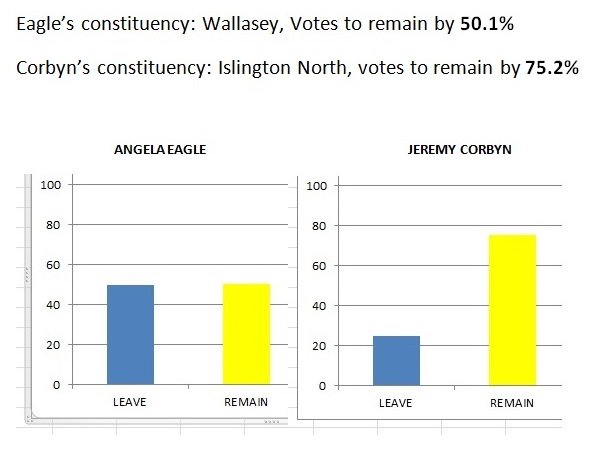
According to a YouGov poll, Eagle commands just 6 per cent support from Labour members while a greater number than last time said they will vote for Corbyn if he were to stand again. In other words, just like last time, Corbyn would likely win more votes than all the other candidates combined. This grass-roots popularity for Corbyn must be seen against a backdrop in which the Labour party gained 60,000 members in one week following the attempted coup against him. Membership of the party currently stands at about 450,000 – a figure that is higher than it’s last peak of 405,000 members last seen under Tony Blair’s leadership.

This would almost certainly translate into Corbyn receiving more votes than his Blairite predecessor Ed Milliband did at the last General Election. With the proportion of the Labour vote increasing under Corbyn, the two main parties are neck-and-neck at 32 per cent. This undercuts the recent claims of elder statesmen like David Blunkett and Neil Kinnock that Corbyn is an electoral liability for Labour.

This narrative is consistent with the notion that the left are un-electable more generally. Such a narrative is a myth. As Craig Murray posited, the idea that you have to be right-wing to win elections is belied by the fact that the SNP under Nicola Sturgeon won the people of Scotland over on a left-wing ticket. Secondly, as he rightly says, there is no point being elected just so you can carry out the same policies as your opponents. Third, the British public’s ‘enthusiasm’ for somebody like Blair in 1997 was not based on policies known as Blairite. As Murray astutely points out:

“The 1997 Labour Manifesto  was not right-wing. It did not mention Academy schools, Private Finance Initiative, Tuition Fees, NHS privatisation, financial sector deregulation or any of the right wing policies Blair was to usher in. Labour actually presented quite a left wing image, and figures like Robin Cook and Clare Short were prominent in the campaign. There was certainly no mention of military invasions. It was only once Labour were in power that Blair shaped his cabinet and his policies on an ineluctably right wing course and Mandelson started to become dominant. As people discovered that New Labour were “intensely relaxed about people getting filthy rich”, to quote Mandelson, their popular support plummeted. “The great communicator” Blair for 90% of his Prime Ministership was no more popular than David Cameron is now. 79% of the electorate did not vote for him by his third election.”

Murray continues:

“Michael Foot consistently led Margaret Thatcher in opinion polls – by a wide margin – until the Falklands War. He was defeated in a victory election by the most appalling and intensive wave of popular war jingoism and militarism, the nostalgia of a fast declining power for its imperial past, an emotional outburst of popular relief that Britain could still notch up a military victory over foreigners in its colonies. It was the most unedifying political climate imaginable. The tabloid demonization of Foot as the antithesis of the military and imperial theme was the first real exhibition of the power of Rupert Murdoch. Few serious commentators at the time doubted that Thatcher might have been defeated were it not for the Falklands War – which in part explains her lack of interest in a peaceful solution. Michael Foot’s position in the demonology ignores these facts. The facts about Blair and about Foot are very different from the media mythology.”

The reality, as one commentator on twitter put it, is that in corporate media and political establishment parlance, “‘un-electable” is media-political code for ‘likely to be highly electable but ‘will not serve elite interests.'”

This description applies to Corbyn. The ‘un-electable left’ meme is likely to intensify the longer Corbyn manages to hang on. In these unsettling and unpredictable times, it’s the one propaganda weapon the establishment is certain to cling to as their means of attempting to prevent democracy from breaking their grip on power.

A second referendum?: The Tories continue to fiddle while Britain stumbles into the abyss

By Daniel Margrain

Last Wednesday afternoon I took the Eurostar from a grey and dismal London to a sunny Paris. I decided that I would try to ignore the news while I was away. However, by Friday, temptation got the better of me. While sitting at a restaurant table in the small picturesque Parisian commuter-belt town town of St Germaine en Laye enjoying my lunch, I asked the waiter if he knew what the result of the EU referendum was. He expressed his shock at the decision of the British public to renounce their membership of the 28 member club. “That’s it”, he said, “the European project is dead”. I asked him whether he thought that this was a good thing or a bad thing? “It’s a bad day for Europe”, he exclaimed. “I’m not sure the project can continue to be run effectively with Britain gone but your heart was never really in it anyway”, he continued.

He claimed that Britain had already negotiated for itself numerous concessions and any more would have effectively made the Federalist vision for Europe he was in favour of, a redundant concept. The British position he said was selfish in as much as the government appeared reluctant to use its economic muscle as leverage in order to help improve the living standards of the working classes within poorer nations of the EU which, according to him, was the ethos at the heart of the project. In other words, for the poorer nations to gain something, and for the European project to work, as he saw it, it was necessary for richer nations like Britain, to concede some financial ground at the expense of the poorer nations.

He blamed David Cameron for triggering “an unnecessary referendum based upon unfair criticism of the EU and many years of misinformation about how it actually works”, which in turn was perpetuated by some of the most right-wing media in the whole of Europe. He also claimed that vast swaths of working class people were further disorientated by some political commentators and politician’s on the left of the spectrum who he said, “ought to have known better” than, for example, to effectively blame immigrant workers for allegedly undercutting British workers. All of this, he claimed, had eventually – from a Brexit perspective – “bore fruit”.

It was difficult for me to disagree with any of this. The news that the British people had decided to leave the EU appeared to have been as much of a shock to him as it was to me. The statistics show that the demographic of those who voted to leave were mainly the elderly age group and those who voted to remain were from the younger age group. However, the elderly will not be around for long compared to the young. It therefore, follows, the former will experience the consequence of a decision that they made to a far lesser degree than the latter who didn’t.

It does seem strange that an ageing population who were allowed to vote but statistically are less able to make an informed decision with regards to issues that have long-term ramifications, are considered to be a better judge for what is best for the country than people who are, say, 16 or 17 years old but are prevented from voting on something that will effect them to a far greater degree and for far longer. For this and other reasons, it makes sense why younger people might be furious with older people. The latter, for example, have overseen the ruination of the environment that includes the spreading of poisons throughout the atmosphere, sea and soil. They have also overseen climate change, the ruination of entire economies and been at the forefront of the shift in wealth from the many to the few, which will mean that the generation to come will not only be poorer than the preceding one, but will die sooner.

In short, the older generation have run the world for their own selfish short-term gain. The younger generation are suffering, and will continue to suffer, the consequences wrought by a post-war generation that were virtually guaranteed socioeconomic protections that will be denied to their young counterparts. This includes the concept of a job for life, free higher education and gold-plated, index-linked pensions that the elderly have taken for granted. Relatively speaking, the post war-generation have never had it so good, although one will be hard pressed to draw such a conclusion from the mainstream media. And to top it all, by disproportionately voting to leave, the older generation have now given a future to the young that they specifically do not want – problems that will be further compounded by the imminent growth in automation and increasing global competition.

What is also bizarre is that countries and regions like London, Scotland and Gibralter wanted to stay in the EU within a context in which some of the most deprived parts of England and Wales were intent on leaving. In Boston, in North East England, for example, 75.6 per cent voted to leave the EU. Paradoxically, given that Brexit means that no more EU funds will be forthcoming to these deprived regions, it’s the poorest who will be most adversely affected as a result of this decision to leave. Consequently, it would appear that the poorest have been persuaded to make the decision to leave for the worse reasons, predicated largely on lies. These lies included the amount of money they were told the government spends on the EU and what amount, by contrast, it spends domestically.

The leave campaign also understated the positives of continued membership in terms of the amount of funds Britain receives from the EU as well as insisting that by leaving the British people would have the prospect of being surrounded by fewer foreigners. On all these points, and more, the public were lied to by the leave campaign. In terms of the second of these issues, for example, UKIPs Nigel Farage has already back-tracked in relation to his assertion that the £350 million a week that he wrongly claimed was spent on the EU would, instead, be spent on the NHS. The more likely scenario is the correct £161 million net figure will be used to pay for more tax cuts for the rich. Apparently leave have deleted their promises from their website. This is a useful aide-memoire.

Almost a week has passed since the referendum result was announced and the Conservative government under PM David Cameron is in disarray. With the PM still not having made any definitive legal commitment to leave, the political consequences for the remaining 27 members is far from certain. With Britain’s new status outside the EU yet to be legally formalized, its legal sequestration remains uncertain. For all those who thought that the Brexit vote would have meant a hasty political decision to leave based on a legal determination, might need to think again. As I said in my previous post, in legal terms, the referendum is advisory not mandatory. What happens next is a matter of politics, not law – a determination that’s dependent upon whether the government decides to invoke Article 50 of the Lisbon Treaty.

Even though I supported the remain camp, I respect the democratic decision the British people made when they voted to leave. Any decision to either seriously delay invoking Article 50, or any attempt at backtracking on the referendum result would, in my view, be totally unacceptable. Nevertheless, delaying the democratic decision of the majority is what the government appears to be intent on doing. Seemingly, this will involve the implementation of a possible second referendum. The government intends to respond to calls for it within the next few days. This will likely take the form of a debate in parliament following the signing of a government petition by four million people to that affect.

In many other democracies throughout the world, four million signatures would guarantee a vote on the issue. But in Britain, a similar amount of signatures only guarantees that the government will consider talking about the possibility of a vote. The governments petition committee is currently considering the protest following a meeting they held yesterday (June 28). The petition entitled EU Referendum Rules Triggering A Second EU Referendum, reads:

“We the undersigned call upon HM government to implement a rule that if the remain or leave vote is less than 60 per cent based on a turnout less than 75 per cent, there should be another referendum.”

Will the government give in to the demands set by the petition and thereby allow a second referendum to take place?

The wider issue seems to be that unless the government can find a way of presenting simple solutions to a complex set of problems, people on the whole will not understand them. However, the problem is there are no simple solutions to such complex problems. Ultimately, David Cameron will go down in history as the man who set in motion the chaos and uncertainty that will almost certainly ensue in the coming days, weeks, months and possibly years.

Because Cameron attempted to assert his authority over the Tory party, he assumed that by offering the people a referendum and winning it, would cement this authority and garner the UKIP vote as a consequence. But by losing, he has bolstered the xenophobic fringe within the UKIP and Tory parties, unleashed the potential for a rise in racist attacks and hastened the rush for Scotland to break from the UK. But perhaps most significantly of all, is that a final decision to leave, will prompt the 60 per cent of companies outside the EU who have their EU HQs in the UK and who trade with the EU, to re-locate elsewhere. If you headed a company that was based outside the EU but was big enough to have a EU HQs and you selected to be in a country that is now potentially going to be outside the EU, what would you do?

It’s a no brainer. You would have to up-sticks and move to the EU. Having an EU HQs in a country that is no longer in the EU, makes about as much sense as having a US HQs in London. So in the event of Britain definitively leaving the EU both politically and legally, tens of thousands of jobs will be lost. This is a bare minimum of the chaos that is likely to occur set against a backdrop of increasing resentment, suspicion, xenophobia and racism. Buckle up, it’s going to be a bumpy ride ahead.

A victory for Brexit is unlikely to change anything in the near future

By Daniel Margrain


For all those who thought that a Brexit vote in Thursday’s (June 23) highly anticipated and drawn -out referendum campaign will result in closure, might need to think again. In legal terms, the referendum is advisory rather than mandatory. What happens next is a matter of politics, not law – a determination that’s dependent upon whether the government decides to invoke Article 50 of the Lisbon Treaty.

To put it another way, the government doesn’t necessarily have to pay attention to what the British public says. What will happen on Thursday is that we, the British electorate, will effectively be advising and giving our opinion which doesn’t make the decision to leave, if that is indeed the outcome, necessarily legal. If we vote in a way that Osborne and Cameron disagree with, the government will almost certainly reconsider the result, particularly if the outcome is close.

Say, hypothetically, the turnout is 50 per cent and 51 per cent of that 50 per cent voted to leave, it would mean that 25.5 per cent of the electorate would have made the decision to leave which would adversely impact on the remaining 74.5 per cent. In other words, if something similar to this hypothetical situation did arise it would not, the government could argue, be indicative of a mandate to leave. Given how close the result is predicted to be, the vote tomorrow is unlikely to be the end of the matter, but merely the beginning of a long and drawn out process that will likely continue until the electorate arrives at a decision that Cameron and Osborne regard as acceptable.

As the Financial Times puts it:

What happens next in the event of a vote to leave…. will come down to what is politically expedient and practicable. The UK government could seek to ignore such a vote; to explain it away and characterise it in terms that it has no credibility or binding effect (low turnout may be such an excuse). Or they could say it is now a matter for parliament, and then endeavour to win the parliamentary vote. Or ministers could try to re-negotiate another deal and put that to another referendum. There is, after all, a tradition of EU member states repeating referendums on EU-related matters until voters eventually vote the “right” way.

What matters in law is when and whether the government invokes Article 50 of the Lisbon Treaty. This is the significant “red button”. Once the Article 50 process is commenced then Brexit does become a matter of law, and quite an urgent one. It would appear this process is (and is intended to be) irreversible and irrevocable once it starts. But invoking Article 50 is a legally distinct step from the referendum result — it is not an obligation.

There are three points of interest here in respect of any withdrawal from the EU by the UK.

First, it is a matter for a member state’s “own constitutional requirements” as to how it decides to withdraw. The manner is not prescribed: so it can be a referendum, or a parliamentary vote, or some other means. In the UK, it would seem that some form of parliamentary approval would be required — perhaps a motion or resolution rather than a statute. The position, however, is not clear and the UK government has so far been coy about being specific.

Second, the crucial act is the notification by the member state under Article 50(2). That is the event which commences the formal process, which is then intended to be effected by negotiation and agreement. There is no (express) provision for a member state to withdraw from the process or revoke the notification. Once the notification is given, the member state and the EU are stuck with it.

And third, there is a hard deadline of two years. This is what gives real force to Article 50. The alternative would be the prospect of a never ending story of rounds of discussions and negotiations. Once notification is given, then the member state is out in two years, unless this period is extended by unanimous agreement. It is possible that such unanimity may be forthcoming – but this would be outside of the power of the member state. Once the button is pushed, the countdown cannot just be switched off by a member state saying it has changed its mind, or by claiming that the Article 50 notification was just a negotiation tactic all along. That will not wash.

This said, what is created by international agreement can be undone by international agreement. Practical politicians in Brussels may come up with some muddling fudge which holds off the two year deadline. Or there could be some new treaty amendment. These conveniences cannot, however, be counted on. The assumption must be that once the Article 50 notification is given, the UK will be out of the EU in two years or less.

What happens between a Leave vote and any Article 50 notification will be driven by politics. The conventional wisdom is that, of course, a vote for Brexit would have to be respected. (This is the same conventional wisdom which told us that, of course, Jeremy Corbyn would not be elected Labour leader and that, of course, Donald Trump would not be the Republican nominee.) To not do so would be “unthinkable” and “political suicide” and so on.

And if there is a parliamentary vote before any Article 50 notification then there is the potential irony of those seeking to defend parliamentary sovereignty demanding that an extra-parliamentary referendum be treated as binding. But it must be right that the final decision is made by parliament, regardless of what the supposed defenders of parliamentary sovereignty say.

What is certain is that if there is an Article 50 notification then there will be immense legal work to be done. Over 40 years of law-making — tens of thousands of legal instruments — will have to be unpicked and either placed on some fresh basis or discarded with thought as to the consequences. The UK government has depended since 1972 — indeed it has over-depended — on it being easy to implement law derived from the EU. The task of repeal and replacement will take years to complete, if it is ever completed. Even if the key legislation — especially the European Communities Act 1972 — is repealed there will have to be holding and saving legislation for at least a political generation.

A vote for Brexit will not be determinative of whether the UK will leave the EU. That potential outcome comes down to the political decisions which then follow before the Article 50 notification. The policy of the government (if not of all of its ministers) is to remain in the EU. The UK government may thereby seek to put off the Article 50 notification, regardless of political pressure and conventional wisdom.

There may already be plans in place to slow things down and to put off any substantive decision until after summer. In turn, those supporting Brexit cannot simply celebrate a vote for leave as a job done — for them the real political work begins in getting the government to make the Article 50 notification as soon as possible with no further preconditions.

On the day after a vote for Brexit, the UK will still be a member state of the EU. All the legislation which gives effect to EU law will still be in place. Nothing as a matter of law changes in any way just because of a vote to Leave. What will make all the legal difference is not a decision to leave by UK voters in a non-binding advisory vote, but the decision of the prime minister on making any Article 50 notification.

And what the prime minister will do politically after a referendum vote for Brexit is, at the moment, as unknown as the result of the referendum itself.

Why it’s inappropriate to charge the killer of Jo Cox under terrorism legislation

By Daniel Margrain


A message from the vigil for Jo Cox in Leeds

A message from the vigil for Jo Cox in Leeds (Pic: Andrew Brammer)


It is my contention that it is wrong that Thomas Mair, who allegedly killed MP Jo Cox, be charged under terrorism legislation on the basis that such a determination is bound up with all kinds of ideological connotations. The argument of many of those commentators on the political left of the spectrum who take the contrary position and believe that it is appropriate to describe the violent actions committed against the Labour MP, as well as other far right-wing inspired attacks such as the Orlando massacre, as acts of terrorism, seem to have arrived at that conclusion based solely on the question of media’s lack of consistency when describing other similarly planned attacks – albeit motivated by the other end of the political or ideological spectrum.

While on the surface, the ‘lack of consistency’ observation is arguably an accurate one – as evidenced, for example, by the media’s hypocritical response to the case of Ryan McGee who built a nail bomb to attack Muslims – I will attempt to show, however, that it is not a necessarily commendable position to take. Over the last 15 years, the killing of individuals or groups in Western societies have to a greater extent involved a political subtext as a result of the media’s response to them, particularly within a context in which Western-instigated wars waged against Muslim countries have resulted in their ruination and destabilization.

Given that there is no universally accepted definition of terrorism, it follows that the political-inspired violence of individuals or groups, either in support of wars of aggression enacted by the state against its official adversaries, or in what is often perceived to be in opposition to them, illustrates the limitations of this narrow conceptual framework. Specifically, this can be seen, firstly, in terms of the difficulties involved in ascertaining what constitutes a terrorist act and, secondly, relates to the question as to who determines the conceptual framework by which those who are accused of terrorism are legally bound?

The widely used definition of terrorism which pertains to the use of violence and threats to intimidate or coerce, especially for political purposes”, does not preclude the violence undertaken by states to similarly achieve political ends. Based on this understanding, it’s clear that all politically-motivated violence – whether undertaken by individuals, groups of state actors that include illegally constituted wars – amount to acts of ‘terrorism.’ Ostensibly, therefore, politician’s like Tony Blair and G.W. Bush who illegally led the rush to war against Saddam Hussein’s Iraq in 2003, are as equally culpable of committing terrorist acts as somebody like Osama bin Laden or Timothy McVeigh.

However, whilst on the surface such a determination sounds positive and is seen to serve a need for those who desire justice to be achieved, this consensus level playing field approach is paradoxically one that the state is keen to resist. Moreover, given the absence of any universally- defined legal framework for terrorism, the term is subjective. As Bruce Hoffman has noted:

“Terrorism is a pejorative term. It is a word with intrinsically negative connotations that is generally applied to one’s enemies and opponents, or to those with whom one disagrees and would otherwise prefer to ignore. Hence the decision to call someone or label some organization ‘terrorist’ becomes almost unavoidably subjective, depending largely on whether one sympathizes with or opposes the person/group/cause concerned. If one identifies with the victim of the violence, for example, then the act is terrorism. If, however, one identifies with the perpetrator, the violent act is regarded in a more sympathetic, if not positive (or, at the worst, an ambivalent) light; and it is not terrorism.”

As Hoffman also notes, for this and for political reasons, many news sources avoid using this term, opting instead for less accusatory words like “bombers” and “militants”.

It’s my argument that from an activists point of view, it’s important that the media make a distinction between illegal wars undertaken by state actors and the non-state politically-inspired violence of individuals and groups irrespective of whether the latter emanate from the left or right of the political spectrum. By charging some individuals or groups with terrorism offences predicated on politically-inspired violent actions but not others, potentially lends itself to accusations of double-standards and propaganda by the state. Those who doubt the veracity regarding the intention of the state to selectively invoke terrorism legislation need to look no further than the case of Pavlo Lapshyn – who murdered a Muslim and bombed mosques. This case represents the tip of a very large ice berg. As Craig Murray put it:

“Mair, McGee and Lapshyn would all, beyond any possible shadow of a doubt, have been charged with terrorism if they were Muslims. The decision is made by the Crown Prosecution Service, which has also recently decided that Tony Blair, Jack Straw, John Scarlett, Mark Allen et all will not stand trial for extraordinary rendition and complicity in torture, despite overwhelming evidence presented by the Metropolitan Police, including my own. There is a dark cloud of Islamophobia hanging over the Crown Prosecution Service. Given the totality of these decisions, there has to be.”

UK terrorism legislation which built up following the events on 9/11 and 7/7, is clearly intended as an ideological weapon whose purpose is to perpetuate this propaganda offensive in a highly selective and discriminatory way. This explains why the media resisted all attempts to describe the likes of the alleged far-right fascist killer of Jo Cox and the ultra-Zionist who hospitalized MP George Galloway as terrorists, but nevertheless regularly use the terrorist epithet to describe Islamist-inspired violence. The reality of the situation is that all charges of terrorism are legally unnecessary.

Instead, the appropriate course of action for the state to take is to invoke perfectly adequate murder and conspiracy to murder charges. Rather than running with the notion that Mair was a murderer who was almost certainly inspired by far-right politics, the line of the right-wing Daily Mail preferred the suggestion that the killer of Jo Cox allegedly targeted the MP due to a history of mental health problems. The implication is that these alleged mental health issues – in isolation – led to the attack on the Labour MP as though being mentally ill somehow makes one immune, as opposed to being sensitive, to the world which is the reality. The reality is that the mentally ill have no more propensity to violence than anybody else. As one commentator put it:

“The mentally ill are not other. They live in this world. They see the same media. And when the media tries to whip people into a frenzy, it is no surprise that some are whipped into a literal frenzy.”

The truth is that the right-wing media are using the issue of mental illness as a scapegoat for the crimes committed by a far-right politically-motivated murderer. As somebody who is currently diagnosed with anxiety and depression, the notion that some of the media are attempting to attribute the cause of the murder of Jo Cox to similar symptoms, is deeply offensive. This is not an attempt to absolve the murderer of any mental illness he may be suffering with, but merely to highlight that on its own it would have been highly unlikely to have been the cause.

It’s about time the media became unequivocal in emphasizing that, for the most part, wars are illegal state-sanctioned forms of collective violence, on the one hand, while on the other hand, they need to attribute lone killings – whatever their ideological motivations – as murders. In turn, the state needs to stop charging these murderers under terrorist legislation.


English football hooliganism: the UK political establishment’s trade-off

By Daniel Margrain

A teargas grenade explodes near an England fan ahead of England's EURO 2016 match in Marseille, France
Violence erupts on the streets of Marseille CREDIT: REUTERS

Almost 18 years ago to the day, the English national football team beat Tunisia 2-0 in the opening game of their World Cup campaign in the Mediterranean port city of Marseille in the south of France. For many, the victory was overshadowed by the violence off the pitch that preceded it. For the last three days running, football hooliganism in Marseille involving England fans has once again dominated the media headlines. Reuters journalist Mitch Phillips described the influx of the first wave of 70,000 England fans on the French port city:

“….the fans wasted no time establishing a foothold in Vieux Port to start three days of drinking and singing ahead of Saturday’s Euro 2016 match against Russia. Noisy and boisterous, bare-chested and full of lager and bravado, they draped the flags around the Queen Victoria “British pub” and roared out their songs of defiance in the time-honored manner of “England Away”, just as they had in the same port-side bars 18 years ago.”

Shortly after the fans had gathered in large numbers in the bars and pubs of the city on Thursday (June 9), scenes of drunken mayhem followed that involved pitched battles, the throwing of bottles and chairs and the chanting of racist abuse. This was preceded by crude displays of jingoism that included the singing of the words “f**k off Europe, we’re all voting out” and “sit down if you hate the French”. The incitement of this kind of hatred in a foreign country is bound up with the notion that these kinds of thugs perceive themselves as superior to their hosts. This in turn forms part of a wider imperialist narrative of entitlement, ownership and control. As one sports writer put it:

“The members of this anti-social faction do not visit a foreign city: they occupy it. They erase the local culture and try to turn the place they are in into a satellite of their own English town or city.”

This view neatly encapsulates why the kind of hooliganism experienced in Marseille cannot be divorced from a wider historical context. Since the mid 20th century, Britain in general – but particularly England – has existed in a post-empire historical setting. The question is, why does hooliganism and loutish behaviour appear to be more of an English trait compared to other nationalities? It seems to me that England, more than many other European societies, finds it difficult to cast off its imperial legacy. When groups of English men gather together in a foreign country there seems to be a reluctance among a large swath of them to relinquish the notion of the concept of empire.

This mentality appears to be underscored by an entrenched nationalism as evidenced by the repeated singing of the national anthem during games, an emphasis on the notion that ‘Britannia rules the waves’ and that football hooligans carry the mantle of this imperial and colonial legacy, ostensibly on behalf of their ruling class overseers. There seems, in other words, to be something deeply embedded within the mindset of English football fans when they gather collectively that transcends the simplistic argument that their hooliganism is an expression of nothing more than drunken and pathologically-driven related violence and thuggery.

This transcendence, I would argue, corresponds to the kind of historical, social and cultural setting described that enables it. Secondly, sport doesn’t exist in a political vacuum. One can see this, for example, in the chants at both club and international level and the England-Germany rivalry which constantly mobilizes ideas about the Second World War. The third broader point is that national sports are a forum and reservoir for jingoistic sentiment in general. What happens is that banal forms of nationalism and jingoistic group-think mentality – expressed through violence and an adherence to political-inspired chanting – is cynically co-opted and reinforced by national states and governments for wider sinister political objectives.

Take the current political climate as an example. The right-wing Brexit elements within the EU debate often echo the xenophobic anti-German and anti-European sentiments of many of those who chanted the anti-French rhetoric outlined above. Football hooliganism is not just an illustration of a few ‘bad eggs’ as is so often depicted in the media, but represents a far wider problem. The reality, in other words, is that football tends to be a vehicle for deep-seated expressions and outpourings of nationalistic narcissism and patriotism.

This is dangerous in another way in as much as these linkages provide a ready pool which governments can then use in order to justify even more sinister foreign policy purposes such as foreign invasions and occupations. The question is though, are the majority of football hooligans aware of the historical and anthropological background described, or is it simply that English men these days don’t generally go to war or fight as part of an organized army but have a lot of testosterone-based pent up aggression that needs to be expelled?

I would contend that it’s not necessary for individuals to be conscious of the notion of post-empire and the loss of colonial possessions – what dissident French psychoanalyst Jacques Lacan termed jouissance – in order for them to experience excess indicative of societal breakdown achieved as part of a shared group. There are certain settings or locations in which the establishment deem it unacceptable to reach jouissance – mainly within the political sphere. This sphere has increasingly become limited because of the potential threat it poses to the existing class structure that this implies. Instead, jouissance is channeled as a displacement activity at football matches, pubs, nightclubs and bars.

Paradoxically, it’s precisely these kinds of violent outpourings or expulsions of visceral energy that enables civilized society to function. If the collective outward violent expression of mainly young men were to be severely suppressed, football hooligans and others would almost certainly turn their energy inwards which would be even more dangerous as far as its impact on civilized society is concerned. This is because any suppression of ‘orgasmic’ violence would be more radically destabilizing in terms of the potential for the derailment of the functioning of wider society. In other words, any major repression of the ability of hooligans to vent their anger might instead be turned against their bosses and, perhaps more widely, the owners of the means of production itself.

This is, of course, not in any way an attempt to justify the kinds of hooliganism witnessed in Marseille, but to recognize that in a wider symbolic and societal setting, such violence is arguably necessary. Englishmen abroad with their smart phones and apps, set against a context of Cultural Marxism, is an unholy, potent and potentially perilous mix for the establishment to negotiate. Nevertheless, it’s a trade-off that the said establishment is willing, albeit reluctantly, to endure in order that the current political status-quo be maintained.

Muhammad Ali: Brilliant but flawed icon

By Daniel Margrain

Muhammad Ali captivated the imagination of millions (this writer included) during his peak from the mid-1960s to the early 1970s. His iconic status transcended his work inside the boxing ring. His larger than life personality, good looks and quickness of thought outside the ring was matched by the speed, deftness and grace inside it. It was precisely the combination of his magnificent athleticism as a champion allied with his ability to articulate what was happening in society that made him the icon and legend that he was and will almost certainly continue to be in the decades to come. In simple terms, Ali’s legendary status as a sportsman and his civil rights activism were deeply intertwined.
Despite many of today’s leading sportsmen and women and stars of the entertainment industry having the requisite platform with which to confront the injustices that surround them, they invariably lack the integrity to do so. This was not true of Ali. Born Cassius Clay in Louisville, Kentucky on the 17th January 1942, the most famous sporting icon on the planet used the media in a brilliantly imaginative way to stand up to what he believed in and he did so in the knowledge that the personal price to be paid would be the threat of imprisonment and a massive loss of income. For Ali, following the easy path wasn’t an option.

It’s perhaps easy to underestimate the extent to which Ali helped lay the foundations for what many people today almost certainly take for granted in terms of the relative social harmony that exists within our contemporary multicultural societies. But it has to be remembered the context in which black people lived their lives when Clay came to prominence after he became world heavyweight champion in 1964. Objectively, the lives of black people in Clay’s U.S homeland hadn’t changed much for the better at the time of the boxers first major triumph in the ring.

Despite the fact that the massive expansion of U.S capitalism which followed WW2 created thousands of new jobs and thereby put strains on the racist job reservation policies that existed in many industries, considerable resistance to fundamental change remained well into the 1950s. As Kevin Ovenden points out, up until this point, the political establishment in the North of the U.S were grouped around the Republican party who remained largely indifferent to the racism and urban poverty in the South. Nor did they care that in the South everything was run by the same establishment who had fought the Civil War to preserve slavery.

The South was run as a one party state by the Democrats – the party supported by the section of the American ruling class who fought longest and hardest to keep blacks under a state of virtual apartheid. Change, when it did come, was inspired by the struggles of southern blacks themselves which theoretically began to make inroads following the 1954 American Supreme Court adjudication of the Brown versus the Topeka Board of Education case which proffered that racially segregated schooling was unconstitutional. The case which had been brought by the National Association for the Advancement of Colored People (NAACP) was, however, tokenistic and hence it did not result in widespread desegregation.

This was the context which led a member of the NAACP, Rosa Parks in 1955, to refuse to give up her seat to a white woman on a bus in Montgomery, Alabama. Following Parks’ arrest, activists began to organize and the Montgomery bus boycott was born. The ensuing victory a year later inspired civil rights activists everywhere and propelled the Baptist minister, Martin Luther King to nationwide prominence. Consequently, what began as a question of attaining legal rights spread to the economic and political sphere. This was the point at which Clay began to make his mark, politically.

Eight years after the successful Montgomery bus boycott, Clay at 22 years of age returned to his homeland as a world heavyweight champion after beating Sonny Liston in what was widely regarded as an upset. Despite his new found fame and status, Clay was still subjected to the humiliating institutional discrimination that blighted the lives of black people in the US. He was refused service at a ‘whites only’ restaurant and was set upon by a gang of racists. He had trouble finding a hotel to stay when he traveled to fight.

Already he displayed the outspoken bravado for which he was famous. Interviewed in the ring immediately after the fight, he said, “I don’t have a mark on my face, and I upset Sonny Liston, and I just turned twenty-two years old. I must be the greatest.” The following morning he confirmed the rumours of his involvement with the Nation of Islam or the ‘Black Muslims’ as they were also known, founded by a Middle Eastern immigrant, Wallace D Fard in 1930. It was during this period that he changed his name from Cassius Clay to Muhammad Ali.

Ali’s involvement with the militant black separatist movement, the Nation of Islam, which was growing in influence and challenging the hegemony of Martin Luther King and the Civil Rights movement, coincided with the rise to prominence of Malcolm X, the Nation’s most charismatic figure and talented spokesperson who would go on to mentor him. Two years after experiencing racism first hand that followed his defeat of Liston, Ali further antagonized the white establishment by refusing to be conscripted into the U.S military citing his religious beliefs and opposition to American involvement in the Vietnam War.  Ali’s response was clear and emphatic:

“No, I am not going ten thousand miles from home to help murder and burn another poor nation simply to continue the domination of white slave-masters of the darker people the world over.”

The price Ali paid was a heavy one. He was convicted by an all white jury of evading the draft and sentenced to five years imprisonment and a $10,000 fine. Though he never actually served time in jail the threat remained until his conviction was eventually overturned in June 1971. Meanwhile he was stripped of his titles and governing bodies across the world including the British Boxing Board of Control revoked his licence to box. Ali’s principled stance as a conscientious objector to the Vietnam war made him an icon for the larger counterculture generation.

Writer Mike Marqusee highlights the fact that four days after he was ordered to report for duty in April 1967 a huge 125,000 strong anti-war rally was held in Central Park. His defiant declaration was that he had nothing against the Vietnamese:

“They never called me nigger, they never lynched me, they didn’t put no dogs on me, they didn’t rob me of my nationality, rape and kill my mother and father… Shoot them for what? …How can I shoot them poor people, Just take me to jail.”

Such an outspoken stance gave other dissenters and the wider anti-war and anti racist movements a huge boost. Other sporting and cultural figures were to follow his lead including the athletes who gave the famous Black Power Salute at the 1968 Mexico Olympics. However, despite his many outstanding achievements in and out of the ring, it was clear that by the early 1970s Malcolm X’s mentoring had seriously disorientated Ali. It was his proclamations of racist pseudo-science – the formal ideas of which were codified as part of the belief system of the Nation of Islam – which was to result in some of Ali’s more bizarre and eccentric rhetorical flourishes. This culminated in his famous interview with Michael Parkinson in 1971.

Three years later, Ali was back in the ring after having been stripped of his world title seven years previously. One of my earliest childhood sporting memories was the famous ‘Rumble in the Jungle‘ bout when he reclaimed his world title from George Foreman. Back then very few black people appeared on TV and when they did it was invariably as villains, who were swiftly dispatched or buffoons to be ridiculed.

Ali finally retired after humiliating defeats against his former sparring partner Larry Holmes and a journeyman Trevor Berbick in 1980 and 81. It’s a pity as far as this writer is concerned that he made the undignified decision to carry on fighting well beyond his peak. This was probably due to a combination of his own vanity and his attempt to recoup some of the money from those whose greed had exploited him throughout his career, stripping him of much of his wealth. By this time he was already suffering the early onset of the Parkinson’s Syndrome that was to afflict him so dramatically in later life.

Despite his lack of clarity of political thought, Ali along with Malcolm X, gained a reputation for what other leading black figures did not dare voice. Ultimately, it was the denunciation of the system that won them support. As far back as late 1964 Malcolm X appeared to reject the obscurantist philosophy that underpinned the Nation of Islam and began to speak openly and favourably about socialism saying white anti-racists tended to be socialists. He was also aware that the source of racism was located at the heart of capitalism. As writer George Breitman, quoting Malcolm X, put it:

“The system in this country cannot produce freedom for the Afro-American. It is impossible for this system, this economic system, this political system, this social system, this system, period. It’s impossible for this system, as it stands, to produce freedom right now for the black man in this country.”

Whether Muhammed Ali had moved towards this view during the end of his life is not clear. Nevertheless, regardless of Ali’s perceived political weaknesses, these flaws are outweighed by the fact that he remains one of the most historically outstanding cultural figures in the struggle against racism, war and imperialism of modern times.


Racist tropes & the Zionist attempt to make ethics illegal

By Daniel Margrain

There is something deeply unsettling about the manner in which powerful and influential Zionists and Zionist political entities in Britain and Israel appear to be intent on subverting the democratic process in order to reinforce their mutual interests. This is sustained when tropes are adhered to which perpetuate existing racist myths such as those that invoke ‘loyalty oaths’. Whenever, for example, an atrocity is committed on British soil by those who self-identify as Muslims, the wider Muslim community are effectively urged to pledge an allegiance to the country of their birth or, alternatively, they are encouraged to collectively condemn the actions of terrorists. Often it’s both of those things.

Any attempts to resist apology projection is deemed by the establishment to be akin to a form of treachery in which tacit support for an official enemy is implied. Crude loyalty binaries are invoked. Opposition to this stereotypical attitude often evokes the specter of the ‘enemy within’ trope among significant sections of the corporate-controlled media and political establishments. The Muslim community is thus tarnished with the ‘terrorist sympathizers’ brush. Arguably, the most famous example of the establishment pressurizing dissidents to conform to this collective condemnation of the official enemy narrative was in relation to George W Bush’s evoking of the binary “you are either with us or with the terrorists” proclamation that followed the events on 9-11. It is therefore unfortunate that some prominent Zionists appear to be intent on perpetuating and reinforcing the ‘divided loyalties trope’ which has the effect of playing into the hands of racists and antisemites.

Matthew Gould and Jake Wallis Simons are two relatively recent examples of what appears to be British-born Jewish Zionists conforming to stereotypical tropes that involve the prioritizing of a foreign power, namely Israel, above the interests of the British state. The former was the first Jewish-Zionist to have been appointed as Britain’s ambassador to Israel. Gould, who along with Minister of Defence, Liam Fox and his businessman friend, Adam Werritty, through undisclosed meetings, seemed intent on ensuring that Britain would be drawn into a war with Iran, ostensibly on Israel’s behalf. Gould’s openly Zionist leanings implied a serious conflict of interest issue.

The latter example, the Daily Mail’s Jake Wallis Simons, who has been at the forefront of a sustained and coordinated media witch-hunt as part of a coup attempt against pro-Palestinian Jeremy Corbyn while simultaneously labeling anybody who supports Corbyn’s position as an “antisemite” said that he would support Israel if Britain and the Jewish state were hypothetically to go to war. Needless to say that if a British-Muslim had proffered support for any one of Britain’s official enemies, the security forces would have almost certainly detained him/her under terrorism legislation and the corporate media would have plastered the story over its front pages.

The same double standards apply to the media’s reaction to their coverage of the governments crackdown on those who support boycotts against Israel which the government looks set to make illegal. In light of the current political crackdown on almost all criticism of the Zionist state, one wonders when the government will consider the banning of anti-Zionism critiques. The governments claim appears to be that boycotts, which favour the Palestinians, are a form of “antisemitism” It’s clear that anti-democratic crackdowns of this nature violate the right to make an ethical stand against any perceived injustice and will thereby set a dangerous precedent.

According to.pro-Israeli propagandist and former representative of the Zionist Federation, Jonathan Sacerdoti- whose current job title is ‘Director of Communications for the Campaign Against Antisemitism’ – Jews regard boycotts against Israel to not only be intimidating but are also perceived to be an illustration of “antisemitism disguised as criticism of Israel which are driving Jews in fear of their lives from Britain to Israel.” With such highly exaggerated nonsense clearly predicated on an overriding and deep-seated sense of victim hood,  Sacerdoti appears to be confusing Britain’s multicultural, secular and pluralistic liberal democracy with the inherently racist, Zionist entity headed by a PM who also sees himself as the leader of the whole of the Jewish world. 

Clearly, it hadn’t occurred to Netanyahu that Jewish British people are British, just like Black, Asian or other British people. They are not Israeli. With the exception of Zionists like Jake Wallis Simons who would sooner see Israel triumph against the land of his birth, Netanyahu can make no legitimate claim to lead or control the Jewish diaspora. To suggest otherwise is to replicate the false racist and sectarian-based argument that Zionists and Jews are synonymous, and therefore to attack Israel is “antisemitism”. Netanyahu outwardly expressed this racism when he attempted to shift the blame for the Holocaust from Hitler on to the Grand Mufti. This makes sense given that Muslims are the joint enemy of both the European far-right and their Zionist allies.

The impression the Zionist propagandists want to give is that British cities are rife with antisemitism in which boycotts of Israel are regarded as emblematic. This rationalization serves a political purpose. Currently the non-Jewish population of Israel stands at about a quarter of the total and the proportion is growing. The Zionists need to halt the demographic shift and the way to do that is to invent, provoke or exaggerate, in the UK and elsewhere, instances of the new “antisemitism.” Zionism is threatened from within and so needs a new influx of ethnic Jews in order for the ethnically-based Jewish state to survive in its current form. Ideologically there is no principal difference between Zionism and Nazism in that regard. Indeed, antisemitism is the flesh and blood that Zionism and all related industries and institutions connected to it feed off in order for them to justify their existence. As Gilad Atzmon has argued:

“The Zionist project, from its onset, formed a symbiotic relationship between Zionist Jews and the Jew haters who wanted the Jews out of Europe. Zionism promised a national home for the Jews and at the same time offered to ‘take the Jews away.’… Zionism as well as the State of Israel are sustained by Jew hatred. If ‘antisemitism’ disappears, Israel and Zionism become obsolete concepts. Understanding this, Israel and Zionism have consistently contributed to the rise of antisemitism. When there is no antisemitism to point at, Jewish institutions simply invent it, as they are presently doing in the Labour party.”

But even if we were to accept the high levels of antisemitic incidences outlined by Sacerdoti (which I don’t), the implied racism inherent in the notion that there is a correlation between Zionism and Judaism, is offensive to the silent majority of Jews who want nothing to do with the apartheid, racist state. The implied notion that intimidation and boycotts are synonymous is not sustainable either. In any case the argument is a red-herring since there are existing laws against intimidation and violence. Sacerdoti seems unaware that for boycotts to have any impact there has to be a form of collective action which he is conflating with the potential negative affects they have on particular groups of people.

The position of Sacerdoti, who claims to speak on behalf of all Jews, is essentially twofold. First, that democratic expression should be constrained if it upsets people, and secondly, it should be curtailed if it leads some people to act illegally on the basis of those values. If these two principles were to be applied, there wouldn’t be much of British democracy left. The government is losing the moral high ground by seeking to quash boycotts and prevent legitimate political activism more generally. In so doing, it is using a sledgehammer to crack a nut. Ultimately, it has to be a legitimate course of action in a democracy like Britain for a group of people to be able to pass a resolution condemning a country because they are opposed to its political values.

Clearly, what is behind the governments decision to ban boycotts is to clamp down on local democracy and to shut down any debate that’s critical of the human rights record, not only of Israel, but its other regional allies too. It seems to me to be remarkable the extent to which double standards are applied in relation to the media’s response to those who are opposed to the governments crackdown on boycotts against Israel in the occupied territories on the one hand, and in terms of their response to Zionist state terrorism on the other. Muslims are repeatedly pressured by the elites to apologize for acts of terror committed in their name by Islamist Jihadists and more often than not, they willingly oblige. However, this rule of thumb doesn’t seem to apply to Jews following the massacres of Palestinians by Zionists.

In the current climate of Zionist witch-hunts and McCarthy-like smears, any justifiable criticism of Israel’s treatment of the Palestinians or opposition to boycotts is to risk being labelled an “antisemite”. Hadley Freeman’s complaint that she was put under special pressure to criticise Zionist violence following the successful campaign to boycott the Tricycle Theatre resulting in the cancellation of a Jewish Film Festival in Kilburn, London (despite having written an article on the subject), underlies her total disregard for the plight of the Palestinians as a consequence of this violence. This is far from unique among Zionists. Neither the Guardian’s Jonathan Freedland nor the Mail’s Melanie Philips, for example, have ever acknowledged the terrible crimes committed by Israel against the Palestinian people. Instead, their preferred tactic is to take aim at Israel’s critics by accusing them of singling Israel out.   


The rot at the heart of British society runs deeper than the travails of Philip Green

By Daniel Margrain

The news that serial tax dodger Philip Green bought his third luxury super-yacht for £100 million, a sum similar to the amount that was effectively sequestered from the BHS pension fund, and which was subsequently hid in tax havens wrecking the lives of thousands of his employees in the process, is symptomatic of the kind of rot that has spread throughout the high echelons of the ruling class. Like rising damp in an old building that spreads throughout the foundations before working its way through the brickwork until it eventually subsumes the entire edifice, Britain is currently suffering from another kind of infestation that of the ruling class “elite” whose unprecedented actions and decisions are undermining the rules and laws on which the proper functioning of a civilized society depend.

The biggest scandal isn’t about the corruption surrounding the Panama Papers, bankers and the revelations about Philip Green (as bad as they are), but about wealth inequality. Currently, the top 1 per cent own as much as 99 per cent of the rest of the world combined. What the Panama Papers revelations highlighted was just how unequal the world is. In his book, ‘The Hidden Wealth of Nations’, economist Gabriel Zucman estimates that worldwide, more than $7.5 trillion is stashed away in offshore accounts. As an indication of just how much that is, the sum amounts to some 8 per cent of the entire financial wealth of the world. About 80 per cent of that has not, and will not, be taxed at all, ever.

This level of tax avoidance increases the wealth gap between the rich and poor. Hiding vast sums of wealth from the prying eye of governments makes it easier for the super rich, represented by the 1 per cent, to remain rich and avoid tax policies which are meant to help the 99 per cent. Off-shore accounts also make it more difficult for everybody else to get rich because of the uneven playing field that results from these tax havens. The 99 per cent among the mainly middle income earners are paying higher taxes to make up for the taxes that the 1 per cent don’t pay.

Although on average slightly less than 8 per cent of all the financial wealth of the world is off-shore, Europe fares worse at 10 per cent. By contrast, off-shore financial wealth in Latin America stands at 20 per cent, in Africa the figure is 30 per cent and in Russia an incredible 50 per cent of all its financial wealth remains hidden off-shore. What all this indicates is the sheer scale of a problem that hits the developing world the hardest where the results for the very poorest who have no access to any form of social protection, can literally be death.

As far as Europe is concerned, the massive use of tax havens began in the 1920s in Switzerland. In Britain this trend became a feature of society around the mid-to-late 1970s. Numerous tax havens had began to spring up during this time which is when the great wealth disparity really started to make its mark. This was no accident. During this period, the function of the state began to change from that of ‘welfare provider’ to more ‘pro-business facilitator’. The ideology that came to embody this change was neoliberalism.

Instead of the direct provision of services administered democratically at the local level, the trend has increasingly been for the state to act as a purchaser of these services which have then been provided privately and indirectly. As each separate financial intermediary takes their slice of the financial pie, the temptation for corrupt practices becomes greater and the concentration of capital and deregulation of labour markets more acute.

With the balance of economic power tilted increasingly towards the rich who are able to buy the influence of politician’s, the impact on democracy has been devastating for millions of ordinary people. This hollowed out system of democracy is one in which the 99 per cent increasingly seem to find it difficult to find some personal and meaningful pattern in a social world dominated by huge and distant monoliths whose power over the livelihood of millions seems absolute.

This explains the growing popularity of ‘unorthodox’ politician’s like Jeremy Corbyn, Bernie Sander’s and even to an extent, Donald Trump, who offer the electorate an alternative to the ‘business as usual’ politics of the corporate controlled political machine. However, until a distinct break with the current system occurs, the masses are faced with the prospect of more of the same neoliberal ideology predicated on austerity.

Contrary to popular mythology, it wasn’t the Conservative government of Margaret Thatcher which came to power in 1979 that invented neoliberalism, rather that distinction is reserved for the preceding Labour administration under James Callaghan. It was the Labour government, not the Tories, who accepted the terms of the austerity package proposed by the IMF in 1976. The main condition of the IMF loan, insisted on by the US Treasury, was that the government deficit must be reduced by cutting demand.

Interest rates were raised and government spending reduced. Wage, job and welfare cuts were the hallmark of the ‘social contract’ between wage labour and capital agreed by the unions to bail out the government. As Colin Leys notes:

“From 1976 onwards, Labour accordingly became ‘monetarist’. Its leaders accepted that full employment could no longer be achieved by government spending but must be sought through private sector growth. For the necessary investment to take place, prices must reflect real values, and this in turn required ‘squeezing’ inflation out of the system and permitting the free movement of capital. In 1978 Treasury officials began preparing to abolish capital controls.”

Spearheaded by the deregulation of the movement of capital, the breaking of the unions and the centralization of state power that favoured the corporations in the running of state enterprises, rates of inequality that had been reduced from the previous highs of the depression years of the late 1920s began to grow again. During the 1920s wealth disparity was huge. Then, as people at the top paid more taxes, and people in the middle began to earn more, the gap became increasingly smaller.

As the consensus between capital and wage labour started to go in reverse from about 1980, inequality began to increase steadily to 1920s levels which is roughly the point they are today. By the mid 1980s tax havens started to emerge in places like the Caymen Islands, Singapore, Hong Kong, Panama, Bermuda the British Virgin Islands and increasingly, London. All of the wealth located in these havens isn’t actually invested their. This means that the vast majority of people who live in, say, London, don’t benefit from foreign money that’s invested in, for example, property due to the massive rise in property prices that result from these investments.

So why do the 99 per cent put up with all this?

Many people tend to get distracted, whether that’s through working all the hours under the sun merely to survive, or through sports or other forms of leisure activities. Many others are angry but feel disconnected from the political process. The politicians, by contrast, benefit from the current situation so they are not motivated to change it, largely because they are immune from any effective political pressure from below.

The consequences for civil society that emanate from the combination of public apathy and apoplexy are potentially extreme. The lack of proper investment in public services like the NHS, social care, libraries and schools will end up with them collapsing. This is a process that to a large extent is already happening. The fact that the super rich have their money stashed away off-shore, while many among the poor don’t earn enough to pay tax in the first place, has resulted in an insufficient tax yield.

The reason why many people can’t get a prompt appointment with their GP, paving stones in the streets are cracked, their libraries are staffed by volunteers and there are pot holes on the roads that never get attended to, is directly linked to these factors. So while public services are being slashed on the one hand, people are increasingly having to pay for the ones that remain with money, in many cases, they haven’t got. If they are fortunate enough to have a job, it’s likely that their disposable income in real terms wouldn’t of increased in the last four decades.

Particularly for the young, the prospects of finding secure, fulfilling and well paid work is as remote now than it has been for at least 70 years and the situation is likely to get even worse as robots begin to replace many traditional blue collar and even white collar jobs. Leaving aside the threats posed by climate change, the underlying root cause of the problems society faces both now and in the coming period, is the inability of governments’ to take a long term approach to tackling levels of inequality that are so extreme that violent disorder on the streets may be the only language the politician’s will take note of.

‘Move along, nothing else to say’: A summary of Cameron’s role in the Panama Paper’s scandal.

By Daniel Margrain

David Cameron’s speech to the House of Commons yesterday afternoon (April 11) was clearly intended to draw a line under the Panama Papers scandal. The Public will keep this in mind when the Tory government remind us all about “belt tightening”, “austerity” and “we’re all in this together”. The government has 92 special advisers on its books whose combined wages costs us, the British taxpayer’s, a massive £8.4 million a year, one of whom we learned this past week is paid £53,000 to “advise” Cameron’s wife about her choice of wardrobe. Maybe the British public should insist these “special advisers” run the country and cut out the middle man?

Cameron was pulled into the Panama Papers debacle last Monday (April 4) after details of Ian Cameron’s (the PMs deceased father’s) dealings featured in the first batch of documents from law firm Mossack Fonseca. This is a problem for David Cameron because he had previously made statements condemning tax reduction schemes by saying they were “wrong”, which is a word he frequently uses to describe problems he appears to have no intention of ever addressing. In 2012 he said “tax avoidance is morally wrong.” Last Monday (April 4) he again stated that those who attempt to hide their money from the UK tax authorities were “wrong”. However, when the tax affairs of his own family were brought into the media spotlight, he appeared to change his tune by claiming that such affairs were “a private matter”.

The next day (Tuesday, April 5) he said:

“In terms of my own financial affairs, I own no shares..I have a salary as a Prime Minister, and I have some savings which I get some interest from and I have a house which we used to live which we now let out while we are living in Downing Street and that’s all I have.”

The British public were supposed to be impressed with this outward selfless expression of personal “frugality”. He continued“I have had no shares, no offshore trusts, no offshore funds, nothing like that. So I think that’s a very clear description”.  This was obviously part of a carefully prepared and scripted speech by his “special adviser’s” that sounded like a hundred lawyers had poured over it into the early hours to ensure its absolute accuracy to the last syllable. Cameron’s statement, in other words, might of been accurate but it wasn’t necessarily clear.

By Tuesday afternoon, Number 10 had sent out another clarification – a clarification of their previous clarification. This third clarification said, “To be clear, the Prime Minister, his wife and their children do not benefit from any offshore funds. The Prime Minister owns no shares.” It then went on to say, “It’s time for people to either put up or shut up in relation to questioning Cameron’s tax affairs.” (adding the word “peasants” to the end of the sentence would not have sounded out of place).

However, it’s clear the people won’t shut up. Cameron will discover that his attempts to draw a metaphorical line in the sand in relation to this ongoing scandal won’t be heeded in quite the way that he and his advisers would like. They have totally underestimated the public mood and the extent to which the British people recognize that a week of Cameron’s shenanigans represents merely the end of the beginning as opposed to the beginning of the end. The public are only now warming up for the long haul as Cameron tries his best to put his role in the scandal to bed.

Meanwhile, on Wednesday (April 6), there was a fourth clarification which stated that “there are no offshore funds or trusts which the Prime Minister, Mrs Cameron or their children will benefit from in future.” Crucially, Cameron’s lawyers and advisers had thus changed the tense. On Thursday (April 7) afternoon, there was a fifth clarification: Cameron maintained that he had nothing to hide. He revealed for the first time that both he and his wife had sold interests worth more than £30,000 in Blairmore which uses bearer shares to protect the privacy of investors’. As with money, whoever bears bearer shares owns them but they are much more portable in that they can be moved around without any paper trail. Consequently, due to the criminal implications associated with them, they have been banned in the UK. Ironically it was the tax swindler, Cameron, who banned them.

Blairmore used more than £30,000 worth of bearer shares to protect the privacy of the Cameron family’s offshore activities. David Cameron insisted that he didn’t personally benefit from any funds from his fathers tax efficient holdings other than the £30,000 described. This is clearly nonsense. As the political satirist Mark Steel in brilliantly comic fashion highlighted, this presupposes that a young David Cameron would have paid for his elite privately funded education at Eton using money he had earned himself after having saved up while undertaking a paper round.

When interviewed by ITVs inscrutable Robert Peston, who sounds like he eats a vowel and pickle sandwich every day for lunch, Cameron said that his father had left him £300,000 and that he couldn’t reveal the source of every bit of the money because his Dad was no longer around to answer any questions about it. Peston asked Cameron how he could of been certain that some of the £300,000 didn’t come from offshore sources. The answer the PM gave was that he and his advisers couldn’t be certain. This, in other words, is code for the money did indeed come from offshore sources. So unless Cameron spent the £300,000 on sweets and comics, then he is currently benefiting from offshore funds.

Let’s make a fairly safe bet and assume that he spent the £300,000 on a relatively secure investment such as property. A decade ago, a £300,000 deposit would have landed a huge investment – particularly in London – in a comfortable family home. The point being, unless Cameron blew the money, on say, cocaine and hookers or otherwise spent it unwisely (which is extremely unlikely), it’s ludicrous to suggest that he will not be benefiting from offshore funds in either the present or the future. It should be remembered that about 15 years ago Cameron bought a house with a mortgage in Oxfordshire with financial help from his father. We, the public, also helped out Cameron by paying the interest on that mortgage for the remainder of what the house cost.

The Cameron family still owns it and its value has increased to over £1 million. It will continue to increase in the foreseeable future. So too will the £300,000 worth of assets from his father increase in value. This £300,000, remember, is a sum Cameron claims neither he, his wife or children have benefited from. So contrary to the assertions of Cameron and his advisers, the notion that he is not benefiting, and will not benefit from, his fathers business in future is also an obvious nonsense. In addition to all this, he owns a second home in Ladbroke Grove in London worth £3.5 million and rising.

It’s inconceivable that Cameron would of been unaware of his father’s financial dealings in Blairmore given that he was himself involved in the Blairmore fund for 14 years (1996-2010). Secondly, the notion that he was somehow oblivious to the fact that Blairmore boasted that it was able to avoid UK tax or, thirdly, that the MPs Code of Conduct compels MPs to declare a financial interest to fellow MPs prior to participating in House of Commons business, are also too far fetched to garner any credibility.

As far as the political and media establishment are concerned, the revelation that Cameron was implicated in the Panama Papers scandal comes down to a question of PR/media mismanagement, as opposed to recognizing that his actions are immoral and, if the law was applied equally, illegal enough to warrant a prison sentence. Let me be clear about this: The super rich elites like Cameron who avoid or evade their taxes, live in the society that the rest of us who do pay our taxes are also a part of. They do not exist as a separate hermetically sealed entity isolated from the rest of humanity.

So they need to be compelled by law to pay their fair share of taxes in order that we are all able to maximize the revenues that accrue for the greatest possible utility. Failing to participate in UK society while presuming to tell the rest of us how it should be run, is incompatible with democracy. What the super rich clearly regard as their inalienable right not to pay tax, is indicative of the fact that 78 per cent of MPs are millionaires compared to just 0.7 per cent of the British population in general. Unfortunately, therefore, democracy has become a by-word for a self-serving system in which MPs effectively represent themselves and the interests of the wealthy.

This explains why the government places a greater emphasis on tackling benefit fraud which represents a relatively tiny proportion of revenue loss compared to the resources that goes into tackling tax evasion and avoidance of the one per cent of the super rich. It might also explain why HMRC chief Edward Troup was a partner at the law firm that acted for Cameron’s offshore fund. What is certain is that these kinds of cozy relationships and practices are contributing to an astounding rate of inequality in which 62 people currently own the same wealth as 3.6 billion people – 50 per cent of the world’s total population.

In terms of Britain, the end result is that tax evasion and avoidance costs the UK treasury a massive £95 billion a year which is enough to fund the entire NHS in England. The surreal irony, in light of all these shenanigans, is that during last Saturday’s London demonstration, tax payer funded police were seen outside Downing Street lining up to protect the one per cent of super rich tax dodgers from the 99 per cent of tax payers.

Another piece of surreal theatre was illustrated by the fact that the demonstration in London last Saturday was barely reported by the BBC but – in the name of impartiality – the demo outside the Iceland parliament received widespread coverage. Despite the efforts of the chattering corporate media class, their counterparts within both the Tory government and the Blairites of Labour’s  PLP, this is a scandal that the public will ensure will not go away any time soon.

The Panama Papers

By Daniel Margrain

The handing over by an anonymous source of massive amounts of data from the Panama-based, German-run law firm Mossack Fonseca which specializes in providing clients with dodgy offshore accounts, had clearly contributed to some unease within the camp of British Prime Minister, David Cameron. Rarely, if ever, do corporate journalists give Cameron a hard time and this was no exception. Having just returned from one of many in a long line of luxury holiday’s on the back of the impending collapse of the UK steel industry, a car crash shambles of a budget, divisions within his own party over Europe and with government policy over schools and health in meltdown, Cameron angrily snapped at reporters in response to feeble attempts to bring him to account regarding the extent to which his father allegedly attempted to shield his wealth from the UK tax authorities.

Cameron was clearly in no mood for such media games especially as both he, the media elite and the Westminster political hierarchy in general, know that due to the specific nature of the leak, much of the potentially incendiary material will never see the light of day within the public domain. It’s disgraceful that Cameron and some Tory ministers are using the ‘privacy prerogative’ to hide behind the morally repugnant and possible criminal activities associated with Cameron’s father which means that the PM is also potentially complicit.

The reason why leaked material that’s likely to be detrimental to the powers that be is hidden from the public on so called privacy grounds can be explained by the fact that the said material is being managed by the International Consortium of Investigative Journalists (ICIJ) who in turn are supported by some of America’s biggest corporate funders. I’m not reassured by the ICIJ when they said they’ll be releasing the full list of people and companies in early May. In any case, the true nature of the revelations won’t be revealed as to who was acting legally and who wasn’t.

Had the leaker approached Wikileaks with the 2.6 terabytes of data consisting of 11.5 millions documents, rather than Suddeutsche Zeitung – and by extension, the Western media more widely – the impact and potential consequences for those concerned would of been far greater. Instead, the largest data leak that journalists have ever worked with will be selectively ‘drip-fed’ with most of the significant amounts implicating Western elites being censored from the public gaze.

We have already seen signs of this with Luke Harding’s Guardian piece published Monday (April 4) which, predictably, focused on Russian individuals and companies whose wealth represents a minority of the money stashed away. Harding’s seriously compromised piece failed to mention that 9,670 UK Companies and over 3,000 US Companies, as well as Cameron’s father, top Tories and some of the UK’s biggest allies, were implicated and/or named in the Panama Papers.

Did the corporate media vilify David Cameron for some serious high-ranking connections to this mother of all leaks? No, it did not. Did the same media publish any damning report that featured Cameron airbrushed alongside global ‘baddies,’ like former Iranian leader Ahmadinejad? No. But it seems as far as Putin and Russia is concerned, anything the media dishes out is regarded by the elites as fair game.

Arguably, the most important graph in the Panama Papers scandal is highlighted below. It shows the number of intermediaries (banks, accountants) in each country.


There is no mention of these by the media or of the numerous huge Western multinational corporations or billionaires, some of whom sit in the House of Lords. Neither does Harding mention by name any of the 12 leaders, past and present, identified in the documents. Instead, the Guardian journalist, in line with the methodological approach adopted by Suddeutsche Zeitung which received the leak, selectively focused on the West’s official enemies – Russia, Syria and North Korea.

Despite the fact that Putin wasn’t personally mentioned in the Panama Papers, I’m in no doubt whatsoever that since he uses Russia as a personal fiefdom, he should not be exonerated. It’s one thing ridding the country of the oligarch’s who were responsible for asset stripping its resources which subsequently turned Russia into a gangster capitalist paradise, but another to pocket a large chunk yourself by getting shot of the competition which is effectively what Putin has done. Putin’s primary interest is Putin himself.

But what the Panama papers reveal is that he’s not alone. The global web of corruption and tax avoidance extends to 72 states, heads or former heads of state. Yet you would be unlikely to have reached this conclusion having read the Guardian article or observed the cover of the paper which sensationally headlined with the words “Exclusive: The Secret $2bn trail of deals that lead all the way to Putin”. Neither would you have reached the conclusion having watched the UK state broadcaster, the BBC, who chose to mention just five of the 72 – Egypt, Iceland, Gaddafi, Putin and Assad.

Central to all this is the pathetic kow-towing to power by our media that’s supposed to be impartial and independent yet they act reflexively en masse by directing their fire at enemies of the state. If you don’t believe me, just look how often Putin has been foregrounded in the coverage of these leaked documents, complete with the requisite ‘shady’ photographs. Naturally, the media cannot be perceived to be so transparently biased which is why the occasional ‘balanced’ message is required. Step forward the Telegraph.

On Monday April 4, the paper dutifully reported:

David Cameron’s father ran an offshore fund which avoided paying tax in Britain by hiring Bahamas residents, including a bishop, to sign paperwork…The fund, which was established in the 1980s with help from the Prime Minister’s late father, continues today. The Guardian says it has confirmed that ‘in 30 years Blairmore has never paid a penny of tax in the UK on its profits.”

Nevertheless, the targeting of a dead man is virtually risk free as will be the ‘outing’ of a senile corrupt Lord to be cynically used a sacrificial lamb for the media hacks to peruse over if and when the time is right. Ultimately, the UK Secret Services will never allow the media to publish anything that is likely to damage the ‘reputations’ of leading establishment figures. The destruction of the Snowden files that the Guardian had in its possession but were requested to destroy by M15, are proof of that.

I had been watching the UK media all day on Monday after the story had broken, and news bulletins prefaced the scandal with either Putin, Cameron’s deceased father or Assad. It’s mainly the first two which are easy and convenient targets intended to deflect away from the crimes that implicate ‘our’ leaders. Almost certainly then, there is a highly motivated political agenda at work here that probably explains why Iceland, who locked up many of its corrupt and criminal bankers, was also named.

Following the revelations that Iceland’s PM was implicated in the scandal, the people of Reykjavik took to the streets in their thousands. At the time of writing, I watched the BBC News at Ten which reported from outside the Icelandic parliament. Following the resignation of the PM, the BBC reporter interviewed some Icelander’s. What the people on the streets of the country are increasingly aware of is that corruption within the corridors of power in Iceland and elsewhere is systemic.

The elites on both sides of the Atlantic are concerned about the effect the revealing of undoubted widespread and systematic corruption within the high echelons of media and politics will have on the body politic of Europe and North America. They don’t want Reykjavik to spread to London, Paris and Washington. This is another reason why the full scale nature of those implicated will never be revealed.

What all this highlights is the public is being cynically deceived by the corporate media in order to get their fellow elites off the hook. Craig Murray’s brilliant expose of the BBC Panorama documentary entitled Tax Havens of the Rich and Powerful Exposed, highlights the extent to which BBC producers and presenters will go to in order to misdirect its audience to this end. Perhaps less subtle than the overt propaganda pieceSaving Syria’s Children, but no less effective, the BBC related at length the stories of the money laundering companies of the Icelandic PM and Putin’s alleged cellist. As Murray said:

“The impression was definitely given and reinforced that these companies were in Panama. [Presenter] Richard Bilton deliberately suppressed the information that all the companies involved were in fact not Panamanian but in the corrupt British colony of the British Virgin Islands. At no stage did Bilton even mention the British Virgin Islands.”

Murray goes on to say:

“Is it not truly, truly, astonishing the British Virgin Islands were not even mentioned when the BBC broadcast their “investigation” of these documents?”

Indeed, Mr Murray, it is.

The BBC and media in general are obscuring the key role British money-laundering via its base in the British Virgin Islands plays in these transactions. This scandal must also be seen within a context in which between £30bn and £120bn a year of UK tax is either avoided, evaded or uncollected (sources (Tax justice/ PCS estimate & HMRC estimates). Meanwhile, £16bn worth of benefits a year remain unclaimed (HMRC estimate) against a backdrop in which benefit fraud amounts to a relatively tiny £1.2bn (DWP estimate).

Which of the above figures do you think the government and their media mouthpieces constantly highlight?

It can never be stated enough that this corruption scandal is mostly centred on the British Virgin Islands. Yes, the corruption is widespread and involves a number of world leaders, some of whom are our official enemies. However, in the broader scheme of things, these political figures are essentially peripheral. The level of corruption is widespread and systemic. As far as the major players are concerned, the media need to focus closer to home.

SPeye Joe (Welfarewrites)

Joe Halewood writes about tenant and welfare wrongs

Bryan Hemming

short stories, comment, articles, humour and photography

juxtaposed

Subject to change.

Modern Monetary Theory: Real Economics

"The economy doesn't work like most people think it works!"

Always Under-Occupied

Experiences and Thoughts of an Angry Carer

Think Left

The purpose of Think Left is to present a view of politics from a left-wing perspective.

Rocoja's Blog

Social Media for Small Business in Surrey & SW London

Rogues & Vagabonds

theatre, film & tv past and present 2001-2008 & 2013...

Tory Britain!

Since 2010 the Tories have killed over 250,000 claimants & starved and made homeless millions more! The poor, sick & disabled need your help for this to end. Not voting Tory is a start!

Politics and Insights

Public interest issues, policy, equality, human rights, social science, analysis

Road To Somewhere Else

the view from the dark side: politics, media, cities & culture

Kendrickmusicfreak

Blogging about music from early 80s indie to Britpop and beyond

Unknowing

interior intimo meo

L u k e n . o r g

FATHER + SAILOR + TECHNOLOGIST + MUSICIAN + CYCLIST

The Electronic Intifada - Ilan Pappe

the view from the dark side: politics, media, cities & culture

John Pilger

the view from the dark side: politics, media, cities & culture

Jonathan Cook: the View from Nazareth

the view from the dark side: politics, media, cities & culture

John Molyneux

the view from the dark side: politics, media, cities & culture

All That Is Solid ...

the view from the dark side: politics, media, cities & culture

openDemocracy RSS

the view from the dark side: politics, media, cities & culture

Bloggerheads

the view from the dark side: politics, media, cities & culture

Informed Comment

the view from the dark side: politics, media, cities & culture

George Monbiot

the view from the dark side: politics, media, cities & culture

Media Lens

the view from the dark side: politics, media, cities & culture

Craig Murray

the view from the dark side: politics, media, cities & culture

WordPress.com News

The latest news on WordPress.com and the WordPress community.

Eleventh Stack

A books, movies, and more blog from the staff at the Carnegie Library of Pittsburgh - Main.

the void

narking off the state since 2005