Month: April 2016

The rot at the heart of British society runs deeper than the travails of Philip Green

By Daniel Margrain

The news that serial tax dodger Philip Green bought his third luxury super-yacht for £100 million, a sum similar to the amount that was effectively sequestered from the BHS pension fund, and which was subsequently hid in tax havens wrecking the lives of thousands of his employees in the process, is symptomatic of the kind of rot that has spread throughout the high echelons of the ruling class. Like rising damp in an old building that spreads throughout the foundations before working its way through the brickwork until it eventually subsumes the entire edifice, Britain is currently suffering from another kind of infestation that of the ruling class “elite” whose unprecedented actions and decisions are undermining the rules and laws on which the proper functioning of a civilized society depend.

The biggest scandal isn’t about the corruption surrounding the Panama Papers, bankers and the revelations about Philip Green (as bad as they are), but about wealth inequality. Currently, the top 1 per cent own as much as 99 per cent of the rest of the world combined. What the Panama Papers revelations highlighted was just how unequal the world is. In his book, ‘The Hidden Wealth of Nations’, economist Gabriel Zucman estimates that worldwide, more than $7.5 trillion is stashed away in offshore accounts. As an indication of just how much that is, the sum amounts to some 8 per cent of the entire financial wealth of the world. About 80 per cent of that has not, and will not, be taxed at all, ever.

This level of tax avoidance increases the wealth gap between the rich and poor. Hiding vast sums of wealth from the prying eye of governments makes it easier for the super rich, represented by the 1 per cent, to remain rich and avoid tax policies which are meant to help the 99 per cent. Off-shore accounts also make it more difficult for everybody else to get rich because of the uneven playing field that results from these tax havens. The 99 per cent among the mainly middle income earners are paying higher taxes to make up for the taxes that the 1 per cent don’t pay.

Although on average slightly less than 8 per cent of all the financial wealth of the world is off-shore, Europe fares worse at 10 per cent. By contrast, off-shore financial wealth in Latin America stands at 20 per cent, in Africa the figure is 30 per cent and in Russia an incredible 50 per cent of all its financial wealth remains hidden off-shore. What all this indicates is the sheer scale of a problem that hits the developing world the hardest where the results for the very poorest who have no access to any form of social protection, can literally be death.

As far as Europe is concerned, the massive use of tax havens began in the 1920s in Switzerland. In Britain this trend became a feature of society around the mid-to-late 1970s. Numerous tax havens had began to spring up during this time which is when the great wealth disparity really started to make its mark. This was no accident. During this period, the function of the state began to change from that of ‘welfare provider’ to more ‘pro-business facilitator’. The ideology that came to embody this change was neoliberalism.

Instead of the direct provision of services administered democratically at the local level, the trend has increasingly been for the state to act as a purchaser of these services which have then been provided privately and indirectly. As each separate financial intermediary takes their slice of the financial pie, the temptation for corrupt practices becomes greater and the concentration of capital and deregulation of labour markets more acute.

With the balance of economic power tilted increasingly towards the rich who are able to buy the influence of politician’s, the impact on democracy has been devastating for millions of ordinary people. This hollowed out system of democracy is one in which the 99 per cent increasingly seem to find it difficult to find some personal and meaningful pattern in a social world dominated by huge and distant monoliths whose power over the livelihood of millions seems absolute.

This explains the growing popularity of ‘unorthodox’ politician’s like Jeremy Corbyn, Bernie Sander’s and even to an extent, Donald Trump, who offer the electorate an alternative to the ‘business as usual’ politics of the corporate controlled political machine. However, until a distinct break with the current system occurs, the masses are faced with the prospect of more of the same neoliberal ideology predicated on austerity.

Contrary to popular mythology, it wasn’t the Conservative government of Margaret Thatcher which came to power in 1979 that invented neoliberalism, rather that distinction is reserved for the preceding Labour administration under James Callaghan. It was the Labour government, not the Tories, who accepted the terms of the austerity package proposed by the IMF in 1976. The main condition of the IMF loan, insisted on by the US Treasury, was that the government deficit must be reduced by cutting demand.

Interest rates were raised and government spending reduced. Wage, job and welfare cuts were the hallmark of the ‘social contract’ between wage labour and capital agreed by the unions to bail out the government. As Colin Leys notes:

“From 1976 onwards, Labour accordingly became ‘monetarist’. Its leaders accepted that full employment could no longer be achieved by government spending but must be sought through private sector growth. For the necessary investment to take place, prices must reflect real values, and this in turn required ‘squeezing’ inflation out of the system and permitting the free movement of capital. In 1978 Treasury officials began preparing to abolish capital controls.”

Spearheaded by the deregulation of the movement of capital, the breaking of the unions and the centralization of state power that favoured the corporations in the running of state enterprises, rates of inequality that had been reduced from the previous highs of the depression years of the late 1920s began to grow again. During the 1920s wealth disparity was huge. Then, as people at the top paid more taxes, and people in the middle began to earn more, the gap became increasingly smaller.

As the consensus between capital and wage labour started to go in reverse from about 1980, inequality began to increase steadily to 1920s levels which is roughly the point they are today. By the mid 1980s tax havens started to emerge in places like the Caymen Islands, Singapore, Hong Kong, Panama, Bermuda the British Virgin Islands and increasingly, London. All of the wealth located in these havens isn’t actually invested their. This means that the vast majority of people who live in, say, London, don’t benefit from foreign money that’s invested in, for example, property due to the massive rise in property prices that result from these investments.

So why do the 99 per cent put up with all this?

Many people tend to get distracted, whether that’s through working all the hours under the sun merely to survive, or through sports or other forms of leisure activities. Many others are angry but feel disconnected from the political process. The politicians, by contrast, benefit from the current situation so they are not motivated to change it, largely because they are immune from any effective political pressure from below.

The consequences for civil society that emanate from the combination of public apathy and apoplexy are potentially extreme. The lack of proper investment in public services like the NHS, social care, libraries and schools will end up with them collapsing. This is a process that to a large extent is already happening. The fact that the super rich have their money stashed away off-shore, while many among the poor don’t earn enough to pay tax in the first place, has resulted in an insufficient tax yield.

The reason why many people can’t get a prompt appointment with their GP, paving stones in the streets are cracked, their libraries are staffed by volunteers and there are pot holes on the roads that never get attended to, is directly linked to these factors. So while public services are being slashed on the one hand, people are increasingly having to pay for the ones that remain with money, in many cases, they haven’t got. If they are fortunate enough to have a job, it’s likely that their disposable income in real terms wouldn’t of increased in the last four decades.

Particularly for the young, the prospects of finding secure, fulfilling and well paid work is as remote now than it has been for at least 70 years and the situation is likely to get even worse as robots begin to replace many traditional blue collar and even white collar jobs. Leaving aside the threats posed by climate change, the underlying root cause of the problems society faces both now and in the coming period, is the inability of governments’ to take a long term approach to tackling levels of inequality that are so extreme that violent disorder on the streets may be the only language the politician’s will take note of.
The New McCarthyism?

By Daniel Margrain

According to the on-line dictionary, McCarthyism broadly means “the practice of making unfair allegations or using unfair investigative techniques, especially in order to restrict dissent or political criticism.” Initially used during the period in the United States from the mid to late 1950s against communists, as well as a campaign spreading fear of their influence on American institutions and of espionage by Soviet agents, it is a term that is also now used to describe reckless, unsubstantiated accusations, as well as to character assassinate political adversaries.

The author Albert Fried in his excellent documented account of the McCarthy era noted that accusations invariably based on inconclusive or questionable evidence, and the level of threat posed by a person’s real or supposed leftist associations or beliefs, were often greatly exaggerated. Consequently, many people suffered loss of employment and/or destruction of their careers while others served time in prison. Most of these punishments came about through trial verdicts later overturned.

Over recent weeks, instances of alleged antisemitism by a handful of marginal ‘leftists’ such as the principled Jewish socialist, Tony Greenstein and the eccentric Gerry Downing, have been brought into the public domain mainly by the Jewish press as well as leading labour figures within the PLP, many of whom are clearly intent on exaggerating this metaphorical ‘storm in a teacup’ by suggesting that Jeremy Corbyn is somehow tolerant of antisemitism within his party. This is the ugliest form of political opportunism possible, the intention of which is to undermine Corbyn’s leadership in order that the narrow political ambitions of those smearing him will be the first in line to argue for his ousting.

Labour’s mayoral candidate, Sadiq Khan for instance, appears willing to say and do almost anything at the drop of a hat to undermine and discredit Corbyn. He has recently changed his position on Israel, clearly in a cynical attempt to appeal to the Jewish community for the £9.7 million worth of funds which dried up following the run-up to the General Election last May. The attacks on Corbyn’s leadership are clearly part of what can best be described as a ‘purge’. All these shenanigans seemed to have prompted Jamie Palmer to write a broader historical and intellectual analysis of antisemitism within the European Left. Outlining the supposed irreconcilable nature of Jews/Zionism and the left. Palmer writes:

“Over the past few years, a palpable sense of alarm has been quietly growing amongst Jews on the European Left. At the heart of an often-fraught relationship lies the following dilemma: The vast majority of Jews are Zionist, and the vast majority of Left-wing opinion is not.”

Palmer doesn’t substantiate his contention that “the vast majority of Jews are Zionist.” In the United States a silent majority of the diaspora have never supported Zionism, while others less silent refuse to accept that the destructively nationalistic ideology of political Zionism represent them or their identity as Jews.

Unperturbed, Palmer continues:

“But the problem goes beyond the question of Israel itself. It also involves a general sense that the Left is unconcerned with Jewish interests and unwilling to take the matter of rising anti-Semitism seriously, preferring instead to dismiss it as a consequence of Israeli policies or a censorious attempt to close down discussion of the same. The horror with which many Jews greeted the election of Jeremy Corbyn to the leadership of the Labour Party was outstripped only by the realization that his supporters felt that his fondness for the company of anti-Semites was unworthy of their concern.”

The crude appeal to sectarianism that Palmer evokes, predicated on inconclusive or questionable evidence indicative of the perceived beliefs attributable to no more than a handful of marginal political figures, is the kind of exaggerated feature of the McCarthy witch-hunts outlined above. While supporters of the rogue Israeli state have not suggested Corbyn is an antisemite by name, the inference of guilt by association is clear. Politically, the purpose of the misuse of antisemitism by neo-Zionists is to quash all legitimate criticisms of Israel, its oppression of the Palestinian people and by extension, Muslim/Arab nationalist aspirations more generally.

Nowhere does Palmer mention the ideological and historical links between Zionism and Hitler fascism. In 1933, for example, the Zionist Federation of Germany sent a memorandum of support to the Nazis which said:

“On the foundation of the new [Nazi] state which has established the principle of race, we wish to fit our community into the total structure so that for us, too, in the sphere assigned to us, fruitful activity for the Fatherland is possible.”

Later that year, the World Zionist Organization congress defeated a resolution for action against Hitler by a vote of 240 to 43.

Leading Nazis like Joseph Goebbels wrote articles praising Zionism, and some Zionists received Nazi funds. A member of the Haganah, a Zionist militia in Palestine, delivered the following message to the German SS in 1937:

“Jewish nationalist circles…were very pleased with the radical German policy, since the strength of the Jewish population in Palestine would be so far increased thereby that in the foreseeable future the Jews could reckon upon numerical superiority over the Arabs”.

The Zionist movement went so far as to oppose changes in the immigration laws of the U.S. and Western Europe, which would have permitted more Jews to find refuge in these countries. In 1938, David Ben-Gurion, who was to become the first prime minister of Israel, wrote:

“If I knew that it would be possible to save all the children in Germany by bringing them over to England and only half of them by transporting them to Eretz Yisrael [greater Israel], then I would opt for the second alternative.”

This philosophy was put into practice. As the author Ralph Schoenman notes:

“Throughout the late thirties and forties, Jewish spokespersons in Europe cried out for help, for public campaigns, for organized resistance, for demonstrations to force the hand of allied governments–only to be met not merely by Zionist silence but by active Zionist sabotage of the meager efforts which were proposed or prepared in Great Britain and the United States.

The dirty secret of Zionist history is that Zionism was threatened by the Jews themselves. Defending the Jewish people from persecution meant organizing resistance to the regimes which menaced them. But these regimes embodied the imperial order which comprised the only social force willing or able to impose a settler colony on the Palestinian people. Hence, the Zionists needed the persecution of the Jews to persuade Jews to become colonizers afar, and they needed the persecutors to sponsor the enterprise.”

Unfortunately, antisemitism has been exploited politically and hence become a loaded term. The result of the demonization of all those who question the neo-Zionist narrative is to devalue antisemitism, thereby undermining any genuine attempts at dealing with it. Consequently, the visceral power antisemitism once had has diminished over time. The neo-Zionist narrative is given outward political expression by ideologically-aligned far right groups throughout Europe, many of whom court Jewish support and whose virulent racism is directed mainly against Arabs and Muslims.

Political Zionism also has a religious component, which in common with its evangelical fundamentalist Christian counterpart, cynically exploit the concept of the Biblical imperative predicated on the notion that God is a metaphorical ‘real estate agent in the Heavens’ who has ascribed Palestinian land and property to Jews. It’s this narrative that is the main ideological force that drives neo-Zionism on. In other words, religious and political extremists justify the theft of Palestinian land by recourse to ancient religious texts that’s concomitant to modern day Italian’s making claim to the property of Londoner’s based on the premise that at some point in ancient history the Romans populated Londinium.

The Labour Party is regarded as having a problem with antisemitism within its ranks in part because of the undue influence the neo-Zionist imbued Labour Friends of Israel, (whose primary motivation is determined by its political allegiance to Israel), has within the hierarchy of the Labout party machine. Ultimately, any perceived difficulties the party has with antisemitism is outflanked by the far greater problems it has with neo-Zionism which are never addressed. Israel’s ‘friends’ within the PLP, for example, continue to remain silent about the illegal ongoing dispossession of Palestinians from their land and the historical Zionist programme of ethnic cleansing of which the Koenig PlanOperation Cast Lead and Operation Protective Edge are historical manifestations. The final irony of Zionism is that it turned the oppressed minority of Jews of Europe into an oppressor majority in Palestine.

‘Move along, nothing else to say’: A summary of Cameron’s role in the Panama Paper’s scandal.

By Daniel Margrain

David Cameron’s speech to the House of Commons yesterday afternoon (April 11) was clearly intended to draw a line under the Panama Papers scandal. The Public will keep this in mind when the Tory government remind us all about “belt tightening”, “austerity” and “we’re all in this together”. The government has 92 special advisers on its books whose combined wages costs us, the British taxpayer’s, a massive £8.4 million a year, one of whom we learned this past week is paid £53,000 to “advise” Cameron’s wife about her choice of wardrobe. Maybe the British public should insist these “special advisers” run the country and cut out the middle man?

Cameron was pulled into the Panama Papers debacle last Monday (April 4) after details of Ian Cameron’s (the PMs deceased father’s) dealings featured in the first batch of documents from law firm Mossack Fonseca. This is a problem for David Cameron because he had previously made statements condemning tax reduction schemes by saying they were “wrong”, which is a word he frequently uses to describe problems he appears to have no intention of ever addressing. In 2012 he said “tax avoidance is morally wrong.” Last Monday (April 4) he again stated that those who attempt to hide their money from the UK tax authorities were “wrong”. However, when the tax affairs of his own family were brought into the media spotlight, he appeared to change his tune by claiming that such affairs were “a private matter”.

The next day (Tuesday, April 5) he said:

“In terms of my own financial affairs, I own no shares..I have a salary as a Prime Minister, and I have some savings which I get some interest from and I have a house which we used to live which we now let out while we are living in Downing Street and that’s all I have.”

The British public were supposed to be impressed with this outward selfless expression of personal “frugality”. He continued“I have had no shares, no offshore trusts, no offshore funds, nothing like that. So I think that’s a very clear description”.  This was obviously part of a carefully prepared and scripted speech by his “special adviser’s” that sounded like a hundred lawyers had poured over it into the early hours to ensure its absolute accuracy to the last syllable. Cameron’s statement, in other words, might of been accurate but it wasn’t necessarily clear.

By Tuesday afternoon, Number 10 had sent out another clarification – a clarification of their previous clarification. This third clarification said, “To be clear, the Prime Minister, his wife and their children do not benefit from any offshore funds. The Prime Minister owns no shares.” It then went on to say, “It’s time for people to either put up or shut up in relation to questioning Cameron’s tax affairs.” (adding the word “peasants” to the end of the sentence would not have sounded out of place).

However, it’s clear the people won’t shut up. Cameron will discover that his attempts to draw a metaphorical line in the sand in relation to this ongoing scandal won’t be heeded in quite the way that he and his advisers would like. They have totally underestimated the public mood and the extent to which the British people recognize that a week of Cameron’s shenanigans represents merely the end of the beginning as opposed to the beginning of the end. The public are only now warming up for the long haul as Cameron tries his best to put his role in the scandal to bed.

Meanwhile, on Wednesday (April 6), there was a fourth clarification which stated that “there are no offshore funds or trusts which the Prime Minister, Mrs Cameron or their children will benefit from in future.” Crucially, Cameron’s lawyers and advisers had thus changed the tense. On Thursday (April 7) afternoon, there was a fifth clarification: Cameron maintained that he had nothing to hide. He revealed for the first time that both he and his wife had sold interests worth more than £30,000 in Blairmore which uses bearer shares to protect the privacy of investors’. As with money, whoever bears bearer shares owns them but they are much more portable in that they can be moved around without any paper trail. Consequently, due to the criminal implications associated with them, they have been banned in the UK. Ironically it was the tax swindler, Cameron, who banned them.

Blairmore used more than £30,000 worth of bearer shares to protect the privacy of the Cameron family’s offshore activities. David Cameron insisted that he didn’t personally benefit from any funds from his fathers tax efficient holdings other than the £30,000 described. This is clearly nonsense. As the political satirist Mark Steel in brilliantly comic fashion highlighted, this presupposes that a young David Cameron would have paid for his elite privately funded education at Eton using money he had earned himself after having saved up while undertaking a paper round.

When interviewed by ITVs inscrutable Robert Peston, who sounds like he eats a vowel and pickle sandwich every day for lunch, Cameron said that his father had left him £300,000 and that he couldn’t reveal the source of every bit of the money because his Dad was no longer around to answer any questions about it. Peston asked Cameron how he could of been certain that some of the £300,000 didn’t come from offshore sources. The answer the PM gave was that he and his advisers couldn’t be certain. This, in other words, is code for the money did indeed come from offshore sources. So unless Cameron spent the £300,000 on sweets and comics, then he is currently benefiting from offshore funds.

Let’s make a fairly safe bet and assume that he spent the £300,000 on a relatively secure investment such as property. A decade ago, a £300,000 deposit would have landed a huge investment – particularly in London – in a comfortable family home. The point being, unless Cameron blew the money, on say, cocaine and hookers or otherwise spent it unwisely (which is extremely unlikely), it’s ludicrous to suggest that he will not be benefiting from offshore funds in either the present or the future. It should be remembered that about 15 years ago Cameron bought a house with a mortgage in Oxfordshire with financial help from his father. We, the public, also helped out Cameron by paying the interest on that mortgage for the remainder of what the house cost.

The Cameron family still owns it and its value has increased to over £1 million. It will continue to increase in the foreseeable future. So too will the £300,000 worth of assets from his father increase in value. This £300,000, remember, is a sum Cameron claims neither he, his wife or children have benefited from. So contrary to the assertions of Cameron and his advisers, the notion that he is not benefiting, and will not benefit from, his fathers business in future is also an obvious nonsense. In addition to all this, he owns a second home in Ladbroke Grove in London worth £3.5 million and rising.

It’s inconceivable that Cameron would of been unaware of his father’s financial dealings in Blairmore given that he was himself involved in the Blairmore fund for 14 years (1996-2010). Secondly, the notion that he was somehow oblivious to the fact that Blairmore boasted that it was able to avoid UK tax or, thirdly, that the MPs Code of Conduct compels MPs to declare a financial interest to fellow MPs prior to participating in House of Commons business, are also too far fetched to garner any credibility.

As far as the political and media establishment are concerned, the revelation that Cameron was implicated in the Panama Papers scandal comes down to a question of PR/media mismanagement, as opposed to recognizing that his actions are immoral and, if the law was applied equally, illegal enough to warrant a prison sentence. Let me be clear about this: The super rich elites like Cameron who avoid or evade their taxes, live in the society that the rest of us who do pay our taxes are also a part of. They do not exist as a separate hermetically sealed entity isolated from the rest of humanity.

So they need to be compelled by law to pay their fair share of taxes in order that we are all able to maximize the revenues that accrue for the greatest possible utility. Failing to participate in UK society while presuming to tell the rest of us how it should be run, is incompatible with democracy. What the super rich clearly regard as their inalienable right not to pay tax, is indicative of the fact that 78 per cent of MPs are millionaires compared to just 0.7 per cent of the British population in general. Unfortunately, therefore, democracy has become a by-word for a self-serving system in which MPs effectively represent themselves and the interests of the wealthy.

This explains why the government places a greater emphasis on tackling benefit fraud which represents a relatively tiny proportion of revenue loss compared to the resources that goes into tackling tax evasion and avoidance of the one per cent of the super rich. It might also explain why HMRC chief Edward Troup was a partner at the law firm that acted for Cameron’s offshore fund. What is certain is that these kinds of cozy relationships and practices are contributing to an astounding rate of inequality in which 62 people currently own the same wealth as 3.6 billion people – 50 per cent of the world’s total population.

In terms of Britain, the end result is that tax evasion and avoidance costs the UK treasury a massive £95 billion a year which is enough to fund the entire NHS in England. The surreal irony, in light of all these shenanigans, is that during last Saturday’s London demonstration, tax payer funded police were seen outside Downing Street lining up to protect the one per cent of super rich tax dodgers from the 99 per cent of tax payers.

Another piece of surreal theatre was illustrated by the fact that the demonstration in London last Saturday was barely reported by the BBC but – in the name of impartiality – the demo outside the Iceland parliament received widespread coverage. Despite the efforts of the chattering corporate media class, their counterparts within both the Tory government and the Blairites of Labour’s  PLP, this is a scandal that the public will ensure will not go away any time soon.

The Panama Papers

By Daniel Margrain

The handing over by an anonymous source of massive amounts of data from the Panama-based, German-run law firm Mossack Fonseca which specializes in providing clients with dodgy offshore accounts, had clearly contributed to some unease within the camp of British Prime Minister, David Cameron. Rarely, if ever, do corporate journalists give Cameron a hard time and this was no exception. Having just returned from one of many in a long line of luxury holiday’s on the back of the impending collapse of the UK steel industry, a car crash shambles of a budget, divisions within his own party over Europe and with government policy over schools and health in meltdown, Cameron angrily snapped at reporters in response to feeble attempts to bring him to account regarding the extent to which his father allegedly attempted to shield his wealth from the UK tax authorities.

Cameron was clearly in no mood for such media games especially as both he, the media elite and the Westminster political hierarchy in general, know that due to the specific nature of the leak, much of the potentially incendiary material will never see the light of day within the public domain. It’s disgraceful that Cameron and some Tory ministers are using the ‘privacy prerogative’ to hide behind the morally repugnant and possible criminal activities associated with Cameron’s father which means that the PM is also potentially complicit.

The reason why leaked material that’s likely to be detrimental to the powers that be is hidden from the public on so called privacy grounds can be explained by the fact that the said material is being managed by the International Consortium of Investigative Journalists (ICIJ) who in turn are supported by some of America’s biggest corporate funders. I’m not reassured by the ICIJ when they said they’ll be releasing the full list of people and companies in early May. In any case, the true nature of the revelations won’t be revealed as to who was acting legally and who wasn’t.

Had the leaker approached Wikileaks with the 2.6 terabytes of data consisting of 11.5 millions documents, rather than Suddeutsche Zeitung – and by extension, the Western media more widely – the impact and potential consequences for those concerned would of been far greater. Instead, the largest data leak that journalists have ever worked with will be selectively ‘drip-fed’ with most of the significant amounts implicating Western elites being censored from the public gaze.

We have already seen signs of this with Luke Harding’s Guardian piece published Monday (April 4) which, predictably, focused on Russian individuals and companies whose wealth represents a minority of the money stashed away. Harding’s seriously compromised piece failed to mention that 9,670 UK Companies and over 3,000 US Companies, as well as Cameron’s father, top Tories and some of the UK’s biggest allies, were implicated and/or named in the Panama Papers.

Did the corporate media vilify David Cameron for some serious high-ranking connections to this mother of all leaks? No, it did not. Did the same media publish any damning report that featured Cameron airbrushed alongside global ‘baddies,’ like former Iranian leader Ahmadinejad? No. But it seems as far as Putin and Russia is concerned, anything the media dishes out is regarded by the elites as fair game.

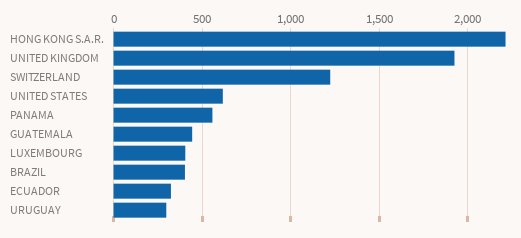
Arguably, the most important graph in the Panama Papers scandal is highlighted below. It shows the number of intermediaries (banks, accountants) in each country.


There is no mention of these by the media or of the numerous huge Western multinational corporations or billionaires, some of whom sit in the House of Lords. Neither does Harding mention by name any of the 12 leaders, past and present, identified in the documents. Instead, the Guardian journalist, in line with the methodological approach adopted by Suddeutsche Zeitung which received the leak, selectively focused on the West’s official enemies – Russia, Syria and North Korea.

Despite the fact that Putin wasn’t personally mentioned in the Panama Papers, I’m in no doubt whatsoever that since he uses Russia as a personal fiefdom, he should not be exonerated. It’s one thing ridding the country of the oligarch’s who were responsible for asset stripping its resources which subsequently turned Russia into a gangster capitalist paradise, but another to pocket a large chunk yourself by getting shot of the competition which is effectively what Putin has done. Putin’s primary interest is Putin himself.

But what the Panama papers reveal is that he’s not alone. The global web of corruption and tax avoidance extends to 72 states, heads or former heads of state. Yet you would be unlikely to have reached this conclusion having read the Guardian article or observed the cover of the paper which sensationally headlined with the words “Exclusive: The Secret $2bn trail of deals that lead all the way to Putin”. Neither would you have reached the conclusion having watched the UK state broadcaster, the BBC, who chose to mention just five of the 72 – Egypt, Iceland, Gaddafi, Putin and Assad.

Central to all this is the pathetic kow-towing to power by our media that’s supposed to be impartial and independent yet they act reflexively en masse by directing their fire at enemies of the state. If you don’t believe me, just look how often Putin has been foregrounded in the coverage of these leaked documents, complete with the requisite ‘shady’ photographs. Naturally, the media cannot be perceived to be so transparently biased which is why the occasional ‘balanced’ message is required. Step forward the Telegraph.

On Monday April 4, the paper dutifully reported:

David Cameron’s father ran an offshore fund which avoided paying tax in Britain by hiring Bahamas residents, including a bishop, to sign paperwork…The fund, which was established in the 1980s with help from the Prime Minister’s late father, continues today. The Guardian says it has confirmed that ‘in 30 years Blairmore has never paid a penny of tax in the UK on its profits.”

Nevertheless, the targeting of a dead man is virtually risk free as will be the ‘outing’ of a senile corrupt Lord to be cynically used a sacrificial lamb for the media hacks to peruse over if and when the time is right. Ultimately, the UK Secret Services will never allow the media to publish anything that is likely to damage the ‘reputations’ of leading establishment figures. The destruction of the Snowden files that the Guardian had in its possession but were requested to destroy by M15, are proof of that.

I had been watching the UK media all day on Monday after the story had broken, and news bulletins prefaced the scandal with either Putin, Cameron’s deceased father or Assad. It’s mainly the first two which are easy and convenient targets intended to deflect away from the crimes that implicate ‘our’ leaders. Almost certainly then, there is a highly motivated political agenda at work here that probably explains why Iceland, who locked up many of its corrupt and criminal bankers, was also named.

Following the revelations that Iceland’s PM was implicated in the scandal, the people of Reykjavik took to the streets in their thousands. At the time of writing, I watched the BBC News at Ten which reported from outside the Icelandic parliament. Following the resignation of the PM, the BBC reporter interviewed some Icelander’s. What the people on the streets of the country are increasingly aware of is that corruption within the corridors of power in Iceland and elsewhere is systemic.

The elites on both sides of the Atlantic are concerned about the effect the revealing of undoubted widespread and systematic corruption within the high echelons of media and politics will have on the body politic of Europe and North America. They don’t want Reykjavik to spread to London, Paris and Washington. This is another reason why the full scale nature of those implicated will never be revealed.

What all this highlights is the public is being cynically deceived by the corporate media in order to get their fellow elites off the hook. Craig Murray’s brilliant expose of the BBC Panorama documentary entitled Tax Havens of the Rich and Powerful Exposed, highlights the extent to which BBC producers and presenters will go to in order to misdirect its audience to this end. Perhaps less subtle than the overt propaganda pieceSaving Syria’s Children, but no less effective, the BBC related at length the stories of the money laundering companies of the Icelandic PM and Putin’s alleged cellist. As Murray said:

“The impression was definitely given and reinforced that these companies were in Panama. [Presenter] Richard Bilton deliberately suppressed the information that all the companies involved were in fact not Panamanian but in the corrupt British colony of the British Virgin Islands. At no stage did Bilton even mention the British Virgin Islands.”

Murray goes on to say:

“Is it not truly, truly, astonishing the British Virgin Islands were not even mentioned when the BBC broadcast their “investigation” of these documents?”

Indeed, Mr Murray, it is.

The BBC and media in general are obscuring the key role British money-laundering via its base in the British Virgin Islands plays in these transactions. This scandal must also be seen within a context in which between £30bn and £120bn a year of UK tax is either avoided, evaded or uncollected (sources (Tax justice/ PCS estimate & HMRC estimates). Meanwhile, £16bn worth of benefits a year remain unclaimed (HMRC estimate) against a backdrop in which benefit fraud amounts to a relatively tiny £1.2bn (DWP estimate).

Which of the above figures do you think the government and their media mouthpieces constantly highlight?

It can never be stated enough that this corruption scandal is mostly centred on the British Virgin Islands. Yes, the corruption is widespread and involves a number of world leaders, some of whom are our official enemies. However, in the broader scheme of things, these political figures are essentially peripheral. The level of corruption is widespread and systemic. As far as the major players are concerned, the media need to focus closer to home.